August 21st, 2026
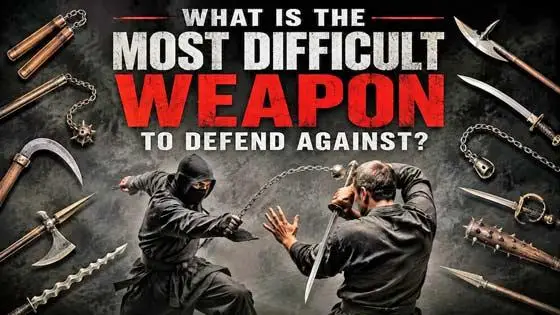
Some weapons are frightening because of their size, speed, or raw power. Others are dangerous for a completely different reason: they are extraordinarily difficult to read. A sword follows relatively predictable lines, but what happens when the weapon bends, changes direction in the middle of its movement, attacks from several angles, or reaches farther than it appears capable of reaching? Throughout history, weapon designers found ways to make defense increasingly complicated, from flexible chains and articulated staffs to deceptive blades and unusually long weapons. But if you had to judge them purely by the problems they create for someone trying to defend against them, which weapon would be the hardest of all to deal with?
August 21st, 2026
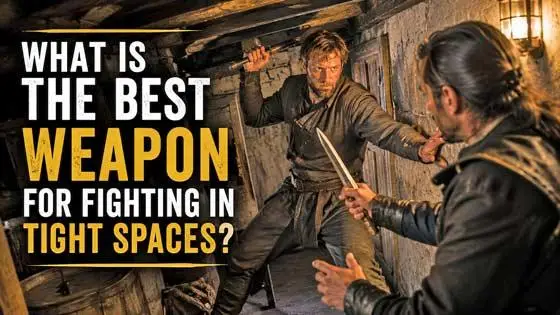
Some weapons seem almost unbeatable when there is room to move. A long spear can keep an opponent at a distance, a powerful axe can generate tremendous momentum, and a sword has enough reach to dominate the space around its wielder. Put those same weapons inside a narrow hallway, cramped ship, tiny room, or twisting staircase, however, and their greatest advantages can suddenly become serious limitations. Walls interrupt swings, ceilings restrict movement, furniture blocks footwork, and long weapons become increasingly difficult to reposition. Throughout history, fighters operating in confined spaces faced a completely different set of problems than soldiers on an open battlefield, and the weapons best suited to those environments were not always the ones you might expect. So if reach and raw power stop being the deciding factors, what actually makes a weapon effective when there is barely enough room to fight?
August 21st, 2026
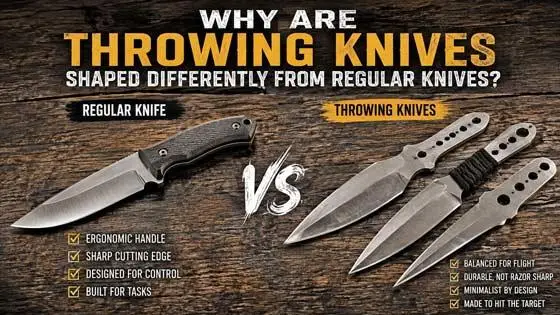
Most knives are designed around the hand. They have comfortable handles, sharpened cutting edges, finger guards, and blade shapes meant to give the user as much control as possible. Throwing knives seem to ignore many of those rules. Some have almost no handle at all, others are little more than a single piece of sharpened steel, and many have strange symmetrical shapes that would make little sense on an ordinary knife. None of this is accidental. The moment a knife leaves your hand, ergonomics stop being the only priority and balance, rotation, durability, and predictable flight suddenly become much more important. That simple change in purpose explains why a good throwing knife can look strangely primitive compared with a regular knife, while actually being highly specialized for the one thing it was built to do.
August 19th, 2026
Hardwood sounds like the obvious choice for a fighting stick. It is dense, strong, and capable of delivering tremendous impact, so why did rattan become one of the most recognizable materials used for escrima sticks? The answer has less to do with raw hardness than with what happens when two sticks collide again and again. Rattan is unusually light, resilient, and forgiving under repeated impacts, and when it eventually begins to fail, it behaves very differently from many hardwoods. Those qualities made a tropical climbing palm surprisingly well suited to the fast, impact-heavy training found in Filipino martial arts. To understand why generations of practitioners embraced it, we first have to look inside rattan itself and discover why it is not really wood at all.
August 14th, 2026
Few ancient weapons are as instantly recognizable as the khopesh. With a blade that sweeps forward into a dramatic crescent, it looks almost as if an ordinary sword were deliberately bent into the shape of a sickle. But the khopesh was not created simply to look intimidating. Its unusual profile developed from much older weapons, and the same curve that makes it so distinctive may have offered practical advantages in combat. To understand why Egyptian warriors carried swords shaped unlike almost anything used today, we have to go back to a time when the line between a battle axe and a sword was not nearly as clear as it seems.