September 2nd, 2026
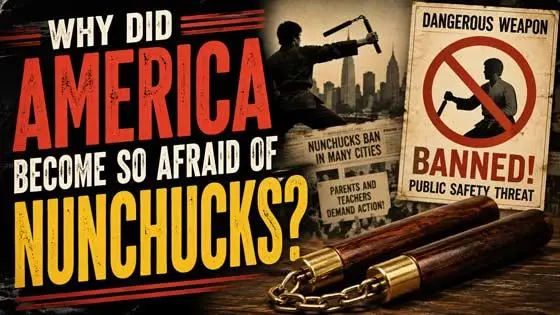
For a weapon made from two short sticks connected by a chain or cord, nunchucks managed to cause an extraordinary amount of anxiety in the United States. By the 1970s, they were appearing on movie screens, turning up in martial arts schools, and becoming instantly recognizable to millions of Americans who had barely known they existed a decade earlier. Then something unusual happened. Instead of being treated like just another exotic martial arts weapon, nunchucks became the target of bans, alarming news coverage, and laws that sometimes placed them in a category all their own. How did an obscure weapon associated with Okinawan martial arts become frightening enough that lawmakers felt compelled to single it out? The answer has as much to do with movies, changing American culture, and public perception as it does with the weapon itself.
September 2nd, 2026
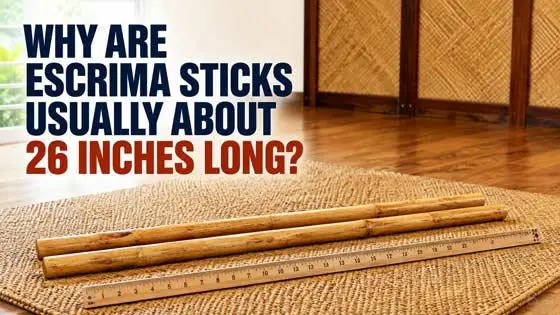
For generations, martial artists across the Philippines trained with sticks that were remarkably consistent in size. Whether called escrima, arnis, or kali sticks, many measured close to 26 inches long. That length was not chosen at random. It created a carefully balanced weapon that could reach an opponent without becoming slow, awkward, or difficult to control at close range. But why did 26 inches become such a common standard when a longer stick would seem to offer more reach and a shorter one would be easier to move? The answer can be found in the unique demands of Filipino martial arts, where speed, distance, concealability, and the ability to transition between striking and grappling all had to fit inside a single piece of rattan.
August 31st, 2026
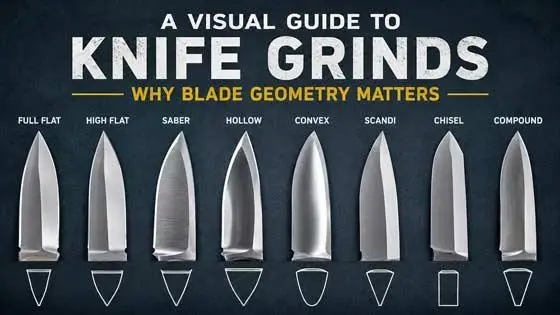
A knife can have the perfect blade shape and still cut completely differently from another knife that looks almost identical. The reason is often hidden in the geometry between the spine and the cutting edge. Known as the blade grind, this cross-sectional shape determines how quickly a blade becomes thinner toward its edge, how much material remains behind that edge, and how the blade moves through whatever it is cutting. Full flat grinds, hollow grinds, saber grinds, convex grinds, Scandi grinds, and other designs each approach that geometry differently, creating tradeoffs that are almost impossible to understand from a side-view photograph alone. In this visual guide, we'll look at knife blades from a different angle, breaking down the major grind types and showing why the geometry you barely notice can have such a significant effect on how a knife behaves.
August 28th, 2026
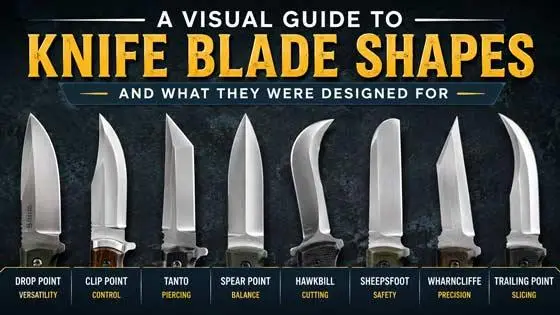
The shape of a knife blade is rarely accidental. Long before modern knives were categorized as drop points, clip points, tanto blades, hawkbills, or trailing points, blade makers were already experimenting with different combinations of curves, points, edges, and thicknesses to make knives better suited to particular jobs. Some shapes favor controlled slicing, others provide a stronger tip, and some evolved for specialized cutting tasks that immediately explain their unusual appearance. In this visual guide, we'll break down the most recognizable knife blade shapes, examine where their designs came from, and look at the practical reasons they developed so differently.
August 27th, 2026
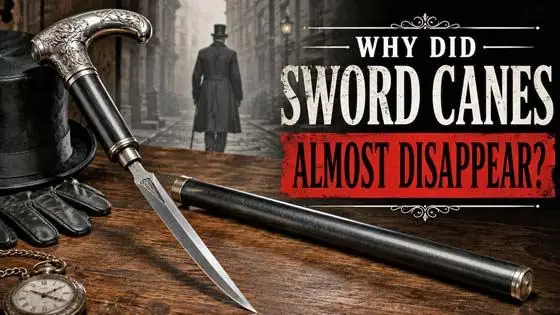
For centuries, a walking cane could be far more than something used for balance. It was a fashion accessory, a symbol of status, and, in some cases, the perfect hiding place for a long steel blade. Sword canes allowed their owners to carry something resembling an ordinary walking stick while concealing a weapon inside, making them particularly intriguing during an era when gentlemen routinely carried canes through crowded city streets. Yet today, sword canes are unusual enough that many people have never encountered one outside a collection or movie. So what happened? Their decline was not caused by one invention or one sudden prohibition. Instead, changing fashion, new attitudes toward concealed weapons, increasingly restrictive laws, and the disappearance of the everyday walking stick gradually stripped away nearly every reason the sword cane had existed in the first place.