




Why Did America Become So Afraid of Nunchucks?
September 2nd, 2026
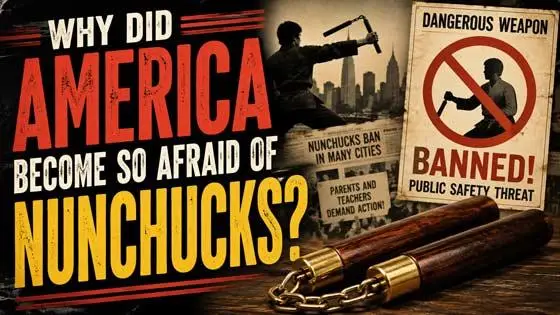
For a weapon made from two short sticks connected by a chain or cord, nunchucks managed to cause an extraordinary amount of anxiety in the United States. By the 1970s, they were appearing on movie screens, turning up in martial arts schools, and becoming instantly recognizable to millions of Americans who had barely known they existed a decade earlier. Then something unusual happened. Instead of being treated like just another exotic martial arts weapon, nunchucks became the target of bans, alarming news coverage, and laws that sometimes placed them in a category all their own. How did an obscure weapon associated with Okinawan martial arts become frightening enough that lawmakers felt compelled to single it out? The answer has as much to do with movies, changing American culture, and public perception as it does with the weapon itself.
In This Article
Before America knew nunchucks
The 1970s kung fu boom
The nunchuck craze spreads
Why nunchucks looked so frightening
New York turns fear into law
Why perception mattered
How movies shaped their reputation
Nunchucks become a cultural symbol
Why the bans lasted for decades
Why America became less afraid
What the panic really tells us
Frequently asked questions
Before America knew nunchucks
The 1970s kung fu boom
The nunchuck craze spreads
Why nunchucks looked so frightening
New York turns fear into law
Why perception mattered
How movies shaped their reputation
Nunchucks become a cultural symbol
Why the bans lasted for decades
Why America became less afraid
What the panic really tells us
Frequently asked questions
Before the 1970s, Most Americans Had Barely Heard of Nunchucks
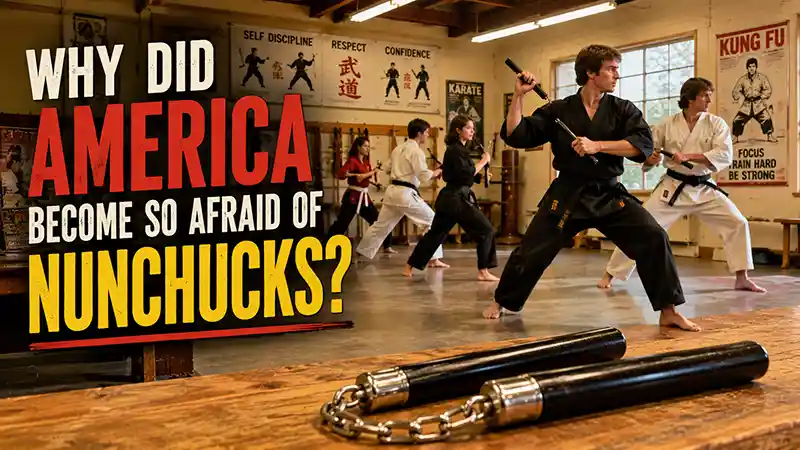
That began changing as Asian martial arts gained a much larger American audience during the 1960s and especially the early 1970s. Karate schools multiplied, martial arts magazines reached growing audiences, and imported kung fu films exposed viewers to fighting styles and weapons that looked dramatically different from anything appearing in conventional American action movies. Nunchaku were particularly memorable. Their rapid movement made them visually spectacular, while the flexible connection between the handles gave them an unpredictable appearance that ordinary clubs simply did not have.
There was also something almost perfectly suited to television and cinema about them. A skilled practitioner could make nunchaku whip around the body, change direction suddenly, disappear behind a shoulder, and reappear on the opposite side. To someone who understood the weapon, much of that movement demonstrated coordination and control. To an unfamiliar audience seeing it for the first time, it could look like an astonishingly fast weapon capable of striking from everywhere at once.
That distinction would become enormously important. Americans were not gradually becoming familiar with an everyday weapon they routinely encountered in real life. Many were forming their first impressions through entertainment, demonstrations, sensational imagery, and increasingly dramatic cultural portrayals. Within a remarkably short period, the various styles of nunchaku went from obscure martial arts equipment to one of the most recognizable weapons in the country. Recognition, however, was about to arrive much faster than understanding.
Then the Kung Fu Boom Put Nunchucks in Front of Millions
The transformation accelerated in the early 1970s, when martial arts suddenly became a major part of American popular culture. Kung fu movies found enthusiastic audiences, martial arts schools benefited from a surge of interest, and television helped turn techniques that had once seemed obscure into something almost instantly recognizable. Nunchucks were perfectly positioned for this new visual culture because they did not merely look dangerous. In skilled hands, they looked almost impossible.
Few people were more important to that change than Bruce Lee. His use of nunchaku on screen gave enormous audiences an unforgettable demonstration of what the weapon could look like in the hands of an exceptionally fast and charismatic martial artist. The important distinction is that Lee did not introduce nunchaku to America single-handedly, nor did every later appearance trace directly back to him. But his films unquestionably helped make the weapon dramatically more visible during the period when American enthusiasm for martial arts was exploding.
That visibility created an unusual problem. Audiences were watching highly choreographed performances by trained martial artists, but the weapon itself was increasingly available to ordinary people who wanted to imitate what they had seen. Martial arts shops advertised nunchaku, instructional material appeared, and homemade versions were not especially difficult to construct. The distance between seeing an exotic weapon on a movie screen and having one in your hands could suddenly become very short.
Modern nunchaku come in a surprisingly wide range of materials and designs, but the versions entering American popular consciousness during this period were often understood much more simply: two hard handles joined by a flexible connector, capable of moving at startling speed. That simple image was powerful enough to stick. Before long, nunchucks were no longer merely something Americans had seen in martial arts demonstrations. They were becoming a fad, and fads have a way of attracting attention far beyond the people who actually understand them.
The remarkable part: Nunchucks did not slowly become familiar to Americans over generations. They went from an obscure martial arts weapon to a pop-culture phenomenon within a remarkably short period.
Nunchucks Escaped the Dojo and Became a Teenage Craze
Once nunchucks became recognizable, they did not remain confined to serious martial arts training for long. Their appeal was almost tailor-made for young people caught up in the martial arts boom. They looked exotic, could be carried easily, and offered an immediate challenge: learn a few spins, catches, and passes without smashing yourself in the elbow. Owning a pair could feel like owning a small piece of the martial arts world that movies and magazines had made so exciting.
That popularity also stripped away much of the context surrounding the weapon. Inside a martial arts school, nunchaku could be introduced alongside instruction, repetition, restraint, and an understanding that controlling the returning handle was part of learning to use them safely. Outside that environment, someone could simply acquire a pair and start experimenting. The results were predictable. A flexible weapon does not stop moving just because its inexperienced user loses control of it.
This was one reason safer training versions became so useful. Foam-covered designs allowed beginners to practice basic movements with substantially less risk than hard wooden or metal handles. That distinction still exists today, with equipment such as foam chain nunchaku occupying a very different training role from heavier traditional versions. During the height of America's nunchuck fascination, however, the broader public was unlikely to make careful distinctions between training equipment, martial arts practice, reckless experimentation, and weapons carried with criminal intent.
That blurred line mattered. The more nunchucks appeared outside martial arts schools, the easier it became for parents, teachers, police, journalists, and lawmakers to encounter them without the disciplined setting in which martial artists understood them. The weapon's cultural identity was beginning to change. What had recently been an obscure martial arts implement was becoming something associated with teenagers, imitation, injuries, street encounters, and a growing question that would soon become political: why were people allowed to carry these things at all?
The Weapon Looked More Terrifying Than Most People Understood
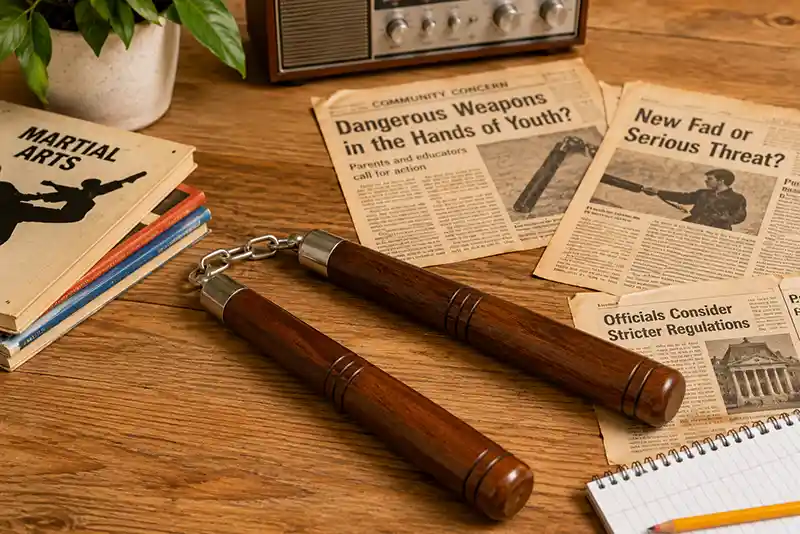
The physics added to that impression. Because one handle moves freely around a flexible connection, nunchaku can generate considerable speed during a swing. Yet that same flexibility also makes them demanding to control. The moving handle can rebound, lose its intended path, or strike the person holding the weapon. The spectacular movement that made nunchucks appear unusually formidable was therefore also one of their greatest practical complications.
Popular perception rarely captured that tradeoff. Americans encountering nunchucks through movies, demonstrations, news stories, or secondhand accounts were more likely to notice their speed than their limitations. The weapon could consequently acquire an almost exaggerated reputation, as though the chain transformed two short sticks into something fundamentally more dangerous than other impact weapons.
Even the weapon's origins were surrounded by stories that made it seem more mysterious. The familiar claim that nunchaku began as a simple rice-threshing tool is much less certain than it is often presented, and several competing explanations exist for how the weapon developed. The question of why nunchucks were originally invented is complicated precisely because the historical record does not give us the neat origin story popular culture often prefers. By the 1970s, however, uncertainty about their past only added to their exotic image. America had become fascinated with a weapon it was still struggling to understand.
Perception mattered.
The same flexible connection that made nunchaku appear unusually fast and unpredictable also made them harder to control. Popular culture tended to show audiences the first characteristic while hiding the second.
The same flexible connection that made nunchaku appear unusually fast and unpredictable also made them harder to control. Popular culture tended to show audiences the first characteristic while hiding the second.
New York Turned the Nunchuck Scare Into Law
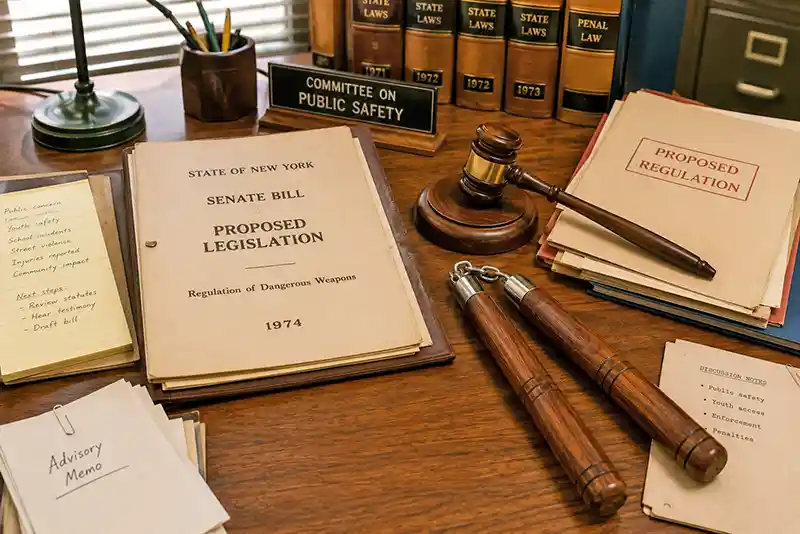
The concern was not purely imaginary. Nunchaku can cause serious injury, and lawmakers were particularly troubled by their growing popularity among young people and the possibility that they could be used in street violence. Yet the decision to specifically prohibit them also reflected the unusual reputation the weapon had acquired. America contained plenty of ordinary objects capable of functioning as impact weapons, but nunchucks were visually distinctive, newly fashionable, and increasingly associated with danger. That made them an unusually visible target for regulation.
New York's prohibition was especially sweeping because it did not merely restrict carrying nunchaku in public. For decades, the law effectively prohibited ordinary possession, including possession inside the home. Martial artists therefore faced the strange situation of having a traditional training weapon treated as contraband even when it was being kept for practice rather than carried as a street weapon.
Other jurisdictions adopted their own restrictions, and nunchucks gradually became one of those weapons whose legality could change dramatically depending on where someone lived. The laws were not identical, nor did every state respond with a ban. But the fact that legislators were writing rules specifically naming nunchaku demonstrates how thoroughly the weapon had entered America's imagination. A martial arts implement most Americans had barely recognized before the kung fu boom was now important enough to receive its own lines in criminal statutes.
1974
New York enacted its sweeping prohibition on nunchaku during the height of America's martial arts boom.
New York enacted its sweeping prohibition on nunchaku during the height of America's martial arts boom.
The Fear Wasnt Just About What Nunchucks Could Do
By this point, nunchucks had acquired something more powerful than a reputation for causing injury. They had acquired an image. Their sudden arrival in American culture coincided with broader anxieties about street crime, youth violence, and unfamiliar martial arts weapons. To people who had never trained with them, nunchucks could seem less like two connected sticks and more like a specialized weapon designed for a kind of violence they did not understand.
That perception mattered because people tend to judge unfamiliar weapons differently from familiar objects. A baseball bat could cause devastating injuries, but nobody wondered why baseball bats existed. Nunchucks had no comparable everyday purpose in the minds of most Americans. Their unusual shape, foreign origins, and association with fighting made them easier to categorize as inherently threatening. Once they began appearing in police reports or being carried outside martial arts schools, those characteristics made for a particularly alarming combination.
The expanding variety of nunchaku probably did little to soften that image. Traditional wooden versions could look relatively simple, while metal designs appeared unmistakably weapon-like. A pair such as steel nunchaku makes the contrast especially obvious. To a trained enthusiast, material and construction affect weight, handling, durability, and intended use. To a nervous public, a pair of connected steel handles could simply look like the more intimidating evolution of an already frightening weapon.
This helps explain why America's reaction cannot be reduced to a simple calculation of how dangerous nunchucks were compared with every other object capable of causing injury. Laws are influenced by events, but they are also influenced by visibility and perception. Nunchucks arrived at precisely the moment when American culture was fascinated by martial arts, worried about crime, and increasingly aware that an exotic-looking weapon from the movies was showing up in the real world. That combination gave them a notoriety many more familiar weapons never acquired.
Movies Made Skilled Nunchaku Use Look Almost Superhuman
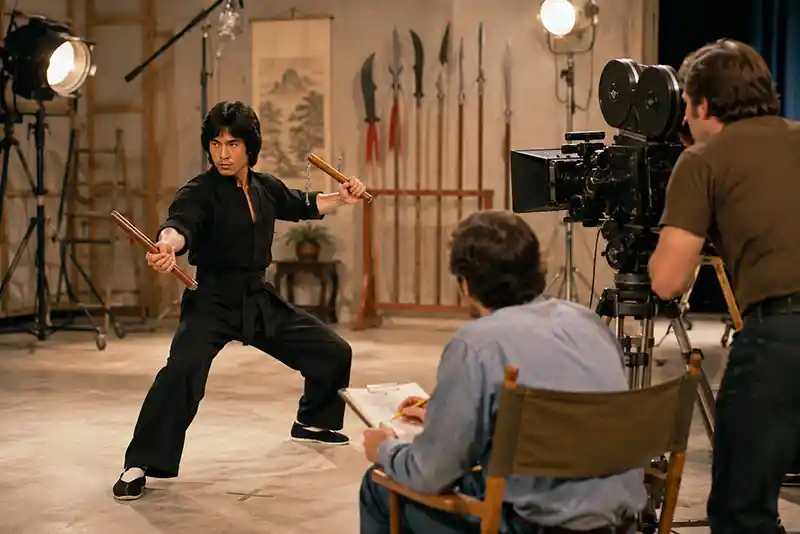
The problem was that spectacular movement could easily be mistaken for effortless effectiveness. Movies rarely lingered on the awkward realities of learning a flexible weapon, such as mistiming the returning handle, losing momentum, striking yourself, or simply fumbling a catch. Instead, audiences saw nunchucks flowing around the body and changing direction with extraordinary precision. The person holding them appeared to have access to a weapon that opponents could barely follow, much less defend against.
Real training is considerably less glamorous. Beginners generally benefit from lighter and more forgiving equipment while developing coordination, which is why choosing nunchaku appropriate to a person's experience matters. The same flexible connection that creates impressive speed also means the second handle continues moving after the first has been redirected. Controlling that movement takes practice. The weapon does not provide the user with the almost magical advantage that cinematic choreography sometimes implied.
Yet those limitations were largely invisible to the wider public. The image that endured was the expert performance, not the hours required to produce it. Nunchucks therefore benefited from a peculiar form of intimidation: audiences repeatedly saw them at their absolute best, wielded under conditions designed to make them appear as dramatic as possible. By the time lawmakers and concerned parents were trying to decide how threatening the weapon really was, popular culture had already supplied a remarkably persuasive answer.
By the 1980s, Nunchucks Had Become a Symbol of Dangerous Martial Arts
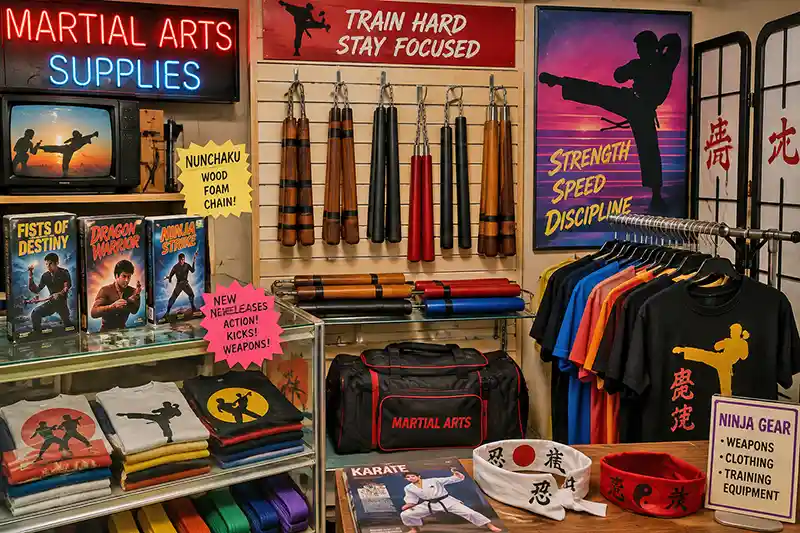
That symbolism sometimes became more important than the weapon itself. Nunchaku were visually distinctive in a way that an ordinary stick could never be. Put two connected handles into someone's hands and the audience immediately understood that the person was meant to possess specialized fighting skills. The weapon suggested speed, unpredictability, and exotic expertise before it was ever swung.
The irony was that this increasingly dramatic American identity obscured the much more complicated history behind the weapon. Nunchaku had existed within Okinawan martial traditions long before Americans turned them into a pop-culture phenomenon, and their exact development remains the subject of competing theories. Looking at the broader history of nunchaku reveals a weapon with a far more interesting journey than the frightening image that became attached to it during the martial arts boom.
By then, however, perception had hardened. Nunchucks were no longer merely unfamiliar. They had become culturally coded as dangerous. That distinction helps explain why restrictions could survive long after the initial 1970s craze had faded. Once lawmakers and the public had accepted the idea that nunchaku belonged in a special category of threatening weapons, reversing that assumption would prove much harder than creating it in the first place.
For Decades, the Laws Outlasted the Craze That Created Them
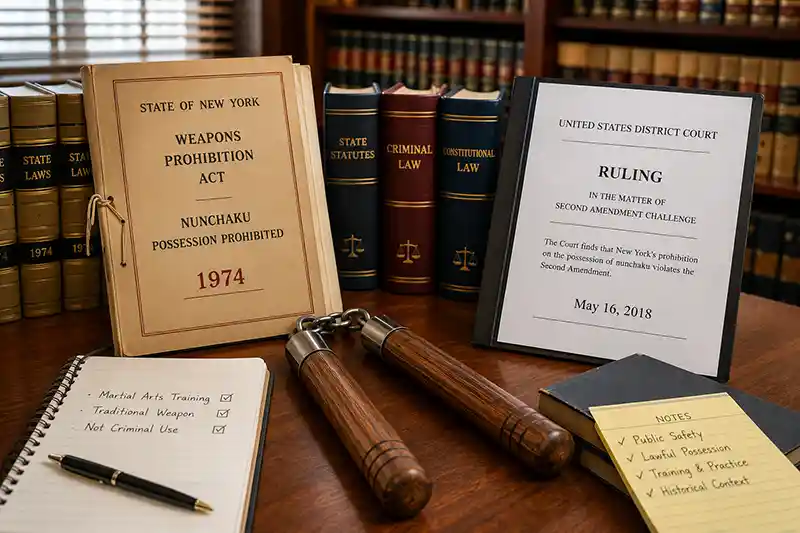
New York provides the most striking example. Its 1974 prohibition survived for more than four decades before a federal court struck it down in 2018. The case was brought by James Maloney, a martial artist who had challenged the state's restrictions for years. The court concluded that New York's sweeping ban violated the Second Amendment, ending a prohibition that had begun during an era when kung fu movies and the nunchuck craze were transforming the weapon's American reputation.
That did not mean every restriction on nunchaku disappeared across the country. Weapon laws vary by jurisdiction, and rules concerning possession, carrying, use, schools, public buildings, and other circumstances can differ considerably. But the New York decision highlighted just how much America's attitude had changed. A weapon once considered alarming enough to prohibit even in the home was now being reconsidered through a very different legal and cultural lens.
The change also exposed an important distinction that had been blurred during the original panic: owning nunchaku for martial arts practice is not the same thing as using them criminally. Modern enthusiasts can choose among traditional wood, training foam, metal, and lighter materials such as rattan nunchaku, each with different handling characteristics and purposes. The variety itself is a reminder that "nunchucks" were never one uniform object with one uniform use, even though decades of public debate often treated them that way.
44 Years Later
In 2018, a federal court struck down New York's longstanding nunchaku prohibition.
In 2018, a federal court struck down New York's longstanding nunchaku prohibition.
America Eventually Became Less Afraid of Nunchucks
At the same time, the public gained a clearer picture of what nunchaku actually are. They can certainly cause serious injury, particularly when made from hard materials, but they are also difficult to use well. The flexible connector that makes them visually intimidating demands coordination and control from the person holding them. The old image of nunchucks as an almost unstoppable weapon began to look increasingly like a product of the era that had created it.
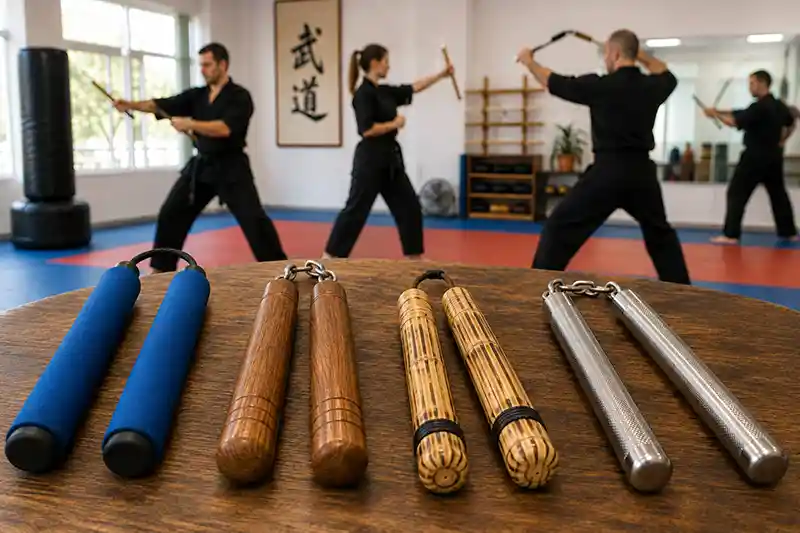
Modern martial arts culture also makes distinctions that were often lost during the original panic. Foam training nunchaku, lightweight practice designs, traditional wooden versions, and heavier metal models are not interchangeable simply because they share the same basic shape. Different constructions exist for different forms of training, performance, collecting, and martial arts practice. What frightened outsiders as one mysterious category of weapon is much easier to understand once those differences become familiar.
In that sense, the decline of America's nunchuck panic may have been almost inevitable. The weapon did not fundamentally change. Americans simply had decades to become accustomed to it. Nunchucks went from something strange enough to inspire sensationalism and sweeping prohibitions to a recognizable part of martial arts culture. The fear faded as the mystery did.
The Nunchuck Panic Says More About America Than It Does About Nunchucks
Looking back, the remarkable part of this story is not that Americans recognized nunchaku could be dangerous. They can be. What stands out is the speed with which an unfamiliar martial arts weapon became a national cultural symbol. Within a relatively short span, nunchucks moved from obscurity to movie screens, martial arts schools, popular fascination, public anxiety, and eventually criminal statutes written specifically around them.
That sequence helps explain why comparing nunchucks mechanically with other weapons never tells the whole story. America was reacting to more than striking power. It was reacting to novelty, dramatic entertainment, changing attitudes toward crime, inexperienced people imitating martial arts performers, and a weapon whose unusual movement made it look almost unnaturally dangerous. Those forces reinforced one another until the reputation became larger than the object that inspired it.
Today, nunchaku no longer carry quite the same cultural shock. They remain serious martial arts equipment that demands responsible handling, but they are also familiar enough that most people can separate a skilled demonstration from movie fantasy. The weapon that once seemed mysterious enough to frighten lawmakers has become an established part of martial arts culture.
In the end, America did not become afraid of nunchucks because someone suddenly proved they were the most dangerous weapon on the street. America became afraid of them because they arrived at exactly the right cultural moment to become a sensation. Movies made them spectacular, popularity made them visible, misuse made them concerning, and unfamiliarity made them easy to fear. By the time the craze faded, the laws and mythology it created had already taken on lives of their own.
Frequently Asked Questions About Nunchucks
The strange history of America's relationship with nunchaku raises plenty of questions beyond the story itself. Here are answers to some of the most common questions about nunchuck bans, legality, terminology, and their reputation in the United States.
When Were Nunchucks Banned in New York?
New York enacted its statewide prohibition on nunchaku in 1974, during the height of America's growing fascination with martial arts. The law broadly prohibited possession of what it called a "chuka stick," the terminology used in the statute for nunchaku. The timing closely coincided with the period when martial arts movies and the wider kung fu boom were making the weapon dramatically more familiar to the American public.
Remarkably, the prohibition remained in place for more than four decades. In 2018, a federal court ruled that New York's ban on possessing nunchaku violated the Second Amendment. The decision effectively ended a restriction that had survived long after the cultural craze that helped inspire it had faded.
Are Nunchucks Still Illegal in the United States?
There is no single nationwide rule that makes ordinary possession of nunchaku illegal everywhere in the United States. Laws can vary by state and locality, and restrictions may distinguish between owning nunchaku at home, carrying them in public, possessing them in certain locations, or using them in a threatening or unlawful manner.
The legal landscape has also changed over time. New York's longstanding possession ban, for example, was struck down by a federal court in 2018. That does not mean someone should assume nunchaku are unrestricted everywhere else. State laws, local ordinances, school rules, and restrictions applying to particular locations can still matter.
Because weapon laws can change and sometimes depend on the circumstances of possession or carry, anyone concerned about legality should check the current laws that apply where they live rather than relying on an old list of states where nunchucks are supposedly "legal" or "illegal."
Why Were Nunchucks Singled Out When Other Impact Weapons Were Legal?
Part of the answer is visibility. During the martial arts boom of the 1970s, nunchucks became instantly recognizable at the same time that many Americans were encountering them for the first time. Ordinary sticks, bats, and clubs were familiar objects. Nunchaku looked specialized, moved unpredictably, and appeared to exist specifically for fighting. That made them much easier to portray as a distinct public-safety problem.
Their reputation was also shaped by entertainment. Audiences frequently saw nunchaku used by highly skilled martial artists in choreographed sequences that emphasized speed and dramatic movement. Someone unfamiliar with the difficulty of controlling the weapon could reasonably come away believing that nunchucks offered an extraordinary advantage over more conventional impact weapons.
This does not mean lawmakers had no legitimate reason to worry about misuse. Hard nunchaku are capable of causing serious injuries. But their unusual legal treatment cannot be understood solely by comparing their physical capabilities with every other object that could be used as a weapon. Nunchucks became culturally notorious at exactly the moment legislators were deciding what to do about them, and that notoriety helped make them an obvious target for weapon-specific laws.
Did Nunchuck Bans Actually Reduce Crime?
There is little reason to assume that the historical case for banning nunchaku rested on strong evidence that they were responsible for a major share of violent crime. The restrictions emerged during a period when the weapon's popularity and cultural visibility were increasing rapidly, and lawmakers were responding partly to concerns about what might happen as nunchucks became easier to obtain.
That also makes the effect of the bans difficult to isolate. If nunchaku-related incidents declined after a prohibition, that would not automatically prove the law caused the decline. The enormous martial arts craze surrounding the weapon also faded, public fashions changed, and nunchucks became less novel. Researchers would need reliable before-and-after crime data while accounting for those other changes to make a convincing claim about the bans themselves.
What can be said more confidently is that nunchucks never became the enduring American crime problem their extraordinary reputation might suggest. Whether legislation deserves credit for that is a much harder historical question. The available story is considerably clearer about the rise and fall of America's fear of nunchucks than it is about any measurable crime reduction produced by banning them.
Why Did Nunchucks Become So Popular in the 1970s?
Nunchucks arrived in American popular culture at almost the perfect moment. Interest in Asian martial arts was surging, kung fu films were finding enthusiastic audiences, and martial arts schools were becoming increasingly visible across the country. Nunchaku stood out even among other unfamiliar weapons because their speed and movement translated exceptionally well to the screen.
Bruce Lee played an especially important role in making nunchaku recognizable to Western audiences. His performances demonstrated the weapon with a level of speed and control that made it unforgettable, helping turn something previously known mainly within martial arts circles into an object millions of moviegoers could immediately recognize. Other martial arts films, demonstrations, magazines, and instructors then contributed to the wider craze.
The weapon was also appealing because people could attempt to learn its distinctive movements themselves. Nunchaku could be practiced through spins, passes, catches, and combinations that looked impressive even outside a fighting context. That combination of movie exposure, martial arts enthusiasm, visual spectacle, and hands-on appeal helped transform nunchucks from an obscure weapon into one of the defining symbols of America's 1970s martial arts boom.
Were Nunchucks Commonly Used by Criminals in the 1970s?
Nunchucks certainly appeared in criminal incidents, and concerns about their use outside martial arts schools contributed to the political reaction surrounding them. But their reputation can create a misleading impression that nunchaku had suddenly become one of the dominant weapons of American street crime. The historical evidence does not support treating them as anything comparable to more commonly encountered weapons.
What nunchucks possessed in abundance was visibility. An incident involving an unfamiliar martial arts weapon was inherently more unusual and newsworthy than one involving an ordinary club. Their growing association with martial arts movies also meant that stories involving nunchaku fit neatly into an existing narrative about a frightening new weapon spreading through American culture.
This distinction is important when looking back at the bans. Legislators did not necessarily need nunchucks to become statistically common before deciding they represented a problem worth addressing. The combination of actual misuse, rapidly increasing popularity, and an intimidating public image could create political pressure even if the weapon remained relatively uncommon in crime overall.
Why Did New York Call Nunchucks Chuka Sticks?
When New York prohibited nunchaku in 1974, the statute used the term "chuka stick" rather than the name most martial artists would recognize today. The law defined the object by its basic construction, describing two or more rigid sticks connected by a rope, cord, wire, or chain that could swing freely around one another.
"Chuka stick" never became the standard American name for the weapon. Nunchaku remained the traditional term used within martial arts, while "nunchucks" became the familiar English-language nickname. As a result, someone reading older New York weapon laws can encounter the peculiar situation of seeing an unfamiliar legal name attached to an extremely familiar weapon.
The terminology is also a small reminder of how unfamiliar nunchaku still were when lawmakers began regulating them. Legislatures were attempting to define and classify a martial arts weapon that had only recently entered mainstream American awareness, which helped produce legal terminology that developed separately from the language martial artists actually used.
Are Nunchucks More Dangerous Than a Regular Club?
Not automatically. Nunchaku and rigid clubs behave differently, and reducing the comparison to which one is "more dangerous" ignores important tradeoffs. The flexible connection allows the free handle of a nunchaku to accelerate through a wide arc and approach from changing angles, but it also makes the weapon considerably more complicated to control.
A rigid club is mechanically simpler. The user's hand directly controls the striking object throughout the movement, making its path and recovery comparatively predictable. With nunchaku, the second handle continues moving around the connector, creating the speed and unusual trajectories that make the weapon impressive while also introducing opportunities for rebounds, missed catches, loss of control, and self-injury.
That helps explain one of the central contradictions behind America's nunchuck panic. Their movement can make them look dramatically more formidable than an ordinary stick, particularly during an expert demonstration, but visual complexity does not automatically translate into greater practical effectiveness. Much depends on the construction of the weapon, the circumstances in which it is used, and especially the skill of the person holding it.
Why Did Nunchuck Bans Last So Long After the 1970s?
Once a weapon restriction becomes part of a state's criminal code, it does not automatically disappear when the cultural moment that inspired it passes. Repealing an old law generally requires lawmakers to revisit the issue, while challenging one through the courts requires someone with the time, resources, and legal grounds to pursue a case. If a restriction affects relatively few people, there may be little political pressure to reconsider it.
Nunchucks were particularly susceptible to this kind of legal inertia. The enormous martial arts craze surrounding them faded, but there was also little mainstream constituency demanding that legislators prioritize nunchaku reform. A prohibition created during the 1970s could therefore remain largely unnoticed by most of the public while continuing to affect martial artists and collectors decades later.
New York illustrates the point especially well. Its 1974 prohibition survived until a federal court struck the ban down in 2018. By then, the cultural environment surrounding nunchaku had changed enormously, yet the basic restriction had endured for more than forty years. The longevity of the ban was not necessarily evidence that Americans remained as frightened of nunchucks as they had been during the martial arts boom. In large part, the law simply lasted far longer than the panic that helped create it.
Did Bruce Lee Cause Nunchucks to Be Banned?
No. It would be too simplistic to draw a straight line from Bruce Lee using nunchaku on screen to lawmakers banning them. He was enormously important in making the weapon recognizable to American audiences, but the legal reaction involved a much broader combination of factors, including the martial arts boom, growing availability of nunchaku, concerns about inexperienced users, reports of criminal misuse, and wider anxieties about violent crime.
What Lee helped change was visibility. Millions of viewers could suddenly see what nunchaku looked like when handled with extraordinary speed and precision. That contributed to demand for the weapon and helped establish the spectacular image that followed it through the 1970s. Other movies, martial artists, magazines, demonstrations, and the broader kung fu craze amplified that fascination.
It is therefore more accurate to view Bruce Lee as an important figure in the cultural chain of events rather than the cause of the bans themselves. Nunchaku became famous, people wanted them, concerns about misuse followed, and lawmakers responded within a much larger social environment. Blaming one performer for that entire sequence makes for a neat story, but the real history is considerably more complicated.
Can You Still Train With Nunchucks Today?
Yes. Nunchaku remain part of martial arts training, demonstrations, forms, freestyle practice, and competition. Modern practitioners also have access to a much wider range of equipment than someone caught up in the American nunchuck craze of the 1970s would have encountered, including padded training versions and traditional wooden designs.
The appropriate type depends heavily on experience and purpose. Beginners commonly start with lighter or padded nunchaku while developing coordination and learning how the free handle behaves. More experienced practitioners may train with wood, rattan, or other materials depending on their martial art and training goals. Regardless of construction, responsible practice requires adequate space, control, and attention to the people and objects nearby.
Local rules still matter as well. The legality of possessing, carrying, or training with nunchaku can depend on jurisdiction and location, so martial artists should check current rules where they live and train rather than assuming that laws are identical throughout the United States.
Were Nunchucks Banned Because Kids Were Getting Hurt With Them?
Concern about young people was part of the atmosphere surrounding nunchaku during the 1970s, particularly as martial arts became enormously popular and inexperienced people attempted to imitate techniques they had seen demonstrated elsewhere. Nunchaku are unforgiving when mishandled, since the free handle can rebound toward the user or travel somewhere completely unintended after a poorly controlled swing.
It would be misleading, however, to suggest that America's nunchuck laws can be explained simply as a response to an epidemic of children injuring themselves. The political concern was broader. Lawmakers and law-enforcement officials were also worried about nunchaku being carried as weapons, used in assaults, or becoming increasingly common outside supervised martial arts environments.
Youth fascination therefore contributed to the larger nunchuck scare, but it was only one part of it. The weapon's rapid rise in popularity, intimidating appearance, association with martial arts entertainment, and potential for misuse all helped create the environment in which restrictions became politically attractive.
Which States Originally Banned Nunchucks?
Several states imposed significant restrictions on nunchaku as concern about martial arts weapons grew, but the history is more complicated than the frequently repeated online lists suggesting that the same handful of states simply "banned nunchucks." Different jurisdictions used different definitions, prohibited different conduct, and changed their laws at different times.
New York became one of the best-known examples when it enacted its sweeping prohibition in 1974. Other states, including California and Massachusetts, have also historically regulated nunchaku under their weapons laws, although the scope and later evolution of those restrictions have differed considerably.
That is why old lists of supposedly legal and illegal states should be treated cautiously. Weapon statutes are amended, court decisions can invalidate restrictions, and a law governing public carry may be very different from one governing possession in a home or martial arts school. Anyone trying to determine the current legality of nunchaku should consult current state and local law rather than relying on the historical status of a particular state.
Why Are They Called Nunchucks Instead of Nunchaku?
"Nunchaku" is the established martial arts term for the weapon, while "nunchucks" developed as the much more familiar English-language version. As the weapon entered American popular culture, unfamiliar Japanese and Okinawan terminology was inevitably adapted by English speakers, and "nunchucks" became easy to say, remember, and recognize.
Today, both terms are widely understood. "Nunchaku" is common when discussing martial arts, history, and traditional terminology, while "nunchucks" remains extremely common in everyday American English. The plural-sounding ending of "nunchucks" can even make people assume that a single weapon should be called a "nunchuck," although practitioners frequently use nunchaku for both the weapon and the general weapon type.
The existence of multiple names fits the larger story surprisingly well. Americans did not merely adopt the weapon during the martial arts boom. They absorbed it into popular culture, changed the way its name was commonly spoken, and eventually made "nunchucks" a word recognizable even to people with no martial arts background whatsoever.
Did Other Countries Ban Nunchucks Too?
Yes. Concern about nunchaku was not uniquely American, and other countries have imposed restrictions on their possession, sale, importation, carry, or depiction at various points. The precise rules have varied considerably, making broad statements that nunchucks are simply "banned" in a particular country potentially misleading without considering the specific law and time period.
The United Kingdom provides an especially interesting example of how strong the cultural anxiety surrounding nunchaku became. British concerns about martial arts weapons extended beyond possession and into popular media, with nunchaku famously becoming a target of film censorship during an era when screen violence involving martial arts weapons received particularly close scrutiny.
That international reaction reinforces one of the central themes of the nunchuck story. The weapon's reputation was shaped not only by what it could physically do, but by what it represented. Once martial arts films transformed nunchaku into an instantly recognizable symbol of exotic and potentially frightening violence, public anxiety about them could cross national borders almost as easily as the movies themselves.
You May Also Be Interested In:
- How Switchblades Became the Most Feared Knives in America
- What are the Best Nunchucks for You?
- Could Nunchucks Actually Break a Sword?
- Were Nunchucks Ever Actually Used in Real Combat?
- New Lightweight Metal Nunchucks for Competitions and Demonstrations
- Why Were Nunchucks Actually Invented? (The Real History Might Surprise You)
Leave a Reply