




Could an Escrima Stick Actually Stop a Sword?
September 21st, 2026
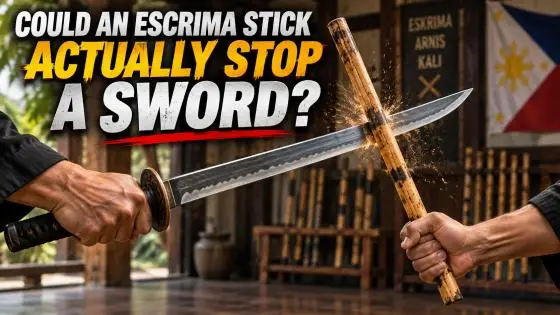
A sword blade slamming into a simple rattan stick looks like a hopeless mismatch. Steel is harder, sharper, and specifically designed to cut, while an escrima stick is little more than a lightweight length of cane. Yet Filipino martial arts have long trained practitioners to deal with edged weapons while holding sticks, creating an obvious question: if a sword came down with real force, could an escrima stick actually stop it? The answer depends on what we mean by "stop." Deflecting a blade, surviving a glancing impact, and absorbing a powerful direct cut are three very different tests, and rattan behaves in ways that make the outcome more interesting than it first appears.
A Sword Does Not Have to Cut Straight Through the Stick
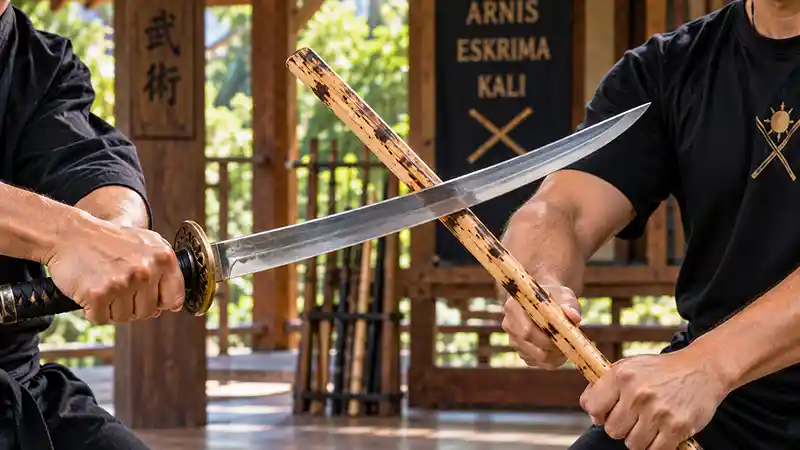
The first thing to understand is that "stopping" a sword does not necessarily mean catching a full-power cut and holding it motionless. That is the version we tend to imagine because movies love dramatic weapon-on-weapon collisions. In reality, preventing a blade from reaching its intended target can also mean changing its direction, disrupting its angle, or redirecting enough of its momentum that the attack no longer lands as intended.
That distinction gives a lightweight stick a much more realistic chance. An escrima stick does not need to be harder or stronger than steel to interfere with the path of a sword. If contact occurs at an angle rather than directly against the most powerful part of the swing, some of the blade's energy can be redirected instead of being absorbed entirely by the rattan.
But the margin for error is enormous. A glancing encounter between blade and stick is very different from planting a piece of rattan directly in front of a committed cut. The sword's mass, speed, edge geometry, blade length, and angle of impact all matter, as do the diameter, condition, and material of the stick. Even where the stick prevents the blade from continuing along its original path, that does not mean the stick emerges undamaged.
So the surprising answer begins with an important distinction: an escrima stick could potentially stop a sword from reaching its target without actually being capable of simply overpowering the sword. Once steel meets rattan, what happens next depends heavily on how that collision occurs.
Rattan Behaves Very Differently From Ordinary Wood
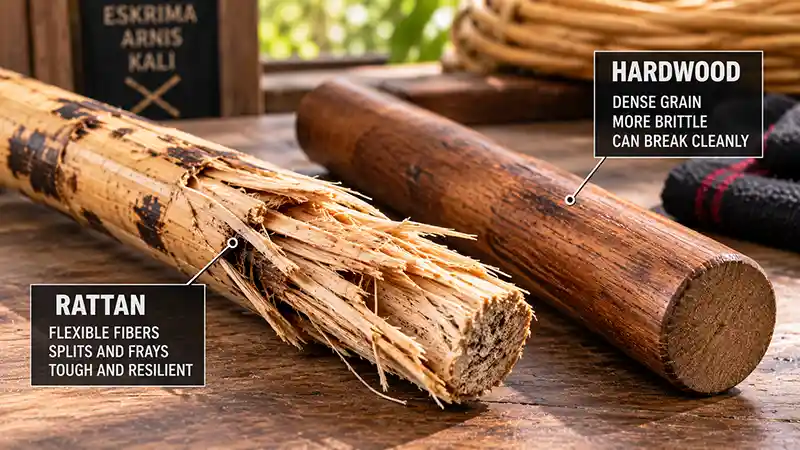
At first glance, rattan seems like a terrible material to put in front of a steel blade. It is dramatically softer than steel and light enough that a sword appears capable of slicing straight through it. But rattan has one characteristic that makes the comparison more interesting: it does not behave like a rigid piece of ordinary hardwood when struck.
Rattan is a fibrous vine with long strands running through its structure. Under heavy impact, those fibers can flex, compress, split, and gradually fray rather than immediately producing the clean, brittle fracture that can occur with some woods. That does not make rattan resistant to sword cuts, but it does mean that damaging the stick and completely severing it are not necessarily the same thing.
This combination of flexibility and toughness is a major reason rattan works so well for escrima sticks. During ordinary stick training, repeated impacts can slowly break down the outer fibers while the stick remains usable. Against a sharp blade, the forces are obviously much more severe, but the same fibrous structure still influences how the material fails.
A sword could bite deeply into rattan, peel away fibers, or severely weaken the stick without necessarily passing cleanly through it on every impact. And if the stick survives long enough to alter the sword's path, it may already have accomplished the only thing that mattered in that instant, even if the rattan is badly damaged afterward.
A Direct Block Is the Worst-Case Collision
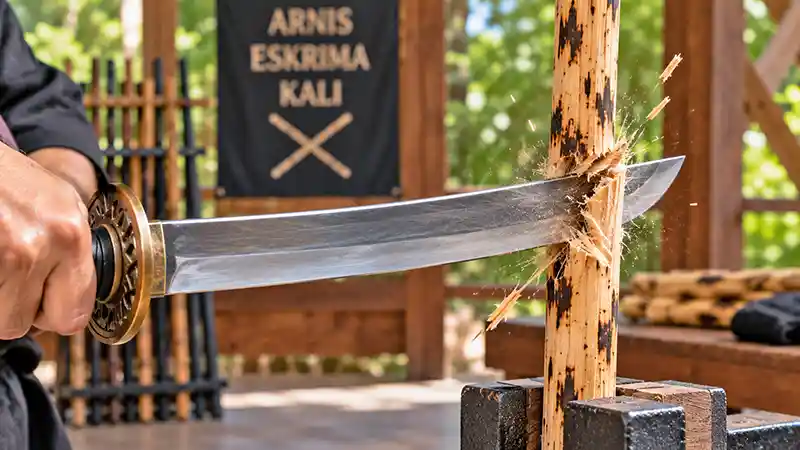
The most punishing scenario for an escrima stick would be exactly what action movies tend to show: holding the stick rigidly across the path of a powerful sword cut and allowing the blade to strike it directly. In that situation, the rattan has very little opportunity to redirect the sword. Instead, it has to absorb a large portion of the impact while a sharp edge concentrates that force onto a narrow area.
The type of sword would make an enormous difference. The term sword covers weapons with very different weights, blade geometries, edge profiles, and cutting abilities. A relatively light blade making imperfect contact presents a very different problem from a heavier, extremely sharp cutting sword arriving near the fastest-moving portion of its arc.
Even if the rattan were not completely severed, a direct impact could crush fibers, carve deeply into the stick, bend it, or leave it weakened enough that another hard strike could finish the job. The person's hands would also still have to deal with the shock of the collision. Simply showing an intact stick after one impact would therefore tell us surprisingly little about whether it had "won" the encounter.
This is why the dramatic sword-versus-stick question becomes much less favorable to the stick when we require it to function like a rigid shield. Rattan has useful properties, but it does not become stronger than sharpened steel simply because it is flexible. Its more interesting advantage appears when the collision is not a perfect head-on contest of cutting power against material strength.
The Angle of Impact Changes Everything
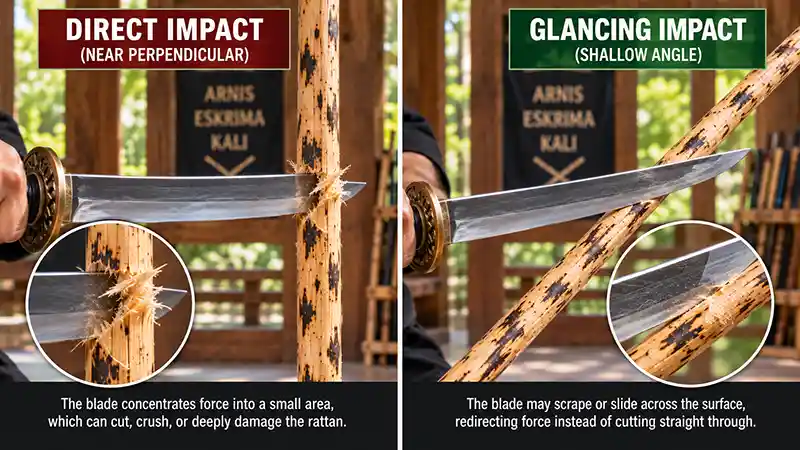
A sword striking a stick is not a simple contest between steel and rattan. The angle at which the two meet can completely change what happens. When a blade hits close to perpendicular, its edge can concentrate force into a relatively small section of the stick. When contact occurs at a shallower angle, however, the blade may scrape, slide, or glance across the surface instead of driving directly through it.
That difference is especially important because a moving stick does not have to remain perfectly rigid during contact. Rattan can flex slightly, and the stick itself can move as force is transferred into it. Instead of forcing one small section to absorb everything, the collision may redirect some of the sword's momentum and change the path of the blade.
This is also where speed becomes more important than raw strength. Filipino martial arts are known for rapid changes in angle and quick weapon movement, which is one reason escrima appears in discussions of the fastest weapons in martial arts. A relatively light stick can be repositioned quickly, making it better suited to intercepting or redirecting movement than its modest weight might suggest.
None of this means that an escrima stick becomes safe against a sword. A small difference in timing or angle could turn a glancing collision into a much more destructive one. But it does explain why asking whether a sword can "cut through rattan" does not completely answer the original question. The outcome depends not only on what the two weapons are made from, but on how they actually meet.
Where the Sword Hits the Stick Matters Too
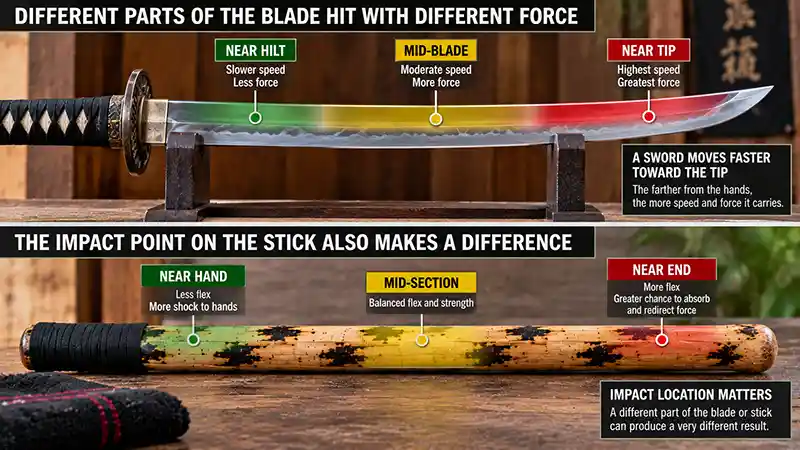
Even if the angle of contact is identical, moving the impact point only a few inches can change the collision dramatically. A sword does not travel at the same speed along its entire length. During a swinging cut, the portion of the blade farther from the hands generally moves through a larger arc and can arrive with considerable speed, while contact closer to the hilt creates a very different mechanical interaction.
The escrima stick has its own variables. Contact near the unsupported end gives the rattan more room to move and flex, while an impact much closer to the gripping hand leaves less material available to absorb and redirect the force. Diameter, wear, existing cracks, and previous impact damage can further change how well the stick survives.
This is one reason the familiar proportions of escrima sticks are more important than they might appear. As discussed in our look at why escrima sticks are often around 26 inches long, their dimensions balance reach with maneuverability. Against something as unforgiving as a blade, however, every part of that length is not equally favorable for making contact.
There is therefore no single answer to what happens when a sword strikes an escrima stick. A different sword, a different section of the blade, or a different point along the rattan can produce a noticeably different result. Two tests that appear almost identical at first glance may actually be testing very different collisions.
A Damaged Stick Can Still Have Done Its Job
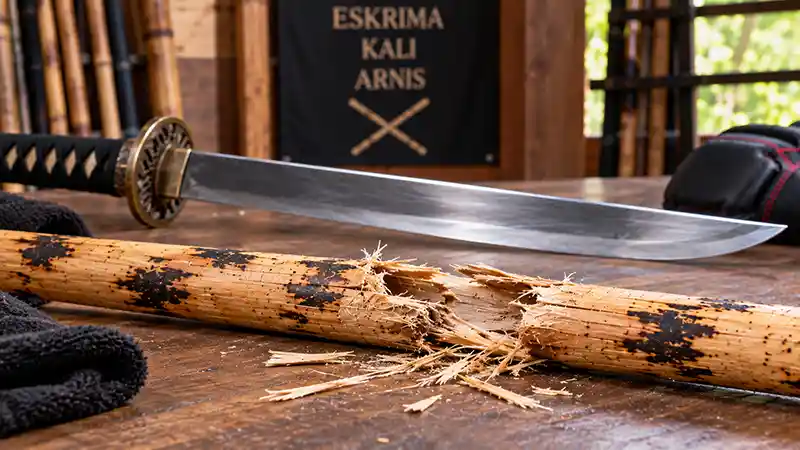
It is tempting to judge a sword-versus-stick collision by looking at the escrima stick afterward. If the rattan is deeply cut, crushed, or beginning to split, it seems obvious that the sword won. But that misses the more important question: did the blade continue along the path it was originally traveling?
A defensive object does not necessarily need to survive intact to be useful. If the sword becomes embedded briefly in the fibers, loses some of its momentum, or is pushed far enough off its original path that it misses its intended target, the stick may have succeeded even while sustaining severe damage. In a real encounter, preserving the stick would be considerably less important than preventing the blade from completing its cut.
Rattan is particularly interesting in this respect because damage can accumulate progressively. Its fibers may peel, crush, and separate while portions of the stick remain connected. That gives us a very different failure pattern from the dramatic movie image of a wooden weapon instantly snapping into two clean pieces.
This also helps explain why the history of Filipino stick fighting is more complicated than treating the stick as either a harmless trainer or an indestructible weapon. As we saw in the history of escrima sticks, the weapon existed within a broader tradition that adapted sticks, blades, and other available weapons to different circumstances. Survival did not depend on the stick being stronger than everything it encountered. It depended on whether the person holding it could make the tool useful for the situation at hand.
Not Every Sword Would Produce the Same Result
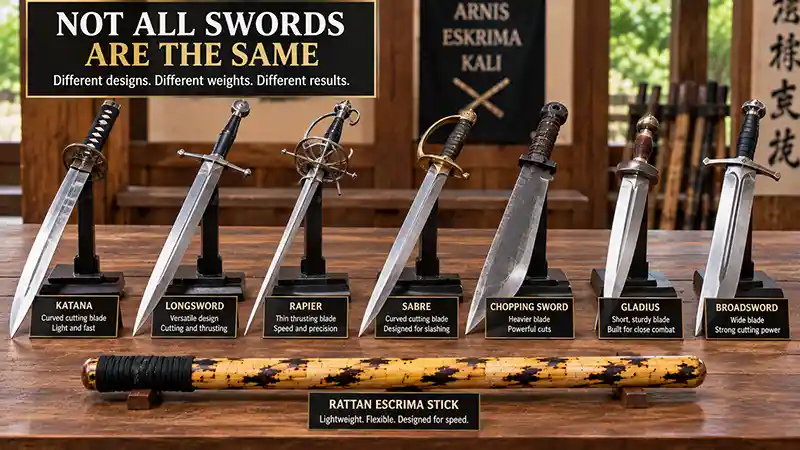
One of the biggest problems with asking whether an escrima stick could stop "a sword" is that swords vary enormously. A thin thrusting blade, a broad cutting sword, and a heavy chopping blade may all be called swords, yet they deliver force in very different ways. Even two swords of similar size can behave differently depending on their weight, balance, sharpness, edge geometry, and flexibility.
A blade optimized for cutting presents the most obvious danger to rattan because its edge is designed to concentrate force and separate material. But even then, sharpness alone does not determine the outcome. A poorly aligned cut can perform dramatically worse than one in which the edge travels cleanly through the target. Likewise, a heavier sword does not automatically guarantee a cleaner cut if its geometry or the angle of contact is unfavorable.
The condition of the blade matters as well. A freshly sharpened edge and a dull or damaged one should not be expected to interact with rattan identically. That makes sweeping demonstrations especially misleading. Showing one particular sword cutting through one particular stick proves what happened during that test, not what every Arnis, Eskrima, or Kali practitioner throughout history could expect from every edged weapon they encountered.
This enormous variation is part of what makes the question so interesting. There is no universal "sword versus escrima stick" collision. Change the blade, the stick, the angle, the impact point, or the quality of the cut, and the result can change with it. Any simple claim that a sword will always slice straight through rattan, or that an escrima stick can reliably withstand a sword, ignores too many variables to be very useful.
Historical Fighters Were Not Trying to Prove the Stick Was Stronger
Modern comparisons sometimes turn the question into a contest between materials: steel versus rattan, with whichever one survives being declared the better weapon. But that is probably the wrong way to understand why sticks and blades existed within the same Filipino martial traditions. A fighter did not need to believe that a stick was stronger than a sword to recognize that it might still be useful when facing one.
Filipino martial arts developed around adaptability rather than the assumption that every opponent would carry the same weapon. Skills could transfer between sticks, blades, and other objects, while the properties of whatever was actually in the hand changed what was possible. A stick offered reach, speed, and the ability to make contact with another weapon without exposing an empty hand directly to a blade.
This is especially important because the familiar escrima stick was never some magical answer to edged weapons. Historical fighters had access to their own swords, bolos, knives, and other weapons when circumstances allowed. Stick training existed within that much larger weapon culture rather than replacing it.
The question, then, was not whether rattan could defeat steel in a laboratory-style strength test. It was whether a stick could interfere with an incoming weapon long enough to matter. Once we frame the problem that way, the apparent mismatch becomes easier to understand. The stick did not have to emerge untouched. It only had to change what happened next.
Could a Sword Completely Cut Through an Escrima Stick?
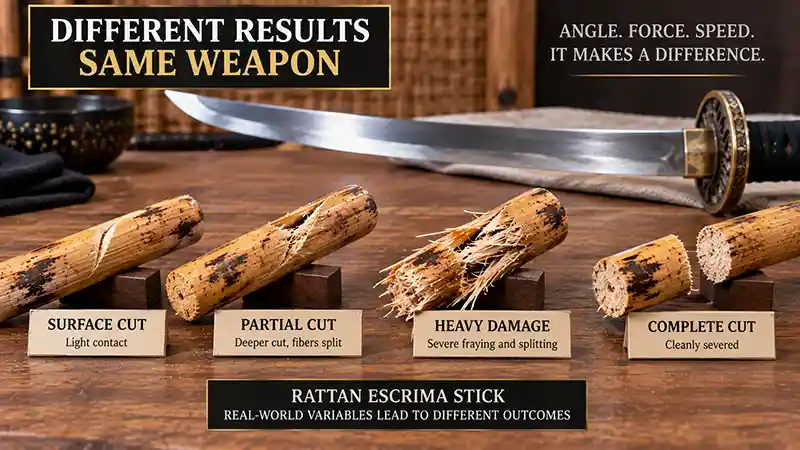
Yes. Under the right conditions, a sufficiently sharp sword can cut completely through a rattan stick. Rattan's flexibility and fibrous structure make it surprisingly resilient, but they do not make it cut-proof. A clean strike from an appropriate blade, delivered with good edge alignment and enough speed, can sever material that is much tougher than it initially appears.
What becomes misleading is turning that possibility into a guarantee. Cutting a stationary piece of rattan under controlled conditions is different from striking a moving object that can flex, rotate, or make contact at an imperfect angle. A blade that slices cleanly through one stick might only gouge, split, or partially sever another if any of those variables change.
Repeated impacts complicate things further. Even when the first strike fails to pass completely through, damaged fibers leave the stick progressively weaker. A deep cut can create a vulnerable point where later impacts cause greater splitting or eventual failure. The fact that rattan survives one collision therefore does not mean it could continue absorbing sword strikes indefinitely.
So the dramatic image of a sword slicing an escrima stick cleanly in half is physically plausible, but it represents one possible outcome rather than an inevitable one. Rattan can be cut. The more interesting question has always been whether the blade reaches what lies beyond the stick, and that depends on much more than the relative hardness of steel and cane.
Why Escrima Training Does Not Rely on Standing Still and Blocking
All of this helps explain something important about Filipino martial arts: the stick was never meant to function like a shield. Training with escrima sticks emphasizes movement, timing, distance, angles, and adaptability precisely because relying on a lightweight piece of rattan to absorb the full force of every incoming weapon would be a poor assumption.
That becomes especially important when edged weapons enter the picture. A rigid collision gives the blade an opportunity to concentrate its cutting force against the stick. Movement can change the geometry of that collision, turning what might have been a direct impact into something less destructive. The underlying principle is not that rattan somehow becomes stronger than steel, but that the collision itself does not have to occur under the sword's most favorable conditions.
This relationship between sticks and blades is one reason Filipino martial arts can be difficult to understand when viewed only through modern stick sparring. The stick provides a relatively practical way to develop timing and weapon awareness, but many of the concepts exist within a much broader martial tradition involving edged weapons as well. A practitioner training with rattan is therefore learning more than how to make one stick collide with another.
That perspective also makes the original sword-versus-stick question more realistic. An escrima stick's best chance of interfering with a sword does not come from proving it can withstand repeated full-power cuts. It comes from the qualities that made the stick useful in the first place: speed, maneuverability, reach, resilience, and the ability to change the interaction before the blade completes its intended path.
So Could an Escrima Stick Actually Stop a Sword?
Yes, an escrima stick could potentially stop a sword from reaching its intended target, but that is very different from saying a rattan stick can reliably withstand a direct sword cut. A sharp blade striking cleanly and forcefully can severely damage or even completely sever rattan. There is no mysterious property that makes an escrima stick stronger than steel.
What makes the answer interesting is everything that happens between the extremes of "the sword cuts straight through" and "the stick blocks the sword." A glancing impact may redirect the blade. Rattan may flex or move during contact. The sword may cut deeply into the fibers without completely severing them. Even a badly damaged stick could potentially alter the blade's path enough to prevent it from continuing where it was originally headed.
That means the outcome depends on a surprisingly long list of variables: the type and sharpness of the sword, the quality of the cut, the angle of contact, where the blade meets the stick, the condition and diameter of the rattan, and how both weapons are moving at the moment of impact. Change any one of those factors and the result can change with it.
So if the question is whether an escrima stick could survive repeated direct blows from a sharp sword, it would be foolish to count on it. But if the question is whether a simple rattan stick could interfere with, redirect, or occasionally stop a sword attack from continuing along its original path, the answer is much more plausible. The stick does not have to defeat the sword. In the moment that matters, it only has to prevent the sword from getting where it was going.
Frequently Asked Questions
Can a Sword Cut Through an Escrima Stick?
Yes. A sharp sword delivered with sufficient speed and good edge alignment can cut completely through a rattan escrima stick. Rattan is tough and flexible, but it is not resistant to cutting in the way metal would be.
However, complete severing is not guaranteed every time a sword contacts rattan. The angle of impact, sharpness and design of the blade, condition of the stick, and movement of both objects can determine whether the sword cuts through, becomes partially embedded, produces heavy fraying, or simply damages the surface.
Can an Escrima Stick Block a Sword?
An escrima stick could potentially prevent a sword from continuing toward its intended target, particularly if the contact redirects the blade rather than attempting to absorb the entire impact directly. That does not mean the stick would remain undamaged.
A direct collision with a powerful cutting stroke would be considerably more destructive to the rattan than an angled or glancing impact. This is why "blocking" can be a misleading word. Changing the sword's path and stopping its edge dead against the stick are very different events.
Would a Sword Cut Through Rattan or Hardwood More Easily?
There is no universal answer because both materials vary considerably. Dense hardwood can offer substantial resistance, while rattan has a fibrous structure that allows it to flex, crush, split, and fray instead of always failing with a clean break.
Blade geometry, sharpness, material thickness, grain structure, impact angle, and the quality of the cut can all affect the result. Rattan's advantage as an escrima material is therefore not that it is impossible to cut, but that its combination of toughness, flexibility, and relatively low weight makes it particularly useful for repeated martial arts training.
Why Does Rattan Fray Instead of Snapping?
Rattan contains long fibers running through its structure. As the material accumulates damage, those fibers can begin separating and peeling away from one another. This produces the familiar frayed appearance of a heavily used rattan escrima stick.
That failure pattern is one reason rattan became popular for martial arts practice. Rather than necessarily breaking suddenly into sharp pieces, it often shows progressive damage that becomes increasingly obvious as the stick wears out.
Could an Escrima Stick Damage a Sword?
It is possible for weapon-to-weapon contact to damage a sword, but the outcome would depend heavily on the sword and the collision. Edges can become scratched, rolled, chipped, or otherwise damaged under unfavorable impacts, particularly when a blade strikes another hard object.
That does not mean a rattan stick should be expected to destroy a sword. Steel is dramatically harder than rattan, and a properly made sword is designed to withstand substantial forces. The more realistic concern in a sword-and-stick collision is usually what happens to the stick and whether the sword's path changes.
Does the Type of Sword Matter Against an Escrima Stick?
Very much. Swords differ in weight, length, balance, sharpness, edge geometry, blade thickness, and intended purpose. A weapon optimized for powerful cutting can interact with rattan very differently from a lighter blade designed primarily for thrusting.
Even swords within the same general category can produce different results depending on their condition and construction. This is why a single cutting demonstration cannot establish what would happen with every type of sword and every escrima stick.
Why Are Escrima Sticks Made From Rattan?
Rattan combines low weight with flexibility and toughness. Those properties allow an escrima stick to move quickly while tolerating the repeated impacts common in Filipino martial arts training.
Rattan also tends to develop visible fraying as its fibers deteriorate, giving practitioners warning that a heavily used stick is becoming damaged. Historical fighting sticks were not exclusively made from rattan, but rattan eventually became one of the materials most closely associated with modern escrima practice.
Were Escrima Sticks Designed to Fight Swords?
It would be misleading to describe the modern rattan escrima stick simply as a weapon specifically designed to fight swords. Filipino martial arts developed around a much broader collection of sticks, blades, and other weapons, with many principles transferring between them.
Stick training could help develop timing, distance, angles, coordination, and weapon awareness relevant to edged weapons, while sticks could also function as weapons themselves. Their historical role is therefore much broader than serving as dedicated sword blockers.
Is an Escrima Stick Stronger Than a Sword?
No. Rattan is not stronger or harder than the steel used to make a sword blade. A sufficiently sharp sword making favorable contact can seriously damage or completely sever an escrima stick.
The reason an escrima stick could still interfere with a sword has less to do with material strength than with movement, angle, flexibility, and the nature of the collision. Preventing a blade from reaching its target does not require the stick itself to be stronger than the sword.
Could an Escrima Stick Stop More Than One Sword Strike?
Possibly, but there would be no reliable number of impacts a rattan stick could withstand. A glancing contact might leave relatively little damage, while a single well-aligned cut could severely weaken or completely sever the stick.
Damage also accumulates. Once fibers have been deeply cut or split, subsequent impacts may cause the damaged area to deteriorate much faster. An escrima stick surviving one sword strike therefore tells us very little about whether it would survive another.
You May Also Be Interested In:
- Hidden Sword Battle Stick and Other Combat Weapons
- Survival Walking Stick and Other Rugged Weapons
- Knife Throwing for Beginners: How to Stick Every Throw
- War Hammer Walking Stick and Other Deadly Weapons
- Why Did Sword Canes Almost Disappear?
- Could Nunchucks Actually Break a Sword?
- How to Tell a Real Katana from a Decorative Sword
- Combat Spear Sword and Other New Weapons
- New Competition Escrima Sticks
- Why Are Escrima Sticks Usually About 26 Inches Long?
Leave a Reply