




Why Are Escrima Sticks Usually About 26 Inches Long?
September 2nd, 2026
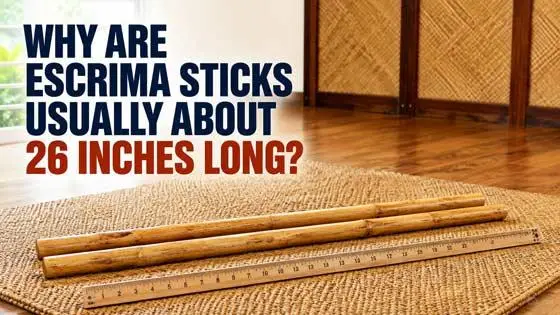
For generations, martial artists across the Philippines trained with sticks that were remarkably consistent in size. Whether called escrima, arnis, or kali sticks, many measured close to 26 inches long. That length was not chosen at random. It created a carefully balanced weapon that could reach an opponent without becoming slow, awkward, or difficult to control at close range. But why did 26 inches become such a common standard when a longer stick would seem to offer more reach and a shorter one would be easier to move? The answer can be found in the unique demands of Filipino martial arts, where speed, distance, concealability, and the ability to transition between striking and grappling all had to fit inside a single piece of rattan.
The Length Was a Compromise Between Reach and Control
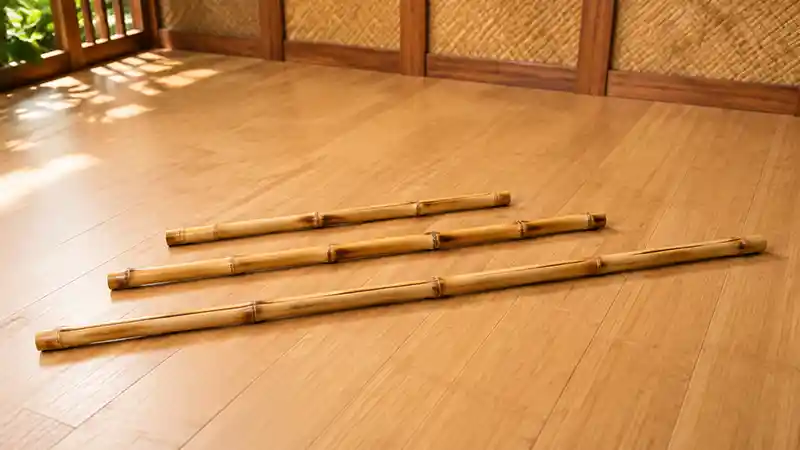
A 26-inch stick sits in a remarkably useful middle ground. It is long enough to extend beyond the hand and forearm, giving the wielder meaningful striking distance, yet short enough to accelerate quickly and change direction without feeling cumbersome. In Filipino martial arts, where attacks may arrive from several angles in rapid succession, that balance is often more valuable than maximum reach.
A longer weapon can generate tremendous leverage, but it also requires more room to move. Wide hallways, dense vegetation, crowded homes, ship decks, and close-range encounters do not always provide that space. A much shorter stick is easier to maneuver, but it sacrifices reach and reduces the amount of momentum created during a strike. The traditional dimensions of many escrima sticks allow them to remain fast in confined areas while still extending far enough to intercept an incoming limb or weapon.
This is one reason the stick feels so versatile during training. Its length supports powerful swings, compact defensive movements, rapid combinations, and close-range trapping without forcing the practitioner to switch weapons as the distance changes. Twenty-six inches is not a magical measurement, but it is close to the point where reach and maneuverability stop competing and begin working together.
The Stick Became an Extension of the Fighter's Arm
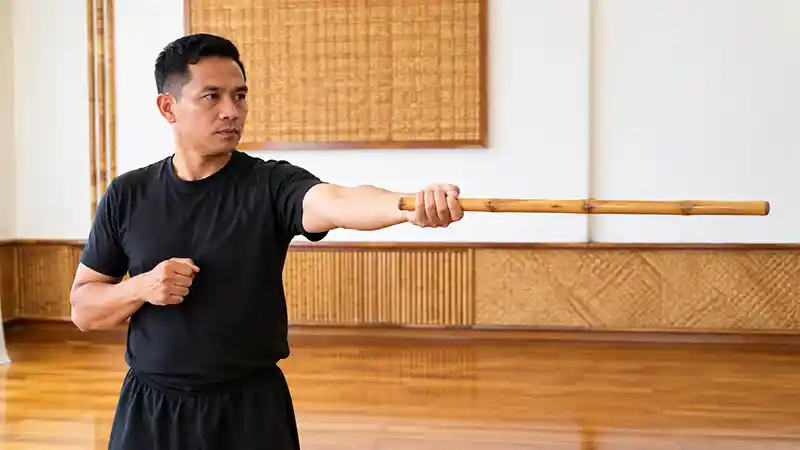
The effectiveness of an escrima stick is closely connected to the proportions of the person holding it. At approximately 26 inches, the weapon extends well beyond the fist while remaining short enough to follow the natural rotation of the wrist, elbow, and shoulder. Instead of feeling like a separate object that must be dragged through each movement, it can move almost as if it were an extension of the forearm.
This relationship is especially important during rapid combinations. Filipino martial arts often use continuous patterns in which one strike flows directly into the next. The stick may travel from a forehand strike into a backhand, block an incoming attack, circle around the head, and return from another angle within seconds. If the weapon is too long, its tip creates a wider arc that takes more time and space to redirect. If it is too short, the fighter loses much of the reach and striking leverage that makes the weapon useful.
A traditional rattan escrima stick provides enough length to amplify the motion of the arm without overwhelming it. This allows the practitioner to rely on familiar body mechanics rather than forcing the shoulders and wrists to compensate for an oversized weapon. The result is a stick that feels fast, responsive, and naturally connected to the fighter's movement.
Filipino Martial Arts Developed for Close-Range Encounters
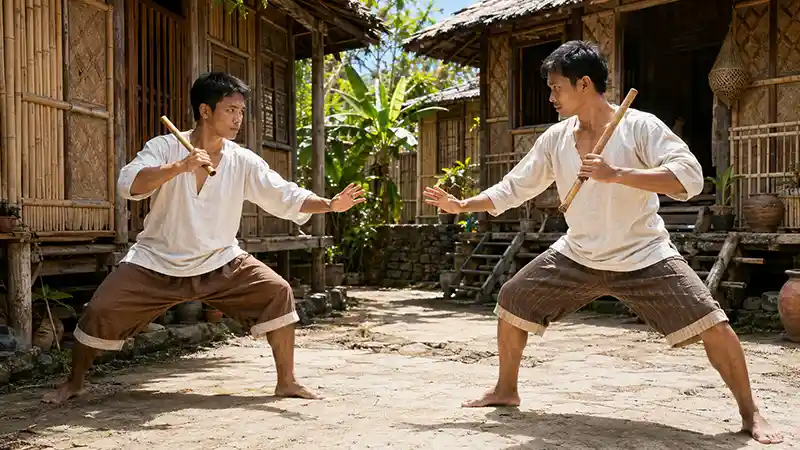
Escrima did not evolve around formal duels fought across wide, empty fields. Its techniques were shaped by environments where space could disappear quickly. Homes, village paths, dense vegetation, boats, and crowded streets all favored weapons that could strike without requiring a large swinging arc. A stick approximately 26 inches long could remain effective even when an opponent was only a few steps away.
That compact length also allowed the weapon to move through narrow defensive lines. A practitioner could intercept an attack, strike the hand or forearm, and immediately redirect the stick toward another target. Longer weapons offered greater reach, but they became harder to recover once an opponent moved inside their ideal striking distance. Escrima fighters needed a weapon that remained dangerous after the fight had already become close and chaotic.
As explored in the real history of escrima sticks, these weapons developed alongside practical fighting systems shaped by warfare, cultural exchange, and everyday necessity. Their familiar length survived because it worked across many different situations, from open movement at the edge of striking range to compact blocks and counters at arm's length.
The Length Creates a Balance Between Reach and Control
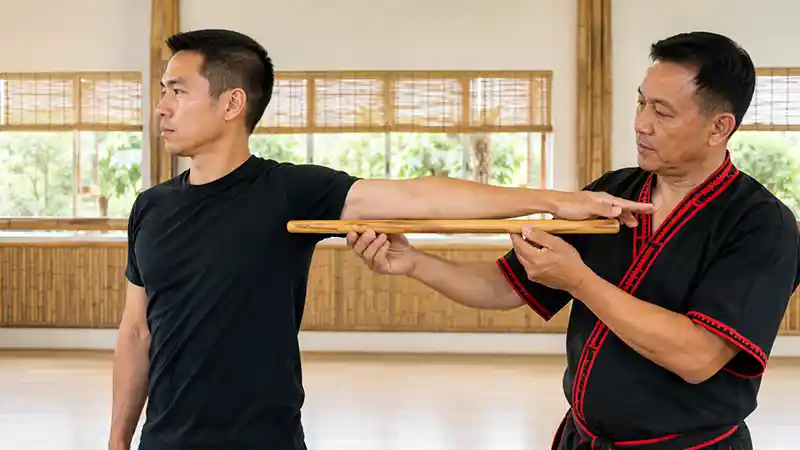
A 26-inch escrima stick is long enough to extend well beyond the practitioner's fist, giving each strike meaningful reach without making the weapon feel disconnected from the hand. This allows a fighter to target an opponent's wrist, forearm, or head while remaining outside the range of an empty-hand counter. The stick adds distance, but not so much that subtle movements become slow or difficult to control.
That balance becomes especially important during rapid combinations. Escrima techniques often move from one angle of attack to another without a complete pause between strikes. A compact stick can change direction quickly because less of its weight sits far beyond the hand. The practitioner can strike, retract, circle, and strike again without fighting against excessive momentum.
The same proportions also make defensive movements more precise. Enough of the stick extends in front of the hand to intercept an incoming attack, while the shorter rear portion remains manageable during blocks, traps, and close-range manipulations. If the weapon were much longer, it would offer additional reach but respond more slowly. If it were much shorter, it would sacrifice much of the distance and striking leverage that make an escrima stick effective.
Double-Stick Fighting Places an Even Greater Limit on Length
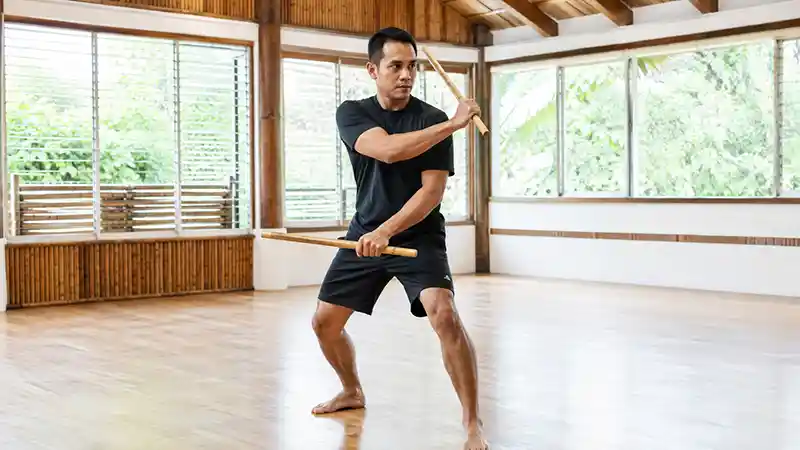
Many Filipino martial arts systems train with one stick in each hand. This changes the practical requirements of the weapon because both sticks must move through the same limited space without colliding. A length of approximately 26 inches gives each hand enough reach to attack effectively while leaving room for alternating strikes, crossed defenses, and rapid transitions.
Longer sticks become increasingly difficult to coordinate when used as a pair. Their tips travel through wider arcs, making accidental collisions more likely as the hands pass in front of the body. They can also interfere with the practitioner's shoulders, hips, and opposite arm during tight combinations. The extra reach may seem beneficial, but it can disrupt the continuous rhythm that double-stick techniques depend upon.
Compact sticks allow the hands to operate independently while still supporting one another. One stick can intercept an incoming attack as the other delivers a counterstrike, and both can quickly return to protective positions. The familiar length is therefore not only suited to single-stick fighting. It also preserves the clearance and coordination required for fluid double-stick training.
A Common Length Makes Partner Training More Consistent
Escrima was traditionally taught through repeated partner drills in which both practitioners learned the same angles, defenses, and counters. When the sticks were reasonably similar in length, each person encountered comparable reach and timing. This made it easier to understand whether a technique succeeded because of proper movement rather than because one weapon happened to be dramatically longer than the other.
Consistent sizing also helped instructors demonstrate techniques to groups. Students could follow the same striking patterns without constantly adjusting for weapons that behaved differently. The distance required to evade a strike, the point where two sticks met during a block, and the timing of a counterattack all became more predictable when everyone trained with sticks near the same length.
Over time, repeated use created a practical standard. A stick around 26 inches worked for a wide range of adult practitioners, suited both single-stick and double-stick methods, and could be produced easily from sections of rattan. The measurement was not established by a single governing authority. It became common because generations of practitioners found that it allowed their training methods to be taught and practiced reliably.
Twenty-Six Inches Is a Standard, Not a Strict Rule
Although 26 inches is one of the most common lengths, escrima sticks are not required to match that measurement exactly. Different Filipino martial arts systems may favor slightly different proportions based on their preferred techniques. Some use shorter sticks for exceptionally close-range movements, while others choose longer sticks to place greater emphasis on reach and powerful swinging strikes.
Individual practitioners may also adjust the length to suit their height, arm length, and training goals. A smaller person might find a 24-inch stick easier to maneuver, while a taller practitioner may be comfortable with one measuring 28 inches or more. These differences do not make the weapons less authentic. They reflect the practical nature of Filipino martial arts, where equipment is often adapted to the person using it.
The popularity of the 26-inch stick comes from its versatility rather than an inflexible tradition. It falls within a useful middle range that supports striking, blocking, trapping, and double-stick combinations without becoming unusually short or difficult to control. That makes it a dependable starting point, even when a practitioner eventually decides that a slightly different length feels more natural.
Modern Training Reinforced the 26-Inch Standard
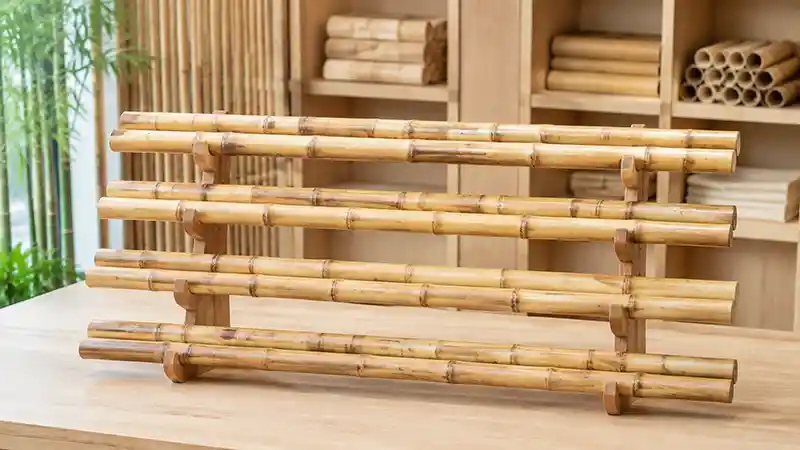
As Filipino martial arts spread internationally, instructors needed equipment that could be purchased in consistent sizes. Commercial suppliers began producing rattan sticks near the dimensions already favored by many practitioners, and approximately 26 inches became one of the most widely available options. Students could order a matching pair without cutting and preparing raw rattan themselves.
Seminars, martial arts schools, demonstrations, and organized competitions further strengthened this preference. A familiar stick length allowed people from different schools to train together without encountering major differences in reach or handling. Protective equipment, training distances, and partner drills could all be organized around weapons with relatively predictable dimensions.
Commercial standardization did not create the 26-inch escrima stick, but it helped preserve its popularity. A practical traditional size became easier to manufacture, teach with, transport, and replace. Once generations of new students began learning with sticks of roughly the same length, that measurement became even more closely associated with escrima around the world.
Twenty-Six Inches Endured Because It Solved Several Problems at Once
The familiar length of an escrima stick was not chosen for a single technique or imposed by an official rule. It endured because it offered enough reach to extend beyond the empty hand, enough leverage to make strikes powerful, and enough control to recover quickly after every movement. The same proportions also worked well in confined environments where a longer weapon could become difficult to maneuver.
A stick near 26 inches could be used for single-stick fighting, coordinated double-stick patterns, close-range defenses, and repeatable partner drills. It suited the proportions of many adult practitioners while remaining easy to carry, manufacture, and replace. Few other lengths offered such a practical compromise across so many different demands.
Individual schools and practitioners will continue to use shorter or longer sticks, but the standard remains popular because it rarely creates a serious disadvantage. It is neither the longest nor the fastest possible option. It is the length that performs reliably across the widest range of escrima techniques, which is why it has remained the most recognizable choice for generations.
Are All Escrima Sticks 26 Inches Long?
No. Twenty-six inches is a common standard, but escrima sticks are available in several lengths. Shorter sticks around 24 inches may feel faster and easier to use in confined spaces, while longer sticks measuring 28 inches or more provide additional reach. Some practitioners choose a length based on the distance from their armpit to their fingertips, while others follow the preference of their instructor or martial arts system.
What Is the Best Escrima Stick Length for a Beginner?
A stick between 26 and 28 inches is a practical starting point for most adult beginners. This range provides enough reach for learning traditional striking angles while remaining manageable during blocks, transitions, and double-stick drills. Smaller practitioners may feel more comfortable with a 24-inch stick, especially if a longer weapon repeatedly strikes the body during practice.
How Do You Measure the Correct Escrima Stick Length?
A common method is to extend one arm straight out and measure from the armpit to the fingertips. An escrima stick close to that length should move naturally with the arm without becoming difficult to control. This is a useful guideline rather than an exact requirement, since the practitioner's training style and personal preference may favor a slightly shorter or longer stick.
Are Longer Escrima Sticks More Powerful?
A longer escrima stick can generate greater leverage and tip speed when swung through a full arc, but that does not automatically make it more effective. The additional length also creates more momentum, requires greater clearance, and can make the weapon slower to redirect. A shorter stick may deliver less force at the tip, but it can strike repeatedly and recover more quickly in close-range situations.
Why Are Escrima Sticks Usually Made from Rattan?
Rattan is lightweight, flexible, and resistant to dangerous splintering. When damaged, its fibers tend to fray rather than breaking into sharp fragments like many hardwoods. This makes rattan particularly useful for repeated partner drills, where sticks regularly collide. Its low weight also complements the common 26-inch length by allowing practitioners to practice fast combinations without excessive fatigue.
How Thick Should an Escrima Stick Be?
Most escrima sticks measure approximately three-quarters of an inch to one inch in diameter. Thinner sticks feel faster and may be easier for smaller hands to grip, while thicker sticks provide more weight and durability. The ideal diameter should allow the practitioner to close the hand securely around the weapon without excessive tension.
How Much of an Escrima Stick Should Extend Below the Hand?
Approximately two to three inches of the stick commonly extends below the gripping hand. This short portion is known as the punyo and can support trapping, checking, and close-range striking techniques. Leaving too much stick below the hand may interfere with wrist movement, while gripping directly at the end removes many of the punyo's practical uses.
Should Double Escrima Sticks Be the Same Length?
Matching sticks are usually best for double-stick training because they provide consistent reach, weight, and timing on both sides of the body. This makes alternating strikes and mirrored patterns easier to learn. Advanced practitioners may occasionally train with mismatched weapons, but beginners generally benefit from using an identical pair.
Do Children Need Shorter Escrima Sticks?
Children generally benefit from shorter and lighter sticks that match their smaller arms and hands. The armpit-to-fingertips guideline can provide a useful starting measurement. Padded training sticks may also be appropriate for supervised partner drills, depending on the child's experience and the instructor's safety requirements.
Are Padded Escrima Sticks the Same Length as Rattan Sticks?
Many padded escrima sticks are designed to approximate the length of standard rattan sticks, but their dimensions can vary. Thick foam padding may make a training weapon feel bulkier and move differently even when its overall length is similar. Practitioners should compare the usable shaft length and weight rather than relying only on the advertised measurement.
Can You Cut a Rattan Escrima Stick to Fit Your Arm?
Yes. A rattan stick can be shortened to better match the practitioner's arm length or training preference. The cut should be clean and straight, and the newly exposed end should be sanded smooth to remove rough fibers. Any sharp edges or developing cracks should be corrected before the stick is used for training.
Does Stick Length Change Between Escrima, Kali, and Arnis?
Escrima, kali, and arnis include many different systems rather than one universal set of equipment rules. Sticks around 26 inches are common across all three names, but individual schools may prefer shorter or longer weapons. The instructor's methods and regional lineage usually influence stick length more than the particular name used for the martial art.
Do Escrima Competitions Have Standard Stick-Length Rules?
Competition requirements vary between organizations and events. Some specify an acceptable range for stick length, diameter, weight, or padding, while others provide approved equipment to every competitor. Anyone preparing for a tournament should review that event's current rules instead of assuming that a standard 26-inch rattan stick will automatically qualify.
You May Also Be Interested In:
- New Competition Escrima Sticks
- Were Escrima Sticks Ever Actually Used in Real Combat?
- Why Is Rattan Better Than Hardwood for Escrima Sticks?
- The Real History of Escrima Sticks: From Battlefield Weapon to Modern Martial Art
- Could an Escrima Stick Actually Stop a Sword?
- Why Choose a Ribbed Grip Aluminum Escrima?
Leave a Reply