




Why Is Rattan Better Than Hardwood for Escrima Sticks?
August 19th, 2026
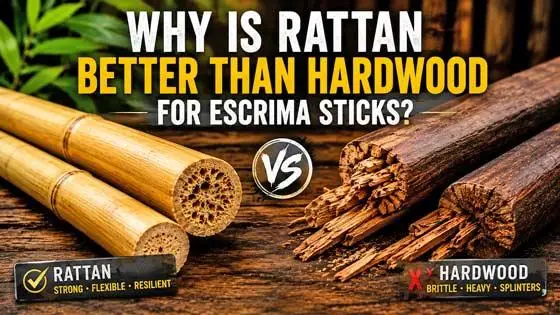
Hardwood sounds like the obvious choice for a fighting stick. It is dense, strong, and capable of delivering tremendous impact, so why did rattan become one of the most recognizable materials used for escrima sticks? The answer has less to do with raw hardness than with what happens when two sticks collide again and again. Rattan is unusually light, resilient, and forgiving under repeated impacts, and when it eventually begins to fail, it behaves very differently from many hardwoods. Those qualities made a tropical climbing palm surprisingly well suited to the fast, impact-heavy training found in Filipino martial arts. To understand why generations of practitioners embraced it, we first have to look inside rattan itself and discover why it is not really wood at all.
Rattan Is Not Actually Wood
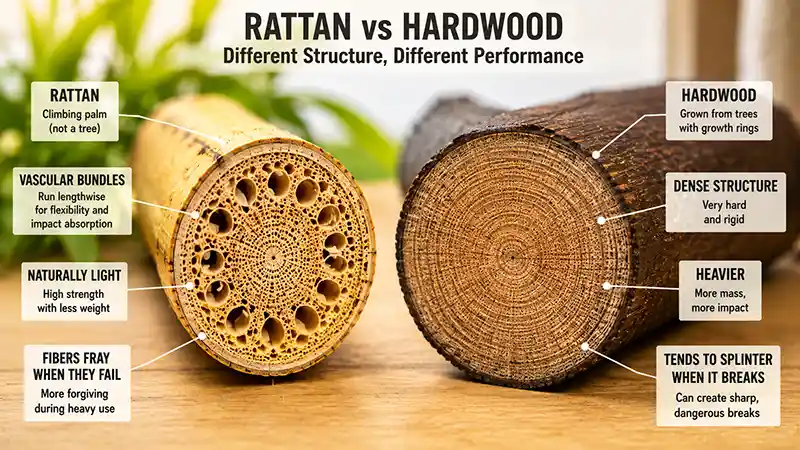
The first surprise is that an escrima stick made from rattan is not technically a wooden stick at all. Rattan comes from climbing palms that grow throughout tropical regions of Asia, including the Philippines. Unlike a hardwood tree, which develops a trunk with growth rings and a very different internal structure, rattan grows as a long, solid cane packed with vascular bundles running through its length.
That internal structure helps explain why rattan behaves so differently when struck. Instead of relying on the rigid structure that gives many hardwoods their density and hardness, rattan combines longitudinal fibers with a comparatively resilient interior. A good piece of rattan can bend slightly under stress, absorb repeated impacts, and continue functioning even after its outer surface begins showing obvious signs of wear.
This makes rattan particularly well suited to the repeated stick-on-stick contact encountered when training with escrima sticks. Harder is not automatically better when two weapons are colliding hundreds or thousands of times. A material that can give slightly under impact may survive that punishment differently from one that is harder but less forgiving.
Rattan also has another characteristic that becomes increasingly important as a training stick ages. When it finally begins to fail, its long fibers tend to fray and separate rather than breaking in exactly the same manner as many hardwood sticks. That difference in failure behavior is one of the biggest clues to why generations of martial artists found rattan so practical, and it is something we will examine much more closely next.
Rattan Frays Instead of Failing All at Once
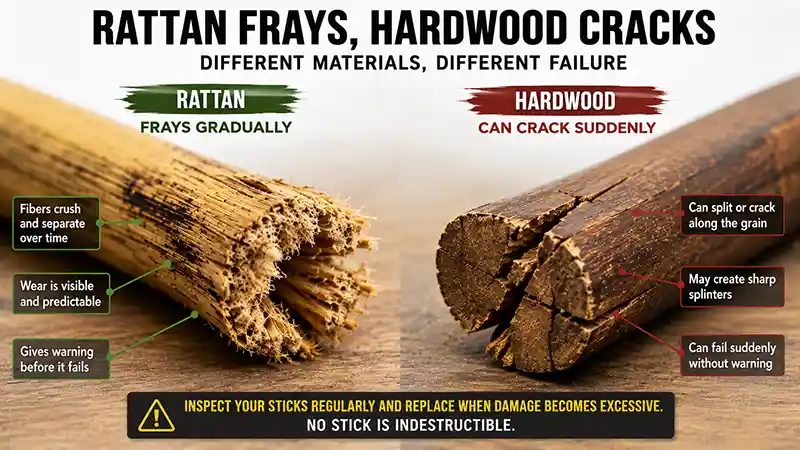
One of rattan's biggest advantages becomes obvious only after an escrima stick has taken a serious amount of punishment. Repeated impacts gradually crush and separate the long fibers near the surface. The stick can become fuzzy, battered, and visibly worn while much of its internal structure remains connected. Instead of looking pristine one moment and suddenly snapping the next, rattan often gives the practitioner plenty of warning that it is reaching the end of its useful life.
Hardwoods can fail differently. The exact behavior depends heavily on the species, grain, moisture content, defects, and direction of the impact, so it would be wrong to say that every hardwood stick simply shatters. But dense wood can crack or split along its grain, sometimes creating sharp splinters or jagged sections that make a damaged training stick something you do not want flying around during partner drills.
Rattan's tendency to fray is not indestructibility. A badly damaged rattan stick should still be retired, and loose fibers can eventually become a nuisance of their own. The advantage is that deterioration is often progressive and highly visible. A practitioner can inspect the battered areas, notice the fibers separating, and replace the stick before the damage becomes excessive.
This is particularly valuable in an art built around repeated contact. An unpeeled rattan escrima stick does not need to remain cosmetically perfect to keep functioning as a training tool. It needs to tolerate thousands of strikes predictably, show its wear clearly, and fail in a manageable way. Rattan's fibrous structure happens to be remarkably good at all three.
Rattan Absorbs Shock Instead of Sending All of It Back Into Your Hands
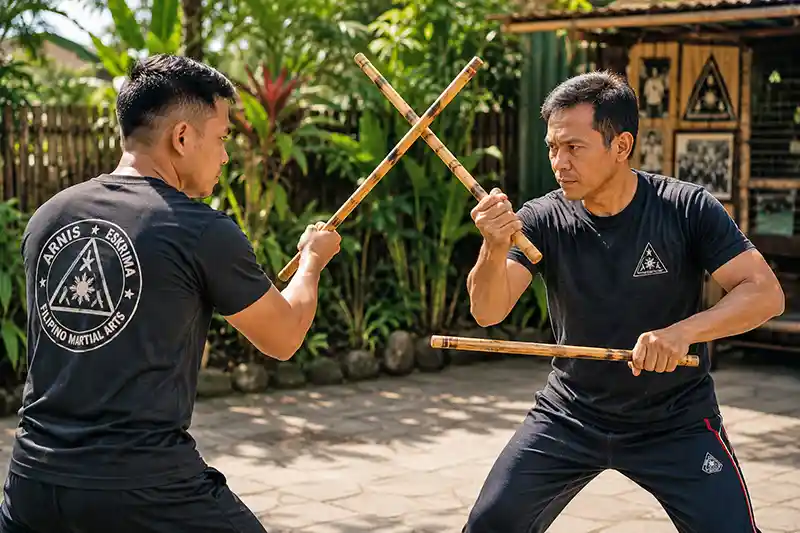
Anyone who has repeatedly struck two rigid objects together knows that the collision does not end at the point of impact. Some of that energy travels back through whatever you are holding and into your hands, wrists, and arms. With escrima training, where practitioners may perform hundreds of strikes, blocks, and partner drills in a single session, that repeated feedback becomes an important part of how a training stick feels.
Rattan's slight flexibility helps it behave differently from a dense, rigid hardwood. When two rattan sticks collide, the material can deform slightly and vibrate, allowing some of the impact energy to be distributed through the stick rather than producing the same sharp sensation associated with a more rigid material. The difference may seem small during a single strike, but repeated contact is where the characteristic becomes much more noticeable.
This does not mean rattan somehow makes hard contact harmless. Escrima sticks can still transmit substantial force, and rattan remains a tough material. The advantage is more subtle. It combines enough rigidity to behave like a stick with enough resilience to make repeated contact more forgiving than many extremely dense alternatives.
That combination helps explain why rattan became so practical for an art built around fast, repetitive weapon movements. In fact, the characteristics that make escrima sticks feel so quick are closely connected to why they have earned a reputation as one of the fastest weapons in martial arts. A relatively light, resilient stick can accelerate rapidly without burdening the practitioner with the mass and harsher feedback of a much denser material.
Being Lighter Makes Rattan Faster Without Making It Flimsy
Weight matters enormously when a weapon is expected to change direction quickly. Escrima involves rapid strikes, redirections, checks, combinations, and defensive movements, so every additional ounce affects how easily the stick can accelerate and stop. Rattan offers an unusually useful compromise because it can provide enough structural strength for repeated training without requiring the density of many hardwoods.
That difference becomes particularly noticeable during longer practice sessions. A dense hardwood stick can feel powerful and substantial, but repeatedly accelerating that extra mass requires more effort. Rattan allows practitioners to work at higher speeds and perform large numbers of repetitions without making the stick feel insubstantial. It still has enough mass to provide meaningful feedback when strikes connect.
The lower weight also complements one of the defining characteristics of Filipino stick systems: movements can flow rapidly from one angle into another. The weapon does not need to be muscled through every transition. It can be redirected quickly, allowing practitioners to develop combinations and reactions at the speed these arts demand.
This helps explain why seemingly simple sticks became such sophisticated training tools within Arnis, Eskrima, and Kali. Rattan was not chosen because practitioners lacked access to harder materials. Its combination of low weight, resilience, and sufficient rigidity happened to fit the movements and repetitive training methods exceptionally well.
Harder Is Not the Same Thing as More Durable
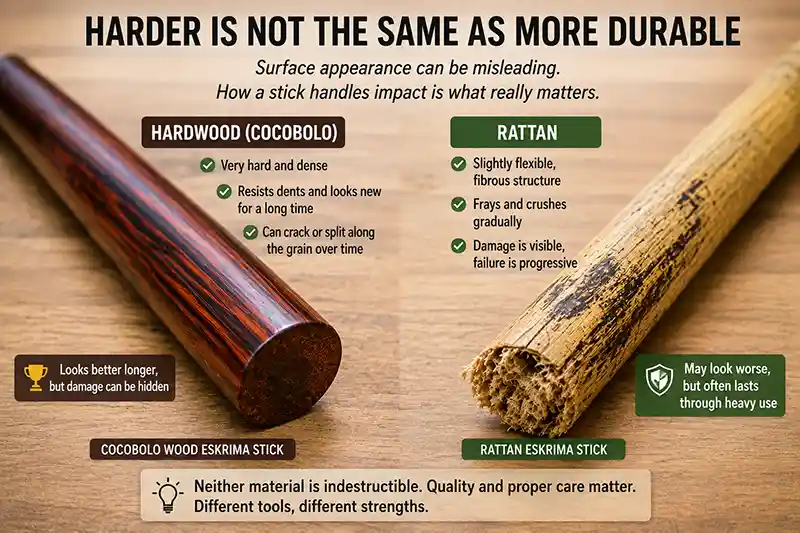
It is easy to assume that a harder material must make a better escrima stick. After all, hardwood can resist dents, feel extremely solid, and deliver a powerful impact. But hardness measures only part of what matters when a stick is repeatedly smashed against another stick. The ability to survive that punishment also depends on toughness, flexibility, grain structure, and how the material responds when a crack begins to form.
A dense hardwood can be extremely strong while still being less forgiving of certain impacts. Once a crack develops along the grain, repeated strikes can encourage that crack to spread. Rattan takes a different approach. Its fibrous structure can deform, crush, and gradually fray while the stick remains largely intact. It may look more battered on the surface even while continuing to tolerate repeated training.
This creates an interesting paradox. The rattan stick can sometimes look worse while actually failing more progressively. A hardwood stick may remain smooth and impressive for a long time, yet damage developing along the grain can eventually become much more significant. Neither material is indestructible, and the quality of the individual stick matters enormously, but visible surface damage alone does not tell you which material has handled repeated impacts better.
That is also why hardwood still has a legitimate place in escrima. A dense stick such as a cocobolo wood escrima stick offers greater weight, rigidity, and a very different feel in the hand. Those can be desirable characteristics depending on what someone wants from the weapon. Rattan's advantage is not that hardwood is weak. It is that rattan sacrifices some hardness and density in exchange for characteristics that are particularly useful during repeated contact training.
Rattan Can Bend Without Feeling Like a Flexible Weapon
Rattan's flexibility can be easy to misunderstand. An escrima stick does not bend dramatically in the hand like a whip or a flexible training weapon. During normal movement it feels like a rigid stick. The difference appears when enough force is applied, particularly during repeated impacts, because the material can deform slightly and then recover rather than resisting every collision with complete rigidity.
That small amount of give is one reason rattan handles punishment so effectively. When two sticks collide, a perfectly rigid material has fewer ways to accommodate the sudden load. Rattan's long internal fibers allow the cane to flex slightly along its length, spreading stress through more of the stick instead of concentrating everything at one small point.
The important part is that rattan achieves this without becoming difficult to control. It remains stiff enough for rapid strikes, blocks, traps, and directional changes. Practitioners get the handling characteristics of a solid stick while benefiting from a material that can tolerate a surprising amount of deformation before suffering catastrophic damage.
Individual pieces of rattan can still vary considerably. Diameter, density, moisture, age, processing, and the particular cane all affect how a finished stick feels. Even two visually similar sticks can differ in weight and stiffness. Products such as the Tiger Rattan Escrima Stick also show how the natural material can retain its traditional characteristics while being finished into a distinctive training weapon.
Why the Philippines Had So Much Rattan to Work With
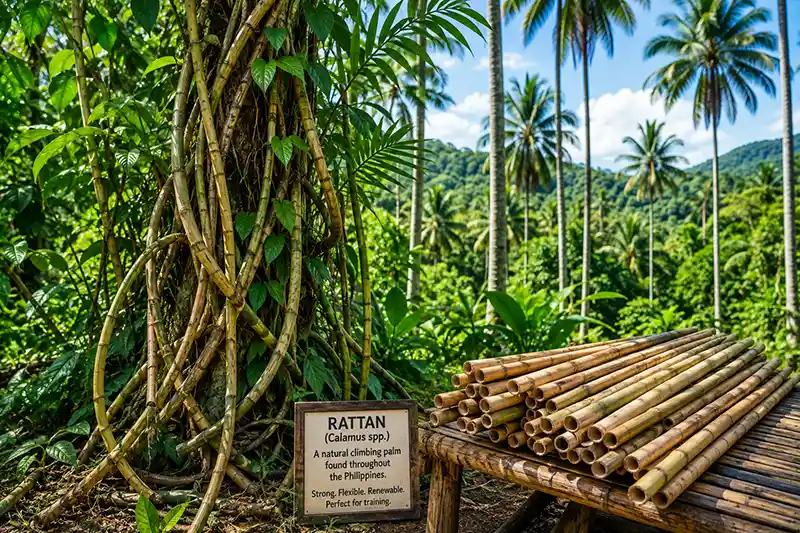
Rattan's success as an escrima-stick material was not simply the result of someone comparing every possible material and deciding that it performed best. Geography mattered. Rattan grows naturally throughout tropical Southeast Asia, and the Philippines is home to numerous rattan species. For communities developing fighting systems in that environment, long, strong canes were a locally available material that could be cut and shaped into practical sticks.
That availability matters more than it might seem. Martial traditions historically developed around materials people could actually obtain, replace, and work with. A training weapon that performs beautifully but requires an expensive or scarce imported hardwood is far less practical than one made from a renewable material growing within the region. Rattan offered long sections of relatively straight cane that required comparatively little transformation before they could become usable sticks.
Its natural dimensions were another advantage. Many rattan palms grow as long climbing stems rather than thick tree trunks, producing cane that can be cut into convenient lengths without first sawing a large piece of timber down into narrow rods. Once harvested and dried, sections could be selected according to diameter, straightened or finished as needed, and turned into durable training implements.
This helps connect the material to the much larger history of escrima sticks. Rattan did not become important in Filipino martial arts because of a single invention or moment of discovery. It was a useful local material whose natural properties happened to match the demands of repeated stick training remarkably well. Geography supplied the cane, but its performance helped ensure that practitioners kept using it.
Why Some Rattan Escrima Sticks Are Burned
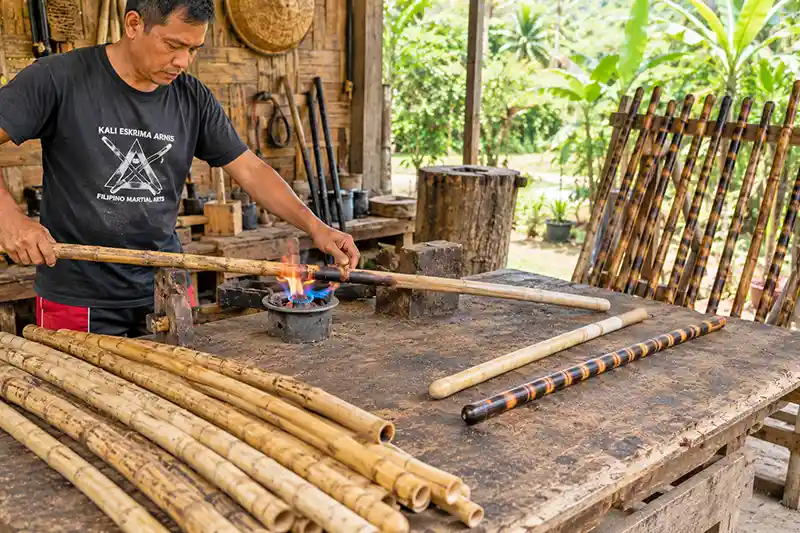
The dark bands and scorched patterns found on some rattan escrima sticks are easy to mistake for purely decorative markings. They certainly give the sticks a distinctive appearance, but heat has also traditionally been used when working and finishing rattan. Because natural cane does not always grow perfectly straight, controlled heating can make it easier to manipulate while the stick is being prepared.
When rattan is warmed carefully, it becomes more cooperative, allowing bends and irregularities to be corrected before the cane cools. This is useful for escrima sticks because even a naturally strong piece of rattan can be frustrating to train with if it curves noticeably along its length. Selecting good cane and straightening it during preparation helps turn an irregular climbing palm into a much more consistent training weapon.
The familiar burned appearance can then become part of the finish itself. Applying heat to portions of the outer surface creates the brown and black coloration seen on many traditional-looking sticks. The amount and pattern can vary considerably, which is why some burned rattan sticks have subtle markings while others display dramatic alternating bands of natural and darkened cane.
A stick such as the Unpeeled Burned Rattan Escrima also retains the natural outer skin rather than being sanded down to a uniformly pale surface. The result makes the origins of the material particularly obvious. What looks like a carefully manufactured wooden dowel is actually a section of tropical climbing palm that has been selected, dried, straightened, and finished into a remarkably effective martial arts training tool.
Why Rattan Diameter Matters More Than It Looks
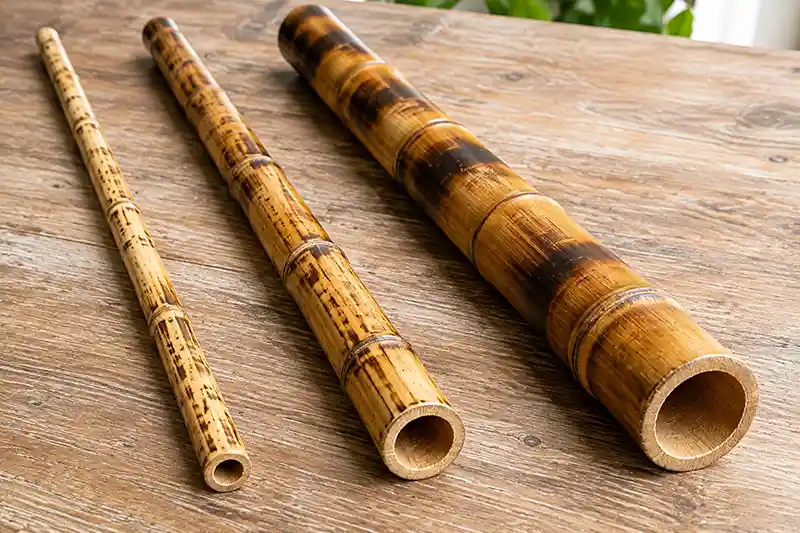
Two rattan escrima sticks can be the same length and made from the same general material yet feel surprisingly different in the hand. One of the biggest reasons is diameter. Increasing the thickness of a stick adds material, which can change its weight, stiffness, grip, and the amount of momentum it carries through a movement. Even relatively small differences can become noticeable during rapid combinations.
A thinner rattan stick generally feels quicker and easier to redirect. It can be particularly comfortable for repetitive drills where speed and fluid transitions matter. Increase the diameter and the stick usually begins to feel more substantial. There is more material resisting flex, more mass moving through each strike, and a larger surface for the hand to control.
Density complicates things further because rattan is a natural material rather than a perfectly uniform manufactured rod. Two sticks with similar dimensions do not necessarily weigh exactly the same. Individual canes can differ in density and internal structure, which means experienced practitioners may judge a stick by picking it up, feeling its balance, and examining the cane rather than relying entirely on its measurements.
This is another reason there is no single "perfect" rattan escrima stick. A practitioner interested in extremely fast forms may appreciate a lighter stick, while someone who wants more substantial feedback during drills may prefer something thicker and heavier. Rattan gives makers considerable room to adjust those characteristics while retaining the resilience that made the material so useful in the first place.
Why Rattan Works So Well for Partner Drills
The qualities that make rattan durable also become important when another person is standing a few feet away holding a stick of their own. Escrima training frequently involves repetitive partner drills in which practitioners practice angles, blocks, counters, redirections, and timing. The sticks may collide constantly, so training equipment needs to tolerate contact without making every impact unnecessarily punishing.
Rattan's relatively low mass helps here. A lighter stick carries less momentum than a much heavier stick traveling at the same speed, while its slight resilience can make stick-on-stick contact less harsh. That does not make rattan safe to strike a training partner with at full force, but it does make it particularly practical for controlled drills where accidental contact and repeated weapon collisions are always possibilities.
Its progressive wear is another advantage. Partner training is a poor environment for equipment that can develop dangerous cracks or sharp fragments without being noticed. Rattan usually provides visible evidence as it deteriorates. Fraying, crushed fibers, and badly worn impact areas tell practitioners that a stick should be inspected and eventually replaced.
This may be one of the most important reasons rattan endured even as martial arts training changed. The material was useful when sticks represented serious weapons, but it remained useful when escrima increasingly moved into schools, structured drills, demonstrations, and modern training environments. Rattan was not merely traditional. It continued solving a very practical problem.
Rattan Does Not Need to Be Peeled to Work
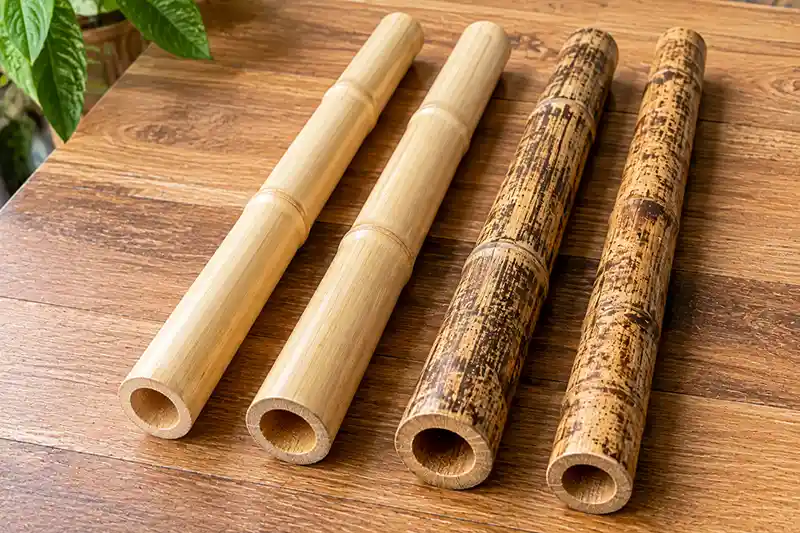
Rattan escrima sticks can look surprisingly different even when they come from the same basic material. Some are pale, smooth, and heavily finished, while others retain the darker natural outer surface of the cane. This difference often comes down to whether the rattan has been peeled, sanded, burned, or otherwise finished before becoming a training stick.
The outer skin of rattan is naturally harder and denser than much of the material beneath it. Leaving that surface intact can give an unpeeled stick a distinctive texture and appearance while preserving more of the cane in its natural state. Peeling or sanding rattan creates the smoother, more uniform appearance many people associate with commercially produced escrima sticks.
Neither treatment changes the fundamental reason rattan works so well. Beneath the surface, the stick still contains the long fibrous structure responsible for its combination of toughness and resilience. Processing can affect surface texture, diameter, weight, finish, and how the stick feels in the hand, but rattan does not need to be transformed into something resembling a polished hardwood dowel before it becomes useful.
An unpeeled rattan escrima stick makes that particularly easy to see. Its natural surface is a reminder that the weapon began as a section of climbing palm rather than a piece cut from a conventional tree. What appears to be a simple choice of finish actually reveals just how little processing this remarkably well-suited material needs before it can become an effective training stick.
Rattan Is Easier on the Stick You Are Training Against
An escrima stick does not experience impact in isolation. Every time two sticks collide, both weapons absorb part of the force. This creates another advantage for rattan that is easy to overlook: a somewhat forgiving training stick can also reduce the punishment being delivered to the other stick.
Dense hardwood changes that equation. When two very hard, rigid sticks meet, neither material gives very much. The collision can produce sharper impact forces at the contact point, potentially accelerating dents, cracks, and other damage. Rattan can compress and deform slightly instead, making repeated stick-on-stick practice less punishing to the equipment on both sides of the drill.
This becomes increasingly important when practitioners train regularly. Escrima sticks are consumable training equipment. They are expected to accumulate dents, scratches, crushed fibers, and other signs of use. The goal is not to find a material that remains pristine forever. It is to find one that can endure large numbers of controlled collisions while deteriorating in a relatively predictable way.
That helps explain why rattan's advantages become much clearer in pairs than they do when examining a single stick on a shelf. A dense hardwood stick may initially feel tougher because it is heavier and harder. Rattan reveals its strengths after hundreds of collisions, when its combination of resilience, lower mass, and progressive wear begins to matter far more than surface hardness.
Rattan Is Cheap Enough to Be Treated Like Training Equipment
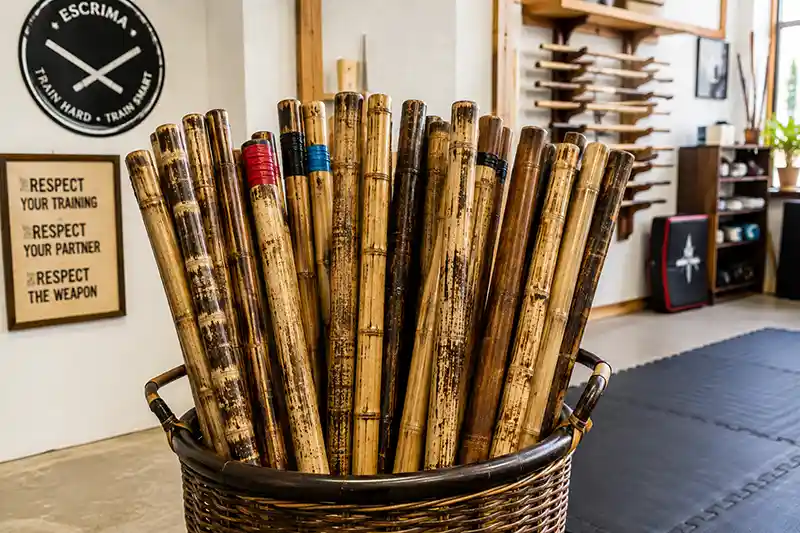
One of rattan's greatest advantages has nothing to do with impact physics. Escrima sticks eventually wear out. If practitioners are repeatedly striking sticks together, no natural material should be expected to last forever. That makes replacement cost surprisingly important, especially in schools where dozens of students may be putting equipment through heavy use every week.
Rattan fits that role exceptionally well because it does not need to be an exotic piece of precision craftsmanship to function effectively. Suitable cane can be harvested, dried, cut to length, straightened, and finished with relatively little material waste. Compared with dense premium hardwoods that must be selected and shaped from larger pieces of timber, rattan lends itself naturally to producing straightforward training sticks.
That changes how practitioners can think about wear. A rattan stick does not have to be protected like an expensive piece of equipment. It can accumulate dents, dark impact marks, crushed fibers, and eventually fraying because those are expected consequences of training. Once the damage becomes excessive, the stick can simply be retired and replaced.
There is something almost ideal about that relationship. Escrima training demands a stick tough enough to survive repeated punishment, but inexpensive and replaceable enough that practitioners are not afraid to actually punish it. Rattan occupies that middle ground remarkably well. Its greatest strength may not be that it lasts forever, but that it lasts long enough while behaving predictably throughout its working life.
Hardwood Still Has One Advantage Rattan Cannot Completely Match
If rattan were superior in every possible way, hardwood escrima sticks would have little reason to exist. They do, because density brings an important advantage of its own: mass. A hardwood stick of similar dimensions can be considerably heavier than rattan, giving it a more substantial feel and allowing it to carry greater momentum once it is moving.
That changes the character of the weapon. A dense hardwood stick may accelerate more slowly, but the additional weight can make movements feel more deliberate and demanding. Practitioners can use that resistance when they specifically want a heavier training implement, and some simply prefer the solid feedback and balance of dense wood.
Hardwood can also offer a dramatically different tactile experience. Species such as cocobolo can be exceptionally dense and beautifully figured, producing a stick that feels closer to a finished piece of craftsmanship than a consumable length of training cane. For certain forms of solo practice or for practitioners who specifically want additional weight, those qualities can be appealing rather than disadvantages.
The problem appears when we ask which characteristics are best suited to frequent stick-on-stick training. Greater mass means more energy during a collision. Greater rigidity means less ability to deform under that collision. And a material that can split along its grain may eventually fail in a less forgiving way than rattan's progressively fraying fibers. Hardwood can be stronger in some senses while still being less practical for the particular punishment escrima training repeatedly creates.
That is the key distinction behind this entire comparison. Rattan did not beat hardwood by being harder, heavier, or stronger in every measurable way. It became such an effective escrima material because it did not need to be. Its advantages come from giving up some of those seemingly desirable qualities in exchange for speed, resilience, predictable wear, and repeatable performance.
Metal Escrima Sticks Reveal What Rattan Is Really Doing
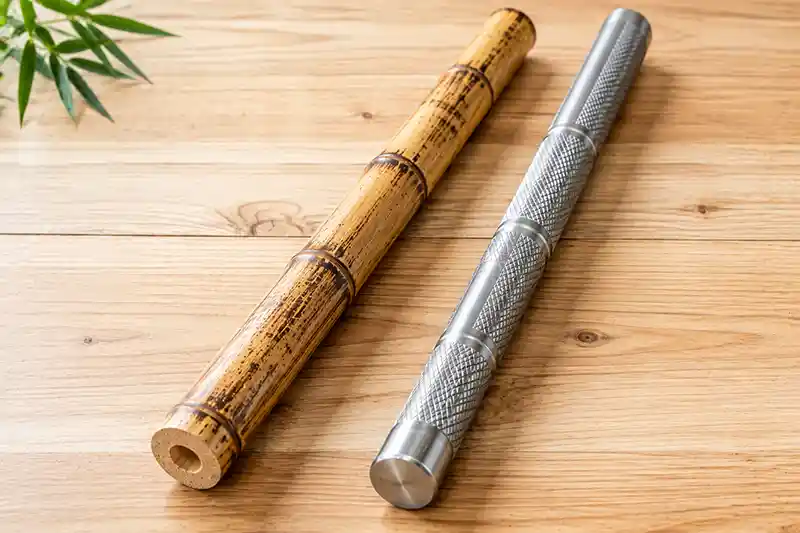
One of the easiest ways to appreciate rattan is to replace it with something dramatically more rigid. Metal escrima sticks preserve the familiar shape and dimensions of the weapon while changing nearly everything about how the material behaves. The result demonstrates just how much of the traditional training experience comes from the properties of rattan rather than from the shape of the stick alone.
A metal stick does not compress, fray, or absorb impacts the way rattan does. Depending on its construction, it can feel considerably more rigid and transmit sharper vibrations back through the hand when it strikes another hard object. Changing the material can also alter weight distribution and momentum, even when the overall dimensions remain similar.
That does not make metal inherently inferior. A specialized weapon such as a titanium escrima stick offers qualities that natural cane simply cannot duplicate. Metal can provide exceptional rigidity, resistance to ordinary surface wear, and a completely different handling experience. It demonstrates that the basic escrima-stick form can be adapted far beyond its traditional material.
But that comparison also reveals why rattan remains so difficult to replace for routine contact training. The more rigid the alternative becomes, the easier it is to appreciate the unusual compromise rattan provides. It is light without feeling useless, flexible without feeling floppy, durable without needing to be extremely hard, and capable of absorbing repeated punishment while gradually showing exactly where that punishment has occurred.
Sometimes the best way to understand why a traditional material survived for generations is to replace it with something technologically impressive and notice all the useful characteristics that disappeared.
The Best Escrima Material Depends on What You Are Actually Doing
Calling rattan "better" than hardwood needs one important qualification. Better for what? If the goal is repeated stick-on-stick training, fast partner drills, and equipment that can absorb punishment while remaining relatively light and replaceable, rattan has an unusually strong collection of advantages. Change the goal, however, and the answer can change with it.
A practitioner who wants additional weight may deliberately choose hardwood. Someone interested primarily in solo conditioning might appreciate the resistance of a denser stick. Metal versions can provide an entirely different experience again. Even within rattan, changing the diameter, density, surface treatment, and overall weight can produce sticks that feel noticeably different from one another.
This is why comparing materials solely by strength can be misleading. The hardest stick is not automatically the best training stick, just as the lightest stick is not automatically the fastest in every practitioner's hands. Escrima places unusual demands on its equipment because the weapon must be maneuverable enough for rapid technique while also surviving repeated collisions with another weapon.
Rattan happens to sit remarkably close to the middle of those competing requirements. It is rigid enough to behave like a solid weapon, flexible enough to tolerate shock, light enough for speed, tough enough for repeated contact, and inexpensive enough to replace when heavy training finally wears it out. Few natural materials combine all of those characteristics quite so conveniently.
That is ultimately why hardwood never made rattan obsolete despite being harder, and why modern materials have not made traditional cane disappear. Rattan is not the strongest possible material for an escrima stick. It is something more useful: a material whose weaknesses and strengths happen to match the demands of escrima training exceptionally well.
Rattan Became Traditional Because It Kept Proving Itself
It is tempting to assume that martial arts traditions preserve certain materials simply because they are old. Rattan tells a more interesting story. Its continued use in escrima is not just a matter of maintaining a connection to the past. Generation after generation kept using it because the material continued to perform remarkably well under the exact conditions created by stick training.
That distinction matters because modern practitioners have far more choices than their predecessors did. Dense exotic hardwoods can be shaped into beautiful sticks. Synthetic materials can be engineered for consistency. Metals can produce escrima sticks that would have been impossible for earlier generations to manufacture. Yet ordinary rattan remains everywhere in Filipino martial arts schools.
Its survival becomes even more impressive when you consider how little technology is hidden inside it. There are no laminates, reinforcing rods, advanced polymers, or complicated manufacturing processes required. A properly selected piece of climbing palm already contains the long fibers, low weight, resilience, and progressive failure characteristics that make it so effective. Preparation improves the stick, but nature does most of the engineering.
This is one of those rare cases where tradition and practicality point toward the same answer. Rattan was available in the region where these martial arts developed, but availability alone cannot explain why it remained popular after alternatives became easy to obtain. Escrima practitioners kept striking rattan sticks together, wearing them out, replacing them, and choosing rattan again.
Hardwood may feel tougher when you first pick it up. Metal may seem more advanced. But after thousands of impacts, rattan begins to reveal why a seemingly ordinary piece of tropical cane became so closely associated with one of the world's great stick-fighting traditions.
Why Rattan Won the Escrima Stick Debate
At first glance, rattan seems like the material that should lose. Hardwood is denser, harder, and often more impressive in the hand. Metal can be stronger and more resistant to ordinary wear. Yet neither of those qualities automatically produces a better stick for the repetitive, fast-moving contact that defines so much escrima training.
Rattan succeeds because of the way its advantages work together. Its fibrous structure allows it to absorb punishment and flex slightly under stress. Its relatively low weight helps practitioners move quickly through combinations and directional changes. When damage accumulates, the cane tends to show that deterioration through crushing and fraying rather than hiding all of its wear beneath an apparently perfect surface.
Just as importantly, rattan was readily available in the part of the world where Filipino martial arts developed. Practitioners did not have to invent an exotic material or complicated manufacturing process. They had access to a climbing palm that could be harvested, straightened, finished, trained with relentlessly, and replaced when it finally wore out.
So is rattan really better than hardwood for escrima sticks? For every possible purpose, no. Hardwood still offers greater density, weight, rigidity, and a distinctive training experience. But for repeated stick-on-stick practice, rattan brings together speed, resilience, predictable wear, affordability, and practicality in a combination that is remarkably difficult to beat.
Sometimes the material that looks strongest on paper is not the one that survives best in the real world. Rattan became synonymous with escrima not because it was the hardest material available, but because generations of practitioners discovered that hardness was never the quality that mattered most.
Are rattan escrima sticks better than hardwood sticks?
For repeated stick-on-stick training, rattan often has practical advantages over hardwood. It is relatively lightweight, slightly resilient, and capable of absorbing repeated impacts while gradually showing wear through crushing and fraying. Those characteristics make it particularly well suited to partner drills and high-repetition practice.
Hardwood is not necessarily inferior. Dense hardwood sticks can offer greater weight, rigidity, and a more substantial feel that some practitioners prefer. The better material ultimately depends on the type of training, but rattan's combination of speed, resilience, durability, and predictable wear explains why it remains the traditional choice for so much escrima practice.
How long do rattan escrima sticks last?
There is no fixed lifespan for a rattan escrima stick. How long one lasts depends on the quality and density of the cane, how frequently it is used, the intensity of the training, and how often it makes hard contact with other sticks. A lightly used stick may last a long time, while one subjected to frequent impact drills will naturally wear much faster.
One advantage of rattan is that its deterioration is usually easy to see. Dents, crushed areas, loose fibers, and increasing fraying provide clues that the stick is wearing out. Some surface damage is normal, but a stick with severe splitting, extensive fiber separation, or structural damage should be retired rather than pushed until it completely fails.
Why do rattan escrima sticks fray?
Rattan frays because of its fibrous internal structure. Repeated impacts can crush and separate the long fibers running through the cane, eventually producing the fuzzy or stringy surface commonly seen on heavily used escrima sticks.
This fraying is one reason rattan behaves differently from many hardwoods. Rather than necessarily developing a clean crack along the grain, rattan can deteriorate progressively as more fibers become damaged. Some fraying is therefore a normal sign of wear, although severe fiber separation, deep splits, or loss of structural integrity are signs that the stick should be replaced.
Why are rattan escrima sticks burned?
Burned rattan escrima sticks get their distinctive dark markings from controlled heat applied during preparation and finishing. Heat can also help make natural rattan easier to manipulate, which is useful when straightening sections of cane that did not grow perfectly straight.
The burned patterns themselves can vary from subtle darkening to dramatic stripes and patches, giving each stick a distinctive appearance. Burning does not fundamentally create the qualities that make rattan useful for escrima, however. Its resilience, low weight, and fibrous structure come primarily from the cane itself. The heat treatment is better understood as part of preparing and finishing the natural material rather than the secret behind its durability.
Are thicker rattan escrima sticks better?
Not necessarily. A thicker rattan stick generally contains more material, which can make it heavier, stiffer, and more substantial in the hand. Some practitioners prefer that additional weight and resistance, while others find that a thinner stick is easier to accelerate and redirect during fast combinations and repetitive drills.
Rattan is also a natural material, so diameter alone does not determine how a stick will feel. Density, moisture content, the individual piece of cane, length, and processing can all affect weight and stiffness. The best diameter therefore depends on the practitioner and the type of training rather than there being one thickness that is universally superior.
Are peeled or unpeeled rattan escrima sticks better?
Neither is universally better. Peeled rattan has had more of its natural outer surface removed, typically producing a smoother and more uniform appearance. Unpeeled rattan retains more of the cane's natural skin, giving the stick a rougher, more organic texture and often a darker or more varied appearance.
The choice can come down to grip preference, finish, weight, and the individual piece of rattan. Both peeled and unpeeled sticks retain the fibrous internal structure responsible for rattan's resilience and characteristic wear. For most practitioners, the quality, straightness, density, diameter, and overall feel of the individual stick matter more than whether the cane has been peeled.
Can rattan escrima sticks break?
Yes. Rattan is remarkably resilient, but it is not indestructible. Repeated hard impacts can eventually crush its fibers, create splits, and weaken the structure enough that the stick needs to be replaced. The lifespan can vary considerably depending on the quality of the cane and how aggressively it is used.
What makes rattan particularly useful for training is the way this damage often develops. Instead of remaining apparently perfect until suddenly failing, a heavily used stick will frequently show increasing dents, fraying, crushed fibers, and other visible signs of deterioration. That gives practitioners an opportunity to inspect the stick and retire it once the damage becomes excessive rather than expecting it to last indefinitely.
Why is rattan traditionally used for escrima sticks?
Rattan combines several qualities that happen to fit escrima training extremely well. It is relatively lightweight, resilient, readily shaped into straight sticks, and capable of tolerating repeated impacts without requiring the density and rigidity of many hardwoods. Its fibrous structure also allows damage to develop progressively through crushing and fraying.
Geography played an important role as well. Rattan grows naturally throughout tropical Southeast Asia, including the Philippines, so it was a practical local material in the region where Filipino martial arts developed. Its continued popularity, however, is not simply a matter of tradition. Even with hardwood, synthetic, and metal alternatives readily available today, rattan remains widely used because its natural properties are particularly well suited to repetitive stick training.
Is rattan a type of bamboo?
No. Rattan and bamboo can look surprisingly similar once they have been cut into sticks, but they come from very different plants. Bamboo belongs to the grass family, while rattan comes from a group of climbing palms found primarily in tropical regions of Asia.
One particularly important difference is their internal structure. Many familiar bamboo canes are hollow between their nodes, while rattan stems are generally solid and filled with fibrous vascular tissue. That solid, fiber-rich construction contributes to the combination of resilience, relatively low weight, and progressive wear that makes rattan so useful for escrima training.
Are rattan escrima sticks solid or hollow?
Rattan escrima sticks are generally solid rather than hollow. This is one of the easiest ways to distinguish rattan from the bamboo that many people initially assume escrima sticks are made from. Cut across a piece of rattan and you can see a solid interior containing numerous vascular bundles running along the length of the cane.
Those long internal fibers are an important part of rattan's unusual behavior under repeated impacts. As the stick becomes damaged, fibers can crush, separate, and gradually fray while much of the structure remains connected. That is very different from the behavior people might expect from a hollow tube of bamboo.
Do rattan escrima sticks need to be oiled?
Rattan escrima sticks do not necessarily need to be oiled to function properly, although some practitioners condition natural rattan periodically as part of caring for their equipment. Whether this is appropriate can depend on how the particular stick was processed and finished, so any care instructions provided with the stick should take priority.
Storage conditions can be just as important. Natural rattan should not be unnecessarily exposed to extreme moisture, prolonged heat, or other conditions that can affect organic materials. Regularly inspecting the stick for severe dryness, cracking, splitting, or excessive fraying is more important than assuming every rattan stick needs the same treatment.
Can you straighten a bent rattan escrima stick?
Rattan can often be manipulated with carefully controlled heat, which is one reason heating has traditionally been useful during the preparation of natural cane. Warming the material can make it more cooperative while bends and irregularities are corrected, after which the cane can retain a straighter shape as it cools.
That does not mean every warped or damaged escrima stick should automatically be repaired. A bend caused by structural damage, severe splitting, or crushed fibers is different from the natural curvature of an otherwise sound piece of cane. Once an escrima stick has become significantly damaged through training, replacement may make more sense than attempting to restore its appearance.
Are hardwood escrima sticks more powerful than rattan?
A dense hardwood stick of similar dimensions can be considerably heavier than a rattan stick. If both are moving at comparable speeds, that additional mass can affect the momentum and impact characteristics of the hardwood stick. This is one reason hardwood escrima sticks can feel noticeably more substantial during handling.
More mass does not automatically make hardwood the better material, however. The practitioner still has to accelerate, stop, and redirect that additional weight, and greater rigidity changes how impacts are transmitted through the stick. For repetitive training, rattan's lower weight, resilience, and progressive wear can be more useful than simply maximizing mass. The two materials emphasize different characteristics rather than one being universally more powerful or superior.
You May Also Be Interested In:
- New Competition Escrima Sticks
- Were Escrima Sticks Ever Actually Used in Real Combat?
- Why Are Escrima Sticks Usually About 26 Inches Long?
- The Real History of Escrima Sticks: From Battlefield Weapon to Modern Martial Art
- Could an Escrima Stick Actually Stop a Sword?
- Why Choose a Ribbed Grip Aluminum Escrima?
Leave a Reply