




The Fastest Weapon in Martial Arts? Why Kali Practitioners Move So Differently
June 2nd, 2026

Watch a skilled Kali practitioner move with a pair of sticks and it almost looks like the video has been sped up. The strikes come from odd angles, the hands switch positions without warning, and the rhythm feels completely different from most martial arts weapons training. That speed is not just about fast hands. It comes from the way Kali teaches footwork, timing, angles, flow, and reaction all at the same time. So is the Kali stick really the fastest weapon in martial arts, or does it just look that way because of how Filipino martial arts are built? Let's break down why Kali practitioners move so differently, and why this style of stick fighting has earned such a serious reputation.
It Starts With the Way Kali Trains Both Hands
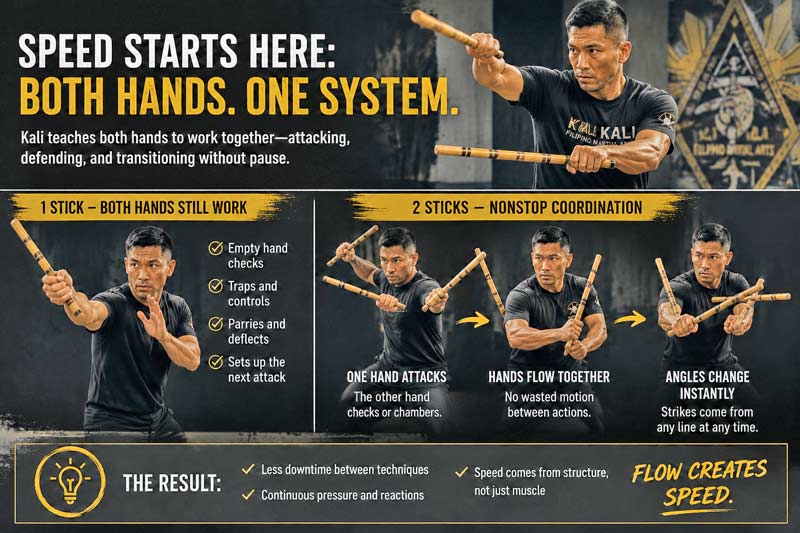
Most martial arts weapons systems are built around one dominant hand doing most of the work. Kali feels different because both hands are constantly involved. Even when a practitioner is only holding one stick, the empty hand is still checking, trapping, parrying, grabbing, or preparing to transition. With two sticks, that speed becomes even more obvious because the left and right hand are not waiting for each other. They are working together in a rhythm that can make the strikes look almost continuous.
That is one of the biggest reasons Kali stick fighting can look so fast compared to other weapon arts. It is not always that each individual strike is faster. It is that there is less wasted motion between strikes. One hand can be attacking while the other is chambering, checking, or flowing into the next angle. The result is a style that feels less like a single attack followed by a reset, and more like a chain reaction.
This is also why beginners often struggle when they first pick up Kali sticks. The movements are not just about swinging harder or faster. The real skill is learning how the hands connect to each other, how one motion feeds the next, and how the body stays organized while the sticks are moving at high speed. Once that coordination starts to click, the practitioner can generate a surprising amount of speed without looking tense or forced.
Why Kali Angles Make Practitioners Look Faster Than They Really Are
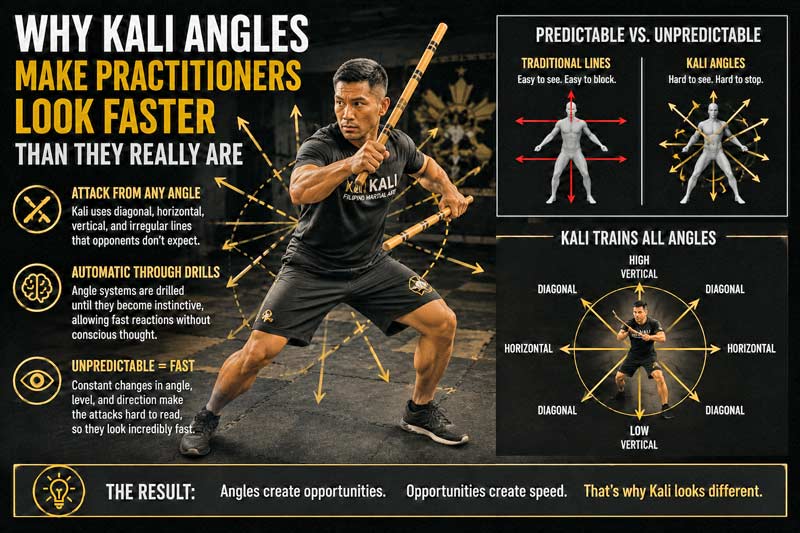
Another reason Kali practitioners seem unusually fast is because of the way they attack from angles most people are not used to seeing. In many martial arts, attacks tend to come in predictable lines. A punch goes straight. A kick comes from a familiar direction. Kali is different. Practitioners are trained to strike diagonally, horizontally, vertically, and in combinations that can change direction almost instantly.
Instead of memorizing long choreographed movements, Kali training often focuses on angle systems. Students repeatedly drill striking patterns that teach them how to attack and defend from nearly every direction. Over time, those movements become automatic. That is part of why experienced practitioners can react so quickly without appearing to think about it first.
This also creates a strange visual effect for people watching Kali for the first time. The speed looks overwhelming because the attacks are not only fast, they are unpredictable. A strike might start high and suddenly redirect low. A practitioner may switch hands, reverse direction, or flow into a defensive movement without stopping. That unpredictability is one of the reasons Filipino martial arts like Kali, Eskrima, and Arnis have developed such a strong reputation for practical weapons training. If you are still confused about the terminology, this guide on the differences between Arnis, Eskrima, and Kali breaks it down clearly.
Speed Comes From Flow, Not Muscle
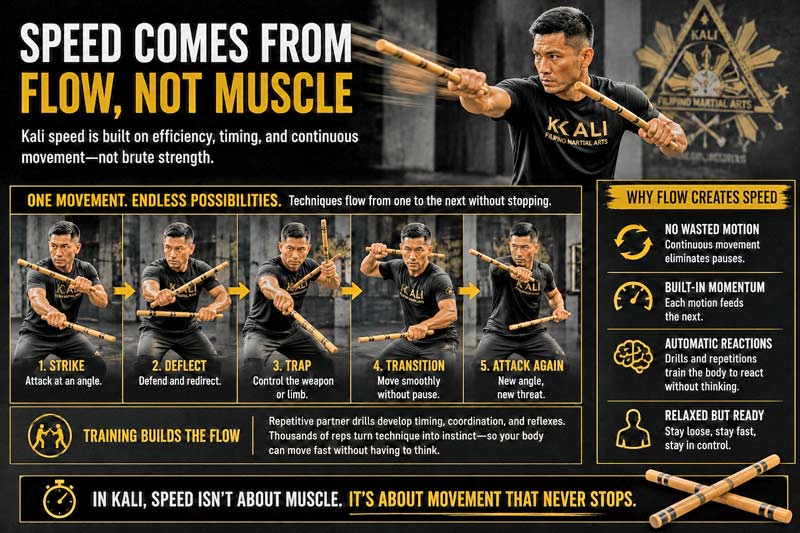
One thing that surprises people about experienced Kali practitioners is that they often do not look tense when they move. They are fast, but they are usually not trying to overpower every strike. In fact, one of the biggest secrets behind Kali speed is that it relies more on flow and efficiency than raw strength. The goal is to keep moving without pauses, hesitation, or unnecessary resets between techniques.
Instead of treating every strike like a separate movement, Kali teaches practitioners to link motions together. One strike naturally becomes the next. A missed attack can instantly turn into a defensive movement, a hand trap, or another angle of attack. This constant transition is part of what makes Filipino stick fighting look so fluid. The weapon rarely stops moving for long, which creates pressure and makes reactions harder for an opponent.
A lot of Kali drills are designed specifically to build this rhythm. Repetitive partner drills train timing, coordination, and reflexes until reactions become automatic. If you have ever watched experienced practitioners spar with escrima sticks, you have probably noticed that they seem to move without thinking. That is not because they are naturally faster than everyone else. It is because thousands of repetitions have trained their body to move smoothly and efficiently under pressure.
Why Kali Was Designed for Speed in the First Place
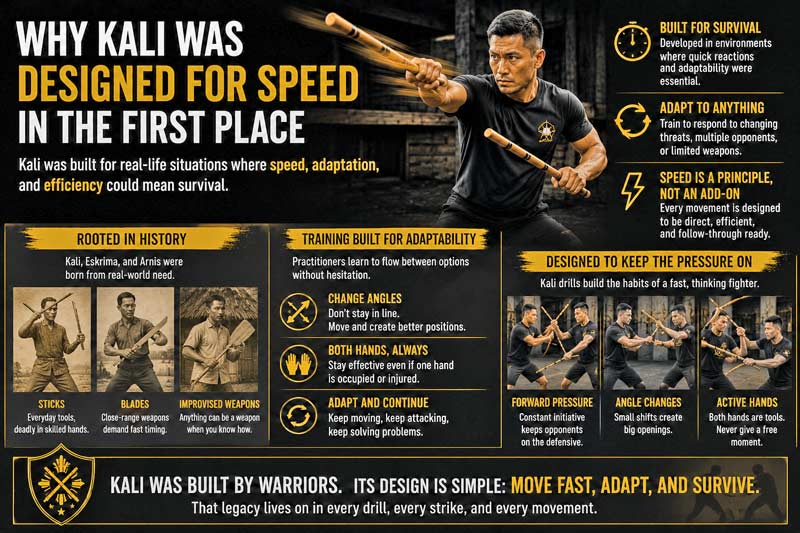
Part of what makes Kali movement look so different is that the system was never designed to be slow or ceremonial. Filipino martial arts developed in situations where speed could mean survival. Practitioners needed to react quickly, adapt to changing threats, and keep moving under pressure. That history shaped a fighting style that values efficiency, timing, and fast transitions over flashy movements or rigid forms.
Historically, Kali, Eskrima, and Arnis were used with practical weapons like sticks, blades, and improvised tools. Fighters often trained to move between weapons or continue fighting if one hand became occupied or injured. That is part of why Kali drills emphasize adaptability so heavily. The practitioner is constantly learning how to react instead of freezing when something unexpected happens.
You can still see traces of that battlefield mindset in modern training. Many drills focus on maintaining forward pressure, changing angles, and keeping both hands active at all times. Even simple stick drills are designed to sharpen reaction speed and decision-making under stress. If you want a deeper look at how these weapons evolved over time, this history of escrima sticks and Filipino martial arts does a great job explaining where these training methods came from.
So Is Kali Actually the Fastest Weapon in Martial Arts?
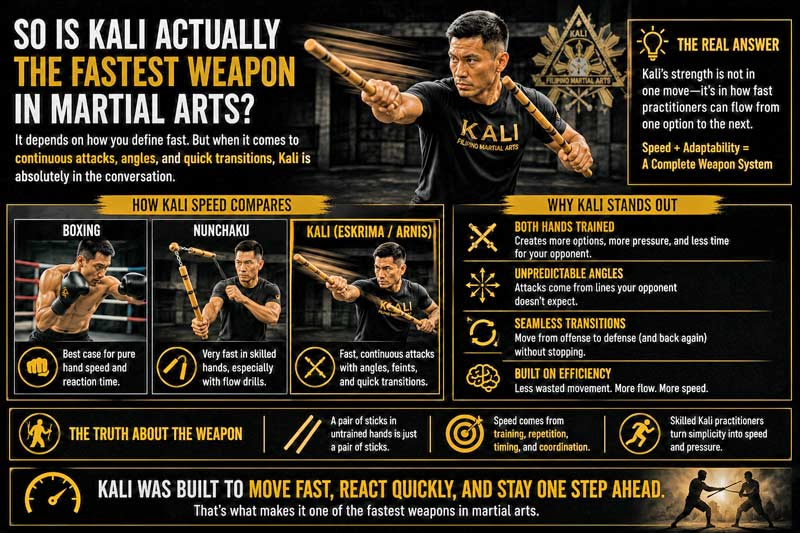
That depends on how you define fast. If we are talking about pure hand speed, there are arguments for boxing. If we are talking about spinning weapons, some people would point to nunchaku. But when it comes to fast, continuous attacks combined with unpredictable angles and quick transitions, Kali is absolutely in the conversation.
What makes Kali stand out is that speed is built into nearly every part of the system. Practitioners train both hands, drill unusual attack angles, and learn to move from offense to defense without stopping. Instead of relying on strength or dramatic movements, Kali rewards efficiency. That is why experienced practitioners can look almost effortless while still moving at an intimidating pace.
Of course, the weapon itself is only part of the equation. A pair of sticks in untrained hands is just a pair of sticks. The speed comes from training, repetition, timing, and coordination. But if you have ever watched skilled Filipino martial artists move and wondered why it looked so different from almost every other weapon system, now you know. Kali was built to move fast, react quickly, and stay one step ahead.
Why Kali Training Looks Different From Almost Every Other Martial Art
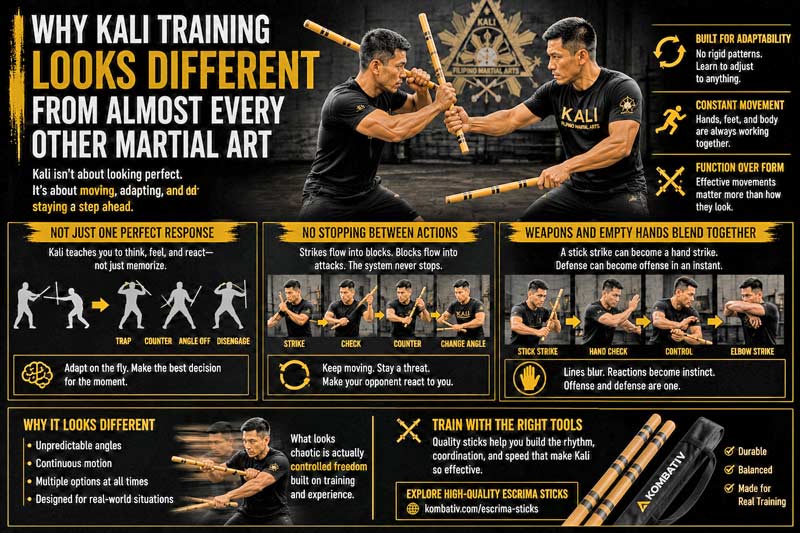
If you watch enough martial arts videos online, you start noticing a pattern. Many styles focus on perfect technique, powerful strikes, or controlled combinations. Kali stands out because it often looks messy to beginners, at least at first glance. The hands are constantly moving, the footwork shifts quickly, and the practitioner rarely stays frozen in one position for very long.
That difference is intentional. Kali training is built around adaptability instead of memorizing one perfect response. Practitioners learn to adjust on the fly, react to pressure, and keep moving even when things stop going according to plan. Instead of stopping after every strike, they are trained to continue flowing into the next movement, whether that means attacking, defending, trapping, or changing angles.
Another thing that makes Kali look unusual is how quickly practitioners transition between weapons and empty-hand techniques. A stick strike can become a hand check. A defensive movement can immediately turn into an attack. Many drills are designed to blur the line between offense and defense so that reactions become second nature over time. That is one reason Kali often looks faster and more chaotic than traditional martial arts, even when the practitioner is staying calm and controlled.
For people who want to experience this style of training firsthand, practicing with quality sticks makes a big difference. The right pair of escrima sticks for training can help you build rhythm, coordination, and the hand speed that makes Kali so recognizable.
Can You Learn Kali for Self Defense, or Is It Just for Weapons?
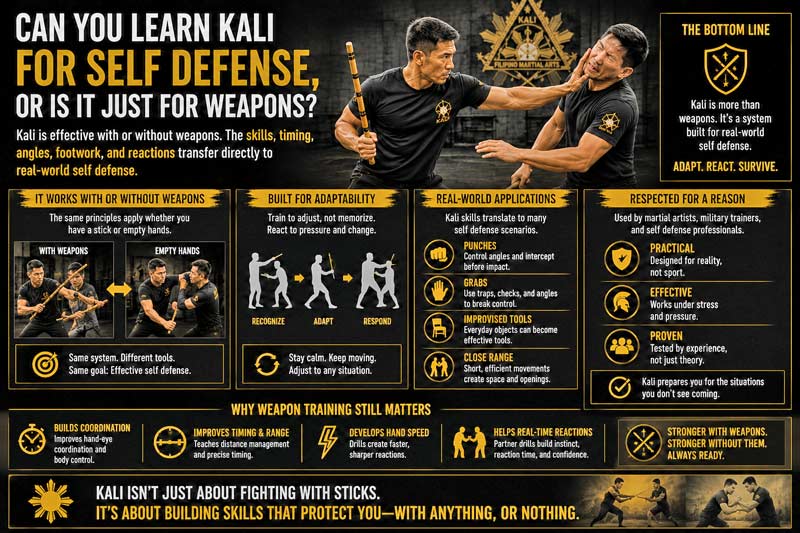
One of the biggest misconceptions about Kali is that it only works if you are carrying sticks. In reality, many people train Kali because the movements transfer surprisingly well to empty-hand self defense. The same timing, angles, footwork, and reaction skills used with sticks can also apply to punches, grabs, improvised tools, and close-range situations.
That is partly because Kali training often treats weapons and empty hands as part of the same system instead of separate skills. A practitioner might train with sticks one minute and immediately apply similar movements without weapons the next. The goal is not to memorize one exact technique for every situation. It is to build reactions that adapt quickly under pressure.
This practical mindset is one reason Kali has earned respect among martial artists, military trainers, and self defense enthusiasts. Instead of assuming everything will go according to plan, the system teaches people how to keep moving, adjust, and respond when things get unpredictable. That adaptability is a big reason many practitioners believe Kali feels more realistic than highly structured martial arts systems.
That said, the weapon training is still a major part of what makes the art unique. Learning with sticks helps build coordination, timing, range awareness, and hand speed in ways that are difficult to replicate through empty-hand training alone. Even simple partner drills can teach valuable lessons about reaction time and positioning that carry over into other forms of martial arts.
What Makes Kali So Addictive to Train?
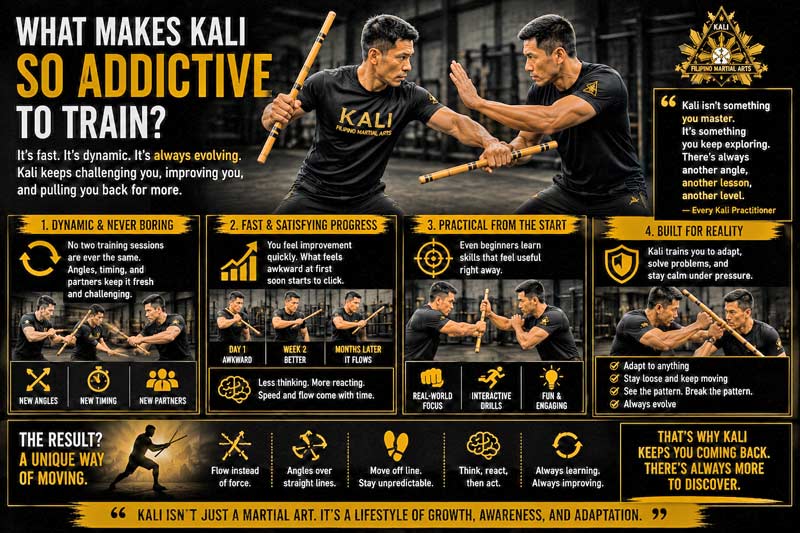
Talk to people who train Kali for a while and you will hear the same thing over and over: it becomes hard to stop. Part of that comes from how dynamic the training feels. Unlike martial arts that repeat the same combinations or forms endlessly, Kali constantly changes. The angles shift, the timing changes, and every partner brings a slightly different rhythm to the drill.
There is also a satisfying feeling that comes from seeing improvement happen quickly. In the beginning, the movements can feel awkward and chaotic. Then something clicks. The hands start moving more naturally, reactions become faster, and combinations begin to flow without as much thinking. That progression is one reason many people stay hooked on Filipino martial arts for years.
Another reason Kali stands out is that it feels practical. Even beginners often feel like they are learning something useful right away instead of spending months memorizing formal movements before applying them. The drills can be fast, interactive, and surprisingly fun while still teaching timing, coordination, and real-world awareness.
That mix of speed, unpredictability, and constant problem-solving is part of why Kali practitioners move so differently in the first place. The system rewards people who stay loose, adapt quickly, and learn to flow instead of freezing up. Once you start seeing the patterns behind the movement, it becomes easier to understand why Kali has earned such a devoted following around the world.
What Should Beginners Know Before Trying Kali?
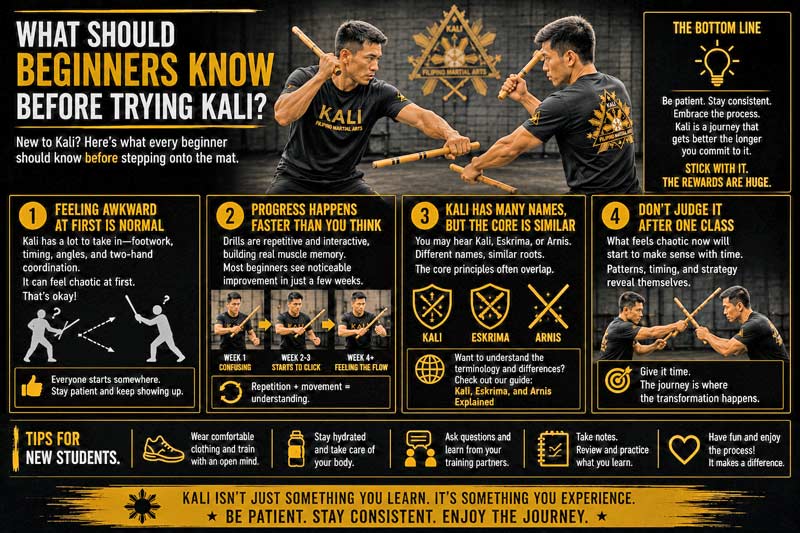
If you are curious about trying Kali for the first time, the biggest thing to know is that feeling awkward at the beginning is completely normal. Unlike martial arts that focus on a small number of movements early on, Kali throws a lot at you quickly. You are learning footwork, timing, angles, coordination, and often how to move both hands independently at the same time. At first, it can feel like trying to pat your head and rub your stomach while someone swings a stick at you.
The good news is that progress usually happens faster than people expect. Many beginners notice improvement within a few weeks because Kali training is so repetitive and interactive. The drills are designed to build muscle memory through movement instead of endless memorization. Over time, the chaos starts making sense. Movements feel smoother, reactions get quicker, and the rhythm starts to click.
It also helps to understand that Kali is called different things depending on the school or region. Some instructors call it Kali, others use Eskrima or Arnis, and the terminology can feel confusing at first. The differences are usually smaller than people think, and the core ideas often overlap. If you want a better understanding before jumping in, this breakdown of Kali, Eskrima, and Arnis terminology can help clear things up.
Most importantly, do not judge the art too quickly after one class. Kali is one of those systems that becomes more interesting the longer you train. What seems chaotic at first gradually starts revealing patterns, timing, and strategy. Once that happens, it becomes much easier to understand why so many practitioners end up sticking with it for years.
Why Kali Practitioners Seem to React Before You Even Move
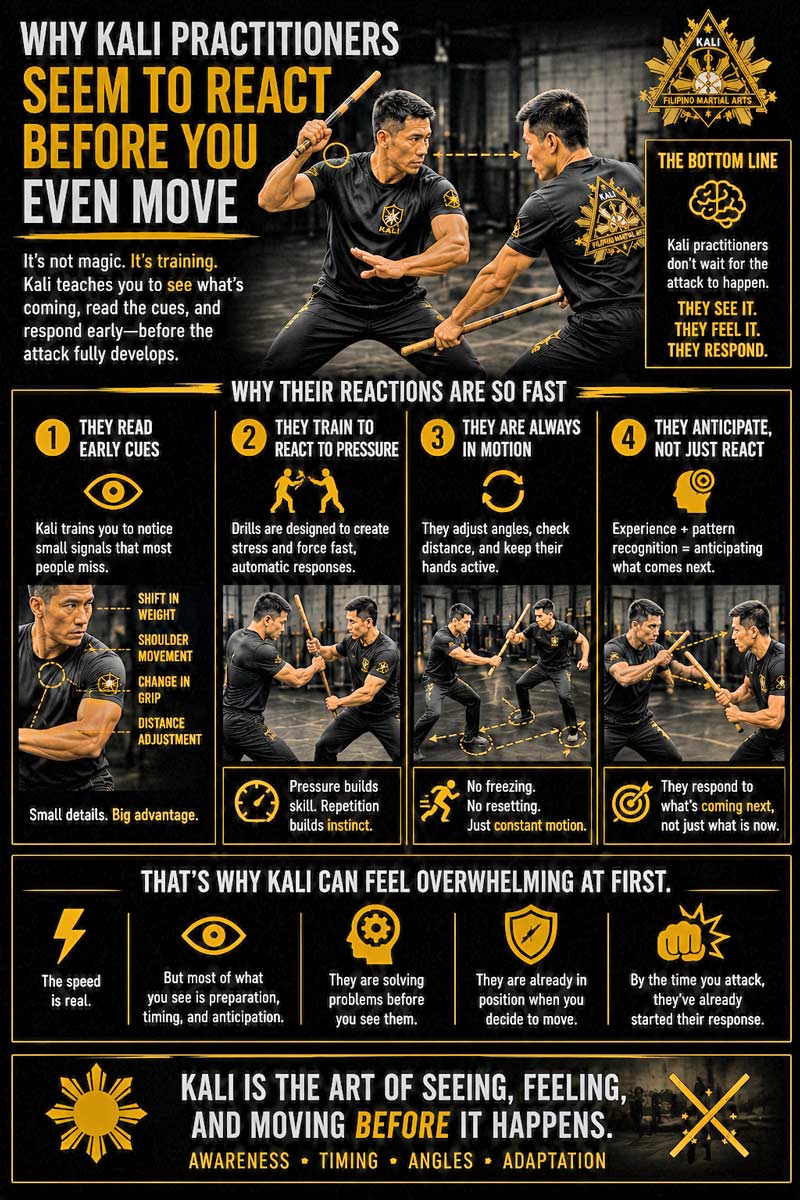
One thing that stands out when watching experienced Kali practitioners is how quickly they respond. Sometimes it almost looks like they are reacting before the attack even happens. That illusion comes from training. Kali places a huge emphasis on reading movement, recognizing patterns, and responding to pressure as early as possible instead of waiting for a strike to fully develop.
Many Kali drills train practitioners to react to small cues instead of obvious attacks. A shift in body weight, a shoulder movement, a change in grip, or even a slight adjustment in distance can signal what is about to happen next. Over time, students become better at noticing these subtle details, which makes their reactions feel unusually fast.
Another factor is that Kali practitioners are rarely standing still waiting to react. They are constantly adjusting angles, checking distance, and staying active with both hands. Instead of freezing and then responding, they are already in motion. That makes transitions between defense and offense feel much faster than systems that rely on stopping and resetting between exchanges.
This is one reason Kali can feel so overwhelming to people seeing it for the first time. The speed is real, but a big part of what you are actually seeing is preparation, timing, and anticipation. Experienced practitioners are often responding to what they expect is coming next, not just what is happening right now.
Could Kali Become More Popular Than Traditional Martial Arts?
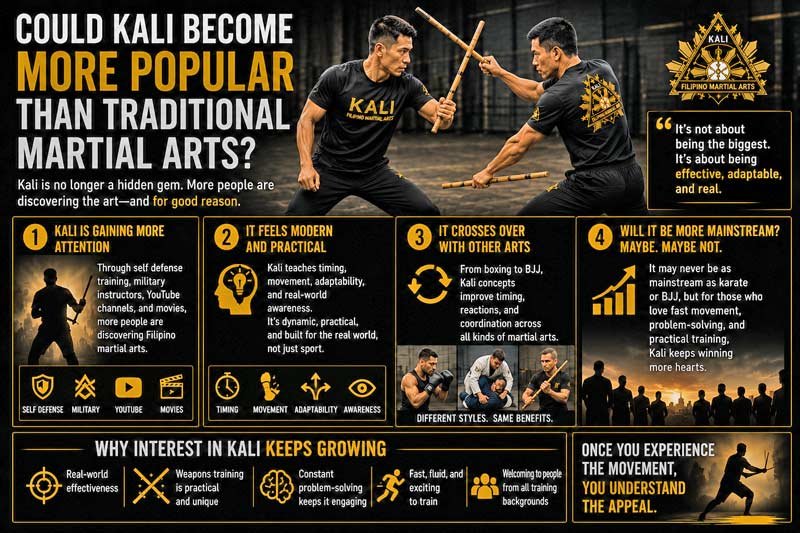
For a long time, Kali stayed somewhat under the radar compared to martial arts like karate, taekwondo, boxing, or Brazilian jiu-jitsu. But that has started changing. More people are discovering Filipino martial arts through self defense training, military instructors, martial arts YouTube channels, and even action movies that showcase fast stick and blade movements.
Part of Kali's growing appeal is that it feels modern and practical. Many people are drawn to systems that teach timing, movement, adaptability, and real-world awareness instead of only tournament rules or formal routines. Kali also appeals to people who enjoy problem-solving because the training constantly changes. No two exchanges feel exactly the same, and there is always something new to improve.
Another reason interest keeps growing is that Kali crosses over well with other martial arts. Boxers use the timing drills. Self defense practitioners like the focus on awareness and angles. Even people who primarily train empty-hand systems often borrow concepts from Filipino martial arts to improve reactions and coordination. That flexibility helps explain why Kali schools keep attracting people from very different training backgrounds.
Will Kali ever become as mainstream as karate or Brazilian jiu-jitsu? Maybe not. But for people who enjoy fast movement, constant problem-solving, and practical weapons training, it is easy to understand why interest continues to grow. Once people experience how different the movement feels, many end up wondering why they had never heard more about it sooner.
Why Kali Looks So Different on Video Than It Feels in Real Life
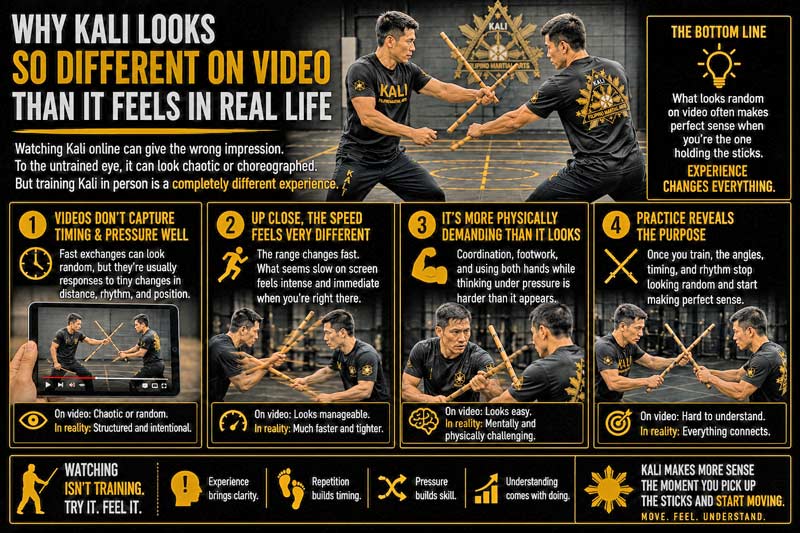
Watching Kali online can sometimes give the wrong impression. To someone unfamiliar with Filipino martial arts, it can look chaotic, overly flashy, or even choreographed. The sticks move quickly, the angles change constantly, and experienced practitioners often flow through drills so smoothly that it almost seems unrealistic. But training Kali in person feels very different from simply watching it on a screen.
One reason is that videos rarely capture timing and pressure very well. A fast exchange might look like random movement to a beginner, but the people training are usually reacting to tiny changes in distance, rhythm, and positioning. What seems chaotic is often highly structured once you understand the patterns behind it. The speed also feels much more intense up close because the range changes so quickly.
Another difference is how physically demanding Kali can be. Beginners are often surprised by how much coordination it takes to keep both hands active, maintain footwork, and react under pressure at the same time. Watching someone do it makes it look easy. Trying to keep up during drills is a different experience entirely.
That disconnect between watching and doing is part of what makes Kali so interesting. It is one of those martial arts that tends to make more sense the moment you pick up the sticks and start moving. Suddenly, the speed, rhythm, and unusual angles stop looking random and start feeling purposeful.
What Is the Best Way to Start Training Kali at Home?
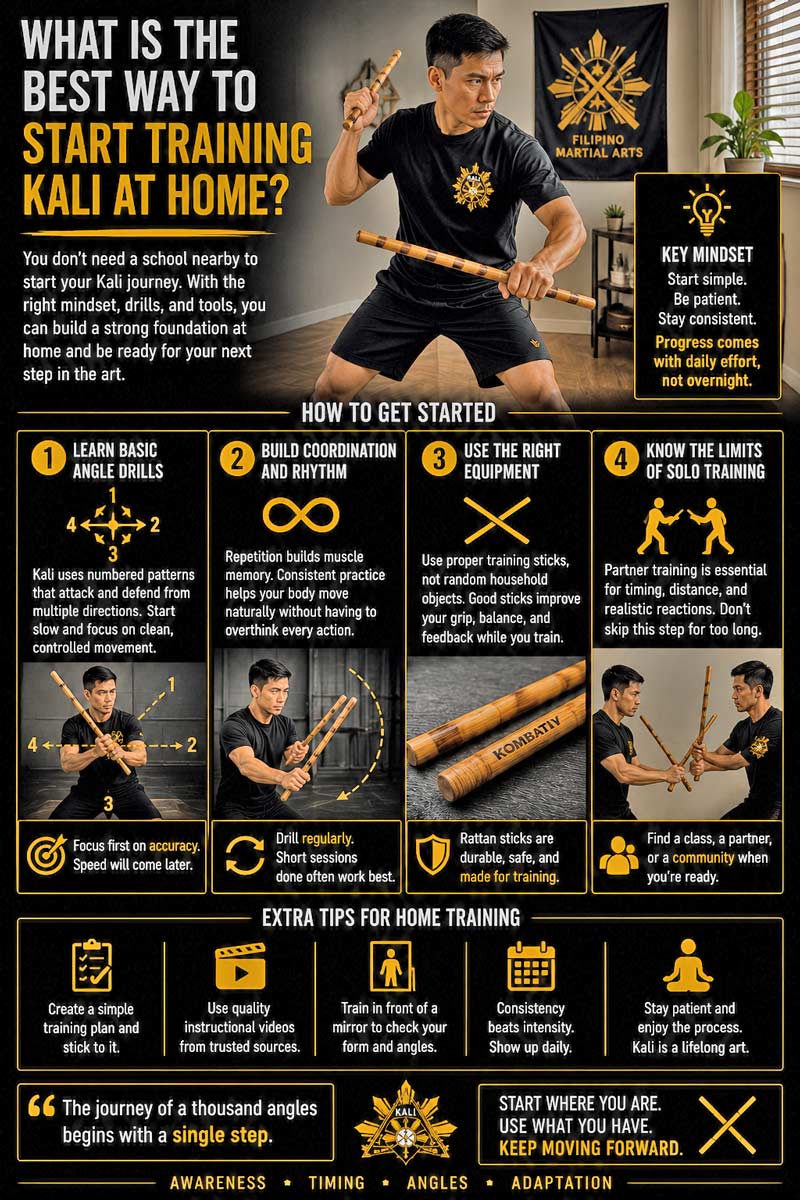
Not everyone has a Filipino martial arts school nearby, and that is okay. Plenty of people start exploring Kali at home before ever stepping into a class. The key is keeping expectations realistic. Watching a few videos will not instantly make anyone fast with sticks, but you can absolutely begin building coordination, rhythm, and basic movement patterns on your own.
For most beginners, the best place to start is simple angle drills. Kali often teaches numbered striking patterns that train you to attack and defend from different directions. Repeating these slowly helps build muscle memory and teaches your body how to move without overthinking every motion. Speed comes later. The goal in the beginning is clean movement and consistency.
It also helps to practice with proper equipment instead of random household objects. A good pair of training sticks gives you better balance, grip, and feedback while learning drills. Many beginners start with lightweight rattan or hardwood escrima sticks designed for practice because they are durable and made specifically for Filipino martial arts training.
That said, solo training has limits. Partner drills are a huge part of what makes Kali so effective because timing, reactions, and distance are difficult to fully develop alone. Even if you start at home, finding a class, training partner, or community later on can make a massive difference in how quickly everything begins to click.
Why Kali Feels Like a Game of Chess at Full Speed
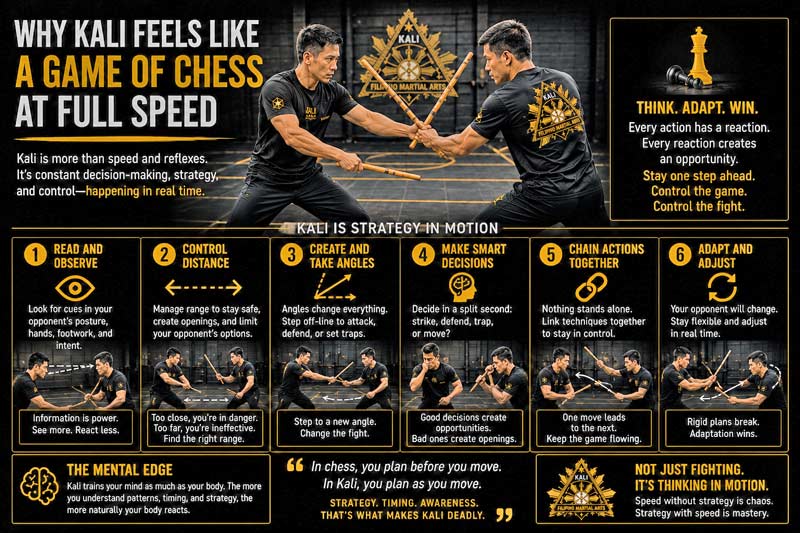
One thing many beginners do not expect is how mentally demanding Kali can be. From the outside, it looks like speed and reflexes are doing all the work. But once you start training, you realize there is a lot of decision-making happening in real time. Practitioners are constantly reading movement, changing angles, controlling distance, and deciding whether to strike, defend, trap, or reposition.
That is one reason experienced Kali practitioners often describe training as feeling like chess played at high speed. Every movement creates options, and every mistake creates openings. A simple change in distance can turn a safe position into a bad one. A blocked strike might instantly become an opportunity for a counterattack. Instead of memorizing one perfect response, practitioners learn to solve problems as they appear.
This mental side of Kali is part of what makes it so engaging over the long term. There is always another timing adjustment to improve, another angle to understand, or another reaction to sharpen. Even people who have trained for years often say they still feel like they are learning. That constant problem-solving keeps the training interesting and helps explain why Kali tends to attract people who enjoy both strategy and movement.
It also explains why Kali practitioners often move so differently from other martial artists. They are not just reacting physically. They are thinking ahead, recognizing patterns, and adjusting in real time. That combination of speed and strategy is what makes the art feel so unique once you experience it firsthand.
Why Kali Practitioners Rarely Stand Still
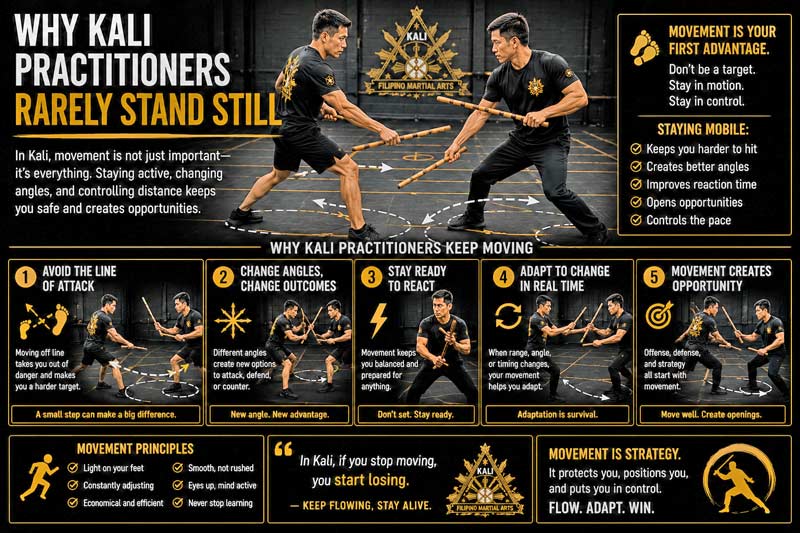
If you watch experienced Kali practitioners, one thing becomes obvious very quickly: they almost never stop moving. Even during moments that look calm, there is usually subtle footwork, shifting angles, hand movement, or distance control happening in the background. Standing still for too long creates openings, and Kali training teaches people to avoid becoming an easy target.
A big part of this comes down to positioning. Instead of meeting force head-on, Kali often encourages moving off line, changing angles, and creating better positions to attack or defend. A small step to the side can completely change what targets are available or take a practitioner out of danger. That constant movement is one reason Kali exchanges can look so fast and unpredictable to beginners.
The footwork also helps practitioners stay ready to react. Rather than planting their feet and waiting, Kali training encourages mobility so people can adapt quickly if something changes. If an attack comes from an unexpected angle, if range suddenly shifts, or if an opening appears, movement makes it easier to respond without freezing or resetting.
This idea of never staying static connects back to why Kali feels so different from many other martial arts. The system rewards flow, adaptability, and staying one step ahead. In many ways, movement itself becomes part of the defense, the attack, and the strategy all at once.
Why Some Martial Artists Think Kali Is the Most Underrated Fighting System
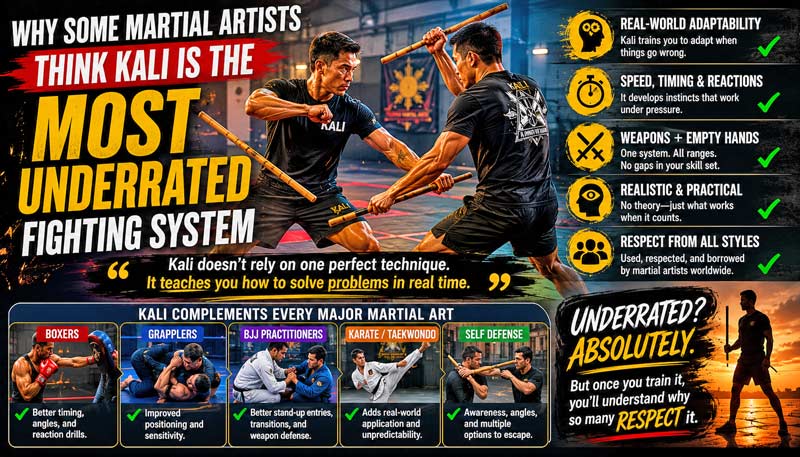
Ask ten martial artists what the most effective or practical fighting system is, and you will probably get ten different answers. But Kali tends to come up more often than people expect, especially among experienced practitioners who have trained in multiple styles. That is partly because Kali blends speed, timing, adaptability, weapons awareness, and empty-hand skills into one system instead of treating them as completely separate things.
A lot of martial artists also appreciate how realistic Kali training feels. The system assumes things will go wrong. Opponents move unpredictably. Distance changes. Plans fail. Instead of training one perfect response to every situation, Kali teaches people how to adapt in real time. That mindset appeals to people who value practical skill over memorizing forms or routines.
Another reason Kali earns so much respect is how well it complements other martial arts. Boxers often appreciate the timing and reaction drills. Grapplers like the emphasis on positioning and sensitivity to movement. Self defense practitioners value the awareness, angles, and ability to transition between tools and empty hands. Even people who never fully switch to Kali often borrow ideas from it to improve their own training.
That does not mean Kali is automatically better than every other martial art. Every system has strengths, weaknesses, and different goals. But when people talk about arts that feel practical, fast, adaptable, and surprisingly effective, Kali keeps finding its way into the conversation. And for a style that still feels relatively unknown compared to karate or jiu-jitsu, that says a lot about the impression it leaves on people who train it.
Why Do Kali Practitioners Move So Fast?
Kali practitioners often look unusually fast because the system is designed around continuous movement instead of stopping and resetting between techniques. Rather than throwing one strike and pulling back, practitioners learn to flow from one movement to the next. Attacks, defenses, angle changes, hand checks, and counters all connect together, which creates the impression of nonstop speed.
Another big factor is repetition. Kali drills are practiced over and over until reactions become automatic. Experienced practitioners are not usually thinking through every movement in real time. Their body has already learned how to react to angles, timing, and pressure, which makes their speed look almost effortless.
It is also important to understand that what looks like incredible speed is often really efficiency. Kali rewards smooth movement, good positioning, and quick transitions instead of brute force. Practitioners are trained to avoid wasted motion, which is one reason their movements can feel so fast and difficult to predict.
Is Kali Better Than Karate for Self Defense?
That really depends on the person, the school, and what kind of training you are looking for. Karate can be excellent for self defense, especially styles that focus on sparring, timing, and practical application. But many people are drawn to Kali because it tends to focus heavily on adaptability, movement, and reacting to unpredictable situations from the beginning.
One difference is that Kali often treats weapons, empty hands, and real-world problem solving as part of the same system. Practitioners train angles, timing, awareness, and transitions between offense and defense in ways that can feel very practical for chaotic situations. Instead of relying on one perfect technique, the goal is often to adapt quickly when things do not go according to plan.
That said, no martial art automatically makes someone good at self defense. Training quality matters more than style alone. A well-trained karate practitioner may be far more effective than someone who casually trains Kali, and vice versa. The best system is usually the one you enjoy enough to train consistently and realistically over time.
Can You Learn Kali Without Sticks?
Yes, but most experienced practitioners would tell you that training with sticks is still one of the best ways to understand how Kali works. The movements, timing, angles, and coordination used in stick training often carry over into empty-hand techniques. In many schools, students regularly switch between weapons and empty-hand drills because the underlying concepts stay surprisingly similar.
One reason stick training matters is that it helps develop awareness and reaction speed in ways that can be harder to build through empty-hand practice alone. Even simple drills teach distance control, timing, hand coordination, and movement patterns that translate into other parts of the system. That is why many instructors consider the sticks a training tool, not just a weapon.
That said, you do not have to carry or even care about weapons to benefit from Kali. Plenty of people train Filipino martial arts for fitness, coordination, self defense, or because they enjoy the fast-paced problem-solving aspect of the training. The empty-hand side of Kali can still be practical and rewarding, even if sticks are not your main interest.
Do Military or Police Actually Train Kali?
Yes, some military units, law enforcement trainers, and security professionals have incorporated elements of Kali or Filipino martial arts into their training, especially concepts related to timing, weapon awareness, movement, and reaction speed. Kali's emphasis on angles, adaptability, and quick transitions makes it appealing to people who may need to react under unpredictable conditions.
That said, it is important not to overhype the connection. Watching a movie or hearing someone say "special forces train Kali" can make it sound like every military unit secretly relies on Filipino stick fighting, which is not really the case. Different organizations use different systems, and training varies widely depending on the role, instructor, and mission.
What has helped Kali earn respect is that many of its ideas transfer well to real-world movement and awareness. Concepts like distance management, reacting under pressure, reading angles, and transitioning smoothly between offense and defense are valuable skills in a lot of environments. That practicality is one reason Kali continues attracting interest from martial artists, self defense instructors, and tactical communities alike.
How Long Does It Take to Get Good at Kali?
That depends on what you mean by "good." Most beginners start feeling more coordinated within a few weeks because Kali training is so hands-on and repetitive. The awkward feeling at the beginning usually fades faster than people expect, especially once the basic striking angles and footwork start making sense.
If your goal is simply learning basic stick control, movement, and timing, you can make noticeable progress fairly quickly with consistent practice. But becoming truly skilled at Kali takes time because there are so many layers to the system. Timing, reactions, range control, partner sensitivity, footwork, and adaptability all improve gradually through repetition.
One thing that makes Kali different from some martial arts is that progress can feel rewarding early on. Even beginners often feel like they are learning useful movements right away instead of waiting months before applying techniques. That early sense of improvement is part of why many people end up sticking with Filipino martial arts long term.
Like anything else, consistency matters more than speed. Someone who trains regularly for six months will usually improve much more than someone who trains intensely for two weeks and stops. Kali rewards repetition, patience, and staying curious as the movements start becoming second nature.
Is Kali Hard for Beginners to Learn?
Kali can feel confusing at first, but that does not necessarily mean it is hard to learn. The biggest challenge for beginners is usually coordination. Many people are not used to moving both hands independently, changing angles quickly, or combining footwork with weapon movement at the same time. At first, it can feel like a lot is happening all at once.
The good news is that most schools teach Kali through repetition and partner drills, which helps things start clicking faster than people expect. In the beginning, the movements may look chaotic or feel awkward. Then suddenly, certain patterns begin making sense. Strikes start flowing together, timing improves, and reactions become more natural.
Another thing beginners often like about Kali is that it tends to feel practical early on. Instead of spending long periods memorizing formal routines, many students start learning useful movement concepts right away. That hands-on style of training can make the learning process feel more engaging, even when the coordination takes time to develop.
Like any martial art, progress depends a lot on consistency and the quality of instruction. But if you can be patient through the awkward phase at the beginning, Kali becomes much easier to understand and a lot more fun as the pieces start coming together.
Is Kali Effective in a Real Fight?
Many practitioners believe Kali can be very effective in real-world situations because the system emphasizes timing, movement, adaptability, and reacting under pressure instead of relying on perfectly scripted techniques. Kali training often focuses on managing distance, changing angles, and staying mobile, which are skills that can matter when situations become unpredictable.
One reason people see Kali as practical is that it trains reactions instead of rigid sequences. Practitioners learn how to adapt when things go wrong, which is important because real confrontations rarely happen the way people imagine them. Distance changes, people panic, and plans fall apart quickly. Kali is designed around adjusting instead of freezing up.
That said, no martial art guarantees success in a real fight. Fitness, awareness, training quality, stress management, and experience all matter. Context matters too. A skilled practitioner in one situation may struggle in another. Kali is a tool, not magic.
What makes Kali stand out is that many of its ideas translate well beyond stick training. Timing, movement, positioning, awareness, and staying calm under pressure are useful skills no matter what type of conflict someone faces. That practical mindset is one reason so many people find Filipino martial arts appealing for self defense training.
What Is the Difference Between Kali, Eskrima, and Arnis?
For beginners, the terms Kali, Eskrima, and Arnis can feel confusing because people often use them interchangeably. The short answer is that they all refer to Filipino martial arts, but different schools, regions, and instructors prefer different names. In many cases, the actual training looks far more similar than different.
Generally speaking, "Arnis" is the term most commonly associated with the Philippines and is even recognized as the national martial art of the country. "Eskrima" or "Escrima" tends to be more common in certain regions and schools, while "Kali" is often used by instructors who emphasize a broader weapons and combat system. But there is no universal rulebook, which is why the terminology can vary so much from one school to another.
The good news is that beginners usually do not need to stress too much about the labels. Whether a school calls itself Kali, Eskrima, or Arnis, you will often see similar ideas: stick drills, angle systems, footwork, timing, reaction training, and adaptability. The teaching style and instructor quality usually matter more than the exact name on the sign.
If you want a deeper breakdown of the similarities and differences, this guide on Kali, Eskrima, and Arnis explained goes into much more detail.
Can You Get Good at Kali Training at Home?
You can absolutely make progress training Kali at home, especially when it comes to coordination, rhythm, footwork, and basic striking patterns. Many people begin by practicing solo angle drills, shadow movement, and stick control before ever joining a class. Repetition matters a lot in Kali, so even short practice sessions can help build muscle memory over time.
That said, home training has limits. Kali is heavily based on timing, distance, and reacting to another person. Partner drills are a huge part of what makes the system work because they teach you how to read movement, adjust angles, and respond under pressure. Those skills are difficult to fully develop by yourself, no matter how many videos you watch.
A good approach for beginners is to treat home practice as a supplement, not a replacement. You can build coordination and confidence on your own while still planning to train with a partner or instructor when possible. Even occasional classes can help correct mistakes and make the solo training much more useful.
The good news is that Kali tends to reward consistency more than intensity. A few focused sessions each week with basic drills and quality movement can add up surprisingly fast, especially once the rhythm starts clicking.
What Are the Best Kali Sticks for Beginners?
For most beginners, lightweight rattan sticks are usually the best place to start. Rattan has been popular in Filipino martial arts for years because it is durable, lightweight, and absorbs impact better than many harder woods. That makes it easier on the hands during partner drills and more forgiving when mistakes happen, which they definitely will in the beginning.
Stick length matters too. Many Kali practitioners prefer training sticks around 26 to 28 inches long because they offer a good balance between speed, control, and reach. Heavier sticks may feel powerful, but they can slow down learning and make it harder to develop proper timing and fluid movement early on.
Another thing beginners sometimes overlook is grip and balance. A well-balanced pair of sticks tends to feel smoother and more comfortable during repetitive drills. If the sticks are too heavy, slippery, or awkward, practice can become frustrating much faster than it needs to be.
The good news is that you do not need anything overly fancy to get started. A quality pair of beginner escrima sticks is usually more than enough to start learning the basic angles, coordination, and movement patterns that make Kali so unique.
Can Kids Learn Kali, or Is It Too Dangerous?
Yes, kids can absolutely learn Kali, but the experience depends a lot on the school, instructor, and training style. Many Filipino martial arts schools offer beginner programs specifically designed for younger students, using lighter training sticks, slower drills, and a strong focus on coordination, control, and safety instead of full-contact sparring.
One thing parents often like about Kali is that it teaches more than just striking. Kids work on coordination, timing, focus, balance, reaction speed, and learning how to stay calm under pressure. Because both hands are often involved, many drills can feel mentally engaging in a way that keeps students interested.
That said, not every Kali school is the same. Some programs are very family-friendly and beginner-focused, while others are designed more for experienced adults or intensive weapons training. It is usually a good idea to watch a class first, ask about safety equipment, and see how instructors work with younger students before signing up.
Like any martial art, good instruction matters more than the style itself. In the right environment, Kali can be a fun and structured way for kids to build confidence, coordination, and discipline while learning something unique.
Why Do Kali Practitioners Hit Sticks Together So Much in Training?
If you have ever watched Kali training, you have probably noticed practitioners constantly striking sticks against each other in repetitive patterns. To beginners, it can almost look choreographed or even a little strange. But those drills exist for a reason. They help build timing, coordination, reaction speed, and the ability to recognize angles without having to stop and think about every movement.
Many of these partner drills are designed to teach muscle memory under pressure. Instead of memorizing techniques in isolation, students learn how to react while another person is moving, striking, and changing rhythm. Over time, the repetitive patterns train practitioners to respond faster and more naturally when things become unpredictable.
Another reason stick-to-stick drills matter is that they teach range and control. Kali practitioners learn how far they can reach, how to stay protected while moving, and how to adjust when an opponent changes angles or timing. That awareness becomes harder to develop through solo practice alone.
While the drills may look repetitive from the outside, experienced practitioners often see them as the foundation of the art. The goal is not just hitting sticks together. It is building reactions, timing, and movement patterns that eventually feel automatic when speed and pressure increase.
Why Do Kali Practitioners Train With Sticks Instead of Knives?
A lot of beginners assume Kali sticks are just their own weapon system, but in many schools the sticks are actually used as a safer way to train movements that originally came from blade fighting. Sticks let students practice timing, angles, distance, and reactions at higher speed without the obvious risks that come with training knives.
In other words, the stick is often treated like a training tool as much as a weapon. Many of the same movement patterns can later transfer into knife awareness, empty-hand techniques, or improvised self defense tools. That is one reason experienced practitioners sometimes say Kali teaches movement first and weapons second.
It also makes training much more accessible. People can safely practice partner drills, reaction timing, and flow at realistic speeds without needing heavy protective equipment or dangerous risk levels. That balance between realism and practicality is one reason stick training became such a core part of Filipino martial arts.
Why Does Kali Look So Chaotic Compared to Other Martial Arts?
To someone seeing Kali for the first time, it can honestly look a little chaotic. The sticks move quickly, the footwork shifts constantly, and practitioners rarely stop between movements. But what looks random from the outside is usually highly structured once you understand the patterns behind it.
Kali emphasizes adaptability over memorizing one perfect response. Instead of freezing when something unexpected happens, practitioners train to adjust in real time. That often makes the movement look less rigid than martial arts built around forms or fixed combinations.
The speed also changes how everything looks. Since practitioners are constantly changing angles, moving their hands, and transitioning between offense and defense, beginners often miss the rhythm underneath the movement. Once you start training, what looked chaotic usually starts feeling surprisingly organized.
Could Kali Become the Next Big Martial Art?
Kali has quietly been growing for years, even if it still feels less mainstream than karate, Brazilian jiu-jitsu, or Muay Thai. More people are discovering Filipino martial arts through self defense training, action movies, YouTube, military circles, and social media clips showing incredibly fast stick work.
Part of the appeal is that Kali feels modern. People often like that it teaches movement, awareness, timing, and adaptability instead of only focusing on sport competition or formal traditions. It also crosses over well with boxing, grappling, self defense, and weapons awareness, which makes it attractive to people already training something else.
Will it ever become as common as karate? Probably not. But many martial artists already see Kali as one of the most underrated systems out there. As more people discover how different the training feels in real life, it would not be surprising to see Filipino martial arts continue growing in popularity.
You May Also Be Interested In:
- What Is the Hardest Martial Arts Weapon to Master? We Ranked Them
- The 7 Most Misunderstood Martial Arts Weapons
- 7 Weird Martial Arts Weapons That Actually Existed
- Were Martial Arts Weapons Really Farm Tools?
- Why Some Martial Arts Weapons Are Illegal in Certain Places
- The Evolution of the Shuriken: From Samurai to Modern Martial Arts
- What Is a Fighting Cane? A Beginner's Guide to Martial Arts Canes
- The Biggest Lies Movies Told You About Martial Arts Weapons
- The Complete Guide to Martial Arts Staffs: A Beginner-Friendly Breakdown
- The Real History of Escrima Sticks: From Battlefield Weapon to Modern Martial Art
Leave a Reply