




How Switchblades Became the Most Feared Knives in America
June 19th, 2026
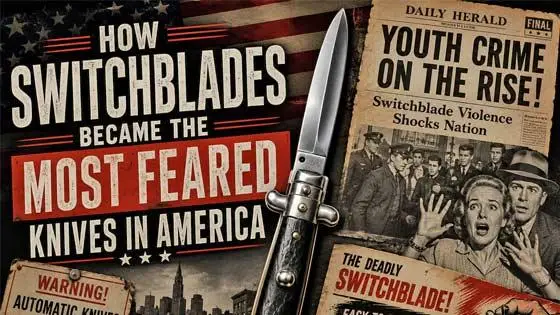
Few knives have inspired as much fear, controversy, and misunderstanding as the switchblade. For decades, it was portrayed as the weapon of juvenile delinquents, street gangs, and movie villains. Newspapers warned about it. Politicians campaigned against it. Entire laws were written around it. Somewhere along the way, the switchblade stopped being just a knife and became a symbol of danger itself.
What's remarkable is that many of the fears surrounding switchblades had less to do with the knives themselves than with the stories people told about them. While countless other knives were just as capable of causing harm, the switchblade became the one that captured the public's imagination. It was fast, mysterious, easy to conceal, and unlike anything most Americans had seen before.
So how did a simple automatic knife become one of the most feared blades in the country? The answer involves a fascinating mix of crime panics, Hollywood influence, sensational headlines, political pressure, and a public eager for something to blame. To understand why switchblades earned such a notorious reputation, we have to go back to the beginning of a fear that still lingers today.
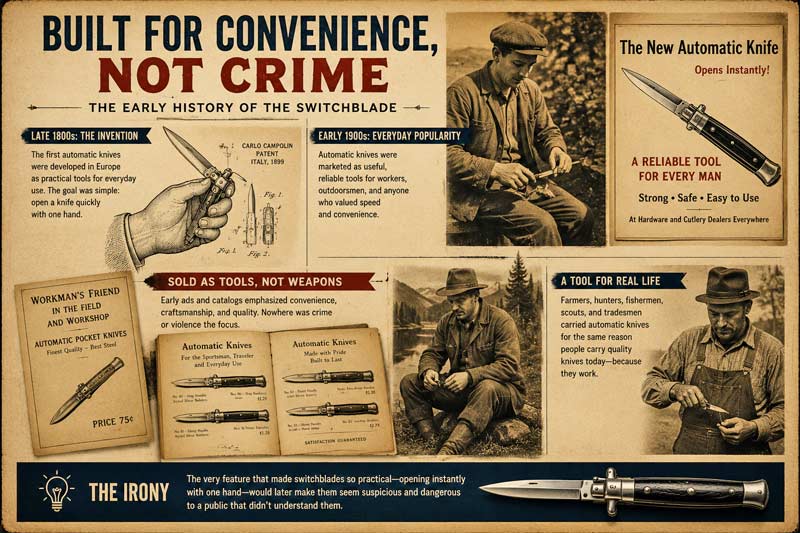
One of the biggest misconceptions about switchblades is that they were invented for violence. In reality, automatic knives began as practical tools designed to solve a simple problem: opening a knife with one hand. Long before they became associated with crime, switchblades were valued for convenience.
Early automatic knives appeared in Europe during the late 1800s and quickly gained popularity among workers, outdoorsmen, and anyone who needed fast access to a cutting tool. The mechanism itself was the innovation. With the press of a button, the blade could deploy instantly without requiring two hands. Today, that same concept remains popular in many modern automatic knives, although the designs and materials have evolved considerably over the years.
By the early twentieth century, switchblades were being imported into the United States and sold alongside countless other pocketknives. They were often marketed as useful tools rather than weapons. Advertisements emphasized convenience, craftsmanship, and ease of use, not criminal activity.
The irony is that the very feature that made switchblades practical also made them seem suspicious to some observers. A knife that opened instantly looked more dangerous than a knife that required manual effort, even if both blades were equally capable once open. That perception would eventually play a major role in shaping public opinion.
As explored in our article on the evolution of automatic knives, the switchblade's transformation from everyday tool to cultural villain did not happen overnight. It was the result of decades of changing attitudes, media coverage, and growing public anxiety.
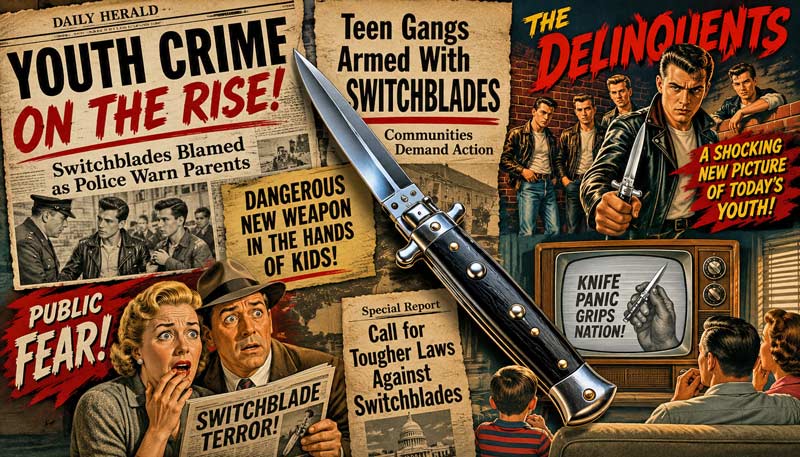
If switchblades had remained simple pocketknives, most Americans probably would have never given them a second thought. The turning point came when newspapers, magazines, and politicians began linking the knives to a growing fear that was spreading across the country: juvenile delinquency.
During the 1940s and 1950s, America became increasingly concerned about rising youth crime. Stories about teenage gangs attracted enormous attention, and reporters were eager for symbols that could represent the perceived threat. The switchblade proved to be a perfect villain. It was easy to conceal, dramatic to deploy, and unfamiliar enough to seem dangerous to the average reader.
Newspaper headlines often portrayed switchblades as the weapon of choice for violent gangs, even though there was little evidence that they were significantly more dangerous than other knives. Fear sells newspapers, and the switchblade became an ideal subject for sensational reporting. The knife itself was transformed from a tool into a cultural symbol.
Hollywood quickly amplified the trend. Films frequently placed switchblades in the hands of gang members and troublemakers, reinforcing the idea that carrying one was inherently suspicious. Many of the myths created during that era survived for decades, much like the misconceptions explored in our article on weapon myths Hollywood got completely wrong.
What made this fear especially powerful was that it fed on itself. The more newspapers covered switchblades, the more movies featured them. The more movies featured them, the more the public associated them with crime. Before long, many Americans viewed the switchblade not as a knife, but as a warning sign of social disorder.
The irony is that the knife's reputation was growing much faster than its actual role in crime. Yet perception often matters more than reality, especially when fear enters the equation.
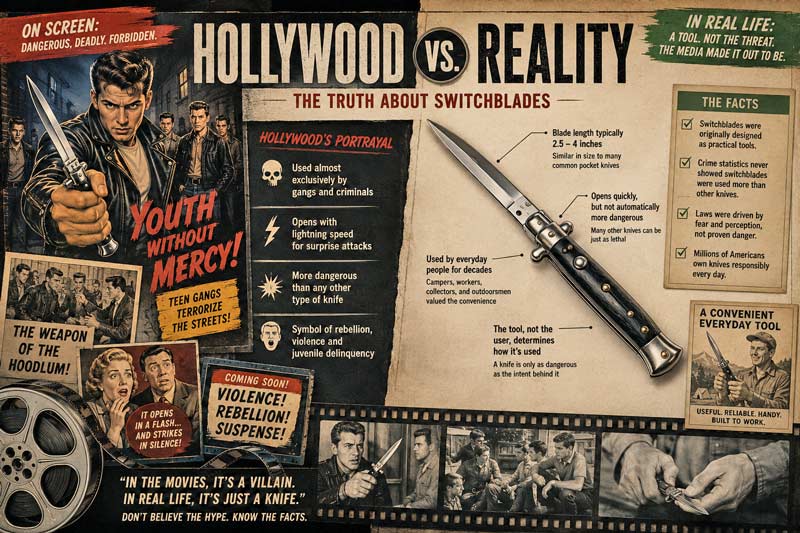
If newspapers laid the foundation for America's fear of switchblades, Hollywood poured gasoline on the fire. By the 1950s, filmmakers had discovered that the switchblade was the perfect visual shortcut for danger. A character didn't need to say he was a criminal. He simply had to pull out a switchblade, and audiences instantly understood the message.
This was partly because switchblades looked dramatic on screen. A revolver could remain hidden in a pocket. A kitchen knife looked ordinary. But a switchblade created a moment. The blade snapped open with speed and sound, making it ideal for movies that wanted to create tension. Directors quickly realized that the knife could become a character in its own right.
Films featuring teenage gangs and street crime often portrayed switchblades as the weapon of choice for rebellious youth. As these movies reached millions of viewers, they reinforced the idea that automatic knives were uniquely dangerous. The public wasn't just reading about switchblades anymore. They were watching them appear in dramatic confrontations on movie screens across the country.
The fascinating part is that many of these portrayals had little connection to reality. Hollywood has a long history of exaggerating weapons for dramatic effect, something we explored in our article about weapon myths Hollywood got completely wrong. The switchblade became another victim of that process. It wasn't necessarily more dangerous than countless other knives, but it was certainly more cinematic.
As the years passed, the image became deeply ingrained in American culture. Even people who had never handled a switchblade often associated it with gangs, crime, and violence. The knife's reputation had effectively become self-sustaining. Once a cultural symbol takes hold, facts often struggle to catch up.
By the time lawmakers began discussing restrictions on switchblades, many Americans already viewed them as a public threat. Hollywood didn't create the fear by itself, but it helped transform a practical tool into one of the most recognizable symbols of danger in modern American history.
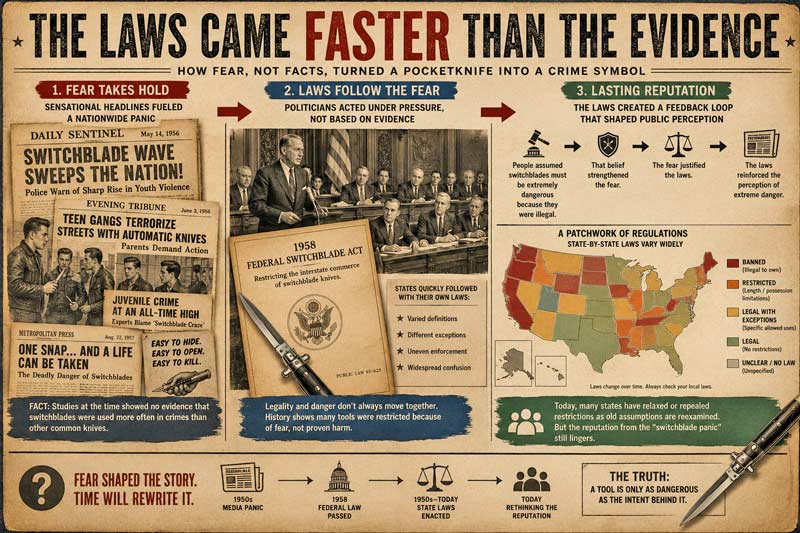
As fear surrounding switchblades grew, politicians faced increasing pressure to take action. By the 1950s, many lawmakers were convinced that automatic knives were contributing to a growing crime problem, particularly among young people. The problem was that public concern was advancing much faster than the available evidence.
Throughout American history, periods of social anxiety have often led to restrictions on objects that become symbols of a broader fear. Sometimes those fears focus on books, music, or new technology. In this case, the switchblade found itself at the center of a national conversation about crime, juvenile delinquency, and changing cultural values.
In 1958, Congress passed the Federal Switchblade Act, restricting the interstate commerce of switchblades. Many states followed with their own laws, creating a patchwork of regulations that varied widely across the country. Almost overnight, the switchblade's reputation as a dangerous weapon became reinforced by the fact that it was now heavily regulated.
What's interesting is that legality and danger do not always move in lockstep. History is filled with examples of tools and weapons that became restricted not necessarily because they were more dangerous than alternatives, but because they became associated with public fears. We explored a similar pattern in our article on why some martial arts weapons are illegal in certain places.
The restrictions created a feedback loop. People assumed switchblades must be exceptionally dangerous because they were illegal. That belief strengthened the fear. The fear justified the laws. And the existence of the laws reinforced the perception that the knives were uniquely threatening.
Decades later, many of those assumptions are being reexamined. Numerous states have relaxed or repealed restrictions on automatic knives, reflecting a growing recognition that the old fears may have been influenced as much by perception as by reality. Yet the reputation established during the switchblade panic continues to linger long after the original headlines faded away.
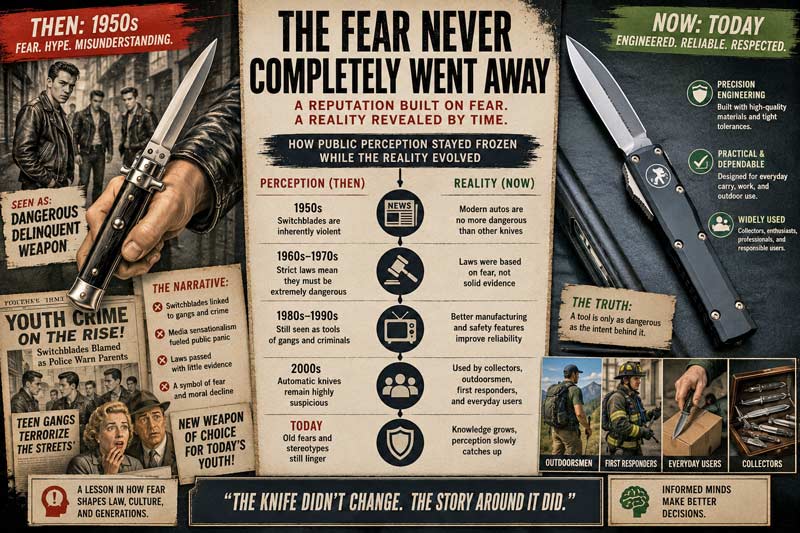
More than half a century after the height of the switchblade panic, many people still react to automatic knives differently than they react to other knives. Someone can see a traditional folding knife and think "tool." They see a switchblade and think "weapon." That distinction is one of the most lasting effects of the fear campaign that began decades ago.
Part of the reason is that cultural reputations are remarkably difficult to change. Most Americans have never read the Federal Switchblade Act. They have never researched crime statistics involving automatic knives. Yet many have absorbed decades of movies, television shows, news stories, and secondhand assumptions that painted switchblades as uniquely dangerous.
Ironically, modern automatic knives are often better engineered and more reliable than the switchblades that originally sparked the controversy. Manufacturing improvements have transformed them into precision tools used by collectors, outdoorsmen, first responders, and everyday knife enthusiasts. As we discussed in our article on how automatic knives actually work, the mechanism itself is far less mysterious than many people imagine.
The rise of OTF knives has also helped introduce a new generation of people to automatic knife technology. Yet even today, discussions about automatic knives often focus on perception rather than function. Questions about reliability, legality, and safety continue to surface because the old reputation remains surprisingly influential. We explored some of those misconceptions in our article on whether OTF knives are actually reliable or just cool.
What's fascinating is that the switchblade's story has become bigger than the knife itself. It is now a case study in how public fears are created, amplified, and sustained. The knife became a symbol, and symbols often outlive the events that created them.
Today, many people who own automatic knives view them as practical tools, collectible pieces of engineering, or simply interesting examples of knife design. Yet the fact that the switchblade still carries such a powerful reputation proves just how successful the fear campaign of the twentieth century really was.
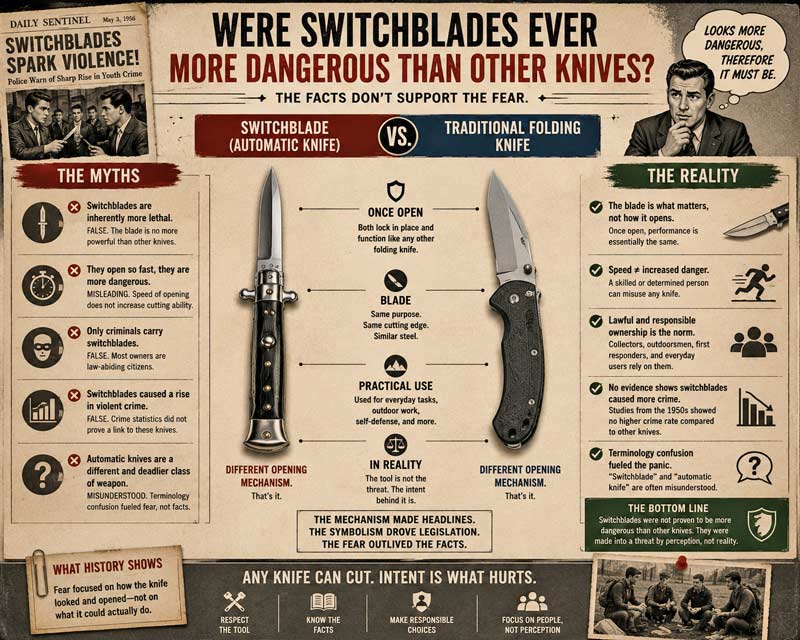
At the heart of the switchblade controversy is a question that surprisingly few people stop to ask: were switchblades ever actually more dangerous than other knives? The answer depends on what you mean by dangerous, but from a purely practical standpoint, the blade itself was rarely the issue.
A switchblade's defining feature is how quickly it opens. Once the blade is locked in place, however, it functions much like countless other folding knives. The cutting edge is not inherently more powerful. The steel is not inherently more lethal. What made the switchblade different was the mechanism, not the blade.
That distinction often got lost during the height of the switchblade panic. Many people assumed that because the knife opened automatically, it must also be significantly more dangerous than a conventional pocketknife. In reality, a determined person could misuse almost any knife. The switchblade simply looked more dramatic while doing it.
This misunderstanding still creates confusion today. Many people use the terms "switchblade" and "automatic knife" interchangeably, while others assume they refer to entirely different categories of knives. As we explained in our article on switchblade vs. automatic knife, the terminology can be surprisingly confusing even among knife enthusiasts.
What the historical record suggests is that fear often focused on the speed of deployment rather than actual differences in capability. A knife that appears more threatening can generate stronger emotional reactions, even if its practical advantages are relatively modest. The public wasn't just reacting to a tool. They were reacting to what the tool represented.
That doesn't mean switchblades are harmless, just as it doesn't mean any knife is harmless. It means that much of their reputation was built around perception. The mechanism made headlines. The symbolism drove legislation. And the fear became attached to the knife long after people stopped asking whether the facts supported it.
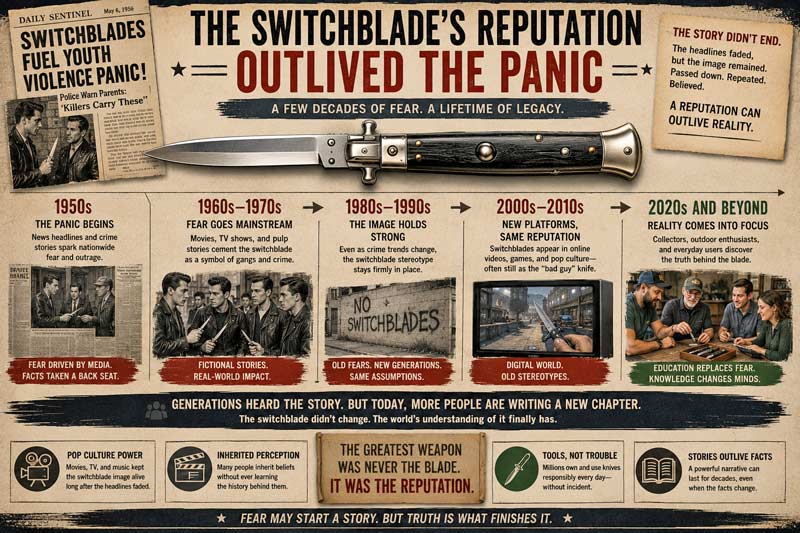
Most moral panics eventually fade. The headlines disappear, the public moves on, and the object at the center of the controversy is largely forgotten. The switchblade followed a different path. While the panic itself peaked decades ago, the reputation it created proved remarkably durable.
Many Americans today still associate switchblades with gangs, crime, and delinquency, even if they couldn't explain exactly why. The image has been passed down through generations of movies, television shows, news stories, and cultural references. In many ways, people inherited the fear without inheriting the history behind it.
What's particularly interesting is that younger generations often encounter switchblades through entirely different channels. Instead of newspaper headlines and crime dramas, they may first see them in online videos, collecting communities, or discussions about knife mechanisms. As a result, many people are discovering that the reality is far more mundane than the reputation suggests.
The same pattern has occurred with other knives throughout history. Certain designs become famous not because they were uniquely dangerous, but because they captured the public imagination. As discussed in our article on the world's most famous knives and the stories behind them, the stories surrounding a knife often become more influential than the knife itself.
Today, millions of people own and use knives responsibly without attracting any attention whatsoever. Yet mention the word "switchblade" and many people immediately picture gang fights, back alleys, and crime movies from the 1950s. That reaction is a testament to how powerful a cultural narrative can become once it takes root.
In the end, the switchblade's greatest weapon was never its blade. It was its reputation. Long after the original fears lost their momentum, the story continued to spread. And for a knife that began life as a practical tool, that may be the most fascinating twist of all.
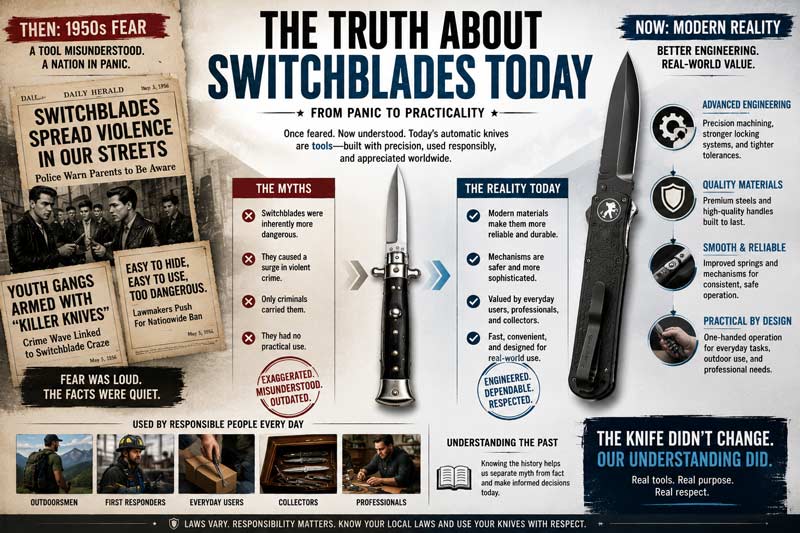
If someone were introduced to switchblades for the first time today without any knowledge of their history, they would probably be surprised to learn how controversial these knives once were. Modern automatic knives are no longer viewed solely through the lens of 1950s crime panics. Instead, they are increasingly appreciated for what they actually are: tools with a unique and convenient opening mechanism.
Advances in manufacturing have dramatically improved reliability, safety, and durability. Modern automatic knives are built with better steels, tighter tolerances, stronger locking systems, and more sophisticated designs than the switchblades that fueled headlines decades ago. Many users choose them simply because they are fast, convenient, and easy to operate with one hand.
The technology itself is no longer mysterious. In fact, many people are surprised to discover that the mechanism is far simpler than the myths surrounding it. If you're curious about what actually happens inside the handle, our article on how automatic knives work breaks down the mechanics in detail.
Perhaps the biggest change is that today's knife enthusiasts tend to judge automatic knives based on performance rather than reputation. Collectors appreciate the engineering. Outdoorsmen appreciate the convenience. Everyday users appreciate the speed and ease of deployment. The conversation has gradually shifted away from fear and toward functionality.
That doesn't mean the switchblade's history should be forgotten. Quite the opposite. The story remains one of the most fascinating examples of how a tool can become a cultural symbol. Understanding that history helps explain why automatic knives still generate strong reactions today, even among people who have never handled one.
For all the headlines, laws, movies, and myths, the switchblade ultimately survived because people continued to find value in it. The panic faded. The reputation evolved. But the knife itself remained. Today, modern knives come in countless designs and configurations, yet the switchblade remains one of the most recognizable examples of how perception and reality can take very different paths.
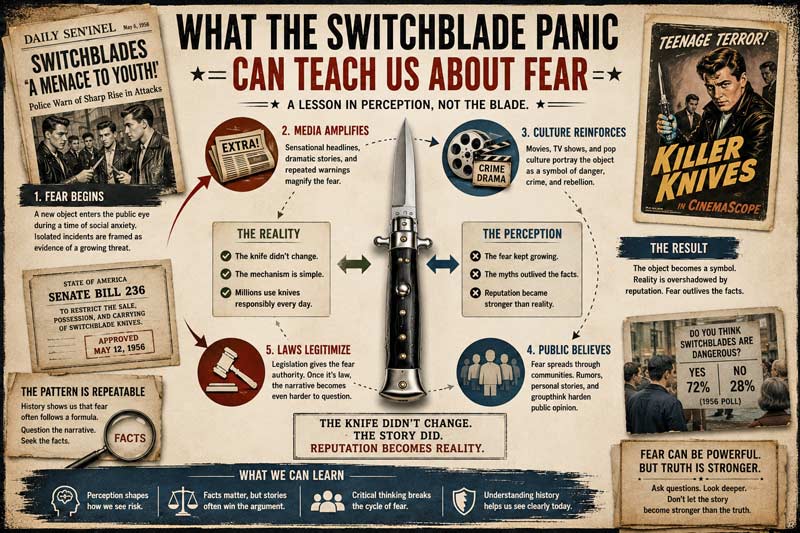
The story of the switchblade is ultimately about much more than a knife. It is a reminder of how easily public perception can shape reality. Once enough people believe an object is dangerous, the fear itself can become more influential than the facts.
Throughout history, societies have repeatedly singled out certain objects as symbols of larger concerns. Sometimes those concerns involve crime. Sometimes they involve changing cultural values, new technology, or younger generations behaving differently than expected. The switchblade happened to arrive at the perfect moment to become a symbol of all those anxieties at once.
What makes the story so fascinating is that the knife never changed. The blade didn't become more dangerous. The mechanism didn't suddenly evolve into something more threatening. What changed was the narrative surrounding it. Newspapers amplified the fear. Hollywood reinforced it. Laws legitimized it. Eventually, the reputation became stronger than the reality.
That pattern helps explain why people often react emotionally to certain weapons and tools. In our article on the weapons people fear most, we explored how public fears are often influenced as much by symbolism as by practical danger. The switchblade may be one of the clearest examples of that phenomenon in modern American history.
Today, the knife serves as a fascinating case study in how myths are created, how reputations spread, and how difficult they can be to reverse. Long after the original panic faded, the story continued to shape public opinion. In many ways, the switchblade became famous not because of what it was, but because of what people believed it represented.
And that may be the most surprising part of all. One of America's most feared knives earned its reputation less through its blade than through the stories told about it.
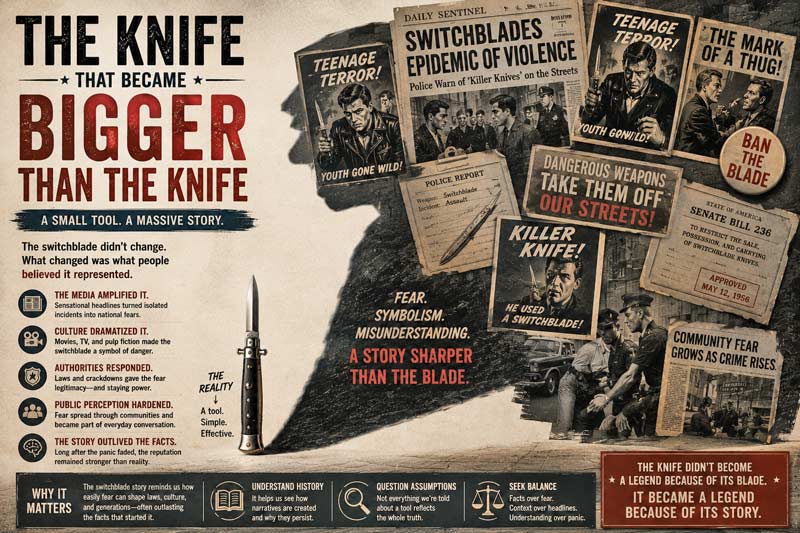
Very few tools ever become cultural symbols. Most remain exactly what they were designed to be. Hammers stay hammers. Wrenches stay wrenches. Even most knives remain simple cutting tools. The switchblade was different. Over time, it became something much larger than the object itself.
By the peak of the switchblade panic, the knife had come to represent fears about crime, rebellious youth, changing social norms, and the loss of control that many Americans felt during a rapidly changing era. The blade itself almost became secondary. What mattered was what people believed it symbolized.
That transformation helps explain why the switchblade became so much more controversial than many other knife designs. Plenty of knives were capable of causing harm. Some were larger, stronger, and more practical than switchblades. Yet few attracted the same level of attention because they lacked the powerful narrative that had developed around automatic knives.
History is full of objects that followed a similar path. A tool becomes associated with a particular group, event, or social concern. Media coverage amplifies the connection. Public perception hardens. Eventually, the story becomes difficult to separate from the object itself. The switchblade may be one of the clearest examples of that process in American history.
Today, many knife enthusiasts are surprised when they learn how much of the switchblade's reputation was shaped by fear, symbolism, and media influence rather than by the knife's actual capabilities. Understanding that history doesn't require people to love switchblades or even carry them. It simply provides important context for why this particular knife occupies such a unique place in American culture.
More than seventy years after the panic began, the switchblade remains one of the most recognizable knife designs in the world. Not because it was the most dangerous. Not because it was the most common. But because few knives have ever accumulated such a powerful story around them. In many ways, that story became sharper than the blade itself.
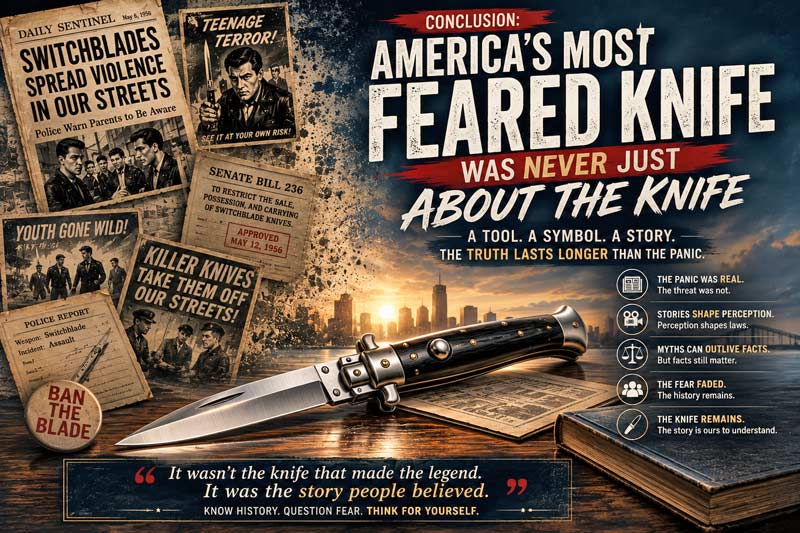
The story of the switchblade isn't really the story of a knife. It's the story of how fear spreads, how symbols are created, and how public perception can sometimes become more powerful than reality.
For decades, switchblades were portrayed as the ultimate criminal weapon. Newspapers warned about them. Movies turned them into icons of rebellion. Lawmakers rushed to regulate them. By the time the panic reached its peak, many Americans had come to see the switchblade as a threat unlike any other knife.
Yet when we look back at the history, a different picture emerges. The switchblade began as a practical tool. Its defining feature was convenience, not violence. While the knife became the focus of a national panic, much of its reputation was built on symbolism, sensationalism, and cultural fears that extended far beyond the blade itself.
Today, the switchblade remains one of the most recognizable knives in America. Not because it proved to be the most dangerous, but because it became one of the most talked about. Few knives have ever accumulated so much history, controversy, and mythology around a single mechanism.
Perhaps that's the ultimate lesson of the switchblade panic. Sometimes the most powerful thing about a weapon isn't what it can do. It's what people believe it can do. And in the case of the switchblade, that belief helped create one of the most enduring reputations in American knife history.
Despite decades of headlines suggesting otherwise, there is little evidence that criminals overwhelmingly preferred switchblades over other types of knives. Much of the knife's reputation came from media coverage and popular culture rather than clear proof that it was uniquely favored by criminals. The switchblade became a symbol of crime long before it became a statistically significant factor in crime itself.
Switchblades were banned or restricted in many places because they became associated with youth crime, gangs, and public disorder during the mid-twentieth century. Lawmakers often respond to public fears, and the switchblade happened to become one of the most visible symbols of those fears. In many cases, the regulations reflected cultural concerns as much as the practical characteristics of the knife itself.
The answer depends on where you live. Knife laws vary significantly between states, and many restrictions that once applied to switchblades have been relaxed or repealed over the years. However, some locations still regulate automatic knives differently than other knife types. Anyone considering ownership should always check the current laws in their state and local jurisdiction.
So how did a simple automatic knife become one of the most feared blades in the country? The answer involves a fascinating mix of crime panics, Hollywood influence, sensational headlines, political pressure, and a public eager for something to blame. To understand why switchblades earned such a notorious reputation, we have to go back to the beginning of a fear that still lingers today.
The Switchblade Was Never Originally a Criminal's Weapon
One of the biggest misconceptions about switchblades is that they were invented for violence. In reality, automatic knives began as practical tools designed to solve a simple problem: opening a knife with one hand. Long before they became associated with crime, switchblades were valued for convenience.
Early automatic knives appeared in Europe during the late 1800s and quickly gained popularity among workers, outdoorsmen, and anyone who needed fast access to a cutting tool. The mechanism itself was the innovation. With the press of a button, the blade could deploy instantly without requiring two hands. Today, that same concept remains popular in many modern automatic knives, although the designs and materials have evolved considerably over the years.
By the early twentieth century, switchblades were being imported into the United States and sold alongside countless other pocketknives. They were often marketed as useful tools rather than weapons. Advertisements emphasized convenience, craftsmanship, and ease of use, not criminal activity.
The irony is that the very feature that made switchblades practical also made them seem suspicious to some observers. A knife that opened instantly looked more dangerous than a knife that required manual effort, even if both blades were equally capable once open. That perception would eventually play a major role in shaping public opinion.
As explored in our article on the evolution of automatic knives, the switchblade's transformation from everyday tool to cultural villain did not happen overnight. It was the result of decades of changing attitudes, media coverage, and growing public anxiety.
The Media Turned Switchblades Into a National Threat
If switchblades had remained simple pocketknives, most Americans probably would have never given them a second thought. The turning point came when newspapers, magazines, and politicians began linking the knives to a growing fear that was spreading across the country: juvenile delinquency.
During the 1940s and 1950s, America became increasingly concerned about rising youth crime. Stories about teenage gangs attracted enormous attention, and reporters were eager for symbols that could represent the perceived threat. The switchblade proved to be a perfect villain. It was easy to conceal, dramatic to deploy, and unfamiliar enough to seem dangerous to the average reader.
Newspaper headlines often portrayed switchblades as the weapon of choice for violent gangs, even though there was little evidence that they were significantly more dangerous than other knives. Fear sells newspapers, and the switchblade became an ideal subject for sensational reporting. The knife itself was transformed from a tool into a cultural symbol.
Hollywood quickly amplified the trend. Films frequently placed switchblades in the hands of gang members and troublemakers, reinforcing the idea that carrying one was inherently suspicious. Many of the myths created during that era survived for decades, much like the misconceptions explored in our article on weapon myths Hollywood got completely wrong.
What made this fear especially powerful was that it fed on itself. The more newspapers covered switchblades, the more movies featured them. The more movies featured them, the more the public associated them with crime. Before long, many Americans viewed the switchblade not as a knife, but as a warning sign of social disorder.
The irony is that the knife's reputation was growing much faster than its actual role in crime. Yet perception often matters more than reality, especially when fear enters the equation.
Hollywood Made the Switchblade a Cultural Villain
If newspapers laid the foundation for America's fear of switchblades, Hollywood poured gasoline on the fire. By the 1950s, filmmakers had discovered that the switchblade was the perfect visual shortcut for danger. A character didn't need to say he was a criminal. He simply had to pull out a switchblade, and audiences instantly understood the message.
This was partly because switchblades looked dramatic on screen. A revolver could remain hidden in a pocket. A kitchen knife looked ordinary. But a switchblade created a moment. The blade snapped open with speed and sound, making it ideal for movies that wanted to create tension. Directors quickly realized that the knife could become a character in its own right.
Films featuring teenage gangs and street crime often portrayed switchblades as the weapon of choice for rebellious youth. As these movies reached millions of viewers, they reinforced the idea that automatic knives were uniquely dangerous. The public wasn't just reading about switchblades anymore. They were watching them appear in dramatic confrontations on movie screens across the country.
The fascinating part is that many of these portrayals had little connection to reality. Hollywood has a long history of exaggerating weapons for dramatic effect, something we explored in our article about weapon myths Hollywood got completely wrong. The switchblade became another victim of that process. It wasn't necessarily more dangerous than countless other knives, but it was certainly more cinematic.
As the years passed, the image became deeply ingrained in American culture. Even people who had never handled a switchblade often associated it with gangs, crime, and violence. The knife's reputation had effectively become self-sustaining. Once a cultural symbol takes hold, facts often struggle to catch up.
By the time lawmakers began discussing restrictions on switchblades, many Americans already viewed them as a public threat. Hollywood didn't create the fear by itself, but it helped transform a practical tool into one of the most recognizable symbols of danger in modern American history.
The Laws Came Faster Than the Evidence
As fear surrounding switchblades grew, politicians faced increasing pressure to take action. By the 1950s, many lawmakers were convinced that automatic knives were contributing to a growing crime problem, particularly among young people. The problem was that public concern was advancing much faster than the available evidence.
Throughout American history, periods of social anxiety have often led to restrictions on objects that become symbols of a broader fear. Sometimes those fears focus on books, music, or new technology. In this case, the switchblade found itself at the center of a national conversation about crime, juvenile delinquency, and changing cultural values.
In 1958, Congress passed the Federal Switchblade Act, restricting the interstate commerce of switchblades. Many states followed with their own laws, creating a patchwork of regulations that varied widely across the country. Almost overnight, the switchblade's reputation as a dangerous weapon became reinforced by the fact that it was now heavily regulated.
What's interesting is that legality and danger do not always move in lockstep. History is filled with examples of tools and weapons that became restricted not necessarily because they were more dangerous than alternatives, but because they became associated with public fears. We explored a similar pattern in our article on why some martial arts weapons are illegal in certain places.
The restrictions created a feedback loop. People assumed switchblades must be exceptionally dangerous because they were illegal. That belief strengthened the fear. The fear justified the laws. And the existence of the laws reinforced the perception that the knives were uniquely threatening.
Decades later, many of those assumptions are being reexamined. Numerous states have relaxed or repealed restrictions on automatic knives, reflecting a growing recognition that the old fears may have been influenced as much by perception as by reality. Yet the reputation established during the switchblade panic continues to linger long after the original headlines faded away.
The Fear Never Completely Went Away
More than half a century after the height of the switchblade panic, many people still react to automatic knives differently than they react to other knives. Someone can see a traditional folding knife and think "tool." They see a switchblade and think "weapon." That distinction is one of the most lasting effects of the fear campaign that began decades ago.
Part of the reason is that cultural reputations are remarkably difficult to change. Most Americans have never read the Federal Switchblade Act. They have never researched crime statistics involving automatic knives. Yet many have absorbed decades of movies, television shows, news stories, and secondhand assumptions that painted switchblades as uniquely dangerous.
Ironically, modern automatic knives are often better engineered and more reliable than the switchblades that originally sparked the controversy. Manufacturing improvements have transformed them into precision tools used by collectors, outdoorsmen, first responders, and everyday knife enthusiasts. As we discussed in our article on how automatic knives actually work, the mechanism itself is far less mysterious than many people imagine.
The rise of OTF knives has also helped introduce a new generation of people to automatic knife technology. Yet even today, discussions about automatic knives often focus on perception rather than function. Questions about reliability, legality, and safety continue to surface because the old reputation remains surprisingly influential. We explored some of those misconceptions in our article on whether OTF knives are actually reliable or just cool.
What's fascinating is that the switchblade's story has become bigger than the knife itself. It is now a case study in how public fears are created, amplified, and sustained. The knife became a symbol, and symbols often outlive the events that created them.
Today, many people who own automatic knives view them as practical tools, collectible pieces of engineering, or simply interesting examples of knife design. Yet the fact that the switchblade still carries such a powerful reputation proves just how successful the fear campaign of the twentieth century really was.
Were Switchblades Ever More Dangerous Than Other Knives?
At the heart of the switchblade controversy is a question that surprisingly few people stop to ask: were switchblades ever actually more dangerous than other knives? The answer depends on what you mean by dangerous, but from a purely practical standpoint, the blade itself was rarely the issue.
A switchblade's defining feature is how quickly it opens. Once the blade is locked in place, however, it functions much like countless other folding knives. The cutting edge is not inherently more powerful. The steel is not inherently more lethal. What made the switchblade different was the mechanism, not the blade.
That distinction often got lost during the height of the switchblade panic. Many people assumed that because the knife opened automatically, it must also be significantly more dangerous than a conventional pocketknife. In reality, a determined person could misuse almost any knife. The switchblade simply looked more dramatic while doing it.
This misunderstanding still creates confusion today. Many people use the terms "switchblade" and "automatic knife" interchangeably, while others assume they refer to entirely different categories of knives. As we explained in our article on switchblade vs. automatic knife, the terminology can be surprisingly confusing even among knife enthusiasts.
What the historical record suggests is that fear often focused on the speed of deployment rather than actual differences in capability. A knife that appears more threatening can generate stronger emotional reactions, even if its practical advantages are relatively modest. The public wasn't just reacting to a tool. They were reacting to what the tool represented.
That doesn't mean switchblades are harmless, just as it doesn't mean any knife is harmless. It means that much of their reputation was built around perception. The mechanism made headlines. The symbolism drove legislation. And the fear became attached to the knife long after people stopped asking whether the facts supported it.
The Switchblade's Reputation Outlived the Panic
Most moral panics eventually fade. The headlines disappear, the public moves on, and the object at the center of the controversy is largely forgotten. The switchblade followed a different path. While the panic itself peaked decades ago, the reputation it created proved remarkably durable.
Many Americans today still associate switchblades with gangs, crime, and delinquency, even if they couldn't explain exactly why. The image has been passed down through generations of movies, television shows, news stories, and cultural references. In many ways, people inherited the fear without inheriting the history behind it.
What's particularly interesting is that younger generations often encounter switchblades through entirely different channels. Instead of newspaper headlines and crime dramas, they may first see them in online videos, collecting communities, or discussions about knife mechanisms. As a result, many people are discovering that the reality is far more mundane than the reputation suggests.
The same pattern has occurred with other knives throughout history. Certain designs become famous not because they were uniquely dangerous, but because they captured the public imagination. As discussed in our article on the world's most famous knives and the stories behind them, the stories surrounding a knife often become more influential than the knife itself.
Today, millions of people own and use knives responsibly without attracting any attention whatsoever. Yet mention the word "switchblade" and many people immediately picture gang fights, back alleys, and crime movies from the 1950s. That reaction is a testament to how powerful a cultural narrative can become once it takes root.
In the end, the switchblade's greatest weapon was never its blade. It was its reputation. Long after the original fears lost their momentum, the story continued to spread. And for a knife that began life as a practical tool, that may be the most fascinating twist of all.
The Truth About Switchblades Today
If someone were introduced to switchblades for the first time today without any knowledge of their history, they would probably be surprised to learn how controversial these knives once were. Modern automatic knives are no longer viewed solely through the lens of 1950s crime panics. Instead, they are increasingly appreciated for what they actually are: tools with a unique and convenient opening mechanism.
Advances in manufacturing have dramatically improved reliability, safety, and durability. Modern automatic knives are built with better steels, tighter tolerances, stronger locking systems, and more sophisticated designs than the switchblades that fueled headlines decades ago. Many users choose them simply because they are fast, convenient, and easy to operate with one hand.
The technology itself is no longer mysterious. In fact, many people are surprised to discover that the mechanism is far simpler than the myths surrounding it. If you're curious about what actually happens inside the handle, our article on how automatic knives work breaks down the mechanics in detail.
Perhaps the biggest change is that today's knife enthusiasts tend to judge automatic knives based on performance rather than reputation. Collectors appreciate the engineering. Outdoorsmen appreciate the convenience. Everyday users appreciate the speed and ease of deployment. The conversation has gradually shifted away from fear and toward functionality.
That doesn't mean the switchblade's history should be forgotten. Quite the opposite. The story remains one of the most fascinating examples of how a tool can become a cultural symbol. Understanding that history helps explain why automatic knives still generate strong reactions today, even among people who have never handled one.
For all the headlines, laws, movies, and myths, the switchblade ultimately survived because people continued to find value in it. The panic faded. The reputation evolved. But the knife itself remained. Today, modern knives come in countless designs and configurations, yet the switchblade remains one of the most recognizable examples of how perception and reality can take very different paths.
What the Switchblade Panic Can Teach Us About Fear
The story of the switchblade is ultimately about much more than a knife. It is a reminder of how easily public perception can shape reality. Once enough people believe an object is dangerous, the fear itself can become more influential than the facts.
Throughout history, societies have repeatedly singled out certain objects as symbols of larger concerns. Sometimes those concerns involve crime. Sometimes they involve changing cultural values, new technology, or younger generations behaving differently than expected. The switchblade happened to arrive at the perfect moment to become a symbol of all those anxieties at once.
What makes the story so fascinating is that the knife never changed. The blade didn't become more dangerous. The mechanism didn't suddenly evolve into something more threatening. What changed was the narrative surrounding it. Newspapers amplified the fear. Hollywood reinforced it. Laws legitimized it. Eventually, the reputation became stronger than the reality.
That pattern helps explain why people often react emotionally to certain weapons and tools. In our article on the weapons people fear most, we explored how public fears are often influenced as much by symbolism as by practical danger. The switchblade may be one of the clearest examples of that phenomenon in modern American history.
Today, the knife serves as a fascinating case study in how myths are created, how reputations spread, and how difficult they can be to reverse. Long after the original panic faded, the story continued to shape public opinion. In many ways, the switchblade became famous not because of what it was, but because of what people believed it represented.
And that may be the most surprising part of all. One of America's most feared knives earned its reputation less through its blade than through the stories told about it.
The Knife That Became Bigger Than the Knife
Very few tools ever become cultural symbols. Most remain exactly what they were designed to be. Hammers stay hammers. Wrenches stay wrenches. Even most knives remain simple cutting tools. The switchblade was different. Over time, it became something much larger than the object itself.
By the peak of the switchblade panic, the knife had come to represent fears about crime, rebellious youth, changing social norms, and the loss of control that many Americans felt during a rapidly changing era. The blade itself almost became secondary. What mattered was what people believed it symbolized.
That transformation helps explain why the switchblade became so much more controversial than many other knife designs. Plenty of knives were capable of causing harm. Some were larger, stronger, and more practical than switchblades. Yet few attracted the same level of attention because they lacked the powerful narrative that had developed around automatic knives.
History is full of objects that followed a similar path. A tool becomes associated with a particular group, event, or social concern. Media coverage amplifies the connection. Public perception hardens. Eventually, the story becomes difficult to separate from the object itself. The switchblade may be one of the clearest examples of that process in American history.
Today, many knife enthusiasts are surprised when they learn how much of the switchblade's reputation was shaped by fear, symbolism, and media influence rather than by the knife's actual capabilities. Understanding that history doesn't require people to love switchblades or even carry them. It simply provides important context for why this particular knife occupies such a unique place in American culture.
More than seventy years after the panic began, the switchblade remains one of the most recognizable knife designs in the world. Not because it was the most dangerous. Not because it was the most common. But because few knives have ever accumulated such a powerful story around them. In many ways, that story became sharper than the blade itself.
Conclusion: America's Most Feared Knife Was Never Just About the Knife
The story of the switchblade isn't really the story of a knife. It's the story of how fear spreads, how symbols are created, and how public perception can sometimes become more powerful than reality.
For decades, switchblades were portrayed as the ultimate criminal weapon. Newspapers warned about them. Movies turned them into icons of rebellion. Lawmakers rushed to regulate them. By the time the panic reached its peak, many Americans had come to see the switchblade as a threat unlike any other knife.
Yet when we look back at the history, a different picture emerges. The switchblade began as a practical tool. Its defining feature was convenience, not violence. While the knife became the focus of a national panic, much of its reputation was built on symbolism, sensationalism, and cultural fears that extended far beyond the blade itself.
Today, the switchblade remains one of the most recognizable knives in America. Not because it proved to be the most dangerous, but because it became one of the most talked about. Few knives have ever accumulated so much history, controversy, and mythology around a single mechanism.
Perhaps that's the ultimate lesson of the switchblade panic. Sometimes the most powerful thing about a weapon isn't what it can do. It's what people believe it can do. And in the case of the switchblade, that belief helped create one of the most enduring reputations in American knife history.
Did Criminals Actually Prefer Switchblades?
Despite decades of headlines suggesting otherwise, there is little evidence that criminals overwhelmingly preferred switchblades over other types of knives. Much of the knife's reputation came from media coverage and popular culture rather than clear proof that it was uniquely favored by criminals. The switchblade became a symbol of crime long before it became a statistically significant factor in crime itself.
Why Were Switchblades Banned Before Many Other Knives?
Switchblades were banned or restricted in many places because they became associated with youth crime, gangs, and public disorder during the mid-twentieth century. Lawmakers often respond to public fears, and the switchblade happened to become one of the most visible symbols of those fears. In many cases, the regulations reflected cultural concerns as much as the practical characteristics of the knife itself.
Are Switchblades Still Illegal in the United States?
The answer depends on where you live. Knife laws vary significantly between states, and many restrictions that once applied to switchblades have been relaxed or repealed over the years. However, some locations still regulate automatic knives differently than other knife types. Anyone considering ownership should always check the current laws in their state and local jurisdiction.
You May Also Be Interested In:
- Why Trench Knives Became the Most Feared Knives of World War I
- Why Did America Become So Afraid of Nunchucks?
- Why Are Throwing Knives Shaped Differently From Regular Knives?
- Why Automatic Knives Belong in Your EDC
- How Automatic Knives Actually Work
- Are OTF Knives Actually Reliable, or Just Cool?
- 6 Unusual Folding Knives
- OTF vs Folding Knives: What's the Difference and Which Is Better?
- The Truth About Ballistic Knives
- Can Butterfly Knives be used for Combat?
Leave a Reply