




The Weapons People Fear Most (And Whether the Fear Makes Sense)
June 12th, 2026
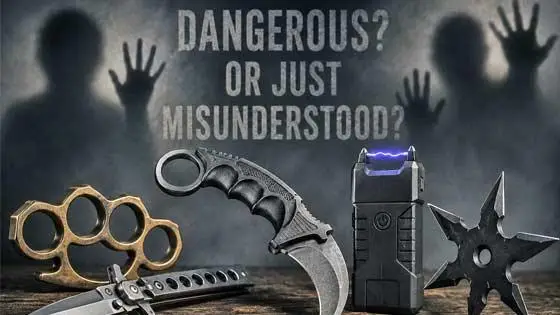
Fear is rarely logical, especially when weapons are involved. Some tools trigger an immediate emotional reaction the moment people see them. A curved karambit looks dangerous before anyone even understands what it is. Brass knuckles feel intimidating because of how personal they seem. Switchblades still carry a reputation shaped by movies from decades ago, while hidden weapons make many people uncomfortable simply because they are designed not to be obvious.
But here is the interesting question: does the fear actually match reality?
Throughout history, certain weapons became symbols of danger far beyond their actual use, often because of media, crime stories, movies, or cultural panic. Meanwhile, some everyday objects cause far more harm statistically but barely register in the public imagination at all. The result is a strange mix of psychology, perception, and myth that shapes how people react to different tools long before they understand them.
In this guide, we are exploring some of the weapons people fear most, why those fears developed, and whether the reputation actually makes sense once you separate emotion from reality.
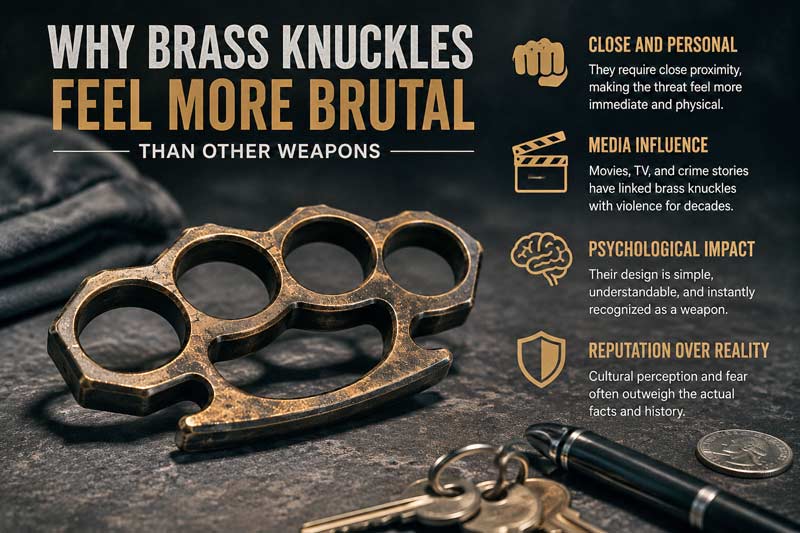
Few weapons trigger an immediate emotional reaction quite like brass knuckles. Even people who know almost nothing about self-defense tools usually recognize them instantly, and for many, the reaction is immediate: dangerous, aggressive, and deeply intimidating.
Part of that fear comes from psychology.
Unlike many weapons that create distance, brass knuckles feel intensely personal. They are associated with punching, close proximity, and direct physical confrontation. There is something uniquely unsettling about a weapon that requires someone to be standing only inches away. That closeness makes the threat feel more visceral than something perceived as distant or detached.
Movies and pop culture helped amplify the reputation too. For decades, brass knuckles appeared in crime films, gang stories, and underground fight scenes, usually associated with brutality rather than self-defense. That repeated imagery shaped how many people view them today, even if they have never actually seen a pair in real life.
Interestingly, the fear often outweighs historical context. Versions of reinforced hand weapons have existed for centuries and evolved for practical close-quarters use rather than dramatic intimidation. We explore that history further in the real history of brass knuckles and how their reputation changed over time.
Does the fear make sense?
To some extent, yes. Brass knuckles are designed for close physical force, which naturally feels threatening to most people. But their cultural reputation has also been exaggerated by decades of movies and media, turning them into something larger than reality in the public imagination.
If you want a closer look at how they actually work and why they became so recognizable, we also break down what brass knuckles are and why compact impact tools developed such an outsized reputation. You can also browse modern styles of knuckle dusters here.
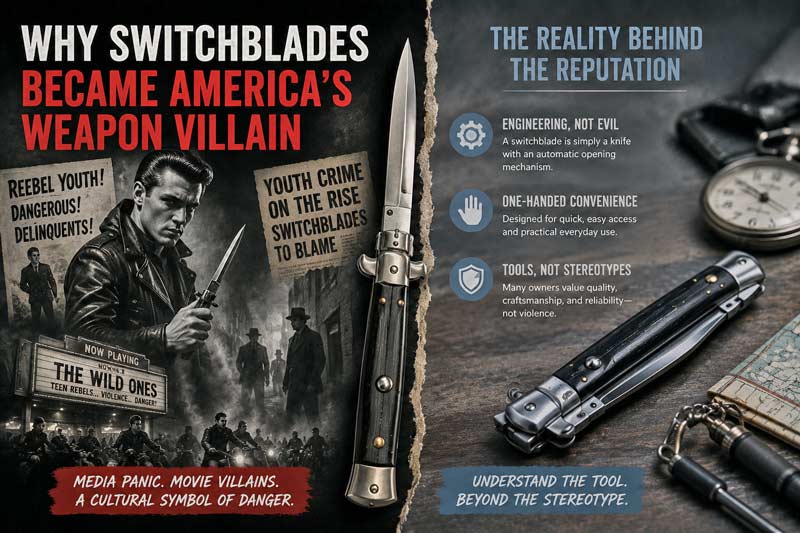
Few weapons carry a reputation as dramatic as the switchblade. Even today, simply hearing the word can make people picture leather jackets, alley fights, gang movies, or dramatic "click" sounds before trouble starts. For decades, switchblades became one of the most feared weapons in American pop culture despite being, at their core, simply knives with a faster opening mechanism.
So where did that fear come from?
Much of it traces back to media and moral panic in the mid-1900s. News stories increasingly connected switchblades to youth crime, gang violence, and juvenile delinquency. Movies amplified the image even further, especially after films and musicals portrayed young criminals flipping knives open dramatically before fights. Over time, the switchblade transformed from a tool into a cultural symbol of danger.
Hollywood deserves a lot of credit for cementing the image. Filmmakers quickly realized that automatic knives created instant tension on screen. The dramatic deployment looked intimidating, sounded memorable, and visually communicated danger in a split second. Few weapons became so tightly linked to movie villains and rebellious characters.
Interestingly, much of the fear had less to do with how dangerous the knife actually was and more to do with symbolism. An automatic knife opens quickly, but mechanically, it is still just another knife design. In many ways, the fear centered around appearance, speed, and what the weapon represented culturally rather than a dramatic difference in function.
Does the fear make sense?
Partially. Quick deployment can feel intimidating, and media associations matter. But decades of movies and headlines arguably turned switchblades into cultural villains far beyond what the mechanism itself justified. In reality, many people simply appreciate them for convenience, one-handed access, and engineering. We explain more in our guide to how automatic knives actually work and why the mechanics are often more practical than dramatic.
If you want to explore how these designs evolved beyond the stereotypes, you can browse different styles of automatic knives here and see why they remain so recognizable today.
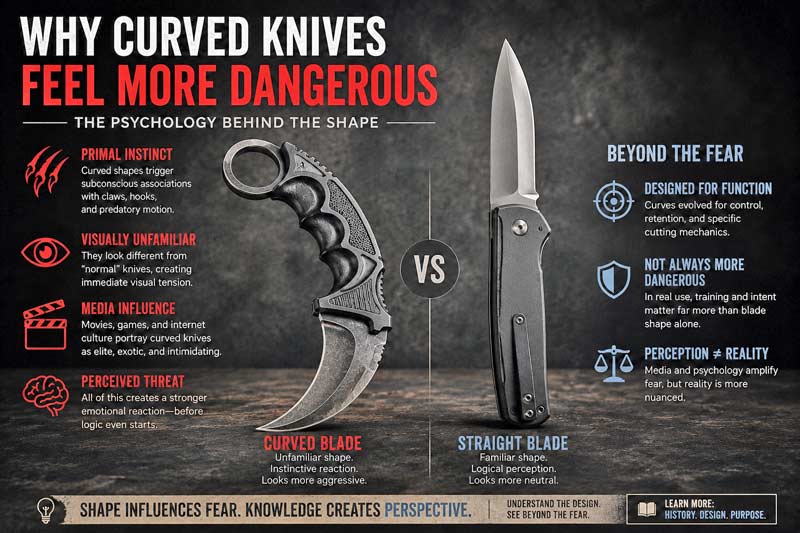
Some weapons trigger fear before people even understand what they are, and curved knives are one of the best examples. Show someone a standard folding knife and they may barely react. Show them a sharply curved karambit, and suddenly the response feels very different: aggressive, intimidating, even predatory.
Part of that reaction comes from psychology and visual instinct.
Humans naturally react to shapes that feel unfamiliar or animal-like, and curved blades often trigger associations with claws, hooks, or tearing motion. A karambit especially feels different because it does not resemble the "normal knife" most people expect. The curved profile and finger ring instantly stand out, making the design seem more threatening even to people who know nothing about knives.
Movies, video games, and internet culture amplified that perception even further. Over the last two decades, karambits became especially recognizable in gaming communities, action content, and tactical media, often portrayed as elite or unusually dangerous weapons. That visibility helped transform them from a niche regional design into one of the most recognizable "intimidating-looking" knives in modern culture. We explore that trend further in why karambit knives became so popular in video games and how media shaped perception.
Interestingly, the original design was shaped more by function than fear. The curved blade evolved for control, retention, and specific cutting motions, not because someone wanted to invent the world's scariest-looking knife. We explain more in why karambit knives are curved and how the shape developed over time.
Does the fear make sense?
Somewhat. Curved blades genuinely look more intimidating to many people because of instinctive visual cues and unfamiliarity. But much of the modern fear surrounding karambits has been amplified by pop culture, gaming, and dramatic presentation rather than everyday reality.
If you want to better understand how the design works, we also break down what the ring on a karambit knife is actually for and why the design evolved the way it did. You can also browse different styles of karambit knives here.
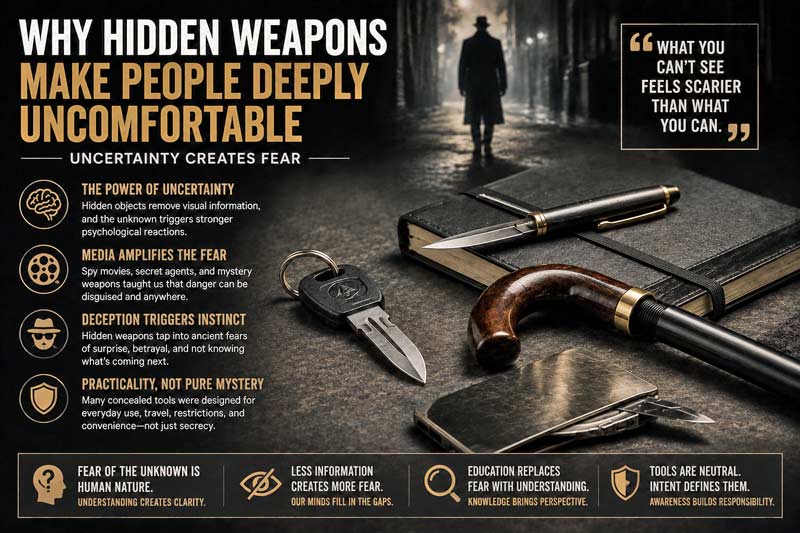
Few things make people more uneasy than the idea of a weapon they cannot immediately see. A visible object feels predictable. A hidden one creates uncertainty, and uncertainty tends to trigger strong psychological reactions.
That discomfort shows up everywhere in human behavior. People are often less afraid of something obvious than something unknown. A visible knife on a kitchen counter may barely register, while the idea of a hidden blade or disguised self-defense tool can feel unsettling long before anyone understands how it actually works.
Part of the fear comes from psychology.
Humans naturally dislike unpredictability. A concealed tool feels more threatening because it removes visual information. If people do not know what someone is carrying, when it might appear, or how it works, the imagination often fills in the blanks. In many cases, fear grows larger than reality simply because uncertainty feels uncomfortable.
Movies and spy culture amplified this reaction even further. Hidden blades, cane swords, disguised tools, and secret gadgets became staples of espionage films, action movies, and comic-book style storytelling. The idea of something dangerous hiding in plain sight taps into a very old fear of deception and surprise.
Interestingly, many concealed tools originally evolved for practicality rather than mystery. Compact or discreet designs often existed because of travel, urban environments, legal restrictions, portability, or simple convenience. We explore that further in our breakdown of hidden blades and discreet tools and why subtle carry concepts developed over time.
Does the fear make sense?
To a degree, yes. Hidden objects naturally feel harder to assess, which makes people uneasy. But much of the emotional reaction also comes from movies, spy fiction, and the psychological discomfort of uncertainty itself rather than direct experience. In many cases, what people imagine feels scarier than the reality.
If you are curious how concealed designs evolved, you can explore different styles of hidden knives and other hidden weapons here to better understand why discreet tools became so culturally fascinating.
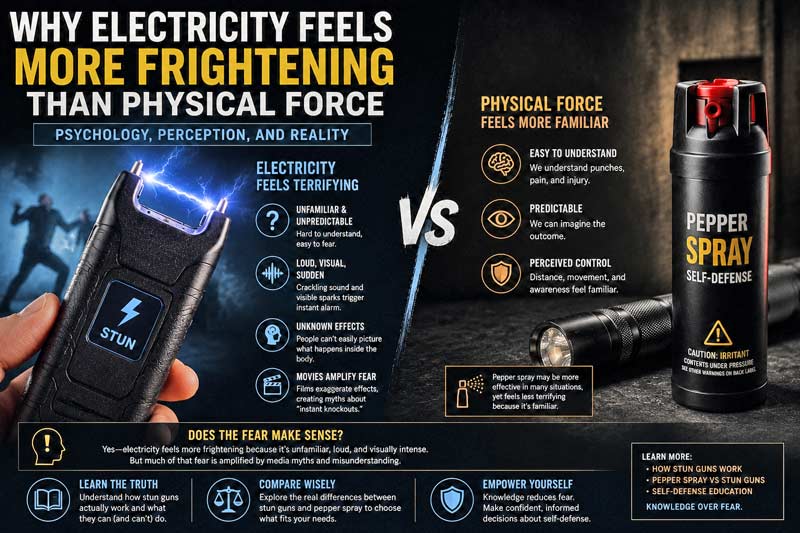
Even people who are not especially afraid of knives or impact tools often react very differently to electricity. A stun device sparks once, makes that loud snapping sound, and suddenly the emotional reaction changes. For many people, electricity feels uniquely unsettling in a way punches, blades, or blunt force sometimes do not.
Part of that fear comes from how unfamiliar electricity feels.
Most people understand physical force intuitively. A punch, a fall, or a cut makes sense because we can picture what happens. Electricity feels different because most people cannot easily visualize how it works inside the body. That uncertainty makes it feel unpredictable, and unpredictability tends to amplify fear.
The sound and visuals matter too. Loud crackling, visible electrical arcs, and sudden movement create an immediate emotional response. Even harmless static electricity can surprise people. A self-defense stun device naturally feels more intimidating because it combines unfamiliarity with dramatic sensory cues.
Movies amplified the fear even further. Films often portray stun devices as instant "off switches," where one quick contact knocks someone unconscious for several convenient minutes. In reality, outcomes are far less predictable, and many devices are designed more around interruption, deterrence, or creating an opportunity to escape than movie-style certainty. We explain more about that difference in our guide to pepper spray vs stun guns and how these tools are actually used.
Interestingly, people are often less emotionally afraid of pepper spray even though it can be extremely effective. Part of that may be because spray feels familiar. We understand irritation, pain, and distance better than electrical sensation. That difference in perception says a lot about how fear works psychologically.
Does the fear make sense?
To a degree, yes. Electricity feels unpredictable and visually intense, which naturally makes people uncomfortable. But media, movie myths, and unfamiliarity likely amplified the fear far beyond what most people realistically understand about modern self-defense devices.
If you want to learn more about how these tools compare, we also break down how stun guns actually work and when people choose them versus pepper spray for everyday carry.
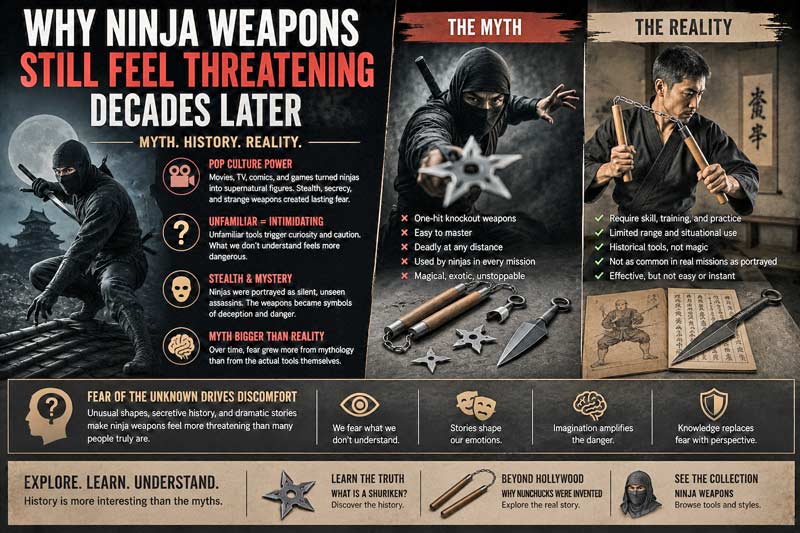
Few categories of weapons trigger instant curiosity and discomfort quite like ninja weapons. Show someone a throwing star, nunchucks, or a mysterious-looking blade, and chances are they immediately associate it with stealth, secrecy, and danger. Even people with no martial arts background often react strongly to the idea of "ninja weapons."
That reaction did not happen by accident.
Movies, television, comic books, and video games spent decades turning ninjas into near-supernatural figures. Silent assassins moving through shadows, disappearing without warning, and carrying strange unfamiliar tools became one of pop culture's most recognizable archetypes. Over time, the weapons themselves inherited some of that fear and mystery.
Part of the discomfort comes from unfamiliarity too. Most people immediately understand what a kitchen knife or baseball bat does. A throwing star or pair of nunchucks feels different because many people have little real-world exposure to them. Unfamiliar tools naturally seem more intimidating, especially when movies frame them as exotic or unusually dangerous.
Interestingly, the reality behind many ninja weapons is often far less dramatic than pop culture suggests. Throwing stars, for example, were not magical one-hit tools flying perfectly across rooftops, and nunchucks require far more skill and patience than movies make them seem. We break down what a shuriken actually is, explore why nunchucks were invented, and take a closer look at how these tools evolved outside of Hollywood fantasy.
Does the fear make sense?
Partially. Unfamiliar designs naturally trigger curiosity and caution, especially when they look visually different from everyday objects. But much of the fear surrounding ninja weapons likely comes from decades of exaggerated portrayals rather than everyday reality. In many ways, people may be reacting more to the mythology of ninjas than the tools themselves.
If you want to explore the broader category, you can browse different styles of ninja weapons here and see how historical tools evolved far beyond movie stereotypes. You can also explore modern throwing stars and nunchaku to better understand why these designs became so recognizable.
Here is where the conversation gets interesting.
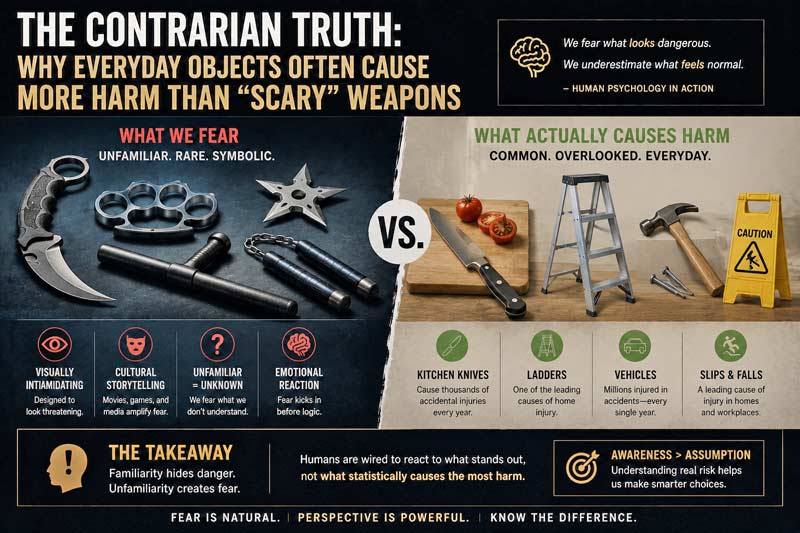
Many of the weapons people fear most are not actually the things that cause the most injuries in everyday life. In fact, humans are often surprisingly bad at judging risk. We tend to fear objects that look dangerous, feel unfamiliar, or have dramatic cultural reputations while overlooking ordinary things we interact with every day.
Psychologists sometimes call this the "availability effect." Dramatic stories stick in our memory more easily than ordinary reality. A sensational movie scene involving brass knuckles or a hidden blade feels emotionally memorable. Slipping in the bathroom, tripping on stairs, or getting hurt by common household tools usually does not.
Take kitchen knives as an example. Most people barely think twice about them because they are familiar, even though knives designed for cooking are involved in far more everyday accidents than many of the "intimidating" weapons people instinctively fear. The same idea applies to tools, ladders, vehicles, sports equipment, and countless other ordinary objects.
Part of the difference comes down to visibility and symbolism. A karambit looks intimidating. Brass knuckles feel aggressive. A throwing star feels mysterious. Those designs trigger emotional reactions before logic has a chance to step in. Meanwhile, everyday risks become invisible because familiarity makes them feel safe.
Does that mean fear of unusual weapons is irrational?
Not necessarily. Humans evolved to react cautiously to unfamiliar or potentially dangerous things, and that instinct exists for a reason. But it does suggest that fear is often shaped just as much by psychology, media, and symbolism as by real-world likelihood.
In many ways, what we fear says just as much about human psychology as it does about the object itself.
The strange reality is that people often fear what looks dangerous while underestimating what feels normal.
After looking at all these examples, the answer turns out to be more complicated than a simple yes or no.
In many cases, the fear people feel is understandable. Brass knuckles feel personal because they require close physical contact. Hidden weapons create uncertainty. Electricity feels unpredictable. Unfamiliar designs like karambits or throwing stars naturally trigger caution because humans are wired to pay attention to things that feel unusual or potentially dangerous.
At the same time, culture plays an enormous role in shaping fear.
Movies turned switchblades into symbols of rebellion. Ninja weapons became wrapped in mystery and exaggeration. Crime stories amplified the reputation of brass knuckles. Spy fiction made concealed tools feel more sinister than practical. Over time, the emotional story surrounding a weapon often became bigger than the object itself.
That does not mean the fear is irrational. Fear exists for a reason. Humans evolved to notice risk, especially when something feels unfamiliar, visually intimidating, or hard to predict. But understanding where those reactions come from can make it easier to separate instinct from reality.
Interestingly, many of the things people fear most are not necessarily the things most likely to cause harm in everyday life. Familiarity often hides risk, while unfamiliarity amplifies it. A dramatic-looking weapon stands out immediately. An ordinary object blends into the background, even if it creates far more accidents over time.
In the end, the question is probably not whether people should fear certain weapons. It is whether the fear matches reality.
Sometimes it does.
Sometimes movies, headlines, and imagination quietly fill in the gaps.
If there is one takeaway from all of this, it is that understanding usually reduces fear. The more we understand where certain tools came from, how they actually work, and why people react to them emotionally, the easier it becomes to separate myth from reality.
If you want to explore the history, psychology, and real-world context behind many of these tools, you can browse more educational guides throughout the Kombativ blog and see how perception often differs from reality.
There is no universal answer, because fear tends to be shaped by psychology, culture, and personal experience more than logic alone. In general, people often fear weapons that feel unfamiliar, visually intimidating, unpredictable, or strongly tied to media stories.
For some people, hidden weapons feel the most unsettling because uncertainty naturally creates anxiety. Others react strongly to electricity-based tools like stun devices because the effects feel unfamiliar and hard to predict. Curved knives such as karambits can feel especially intimidating because they look aggressive and unusual, while brass knuckles often trigger strong reactions because they feel personal and close-range.
Interestingly, movies and headlines play a huge role in shaping what people fear. Switchblades became cultural villains through decades of films and moral panic. Ninja weapons gained mystery through pop culture. Hidden blades became symbols of espionage and secrecy. In many cases, the emotional reputation of a weapon becomes larger than the reality.
The strange truth is that what people fear most often says as much about psychology as it does about the object itself. Humans naturally pay more attention to things that feel dramatic, unfamiliar, or visually threatening, even when everyday risks are statistically more common.
Not necessarily, but they often feel more dangerous.
Much of the discomfort surrounding hidden weapons comes from uncertainty. A visible object feels easier to assess because people can immediately understand what is there. Hidden tools create unanswered questions, and the unknown naturally feels more threatening to most people.
Psychologists sometimes refer to this as uncertainty bias. Humans tend to feel more anxious about risks they cannot clearly see or predict. That is part of why concealed tools, hidden blades, and disguised self-defense items have such a strong psychological effect in movies and real life.
At the same time, visibility alone does not determine danger. Context, training, intent, and circumstance matter far more than whether something is obvious or concealed. In many cases, the fear surrounding hidden weapons comes from imagination filling in the blanks rather than direct experience.
That fear is understandable, though. Humans are naturally cautious about things they cannot immediately identify, which may explain why hidden weapons continue to feel so psychologically powerful even decades after spy movies popularized them.
Throughout history, certain weapons became symbols of danger far beyond their actual use, often because of media, crime stories, movies, or cultural panic. Meanwhile, some everyday objects cause far more harm statistically but barely register in the public imagination at all. The result is a strange mix of psychology, perception, and myth that shapes how people react to different tools long before they understand them.
In this guide, we are exploring some of the weapons people fear most, why those fears developed, and whether the reputation actually makes sense once you separate emotion from reality.
Why Brass Knuckles Feel More Brutal Than Other Weapons
Few weapons trigger an immediate emotional reaction quite like brass knuckles. Even people who know almost nothing about self-defense tools usually recognize them instantly, and for many, the reaction is immediate: dangerous, aggressive, and deeply intimidating.
Part of that fear comes from psychology.
Unlike many weapons that create distance, brass knuckles feel intensely personal. They are associated with punching, close proximity, and direct physical confrontation. There is something uniquely unsettling about a weapon that requires someone to be standing only inches away. That closeness makes the threat feel more visceral than something perceived as distant or detached.
Movies and pop culture helped amplify the reputation too. For decades, brass knuckles appeared in crime films, gang stories, and underground fight scenes, usually associated with brutality rather than self-defense. That repeated imagery shaped how many people view them today, even if they have never actually seen a pair in real life.
Interestingly, the fear often outweighs historical context. Versions of reinforced hand weapons have existed for centuries and evolved for practical close-quarters use rather than dramatic intimidation. We explore that history further in the real history of brass knuckles and how their reputation changed over time.
Does the fear make sense?
To some extent, yes. Brass knuckles are designed for close physical force, which naturally feels threatening to most people. But their cultural reputation has also been exaggerated by decades of movies and media, turning them into something larger than reality in the public imagination.
If you want a closer look at how they actually work and why they became so recognizable, we also break down what brass knuckles are and why compact impact tools developed such an outsized reputation. You can also browse modern styles of knuckle dusters here.
Why Switchblades Became America's Weapon Villain
Few weapons carry a reputation as dramatic as the switchblade. Even today, simply hearing the word can make people picture leather jackets, alley fights, gang movies, or dramatic "click" sounds before trouble starts. For decades, switchblades became one of the most feared weapons in American pop culture despite being, at their core, simply knives with a faster opening mechanism.
So where did that fear come from?
Much of it traces back to media and moral panic in the mid-1900s. News stories increasingly connected switchblades to youth crime, gang violence, and juvenile delinquency. Movies amplified the image even further, especially after films and musicals portrayed young criminals flipping knives open dramatically before fights. Over time, the switchblade transformed from a tool into a cultural symbol of danger.
Hollywood deserves a lot of credit for cementing the image. Filmmakers quickly realized that automatic knives created instant tension on screen. The dramatic deployment looked intimidating, sounded memorable, and visually communicated danger in a split second. Few weapons became so tightly linked to movie villains and rebellious characters.
Interestingly, much of the fear had less to do with how dangerous the knife actually was and more to do with symbolism. An automatic knife opens quickly, but mechanically, it is still just another knife design. In many ways, the fear centered around appearance, speed, and what the weapon represented culturally rather than a dramatic difference in function.
Does the fear make sense?
Partially. Quick deployment can feel intimidating, and media associations matter. But decades of movies and headlines arguably turned switchblades into cultural villains far beyond what the mechanism itself justified. In reality, many people simply appreciate them for convenience, one-handed access, and engineering. We explain more in our guide to how automatic knives actually work and why the mechanics are often more practical than dramatic.
If you want to explore how these designs evolved beyond the stereotypes, you can browse different styles of automatic knives here and see why they remain so recognizable today.
Why Curved Knives Feel More Dangerous Than Straight Blades
Some weapons trigger fear before people even understand what they are, and curved knives are one of the best examples. Show someone a standard folding knife and they may barely react. Show them a sharply curved karambit, and suddenly the response feels very different: aggressive, intimidating, even predatory.
Part of that reaction comes from psychology and visual instinct.
Humans naturally react to shapes that feel unfamiliar or animal-like, and curved blades often trigger associations with claws, hooks, or tearing motion. A karambit especially feels different because it does not resemble the "normal knife" most people expect. The curved profile and finger ring instantly stand out, making the design seem more threatening even to people who know nothing about knives.
Movies, video games, and internet culture amplified that perception even further. Over the last two decades, karambits became especially recognizable in gaming communities, action content, and tactical media, often portrayed as elite or unusually dangerous weapons. That visibility helped transform them from a niche regional design into one of the most recognizable "intimidating-looking" knives in modern culture. We explore that trend further in why karambit knives became so popular in video games and how media shaped perception.
Interestingly, the original design was shaped more by function than fear. The curved blade evolved for control, retention, and specific cutting motions, not because someone wanted to invent the world's scariest-looking knife. We explain more in why karambit knives are curved and how the shape developed over time.
Does the fear make sense?
Somewhat. Curved blades genuinely look more intimidating to many people because of instinctive visual cues and unfamiliarity. But much of the modern fear surrounding karambits has been amplified by pop culture, gaming, and dramatic presentation rather than everyday reality.
If you want to better understand how the design works, we also break down what the ring on a karambit knife is actually for and why the design evolved the way it did. You can also browse different styles of karambit knives here.
Why Hidden Weapons Make People Deeply Uncomfortable
Few things make people more uneasy than the idea of a weapon they cannot immediately see. A visible object feels predictable. A hidden one creates uncertainty, and uncertainty tends to trigger strong psychological reactions.
That discomfort shows up everywhere in human behavior. People are often less afraid of something obvious than something unknown. A visible knife on a kitchen counter may barely register, while the idea of a hidden blade or disguised self-defense tool can feel unsettling long before anyone understands how it actually works.
Part of the fear comes from psychology.
Humans naturally dislike unpredictability. A concealed tool feels more threatening because it removes visual information. If people do not know what someone is carrying, when it might appear, or how it works, the imagination often fills in the blanks. In many cases, fear grows larger than reality simply because uncertainty feels uncomfortable.
Movies and spy culture amplified this reaction even further. Hidden blades, cane swords, disguised tools, and secret gadgets became staples of espionage films, action movies, and comic-book style storytelling. The idea of something dangerous hiding in plain sight taps into a very old fear of deception and surprise.
Interestingly, many concealed tools originally evolved for practicality rather than mystery. Compact or discreet designs often existed because of travel, urban environments, legal restrictions, portability, or simple convenience. We explore that further in our breakdown of hidden blades and discreet tools and why subtle carry concepts developed over time.
Does the fear make sense?
To a degree, yes. Hidden objects naturally feel harder to assess, which makes people uneasy. But much of the emotional reaction also comes from movies, spy fiction, and the psychological discomfort of uncertainty itself rather than direct experience. In many cases, what people imagine feels scarier than the reality.
If you are curious how concealed designs evolved, you can explore different styles of hidden knives and other hidden weapons here to better understand why discreet tools became so culturally fascinating.
Why Electricity Feels More Frightening Than Physical Force
Even people who are not especially afraid of knives or impact tools often react very differently to electricity. A stun device sparks once, makes that loud snapping sound, and suddenly the emotional reaction changes. For many people, electricity feels uniquely unsettling in a way punches, blades, or blunt force sometimes do not.
Part of that fear comes from how unfamiliar electricity feels.
Most people understand physical force intuitively. A punch, a fall, or a cut makes sense because we can picture what happens. Electricity feels different because most people cannot easily visualize how it works inside the body. That uncertainty makes it feel unpredictable, and unpredictability tends to amplify fear.
The sound and visuals matter too. Loud crackling, visible electrical arcs, and sudden movement create an immediate emotional response. Even harmless static electricity can surprise people. A self-defense stun device naturally feels more intimidating because it combines unfamiliarity with dramatic sensory cues.
Movies amplified the fear even further. Films often portray stun devices as instant "off switches," where one quick contact knocks someone unconscious for several convenient minutes. In reality, outcomes are far less predictable, and many devices are designed more around interruption, deterrence, or creating an opportunity to escape than movie-style certainty. We explain more about that difference in our guide to pepper spray vs stun guns and how these tools are actually used.
Interestingly, people are often less emotionally afraid of pepper spray even though it can be extremely effective. Part of that may be because spray feels familiar. We understand irritation, pain, and distance better than electrical sensation. That difference in perception says a lot about how fear works psychologically.
Does the fear make sense?
To a degree, yes. Electricity feels unpredictable and visually intense, which naturally makes people uncomfortable. But media, movie myths, and unfamiliarity likely amplified the fear far beyond what most people realistically understand about modern self-defense devices.
If you want to learn more about how these tools compare, we also break down how stun guns actually work and when people choose them versus pepper spray for everyday carry.
Why Ninja Weapons Still Feel Threatening Decades Later
Few categories of weapons trigger instant curiosity and discomfort quite like ninja weapons. Show someone a throwing star, nunchucks, or a mysterious-looking blade, and chances are they immediately associate it with stealth, secrecy, and danger. Even people with no martial arts background often react strongly to the idea of "ninja weapons."
That reaction did not happen by accident.
Movies, television, comic books, and video games spent decades turning ninjas into near-supernatural figures. Silent assassins moving through shadows, disappearing without warning, and carrying strange unfamiliar tools became one of pop culture's most recognizable archetypes. Over time, the weapons themselves inherited some of that fear and mystery.
Part of the discomfort comes from unfamiliarity too. Most people immediately understand what a kitchen knife or baseball bat does. A throwing star or pair of nunchucks feels different because many people have little real-world exposure to them. Unfamiliar tools naturally seem more intimidating, especially when movies frame them as exotic or unusually dangerous.
Interestingly, the reality behind many ninja weapons is often far less dramatic than pop culture suggests. Throwing stars, for example, were not magical one-hit tools flying perfectly across rooftops, and nunchucks require far more skill and patience than movies make them seem. We break down what a shuriken actually is, explore why nunchucks were invented, and take a closer look at how these tools evolved outside of Hollywood fantasy.
Does the fear make sense?
Partially. Unfamiliar designs naturally trigger curiosity and caution, especially when they look visually different from everyday objects. But much of the fear surrounding ninja weapons likely comes from decades of exaggerated portrayals rather than everyday reality. In many ways, people may be reacting more to the mythology of ninjas than the tools themselves.
If you want to explore the broader category, you can browse different styles of ninja weapons here and see how historical tools evolved far beyond movie stereotypes. You can also explore modern throwing stars and nunchaku to better understand why these designs became so recognizable.
The Contrarian Truth: Why Everyday Objects Often Cause More Harm Than "Scary" Weapons
Here is where the conversation gets interesting.
Many of the weapons people fear most are not actually the things that cause the most injuries in everyday life. In fact, humans are often surprisingly bad at judging risk. We tend to fear objects that look dangerous, feel unfamiliar, or have dramatic cultural reputations while overlooking ordinary things we interact with every day.
Psychologists sometimes call this the "availability effect." Dramatic stories stick in our memory more easily than ordinary reality. A sensational movie scene involving brass knuckles or a hidden blade feels emotionally memorable. Slipping in the bathroom, tripping on stairs, or getting hurt by common household tools usually does not.
Take kitchen knives as an example. Most people barely think twice about them because they are familiar, even though knives designed for cooking are involved in far more everyday accidents than many of the "intimidating" weapons people instinctively fear. The same idea applies to tools, ladders, vehicles, sports equipment, and countless other ordinary objects.
Part of the difference comes down to visibility and symbolism. A karambit looks intimidating. Brass knuckles feel aggressive. A throwing star feels mysterious. Those designs trigger emotional reactions before logic has a chance to step in. Meanwhile, everyday risks become invisible because familiarity makes them feel safe.
Does that mean fear of unusual weapons is irrational?
Not necessarily. Humans evolved to react cautiously to unfamiliar or potentially dangerous things, and that instinct exists for a reason. But it does suggest that fear is often shaped just as much by psychology, media, and symbolism as by real-world likelihood.
In many ways, what we fear says just as much about human psychology as it does about the object itself.
The strange reality is that people often fear what looks dangerous while underestimating what feels normal.
Does the Fear Actually Make Sense?
After looking at all these examples, the answer turns out to be more complicated than a simple yes or no.
In many cases, the fear people feel is understandable. Brass knuckles feel personal because they require close physical contact. Hidden weapons create uncertainty. Electricity feels unpredictable. Unfamiliar designs like karambits or throwing stars naturally trigger caution because humans are wired to pay attention to things that feel unusual or potentially dangerous.
At the same time, culture plays an enormous role in shaping fear.
Movies turned switchblades into symbols of rebellion. Ninja weapons became wrapped in mystery and exaggeration. Crime stories amplified the reputation of brass knuckles. Spy fiction made concealed tools feel more sinister than practical. Over time, the emotional story surrounding a weapon often became bigger than the object itself.
That does not mean the fear is irrational. Fear exists for a reason. Humans evolved to notice risk, especially when something feels unfamiliar, visually intimidating, or hard to predict. But understanding where those reactions come from can make it easier to separate instinct from reality.
Interestingly, many of the things people fear most are not necessarily the things most likely to cause harm in everyday life. Familiarity often hides risk, while unfamiliarity amplifies it. A dramatic-looking weapon stands out immediately. An ordinary object blends into the background, even if it creates far more accidents over time.
In the end, the question is probably not whether people should fear certain weapons. It is whether the fear matches reality.
Sometimes it does.
Sometimes movies, headlines, and imagination quietly fill in the gaps.
If there is one takeaway from all of this, it is that understanding usually reduces fear. The more we understand where certain tools came from, how they actually work, and why people react to them emotionally, the easier it becomes to separate myth from reality.
If you want to explore the history, psychology, and real-world context behind many of these tools, you can browse more educational guides throughout the Kombativ blog and see how perception often differs from reality.
FAQ: What Weapon Do People Fear the Most?
There is no universal answer, because fear tends to be shaped by psychology, culture, and personal experience more than logic alone. In general, people often fear weapons that feel unfamiliar, visually intimidating, unpredictable, or strongly tied to media stories.
For some people, hidden weapons feel the most unsettling because uncertainty naturally creates anxiety. Others react strongly to electricity-based tools like stun devices because the effects feel unfamiliar and hard to predict. Curved knives such as karambits can feel especially intimidating because they look aggressive and unusual, while brass knuckles often trigger strong reactions because they feel personal and close-range.
Interestingly, movies and headlines play a huge role in shaping what people fear. Switchblades became cultural villains through decades of films and moral panic. Ninja weapons gained mystery through pop culture. Hidden blades became symbols of espionage and secrecy. In many cases, the emotional reputation of a weapon becomes larger than the reality.
The strange truth is that what people fear most often says as much about psychology as it does about the object itself. Humans naturally pay more attention to things that feel dramatic, unfamiliar, or visually threatening, even when everyday risks are statistically more common.
FAQ: Are Hidden Weapons More Dangerous Than Visible Ones?
Not necessarily, but they often feel more dangerous.
Much of the discomfort surrounding hidden weapons comes from uncertainty. A visible object feels easier to assess because people can immediately understand what is there. Hidden tools create unanswered questions, and the unknown naturally feels more threatening to most people.
Psychologists sometimes refer to this as uncertainty bias. Humans tend to feel more anxious about risks they cannot clearly see or predict. That is part of why concealed tools, hidden blades, and disguised self-defense items have such a strong psychological effect in movies and real life.
At the same time, visibility alone does not determine danger. Context, training, intent, and circumstance matter far more than whether something is obvious or concealed. In many cases, the fear surrounding hidden weapons comes from imagination filling in the blanks rather than direct experience.
That fear is understandable, though. Humans are naturally cautious about things they cannot immediately identify, which may explain why hidden weapons continue to feel so psychologically powerful even decades after spy movies popularized them.
You May Also Be Interested In:
- What Makes a Good Self Defense Weapon? Key Things to Consider
- The Bizarre Weapons People Once Carried for Self Defense
- Stiletto vs. Switchblade: Why Most People Get Them Confused
- What Is a Boot Knife and Why Do People Carry Them?
- What Is a Neck Knife and Why Do People Carry Them?
- Why Pepper Spray Fails More Often Than People Realize
- The Police Weapon Most People Forgot Ever Existed
- 7 Mistakes People Make When Buying Their First Folding Knife
- Crazy Weapons You Need To See!
- Unusual Weapons You've Never Seen Before
Leave a Reply