




The Strange History of the Tomahawk
July 24th, 2026
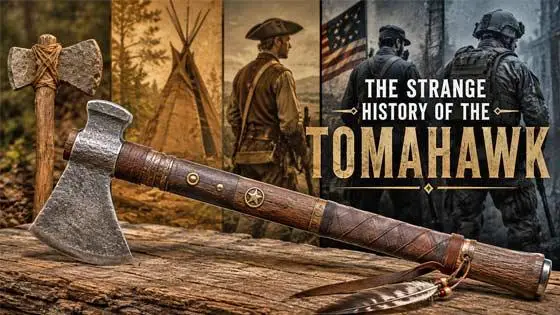
Few weapons have a history as misunderstood as the tomahawk. To many people, it's simply a small axe associated with Native American warriors or a tool that's become popular among modern survivalists and military units. But the tomahawk's story is far more fascinating than that. Over hundreds of years, it evolved from a practical everyday tool into a trade item, a symbol of diplomacy, a feared battlefield weapon, and eventually a piece of modern tactical gear. Along the way, it became wrapped in myths that Hollywood and popular culture continue to repeat today.
From handcrafted stone heads to finely forged steel, the tomahawk has constantly adapted to the people who carried it and the challenges they faced. Its remarkable journey reveals not only how weapons evolve over time, but also how one deceptively simple design managed to remain relevant for centuries. Let's take a closer look at the strange history of one of the world's most iconic axes.
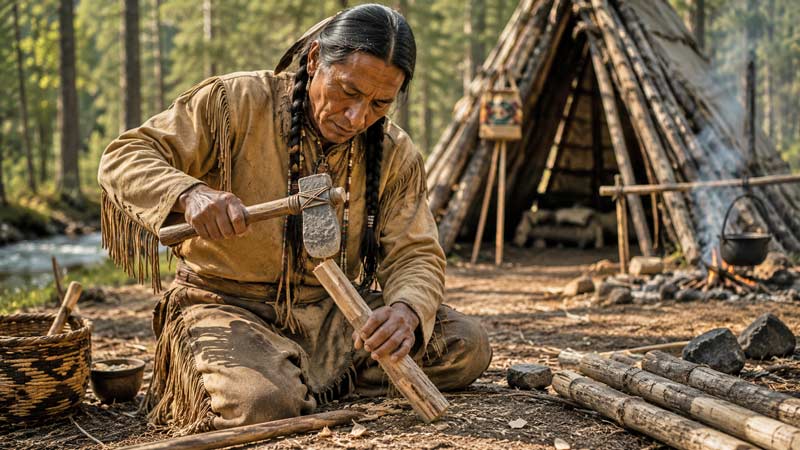
When most people hear the word "tomahawk," they picture a Native American warrior charging into battle with a small axe in hand. While the tomahawk certainly earned its reputation as a formidable weapon, that image tells only a small part of its story. Long before it became associated with combat, the tomahawk was an essential everyday tool. It helped build shelters, split firewood, prepare food, clear brush, and perform countless other tasks that were critical for survival. Like many of history's most successful tools, its greatest strength was its versatility.
The word "tomahawk" itself comes from an Algonquian term referring to a cutting or striking tool. Early versions were crafted from sharpened stone, bone, or antler and securely fastened to wooden handles. Although these primitive designs lacked the durability of later steel heads, they were remarkably effective for the needs of the people who made them. As different tribes adapted the design to suit their own environments, the tomahawk gradually evolved into a wide variety of shapes and sizes, each with its own purpose.
That practical origin is one reason the tomahawk has survived for centuries while so many other historical weapons disappeared. Like the kukri and other multi-purpose blades, it was never limited to a single job. If you're interested in another tool that blurred the line between everyday utility and combat, check out our article on what a kukri knife is and what it's used for. Even today, modern axes and hatchets continue to follow the same philosophy that made the original tomahawk indispensable: one compact tool capable of handling almost anything.
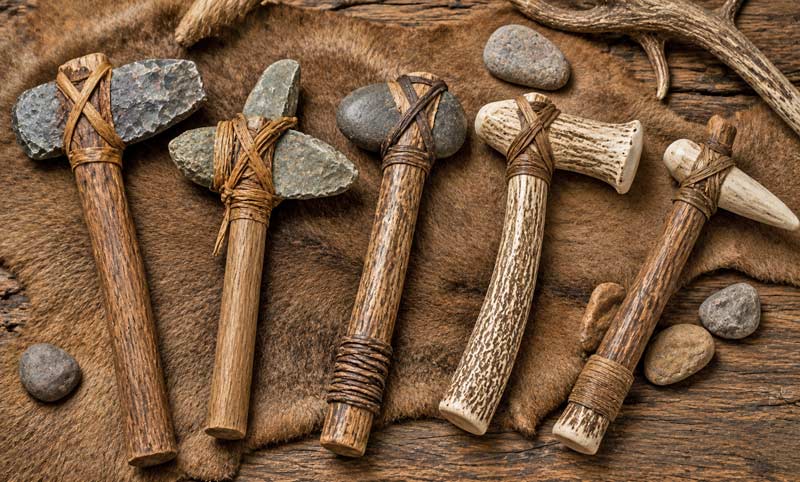
The earliest tools we now associate with tomahawks looked very different from the steel-headed versions most people recognize today. Before metal became widely available, Native American craftspeople shaped stone, bone, and antler into compact striking heads that could be mounted onto wooden handles. Some were ground to a sharp edge, while others were designed more like heavy clubs. The final form depended on the available materials, local traditions, and the work the tool was expected to perform.
Creating one of these early tomahawks required patience and skill. A suitable stone had to be chipped or ground into shape, then secured to a handle using rawhide, sinew, plant fibers, or carefully fitted wooden sockets. A poorly attached head could loosen after only a few strikes, so the strength of the binding mattered almost as much as the cutting edge itself. What appears simple at first glance was actually the result of generations of experimentation.
These early tools were used for much more than combat. They could split small pieces of wood, break bone, process game, clear vegetation, and assist with camp construction. In an environment where every object had to justify the effort required to make and carry it, versatility was essential. A tool that worked only as a weapon would have been far less valuable than one that could serve half a dozen practical purposes throughout the day.
It is also important to remember that there was no single universal "Native American tomahawk." Different nations developed their own tools, styles, and preferences, and many of the designs now grouped under one familiar name would not have been identical. The simplified image seen in films hides a much more complex history shaped by geography, trade, craftsmanship, and the needs of individual communities.
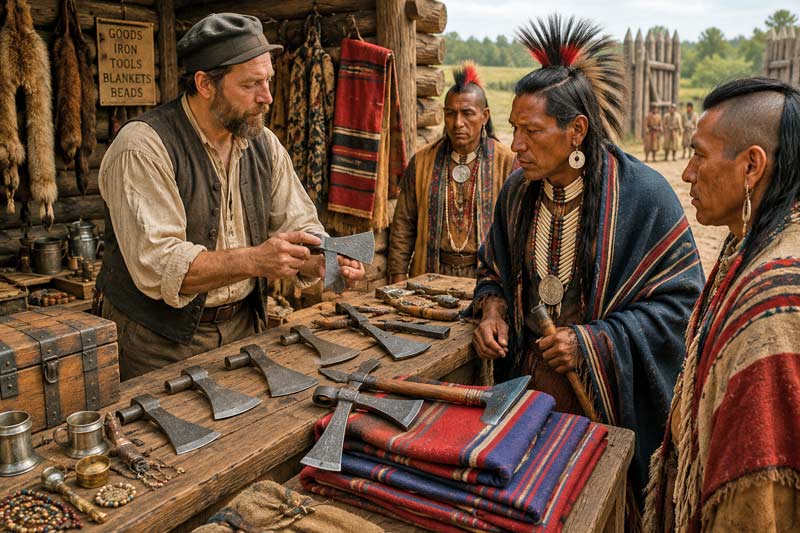
The tomahawk changed dramatically after sustained contact between Native American communities and European traders. Stone and bone heads had served their purpose for generations, but forged iron and steel offered sharper edges, greater durability, and easier maintenance. European-made axe heads quickly became highly valued trade goods, and Native craftspeople adapted them into familiar handle designs that were lighter and more compact than full-sized axes.
This exchange created what are now commonly called trade tomahawks. Blacksmiths produced large numbers of small iron axe heads specifically for use in North American trade, often shaping them with narrow blades and rounded or pointed polls. Once fitted to wooden handles, they became useful tools for cutting, camp work, hunting, and combat. Their compact size also made them easier to carry than heavier European axes.
The change was not simply a case of Europeans replacing an older Indigenous design. The tomahawk that emerged from this period was a hybrid shaped by both cultures. European metalworking supplied new materials and manufacturing techniques, while Native users influenced the size, balance, hafting, and practical role of the finished tool. This kind of cultural exchange has shaped many famous weapons, as explored in our article about how different cultures influenced the world's most famous knives.
Trade tomahawks also became more than ordinary equipment. They could be exchanged during negotiations, presented as gifts, carried as symbols of authority, or decorated to reflect the owner's identity and status. Some examples featured engraved heads, carved handles, brass fittings, or inlaid designs. A practical axe had evolved into an object that could communicate wealth, alliance, and prestige before it was ever used to cut anything.
This transformation helps explain why the tomahawk became so closely tied to the history of colonial North America. It belonged entirely to neither side. Instead, it emerged from trade, conflict, cooperation, and adaptation, becoming one of the clearest examples of how a simple tool can change when different cultures reshape it for their own needs.
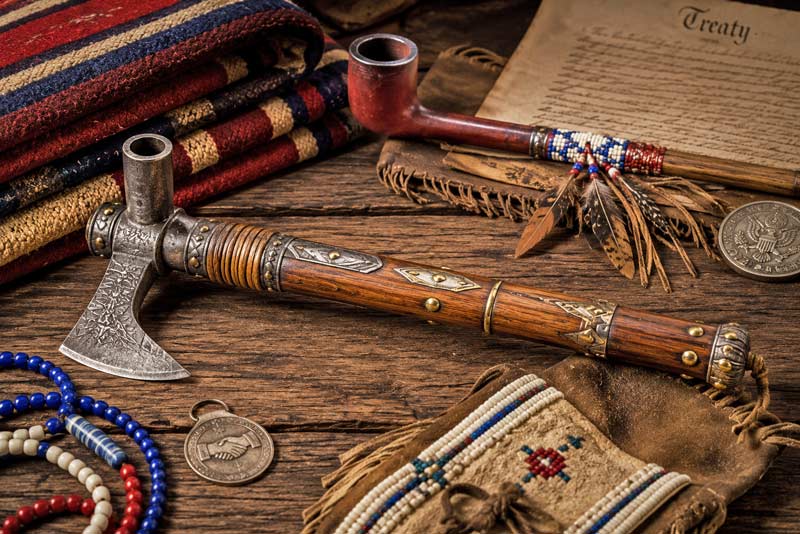
Perhaps the strangest evolution of the tomahawk was the creation of the pipe tomahawk, a remarkable tool that served two completely opposite purposes. At first glance, it looked like an ordinary trade tomahawk, but the hollow metal head connected to a drilled wooden handle, allowing it to function as a smoking pipe. One end could split wood or serve as a weapon, while the other could be used during ceremonies, negotiations, and important gatherings.
Pipe tomahawks became especially popular during the 18th and early 19th centuries, when they were frequently exchanged as diplomatic gifts between European officials and Native American leaders. They symbolized respect, alliance, and mutual trust. In many cases, a finely crafted pipe tomahawk was far more valuable as a ceremonial object than as a battlefield weapon. Elaborate examples featured engraved steel heads, brass tacks, silver inlays, colorful beadwork, and carved wooden handles that reflected the status of the person carrying them.
The combination seems contradictory today. How could the same object represent both peace and violence? Yet throughout history, many important tools carried symbolic meaning beyond their practical use. The pipe tomahawk reminded both sides that diplomacy and conflict often existed side by side on the American frontier. A meeting might begin with conversation and ceremonial smoking, but everyone present understood that the tomahawk remained close at hand if negotiations failed.
Very few historical weapons tell such a complex story. The pipe tomahawk wasn't simply an axe or a ceremonial pipe. It represented survival, craftsmanship, diplomacy, and the uncertain relationship between cultures living on an ever-changing frontier. That unique combination is one reason original examples remain among the most sought-after historical weapons by collectors today.
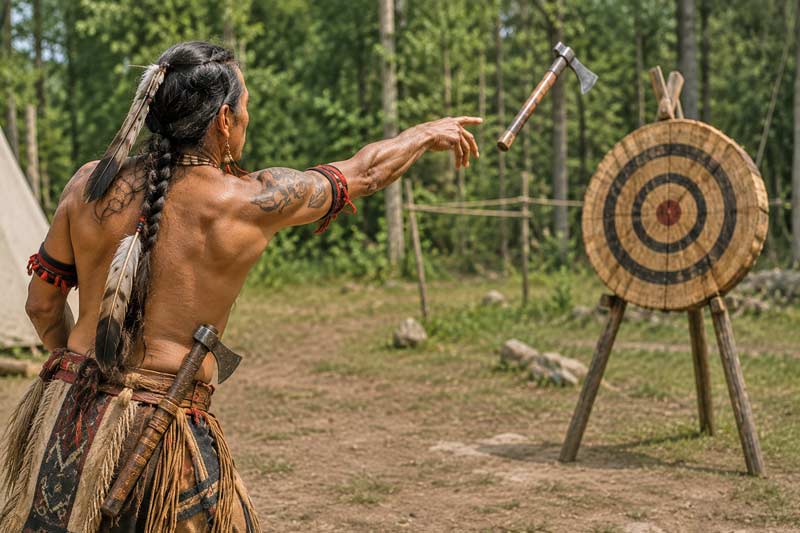
Yes, tomahawks could be thrown, but history looks very different from the endless spinning attacks shown in movies. A well-balanced tomahawk was capable of striking a target at short range, and throwing one may have been useful in hunting, competition, or a desperate moment during combat. Even so, deliberately giving up a valuable hand tool and close-range weapon was a serious gamble, especially if the throw missed or the opponent survived it.
The tomahawk's compact size makes throwing appear easier than it really is. For the blade to land effectively, the user must judge the distance, rotation, grip, and release with considerable precision. A throw from the wrong range could cause the handle, rather than the cutting edge, to strike the target. Skilled users could learn to control that rotation, but it was never the effortless trick that fictional warriors seem able to perform under any conditions.
Historical tomahawks also served many roles beyond combat. Surviving examples in museum collections are identified as tools, weapons, personal possessions, ceremonial objects, and items with spiritual significance, depending on the culture and the person who carried them. That variety makes it misleading to treat every tomahawk as a purpose-built throwing weapon.
Hollywood helped turn tomahawk throwing into the weapon's defining feature because it looks dramatic on screen. Movies often show characters hurling tomahawks accurately across impossible distances, then somehow recovering them moments later. It is another example of how entertainment exaggerates a real technique until the exaggeration becomes more famous than the history, a pattern we explore in 10 Weapon Myths Hollywood Got Completely Wrong.
The more accurate answer is that throwing was one possible use, not the tomahawk's entire purpose. Its real advantage was that it remained useful before, during, and after a confrontation. A warrior could carry it as a close-range weapon, a cutting tool, a symbol of status, or all three at once. Turning it into a projectile was an option, but rarely the only reason it was carried.
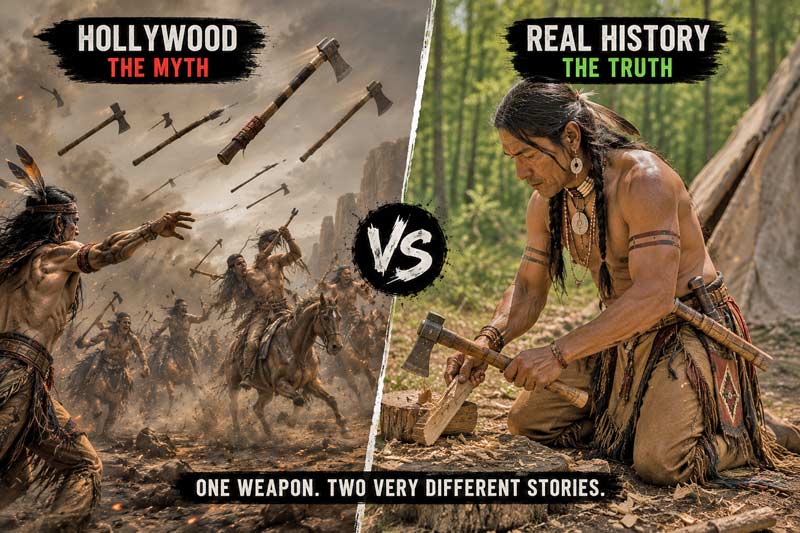
If Hollywood has taught audiences anything about tomahawks, it's that they are almost always flying through the air. From classic Westerns to modern action films, characters throw them with impossible accuracy, recover them effortlessly, and use them as if they were designed primarily as ranged weapons. While these scenes make for exciting entertainment, they bear little resemblance to how tomahawks were actually carried and used throughout history.
Movies have also created the impression that every Native American warrior carried an identical tomahawk. In reality, historical examples varied enormously. Some were simple working tools with little decoration, while others were finely crafted ceremonial pieces featuring engraved metal, carved wooden handles, beadwork, or even pipe bowls. Their appearance depended on the time period, the region, the individual owner, and whether the tomahawk was intended for everyday work, diplomacy, hunting, or combat.
Another common misconception is that tomahawks could easily split armor, chop through thick wooden doors, or survive endless abuse without damage. Real tomahawks were durable, but they were still carefully balanced tools. Like any axe, repeated misuse could chip the edge, loosen the handle, or break the haft. Their effectiveness came from smart design and versatility, not superhuman strength or indestructible construction.
Hollywood has exaggerated many historical weapons in exactly the same way. Switchblades became symbols of violent gangs, gravity knives developed a reputation far beyond their actual history, and countless martial arts weapons gained fictional abilities that their creators never intended. If you enjoy separating fact from fiction, you'll probably also like our articles on the biggest lies movies told you about martial arts weapons and how switchblades became the most feared knives in America.
Ironically, the real history of the tomahawk is far more interesting than the movie version. It wasn't famous because it was flashy. It earned its place in history because it adapted to changing cultures, served countless practical purposes, and remained useful for centuries after many other historical weapons disappeared.
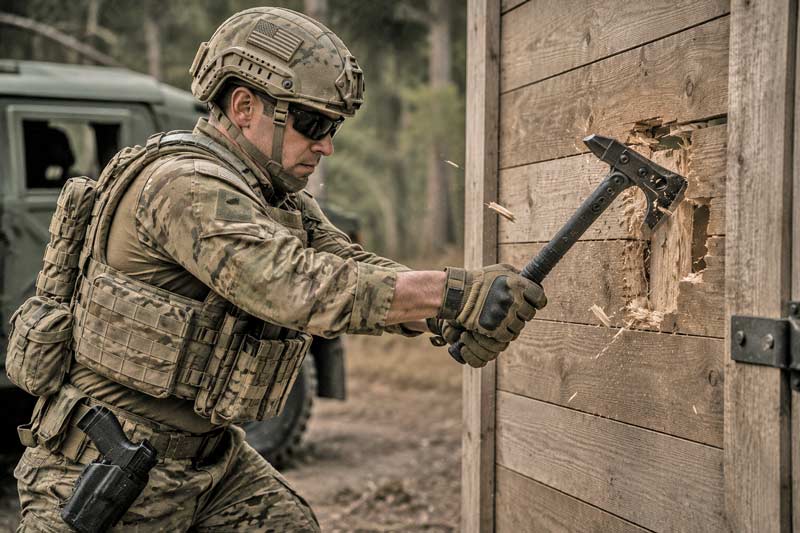
By the beginning of the 20th century, the tomahawk seemed destined to become a historical curiosity. Firearms had transformed warfare, industrial tools had replaced many traditional hand implements, and compact axes no longer appeared essential to a soldier's equipment. Yet the tomahawk never disappeared completely. During the Vietnam War, some American servicemen carried modern versions into the field, helping revive interest in a tool that many people assumed belonged only to the distant frontier.
Its return had less to do with throwing or hand-to-hand combat than with practical utility. A compact tomahawk could cut branches, break through light barriers, open containers, help prepare defensive positions, and perform emergency tasks around a campsite. Unlike a full-sized axe, it could be carried on a belt or attached to field gear without adding excessive bulk. That combination of portability and striking power gave the design new relevance in modern environments.
Contemporary tactical tomahawks have pushed that versatility even further. Many feature reinforced handles, rear spikes, pry edges, or sharpened beard sections intended for breaching, rescue work, and breaking materials. Some models are designed to punch through windows, remove obstacles, or create access points when ordinary hand tools are unavailable. In that sense, the modern tomahawk has returned to its original identity as a multipurpose tool rather than simply a weapon.
That is also what separates a tactical tomahawk from many fixed blade knives. A strong knife is excellent for cutting, carving, and countless field tasks, but it cannot deliver the same concentrated impact as a compact axe head. The tomahawk occupies a useful middle ground between a blade, a hammer, a pry tool, and a small axe, even though it cannot fully replace any specialized tool.
Modern designs may look radically different from the wood-handled trade tomahawks of the 1700s, but the basic idea has barely changed. The Stealth Tactical Tomahawk, for example, reflects the same principle that kept earlier versions useful: pack several capabilities into one compact object that can be carried wherever it might be needed.
The tomahawk's return proves that effective designs do not always vanish when technology advances. Sometimes they simply wait for new materials, new users, and a new purpose. The modern soldier may carry equipment that an 18th-century warrior could never have imagined, yet the small axe at their side remains instantly recognizable.
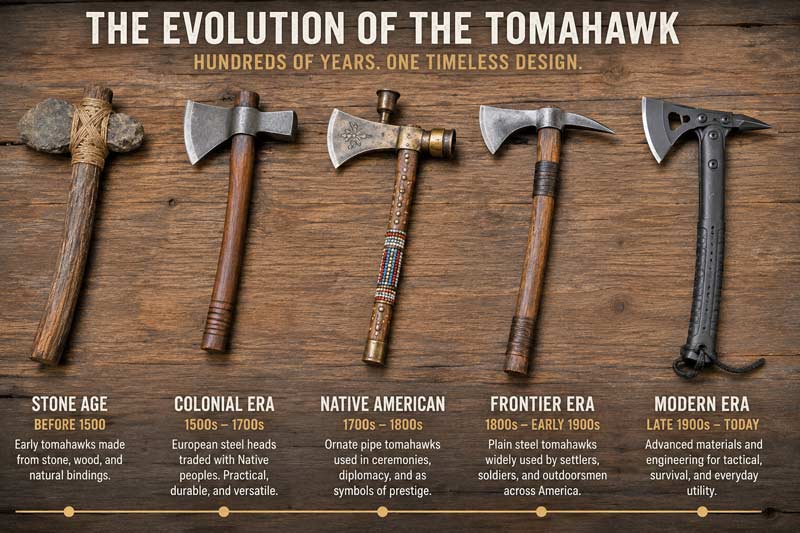
Thousands of weapons have come and gone throughout history, yet the tomahawk remains remarkably relevant. Its continued survival isn't the result of nostalgia or Hollywood popularity. It has endured because the original concept was so practical. A compact tool capable of chopping, hammering, prying, and, when absolutely necessary, defending its owner is just as useful today as it was centuries ago.
The tomahawk also occupies a unique place in American history. It tells the story of Indigenous innovation, European craftsmanship, frontier expansion, military adaptation, and modern engineering all at once. Few tools can trace a history that spans so many different cultures while continuing to evolve with each generation. That long journey has earned it a place alongside other legendary blades and tools that have shaped history, many of which we explore in our article about the world's most famous knives and the stories behind them.
Today, collectors appreciate historical tomahawks for their craftsmanship, outdoorsmen value them for their utility, and tactical users continue to find practical applications for modern designs. While styles and materials have changed dramatically over the centuries, the underlying philosophy remains exactly the same: carry one dependable tool that can solve a wide variety of problems. It's the same reason iconic tools like the Bowie knife continue to attract devoted followers long after their original era has passed.
Perhaps that's the strangest part of the tomahawk's history. It never became obsolete. Instead, it quietly adapted to changing times, new technologies, and different users without losing the qualities that made it valuable in the first place. From stone heads bound with rawhide to modern tactical steel, the tomahawk has proven that the simplest ideas are often the ones that last the longest.
The tomahawk has never belonged to just one moment in history. It began as a practical cutting and striking tool, changed through trade and cultural exchange, became a ceremonial object and symbol of authority, survived the frontier, and eventually returned as a modern tactical tool. Few weapons have transformed so many times without losing their basic identity.
That long evolution is what makes the tomahawk so fascinating. It shares something with other iconic American weapons, including the Bowie knife: both became larger-than-life symbols that were often misunderstood by the people who came later. In reality, their reputations were built not only on combat, but also on usefulness, adaptability, and the stories people attached to them. You can see that same divide between utility and legend in our comparison of the Bowie knife and the hunting knife.
The tomahawk's history also reminds us that the line between tool and weapon has always been more complicated than it appears. Many objects carried into battle began with ordinary practical purposes, a pattern explored in our article asking whether martial arts weapons were really farm tools. What made the tomahawk different was its ability to remain useful in both worlds without being limited to either one.
Today, the design continues to evolve through new materials, improved grips, specialized head shapes, and modern manufacturing. Yet anyone looking at a tactical tomahawk can still recognize the same compact profile carried centuries ago. That continuity is rare. The tomahawk did not survive because history refused to let it go. It survived because generation after generation kept finding new reasons to carry one.
Although tomahawks could be thrown at short range, they were not designed primarily as throwing weapons. Their greatest value came from their versatility. A tomahawk could chop wood, process game, perform camp chores, and serve as a close-range weapon when necessary. Throwing it meant risking the loss of an essential tool if the throw missed, so historical evidence suggests it was only one of many possible uses rather than its primary purpose.
Although the terms are sometimes used interchangeably, a tomahawk and a hatchet were developed with different priorities. A traditional hatchet is primarily a woodworking tool. It usually has a heavier head, a wedge-shaped blade for splitting wood, and is designed to maximize chopping efficiency. A tomahawk, on the other hand, was built to be lighter, faster, and more versatile. It could certainly cut wood, but it was also intended to be easy to carry and capable of serving many different purposes in the field.
Another key difference is balance. Tomahawks generally have thinner heads and a center of gravity closer to the handle, making them quicker to maneuver and, in some cases, suitable for throwing. Hatchets are typically head-heavy to generate more force when chopping logs or driving through dense wood. That extra weight makes them excellent camp tools but less agile than a traditional tomahawk.
Modern designs have blurred the distinction, and many tactical tomahawks borrow features from camping hatchets while some modern hatchets resemble historical tomahawks. In the end, the biggest difference isn't what they're called, but what they were designed to do. Hatchets excel at wood processing, while tomahawks have historically emphasized versatility, portability, and adaptability across a much wider range of tasks.
Yes, although their role has changed significantly. Modern tomahawks are used by outdoorsmen, campers, survival enthusiasts, first responders, and some military personnel who value their compact size and versatility. Rather than serving as dedicated weapons, today's tomahawks are more commonly used for practical tasks such as chopping kindling, clearing brush, breaching light barriers, breaking glass during emergency rescues, or performing general camp chores.
Advances in steel, handle materials, and manufacturing have made modern tomahawks stronger and lighter than their historical counterparts, while preserving the same compact profile that made them so useful centuries ago. Many feature full-tang construction, synthetic grips, and specialized head designs that improve durability without sacrificing portability.
Despite these modern improvements, the basic concept has remained remarkably consistent. Whether carried by a frontier traveler, a wilderness guide, or a modern survivalist, the tomahawk continues to succeed for the same reason it always has: it combines multiple useful functions into one dependable tool that is easy to carry wherever the job takes you.
In general, yes. Traditional tomahawks are lighter, more compact, and better balanced than most axes, making them easier to throw with consistent rotation. Their slimmer heads and longer handles relative to their weight allow them to spin more predictably, which is why tomahawks have become the preferred choice for recreational throwing competitions and target sports.
That said, historical tomahawks were not created specifically for throwing. While many skilled warriors undoubtedly knew how to throw them when the situation called for it, doing so meant giving up a valuable tool that might be needed moments later. For most of history, throwing a tomahawk was an occasional tactic rather than its primary purpose.
Today, if you're interested in target throwing, it's best to use a tomahawk or axe designed specifically for that activity. These models are engineered with proper balance, durable construction, and safety in mind, making them much more suitable than historical replicas or tactical tomahawks intended for field use.
The Tomahawk Was Never Just a Weapon
When most people hear the word "tomahawk," they picture a Native American warrior charging into battle with a small axe in hand. While the tomahawk certainly earned its reputation as a formidable weapon, that image tells only a small part of its story. Long before it became associated with combat, the tomahawk was an essential everyday tool. It helped build shelters, split firewood, prepare food, clear brush, and perform countless other tasks that were critical for survival. Like many of history's most successful tools, its greatest strength was its versatility.
The word "tomahawk" itself comes from an Algonquian term referring to a cutting or striking tool. Early versions were crafted from sharpened stone, bone, or antler and securely fastened to wooden handles. Although these primitive designs lacked the durability of later steel heads, they were remarkably effective for the needs of the people who made them. As different tribes adapted the design to suit their own environments, the tomahawk gradually evolved into a wide variety of shapes and sizes, each with its own purpose.
That practical origin is one reason the tomahawk has survived for centuries while so many other historical weapons disappeared. Like the kukri and other multi-purpose blades, it was never limited to a single job. If you're interested in another tool that blurred the line between everyday utility and combat, check out our article on what a kukri knife is and what it's used for. Even today, modern axes and hatchets continue to follow the same philosophy that made the original tomahawk indispensable: one compact tool capable of handling almost anything.
Stone, Bone, and the First Tomahawks
The earliest tools we now associate with tomahawks looked very different from the steel-headed versions most people recognize today. Before metal became widely available, Native American craftspeople shaped stone, bone, and antler into compact striking heads that could be mounted onto wooden handles. Some were ground to a sharp edge, while others were designed more like heavy clubs. The final form depended on the available materials, local traditions, and the work the tool was expected to perform.
Creating one of these early tomahawks required patience and skill. A suitable stone had to be chipped or ground into shape, then secured to a handle using rawhide, sinew, plant fibers, or carefully fitted wooden sockets. A poorly attached head could loosen after only a few strikes, so the strength of the binding mattered almost as much as the cutting edge itself. What appears simple at first glance was actually the result of generations of experimentation.
These early tools were used for much more than combat. They could split small pieces of wood, break bone, process game, clear vegetation, and assist with camp construction. In an environment where every object had to justify the effort required to make and carry it, versatility was essential. A tool that worked only as a weapon would have been far less valuable than one that could serve half a dozen practical purposes throughout the day.
It is also important to remember that there was no single universal "Native American tomahawk." Different nations developed their own tools, styles, and preferences, and many of the designs now grouped under one familiar name would not have been identical. The simplified image seen in films hides a much more complex history shaped by geography, trade, craftsmanship, and the needs of individual communities.
How European Trade Changed the Tomahawk Forever
The tomahawk changed dramatically after sustained contact between Native American communities and European traders. Stone and bone heads had served their purpose for generations, but forged iron and steel offered sharper edges, greater durability, and easier maintenance. European-made axe heads quickly became highly valued trade goods, and Native craftspeople adapted them into familiar handle designs that were lighter and more compact than full-sized axes.
This exchange created what are now commonly called trade tomahawks. Blacksmiths produced large numbers of small iron axe heads specifically for use in North American trade, often shaping them with narrow blades and rounded or pointed polls. Once fitted to wooden handles, they became useful tools for cutting, camp work, hunting, and combat. Their compact size also made them easier to carry than heavier European axes.
The change was not simply a case of Europeans replacing an older Indigenous design. The tomahawk that emerged from this period was a hybrid shaped by both cultures. European metalworking supplied new materials and manufacturing techniques, while Native users influenced the size, balance, hafting, and practical role of the finished tool. This kind of cultural exchange has shaped many famous weapons, as explored in our article about how different cultures influenced the world's most famous knives.
Trade tomahawks also became more than ordinary equipment. They could be exchanged during negotiations, presented as gifts, carried as symbols of authority, or decorated to reflect the owner's identity and status. Some examples featured engraved heads, carved handles, brass fittings, or inlaid designs. A practical axe had evolved into an object that could communicate wealth, alliance, and prestige before it was ever used to cut anything.
This transformation helps explain why the tomahawk became so closely tied to the history of colonial North America. It belonged entirely to neither side. Instead, it emerged from trade, conflict, cooperation, and adaptation, becoming one of the clearest examples of how a simple tool can change when different cultures reshape it for their own needs.
The Pipe Tomahawk: A Weapon That Could Also Make Peace
Perhaps the strangest evolution of the tomahawk was the creation of the pipe tomahawk, a remarkable tool that served two completely opposite purposes. At first glance, it looked like an ordinary trade tomahawk, but the hollow metal head connected to a drilled wooden handle, allowing it to function as a smoking pipe. One end could split wood or serve as a weapon, while the other could be used during ceremonies, negotiations, and important gatherings.
Pipe tomahawks became especially popular during the 18th and early 19th centuries, when they were frequently exchanged as diplomatic gifts between European officials and Native American leaders. They symbolized respect, alliance, and mutual trust. In many cases, a finely crafted pipe tomahawk was far more valuable as a ceremonial object than as a battlefield weapon. Elaborate examples featured engraved steel heads, brass tacks, silver inlays, colorful beadwork, and carved wooden handles that reflected the status of the person carrying them.
The combination seems contradictory today. How could the same object represent both peace and violence? Yet throughout history, many important tools carried symbolic meaning beyond their practical use. The pipe tomahawk reminded both sides that diplomacy and conflict often existed side by side on the American frontier. A meeting might begin with conversation and ceremonial smoking, but everyone present understood that the tomahawk remained close at hand if negotiations failed.
Very few historical weapons tell such a complex story. The pipe tomahawk wasn't simply an axe or a ceremonial pipe. It represented survival, craftsmanship, diplomacy, and the uncertain relationship between cultures living on an ever-changing frontier. That unique combination is one reason original examples remain among the most sought-after historical weapons by collectors today.
Did Native American Warriors Really Throw Their Tomahawks?
Yes, tomahawks could be thrown, but history looks very different from the endless spinning attacks shown in movies. A well-balanced tomahawk was capable of striking a target at short range, and throwing one may have been useful in hunting, competition, or a desperate moment during combat. Even so, deliberately giving up a valuable hand tool and close-range weapon was a serious gamble, especially if the throw missed or the opponent survived it.
The tomahawk's compact size makes throwing appear easier than it really is. For the blade to land effectively, the user must judge the distance, rotation, grip, and release with considerable precision. A throw from the wrong range could cause the handle, rather than the cutting edge, to strike the target. Skilled users could learn to control that rotation, but it was never the effortless trick that fictional warriors seem able to perform under any conditions.
Historical tomahawks also served many roles beyond combat. Surviving examples in museum collections are identified as tools, weapons, personal possessions, ceremonial objects, and items with spiritual significance, depending on the culture and the person who carried them. That variety makes it misleading to treat every tomahawk as a purpose-built throwing weapon.
Hollywood helped turn tomahawk throwing into the weapon's defining feature because it looks dramatic on screen. Movies often show characters hurling tomahawks accurately across impossible distances, then somehow recovering them moments later. It is another example of how entertainment exaggerates a real technique until the exaggeration becomes more famous than the history, a pattern we explore in 10 Weapon Myths Hollywood Got Completely Wrong.
The more accurate answer is that throwing was one possible use, not the tomahawk's entire purpose. Its real advantage was that it remained useful before, during, and after a confrontation. A warrior could carry it as a close-range weapon, a cutting tool, a symbol of status, or all three at once. Turning it into a projectile was an option, but rarely the only reason it was carried.
Hollywood Turned the Tomahawk Into Something It Never Was
If Hollywood has taught audiences anything about tomahawks, it's that they are almost always flying through the air. From classic Westerns to modern action films, characters throw them with impossible accuracy, recover them effortlessly, and use them as if they were designed primarily as ranged weapons. While these scenes make for exciting entertainment, they bear little resemblance to how tomahawks were actually carried and used throughout history.
Movies have also created the impression that every Native American warrior carried an identical tomahawk. In reality, historical examples varied enormously. Some were simple working tools with little decoration, while others were finely crafted ceremonial pieces featuring engraved metal, carved wooden handles, beadwork, or even pipe bowls. Their appearance depended on the time period, the region, the individual owner, and whether the tomahawk was intended for everyday work, diplomacy, hunting, or combat.
Another common misconception is that tomahawks could easily split armor, chop through thick wooden doors, or survive endless abuse without damage. Real tomahawks were durable, but they were still carefully balanced tools. Like any axe, repeated misuse could chip the edge, loosen the handle, or break the haft. Their effectiveness came from smart design and versatility, not superhuman strength or indestructible construction.
Hollywood has exaggerated many historical weapons in exactly the same way. Switchblades became symbols of violent gangs, gravity knives developed a reputation far beyond their actual history, and countless martial arts weapons gained fictional abilities that their creators never intended. If you enjoy separating fact from fiction, you'll probably also like our articles on the biggest lies movies told you about martial arts weapons and how switchblades became the most feared knives in America.
Ironically, the real history of the tomahawk is far more interesting than the movie version. It wasn't famous because it was flashy. It earned its place in history because it adapted to changing cultures, served countless practical purposes, and remained useful for centuries after many other historical weapons disappeared.
Why Modern Soldiers Started Carrying Tomahawks Again
By the beginning of the 20th century, the tomahawk seemed destined to become a historical curiosity. Firearms had transformed warfare, industrial tools had replaced many traditional hand implements, and compact axes no longer appeared essential to a soldier's equipment. Yet the tomahawk never disappeared completely. During the Vietnam War, some American servicemen carried modern versions into the field, helping revive interest in a tool that many people assumed belonged only to the distant frontier.
Its return had less to do with throwing or hand-to-hand combat than with practical utility. A compact tomahawk could cut branches, break through light barriers, open containers, help prepare defensive positions, and perform emergency tasks around a campsite. Unlike a full-sized axe, it could be carried on a belt or attached to field gear without adding excessive bulk. That combination of portability and striking power gave the design new relevance in modern environments.
Contemporary tactical tomahawks have pushed that versatility even further. Many feature reinforced handles, rear spikes, pry edges, or sharpened beard sections intended for breaching, rescue work, and breaking materials. Some models are designed to punch through windows, remove obstacles, or create access points when ordinary hand tools are unavailable. In that sense, the modern tomahawk has returned to its original identity as a multipurpose tool rather than simply a weapon.
That is also what separates a tactical tomahawk from many fixed blade knives. A strong knife is excellent for cutting, carving, and countless field tasks, but it cannot deliver the same concentrated impact as a compact axe head. The tomahawk occupies a useful middle ground between a blade, a hammer, a pry tool, and a small axe, even though it cannot fully replace any specialized tool.
Modern designs may look radically different from the wood-handled trade tomahawks of the 1700s, but the basic idea has barely changed. The Stealth Tactical Tomahawk, for example, reflects the same principle that kept earlier versions useful: pack several capabilities into one compact object that can be carried wherever it might be needed.
The tomahawk's return proves that effective designs do not always vanish when technology advances. Sometimes they simply wait for new materials, new users, and a new purpose. The modern soldier may carry equipment that an 18th-century warrior could never have imagined, yet the small axe at their side remains instantly recognizable.
Why the Tomahawk Has Survived for Hundreds of Years
Thousands of weapons have come and gone throughout history, yet the tomahawk remains remarkably relevant. Its continued survival isn't the result of nostalgia or Hollywood popularity. It has endured because the original concept was so practical. A compact tool capable of chopping, hammering, prying, and, when absolutely necessary, defending its owner is just as useful today as it was centuries ago.
The tomahawk also occupies a unique place in American history. It tells the story of Indigenous innovation, European craftsmanship, frontier expansion, military adaptation, and modern engineering all at once. Few tools can trace a history that spans so many different cultures while continuing to evolve with each generation. That long journey has earned it a place alongside other legendary blades and tools that have shaped history, many of which we explore in our article about the world's most famous knives and the stories behind them.
Today, collectors appreciate historical tomahawks for their craftsmanship, outdoorsmen value them for their utility, and tactical users continue to find practical applications for modern designs. While styles and materials have changed dramatically over the centuries, the underlying philosophy remains exactly the same: carry one dependable tool that can solve a wide variety of problems. It's the same reason iconic tools like the Bowie knife continue to attract devoted followers long after their original era has passed.
Perhaps that's the strangest part of the tomahawk's history. It never became obsolete. Instead, it quietly adapted to changing times, new technologies, and different users without losing the qualities that made it valuable in the first place. From stone heads bound with rawhide to modern tactical steel, the tomahawk has proven that the simplest ideas are often the ones that last the longest.
The Tomahawk's Story Is Still Being Written
The tomahawk has never belonged to just one moment in history. It began as a practical cutting and striking tool, changed through trade and cultural exchange, became a ceremonial object and symbol of authority, survived the frontier, and eventually returned as a modern tactical tool. Few weapons have transformed so many times without losing their basic identity.
That long evolution is what makes the tomahawk so fascinating. It shares something with other iconic American weapons, including the Bowie knife: both became larger-than-life symbols that were often misunderstood by the people who came later. In reality, their reputations were built not only on combat, but also on usefulness, adaptability, and the stories people attached to them. You can see that same divide between utility and legend in our comparison of the Bowie knife and the hunting knife.
The tomahawk's history also reminds us that the line between tool and weapon has always been more complicated than it appears. Many objects carried into battle began with ordinary practical purposes, a pattern explored in our article asking whether martial arts weapons were really farm tools. What made the tomahawk different was its ability to remain useful in both worlds without being limited to either one.
Today, the design continues to evolve through new materials, improved grips, specialized head shapes, and modern manufacturing. Yet anyone looking at a tactical tomahawk can still recognize the same compact profile carried centuries ago. That continuity is rare. The tomahawk did not survive because history refused to let it go. It survived because generation after generation kept finding new reasons to carry one.
Were Tomahawks Really Designed to Be Thrown?
Although tomahawks could be thrown at short range, they were not designed primarily as throwing weapons. Their greatest value came from their versatility. A tomahawk could chop wood, process game, perform camp chores, and serve as a close-range weapon when necessary. Throwing it meant risking the loss of an essential tool if the throw missed, so historical evidence suggests it was only one of many possible uses rather than its primary purpose.
What's the Difference Between a Tomahawk and a Hatchet?
Although the terms are sometimes used interchangeably, a tomahawk and a hatchet were developed with different priorities. A traditional hatchet is primarily a woodworking tool. It usually has a heavier head, a wedge-shaped blade for splitting wood, and is designed to maximize chopping efficiency. A tomahawk, on the other hand, was built to be lighter, faster, and more versatile. It could certainly cut wood, but it was also intended to be easy to carry and capable of serving many different purposes in the field.
Another key difference is balance. Tomahawks generally have thinner heads and a center of gravity closer to the handle, making them quicker to maneuver and, in some cases, suitable for throwing. Hatchets are typically head-heavy to generate more force when chopping logs or driving through dense wood. That extra weight makes them excellent camp tools but less agile than a traditional tomahawk.
Modern designs have blurred the distinction, and many tactical tomahawks borrow features from camping hatchets while some modern hatchets resemble historical tomahawks. In the end, the biggest difference isn't what they're called, but what they were designed to do. Hatchets excel at wood processing, while tomahawks have historically emphasized versatility, portability, and adaptability across a much wider range of tasks.
Are Tomahawks Still Used Today?
Yes, although their role has changed significantly. Modern tomahawks are used by outdoorsmen, campers, survival enthusiasts, first responders, and some military personnel who value their compact size and versatility. Rather than serving as dedicated weapons, today's tomahawks are more commonly used for practical tasks such as chopping kindling, clearing brush, breaching light barriers, breaking glass during emergency rescues, or performing general camp chores.
Advances in steel, handle materials, and manufacturing have made modern tomahawks stronger and lighter than their historical counterparts, while preserving the same compact profile that made them so useful centuries ago. Many feature full-tang construction, synthetic grips, and specialized head designs that improve durability without sacrificing portability.
Despite these modern improvements, the basic concept has remained remarkably consistent. Whether carried by a frontier traveler, a wilderness guide, or a modern survivalist, the tomahawk continues to succeed for the same reason it always has: it combines multiple useful functions into one dependable tool that is easy to carry wherever the job takes you.
Can You Throw a Tomahawk Better Than an Axe?
In general, yes. Traditional tomahawks are lighter, more compact, and better balanced than most axes, making them easier to throw with consistent rotation. Their slimmer heads and longer handles relative to their weight allow them to spin more predictably, which is why tomahawks have become the preferred choice for recreational throwing competitions and target sports.
That said, historical tomahawks were not created specifically for throwing. While many skilled warriors undoubtedly knew how to throw them when the situation called for it, doing so meant giving up a valuable tool that might be needed moments later. For most of history, throwing a tomahawk was an occasional tactic rather than its primary purpose.
Today, if you're interested in target throwing, it's best to use a tomahawk or axe designed specifically for that activity. These models are engineered with proper balance, durable construction, and safety in mind, making them much more suitable than historical replicas or tactical tomahawks intended for field use.
You May Also Be Interested In:
- The Strange History of the Blackjack
- The Strange History of Cane Swords
- The Strange History of the Push Dagger
- The Strange History of Belt Buckle Knives
- The History and Evolution of the Karambit Knife
- History and Evolution of Self-Defense Keychains
- Why Were Nunchucks Actually Invented? (The Real History Might Surprise You)
- What Is a Push Dagger? History, Design, and Modern Uses
- The Most Famous Knife Fight in American History
- A Brief History of the Push Dagger: From Trench Warfare to Modern EDC
Leave a Reply