




The Biggest Lies Movies Told You About Martial Arts Weapons
June 10th, 2026
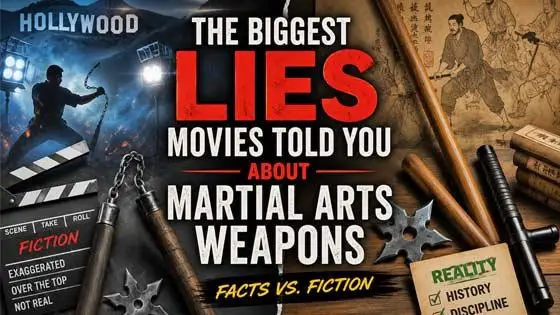
Movies have done a lot for martial arts weapons. They made nunchaku iconic, turned ninja stars into legendary tools of stealth, and convinced generations of people that mastering a weapon mostly involves a dramatic training montage and a few cool spins.
The problem is that Hollywood rarely cares about accuracy.
Martial arts weapons in movies are usually exaggerated, oversimplified, or completely misunderstood. Weapons fly farther than they should, hit harder than reality allows, and somehow end up in perfectly choreographed one-on-one duels where nobody seems concerned about physics. In real martial arts, things are usually much messier, much harder, and far more interesting.
Some movie myths are harmless fun. Others have completely changed how people think certain weapons were actually used. So, let's separate movie fantasy from reality and look at some of the biggest lies films told us about martial arts weapons.
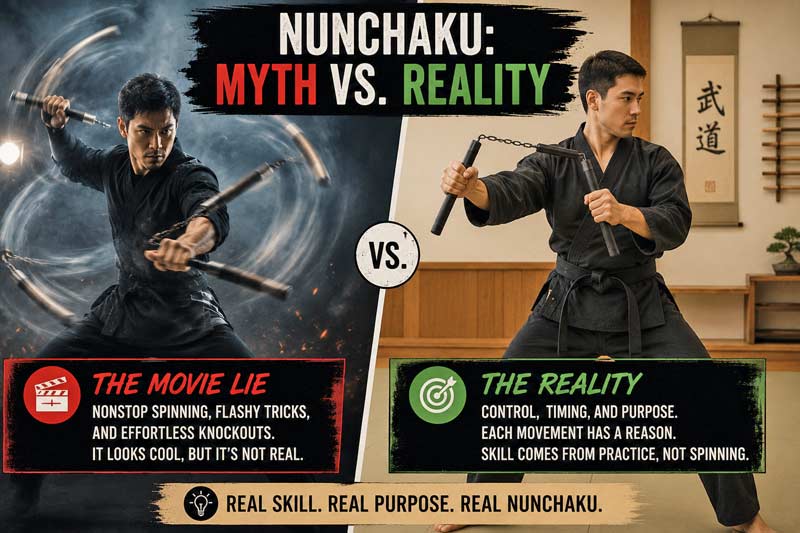
If movies taught us anything about nunchaku, it is that they are apparently supposed to spin nonstop.
According to Hollywood logic, a skilled martial artist spends every second twirling nunchucks like helicopter blades before instantly knocking out an entire room of attackers. The weapon never slows down, never gets tangled, and somehow always looks effortless.
It makes for great entertainment.
It just is not how nunchaku actually work.
In real martial arts training, experienced practitioners are not constantly spinning nunchaku for dramatic effect. Most movements are far more controlled, deliberate, and practical. Spinning certainly exists, but it usually serves a purpose: maintaining momentum, transitioning between positions, setting up strikes, or recovering after movement. Endless flashy rotations are often more about performance than effectiveness.
This is also one of the biggest reasons beginners get frustrated. Movies make nunchaku look intuitive, when in reality they require timing, rhythm, and patience. Most people quickly discover the weapon has very little sympathy for bad timing. Miss a transition and the nunchaku immediately remind you that physics is in charge.
Ironically, the more skilled someone becomes with nunchaku, the less exaggerated their movements often look. Experienced practitioners focus on control rather than chaos. What appears effortless on screen usually took years of repetition to make look smooth in real life.
If you have ever wondered why nunchaku became so iconic in the first place, our guide on why nunchucks were originally invented explains the weapon's surprisingly practical roots. You can also dive into the real history of nunchaku or learn how to choose the right nunchaku for your skill level if you are curious about training with them yourself.
Nunchaku are not about nonstop spinning. Real skill comes from timing, control, transitions, and understanding momentum, not looking like an action movie scene.
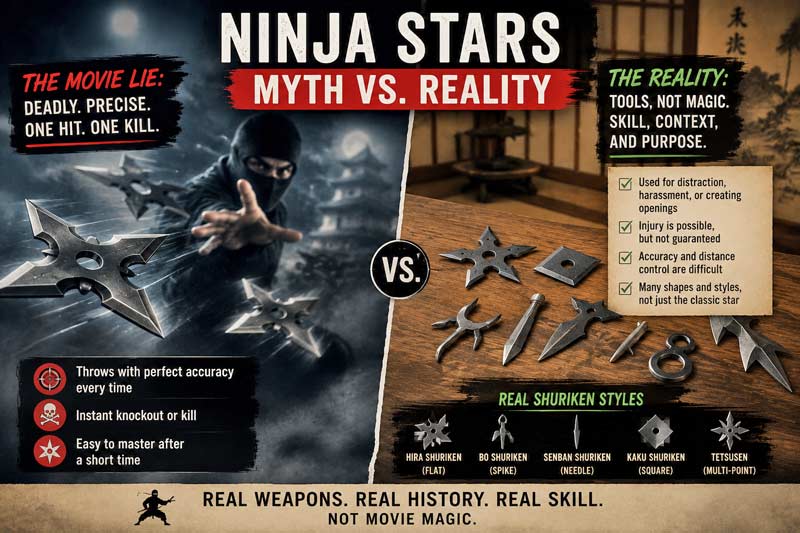
Movies love to portray ninja stars as tiny weapons of instant destruction.
A villain appears, a few throwing stars fly through the air, and somehow they land with impossible accuracy and fight-ending power. In Hollywood, a shuriken often behaves like a miniature throwing knife with supernatural precision.
Reality is a lot less dramatic.
Historically, shuriken were not usually the instant knockout weapons movies turned them into. In many cases, they were used more for distraction, harassment, slowing an opponent down, or creating openings rather than ending a fight immediately. A well-placed throw could certainly injure someone, but real-world use was far more nuanced than movies suggest.
Part of the confusion comes from the fact that "shuriken" does not always mean the classic star shape people picture. The word can refer to different styles of concealed throwing weapons, some of which looked more like spikes or flat blades than what Hollywood popularized. Over time, movies simplified everything into the iconic ninja star image because, frankly, it looked cooler on screen.
There is also a practical problem movies tend to ignore: accuracy is hard.
Throwing any weapon consistently takes skill, repetition, distance control, and patience. Real practitioners spend considerable time learning rotation, grip, timing, and spacing. It is not the kind of thing someone suddenly becomes an expert at after a dramatic training montage.
Ironically, Hollywood made ninja stars more famous than they ever would have been otherwise, even if the version most people recognize is heavily exaggerated. If you want to dive deeper, our guide explaining what a shuriken actually is breaks down the weapon in more detail. You can also explore the evolution of the shuriken and whether throwing stars are actually effective weapons if you are curious how much movie fiction shaped modern perceptions.
For readers interested in traditional styles, there are also many different types of throwing stars and broader categories of ninja weapons that rarely get accurate representation in movies.
Ninja stars were real weapons, but Hollywood greatly exaggerated how deadly and easy to use they actually were.
If movies are to be believed, bo staff fighting mostly consists of spinning a long stick as fast as possible while somehow defeating multiple opponents at once.
The choreography usually looks incredible. A character twirls the staff nonstop, blocks everything effortlessly, and moves with the kind of precision that suggests they mastered the weapon sometime between scenes.
It looks cool.
It is also wildly misleading.
In real martial arts, the bo staff is far more about control than spectacle. Skilled practitioners focus on timing, leverage, footwork, positioning, and distance management. Spinning exists, but like nunchaku, it usually serves a purpose. It helps maintain movement, create transitions, or generate momentum rather than simply looking impressive.
One of the biggest movie myths is that spinning automatically equals skill. In reality, someone can learn flashy staff movements fairly quickly and still struggle with basic fundamentals like targeting, stance, recovery, or controlling range under pressure.
This is partly why beginners are often surprised by how technical staff training becomes. At first, the weapon feels approachable because it is balanced and relatively intuitive to hold. Then the details start piling up. Hand placement matters. Timing matters. Footwork matters. Suddenly, what looked simple in movies starts feeling much more complicated.
Another thing Hollywood rarely shows is how important staff length can be. The wrong size bo staff can make training awkward and frustrating, especially when trying to develop proper mechanics. If you are unsure where to start, our guide on what size bo staff you should use explains how to choose one based on height and experience level. You can also explore what a bo staff actually is or dive deeper into different martial arts staffs and how they are traditionally used.
Ironically, the more experienced someone becomes with a bo staff, the less dramatic their movements often look. Efficiency tends to replace flashy spinning.
Bo staff fighting is not about endless spinning. Real skill comes from timing, leverage, footwork, positioning, and learning how to control distance.
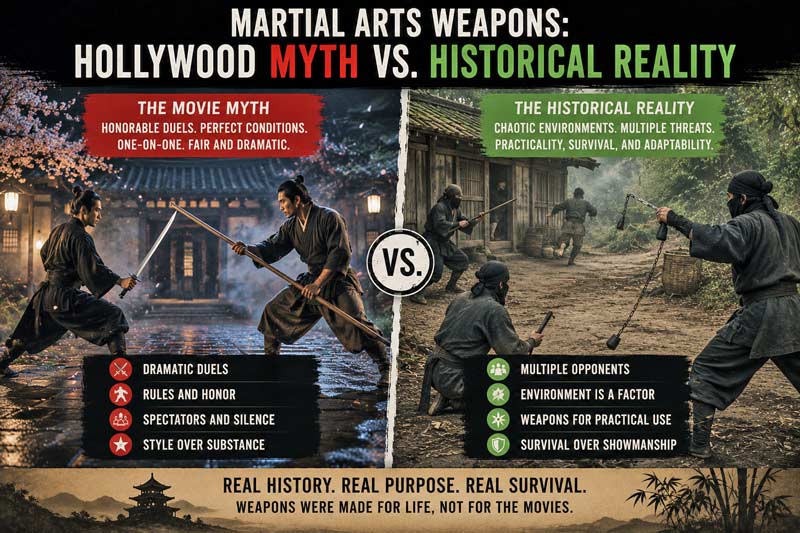
Movies love a good duel.
Two skilled fighters face each other in dramatic silence. Nobody interrupts. Nobody runs. Nobody uses the environment. The fight becomes a perfectly choreographed contest of honor where each person patiently waits their turn to attack.
It makes for great storytelling.
Historically, it was often nothing like reality.
Many martial arts weapons developed in environments that were chaotic, unpredictable, and practical. Battlefields were messy. Ambushes happened. Multiple attackers were common. Weapons were often chosen because they were accessible, concealable, adaptable, or useful in tight spaces, not because they looked impressive in a cinematic showdown.
This is one reason ninja weapons are so misunderstood. Movies often portray them as magical tools designed for dramatic fights, when many were valued because they were practical, versatile, or useful for distraction and escape. A weapon like a shuriken, for example, was not necessarily about instantly defeating an opponent. In many cases, it could be used to create openings, disrupt movement, or buy time.
The same idea applies to many traditional weapons that look unusual today. Chained weapons, compact striking tools, and staff weapons often evolved around practicality and adaptability rather than theatrical combat. Real martial arts history is usually far less glamorous than movies, but arguably much more interesting.
If you want to explore the broader world of traditional ninja weapons, it becomes clear pretty quickly that movies simplified many of them into dramatic stereotypes. You can also browse different types of chained weapons to see how unusual some historical weapon systems actually became over time.
Ironically, one of the biggest myths movies created is the idea that martial arts weapons existed mainly for dramatic one-on-one fights. In reality, survival and practicality usually mattered far more than style.
Martial arts weapons were not designed for perfectly choreographed duels. Many evolved for practicality, unpredictability, multiple opponents, or survival in chaotic situations.
Movies tend to treat tonfa like miniature clubs.
A character grabs them, starts swinging wildly, and suddenly turns into an unstoppable striking machine. On screen, tonfa are often portrayed as purely offensive weapons meant for aggressive attacks and dramatic spinning combinations.
Reality is a little more complicated.
Historically, tonfa were valued as much for defense and control as they were for striking. Their unique side handle design made them especially useful for blocking, redirecting force, protecting the forearm, and controlling distance. Yes, they could absolutely be used offensively, but reducing them to "just hitting weapons" misses a big part of what made them effective.
This is also one reason tonfa can feel awkward for beginners. Movies make them look intuitive, but traditional handling often feels unnatural at first. Many people instinctively want to swing them like short batons when real technique involves positioning, wrist control, defensive movement, and smooth transitions between grips.
Ironically, the more someone understands tonfa, the less flashy their movements often become. Experienced practitioners usually rely on efficiency and control rather than dramatic spinning. In many cases, subtle positioning matters more than speed.
Tonfa also have a much more interesting background than movies usually acknowledge. If you want to dive deeper, our guide on what a tonfa weapon is and how it was originally used explains how this traditional tool evolved over time. You can also browse different styles of tonfa to see how training versions vary in design and handling.
The funny thing is that Hollywood accidentally made tonfa look easier than they really are. In reality, clean technique often takes much longer to develop than movies would have you believe.
Tonfa were not just offensive striking weapons. Much of their effectiveness came from defense, positioning, control, and smart movement.
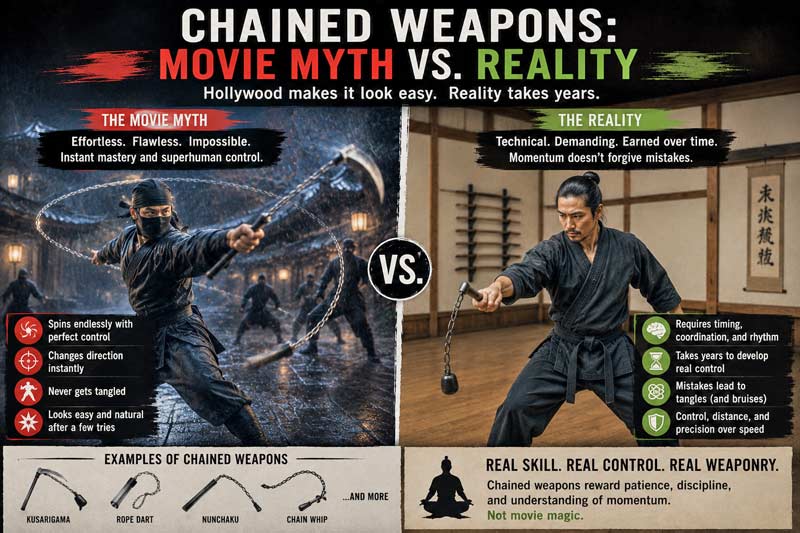
Movies have a strange relationship with chained weapons.
On screen, they seem almost magical. A fighter swings a chain weapon around effortlessly, wraps up opponents with impossible precision, changes direction instantly, and somehow never gets tangled in the process. Whether it is a kusarigama, rope dart, chain whip, or another flexible weapon, Hollywood usually makes them look wildly easy to control.
Reality tends to be much less graceful at first.
Flexible weapons are notoriously difficult because momentum does not forgive mistakes. Unlike rigid weapons that move predictably, chained weapons are constantly shifting direction and speed. Timing matters. Positioning matters. Rhythm matters. One small mistake can quickly turn smooth movement into chaos.
This is one reason so many martial artists consider flexible weapons among the hardest to learn. They demand coordination that movies rarely show. Beginners are not just learning techniques. They are learning how momentum behaves, how to recover when things go wrong, and occasionally how to avoid accidentally hitting themselves in the process.
The funny thing is that movies accidentally create unrealistic expectations. Someone watches a character effortlessly spinning a chain weapon and assumes it will feel natural after a few practice sessions. Then reality arrives very quickly.
If you have ever wondered why these weapons feel so difficult, our breakdown of the hardest martial arts weapon to master explains why momentum-based weapons often rank near the top. You can also explore different styles of chained weapons to see just how varied and technically demanding they can be.
Ironically, this is one area where movies actually make martial artists look superhuman. A skilled practitioner can absolutely make chained weapons look effortless, but getting to that point usually takes far more time and frustration than a training montage would suggest.
Chained weapons are not easy to control. Real skill comes from timing, coordination, rhythm, and learning how to manage momentum without losing control.
Movies love a good training montage.
A character struggles for about thirty seconds, gets frustrated once, then suddenly starts moving with impossible confidence while spinning a complicated weapon like they have been training for years. Few weapons get this treatment more than the three-section staff.
On screen, it usually looks intimidating at first and effortless shortly after.
Reality is much less forgiving.
The three-section staff is widely considered one of the hardest martial arts weapons to actually learn well because it combines the challenges of both rigid and flexible weapons into one system. It moves unpredictably, changes direction quickly, and demands timing that most beginners simply have not developed yet.
What movies rarely show is how frustrating the early learning phase can be. Small timing mistakes compound quickly. A movement that feels smooth in theory suddenly falls apart once momentum enters the equation. Many beginners spend more time recovering from mistakes than executing techniques cleanly.
There is also a mental challenge that movies completely skip over. Hesitation becomes a problem. The moment someone gets tense, movement becomes stiff. Stiffness disrupts rhythm, and disrupted rhythm makes the weapon harder to control. It is one of those martial arts weapons that tends to humble people quickly.
Ironically, that difficulty is part of what makes the weapon so impressive when someone truly masters it. A skilled practitioner makes the three-section staff look smooth, fluid, and almost effortless, which is probably why movies exaggerate it in the first place.
If this weapon caught your attention, you can explore different styles of three-section staffs or read our breakdown of the hardest martial arts weapon to master to see why this weapon consistently lands near the top of the difficulty conversation. For a broader look at traditional staff weapons, our guide to martial arts staffs goes much deeper into training styles and weapon variations.
The funny thing is that Hollywood accidentally creates impossible expectations. People see a few dramatic scenes and assume mastery happens quickly, when in reality even basic control can take considerable patience.
The three-section staff is not a weapon most people master quickly. Real proficiency takes timing, coordination, rhythm, patience, and a lot more practice than movies suggest.
To be fair, movies are not trying to be documentaries.
A perfectly realistic martial arts weapon scene would probably frustrate audiences. Real training is repetitive. Mistakes happen constantly. Even highly skilled practitioners spend years refining timing, control, and movement before things start looking smooth.
That does not always translate into exciting entertainment.
Hollywood tends to exaggerate martial arts weapons for one simple reason: spectacle. Endless nunchaku spinning looks exciting. Ninja stars with perfect accuracy feel dramatic. A three-section staff mastered after one short montage keeps the story moving.
The problem is that these exaggerations slowly become accepted as fact. Over time, people start assuming ninja stars were magical weapons, bo staffs were mostly about spinning, or chained weapons somehow behave like obedient extensions of the body from day one.
Ironically, the truth is often much more interesting than the movie version.
Real martial arts weapons come with history, practical design, steep learning curves, and surprising details that movies usually ignore. A tonfa is more defensive than many people realize. Shuriken were often used differently than Hollywood suggests. And weapons like the three-section staff are far harder to control than movies make them look.
If there is one takeaway from all of this, it is that martial arts weapons are usually much more technical, frustrating, and fascinating than fiction gives them credit for. The cool part is that learning the truth often makes them even more interesting.
Yes, although probably not in the way movies make it seem. Shuriken were real weapons, but historical use was often more practical and nuanced than Hollywood suggests. Rather than acting like magical one-hit weapons, they could be used to distract, slow movement, create openings, or disrupt an opponent. If you want a deeper breakdown, our guide on what a shuriken actually is explains how they were traditionally understood.
In some ways, they are actually harder. Movies often make nunchaku seem intuitive, but real skill takes timing, rhythm, and patience. Beginners usually discover quickly that momentum is unforgiving. The difference is that real practitioners rely more on control and efficiency than nonstop spinning.
Ninja stars are probably near the top of the list. Movies often portray them as perfectly accurate, instant knockout weapons, when historical reality was far more nuanced. Chained weapons and the three-section staff are also frequently exaggerated because films make them look much easier to control than they actually are.
Mostly because realism is not always entertaining. Real martial arts training involves repetition, mistakes, frustration, and years of practice. Movies condense that process into dramatic scenes that are visually exciting and easier for audiences to follow.
Many practitioners consider the three-section staff one of the hardest because it combines the challenges of both rigid and flexible weapons. Timing, coordination, rhythm, and momentum all have to work together. Our breakdown of the hardest martial arts weapon to master explores why it consistently ranks near the top.
In many cases, yes, just not always in the dramatic way films portray them. Traditional martial arts weapons often evolved for practical purposes like defense, control, reach, adaptability, or creating openings. Real effectiveness usually came from skill and context rather than flashy techniques.
Martial arts weapons in movies are usually exaggerated, oversimplified, or completely misunderstood. Weapons fly farther than they should, hit harder than reality allows, and somehow end up in perfectly choreographed one-on-one duels where nobody seems concerned about physics. In real martial arts, things are usually much messier, much harder, and far more interesting.
Some movie myths are harmless fun. Others have completely changed how people think certain weapons were actually used. So, let's separate movie fantasy from reality and look at some of the biggest lies films told us about martial arts weapons.
Lie #1: Nunchaku Were Just Constant Spinning
If movies taught us anything about nunchaku, it is that they are apparently supposed to spin nonstop.
According to Hollywood logic, a skilled martial artist spends every second twirling nunchucks like helicopter blades before instantly knocking out an entire room of attackers. The weapon never slows down, never gets tangled, and somehow always looks effortless.
It makes for great entertainment.
It just is not how nunchaku actually work.
In real martial arts training, experienced practitioners are not constantly spinning nunchaku for dramatic effect. Most movements are far more controlled, deliberate, and practical. Spinning certainly exists, but it usually serves a purpose: maintaining momentum, transitioning between positions, setting up strikes, or recovering after movement. Endless flashy rotations are often more about performance than effectiveness.
This is also one of the biggest reasons beginners get frustrated. Movies make nunchaku look intuitive, when in reality they require timing, rhythm, and patience. Most people quickly discover the weapon has very little sympathy for bad timing. Miss a transition and the nunchaku immediately remind you that physics is in charge.
Ironically, the more skilled someone becomes with nunchaku, the less exaggerated their movements often look. Experienced practitioners focus on control rather than chaos. What appears effortless on screen usually took years of repetition to make look smooth in real life.
If you have ever wondered why nunchaku became so iconic in the first place, our guide on why nunchucks were originally invented explains the weapon's surprisingly practical roots. You can also dive into the real history of nunchaku or learn how to choose the right nunchaku for your skill level if you are curious about training with them yourself.
Reality Check
Nunchaku are not about nonstop spinning. Real skill comes from timing, control, transitions, and understanding momentum, not looking like an action movie scene.
Lie #2: Ninja Stars Were Deadly One-Hit Weapons
Movies love to portray ninja stars as tiny weapons of instant destruction.
A villain appears, a few throwing stars fly through the air, and somehow they land with impossible accuracy and fight-ending power. In Hollywood, a shuriken often behaves like a miniature throwing knife with supernatural precision.
Reality is a lot less dramatic.
Historically, shuriken were not usually the instant knockout weapons movies turned them into. In many cases, they were used more for distraction, harassment, slowing an opponent down, or creating openings rather than ending a fight immediately. A well-placed throw could certainly injure someone, but real-world use was far more nuanced than movies suggest.
Part of the confusion comes from the fact that "shuriken" does not always mean the classic star shape people picture. The word can refer to different styles of concealed throwing weapons, some of which looked more like spikes or flat blades than what Hollywood popularized. Over time, movies simplified everything into the iconic ninja star image because, frankly, it looked cooler on screen.
There is also a practical problem movies tend to ignore: accuracy is hard.
Throwing any weapon consistently takes skill, repetition, distance control, and patience. Real practitioners spend considerable time learning rotation, grip, timing, and spacing. It is not the kind of thing someone suddenly becomes an expert at after a dramatic training montage.
Ironically, Hollywood made ninja stars more famous than they ever would have been otherwise, even if the version most people recognize is heavily exaggerated. If you want to dive deeper, our guide explaining what a shuriken actually is breaks down the weapon in more detail. You can also explore the evolution of the shuriken and whether throwing stars are actually effective weapons if you are curious how much movie fiction shaped modern perceptions.
For readers interested in traditional styles, there are also many different types of throwing stars and broader categories of ninja weapons that rarely get accurate representation in movies.
Reality Check
Ninja stars were real weapons, but Hollywood greatly exaggerated how deadly and easy to use they actually were.
Lie #3: Bo Staff Fighting Is Just Fancy Spinning
If movies are to be believed, bo staff fighting mostly consists of spinning a long stick as fast as possible while somehow defeating multiple opponents at once.
The choreography usually looks incredible. A character twirls the staff nonstop, blocks everything effortlessly, and moves with the kind of precision that suggests they mastered the weapon sometime between scenes.
It looks cool.
It is also wildly misleading.
In real martial arts, the bo staff is far more about control than spectacle. Skilled practitioners focus on timing, leverage, footwork, positioning, and distance management. Spinning exists, but like nunchaku, it usually serves a purpose. It helps maintain movement, create transitions, or generate momentum rather than simply looking impressive.
One of the biggest movie myths is that spinning automatically equals skill. In reality, someone can learn flashy staff movements fairly quickly and still struggle with basic fundamentals like targeting, stance, recovery, or controlling range under pressure.
This is partly why beginners are often surprised by how technical staff training becomes. At first, the weapon feels approachable because it is balanced and relatively intuitive to hold. Then the details start piling up. Hand placement matters. Timing matters. Footwork matters. Suddenly, what looked simple in movies starts feeling much more complicated.
Another thing Hollywood rarely shows is how important staff length can be. The wrong size bo staff can make training awkward and frustrating, especially when trying to develop proper mechanics. If you are unsure where to start, our guide on what size bo staff you should use explains how to choose one based on height and experience level. You can also explore what a bo staff actually is or dive deeper into different martial arts staffs and how they are traditionally used.
Ironically, the more experienced someone becomes with a bo staff, the less dramatic their movements often look. Efficiency tends to replace flashy spinning.
Reality Check
Bo staff fighting is not about endless spinning. Real skill comes from timing, leverage, footwork, positioning, and learning how to control distance.
Lie #4: Martial Arts Weapons Were Mostly Used in One-on-One Duels
Movies love a good duel.
Two skilled fighters face each other in dramatic silence. Nobody interrupts. Nobody runs. Nobody uses the environment. The fight becomes a perfectly choreographed contest of honor where each person patiently waits their turn to attack.
It makes for great storytelling.
Historically, it was often nothing like reality.
Many martial arts weapons developed in environments that were chaotic, unpredictable, and practical. Battlefields were messy. Ambushes happened. Multiple attackers were common. Weapons were often chosen because they were accessible, concealable, adaptable, or useful in tight spaces, not because they looked impressive in a cinematic showdown.
This is one reason ninja weapons are so misunderstood. Movies often portray them as magical tools designed for dramatic fights, when many were valued because they were practical, versatile, or useful for distraction and escape. A weapon like a shuriken, for example, was not necessarily about instantly defeating an opponent. In many cases, it could be used to create openings, disrupt movement, or buy time.
The same idea applies to many traditional weapons that look unusual today. Chained weapons, compact striking tools, and staff weapons often evolved around practicality and adaptability rather than theatrical combat. Real martial arts history is usually far less glamorous than movies, but arguably much more interesting.
If you want to explore the broader world of traditional ninja weapons, it becomes clear pretty quickly that movies simplified many of them into dramatic stereotypes. You can also browse different types of chained weapons to see how unusual some historical weapon systems actually became over time.
Ironically, one of the biggest myths movies created is the idea that martial arts weapons existed mainly for dramatic one-on-one fights. In reality, survival and practicality usually mattered far more than style.
Reality Check
Martial arts weapons were not designed for perfectly choreographed duels. Many evolved for practicality, unpredictability, multiple opponents, or survival in chaotic situations.
Lie #5: Tonfa Were Designed as Offensive Weapons
Movies tend to treat tonfa like miniature clubs.
A character grabs them, starts swinging wildly, and suddenly turns into an unstoppable striking machine. On screen, tonfa are often portrayed as purely offensive weapons meant for aggressive attacks and dramatic spinning combinations.
Reality is a little more complicated.
Historically, tonfa were valued as much for defense and control as they were for striking. Their unique side handle design made them especially useful for blocking, redirecting force, protecting the forearm, and controlling distance. Yes, they could absolutely be used offensively, but reducing them to "just hitting weapons" misses a big part of what made them effective.
This is also one reason tonfa can feel awkward for beginners. Movies make them look intuitive, but traditional handling often feels unnatural at first. Many people instinctively want to swing them like short batons when real technique involves positioning, wrist control, defensive movement, and smooth transitions between grips.
Ironically, the more someone understands tonfa, the less flashy their movements often become. Experienced practitioners usually rely on efficiency and control rather than dramatic spinning. In many cases, subtle positioning matters more than speed.
Tonfa also have a much more interesting background than movies usually acknowledge. If you want to dive deeper, our guide on what a tonfa weapon is and how it was originally used explains how this traditional tool evolved over time. You can also browse different styles of tonfa to see how training versions vary in design and handling.
The funny thing is that Hollywood accidentally made tonfa look easier than they really are. In reality, clean technique often takes much longer to develop than movies would have you believe.
Reality Check
Tonfa were not just offensive striking weapons. Much of their effectiveness came from defense, positioning, control, and smart movement.
Lie #6: Chained Weapons Work Like Movies
Movies have a strange relationship with chained weapons.
On screen, they seem almost magical. A fighter swings a chain weapon around effortlessly, wraps up opponents with impossible precision, changes direction instantly, and somehow never gets tangled in the process. Whether it is a kusarigama, rope dart, chain whip, or another flexible weapon, Hollywood usually makes them look wildly easy to control.
Reality tends to be much less graceful at first.
Flexible weapons are notoriously difficult because momentum does not forgive mistakes. Unlike rigid weapons that move predictably, chained weapons are constantly shifting direction and speed. Timing matters. Positioning matters. Rhythm matters. One small mistake can quickly turn smooth movement into chaos.
This is one reason so many martial artists consider flexible weapons among the hardest to learn. They demand coordination that movies rarely show. Beginners are not just learning techniques. They are learning how momentum behaves, how to recover when things go wrong, and occasionally how to avoid accidentally hitting themselves in the process.
The funny thing is that movies accidentally create unrealistic expectations. Someone watches a character effortlessly spinning a chain weapon and assumes it will feel natural after a few practice sessions. Then reality arrives very quickly.
If you have ever wondered why these weapons feel so difficult, our breakdown of the hardest martial arts weapon to master explains why momentum-based weapons often rank near the top. You can also explore different styles of chained weapons to see just how varied and technically demanding they can be.
Ironically, this is one area where movies actually make martial artists look superhuman. A skilled practitioner can absolutely make chained weapons look effortless, but getting to that point usually takes far more time and frustration than a training montage would suggest.
Reality Check
Chained weapons are not easy to control. Real skill comes from timing, coordination, rhythm, and learning how to manage momentum without losing control.
Lie #7: The Three-Section Staff Is Easy Once You Learn a Few Tricks
Movies love a good training montage.
A character struggles for about thirty seconds, gets frustrated once, then suddenly starts moving with impossible confidence while spinning a complicated weapon like they have been training for years. Few weapons get this treatment more than the three-section staff.
On screen, it usually looks intimidating at first and effortless shortly after.
Reality is much less forgiving.
The three-section staff is widely considered one of the hardest martial arts weapons to actually learn well because it combines the challenges of both rigid and flexible weapons into one system. It moves unpredictably, changes direction quickly, and demands timing that most beginners simply have not developed yet.
What movies rarely show is how frustrating the early learning phase can be. Small timing mistakes compound quickly. A movement that feels smooth in theory suddenly falls apart once momentum enters the equation. Many beginners spend more time recovering from mistakes than executing techniques cleanly.
There is also a mental challenge that movies completely skip over. Hesitation becomes a problem. The moment someone gets tense, movement becomes stiff. Stiffness disrupts rhythm, and disrupted rhythm makes the weapon harder to control. It is one of those martial arts weapons that tends to humble people quickly.
Ironically, that difficulty is part of what makes the weapon so impressive when someone truly masters it. A skilled practitioner makes the three-section staff look smooth, fluid, and almost effortless, which is probably why movies exaggerate it in the first place.
If this weapon caught your attention, you can explore different styles of three-section staffs or read our breakdown of the hardest martial arts weapon to master to see why this weapon consistently lands near the top of the difficulty conversation. For a broader look at traditional staff weapons, our guide to martial arts staffs goes much deeper into training styles and weapon variations.
The funny thing is that Hollywood accidentally creates impossible expectations. People see a few dramatic scenes and assume mastery happens quickly, when in reality even basic control can take considerable patience.
Reality Check
The three-section staff is not a weapon most people master quickly. Real proficiency takes timing, coordination, rhythm, patience, and a lot more practice than movies suggest.
Why Hollywood Keeps Getting Martial Arts Weapons Wrong
To be fair, movies are not trying to be documentaries.
A perfectly realistic martial arts weapon scene would probably frustrate audiences. Real training is repetitive. Mistakes happen constantly. Even highly skilled practitioners spend years refining timing, control, and movement before things start looking smooth.
That does not always translate into exciting entertainment.
Hollywood tends to exaggerate martial arts weapons for one simple reason: spectacle. Endless nunchaku spinning looks exciting. Ninja stars with perfect accuracy feel dramatic. A three-section staff mastered after one short montage keeps the story moving.
The problem is that these exaggerations slowly become accepted as fact. Over time, people start assuming ninja stars were magical weapons, bo staffs were mostly about spinning, or chained weapons somehow behave like obedient extensions of the body from day one.
Ironically, the truth is often much more interesting than the movie version.
Real martial arts weapons come with history, practical design, steep learning curves, and surprising details that movies usually ignore. A tonfa is more defensive than many people realize. Shuriken were often used differently than Hollywood suggests. And weapons like the three-section staff are far harder to control than movies make them look.
If there is one takeaway from all of this, it is that martial arts weapons are usually much more technical, frustrating, and fascinating than fiction gives them credit for. The cool part is that learning the truth often makes them even more interesting.
Frequently Asked Questions
Did ninjas really use throwing stars?
Yes, although probably not in the way movies make it seem. Shuriken were real weapons, but historical use was often more practical and nuanced than Hollywood suggests. Rather than acting like magical one-hit weapons, they could be used to distract, slow movement, create openings, or disrupt an opponent. If you want a deeper breakdown, our guide on what a shuriken actually is explains how they were traditionally understood.
Are nunchaku really as hard to use as movies make them look?
In some ways, they are actually harder. Movies often make nunchaku seem intuitive, but real skill takes timing, rhythm, and patience. Beginners usually discover quickly that momentum is unforgiving. The difference is that real practitioners rely more on control and efficiency than nonstop spinning.
What martial arts weapon do movies exaggerate the most?
Ninja stars are probably near the top of the list. Movies often portray them as perfectly accurate, instant knockout weapons, when historical reality was far more nuanced. Chained weapons and the three-section staff are also frequently exaggerated because films make them look much easier to control than they actually are.
Why do martial arts movies make weapons look easier than they are?
Mostly because realism is not always entertaining. Real martial arts training involves repetition, mistakes, frustration, and years of practice. Movies condense that process into dramatic scenes that are visually exciting and easier for audiences to follow.
What is the hardest martial arts weapon to actually master?
Many practitioners consider the three-section staff one of the hardest because it combines the challenges of both rigid and flexible weapons. Timing, coordination, rhythm, and momentum all have to work together. Our breakdown of the hardest martial arts weapon to master explores why it consistently ranks near the top.
Are martial arts weapons more practical than movies suggest?
In many cases, yes, just not always in the dramatic way films portray them. Traditional martial arts weapons often evolved for practical purposes like defense, control, reach, adaptability, or creating openings. Real effectiveness usually came from skill and context rather than flashy techniques.
You May Also Be Interested In:
- The 7 Most Misunderstood Martial Arts Weapons
- 7 Weird Martial Arts Weapons That Actually Existed
- Why Some Martial Arts Weapons Are Illegal in Certain Places
- Were Martial Arts Weapons Really Farm Tools?
- The Evolution of the Shuriken: From Samurai to Modern Martial Arts
- What Is the Hardest Martial Arts Weapon to Master? We Ranked Them
- What Is a Fighting Cane? A Beginner's Guide to Martial Arts Canes
- The Complete Guide to Martial Arts Staffs: A Beginner-Friendly Breakdown
- The Fastest Weapon in Martial Arts? Why Kali Practitioners Move So Differently
- The Real History of Escrima Sticks: From Battlefield Weapon to Modern Martial Art
Leave a Reply