





How the Kunai Became a Ninja Legend
July 23rd, 2026
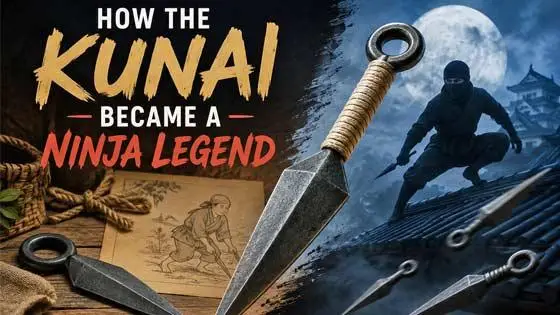
Few weapons are as closely tied to the image of the ninja as the kunai. Movies, comic books, anime, and video games have turned this simple iron tool into an unmistakable symbol of stealth and assassination. To most people, the two seem inseparable.
But the real story is far more surprising. Long before the kunai appeared in the hands of shadowy spies, it likely served far more ordinary purposes. Its journey from a practical everyday tool to one of history's most legendary weapons wasn't driven by medieval ninja alone. It was shaped by centuries of storytelling, folklore, and modern pop culture that gradually transformed an everyday tool into a legendary weapon.
So how did the kunai earn its place among history's most iconic ninja weapons? To answer that question, we have to separate historical fact from popular fiction and trace the remarkable evolution of the kunai from humble beginnings to worldwide legend.
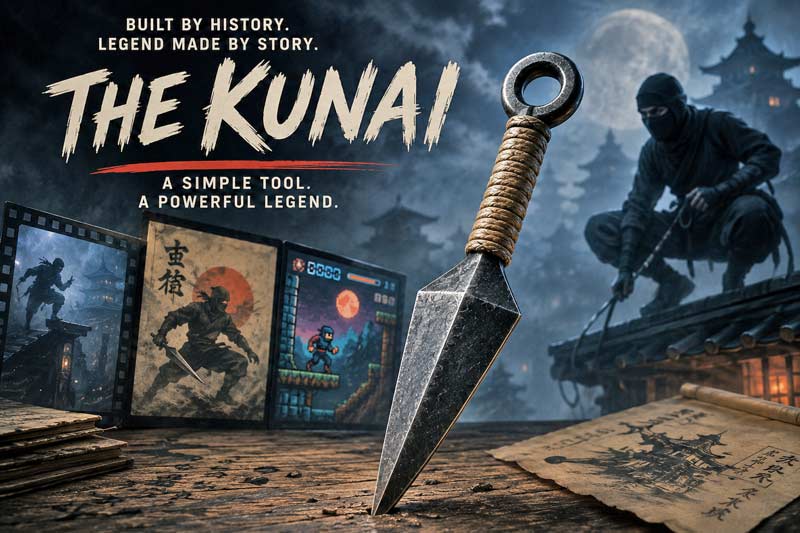
Ask someone to picture a ninja weapon, and there's a good chance they'll imagine a kunai. Its simple spear-shaped blade, wrapped handle, and unmistakable silhouette have appeared in countless movies, television shows, comic books, anime series, and video games. Today, it's almost impossible to separate the kunai from the mysterious image of the ninja, even though history tells a much more complicated story.
Part of the kunai's appeal is its versatility. Popular culture has portrayed it as a throwing weapon, a climbing tool, a close-quarters dagger, and even a grappling hook when tied to a rope. Every new appearance reinforced the idea that it was the ultimate all-purpose ninja weapon, capable of solving almost any problem with speed and stealth. Whether those portrayals were historically accurate rarely mattered because the legend was simply too entertaining.
The irony is that there is surprisingly little historical evidence showing that the kunai was ever the signature weapon people imagine today. Unlike the katana or the spear, the kunai appears only sparingly in surviving historical records, leaving plenty of room for speculation. Over time, that lack of documentation allowed storytellers, filmmakers, and game designers to fill in the blanks with increasingly dramatic interpretations.
Modern audiences have grown up with these fictional versions, making them feel like established history. As a result, many people are genuinely surprised to learn that the kunai's connection to ninja may have been far less glamorous than the legends suggest. Like many famous ninja weapons, its reputation grew over centuries of storytelling until the myth became more recognizable than the facts themselves.
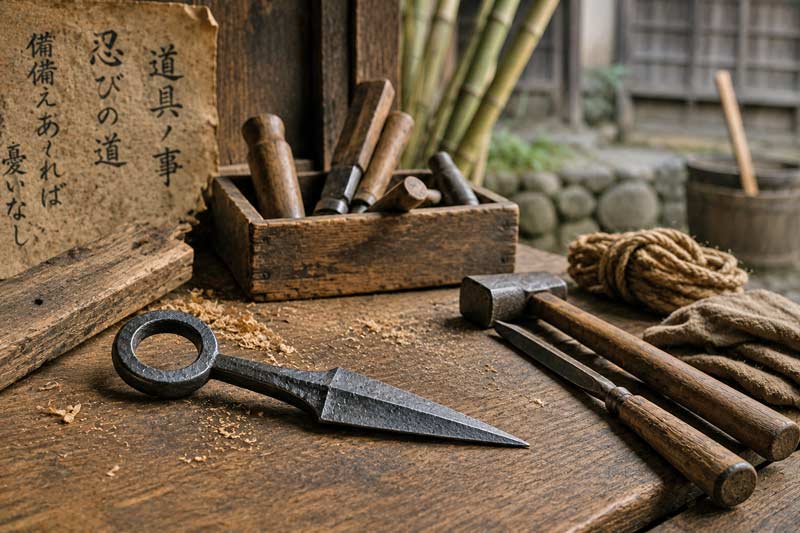
If you traveled back to feudal Japan expecting to find elite ninja carrying kunai on secret missions, you'd probably be disappointed. Historians generally believe the earliest kunai were not purpose-built weapons at all. Instead, they were simple iron hand tools used for digging, prying, scraping, and other everyday tasks. They were inexpensive, durable, and common enough that seeing one wouldn't have attracted much attention.
That ordinary appearance may have been one of the kunai's greatest strengths. Unlike an elaborate sword, a plain iron tool could be carried without immediately identifying its owner as a warrior. If needed, it could be adapted for self-defense, used to loosen stones or boards, or pressed into service wherever a sturdy piece of iron was useful. In many ways, it reflected a practical mindset rather than a martial one.
Over time, the tool's sturdy design made it an obvious candidate for improvisation. A pointed blade could penetrate wood, packed earth, or soft materials, while the ring at the end of the handle made it easy to hang from a cord or carry with other equipment. These features eventually helped blur the line between tool and weapon, especially in stories told long after the people who actually used them were gone.
This practical origin surprises many people because the modern kunai is almost always presented as a fighting knife. In reality, its evolution was far more gradual. If you'd like to explore the weapon's design in greater detail, our guide explaining what a kunai really is takes a closer look at its unique features and how they changed over time.
Even today, that simple design continues to inspire modern fixed blade knives. While today's versions are built with different materials and purposes in mind, they still reflect the same rugged simplicity that made the original kunai such a practical everyday tool centuries ago.
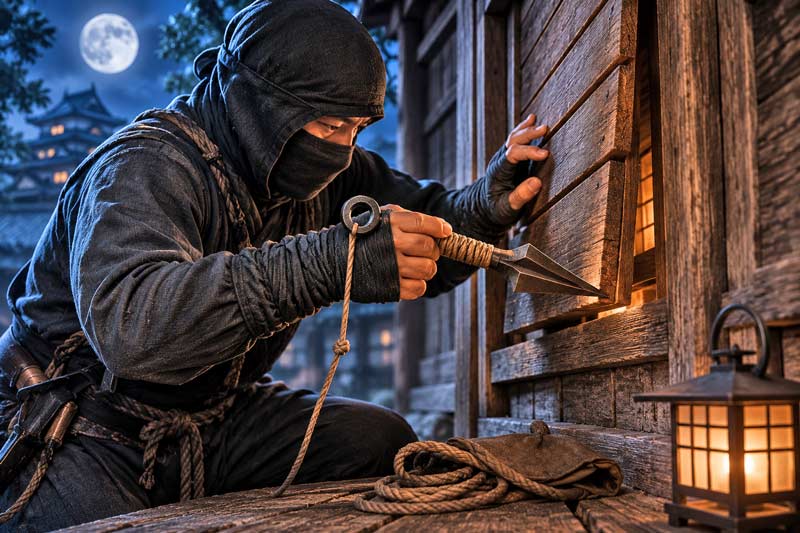
The kunai's ordinary origins did not make it useless to a covert operative. In fact, they may have made it more valuable. A concealed agent, scout, or saboteur often needed tools that could be carried without attracting attention, used for several different tasks, and discarded without sacrificing an expensive weapon. A plain iron implement fit that role far better than an ornate blade.
That practicality helps explain why so many objects associated with ninja were not originally designed for combat. Farming tools, climbing equipment, powders, cords, hooks, and everyday blades could all be adapted when circumstances demanded it. The ninja's reputation was built less on carrying exotic weapons and more on recognizing unexpected uses for ordinary things.
A kunai could potentially pry apart boards, scrape through packed earth, wedge into cracks, or help create leverage. Tied to a cord, its ringed handle made it easier to retrieve or secure. In an emergency, the same object could also become a close-range defensive weapon. Its strength was not that it excelled at one dramatic task, but that it remained useful across many quiet ones.
This is where history begins to blend with legend. Later storytellers took the idea of an adaptable tool and pushed it further, transforming the kunai into a weapon that could be thrown with perfect accuracy, used to scale walls, or carried in endless numbers beneath a ninja's clothing. Those exaggerated abilities were fiction, but they grew from a real principle: covert operatives often relied on versatility more than spectacle.
That broader pattern appears throughout the history of real ninja weapons and their practical uses. The most effective tools were often the ones that looked harmless until someone found a different purpose for them. The kunai became legendary because it embodied that idea better than almost anything else.
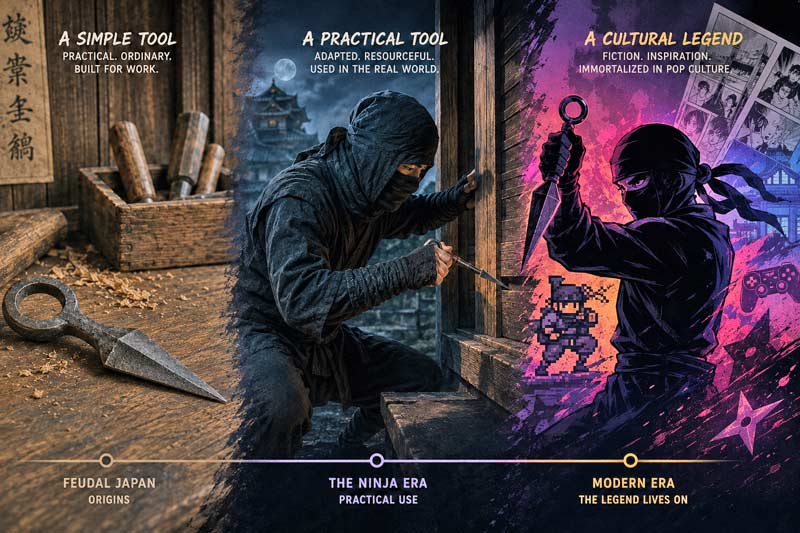
By the late twentieth century, the kunai had begun a transformation unlike almost any other historical tool. It escaped the pages of history books and entered popular culture, where filmmakers, comic book artists, game developers, and anime creators reinvented it as the ultimate ninja weapon. For millions of people around the world, these fictional portrayals became their first and only introduction to the kunai.
On screen, the kunai was no longer a simple iron tool. It became a perfectly balanced throwing weapon that never missed its target, a climbing aid capable of scaling castle walls, and a versatile blade that could solve nearly any problem. Each new interpretation made the legend even more exciting, even if it moved further away from the historical evidence.
The same thing happened to many other famous ninja weapons. Objects that had practical, everyday origins gradually became symbols of mystery and superhuman skill. Even the history of the evolution of the shuriken shows how popular culture often reshaped historical tools into something far more dramatic than their original purpose.
Ironically, those fictional portrayals helped preserve the kunai's legacy. While historians continue debating exactly how often it was used by ninja, there is no debate about its cultural impact. Today, countless people recognize a kunai instantly, even if they've never studied Japanese history. Modern throwing knives inspired by the classic design remain popular because the legend has become every bit as enduring as the object itself.
By the time most people first encountered the kunai, its transformation was already complete. The humble iron tool had become a symbol of secrecy, precision, and supernatural skill. Few viewers stopped to question whether the image was historically accurate because the fictional version was far more memorable than the practical object that inspired it.
That is how legends often work. They do not replace history all at once. They grow through repetition, with each storyteller adding a little more drama until the imagined version feels more authentic than the evidence. The kunai did not become famous because it was the most effective weapon in feudal Japan. It became famous because it perfectly matched the world people wanted ninja to inhabit.
Its simple silhouette helped the myth spread. A ringed handle and pointed blade were easy to recognize, easy to draw, and easy to reinvent. Unlike more elaborate weapons, the kunai could appear ancient, mysterious, and dangerous without needing much explanation. That visual simplicity allowed it to move effortlessly from folklore into movies, comics, games, and modern weapon culture.
The complete evolution of the kunai reveals something larger than the history of a single object. It shows how popular culture can rescue an obscure tool from the past, reshape its identity, and give it a legacy its original users could never have imagined. The kunai may not have begun as the ultimate ninja weapon, but the story built around it proved powerful enough to make it one forever.
Popular culture has made the kunai famous as a precision throwing weapon, but historical evidence for that specific use is surprisingly limited. While a sturdy iron kunai could certainly be thrown if necessary, historians generally believe its greatest value came from its versatility as a tool. It could be used for prying, digging, scraping, climbing assistance, or even self-defense, making it far more practical than a weapon designed solely for throwing. The image of ninja carrying dozens of perfectly balanced throwing kunai is largely a product of modern movies, anime, and video games rather than documented history.
The answer has more to do with storytelling than history. Samurai were traditionally associated with highly recognizable weapons like the katana, spear, and bow, while ninja became linked to secrecy, improvisation, and unconventional tactics. Because the kunai fit that image of adaptability, it gradually became one of the most recognizable symbols of the ninja in books, films, comics, and video games. Whether it was ever their primary weapon remains uncertain, but its simple design and mysterious reputation made it the perfect icon for generations of storytellers.
Probably not. Most historians believe the earliest kunai were simple iron tools used for everyday tasks such as digging, prying, scraping, or working with wood and stone. Their sturdy construction and pointed shape made them easy to adapt for self-defense when necessary, but they were not originally created as dedicated fighting weapons. Over time, their practical design, combined with their association with ninja in popular culture, transformed the kunai from an ordinary utility tool into one of the world's most recognizable legendary weapons.
Few historical weapons are as instantly recognizable as the kunai. Its simple shape, mysterious reputation, and strong connection to ninja have kept it relevant for generations. Even people with little knowledge of Japanese history can usually identify a kunai after seeing it in movies, television, anime, comic books, or video games.
That lasting popularity comes from the fact that the kunai tells two stories at once. It has a fascinating historical background as a practical iron tool, while its legendary reputation continues to inspire modern fiction. Whether you're interested in real history or the myths that grew around it, the kunai remains one of the most enduring symbols of the ninja, proving that sometimes the stories people tell become just as influential as the facts themselves.
The kunai is no longer used as a practical tool or weapon in everyday life, but it remains incredibly popular among collectors, martial arts enthusiasts, and fans of Japanese history. Modern replicas are often made from steel rather than iron and are designed for display, training, or recreational throwing rather than the kinds of practical tasks the original versions likely performed centuries ago.
Its greatest legacy, however, is cultural rather than practical. The kunai has become one of the most recognizable weapons in the world, appearing in countless films, television shows, comics, anime, and video games. While its real history is far less dramatic than its fictional reputation, that blend of historical mystery and modern mythology is exactly what continues to make the kunai so fascinating today.
The idea is easy to believe because the kunai has become almost inseparable from the modern image of the ninja. Decades of movies, television, anime, comics, and video games have repeatedly portrayed it as a specialized ninja weapon, leading many people to assume that it was originally created for espionage and combat.
In reality, the historical evidence suggests a much less dramatic origin. The kunai most likely began as a simple utility tool that was later adapted for a variety of purposes. Its connection to ninja grew stronger over time through storytelling and popular culture, eventually becoming so widespread that the legend overshadowed its true history. It's a perfect example of how fiction can permanently reshape the way we remember the past.
One of the most persistent legends about the kunai is that ninja regularly used it as a climbing tool by driving it into walls or trees. While a sturdy iron kunai could potentially provide leverage in certain situations, there is very little historical evidence that it served as a reliable climbing device. Most stone walls and mature trees would have made that extremely difficult, if not impossible.
The idea likely grew because the kunai was such a versatile tool. It could be used for digging, prying, scraping, or creating small footholds, and over time those practical uses evolved into more dramatic stories. Like many aspects of ninja folklore, the climbing kunai occupies a space where history and legend overlap, making it difficult to separate what was possible from what was simply entertaining to imagine.
Although they're often grouped together as "ninja weapons," the kunai and the shuriken were designed for very different purposes. A shuriken was specifically intended to be thrown, with many designs featuring balanced points that made them effective distraction or harassment weapons. The kunai, on the other hand, was a sturdy iron tool that could be adapted for many different tasks, including prying, digging, scraping, and, if necessary, self-defense.
Popular culture has blurred the distinction by frequently showing characters throwing kunai the same way they throw shuriken. While a kunai certainly could be thrown, that versatility is what truly set it apart. Rather than being created for a single purpose, it was valued because it could perform many jobs, making it one of the most practical tools ever associated with the legend of the ninja.
So how did the kunai earn its place among history's most iconic ninja weapons? To answer that question, we have to separate historical fact from popular fiction and trace the remarkable evolution of the kunai from humble beginnings to worldwide legend.
Why Everyone Thinks the Kunai Was Made for Ninja
Ask someone to picture a ninja weapon, and there's a good chance they'll imagine a kunai. Its simple spear-shaped blade, wrapped handle, and unmistakable silhouette have appeared in countless movies, television shows, comic books, anime series, and video games. Today, it's almost impossible to separate the kunai from the mysterious image of the ninja, even though history tells a much more complicated story.
Part of the kunai's appeal is its versatility. Popular culture has portrayed it as a throwing weapon, a climbing tool, a close-quarters dagger, and even a grappling hook when tied to a rope. Every new appearance reinforced the idea that it was the ultimate all-purpose ninja weapon, capable of solving almost any problem with speed and stealth. Whether those portrayals were historically accurate rarely mattered because the legend was simply too entertaining.
The irony is that there is surprisingly little historical evidence showing that the kunai was ever the signature weapon people imagine today. Unlike the katana or the spear, the kunai appears only sparingly in surviving historical records, leaving plenty of room for speculation. Over time, that lack of documentation allowed storytellers, filmmakers, and game designers to fill in the blanks with increasingly dramatic interpretations.
Modern audiences have grown up with these fictional versions, making them feel like established history. As a result, many people are genuinely surprised to learn that the kunai's connection to ninja may have been far less glamorous than the legends suggest. Like many famous ninja weapons, its reputation grew over centuries of storytelling until the myth became more recognizable than the facts themselves.
The Humble Origins of the Kunai
If you traveled back to feudal Japan expecting to find elite ninja carrying kunai on secret missions, you'd probably be disappointed. Historians generally believe the earliest kunai were not purpose-built weapons at all. Instead, they were simple iron hand tools used for digging, prying, scraping, and other everyday tasks. They were inexpensive, durable, and common enough that seeing one wouldn't have attracted much attention.
That ordinary appearance may have been one of the kunai's greatest strengths. Unlike an elaborate sword, a plain iron tool could be carried without immediately identifying its owner as a warrior. If needed, it could be adapted for self-defense, used to loosen stones or boards, or pressed into service wherever a sturdy piece of iron was useful. In many ways, it reflected a practical mindset rather than a martial one.
Over time, the tool's sturdy design made it an obvious candidate for improvisation. A pointed blade could penetrate wood, packed earth, or soft materials, while the ring at the end of the handle made it easy to hang from a cord or carry with other equipment. These features eventually helped blur the line between tool and weapon, especially in stories told long after the people who actually used them were gone.
This practical origin surprises many people because the modern kunai is almost always presented as a fighting knife. In reality, its evolution was far more gradual. If you'd like to explore the weapon's design in greater detail, our guide explaining what a kunai really is takes a closer look at its unique features and how they changed over time.
Even today, that simple design continues to inspire modern fixed blade knives. While today's versions are built with different materials and purposes in mind, they still reflect the same rugged simplicity that made the original kunai such a practical everyday tool centuries ago.
How Ninja Turned Ordinary Tools Into Extraordinary Weapons
The kunai's ordinary origins did not make it useless to a covert operative. In fact, they may have made it more valuable. A concealed agent, scout, or saboteur often needed tools that could be carried without attracting attention, used for several different tasks, and discarded without sacrificing an expensive weapon. A plain iron implement fit that role far better than an ornate blade.
That practicality helps explain why so many objects associated with ninja were not originally designed for combat. Farming tools, climbing equipment, powders, cords, hooks, and everyday blades could all be adapted when circumstances demanded it. The ninja's reputation was built less on carrying exotic weapons and more on recognizing unexpected uses for ordinary things.
A kunai could potentially pry apart boards, scrape through packed earth, wedge into cracks, or help create leverage. Tied to a cord, its ringed handle made it easier to retrieve or secure. In an emergency, the same object could also become a close-range defensive weapon. Its strength was not that it excelled at one dramatic task, but that it remained useful across many quiet ones.
This is where history begins to blend with legend. Later storytellers took the idea of an adaptable tool and pushed it further, transforming the kunai into a weapon that could be thrown with perfect accuracy, used to scale walls, or carried in endless numbers beneath a ninja's clothing. Those exaggerated abilities were fiction, but they grew from a real principle: covert operatives often relied on versatility more than spectacle.
That broader pattern appears throughout the history of real ninja weapons and their practical uses. The most effective tools were often the ones that looked harmless until someone found a different purpose for them. The kunai became legendary because it embodied that idea better than almost anything else.
How Movies and Video Games Turned the Kunai Into a Legend
By the late twentieth century, the kunai had begun a transformation unlike almost any other historical tool. It escaped the pages of history books and entered popular culture, where filmmakers, comic book artists, game developers, and anime creators reinvented it as the ultimate ninja weapon. For millions of people around the world, these fictional portrayals became their first and only introduction to the kunai.
On screen, the kunai was no longer a simple iron tool. It became a perfectly balanced throwing weapon that never missed its target, a climbing aid capable of scaling castle walls, and a versatile blade that could solve nearly any problem. Each new interpretation made the legend even more exciting, even if it moved further away from the historical evidence.
The same thing happened to many other famous ninja weapons. Objects that had practical, everyday origins gradually became symbols of mystery and superhuman skill. Even the history of the evolution of the shuriken shows how popular culture often reshaped historical tools into something far more dramatic than their original purpose.
Ironically, those fictional portrayals helped preserve the kunai's legacy. While historians continue debating exactly how often it was used by ninja, there is no debate about its cultural impact. Today, countless people recognize a kunai instantly, even if they've never studied Japanese history. Modern throwing knives inspired by the classic design remain popular because the legend has become every bit as enduring as the object itself.
Why the Legend Became More Powerful Than the History
By the time most people first encountered the kunai, its transformation was already complete. The humble iron tool had become a symbol of secrecy, precision, and supernatural skill. Few viewers stopped to question whether the image was historically accurate because the fictional version was far more memorable than the practical object that inspired it.
That is how legends often work. They do not replace history all at once. They grow through repetition, with each storyteller adding a little more drama until the imagined version feels more authentic than the evidence. The kunai did not become famous because it was the most effective weapon in feudal Japan. It became famous because it perfectly matched the world people wanted ninja to inhabit.
Its simple silhouette helped the myth spread. A ringed handle and pointed blade were easy to recognize, easy to draw, and easy to reinvent. Unlike more elaborate weapons, the kunai could appear ancient, mysterious, and dangerous without needing much explanation. That visual simplicity allowed it to move effortlessly from folklore into movies, comics, games, and modern weapon culture.
The complete evolution of the kunai reveals something larger than the history of a single object. It shows how popular culture can rescue an obscure tool from the past, reshape its identity, and give it a legacy its original users could never have imagined. The kunai may not have begun as the ultimate ninja weapon, but the story built around it proved powerful enough to make it one forever.
Did Ninja Actually Throw Kunai Like Throwing Knives?
Popular culture has made the kunai famous as a precision throwing weapon, but historical evidence for that specific use is surprisingly limited. While a sturdy iron kunai could certainly be thrown if necessary, historians generally believe its greatest value came from its versatility as a tool. It could be used for prying, digging, scraping, climbing assistance, or even self-defense, making it far more practical than a weapon designed solely for throwing. The image of ninja carrying dozens of perfectly balanced throwing kunai is largely a product of modern movies, anime, and video games rather than documented history.
Why Is the Kunai Almost Always Associated With Ninja Instead of Samurai?
The answer has more to do with storytelling than history. Samurai were traditionally associated with highly recognizable weapons like the katana, spear, and bow, while ninja became linked to secrecy, improvisation, and unconventional tactics. Because the kunai fit that image of adaptability, it gradually became one of the most recognizable symbols of the ninja in books, films, comics, and video games. Whether it was ever their primary weapon remains uncertain, but its simple design and mysterious reputation made it the perfect icon for generations of storytellers.
Were Kunai Originally Designed as Weapons?
Probably not. Most historians believe the earliest kunai were simple iron tools used for everyday tasks such as digging, prying, scraping, or working with wood and stone. Their sturdy construction and pointed shape made them easy to adapt for self-defense when necessary, but they were not originally created as dedicated fighting weapons. Over time, their practical design, combined with their association with ninja in popular culture, transformed the kunai from an ordinary utility tool into one of the world's most recognizable legendary weapons.
Why Has the Kunai Remained So Popular for So Long?
Few historical weapons are as instantly recognizable as the kunai. Its simple shape, mysterious reputation, and strong connection to ninja have kept it relevant for generations. Even people with little knowledge of Japanese history can usually identify a kunai after seeing it in movies, television, anime, comic books, or video games.
That lasting popularity comes from the fact that the kunai tells two stories at once. It has a fascinating historical background as a practical iron tool, while its legendary reputation continues to inspire modern fiction. Whether you're interested in real history or the myths that grew around it, the kunai remains one of the most enduring symbols of the ninja, proving that sometimes the stories people tell become just as influential as the facts themselves.
Is the Kunai Still Used Today?
The kunai is no longer used as a practical tool or weapon in everyday life, but it remains incredibly popular among collectors, martial arts enthusiasts, and fans of Japanese history. Modern replicas are often made from steel rather than iron and are designed for display, training, or recreational throwing rather than the kinds of practical tasks the original versions likely performed centuries ago.
Its greatest legacy, however, is cultural rather than practical. The kunai has become one of the most recognizable weapons in the world, appearing in countless films, television shows, comics, anime, and video games. While its real history is far less dramatic than its fictional reputation, that blend of historical mystery and modern mythology is exactly what continues to make the kunai so fascinating today.
Why Do So Many People Think the Kunai Was Invented by Ninja?
The idea is easy to believe because the kunai has become almost inseparable from the modern image of the ninja. Decades of movies, television, anime, comics, and video games have repeatedly portrayed it as a specialized ninja weapon, leading many people to assume that it was originally created for espionage and combat.
In reality, the historical evidence suggests a much less dramatic origin. The kunai most likely began as a simple utility tool that was later adapted for a variety of purposes. Its connection to ninja grew stronger over time through storytelling and popular culture, eventually becoming so widespread that the legend overshadowed its true history. It's a perfect example of how fiction can permanently reshape the way we remember the past.
Could a Kunai Really Be Used for Climbing?
One of the most persistent legends about the kunai is that ninja regularly used it as a climbing tool by driving it into walls or trees. While a sturdy iron kunai could potentially provide leverage in certain situations, there is very little historical evidence that it served as a reliable climbing device. Most stone walls and mature trees would have made that extremely difficult, if not impossible.
The idea likely grew because the kunai was such a versatile tool. It could be used for digging, prying, scraping, or creating small footholds, and over time those practical uses evolved into more dramatic stories. Like many aspects of ninja folklore, the climbing kunai occupies a space where history and legend overlap, making it difficult to separate what was possible from what was simply entertaining to imagine.
What Makes the Kunai Different From a Shuriken?
Although they're often grouped together as "ninja weapons," the kunai and the shuriken were designed for very different purposes. A shuriken was specifically intended to be thrown, with many designs featuring balanced points that made them effective distraction or harassment weapons. The kunai, on the other hand, was a sturdy iron tool that could be adapted for many different tasks, including prying, digging, scraping, and, if necessary, self-defense.
Popular culture has blurred the distinction by frequently showing characters throwing kunai the same way they throw shuriken. While a kunai certainly could be thrown, that versatility is what truly set it apart. Rather than being created for a single purpose, it was valued because it could perform many jobs, making it one of the most practical tools ever associated with the legend of the ninja.
You May Also Be Interested In:
Leave a Reply