




Were Nunchucks Ever Actually Used in Real Combat?
September 3rd, 2026
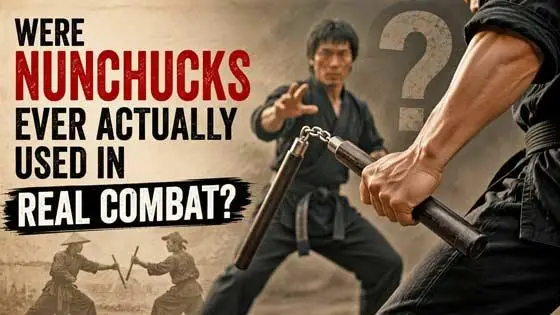
Nunchucks are so firmly established as a fighting weapon that questioning whether anyone actually fought with them sounds almost ridiculous. They appear in martial arts demonstrations, movies, training halls, and modern weapon collections, while their reputation suggests a long history of warriors swinging them against real opponents. Yet when we look beyond popular culture and start searching for evidence of nunchaku being carried into genuine combat, the story becomes surprisingly difficult to pin down. There are traditions, theories, and plenty of claims, but far fewer historical records than their fearsome reputation might lead us to expect. So were nunchucks really weapons of combat, or did they become famous for a role they rarely played?
The Historical Record Is Much Quieter Than the Movies
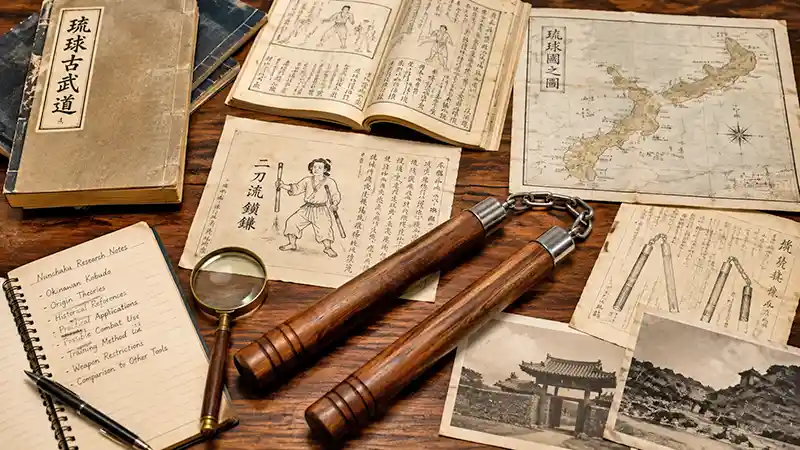
If nunchaku had been a common battlefield weapon, we might expect to find the kinds of evidence that surround other established weapons: military descriptions, surviving battlefield examples, period artwork, accounts of warriors carrying them, or records describing how they were employed against an enemy. Instead, the historical trail is frustratingly thin. Nunchaku certainly became part of Okinawan martial traditions, but proving that they were routinely carried into genuine fights is a much harder task.
That distinction matters because martial arts preservation and battlefield use are not the same thing. A weapon can have legitimate techniques, formal training methods, and generations of practitioners without ever having been a standard piece of military equipment. Okinawan kobudo preserved a number of implements whose histories do not fit neatly into the familiar image of armies marching into battle armed with specialized weapons.
This is one reason the enormous variety of traditional and modern nunchaku we recognize today should not be projected backward onto history. Modern nunchaku can differ dramatically in material, connector type, weight, shape, and intended purpose. Their existence demonstrates how extensively the weapon developed within martial arts culture, but it does not tell us how commonly earlier versions were actually used in violent encounters.
None of this proves that nobody ever fought with nunchaku. That would be an equally difficult historical claim to defend. What it does tell us is that the popular image of nunchaku as a weapon with a long, well-documented combat record is much stronger than the evidence behind it. Before we can decide whether they were genuinely practical fighting weapons, we have to separate three very different questions: where they came from, how martial artists trained with them, and whether people actually trusted them when a fight became real.
Nunchaku Were Almost Certainly Not Battlefield Weapons
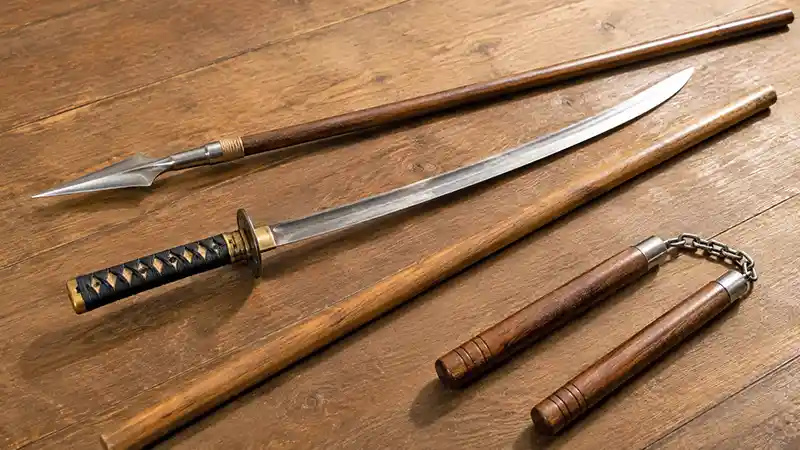
One of the easiest misconceptions to clear up is the idea that nunchaku belonged alongside swords, spears, bows, and other weapons carried by organized warriors. There is little historical evidence to support that picture. On a battlefield, reach matters enormously, and a pair of short wooden handles connected by a cord or chain offers very little of it. A spear can threaten an opponent from several feet away. A sword provides both reach and a cutting edge. Even a simple staff allows a fighter to strike while remaining considerably farther from danger.
Nunchaku also present problems that become especially important in chaotic combat. The flexible connection allows one handle to accelerate around the other, but it also makes the weapon less predictable after impact. A rigid club can strike, recover, block, thrust, and change direction without waiting for a second section to swing back into position. Nunchaku require considerably more control, particularly when space is limited or other people are fighting nearby.
Armor makes the battlefield argument even weaker. Against an opponent wearing substantial protection, a relatively light wooden striking weapon would have to compete with purpose-built military weapons designed to cut, pierce, crush, or exploit openings in armor. Even if nunchaku could deliver a painful or damaging blow, that does not make them an especially logical choice when more effective weapons were available.
This does not mean nunchaku were useless. It means we should be careful about imagining the wrong kind of combat. A weapon can make little sense on an organized battlefield while still having potential value in personal defense, civilian confrontations, martial arts training, or situations where conventional weapons were unavailable. If nunchaku ever had a meaningful history of real fighting, those smaller and less documented encounters are much more plausible places to look.
But Real Combat Doesnt Always Mean a Battlefield
The absence of nunchaku from armies and major battles does not settle the question. Most violence throughout history did not happen between organized formations of soldiers. People fought during robberies, feuds, disputes, arrests, ambushes, and sudden confrontations where whatever happened to be available could become a weapon. Those encounters rarely left behind the detailed records historians would need centuries later.
That distinction is especially important when discussing Okinawa. The martial traditions that eventually preserved nunchaku were not simply miniature versions of samurai battlefield systems. Okinawan kobudo developed around a collection of weapons with very different backgrounds, and attempts to explain all of them with one neat origin story have created some remarkably persistent myths. The familiar claim that ordinary farmers secretly transformed agricultural implements into weapons, for example, is far more complicated than it is often presented. Our examination of whether martial arts weapons were really farm tools shows how quickly a plausible story can become accepted history when the surviving evidence is incomplete.
Nunchaku would make considerably more sense in a small confrontation than on a battlefield. They are compact, relatively easy to carry, and capable of producing powerful strikes without requiring a blade. In the hands of someone who had trained extensively with them, they could certainly injure an opponent. A person facing an unarmored attacker at close range would present a very different problem from a soldier confronting an armed formation.
The frustrating part is that plausibility is not proof. It is perfectly reasonable to conclude that somebody, somewhere, used nunchaku in an actual fight. It would be surprising if a weapon practiced for generations never was. But occasional use in personal violence is very different from demonstrating that nunchaku were historically favored as practical fighting weapons. That gap between what could have happened and what we can actually document is where much of the nunchaku mystery lives.
The Famous Farming Tool Story Doesnt Solve the Mystery
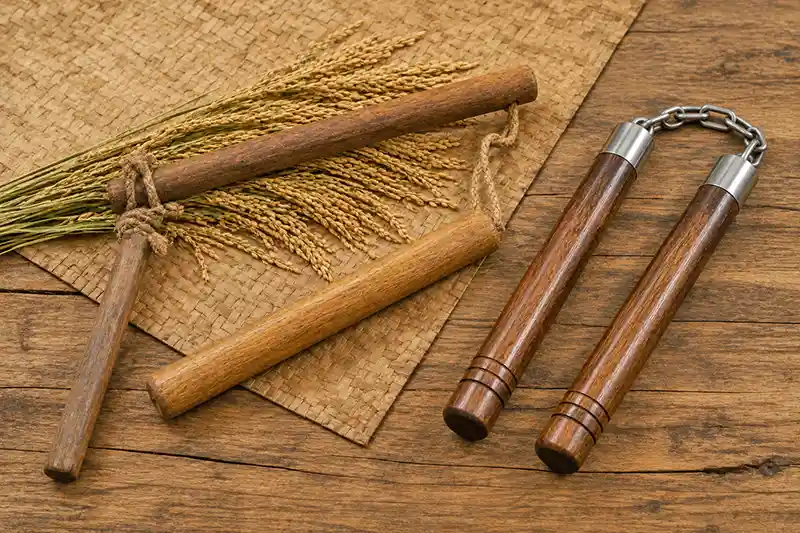
Ask where nunchaku came from and one explanation appears again and again: Okinawan farmers supposedly used them to thresh rice, then converted the tool into a weapon when authorities restricted access to conventional arms. It is an appealing story because it explains almost everything at once. The unusual shape has an agricultural purpose, the martial application develops out of necessity, and an ordinary farming implement becomes a clever weapon of resistance. The problem is that history rarely gives us stories this tidy.
Researchers and martial artists have proposed several possible predecessors for nunchaku, including agricultural implements and devices associated with horses or other everyday tasks. Similar flexible implements also existed elsewhere in Asia, further complicating attempts to identify one definitive point of invention. Even the frequently repeated connection to rice threshing has weaknesses, including questions about whether the dimensions and construction of traditional Okinawan nunchaku closely match the tools that would have been most practical for that job.
This uncertainty is important because the farming story is sometimes used as indirect proof of combat use. If farmers secretly converted a prohibited tool into a weapon, the reasoning goes, then surely they must have fought with it. But one unproven assumption cannot establish another. The question of why nunchucks were actually invented remains surprisingly unsettled, and none of the major origin theories automatically demonstrates that they were regularly used in real fights.
What we can say with much greater confidence is that nunchaku eventually became a genuine part of Okinawan weapon training. That fact deserves to stand on its own. They do not need a dramatic story about oppressed farmers battling armed warriors to qualify as an authentic martial arts weapon. In fact, stripping away that legend makes the unanswered question even more interesting: if nunchaku were not primarily improvised battlefield weapons, what made generations of martial artists consider them worth learning?
Nunchaku Make More Sense as a Training Weapon Than a War Weapon
One possible answer to the mystery becomes clearer when we stop judging nunchaku only by how useful they would have been in a life-or-death fight. Martial arts training has never been limited to practicing with whatever weapon would be most efficient on a battlefield. Training implements can develop coordination, timing, accuracy, posture, distance control, and the ability to generate power through unfamiliar patterns of movement. Nunchaku demand nearly all of those things at once.
Unlike a rigid stick, the second handle does not remain completely under the practitioner's direct control. Every strike sends it moving through an arc that must be anticipated before the next movement begins. Poor timing can cause the weapon to rebound unpredictably or strike the person using it. Smooth transitions require the hands, wrists, arms, and body to work together while constantly accounting for momentum. That difficulty may actually help explain why nunchaku survived as something worth practicing.
This also changes how we should interpret their place in Okinawan kobudo. The fact that generations of martial artists developed techniques for striking, catching, redirecting, and controlling nunchaku tells us that they were taken seriously as a martial discipline. It does not necessarily tell us that practitioners considered them the first weapon they would choose when their lives were at risk. Those are two very different standards.
Seen this way, the nunchaku does not need an impressive battlefield record to have martial value. Its importance may lie partly in what mastering such an unforgiving flexible weapon teaches the practitioner. That explanation is less dramatic than imagining Okinawan fighters defeating sword-wielding enemies with farm tools, but it fits much more comfortably with the evidence we actually have.
There Is a Big Difference Between Being Dangerous and Being Practical
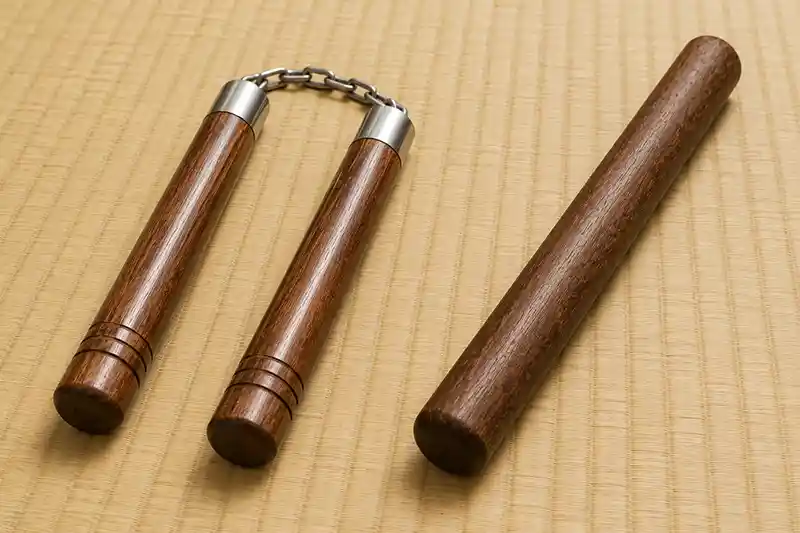
Nobody needs to prove that nunchaku can hurt someone. Two hard wooden handles accelerated through a flexible connection can deliver substantial force, and an experienced practitioner can generate strikes quickly from several directions. The more interesting question is whether those advantages make nunchaku a particularly practical choice when compared with simpler weapons.
A plain wooden stick immediately exposes the tradeoff. It requires relatively little specialized training to swing, offers predictable control after impact, can be used to thrust or block, and does not have a second section capable of rebounding toward the person holding it. Nunchaku can generate impressive speed, but the same flexible connection that gives them their distinctive movement also introduces complexity. Missed strikes, unexpected rebounds, cramped surroundings, and attempts to recover quickly can all create problems that a rigid weapon largely avoids.
That does not make nunchaku ineffective. With sufficient training, many of those disadvantages can be managed, and their compact size allows them to be carried more easily than a long staff or spear. Their unusual movement may also make strikes difficult for an unfamiliar opponent to anticipate. But those benefits come at the price of a much steeper learning curve.
This distinction helps explain why demonstrations can give a misleading impression of combat effectiveness. Watching an expert manipulate nunchaku at high speed shows what the weapon is capable of after extensive practice. It does not answer whether someone expecting a genuine confrontation would choose nunchaku over a simpler weapon capable of producing similar injuries with less training and fewer opportunities for error. A weapon can be genuinely dangerous without being the most practical tool for a fight, and nunchaku may be one of the clearest examples of that difference.
So Why Did Okinawan Martial Artists Keep Training With Them?
If a simple stick was easier to control and a spear or staff offered better reach, the continued survival of nunchaku deserves an explanation. One possibility is that we are applying the wrong standard when we assume every traditional weapon had to outperform its alternatives. Martial traditions preserve more than the single most efficient solution to a fight. They preserve systems of movement, specialized skills, regional practices, and methods passed from teacher to student because practitioners considered them worth keeping.
Nunchaku became firmly associated with Okinawan kobudo, where they existed alongside weapons such as the bo, sai, tonfa, and kama. Within that setting, they were not merely objects to swing at an opponent. Practitioners developed structured methods for controlling the free handle, changing grips, striking from different angles, catching the weapon after movement, and coordinating those actions with footwork and body mechanics.
Their survival may therefore tell us more about martial culture than battlefield necessity. A difficult weapon can remain valuable precisely because it demands unusual control. Once techniques become embedded in a recognized martial tradition, they can be preserved and refined across generations even if the circumstances that originally produced them have disappeared. That process helps explain the broader history of nunchaku far better than assuming every preserved technique must have been proven repeatedly in combat.
This is also why the lack of battlefield evidence should not be mistaken for evidence that nunchaku are somehow fake or invented by modern entertainment. Their place in Okinawan martial arts is real. What becomes questionable is the much more dramatic story later attached to them: that they were once a feared fighting weapon regularly used against armed opponents. Traditional practice supports the first claim. It does not automatically prove the second.
The Best Evidence May Have Disappeared Without Ever Being Recorded
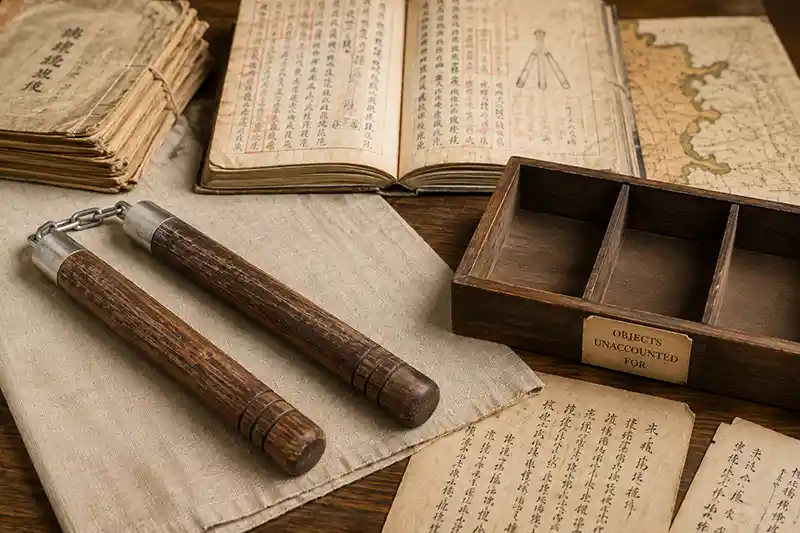
There is an uncomfortable limitation to this entire question: history records some kinds of violence far better than others. Battles involving rulers, armies, and famous warriors were much more likely to appear in chronicles than a confrontation between two ordinary people in an Okinawan village. If nunchaku were occasionally used during personal disputes, self-defense situations, or other small-scale encounters, most of those incidents would have had little reason to survive in the historical record.
The weapon itself creates another problem. Wooden implements are less likely to survive for centuries than carefully preserved swords, armor, or prestigious military equipment. An old pair of nunchaku would also be difficult to connect to a particular violent event unless someone documented its use. Finding a historical example proves that the object existed. It does not tell us whether it spent its life in training, served some everyday purpose, or was ever swung at another person in anger.
Oral traditions can preserve information that written records miss, but they introduce their own difficulties. Stories change as they pass between generations. Explanations become simplified, memorable details get emphasized, and later interpretations can gradually become indistinguishable from older traditions. Once nunchaku became internationally famous, separating genuinely old accounts from stories influenced by their modern reputation became even more difficult.
That leaves us in an unusual position. It would be too confident to declare that nunchaku were never used in real combat simply because surviving documentation is scarce. But it would be equally misleading to fill those gaps with dramatic stories and present them as established history. Sometimes the most accurate historical answer is also the least satisfying one: people may very well have fought with nunchaku, but the evidence needed to tell us how often, against whom, and under what circumstances may never have been recorded at all.
Hollywood Turned a Historical Question Into an Assumed Fact
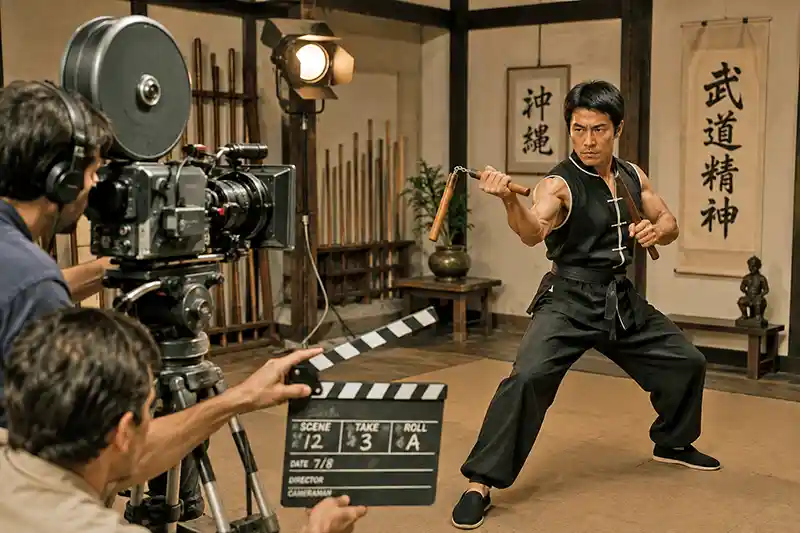
By the time millions of people outside Okinawa encountered nunchaku, they were not seeing an obscure traditional weapon surrounded by unanswered historical questions. They were seeing highly trained martial artists send them whipping through the air at extraordinary speed. Movies and television transformed nunchaku into one of the easiest weapons in the world to recognize, and the image was so convincing that their effectiveness hardly seemed worth questioning.
That visual reputation changed how people imagined the weapon's past. If nunchaku looked devastating in the hands of a martial arts expert on screen, it was easy to assume that earlier fighters must have used them the same way. Centuries of undocumented combat history could almost be filled in automatically. The weapon looked ancient, belonged to a traditional martial art, and appeared frighteningly effective. Put those ingredients together and a legendary battlefield history seemed perfectly believable.
But entertainment is unusually good at emphasizing the qualities that make nunchaku spectacular. Speed, rapid direction changes, spinning movements, and the blur of the free handle all translate beautifully to the screen. The disadvantages are much less exciting. Limited reach, difficult recovery, the possibility of rebound, the training required for reliable control, and the existence of simpler alternatives do not make nearly as memorable a scene.
That enormous gap between historical evidence and modern reputation eventually helped create an entirely different chapter in the weapon's story. Nunchaku became famous enough that Americans not only assumed they were formidable combat weapons, but sometimes regarded them as uniquely threatening. The story of why America became so afraid of nunchucks shows just how powerful that modern image became. Ironically, some of the strongest evidence for the nunchaku's fearsome reputation comes not from the era when they supposedly saw real combat, but from centuries later, when popular culture convinced millions of people that they must have.
Modern Nunchaku Are Not Necessarily the Weapons Earlier Practitioners Knew
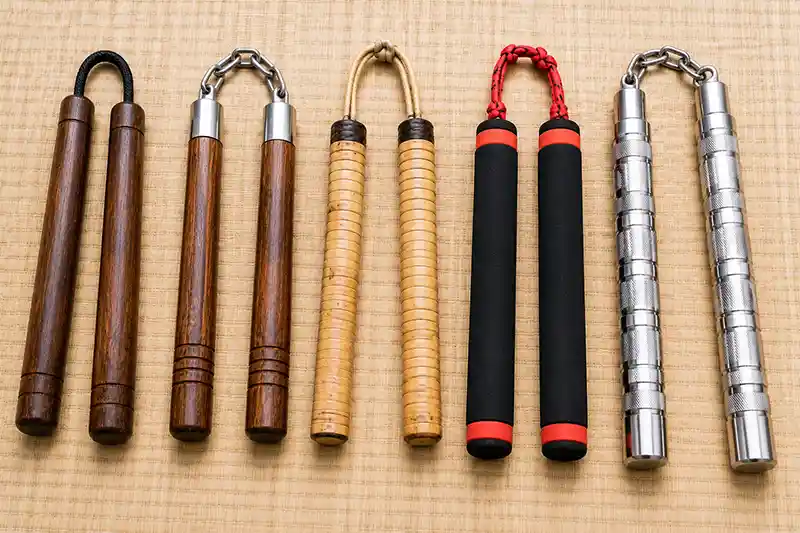
Another complication is that nunchaku did not remain frozen in one historical form. Today they can be made from hardwood, rattan, metal, foam, plastic, and other materials, with handles connected by chain, cord, or specialized swivel systems. Length, weight, shape, and balance can vary substantially. That variety makes modern nunchaku fascinating, but it can also distort the way we picture their earlier counterparts.
A heavy metal pair, for example, can create a very different impression of the weapon's destructive potential than a lighter wooden or corded design. Modern manufacturing also allows precise bearings, durable chains, uniform handles, and materials that historical practitioners simply would not have possessed. Demonstrating what one modern design can do does not automatically tell us how an older Okinawan version behaved.
Even seemingly small changes matter with a flexible weapon. The length of the connector affects how the free handle travels. Handle weight changes momentum. Different cross sections influence grip and control. Cord behaves differently from chain. Because the entire weapon depends on the relationship between two moving sections, changes in construction can noticeably alter how it feels and performs.
This is another reason attempts to judge the historical combat value of nunchaku through modern demonstrations can become misleading. We are not always comparing the same object. The nunchaku that became famous internationally evolved alongside martial arts training, commercial manufacturing, demonstrations, and popular culture. Asking whether nunchaku worked in real combat therefore requires a second question that is easy to overlook: which nunchaku?
So Were Nunchucks Ever Actually Used in Real Combat?
The most defensible answer is almost certainly yes, but probably not in the way their reputation suggests. Nunchaku are genuine martial arts weapons capable of causing serious injury, and they have been practiced for generations. It would be difficult to believe that nobody ever used them during an actual violent confrontation. What we do not have is strong evidence that they were commonly carried into battle, widely preferred for personal combat, or responsible for the kind of legendary fighting history that popular culture later gave them.
That difference is important. Saying that nunchaku were probably used in real fights is a modest conclusion. Saying they were historically important combat weapons requires much stronger evidence. The surviving record supports their place within Okinawan martial traditions far more clearly than it supports stories of fighters routinely defeating armed enemies with them.
Their practical limitations reinforce that interpretation. Nunchaku sacrifice reach and simplicity in exchange for speed, compactness, unusual movement, and the potential to generate powerful strikes. In trained hands those qualities can make them dangerous. In a desperate confrontation, however, an experienced fighter with access to a staff, spear, sword, or even a straightforward club might have had compelling reasons to choose the simpler weapon.
Perhaps that is what makes the real history of nunchaku more interesting than the legend. They do not appear to have become famous because they dominated ancient battlefields. They survived because martial artists preserved a difficult and distinctive weapon, refined its techniques, and eventually introduced it to a world that found it impossible to look away. The nunchaku's greatest victory may not have happened in combat at all. It may have been convincing generations of people that it must have.
The Legend Became Bigger Than the Weapon
Nunchaku occupy a strange place in weapons history. Their documented importance as a traditional martial arts weapon is real, yet the dramatic combat history most people instinctively associate with them is remarkably difficult to demonstrate. There is no convincing trail of battlefield accounts showing warriors routinely choosing nunchaku over longer, simpler, or more purpose-built weapons. There is instead a mixture of martial tradition, uncertain origins, scattered possibilities, and enormous cultural influence.
That does not diminish the skill required to use them. If anything, it makes their survival more interesting. Generations of practitioners considered nunchaku worth preserving even though easier weapons existed. Their difficulty became part of their identity, and the techniques developed around controlling two connected handles eventually turned an obscure Okinawan weapon into one of the most recognizable martial arts implements on Earth.
The mistake is assuming that fame must reflect historical importance. Nunchaku became legendary largely because modern audiences could see what an expert could make them do. Once that image spread around the world, the missing pieces of their history were easily filled with assumptions. A weapon that looked so formidable surely must have an equally formidable past.
The evidence tells a subtler story. Nunchaku were real weapons, real martial artists trained with them, and they were almost certainly used in real confrontations at some point. But their greatest battles appear to belong more to martial arts tradition and popular imagination than to documented warfare. Sometimes the weapon with the biggest legend is not the one that left the biggest mark on the battlefield.
Were Nunchucks Ever Used on a Battlefield?
There is little evidence that nunchaku were commonly used as battlefield weapons. Historical armies generally favored weapons that offered greater reach, simpler control, or better performance against armed and armored opponents, including spears, swords, bows, and other purpose-built military weapons.
That does not prove nunchaku never appeared in a battle or violent conflict. Individual weapons can be used in circumstances that leave no surviving record. However, there is currently a major difference between saying nunchaku could have been used on a battlefield and claiming they were an established battlefield weapon.
Their much clearer historical role is within Okinawan martial traditions, where techniques for using nunchaku were preserved and developed. The popular image of warriors routinely carrying them into battle is considerably stronger than the historical evidence supporting it.
Were Nunchucks Actually Used by Okinawan Farmers?
The familiar story says Okinawan farmers transformed an agricultural tool into nunchaku and learned to use it for self-defense, particularly after restrictions were placed on conventional weapons. Although this explanation has been repeated for decades, the historical evidence behind such a simple origin story is surprisingly uncertain.
Several possible predecessors for nunchaku have been proposed, including agricultural implements and other everyday tools, and similar flexible devices existed elsewhere in Asia. Historians and martial artists have also questioned whether traditional Okinawan nunchaku closely resemble the types of flails that would have been most practical for threshing rice.
It is therefore reasonable to associate nunchaku with Okinawan martial tradition, but much harder to prove the popular image of ordinary farmers routinely converting rice-threshing tools into secret fighting weapons. The farming-tool explanation remains one of the most famous parts of nunchaku lore, but it should not be treated as settled historical fact.
Are Nunchucks Actually Effective in a Real Fight?
Nunchucks can certainly cause serious injury, particularly in the hands of someone who has trained extensively with them. Their flexible design allows the free handle to accelerate rapidly, and an experienced practitioner can deliver powerful strikes from several angles.
The question becomes more complicated when effectiveness is compared with practicality. Nunchucks require considerably more skill to control than a simple rigid stick, offer relatively limited reach, and can rebound unpredictably after a missed or poorly controlled strike. Those disadvantages become particularly important during the confusion and unpredictability of an actual confrontation.
So while nunchucks are capable of being effective weapons, that does not necessarily make them the most practical choice. Much of their extraordinary reputation comes from watching highly skilled martial artists use them under controlled conditions, where their speed and movement are especially impressive.
Why Would Someone Train With Nunchucks If Other Weapons Were Better?
Martial arts training is not always about finding the easiest or most powerful weapon. Nunchucks require practitioners to develop timing, coordination, grip control, accuracy, body mechanics, and an unusually strong awareness of momentum. The flexible connection between the handles makes mistakes immediately noticeable in a way that many rigid weapons do not.
Traditional martial arts also preserve techniques because they belong to a larger system and have been passed between generations. Once nunchaku became established within Okinawan kobudo, learning them could have value beyond preparing someone for a specific type of fight.
This helps explain how nunchucks could remain an important martial arts weapon even if they were rarely the first choice for real combat. Their value as a training discipline does not depend on proving that they were once common battlefield weapons.
Did Samurai Ever Use Nunchucks?
There is little evidence that nunchaku were a standard weapon of the Japanese samurai. Samurai warfare was associated with purpose-built military weapons such as bows, spears, swords, and later firearms, while nunchaku are much more strongly associated with Okinawan martial traditions.
Okinawa also had a distinct history and martial culture from mainland Japan. Treating every traditional Japanese or Okinawan weapon as part of the samurai arsenal can blur important differences between those traditions.
It is always possible that an individual encountered or practiced with a flexible weapon resembling nunchaku, but that is very different from saying samurai commonly carried or fought with them. The familiar image of a samurai warrior using nunchucks has much more support in modern imagination than in the historical record.
How Powerful Is a Nunchuck Strike?
A nunchuck strike can deliver considerable force because the free handle accelerates as it swings around the connecting cord or chain. The exact force varies dramatically depending on the weapon's weight, dimensions, construction, striking technique, and the person using it.
That makes simple claims about nunchucks hitting with a particular amount of force misleading. Different nunchaku can behave very differently, and laboratory measurements taken under one set of conditions should not automatically be applied to every design.
What can safely be said is that hard nunchaku are capable of causing serious injury. Their ability to strike hard, however, does not by itself establish how frequently they were historically used in combat or whether they were more practical than simpler weapons.
Were Traditional Nunchucks Connected With Rope or Chain?
Traditional nunchaku were commonly connected using cord or rope rather than the metal chains many people now associate with the weapon. Chain-connected designs became especially familiar as nunchaku evolved and spread internationally.
The difference is more significant than appearance alone. Connector length, weight, flexibility, and construction affect how the free handle moves and how the weapon responds during techniques. Modern chain-and-swivel systems can therefore behave differently from traditional corded designs.
This is one reason modern demonstrations should be used cautiously when judging historical nunchaku. A contemporary metal or chain-connected pair may differ substantially from the weapon an earlier Okinawan practitioner would have known.
Did Okinawans Really Use Nunchucks to Fight Samurai?
Stories of Okinawan farmers using improvised weapons against sword-carrying samurai fit neatly into the popular mythology surrounding Okinawan martial arts, but the historical reality is much more complicated. There is not strong evidence showing nunchaku being routinely used to fight samurai in the dramatic manner these stories often suggest.
Okinawa did experience political upheaval, outside domination, and restrictions involving weapons at different points in its history. Those real events helped create fertile ground for later stories about ordinary people secretly transforming everyday tools into weapons of resistance.
Nunchaku became a legitimate part of Okinawan martial tradition, but that fact should not be treated as proof that they were commonly used in battles against armed samurai. The dramatic version of the story goes considerably beyond what the surviving evidence can confidently establish.
Are Nunchucks Better Than a Bo Staff in a Real Fight?
A bo staff has one enormous practical advantage over nunchaku: reach. Its rigid construction also makes its movement more predictable and allows it to be used for striking, thrusting, blocking, and controlling distance without having to manage a freely swinging second handle.
Nunchaku are considerably more compact and can generate fast, powerful strikes, but they require greater specialized control. Those characteristics can make them impressive in trained hands without necessarily making them preferable to a longer rigid weapon during an uncontrolled confrontation.
There is no universal answer because circumstances and practitioner skill matter, but the historical prominence of staffs and other pole weapons illustrates an important point: spectacular movement is not always the same thing as practical advantage.
Why Are Nunchucks So Famous If They Were Rarely Used in Combat?
Nunchucks possess almost everything a weapon needs to become a pop-culture phenomenon. They move quickly, produce dramatic circular motions, require obvious skill to control, and look unlike most familiar weapons. That made them extraordinarily effective on film and during martial arts demonstrations.
Their international reputation consequently grew far beyond what their documented combat history would suggest. Millions of people encountered nunchaku through movies, television, martial arts schools, demonstrations, toys, and popular culture rather than through historical accounts of Okinawan fighting.
That may be the central irony of nunchaku history. They became one of the world's most recognizable fighting weapons despite having a surprisingly uncertain record of actual historical fighting.
You May Also Be Interested In:
- Why Were Nunchucks Actually Invented? (The Real History Might Surprise You)
- Were Escrima Sticks Ever Actually Used in Real Combat?
- 10 Weapons Hollywood Made Famous That Would Be Terrible in Real Combat
- What are the Best Nunchucks for You?
- Could Nunchucks Actually Break a Sword?
- Why Did America Become So Afraid of Nunchucks?
- New Lightweight Metal Nunchucks for Competitions and Demonstrations
- 10 Real Ninja Weapons and How They Were Actually Used
- How to Tell a Real Katana from a Decorative Sword
- The Real History of Nunchaku: From Farm Tool to Hollywood Icon
Leave a Reply