




Why Were Nunchucks Actually Invented? (The Real History Might Surprise You)
May 22nd, 2026
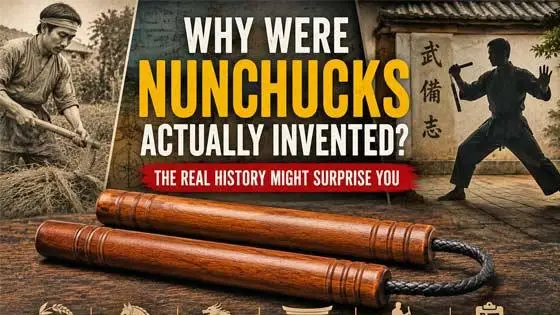
Most people think they already know the story of how nunchucks were invented. According to the version repeated in movies, martial arts schools, and internet articles, Okinawan farmers were banned from carrying weapons and secretly turned a simple rice flail into one of the most recognizable martial arts weapons in history. It is a great story, and honestly, it sounds believable. Two wooden sticks connected by rope certainly do resemble farming equipment. But there is one problem: historians are not completely sure that story is true.
The real history of nunchucks is far more interesting, and a lot more complicated, than most people realize. Some researchers believe the weapon may have evolved from agricultural tools, while others argue it shares stronger connections to horse bridles, Chinese weapons, or older striking tools that existed long before Okinawan martial arts adopted them. In this guide, we are going to look at why nunchucks were likely invented, where they may have actually come from, and why one of the world's most famous martial arts weapons still sparks debate today.
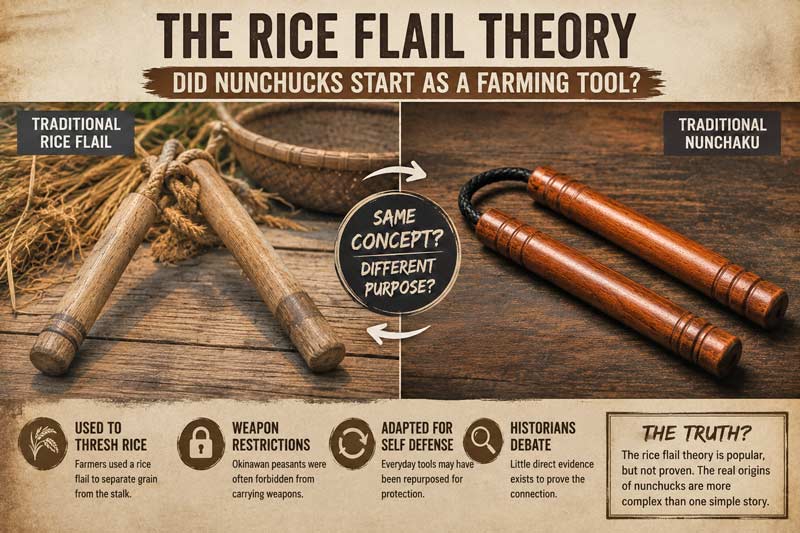
If you ask most people where nunchucks came from, the answer is usually immediate: a rice flail. This is by far the most popular explanation and the one repeated most often in martial arts schools, movies, and online articles. According to the theory, Okinawan farmers used a short flail-like farming tool to thresh rice or grain, and over time, that practical tool evolved into the weapon we now recognize as nunchaku.
At first glance, the theory seems pretty convincing. A rice flail and nunchucks do share some obvious similarities. Both involve two connected sections joined by rope or cord, and both rely on swinging movement. Since Okinawan peasants reportedly faced restrictions on carrying traditional weapons, it feels logical to assume they adapted ordinary farming tools for self defense when necessary.
The problem is that historians have not found much direct evidence proving this story is completely true. While the rice flail explanation became widely accepted over time, researchers point out that surviving examples of Okinawan farming flails often do not closely resemble traditional nunchaku. In some cases, the tools are much larger or shaped differently enough to raise questions about whether one really evolved from the other.
That does not mean the theory is necessarily wrong. It just means there is more uncertainty than most people realize. The idea fits the broader story of martial arts weapons possibly evolving from practical tools, which we explored in our recent post about whether martial arts weapons were really farm tools. But when it comes specifically to nunchucks, historians still debate how strong the connection actually is.
If you want a deeper breakdown of the evidence, this guide on the real history of nunchaku dives much further into the competing theories and historical research.

While the rice flail theory gets most of the attention, some historians believe a horse bridle may actually be a more believable explanation for where nunchucks came from. Specifically, they point to a type of short horse bit or bridle used to help guide animals, arguing that its compact size and connected design may more closely resemble traditional Okinawan nunchaku than large farming flails do.
This theory tends to make sense for a few reasons. First, many surviving rice flails from Okinawa are much larger than traditional nunchucks, raising questions about how one would realistically evolve into the other without major design changes. Horse bridles, on the other hand, were often shorter, easier to carry, and already built around a connected structure that could naturally inspire a compact hand-held tool or weapon.
Another reason historians take this idea seriously is geography and trade. Okinawa sat at the center of important trade routes between China, Japan, and Southeast Asia, meaning weapons and practical tools were constantly being influenced by outside cultures. It is entirely possible that what eventually became nunchaku evolved through a combination of local tools, imported designs, and martial experimentation rather than a single clear origin story.
Of course, just like the rice flail theory, the horse bridle explanation is not proven fact either. There is no historical document that clearly says, "this is exactly where nunchucks came from." That uncertainty is part of why the weapon's history remains so interesting. If you want to explore more theories and historical possibilities, this complete guide to nunchucks breaks down different styles, history, and training uses in more detail.
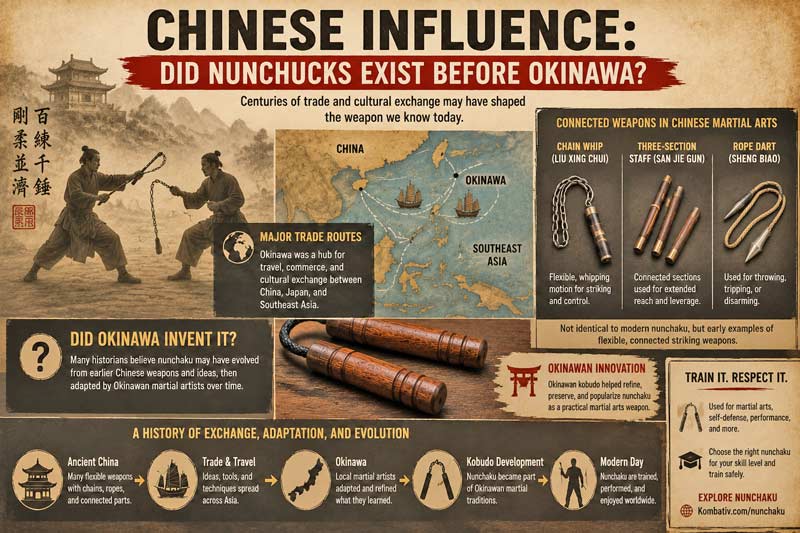
One reason the history of nunchucks becomes so complicated is that Okinawa did not exist in isolation. For centuries, Okinawa sat at the center of major trade routes between China, Japan, and Southeast Asia. Merchants, travelers, martial artists, and military influences moved through the region constantly, which means weapons and fighting systems often blended together rather than developing completely independently.
Because of this, some historians believe versions of connected striking weapons may have existed in China before Okinawan martial arts fully adopted what we now call nunchaku. Chinese martial arts included several flexible weapons involving linked sections, chains, and swinging movements long before Okinawan kobudo became formalized. While these weapons were not always identical to modern nunchucks, the similarities raise an interesting question: did Okinawa invent the weapon, or simply adapt an idea that already existed elsewhere?
This theory tends to make sense because martial arts history is full of borrowed ideas. Weapons changed shape as they moved between regions, and local practitioners often modified tools to fit their own training systems. Rather than a single moment of invention, the nunchaku may have evolved gradually through cultural exchange, experimentation, and adaptation over time.
This is also one reason historians rarely speak about nunchucks with complete certainty. Instead of one perfect explanation, there may have been several influences working together at once. Okinawan culture almost certainly helped refine and popularize the weapon, but some researchers believe its deeper roots may stretch further back than many people realize.
Today, people train with nunchaku for everything from martial arts and demonstrations to collecting and freestyle spinning. If you are new to training, it also helps to choose the right nunchaku for your skill level since beginner-friendly options can make practice much more enjoyable.
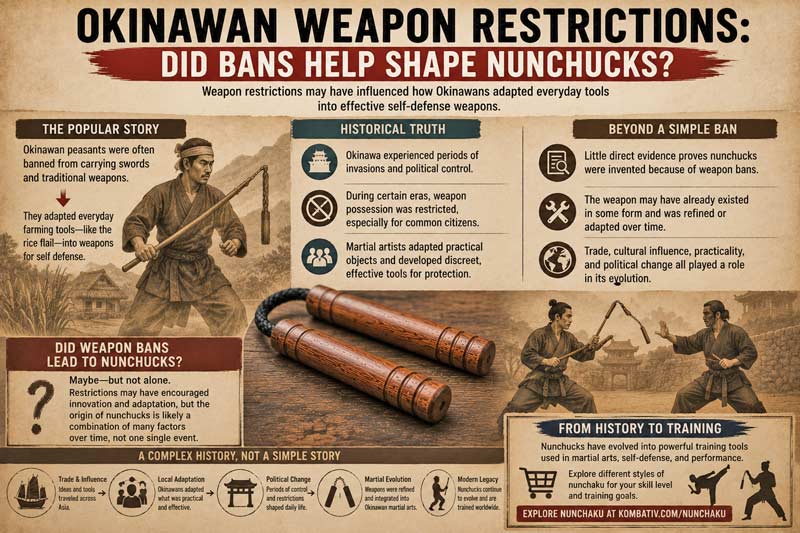
One of the biggest reasons people connect nunchucks to farming tools is the long-standing story that Okinawan peasants were banned from carrying traditional weapons. According to the popular version of events, rulers restricted access to swords and military weapons, forcing ordinary people to adapt everyday objects for self defense. It is a compelling explanation, and one that helped fuel the rice flail theory for generations.
There is at least some historical truth behind this idea. Okinawa experienced periods of political control and weapon restrictions, particularly after invasions and shifts in leadership. During certain eras, access to weapons became more limited, especially for common citizens. Because of this, many historians believe Okinawan martial arts practitioners may have adapted practical objects into defensive tools or refined simpler weapons that were easier to conceal and carry.
At the same time, modern historians caution against oversimplifying the story. Weapon bans alone do not fully explain the origin of nunchucks, and there is little direct evidence proving farmers suddenly invented them after restrictions were introduced. In reality, the weapon may have already existed in some form and simply became more useful, more refined, or more widespread during periods when traditional weapons were harder to access.
This is one reason the history of nunchucks remains so debated. Instead of a single dramatic moment where a farmer turned a tool into a weapon, the truth may involve trade, cultural influence, practical adaptation, and political change all working together over time. Martial arts history is rarely as simple as one perfect story.
If you are curious about how nunchaku eventually evolved into the training tools people use today, there are many styles of nunchaku available depending on experience level, training goals, and preferred materials.
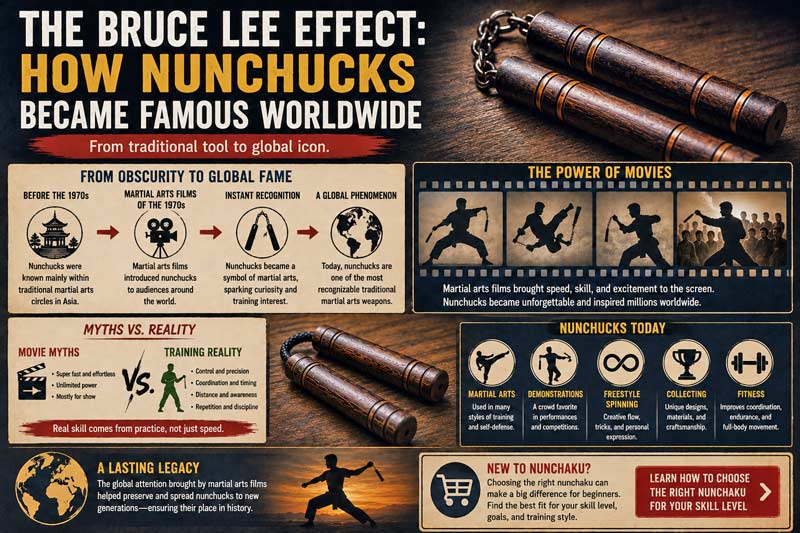
Even though nunchucks existed long before modern movies, there is no question that one person played a massive role in making them famous around the world: martial arts films of the 1970s. Before that era, many people outside of Asia had never even seen nunchaku, let alone understood what they were used for. The weapon was largely tied to traditional martial arts circles and regional training systems rather than mainstream pop culture.
Everything changed when martial arts cinema exploded in popularity. Suddenly, audiences around the world were seeing fast-moving spinning techniques, fluid movement, and dramatic demonstrations involving connected striking weapons. Nunchucks became instantly recognizable, and for many people, they quickly turned into the symbol of martial arts itself. This popularity sparked widespread curiosity, increased training interest, and eventually helped turn nunchaku into one of the best-known traditional martial arts weapons in the world.
Of course, popularity also created a lot of myths. Movies naturally emphasized speed, flashy movements, and dramatic action, which sometimes gave people unrealistic expectations about how nunchucks were actually used in training. In reality, traditional practice tends to focus much more on control, coordination, distance, and repetition than the fast-paced scenes most people picture.
Today, nunchucks remain popular for martial arts training, demonstrations, freestyle spinning, collecting, and even fitness. For beginners especially, it helps to understand the different materials and styles available before jumping in. This guide on how to choose the right nunchaku for your skill level can help make the learning process much smoother.
What is interesting is that the popularity boom created by martial arts films may have actually preserved the weapon's legacy. Without that global attention, nunchaku might have remained a niche traditional tool known mainly inside specialized martial arts communities.
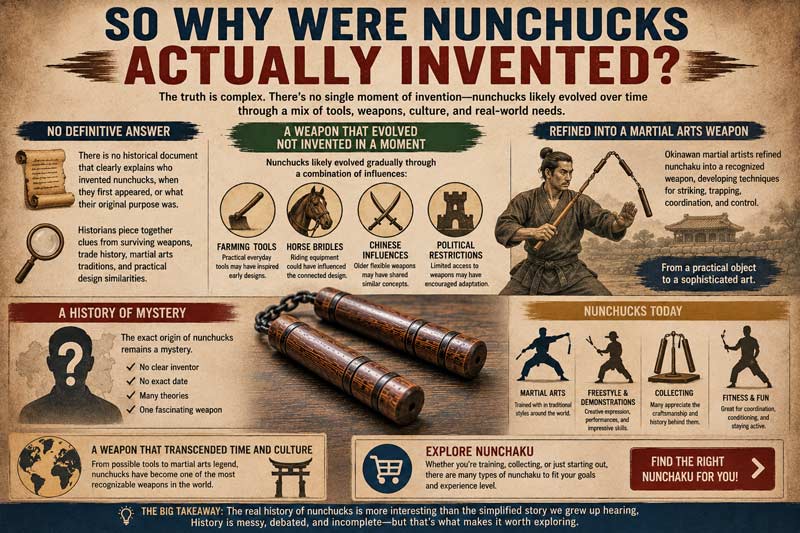
After looking at the different theories, the most honest answer is probably not the satisfying one people expect: nobody knows with complete certainty. There is no historical document that clearly explains exactly who invented nunchucks, when they first appeared, or what their original purpose was. Instead, historians piece together clues from surviving weapons, trade history, martial arts traditions, and practical design similarities.
What seems most likely is that nunchucks evolved gradually rather than being invented in a single moment. The weapon may have borrowed ideas from farming tools, horse bridles, older Chinese flexible weapons, or practical self defense needs during periods of political restriction. Rather than one perfect origin story, the truth may involve several influences blending together over generations.
What we do know is that Okinawan martial artists eventually refined nunchaku into a recognized martial arts weapon. Over time, practitioners developed techniques for striking, trapping, coordination, and control, helping transform the weapon into something far more sophisticated than a simple improvised tool. That evolution is part of what makes nunchucks so interesting. They sit somewhere between practical object, historical mystery, and martial arts tradition.
Today, nunchaku remain one of the most recognizable martial arts weapons in the world. Some people train with them for traditional martial arts, others enjoy freestyle spinning or demonstrations, and many are simply fascinated by the history. If you are curious about the different styles, materials, and beginner-friendly options available, there are many types of nunchaku worth exploring depending on your goals and experience level.
In the end, the biggest takeaway is this: the real history of nunchucks is probably far more interesting than the simplified story most of us grew up hearing. Sometimes history is messy, debated, and incomplete, but honestly, that is what makes it worth exploring.
The Rice Flail Theory: Did Nunchucks Start as a Farming Tool?
If you ask most people where nunchucks came from, the answer is usually immediate: a rice flail. This is by far the most popular explanation and the one repeated most often in martial arts schools, movies, and online articles. According to the theory, Okinawan farmers used a short flail-like farming tool to thresh rice or grain, and over time, that practical tool evolved into the weapon we now recognize as nunchaku.
At first glance, the theory seems pretty convincing. A rice flail and nunchucks do share some obvious similarities. Both involve two connected sections joined by rope or cord, and both rely on swinging movement. Since Okinawan peasants reportedly faced restrictions on carrying traditional weapons, it feels logical to assume they adapted ordinary farming tools for self defense when necessary.
The problem is that historians have not found much direct evidence proving this story is completely true. While the rice flail explanation became widely accepted over time, researchers point out that surviving examples of Okinawan farming flails often do not closely resemble traditional nunchaku. In some cases, the tools are much larger or shaped differently enough to raise questions about whether one really evolved from the other.
That does not mean the theory is necessarily wrong. It just means there is more uncertainty than most people realize. The idea fits the broader story of martial arts weapons possibly evolving from practical tools, which we explored in our recent post about whether martial arts weapons were really farm tools. But when it comes specifically to nunchucks, historians still debate how strong the connection actually is.
If you want a deeper breakdown of the evidence, this guide on the real history of nunchaku dives much further into the competing theories and historical research.
The Horse Bridle Theory: A More Believable Origin?
While the rice flail theory gets most of the attention, some historians believe a horse bridle may actually be a more believable explanation for where nunchucks came from. Specifically, they point to a type of short horse bit or bridle used to help guide animals, arguing that its compact size and connected design may more closely resemble traditional Okinawan nunchaku than large farming flails do.
This theory tends to make sense for a few reasons. First, many surviving rice flails from Okinawa are much larger than traditional nunchucks, raising questions about how one would realistically evolve into the other without major design changes. Horse bridles, on the other hand, were often shorter, easier to carry, and already built around a connected structure that could naturally inspire a compact hand-held tool or weapon.
Another reason historians take this idea seriously is geography and trade. Okinawa sat at the center of important trade routes between China, Japan, and Southeast Asia, meaning weapons and practical tools were constantly being influenced by outside cultures. It is entirely possible that what eventually became nunchaku evolved through a combination of local tools, imported designs, and martial experimentation rather than a single clear origin story.
Of course, just like the rice flail theory, the horse bridle explanation is not proven fact either. There is no historical document that clearly says, "this is exactly where nunchucks came from." That uncertainty is part of why the weapon's history remains so interesting. If you want to explore more theories and historical possibilities, this complete guide to nunchucks breaks down different styles, history, and training uses in more detail.
Chinese Influence: Did Nunchucks Exist Before Okinawa?
One reason the history of nunchucks becomes so complicated is that Okinawa did not exist in isolation. For centuries, Okinawa sat at the center of major trade routes between China, Japan, and Southeast Asia. Merchants, travelers, martial artists, and military influences moved through the region constantly, which means weapons and fighting systems often blended together rather than developing completely independently.
Because of this, some historians believe versions of connected striking weapons may have existed in China before Okinawan martial arts fully adopted what we now call nunchaku. Chinese martial arts included several flexible weapons involving linked sections, chains, and swinging movements long before Okinawan kobudo became formalized. While these weapons were not always identical to modern nunchucks, the similarities raise an interesting question: did Okinawa invent the weapon, or simply adapt an idea that already existed elsewhere?
This theory tends to make sense because martial arts history is full of borrowed ideas. Weapons changed shape as they moved between regions, and local practitioners often modified tools to fit their own training systems. Rather than a single moment of invention, the nunchaku may have evolved gradually through cultural exchange, experimentation, and adaptation over time.
This is also one reason historians rarely speak about nunchucks with complete certainty. Instead of one perfect explanation, there may have been several influences working together at once. Okinawan culture almost certainly helped refine and popularize the weapon, but some researchers believe its deeper roots may stretch further back than many people realize.
Today, people train with nunchaku for everything from martial arts and demonstrations to collecting and freestyle spinning. If you are new to training, it also helps to choose the right nunchaku for your skill level since beginner-friendly options can make practice much more enjoyable.
Okinawan Weapon Restrictions: Did Bans Help Shape Nunchucks?
One of the biggest reasons people connect nunchucks to farming tools is the long-standing story that Okinawan peasants were banned from carrying traditional weapons. According to the popular version of events, rulers restricted access to swords and military weapons, forcing ordinary people to adapt everyday objects for self defense. It is a compelling explanation, and one that helped fuel the rice flail theory for generations.
There is at least some historical truth behind this idea. Okinawa experienced periods of political control and weapon restrictions, particularly after invasions and shifts in leadership. During certain eras, access to weapons became more limited, especially for common citizens. Because of this, many historians believe Okinawan martial arts practitioners may have adapted practical objects into defensive tools or refined simpler weapons that were easier to conceal and carry.
At the same time, modern historians caution against oversimplifying the story. Weapon bans alone do not fully explain the origin of nunchucks, and there is little direct evidence proving farmers suddenly invented them after restrictions were introduced. In reality, the weapon may have already existed in some form and simply became more useful, more refined, or more widespread during periods when traditional weapons were harder to access.
This is one reason the history of nunchucks remains so debated. Instead of a single dramatic moment where a farmer turned a tool into a weapon, the truth may involve trade, cultural influence, practical adaptation, and political change all working together over time. Martial arts history is rarely as simple as one perfect story.
If you are curious about how nunchaku eventually evolved into the training tools people use today, there are many styles of nunchaku available depending on experience level, training goals, and preferred materials.
The Bruce Lee Effect: How Nunchucks Became Famous Worldwide
Even though nunchucks existed long before modern movies, there is no question that one person played a massive role in making them famous around the world: martial arts films of the 1970s. Before that era, many people outside of Asia had never even seen nunchaku, let alone understood what they were used for. The weapon was largely tied to traditional martial arts circles and regional training systems rather than mainstream pop culture.
Everything changed when martial arts cinema exploded in popularity. Suddenly, audiences around the world were seeing fast-moving spinning techniques, fluid movement, and dramatic demonstrations involving connected striking weapons. Nunchucks became instantly recognizable, and for many people, they quickly turned into the symbol of martial arts itself. This popularity sparked widespread curiosity, increased training interest, and eventually helped turn nunchaku into one of the best-known traditional martial arts weapons in the world.
Of course, popularity also created a lot of myths. Movies naturally emphasized speed, flashy movements, and dramatic action, which sometimes gave people unrealistic expectations about how nunchucks were actually used in training. In reality, traditional practice tends to focus much more on control, coordination, distance, and repetition than the fast-paced scenes most people picture.
Today, nunchucks remain popular for martial arts training, demonstrations, freestyle spinning, collecting, and even fitness. For beginners especially, it helps to understand the different materials and styles available before jumping in. This guide on how to choose the right nunchaku for your skill level can help make the learning process much smoother.
What is interesting is that the popularity boom created by martial arts films may have actually preserved the weapon's legacy. Without that global attention, nunchaku might have remained a niche traditional tool known mainly inside specialized martial arts communities.
So Why Were Nunchucks Actually Invented?
After looking at the different theories, the most honest answer is probably not the satisfying one people expect: nobody knows with complete certainty. There is no historical document that clearly explains exactly who invented nunchucks, when they first appeared, or what their original purpose was. Instead, historians piece together clues from surviving weapons, trade history, martial arts traditions, and practical design similarities.
What seems most likely is that nunchucks evolved gradually rather than being invented in a single moment. The weapon may have borrowed ideas from farming tools, horse bridles, older Chinese flexible weapons, or practical self defense needs during periods of political restriction. Rather than one perfect origin story, the truth may involve several influences blending together over generations.
What we do know is that Okinawan martial artists eventually refined nunchaku into a recognized martial arts weapon. Over time, practitioners developed techniques for striking, trapping, coordination, and control, helping transform the weapon into something far more sophisticated than a simple improvised tool. That evolution is part of what makes nunchucks so interesting. They sit somewhere between practical object, historical mystery, and martial arts tradition.
Today, nunchaku remain one of the most recognizable martial arts weapons in the world. Some people train with them for traditional martial arts, others enjoy freestyle spinning or demonstrations, and many are simply fascinated by the history. If you are curious about the different styles, materials, and beginner-friendly options available, there are many types of nunchaku worth exploring depending on your goals and experience level.
In the end, the biggest takeaway is this: the real history of nunchucks is probably far more interesting than the simplified story most of us grew up hearing. Sometimes history is messy, debated, and incomplete, but honestly, that is what makes it worth exploring.
You May Also Be Interested In:
- Were Nunchucks Ever Actually Used in Real Combat?
- The Real History of Nunchaku: From Farm Tool to Hollywood Icon
- The Real History of Brass Knuckles: From Battlefield to Back Pocket
- The Real History of the Balisong: How Butterfly Knives Evolved Through Time
- The Real History of Escrima Sticks: From Battlefield Weapon to Modern Martial Art
- The Most Ingenious Hidden Weapons Ever Invented
- The Most Clever Hidden Knives Ever Invented
- What are the Best Nunchucks for You?
- Could Nunchucks Actually Break a Sword?
- Why Did America Become So Afraid of Nunchucks?
Leave a Reply