




Were Martial Arts Weapons Really Farm Tools?
May 22nd, 2026
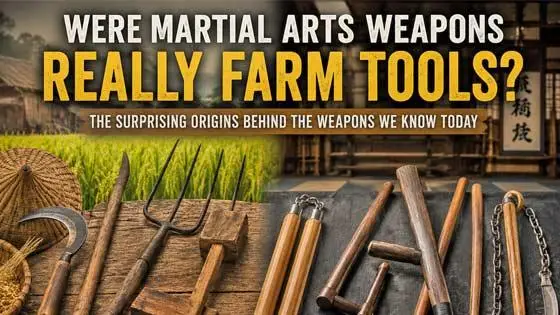
For centuries, people have repeated the same story about martial arts weapons: farmers were banned from owning traditional weapons, so they secretly turned ordinary farming tools into instruments of self defense. It is a great story, and honestly, part of the reason it has survived so long is because it sounds believable. After all, weapons like nunchaku, tonfa, and kama do seem suspiciously similar to tools that might have been found on a farm. But how much of that story is actually true?
The answer is more complicated than most people realize. Some martial arts weapons probably did evolve from practical everyday tools, while others may have been designed specifically for combat from the beginning. Historians still debate the origins of several famous weapons, and in some cases, pop culture has blurred the line between fact and legend. In this guide, we are going to look at where these weapons likely came from, which farm tool stories hold up under scrutiny, and which ones might be more myth than reality.
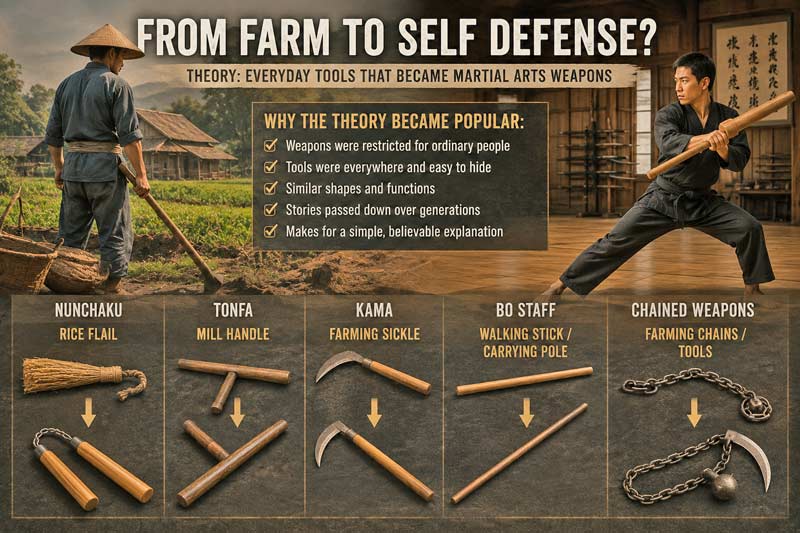
The idea that martial arts weapons started as farm tools has been repeated for so long that many people simply assume it is a proven historical fact. According to the popular story, farmers in places like Okinawa and parts of Asia were banned from owning swords and traditional weapons, so they secretly adapted everyday farming tools for self defense and resistance. It is a simple explanation, and honestly, it sounds pretty convincing at first.
Part of the reason the story stuck is because some martial arts weapons genuinely do resemble tools you might find on a farm. Nunchaku are often said to have evolved from a rice flail, tonfa supposedly came from mill handles, and kama closely resemble farming sickles used for harvesting crops. Even the bo staff is sometimes described as little more than a walking stick or carrying pole that became useful for protection. When you line these similarities up side by side, it becomes easy to see why the theory became so popular.
The problem is that history is rarely that straightforward. Modern historians and martial arts researchers increasingly debate how accurate many of these origin stories really are. In some cases, there is evidence supporting a practical tool connection. In others, the "farm tool" explanation may have been exaggerated over time or simplified into an easy-to-tell story. Some researchers even argue that several famous martial arts weapons may have always been intended for combat or law enforcement rather than farming at all.
This does not mean the farm tool theory is completely wrong. It just means the truth is probably more nuanced than movies and martial arts legends make it seem. As we go through different weapons, you will notice that some stories hold up surprisingly well, while others become much harder to prove once you start looking at the historical details.
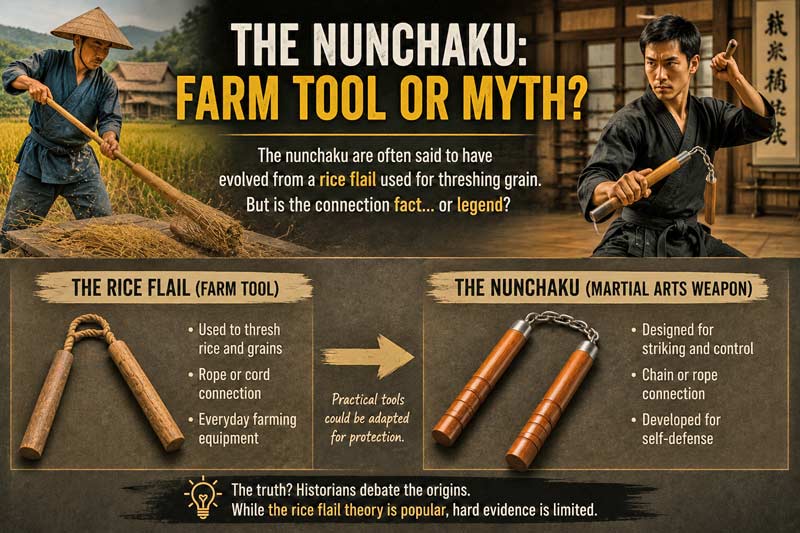
Few martial arts weapons have a stronger "farm tool origin" story than the nunchaku. According to the popular explanation, nunchaku originally evolved from a rice flail, a farming tool used to thresh grain by striking harvested rice to separate the edible part from the stalk. On the surface, the comparison seems pretty convincing. Both tools involve two connected sections joined by rope or chain, and visually, it is easy to see why people started connecting the dots.
The problem is that historians are not completely convinced the story is true. While the rice flail theory has been repeated for decades, there is surprisingly little hard historical evidence proving that nunchaku directly evolved from farming equipment. Some researchers believe the design may have developed from horse bridles or other tools, while others argue that versions of connected striking weapons already existed in parts of China and Southeast Asia long before Okinawan martial arts adopted them.
That does not mean the farm tool theory is completely wrong. It simply means the history may be more complicated than many martial arts schools or movies suggest. Okinawan peasants almost certainly adapted practical objects for defense when weapons were restricted, but whether the nunchaku specifically started as a rice flail remains a topic of debate. If you want a deeper look into the controversy and historical evidence, this breakdown of the real history of nunchaku dives much deeper into where the weapon likely came from.
Regardless of how they began, nunchaku eventually became one of the most recognizable martial arts weapons in the world, especially after Bruce Lee popularized them in film. Today, there are many styles of nunchaku available for training, collecting, and demonstrations. If you are new to them, it also helps to choose the right nunchaku for your skill level since materials and weight can dramatically change how they feel during practice.
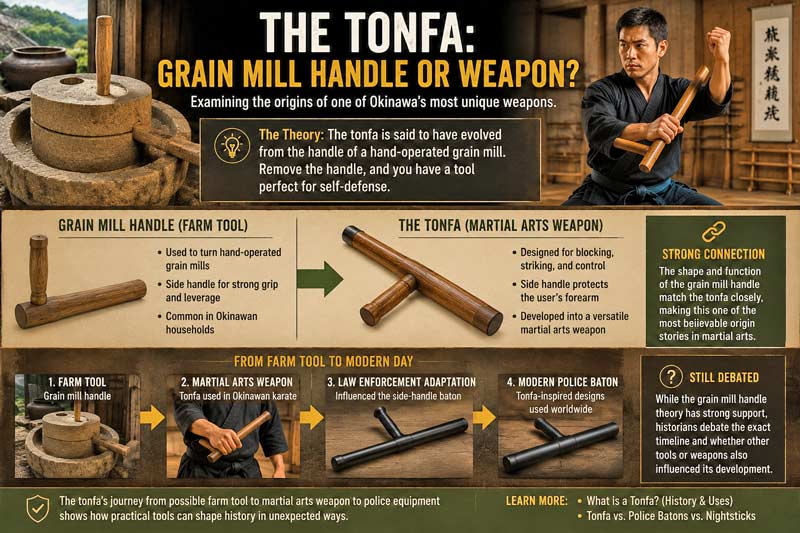
The tonfa has one of the strongest farm tool origin stories in martial arts history. According to the traditional explanation, the weapon evolved from the wooden handle of a hand-operated grain mill used in Okinawa. Since the handle stuck out from the side of the mill, people supposedly realized it could be removed and used for striking, blocking, and leverage, eventually leading to the tonfa weapon we recognize today. When you compare the shape of a traditional tonfa to a mill handle, the connection actually seems pretty believable.
Unlike some other martial arts weapon origin stories, there is at least some historical support for this theory. The tonfa's side handle and overall shape do resemble agricultural grinding tools used in Okinawa and other parts of Asia. That said, historians still debate whether the tonfa directly evolved from farm equipment or whether practical tools and early weapons simply influenced one another over time. As with many historical weapons, the exact timeline is difficult to prove with certainty.
There is another interesting wrinkle to the story. Over time, the tonfa eventually influenced modern side-handle police batons, which many people still recognize today. That evolution from possible farm tool to martial arts weapon to law enforcement equipment makes the tonfa one of the more fascinating examples in this debate. If you want a deeper breakdown, this guide on what a tonfa weapon is and how it was originally used explores its history in much more detail.
Whether the farm tool story is completely accurate or not, there is no question that tonfa weapons became highly effective martial arts tools for blocking, striking, and controlling movement. Their unusual shape may look awkward at first, but once you understand how they work, it becomes easier to see why the design lasted for centuries. You can also see how the weapon eventually influenced law enforcement in this breakdown of the difference between tonfa, police batons, and nightsticks.
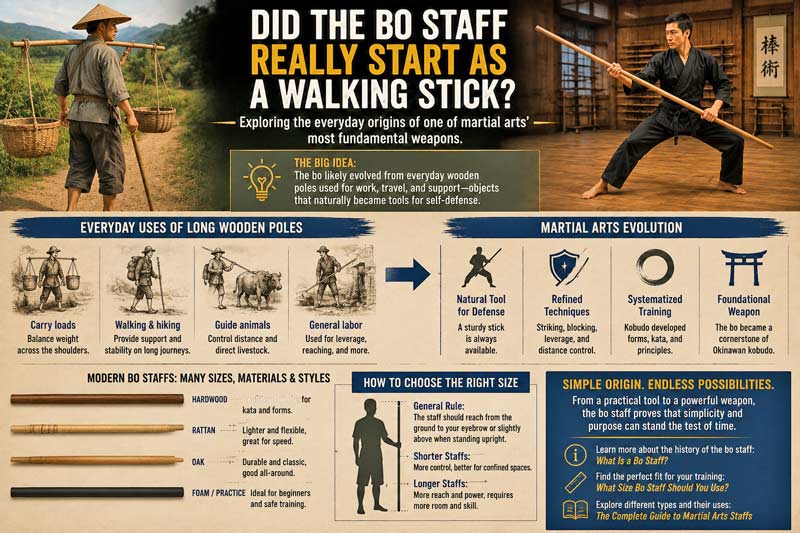
Compared to weapons like the nunchaku or tonfa, the bo staff has a much simpler origin story. Many historians believe the bo likely developed from ordinary wooden poles that were already used in everyday life for carrying supplies, balancing loads across the shoulders, walking long distances, or general labor. In that sense, the bo may have started less as a farming tool and more as an everyday utility object that naturally doubled as something useful for self defense.
This explanation tends to feel more believable than some of the more dramatic martial arts weapon legends. After all, long wooden staffs have existed in nearly every culture throughout history because they are simple, durable, and practical. A sturdy stick can be used for carrying buckets, guiding animals, hiking difficult terrain, or protection when traveling. It does not take much imagination to understand how people would eventually develop techniques for fighting with something they already carried every day.
That said, there is still some debate over how much of the bo staff's martial arts use came from necessity versus intentional training. Okinawan martial arts systems eventually refined the weapon into highly technical forms focused on striking, blocking, leverage, and distance control. Over time, what may have started as a practical tool became one of the foundational weapons of kobudo and traditional martial arts training. If you want a better understanding of what a bo staff is and how it evolved into a martial arts weapon, we covered its history in more detail here.
Today, martial arts staffs come in many sizes, materials, and styles depending on how someone plans to train. Some practitioners prefer traditional hardwood versions for kata and forms, while others experiment with different lengths and weights depending on their goals. If you are curious about sizing, this guide on what size bo staff you should use can help you choose a staff that fits your height and experience level. For a broader breakdown of different staff styles, this complete guide to martial arts staffs covers the major types and training purposes.
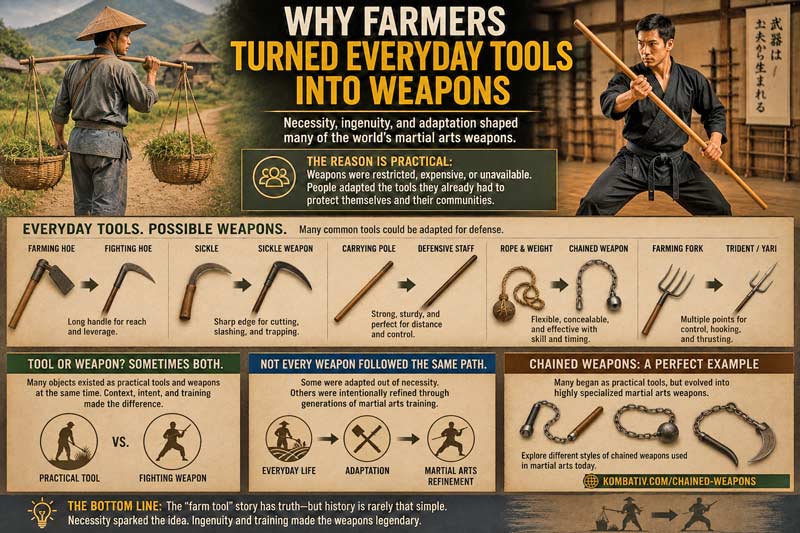
Whether every martial arts weapon truly started as a farm tool is still debated, but there is a very practical reason the idea became so widespread. Throughout history, ordinary people often had limited access to traditional weapons. In places where swords or military equipment were restricted, expensive, or simply unavailable, it made sense to adapt familiar objects into something useful for protection.
Even outside of Okinawa, this pattern shows up repeatedly throughout human history. Farmers, laborers, travelers, and villagers often relied on tools they already owned because they were practical, easy to carry, and did not attract the same attention as military weapons. A long wooden pole could become a defensive staff. A sickle could be adapted into a weapon. A weighted chain or rope tool might evolve into something used for control, trapping, or striking.
This is one reason weapon origins can be so difficult to pin down with complete certainty. In many cases, the same object may have existed both as a practical tool and as a fighting weapon at the same time. Some designs were probably adapted for defense out of necessity, while others may have been intentionally refined into specialized weapons over generations of martial arts training.
Weapons connected by rope or chain are a great example of this overlap. While some likely evolved from practical tools, others became highly specialized martial arts designs focused on timing, distance, and flexibility. Today, there are many styles of chained weapons used in martial arts, ranging from flexible striking tools to complex training weapons that require significant coordination and control.
In the end, the "farm tool" story probably survives because there is at least some truth to it. The mistake happens when people assume every martial arts weapon followed the exact same path. History tends to be messier than that, and honestly, a lot more interesting.
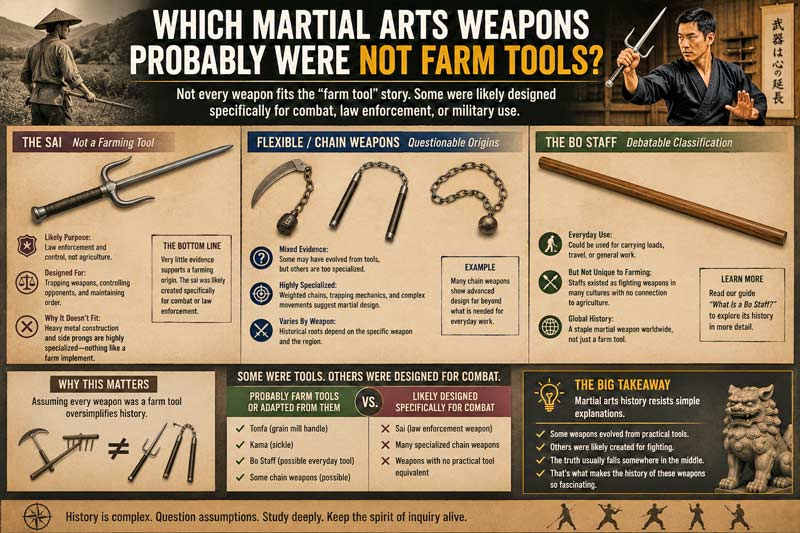
This is where the "everything started as a farm tool" theory begins to fall apart a little. While weapons like the tonfa and kama at least have believable connections to everyday tools, others are much harder to explain through farming origins. In some cases, historians believe certain weapons were likely designed specifically for combat, law enforcement, or military use from the beginning.
The sai is one of the biggest examples. Many people assume it was once a farming tool because of its unusual shape, but historians often point out that there is very little evidence supporting that claim. Instead, the sai may have functioned more like a law enforcement weapon used for controlling suspects, trapping blades, and maintaining order. The heavy metal construction and side prongs make it feel much more specialized than something pulled from everyday farm life.
Some flexible weapons also raise questions. While a few chain-based weapons may have evolved from practical tools, others seem far too specialized to have started as ordinary household objects. Weapons involving weighted chains, trapping mechanisms, or highly technical movement patterns often appear more closely tied to martial systems than daily labor. Today, many practitioners interested in flexible weapon systems train with different styles of chained weapons, but their exact historical roots can vary dramatically depending on the weapon and region.
Even with something as simple as the bo staff, historians debate whether it should really count as a "farm tool weapon" at all. A wooden staff may have been used for carrying loads, travel, or everyday work, but staffs also existed as fighting weapons across many cultures completely unrelated to farming. If you are curious about the weapon's history, we covered more of that in this guide to what a bo staff is.
The biggest takeaway is that martial arts history tends to resist simple explanations. Some weapons probably did evolve from practical tools. Others almost certainly did not. The truth usually lives somewhere in the middle, which is honestly part of what makes these weapons so fascinating to study.
So, were martial arts weapons really farm tools? The honest answer is: sometimes, probably, but not always. Weapons like the tonfa and kama have fairly believable connections to practical tools, while others, like the nunchaku, still spark debate among historians. And some weapons, such as the sai, may have had little to do with farming at all. The deeper you look into martial arts history, the more complicated the story becomes.
What makes these weapons so fascinating is that many of them likely evolved through a mix of practicality, necessity, and refinement over time. A simple object used for work could eventually become part of a martial system, while other weapons may have been designed specifically for combat or law enforcement from the beginning. In many cases, the truth probably lives somewhere between historical evidence and martial arts legend.
That complexity is part of what keeps people interested in traditional weapons today. Whether you are exploring the history of nunchaku, learning about tonfa weapons, or comparing different styles of martial arts staffs, understanding the possible origins makes training and collecting a lot more interesting. These objects are not just tools or weapons. They are pieces of cultural history that evolved over generations.
At the end of the day, the biggest lesson here is probably to question the stories that sound a little too perfect. Martial arts history is full of myths, half-truths, and fascinating surprises. And honestly, that is part of what makes studying it so fun.
Why Do People Think Martial Arts Weapons Were Farm Tools?
The idea that martial arts weapons started as farm tools has been repeated for so long that many people simply assume it is a proven historical fact. According to the popular story, farmers in places like Okinawa and parts of Asia were banned from owning swords and traditional weapons, so they secretly adapted everyday farming tools for self defense and resistance. It is a simple explanation, and honestly, it sounds pretty convincing at first.
Part of the reason the story stuck is because some martial arts weapons genuinely do resemble tools you might find on a farm. Nunchaku are often said to have evolved from a rice flail, tonfa supposedly came from mill handles, and kama closely resemble farming sickles used for harvesting crops. Even the bo staff is sometimes described as little more than a walking stick or carrying pole that became useful for protection. When you line these similarities up side by side, it becomes easy to see why the theory became so popular.
The problem is that history is rarely that straightforward. Modern historians and martial arts researchers increasingly debate how accurate many of these origin stories really are. In some cases, there is evidence supporting a practical tool connection. In others, the "farm tool" explanation may have been exaggerated over time or simplified into an easy-to-tell story. Some researchers even argue that several famous martial arts weapons may have always been intended for combat or law enforcement rather than farming at all.
This does not mean the farm tool theory is completely wrong. It just means the truth is probably more nuanced than movies and martial arts legends make it seem. As we go through different weapons, you will notice that some stories hold up surprisingly well, while others become much harder to prove once you start looking at the historical details.
The Nunchaku: Farm Tool or Myth?
Few martial arts weapons have a stronger "farm tool origin" story than the nunchaku. According to the popular explanation, nunchaku originally evolved from a rice flail, a farming tool used to thresh grain by striking harvested rice to separate the edible part from the stalk. On the surface, the comparison seems pretty convincing. Both tools involve two connected sections joined by rope or chain, and visually, it is easy to see why people started connecting the dots.
The problem is that historians are not completely convinced the story is true. While the rice flail theory has been repeated for decades, there is surprisingly little hard historical evidence proving that nunchaku directly evolved from farming equipment. Some researchers believe the design may have developed from horse bridles or other tools, while others argue that versions of connected striking weapons already existed in parts of China and Southeast Asia long before Okinawan martial arts adopted them.
That does not mean the farm tool theory is completely wrong. It simply means the history may be more complicated than many martial arts schools or movies suggest. Okinawan peasants almost certainly adapted practical objects for defense when weapons were restricted, but whether the nunchaku specifically started as a rice flail remains a topic of debate. If you want a deeper look into the controversy and historical evidence, this breakdown of the real history of nunchaku dives much deeper into where the weapon likely came from.
Regardless of how they began, nunchaku eventually became one of the most recognizable martial arts weapons in the world, especially after Bruce Lee popularized them in film. Today, there are many styles of nunchaku available for training, collecting, and demonstrations. If you are new to them, it also helps to choose the right nunchaku for your skill level since materials and weight can dramatically change how they feel during practice.
The Tonfa: Grain Mill Handle or Weapon?
The tonfa has one of the strongest farm tool origin stories in martial arts history. According to the traditional explanation, the weapon evolved from the wooden handle of a hand-operated grain mill used in Okinawa. Since the handle stuck out from the side of the mill, people supposedly realized it could be removed and used for striking, blocking, and leverage, eventually leading to the tonfa weapon we recognize today. When you compare the shape of a traditional tonfa to a mill handle, the connection actually seems pretty believable.
Unlike some other martial arts weapon origin stories, there is at least some historical support for this theory. The tonfa's side handle and overall shape do resemble agricultural grinding tools used in Okinawa and other parts of Asia. That said, historians still debate whether the tonfa directly evolved from farm equipment or whether practical tools and early weapons simply influenced one another over time. As with many historical weapons, the exact timeline is difficult to prove with certainty.
There is another interesting wrinkle to the story. Over time, the tonfa eventually influenced modern side-handle police batons, which many people still recognize today. That evolution from possible farm tool to martial arts weapon to law enforcement equipment makes the tonfa one of the more fascinating examples in this debate. If you want a deeper breakdown, this guide on what a tonfa weapon is and how it was originally used explores its history in much more detail.
Whether the farm tool story is completely accurate or not, there is no question that tonfa weapons became highly effective martial arts tools for blocking, striking, and controlling movement. Their unusual shape may look awkward at first, but once you understand how they work, it becomes easier to see why the design lasted for centuries. You can also see how the weapon eventually influenced law enforcement in this breakdown of the difference between tonfa, police batons, and nightsticks.
Did the Bo Staff Really Start as a Walking Stick?
Compared to weapons like the nunchaku or tonfa, the bo staff has a much simpler origin story. Many historians believe the bo likely developed from ordinary wooden poles that were already used in everyday life for carrying supplies, balancing loads across the shoulders, walking long distances, or general labor. In that sense, the bo may have started less as a farming tool and more as an everyday utility object that naturally doubled as something useful for self defense.
This explanation tends to feel more believable than some of the more dramatic martial arts weapon legends. After all, long wooden staffs have existed in nearly every culture throughout history because they are simple, durable, and practical. A sturdy stick can be used for carrying buckets, guiding animals, hiking difficult terrain, or protection when traveling. It does not take much imagination to understand how people would eventually develop techniques for fighting with something they already carried every day.
That said, there is still some debate over how much of the bo staff's martial arts use came from necessity versus intentional training. Okinawan martial arts systems eventually refined the weapon into highly technical forms focused on striking, blocking, leverage, and distance control. Over time, what may have started as a practical tool became one of the foundational weapons of kobudo and traditional martial arts training. If you want a better understanding of what a bo staff is and how it evolved into a martial arts weapon, we covered its history in more detail here.
Today, martial arts staffs come in many sizes, materials, and styles depending on how someone plans to train. Some practitioners prefer traditional hardwood versions for kata and forms, while others experiment with different lengths and weights depending on their goals. If you are curious about sizing, this guide on what size bo staff you should use can help you choose a staff that fits your height and experience level. For a broader breakdown of different staff styles, this complete guide to martial arts staffs covers the major types and training purposes.
Why Farmers Turned Everyday Tools Into Weapons
Whether every martial arts weapon truly started as a farm tool is still debated, but there is a very practical reason the idea became so widespread. Throughout history, ordinary people often had limited access to traditional weapons. In places where swords or military equipment were restricted, expensive, or simply unavailable, it made sense to adapt familiar objects into something useful for protection.
Even outside of Okinawa, this pattern shows up repeatedly throughout human history. Farmers, laborers, travelers, and villagers often relied on tools they already owned because they were practical, easy to carry, and did not attract the same attention as military weapons. A long wooden pole could become a defensive staff. A sickle could be adapted into a weapon. A weighted chain or rope tool might evolve into something used for control, trapping, or striking.
This is one reason weapon origins can be so difficult to pin down with complete certainty. In many cases, the same object may have existed both as a practical tool and as a fighting weapon at the same time. Some designs were probably adapted for defense out of necessity, while others may have been intentionally refined into specialized weapons over generations of martial arts training.
Weapons connected by rope or chain are a great example of this overlap. While some likely evolved from practical tools, others became highly specialized martial arts designs focused on timing, distance, and flexibility. Today, there are many styles of chained weapons used in martial arts, ranging from flexible striking tools to complex training weapons that require significant coordination and control.
In the end, the "farm tool" story probably survives because there is at least some truth to it. The mistake happens when people assume every martial arts weapon followed the exact same path. History tends to be messier than that, and honestly, a lot more interesting.
Which Martial Arts Weapons Probably Were NOT Farm Tools?
This is where the "everything started as a farm tool" theory begins to fall apart a little. While weapons like the tonfa and kama at least have believable connections to everyday tools, others are much harder to explain through farming origins. In some cases, historians believe certain weapons were likely designed specifically for combat, law enforcement, or military use from the beginning.
The sai is one of the biggest examples. Many people assume it was once a farming tool because of its unusual shape, but historians often point out that there is very little evidence supporting that claim. Instead, the sai may have functioned more like a law enforcement weapon used for controlling suspects, trapping blades, and maintaining order. The heavy metal construction and side prongs make it feel much more specialized than something pulled from everyday farm life.
Some flexible weapons also raise questions. While a few chain-based weapons may have evolved from practical tools, others seem far too specialized to have started as ordinary household objects. Weapons involving weighted chains, trapping mechanisms, or highly technical movement patterns often appear more closely tied to martial systems than daily labor. Today, many practitioners interested in flexible weapon systems train with different styles of chained weapons, but their exact historical roots can vary dramatically depending on the weapon and region.
Even with something as simple as the bo staff, historians debate whether it should really count as a "farm tool weapon" at all. A wooden staff may have been used for carrying loads, travel, or everyday work, but staffs also existed as fighting weapons across many cultures completely unrelated to farming. If you are curious about the weapon's history, we covered more of that in this guide to what a bo staff is.
The biggest takeaway is that martial arts history tends to resist simple explanations. Some weapons probably did evolve from practical tools. Others almost certainly did not. The truth usually lives somewhere in the middle, which is honestly part of what makes these weapons so fascinating to study.
History Is More Complicated Than Movies Make It Seem
So, were martial arts weapons really farm tools? The honest answer is: sometimes, probably, but not always. Weapons like the tonfa and kama have fairly believable connections to practical tools, while others, like the nunchaku, still spark debate among historians. And some weapons, such as the sai, may have had little to do with farming at all. The deeper you look into martial arts history, the more complicated the story becomes.
What makes these weapons so fascinating is that many of them likely evolved through a mix of practicality, necessity, and refinement over time. A simple object used for work could eventually become part of a martial system, while other weapons may have been designed specifically for combat or law enforcement from the beginning. In many cases, the truth probably lives somewhere between historical evidence and martial arts legend.
That complexity is part of what keeps people interested in traditional weapons today. Whether you are exploring the history of nunchaku, learning about tonfa weapons, or comparing different styles of martial arts staffs, understanding the possible origins makes training and collecting a lot more interesting. These objects are not just tools or weapons. They are pieces of cultural history that evolved over generations.
At the end of the day, the biggest lesson here is probably to question the stories that sound a little too perfect. Martial arts history is full of myths, half-truths, and fascinating surprises. And honestly, that is part of what makes studying it so fun.
You May Also Be Interested In:
- The 7 Most Misunderstood Martial Arts Weapons
- Why Some Martial Arts Weapons Are Illegal in Certain Places
- 7 Weird Martial Arts Weapons That Actually Existed
- The Biggest Lies Movies Told You About Martial Arts Weapons
- The Evolution of the Shuriken: From Samurai to Modern Martial Arts
- What Is the Hardest Martial Arts Weapon to Master? We Ranked Them
- What Is a Fighting Cane? A Beginner's Guide to Martial Arts Canes
- The Complete Guide to Martial Arts Staffs: A Beginner-Friendly Breakdown
- The Fastest Weapon in Martial Arts? Why Kali Practitioners Move So Differently
- The Deadliest Weapons That Started as Everyday Tools
Leave a Reply