




What Is a Bo Staff? Beginner Guide to History, Sizes, and Training
May 13th, 2026
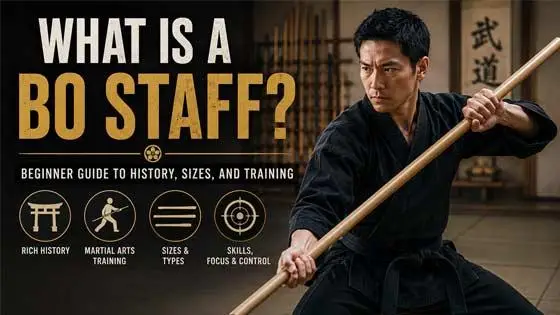
The bo staff is one of the oldest and most recognizable martial arts weapons in the world. Known for its long wooden design and fast spinning techniques, the bo staff has been used for centuries in martial arts training, self-defense practice, demonstrations, and traditional weapon forms. Although many people first discover it through martial arts movies or action scenes, the bo staff has deep roots in Okinawan and Japanese martial arts history and is still widely practiced today.
Modern bo staffs come in several different styles, lengths, and materials ranging from traditional hardwood training staffs to lightweight practice models and even compact expandable designs. Some martial artists use them for kata and demonstrations, while others focus on speed drills, coordination training, or controlled sparring exercises. Whether you are interested in traditional martial arts, learning basic techniques, or exploring different types of bo staffs, understanding the history and purpose behind this classic weapon is a great place to start.
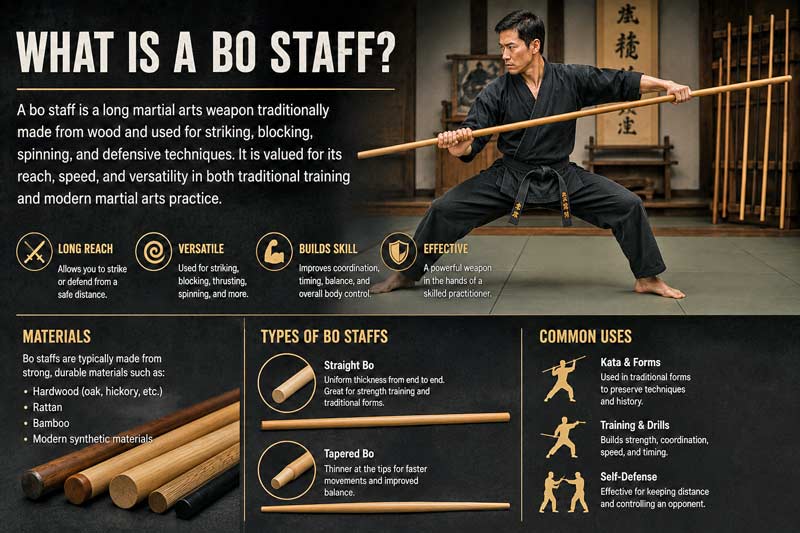
A bo staff is a long martial arts weapon traditionally made from wood and used for striking, blocking, spinning, and defensive techniques. Most bo staffs are around six feet long, though there are several variations depending on the martial arts style, the user's height, and the type of training being practiced. The weapon is known for its speed, reach, and versatility, making it one of the most recognizable traditional martial arts staffs in the world.
The bo staff has strong historical ties to Okinawan and Japanese martial arts, where it became an important training weapon in systems that focused on coordination, timing, movement, and weapon control. Unlike bladed weapons, the bo staff relies heavily on leverage, precision, and body mechanics rather than cutting power. Skilled practitioners can generate surprising speed and force through spinning motions, rapid directional changes, and controlled striking techniques.
Traditional bo staffs are usually made from hardwoods such as oak, rattan, or other dense materials that can withstand repeated training. Some designs are completely straight from end to end, while others taper slightly toward the tips for faster handling and improved balance. Modern training versions may also use lightweight synthetic materials designed for demonstrations, beginner practice, or controlled sparring drills.
Today, bo staffs are commonly used in martial arts schools for kata, demonstrations, freestyle competitions, conditioning drills, and traditional weapons training. Many martial artists also appreciate them because they help develop coordination, grip strength, balance, timing, and overall body control while still being relatively simple to begin learning compared to more complex martial arts weapons.
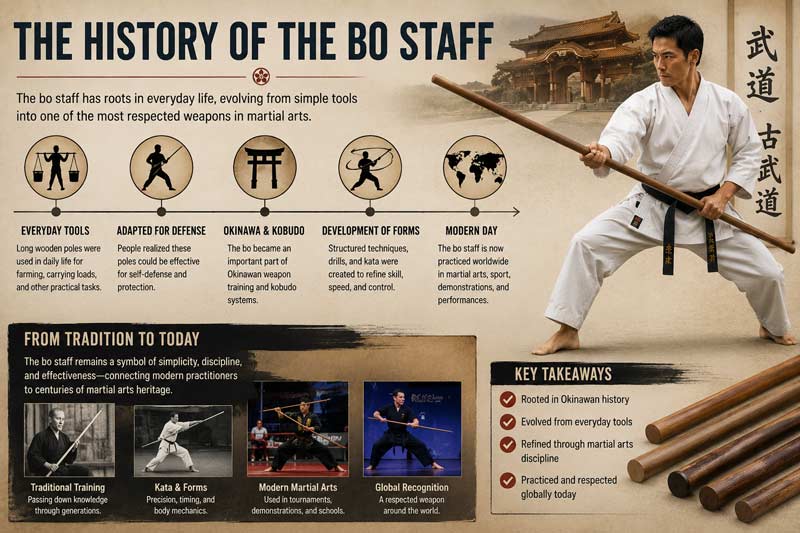
The bo staff has a long history that traces back hundreds of years through Okinawan and Japanese martial arts traditions. While it is now widely recognized as a martial arts weapon, historians generally believe the bo originally developed from common farming or carrying tools that were adapted for self-defense. Long wooden poles were practical, easy to find, and useful for a wide range of everyday tasks long before they became formalized martial arts weapons.
One popular theory is that the bo evolved from carrying poles used to transport buckets, baskets, or supplies across the shoulders. Over time, martial artists discovered that the same long wooden pole could also be highly effective for striking, blocking, sweeping, and controlling distance against an opponent. Because the weapon was simple and widely available, it became an important part of traditional Okinawan weapons training.
The bo staff eventually became closely connected to kobudo, a traditional Okinawan martial arts system focused on weapon training. Practitioners developed structured forms, drills, and techniques designed to improve timing, coordination, speed, and weapon control. Many of the spinning and striking movements seen in modern demonstrations are rooted in these older training systems that emphasized precision and body mechanics rather than brute strength alone.
As martial arts spread internationally through movies, demonstrations, tournaments, and schools, the bo staff became one of the most recognized traditional martial arts weapons in the world. Today it is commonly practiced in karate, kobudo, taekwondo demonstrations, freestyle competitions, and modern martial arts performances. Although many modern practitioners train mainly for sport, discipline, or performance, the bo staff still maintains strong ties to its traditional martial arts origins.
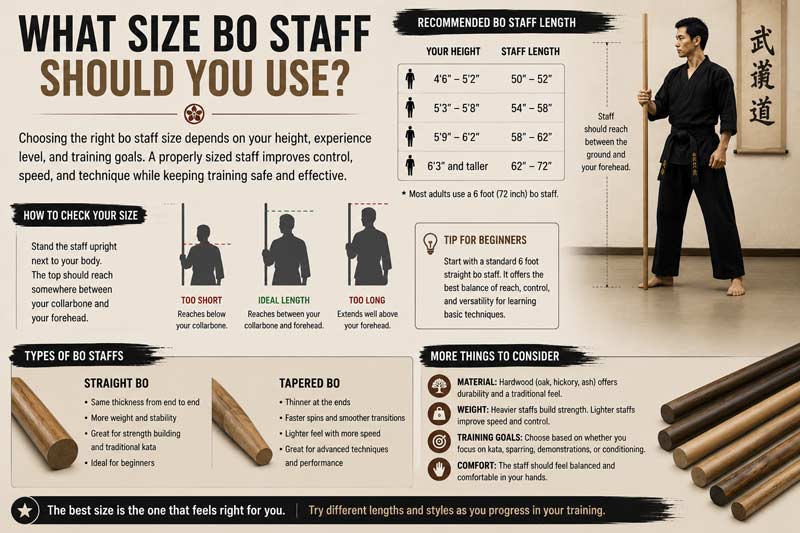
Choosing the right bo staff size depends mostly on your height, experience level, and the type of training you plan to practice. Traditional bo staffs are commonly around six feet long, which works well for many adult martial artists because the staff typically reaches somewhere between the ground and the forehead when stood upright next to the body. That length provides a balance between reach, leverage, speed, and control.
Beginners often start with a standard straight hardwood bo because it offers predictable handling and solid durability during training. A properly sized staff should feel manageable while still giving enough length for spinning techniques, defensive movements, and long-range strikes. If the staff is too long, it can feel slow and difficult to control. If it is too short, it may reduce reach and make some traditional techniques harder to perform correctly.
Some martial artists prefer tapered staffs because the thinner ends reduce weight and allow faster spinning and smoother transitions between techniques. Others prefer heavier straight staffs for strength building, stability, and traditional kata practice. Training goals play a big role in determining which style feels best for each person.
For people interested in traditional wooden training weapons, options like a straight hardwood bo or a tapered hardwood bo can provide very different handling characteristics depending on balance, thickness, and weight distribution. Many martial artists eventually experiment with multiple staff styles to figure out which design works best for their personal training preferences.
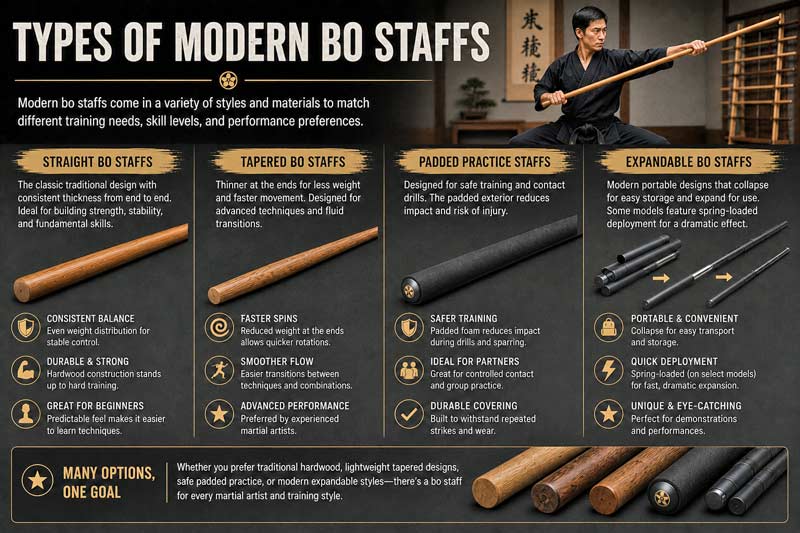
Modern bo staffs come in several different styles designed for different types of martial arts training, demonstrations, and personal preferences. While traditional hardwood staffs are still extremely popular, many martial artists now train with lightweight performance staffs, tapered designs, padded practice staffs, and even compact expandable models depending on how they plan to use them.
Straight staffs are one of the most common traditional designs because they provide consistent thickness and balanced weight distribution from end to end. Many beginners prefer this style because it feels stable during strikes, blocks, and spinning drills. Heavier hardwood staffs can also help build grip strength, coordination, and control during regular practice sessions.
Tapered staffs are designed with thinner ends that reduce overall weight and allow faster spinning techniques. Many advanced practitioners prefer tapered designs because they transition more smoothly between movements and can feel quicker during freestyle demonstrations or fast-paced combinations. Some martial artists enjoy experimenting with both straight and tapered staffs depending on their training goals.
There are also modern portable options such as expandable bo staffs that collapse down into more compact sizes for storage or transport. These modern designs are especially popular among martial arts enthusiasts who enjoy unique training equipment or want something easier to carry between practice sessions. Some advanced models even feature spring-loaded deployment systems that create a dramatic expansion effect when opened.
Although traditional wooden staffs remain the standard choice for many martial arts schools, modern bo staff designs continue evolving to match different training styles, performance preferences, and portability needs. That variety is one reason bo staffs remain one of the most versatile and widely practiced traditional martial arts weapons today.
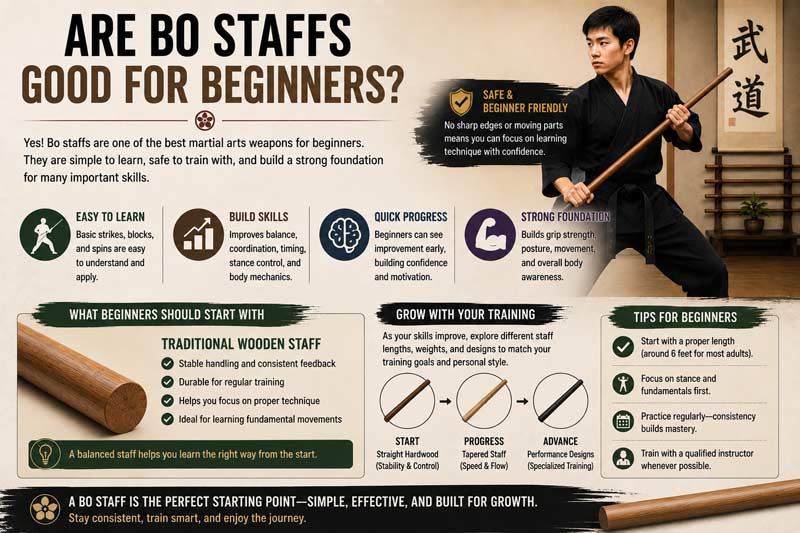
Bo staffs are often considered one of the best traditional martial arts weapons for beginners because the basic concepts are relatively straightforward compared to more complex weapons. Since there are no sharp edges or moving parts, beginners can focus more on learning balance, coordination, timing, stance control, and proper body mechanics without worrying about blade alignment or complicated handling techniques. That makes the bo staff a very common starting point in traditional weapons training.
Another reason beginners often enjoy bo staff training is that progress can feel rewarding fairly quickly. Simple spins, blocks, strikes, and transitions can usually be learned early on, which helps new martial artists build confidence while improving coordination and control. Even basic drills can help strengthen grip, posture, movement, and overall body awareness during training.
Many instructors recommend starting with a traditional wooden staff because it provides stable handling and consistent feedback during practice. A balanced training staff allows beginners to focus on developing proper technique rather than compensating for unusual weight distribution or excessive flexibility. Some martial artists eventually transition into lighter tapered staffs or performance-focused designs as their skill level improves.
For students interested in traditional martial arts training, beginner-friendly options such as a hardwood bo staff are often popular because they offer durability, stability, and a more traditional training feel. As experience grows, many practitioners experiment with different staff lengths, weights, and designs to find what matches their personal style and training goals best.
The bo staff has remained popular for generations because it combines simplicity, versatility, speed, and traditional martial arts history into one highly recognizable weapon. Whether someone is interested in traditional karate and kobudo training, freestyle demonstrations, conditioning drills, or recreational practice, the bo staff offers a wide range of training possibilities for both beginners and advanced martial artists.
One of the biggest advantages of bo staff training is how much it helps develop coordination, timing, balance, grip strength, and body control. Even simple spinning drills and striking combinations require full-body movement and precision, which is why many martial artists continue practicing staff techniques for years as part of their overall training routine.
Modern martial artists also have more options than ever before when choosing training equipment. Traditional hardwood staffs remain extremely popular, but lightweight tapered designs, padded trainers, and portable collapsible bo staffs have added even more variety for different styles of practice and performance. That flexibility has helped the bo staff remain relevant in both traditional martial arts schools and modern freestyle demonstrations.
For many martial artists, the bo staff represents more than just a training weapon. It reflects discipline, timing, control, and the connection between traditional martial arts history and modern practice. From beginner drills to advanced spinning combinations, the bo staff continues to be one of the most respected and widely practiced martial arts weapons in the world.
What Is a Bo Staff?
A bo staff is a long martial arts weapon traditionally made from wood and used for striking, blocking, spinning, and defensive techniques. Most bo staffs are around six feet long, though there are several variations depending on the martial arts style, the user's height, and the type of training being practiced. The weapon is known for its speed, reach, and versatility, making it one of the most recognizable traditional martial arts staffs in the world.
The bo staff has strong historical ties to Okinawan and Japanese martial arts, where it became an important training weapon in systems that focused on coordination, timing, movement, and weapon control. Unlike bladed weapons, the bo staff relies heavily on leverage, precision, and body mechanics rather than cutting power. Skilled practitioners can generate surprising speed and force through spinning motions, rapid directional changes, and controlled striking techniques.
Traditional bo staffs are usually made from hardwoods such as oak, rattan, or other dense materials that can withstand repeated training. Some designs are completely straight from end to end, while others taper slightly toward the tips for faster handling and improved balance. Modern training versions may also use lightweight synthetic materials designed for demonstrations, beginner practice, or controlled sparring drills.
Today, bo staffs are commonly used in martial arts schools for kata, demonstrations, freestyle competitions, conditioning drills, and traditional weapons training. Many martial artists also appreciate them because they help develop coordination, grip strength, balance, timing, and overall body control while still being relatively simple to begin learning compared to more complex martial arts weapons.
The History of the Bo Staff
The bo staff has a long history that traces back hundreds of years through Okinawan and Japanese martial arts traditions. While it is now widely recognized as a martial arts weapon, historians generally believe the bo originally developed from common farming or carrying tools that were adapted for self-defense. Long wooden poles were practical, easy to find, and useful for a wide range of everyday tasks long before they became formalized martial arts weapons.
One popular theory is that the bo evolved from carrying poles used to transport buckets, baskets, or supplies across the shoulders. Over time, martial artists discovered that the same long wooden pole could also be highly effective for striking, blocking, sweeping, and controlling distance against an opponent. Because the weapon was simple and widely available, it became an important part of traditional Okinawan weapons training.
The bo staff eventually became closely connected to kobudo, a traditional Okinawan martial arts system focused on weapon training. Practitioners developed structured forms, drills, and techniques designed to improve timing, coordination, speed, and weapon control. Many of the spinning and striking movements seen in modern demonstrations are rooted in these older training systems that emphasized precision and body mechanics rather than brute strength alone.
As martial arts spread internationally through movies, demonstrations, tournaments, and schools, the bo staff became one of the most recognized traditional martial arts weapons in the world. Today it is commonly practiced in karate, kobudo, taekwondo demonstrations, freestyle competitions, and modern martial arts performances. Although many modern practitioners train mainly for sport, discipline, or performance, the bo staff still maintains strong ties to its traditional martial arts origins.
What Size Bo Staff Should You Use?
Choosing the right bo staff size depends mostly on your height, experience level, and the type of training you plan to practice. Traditional bo staffs are commonly around six feet long, which works well for many adult martial artists because the staff typically reaches somewhere between the ground and the forehead when stood upright next to the body. That length provides a balance between reach, leverage, speed, and control.
Beginners often start with a standard straight hardwood bo because it offers predictable handling and solid durability during training. A properly sized staff should feel manageable while still giving enough length for spinning techniques, defensive movements, and long-range strikes. If the staff is too long, it can feel slow and difficult to control. If it is too short, it may reduce reach and make some traditional techniques harder to perform correctly.
Some martial artists prefer tapered staffs because the thinner ends reduce weight and allow faster spinning and smoother transitions between techniques. Others prefer heavier straight staffs for strength building, stability, and traditional kata practice. Training goals play a big role in determining which style feels best for each person.
For people interested in traditional wooden training weapons, options like a straight hardwood bo or a tapered hardwood bo can provide very different handling characteristics depending on balance, thickness, and weight distribution. Many martial artists eventually experiment with multiple staff styles to figure out which design works best for their personal training preferences.
Types of Modern Bo Staffs
Modern bo staffs come in several different styles designed for different types of martial arts training, demonstrations, and personal preferences. While traditional hardwood staffs are still extremely popular, many martial artists now train with lightweight performance staffs, tapered designs, padded practice staffs, and even compact expandable models depending on how they plan to use them.
Straight staffs are one of the most common traditional designs because they provide consistent thickness and balanced weight distribution from end to end. Many beginners prefer this style because it feels stable during strikes, blocks, and spinning drills. Heavier hardwood staffs can also help build grip strength, coordination, and control during regular practice sessions.
Tapered staffs are designed with thinner ends that reduce overall weight and allow faster spinning techniques. Many advanced practitioners prefer tapered designs because they transition more smoothly between movements and can feel quicker during freestyle demonstrations or fast-paced combinations. Some martial artists enjoy experimenting with both straight and tapered staffs depending on their training goals.
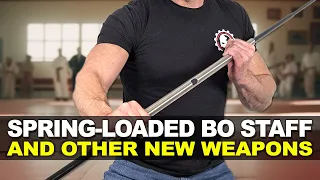
There are also modern portable options such as expandable bo staffs that collapse down into more compact sizes for storage or transport. These modern designs are especially popular among martial arts enthusiasts who enjoy unique training equipment or want something easier to carry between practice sessions. Some advanced models even feature spring-loaded deployment systems that create a dramatic expansion effect when opened.
Although traditional wooden staffs remain the standard choice for many martial arts schools, modern bo staff designs continue evolving to match different training styles, performance preferences, and portability needs. That variety is one reason bo staffs remain one of the most versatile and widely practiced traditional martial arts weapons today.
Are Bo Staffs Good for Beginners?
Bo staffs are often considered one of the best traditional martial arts weapons for beginners because the basic concepts are relatively straightforward compared to more complex weapons. Since there are no sharp edges or moving parts, beginners can focus more on learning balance, coordination, timing, stance control, and proper body mechanics without worrying about blade alignment or complicated handling techniques. That makes the bo staff a very common starting point in traditional weapons training.
Another reason beginners often enjoy bo staff training is that progress can feel rewarding fairly quickly. Simple spins, blocks, strikes, and transitions can usually be learned early on, which helps new martial artists build confidence while improving coordination and control. Even basic drills can help strengthen grip, posture, movement, and overall body awareness during training.
Many instructors recommend starting with a traditional wooden staff because it provides stable handling and consistent feedback during practice. A balanced training staff allows beginners to focus on developing proper technique rather than compensating for unusual weight distribution or excessive flexibility. Some martial artists eventually transition into lighter tapered staffs or performance-focused designs as their skill level improves.
For students interested in traditional martial arts training, beginner-friendly options such as a hardwood bo staff are often popular because they offer durability, stability, and a more traditional training feel. As experience grows, many practitioners experiment with different staff lengths, weights, and designs to find what matches their personal style and training goals best.
Final Thoughts on Bo Staff Training
The bo staff has remained popular for generations because it combines simplicity, versatility, speed, and traditional martial arts history into one highly recognizable weapon. Whether someone is interested in traditional karate and kobudo training, freestyle demonstrations, conditioning drills, or recreational practice, the bo staff offers a wide range of training possibilities for both beginners and advanced martial artists.
One of the biggest advantages of bo staff training is how much it helps develop coordination, timing, balance, grip strength, and body control. Even simple spinning drills and striking combinations require full-body movement and precision, which is why many martial artists continue practicing staff techniques for years as part of their overall training routine.
Modern martial artists also have more options than ever before when choosing training equipment. Traditional hardwood staffs remain extremely popular, but lightweight tapered designs, padded trainers, and portable collapsible bo staffs have added even more variety for different styles of practice and performance. That flexibility has helped the bo staff remain relevant in both traditional martial arts schools and modern freestyle demonstrations.
For many martial artists, the bo staff represents more than just a training weapon. It reflects discipline, timing, control, and the connection between traditional martial arts history and modern practice. From beginner drills to advanced spinning combinations, the bo staff continues to be one of the most respected and widely practiced martial arts weapons in the world.
You May Also Be Interested In:
- What Size Bo Staff Should You Use? A Beginner's Guide
- What Is a Balisong? Beginner Guide to Butterfly Knives
- What Is a Karambit Knife? Beginner Guide to Karambits
- What Is a Fighting Cane? A Beginner's Guide to Martial Arts Canes
- The Complete Guide to Martial Arts Staffs: A Beginner-Friendly Breakdown
- Two Weapons in One with the 2-Piece Expandable Bo Staff
- Spring-Loaded Bo Staff and Other New Weapons
- A Practical Guide to Modern Self-Defense Weapons
- Best Self Defense Weapons for Everyday Carry (EDC Guide)
- What Is EDC? A Complete Guide to Everyday Carry Gear
Leave a Reply