




What Is a Tonfa Weapon and How Was It Originally Used?
May 21st, 2026
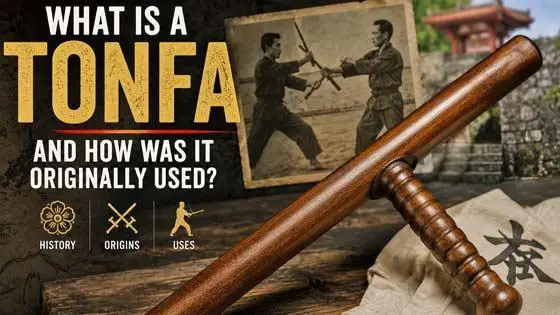
If you have ever seen a martial artist spinning a handled stick along their forearm or a police officer carrying a side-hand baton, you have probably seen a version of the tonfa. This unique weapon has a long and fascinating history that stretches back centuries, evolving from a traditional Okinawan martial arts tool into a weapon still recognized around the world today. But what exactly is a tonfa, and where did it come from?
While many people recognize tonfas from karate demonstrations, movies, or modern police gear, their original purpose may surprise you. Historians and martial artists have debated how the weapon first developed, how it was used in combat, and why its unusual side handle design proved so effective. In this guide, we'll break down the origins of the tonfa weapon, how it evolved over time, and why it remains popular for martial arts training today.
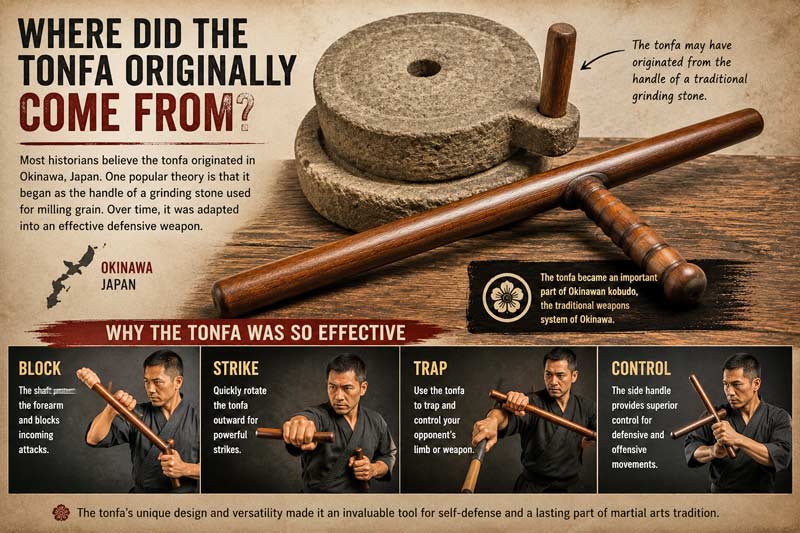
The exact origins of the tonfa are still debated, but most historians agree that the weapon traces back to Okinawa, Japan, where it became closely associated with traditional Okinawan martial arts. One of the most common theories is that the tonfa originally started as the wooden handle of a grinding stone used for milling grain or rice. According to this idea, farmers adapted the tool into a defensive weapon because it was something they already had access to during times when weapons were restricted.
That said, not everyone agrees with the "farm tool" explanation. Some historians argue that the tonfa may have been designed specifically as a weapon from the beginning, pointing out that its shape and handling characteristics are unusually effective for blocking, striking, trapping, and controlling an opponent. Regardless of its exact beginnings, the tonfa became an important part of Okinawan kobudo, a traditional weapons system that also includes tools like sai, nunchaku, and bo staffs.
What made the tonfa especially useful was its versatility. A practitioner could grip the side handle and hold the shaft along the forearm for defense, quickly rotate it outward for powerful strikes, or use it to trap and redirect attacks. Unlike many straight batons, the side handle offered more control and made defensive movements feel fast and fluid.
Today, many martial artists still train with traditional wooden tonfa to practice the same movements and techniques that have been passed down for generations.
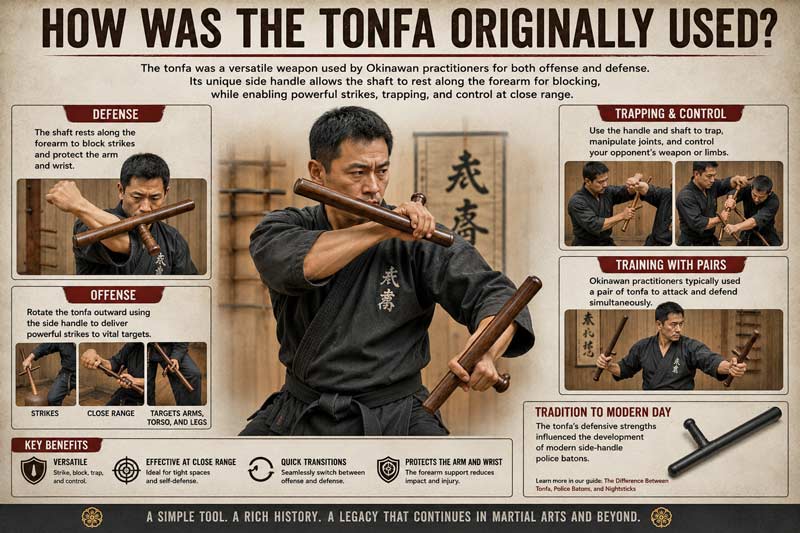
Unlike many traditional weapons that were designed mainly for striking, the tonfa stood out because of how versatile it was in both offense and defense. One of its biggest advantages was the side handle, which allowed the shaft to rest securely along the forearm. In this position, the tonfa acted almost like a shield, helping block strikes while also protecting the wrist and arm from impact.
When it was time to attack, practitioners could quickly rotate the tonfa outward using the side handle to generate speed and force. This made it effective for close-range strikes to the arms, torso, or legs while still allowing fast defensive transitions. Because of its unique shape, the tonfa could also be used for trapping, joint manipulation, and controlling an opponent's weapon or limbs.
Traditional Okinawan practitioners usually trained with a pair of tonfa rather than just one, allowing them to attack and defend at the same time. Forms, drills, and partner exercises focused heavily on coordination, fluid movement, and quick transitions between blocking and striking. Even today, many martial artists continue practicing with specialized options like square tonfa designs that offer a different feel and handling style during training.
Over time, the tonfa's defensive strengths also helped influence modern side-handle police batons. If you are curious about how traditional tonfa compare to law enforcement gear, this guide on the difference between tonfa, police batons, and nightsticks breaks down how these tools evolved in different directions.
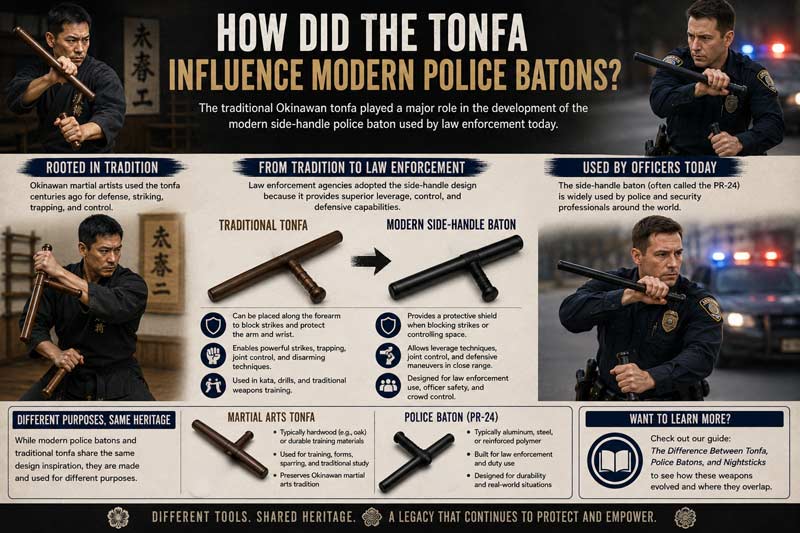
Even if you have never stepped inside a martial arts school, there is a good chance you have seen a modern version of the tonfa without realizing it. The side-handle police baton, sometimes called a PR-24 baton, was heavily inspired by the traditional tonfa design. Law enforcement agencies adopted the concept because the side handle offered better leverage, defensive positioning, and control compared to a straight baton.
Much like traditional martial artists, police officers could hold the baton along the forearm to create a protective shield while blocking strikes or controlling space. The side handle also made it easier to apply leverage techniques, joint control, and defensive maneuvers in close-range situations. This made the design especially useful for crowd control and officer protection.
Despite their similarities, modern police batons and traditional tonfa are not exactly the same. Police versions are typically made from materials like aluminum or reinforced polymers and are designed for law enforcement use, while martial arts tonfa are usually intended for forms, drills, sparring practice, and traditional weapons training. Today, many martial artists train with options like thermoplastic tonfa because they offer durability while still maintaining the familiar feel of the weapon.
If you want a deeper breakdown of how these weapons compare, this guide on the difference between tonfa, police batons, and nightsticks explains how the designs evolved and where they overlap.
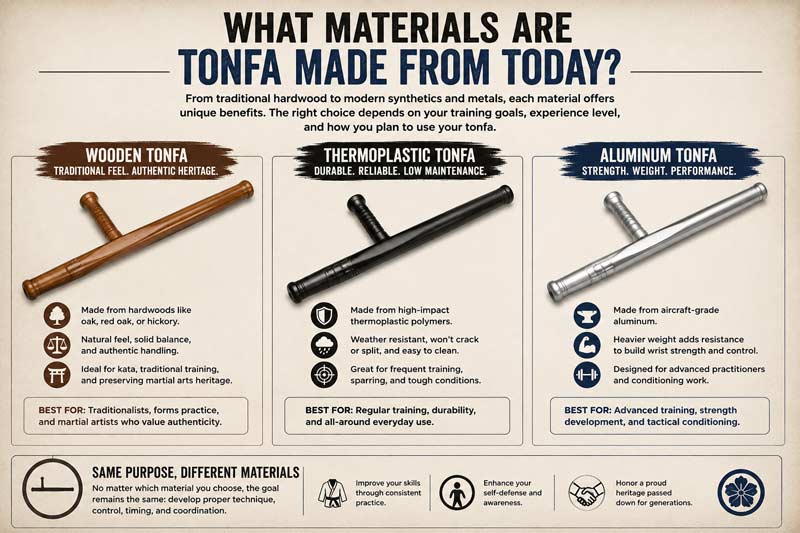
While traditional tonfa were almost always made from hardwood, modern versions come in several different materials depending on how they are meant to be used. Some are designed for martial arts practice and kata, while others focus on durability, lightweight handling, or realistic training. Choosing the right material often comes down to experience level and how you plan to train.
Traditional martial artists often prefer hardwood models because they closely resemble historical Okinawan training weapons. Wood provides a natural feel, solid balance, and authentic handling that many practitioners enjoy for forms and drills. If you want something closer to what martial artists have trained with for generations, many students choose wooden tonfa for their classic appearance and traditional feel.
For students who want something more durable and weather resistant, synthetic materials have become increasingly popular. Many schools and practitioners use thermoplastic tonfa because they can handle repeated practice, resist cracking, and hold up well over time. They are especially useful for frequent training or tougher practice environments.
There are also heavier-duty options designed for advanced practitioners and conditioning work. Some martial artists prefer aluminum tonfa because the added weight changes the feel of movement and can help build wrist strength and control. Regardless of the material, the overall goal stays the same: learning proper technique, control, and coordination through consistent practice.
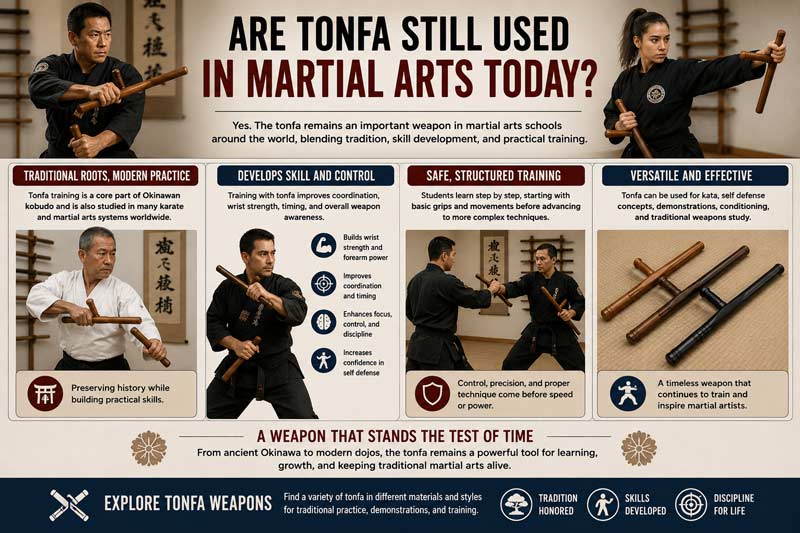
Even though the tonfa has centuries of history behind it, it is still widely used in martial arts schools today. Traditional Okinawan kobudo systems continue to teach tonfa forms, partner drills, blocking techniques, and striking combinations as part of weapons training. Many karate practitioners also study tonfa to improve coordination, wrist strength, control, and overall weapon awareness.
Modern training often combines traditional techniques with safer practice methods. Beginners may start slowly by learning basic grips, defensive positions, and simple spinning movements before moving into more advanced drills. Since the tonfa can rotate quickly and generate a surprising amount of force, instructors usually emphasize control and precision before speed or power.
One reason the tonfa has remained popular is its versatility. Students can train for kata, self defense concepts, demonstrations, conditioning, or simply to better understand traditional Okinawan weapons systems. Some practitioners prefer classic hardwood designs, while others like more durable modern options depending on their training style and goals.
If you are interested in exploring different styles and materials, you can check out a variety of tonfa weapons used for traditional practice, demonstrations, and modern martial arts training.
The tonfa may look unusual compared to many other traditional martial arts weapons, but that unique design is exactly what helped it survive for centuries. From its debated Okinawan origins to its influence on modern side-handle police batons, the tonfa has earned a reputation as one of the most versatile and recognizable weapons in martial arts history.
Part of what makes the tonfa so interesting is how many different ways it can be used. It can block, strike, trap, control, and transition smoothly between offense and defense, all while staying compact and highly maneuverable. Whether someone is studying kobudo, practicing karate weapons forms, or simply learning about traditional martial arts history, the tonfa continues to stand out as a fascinating training tool.
Today, martial artists can choose from traditional hardwood versions, durable synthetic models, and even heavier-duty materials depending on their goals and experience level. Some people train for forms and demonstrations, while others simply enjoy learning the history and mechanics behind classic martial arts weapons. No matter the reason, the tonfa remains an important part of martial arts culture around the world.
If you are thinking about getting started, practicing with the right equipment can make a big difference. From traditional wood to modern training materials, there are many styles available for beginners and experienced practitioners alike.
Where Did the Tonfa Originally Come From?
The exact origins of the tonfa are still debated, but most historians agree that the weapon traces back to Okinawa, Japan, where it became closely associated with traditional Okinawan martial arts. One of the most common theories is that the tonfa originally started as the wooden handle of a grinding stone used for milling grain or rice. According to this idea, farmers adapted the tool into a defensive weapon because it was something they already had access to during times when weapons were restricted.
That said, not everyone agrees with the "farm tool" explanation. Some historians argue that the tonfa may have been designed specifically as a weapon from the beginning, pointing out that its shape and handling characteristics are unusually effective for blocking, striking, trapping, and controlling an opponent. Regardless of its exact beginnings, the tonfa became an important part of Okinawan kobudo, a traditional weapons system that also includes tools like sai, nunchaku, and bo staffs.
What made the tonfa especially useful was its versatility. A practitioner could grip the side handle and hold the shaft along the forearm for defense, quickly rotate it outward for powerful strikes, or use it to trap and redirect attacks. Unlike many straight batons, the side handle offered more control and made defensive movements feel fast and fluid.
Today, many martial artists still train with traditional wooden tonfa to practice the same movements and techniques that have been passed down for generations.
How Was the Tonfa Originally Used?
Unlike many traditional weapons that were designed mainly for striking, the tonfa stood out because of how versatile it was in both offense and defense. One of its biggest advantages was the side handle, which allowed the shaft to rest securely along the forearm. In this position, the tonfa acted almost like a shield, helping block strikes while also protecting the wrist and arm from impact.
When it was time to attack, practitioners could quickly rotate the tonfa outward using the side handle to generate speed and force. This made it effective for close-range strikes to the arms, torso, or legs while still allowing fast defensive transitions. Because of its unique shape, the tonfa could also be used for trapping, joint manipulation, and controlling an opponent's weapon or limbs.
Traditional Okinawan practitioners usually trained with a pair of tonfa rather than just one, allowing them to attack and defend at the same time. Forms, drills, and partner exercises focused heavily on coordination, fluid movement, and quick transitions between blocking and striking. Even today, many martial artists continue practicing with specialized options like square tonfa designs that offer a different feel and handling style during training.
Over time, the tonfa's defensive strengths also helped influence modern side-handle police batons. If you are curious about how traditional tonfa compare to law enforcement gear, this guide on the difference between tonfa, police batons, and nightsticks breaks down how these tools evolved in different directions.
How Did the Tonfa Influence Modern Police Batons?
Even if you have never stepped inside a martial arts school, there is a good chance you have seen a modern version of the tonfa without realizing it. The side-handle police baton, sometimes called a PR-24 baton, was heavily inspired by the traditional tonfa design. Law enforcement agencies adopted the concept because the side handle offered better leverage, defensive positioning, and control compared to a straight baton.
Much like traditional martial artists, police officers could hold the baton along the forearm to create a protective shield while blocking strikes or controlling space. The side handle also made it easier to apply leverage techniques, joint control, and defensive maneuvers in close-range situations. This made the design especially useful for crowd control and officer protection.
Despite their similarities, modern police batons and traditional tonfa are not exactly the same. Police versions are typically made from materials like aluminum or reinforced polymers and are designed for law enforcement use, while martial arts tonfa are usually intended for forms, drills, sparring practice, and traditional weapons training. Today, many martial artists train with options like thermoplastic tonfa because they offer durability while still maintaining the familiar feel of the weapon.
If you want a deeper breakdown of how these weapons compare, this guide on the difference between tonfa, police batons, and nightsticks explains how the designs evolved and where they overlap.
What Materials Are Tonfa Made From Today?
While traditional tonfa were almost always made from hardwood, modern versions come in several different materials depending on how they are meant to be used. Some are designed for martial arts practice and kata, while others focus on durability, lightweight handling, or realistic training. Choosing the right material often comes down to experience level and how you plan to train.
Traditional martial artists often prefer hardwood models because they closely resemble historical Okinawan training weapons. Wood provides a natural feel, solid balance, and authentic handling that many practitioners enjoy for forms and drills. If you want something closer to what martial artists have trained with for generations, many students choose wooden tonfa for their classic appearance and traditional feel.
For students who want something more durable and weather resistant, synthetic materials have become increasingly popular. Many schools and practitioners use thermoplastic tonfa because they can handle repeated practice, resist cracking, and hold up well over time. They are especially useful for frequent training or tougher practice environments.
There are also heavier-duty options designed for advanced practitioners and conditioning work. Some martial artists prefer aluminum tonfa because the added weight changes the feel of movement and can help build wrist strength and control. Regardless of the material, the overall goal stays the same: learning proper technique, control, and coordination through consistent practice.
Are Tonfa Still Used in Martial Arts Today?
Even though the tonfa has centuries of history behind it, it is still widely used in martial arts schools today. Traditional Okinawan kobudo systems continue to teach tonfa forms, partner drills, blocking techniques, and striking combinations as part of weapons training. Many karate practitioners also study tonfa to improve coordination, wrist strength, control, and overall weapon awareness.
Modern training often combines traditional techniques with safer practice methods. Beginners may start slowly by learning basic grips, defensive positions, and simple spinning movements before moving into more advanced drills. Since the tonfa can rotate quickly and generate a surprising amount of force, instructors usually emphasize control and precision before speed or power.
One reason the tonfa has remained popular is its versatility. Students can train for kata, self defense concepts, demonstrations, conditioning, or simply to better understand traditional Okinawan weapons systems. Some practitioners prefer classic hardwood designs, while others like more durable modern options depending on their training style and goals.
If you are interested in exploring different styles and materials, you can check out a variety of tonfa weapons used for traditional practice, demonstrations, and modern martial arts training.
Why the Tonfa Has Stood the Test of Time
The tonfa may look unusual compared to many other traditional martial arts weapons, but that unique design is exactly what helped it survive for centuries. From its debated Okinawan origins to its influence on modern side-handle police batons, the tonfa has earned a reputation as one of the most versatile and recognizable weapons in martial arts history.
Part of what makes the tonfa so interesting is how many different ways it can be used. It can block, strike, trap, control, and transition smoothly between offense and defense, all while staying compact and highly maneuverable. Whether someone is studying kobudo, practicing karate weapons forms, or simply learning about traditional martial arts history, the tonfa continues to stand out as a fascinating training tool.
Today, martial artists can choose from traditional hardwood versions, durable synthetic models, and even heavier-duty materials depending on their goals and experience level. Some people train for forms and demonstrations, while others simply enjoy learning the history and mechanics behind classic martial arts weapons. No matter the reason, the tonfa remains an important part of martial arts culture around the world.
If you are thinking about getting started, practicing with the right equipment can make a big difference. From traditional wood to modern training materials, there are many styles available for beginners and experienced practitioners alike.
You May Also Be Interested In:
- What is the Difference Between Tonfa, Police Batons, and Nightsticks?
- What Is the Most Difficult Weapon to Defend Against?
- Kubaton Weapon: What It Is and How It Works for Self Defense
- What Is the Best Self Defense Weapon for Everyday Carry?
- What Is a Billy Club Weapon and Is It Still Used Today
- What Is the Best Weapon for Fighting in Tight Spaces?
- What Makes a Good Self Defense Weapon? Key Things to Consider
- 10 Weapon Myths Hollywood Got Completely Wrong
- What Is a Kunai? From Japanese Tool to Ninja Weapon
- The Police Weapon Most People Forgot Ever Existed
Leave a Reply