





Why Did Ninja Wear Black? (Or Is That Another Myth?)
July 23rd, 2026
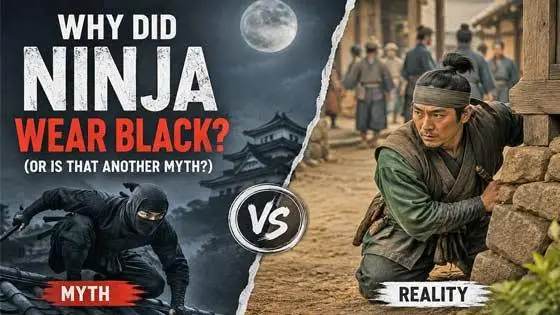
Close your eyes and picture a ninja. Chances are you're imagining someone dressed head to toe in black, their face hidden behind a mask as they silently leap across moonlit rooftops. It's one of the most recognizable images in popular culture, appearing everywhere from blockbuster movies and comic books to video games and Halloween costumes. For many people, the black outfit is as much a part of the ninja as the sword or the throwing star.
The surprising part is that history tells a very different story. While ninja certainly valued stealth and deception, blending into a crowd was often far more effective than standing out in an unmistakable costume. In fact, many historians believe the iconic black outfit was popularized centuries later through theater productions, where stagehands dressed in black were meant to be "invisible" to the audience. Over time, that theatrical convention became one of history's most enduring myths.
So did real ninja actually wear black, or have we been fooled by generations of storytellers? To answer that question, we need to separate historical evidence from popular fiction and uncover how one of the world's most famous outfits became the symbol of warriors who may have dressed like everyone else.
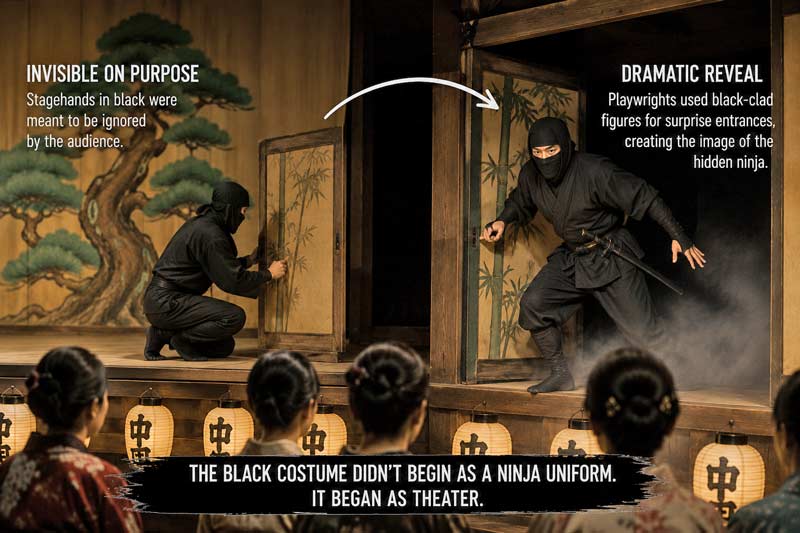
If real ninja probably didn't spend their missions dressed in black, where did the image come from? Surprisingly, many historians trace it not to medieval Japan, but to Japanese theater. During traditional kabuki performances, stagehands wore plain black clothing so audiences would mentally "ignore" them as they moved props and scenery around the stage. They were never meant to be characters. Their black clothing simply signaled that they were invisible to the story.
Playwrights eventually realized they could use that convention to surprise audiences. A stagehand dressed in black could suddenly reveal himself as a hidden assassin, thief, or spy, creating a dramatic twist that instantly captivated theatergoers. Because the audience had already accepted the black-clad figure as invisible, the reveal was especially effective. Over time, these theatrical assassins became increasingly associated with ninja, even though the costume was a product of stagecraft rather than documented history.
As these stories spread through novels, illustrations, films, television, and eventually video games, the costume became inseparable from the ninja itself. Modern audiences came to expect every ninja to wear black because that was how generations of storytellers portrayed them, not because historical evidence demanded it. The myth became so successful that it eventually overshadowed the far more practical reality.
Today, the black outfit is one of the defining symbols of the ninja, despite being one of the least certain aspects of their historical appearance. It's a perfect example of how fiction can become so influential that it reshapes our understanding of history itself.
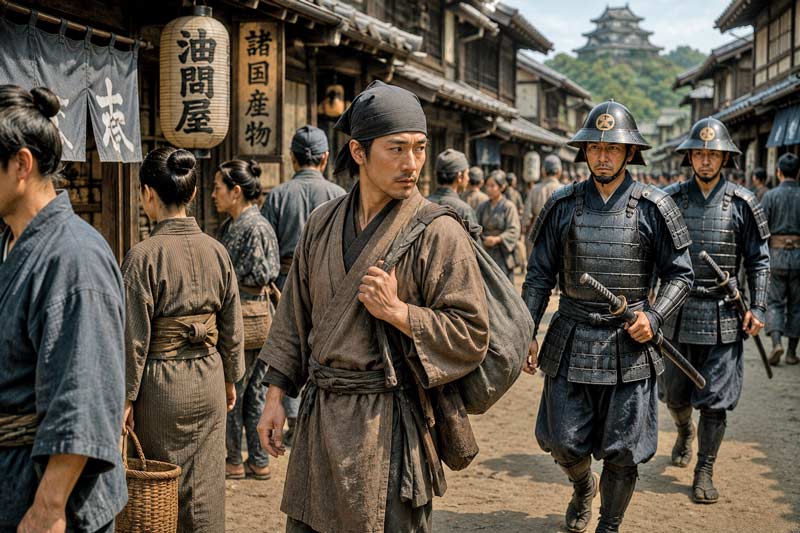
A real operative trying to gather information, enter a guarded location, or move through a crowded town would have had little reason to advertise his presence with a recognizable uniform. The safest disguise was often ordinary clothing. A ninja might dress as a farmer, merchant, monk, laborer, traveling performer, or low-ranking samurai depending on where he needed to go and whom he needed to deceive.
That approach made far more sense than wearing a costume associated with spies and assassins. Clothing was part of the mission, not part of a fixed identity. Someone entering a castle might imitate a servant. Someone traveling along a road could appear to be a pilgrim. Someone watching a military encampment might blend in with workers, messengers, or traders who had legitimate reasons to be nearby.
Even on nighttime missions, pure black may not have been the best choice. Against moonlit walls, pale roads, or natural terrain, a solid black figure could create a sharp silhouette. Dark shades of brown, gray, blue, or muted green would often have blended more effectively with wood, stone, earth, and shadow. Stealth depended on the surroundings, so practical clothing would have changed with the season, location, and objective.
This adaptability was central to the historical idea of ninjutsu. Real ninja were not defined by one costume or one weapon. They relied on observation, disguise, patience, and the ability to appear harmless. The most successful operative may have been the person no one remembered seeing at all.
Historical accuracy was never going to compete easily with the image of a masked figure dressed entirely in black. The costume was simple, dramatic, and instantly recognizable. It told audiences everything they needed to know in a single glance: this character was secretive, dangerous, and capable of appearing from nowhere.
That visual shorthand proved irresistible to artists and filmmakers. Early illustrations helped solidify the look, and later movies gave it movement. Comic books, television shows, toys, and video games then carried the image around the world. Each new version reinforced the last until the black outfit stopped feeling like a creative choice and started feeling like historical fact.
The costume also became a convenient way to separate ninja from samurai. Samurai were shown in armor, carrying swords, and operating openly within a rigid social order. Ninja were portrayed as their opposite: hidden, flexible, unpredictable, and free from conventional rules. Dressing them in black made that contrast immediately visible, even when the stories themselves had little connection to real history.
The same process transformed ordinary tools into legendary weapons. As explored in how the kunai became a ninja legend, popular culture often takes a small piece of history and reshapes it into something far more dramatic. The black ninja costume survived for the same reason. It may not accurately represent how real operatives dressed, but it perfectly represents what the world wants a ninja to be.
So, did ninja wear black? The most honest answer is that they probably did sometimes, but not because it was an official uniform. Like any skilled operative, they would have worn whatever best suited the mission. If darkness offered an advantage, darker clothing may have been useful. If blending into a marketplace, temple, or military camp offered a better chance of success, ordinary clothing was almost certainly the smarter choice.
That conclusion may be less dramatic than the version popularized by Hollywood, but it paints a far more impressive picture of what real ninja were capable of. Their greatest weapon was never a black costume, a sword, or a throwing star. It was their ability to adapt, observe, and disappear into the world around them without attracting attention.
Ironically, the famous black-clad ninja still serves an important purpose today. Even if it isn't historically accurate, it has become one of the most recognizable symbols in popular culture. It reminds us how powerful storytelling can be, preserving the mystery of the ninja for generations while inspiring countless books, films, games, and works of art. Sometimes the legend becomes just as fascinating as the history that inspired it.
The next time you picture a ninja, you might still imagine the familiar black outfit. Just remember that the most successful ninja in history probably looked like everyone else, and that's exactly what made them so difficult to detect.
Sometimes, but probably not as often as popular culture suggests. There is no historical evidence that ninja had an official black uniform they wore on every mission. Instead, they likely dressed according to their objective, blending in as merchants, farmers, monks, laborers, or travelers whenever possible. If a mission required moving under the cover of darkness, darker clothing may have been practical, but it would have been chosen for the environment rather than because it was a traditional ninja costume. The iconic all-black outfit is largely a product of Japanese theater and centuries of storytelling that followed.
The familiar black ninja outfit is one of the easiest ways for filmmakers to tell audiences who the mysterious character is. Its roots can be traced back to traditional Japanese Kabuki theater, where stagehands dressed entirely in black were understood to be "invisible" to the audience. Playwrights eventually used that convention to introduce ninja characters, and the striking visual carried over into books, comics, television, movies, and video games. While it became an unforgettable symbol of the ninja, it was a theatrical invention rather than a historically accurate uniform.
In many situations, yes. The goal of a ninja was to complete a mission without being noticed, not to look mysterious. Walking through a castle town in the clothing of a merchant or servant often attracted far less attention than creeping across rooftops after dark. Historical accounts suggest that disguise, deception, and patience were some of a ninja's most valuable skills. Remaining unnoticed in plain sight was usually safer and more effective than relying solely on darkness for cover, which is one reason many historians believe blending in was far more common than wearing a distinctive black outfit.
Almost certainly. During Japan's feudal period, ninja were not mythical figures lurking in the shadows. They were spies, scouts, guides, and intelligence gatherers who often operated among ordinary people. Samurai who encountered them would have understood that effective operatives relied on disguise rather than a recognizable costume. The image of every ninja wearing black became popular much later through theater and entertainment, long after the people who actually lived during the era were gone. Ironically, the historical samurai were probably far less likely to picture a black-clad ninja than we are today.
Because the image is incredibly memorable. A masked figure dressed entirely in black is instantly recognizable, making it perfect for theater, movies, comic books, and video games. Over time, that fictional version became so widespread that it overshadowed the historical evidence. It's a good reminder that some of history's most famous images aren't based on what people actually did, but on the stories later generations found most exciting to tell. The black-clad ninja is one of the world's greatest historical myths precisely because it's such a compelling one.
So did real ninja actually wear black, or have we been fooled by generations of storytellers? To answer that question, we need to separate historical evidence from popular fiction and uncover how one of the world's most famous outfits became the symbol of warriors who may have dressed like everyone else.
The Image of the Black-Clad Ninja Didn't Come From History
If real ninja probably didn't spend their missions dressed in black, where did the image come from? Surprisingly, many historians trace it not to medieval Japan, but to Japanese theater. During traditional kabuki performances, stagehands wore plain black clothing so audiences would mentally "ignore" them as they moved props and scenery around the stage. They were never meant to be characters. Their black clothing simply signaled that they were invisible to the story.
Playwrights eventually realized they could use that convention to surprise audiences. A stagehand dressed in black could suddenly reveal himself as a hidden assassin, thief, or spy, creating a dramatic twist that instantly captivated theatergoers. Because the audience had already accepted the black-clad figure as invisible, the reveal was especially effective. Over time, these theatrical assassins became increasingly associated with ninja, even though the costume was a product of stagecraft rather than documented history.
As these stories spread through novels, illustrations, films, television, and eventually video games, the costume became inseparable from the ninja itself. Modern audiences came to expect every ninja to wear black because that was how generations of storytellers portrayed them, not because historical evidence demanded it. The myth became so successful that it eventually overshadowed the far more practical reality.
Today, the black outfit is one of the defining symbols of the ninja, despite being one of the least certain aspects of their historical appearance. It's a perfect example of how fiction can become so influential that it reshapes our understanding of history itself.
What Real Ninja Probably Wore Instead
A real operative trying to gather information, enter a guarded location, or move through a crowded town would have had little reason to advertise his presence with a recognizable uniform. The safest disguise was often ordinary clothing. A ninja might dress as a farmer, merchant, monk, laborer, traveling performer, or low-ranking samurai depending on where he needed to go and whom he needed to deceive.
That approach made far more sense than wearing a costume associated with spies and assassins. Clothing was part of the mission, not part of a fixed identity. Someone entering a castle might imitate a servant. Someone traveling along a road could appear to be a pilgrim. Someone watching a military encampment might blend in with workers, messengers, or traders who had legitimate reasons to be nearby.
Even on nighttime missions, pure black may not have been the best choice. Against moonlit walls, pale roads, or natural terrain, a solid black figure could create a sharp silhouette. Dark shades of brown, gray, blue, or muted green would often have blended more effectively with wood, stone, earth, and shadow. Stealth depended on the surroundings, so practical clothing would have changed with the season, location, and objective.
This adaptability was central to the historical idea of ninjutsu. Real ninja were not defined by one costume or one weapon. They relied on observation, disguise, patience, and the ability to appear harmless. The most successful operative may have been the person no one remembered seeing at all.
Why the Black-Clad Ninja Became Impossible to Replace
Historical accuracy was never going to compete easily with the image of a masked figure dressed entirely in black. The costume was simple, dramatic, and instantly recognizable. It told audiences everything they needed to know in a single glance: this character was secretive, dangerous, and capable of appearing from nowhere.
That visual shorthand proved irresistible to artists and filmmakers. Early illustrations helped solidify the look, and later movies gave it movement. Comic books, television shows, toys, and video games then carried the image around the world. Each new version reinforced the last until the black outfit stopped feeling like a creative choice and started feeling like historical fact.
The costume also became a convenient way to separate ninja from samurai. Samurai were shown in armor, carrying swords, and operating openly within a rigid social order. Ninja were portrayed as their opposite: hidden, flexible, unpredictable, and free from conventional rules. Dressing them in black made that contrast immediately visible, even when the stories themselves had little connection to real history.
The same process transformed ordinary tools into legendary weapons. As explored in how the kunai became a ninja legend, popular culture often takes a small piece of history and reshapes it into something far more dramatic. The black ninja costume survived for the same reason. It may not accurately represent how real operatives dressed, but it perfectly represents what the world wants a ninja to be.
The Truth About the Ninja Outfit
So, did ninja wear black? The most honest answer is that they probably did sometimes, but not because it was an official uniform. Like any skilled operative, they would have worn whatever best suited the mission. If darkness offered an advantage, darker clothing may have been useful. If blending into a marketplace, temple, or military camp offered a better chance of success, ordinary clothing was almost certainly the smarter choice.
That conclusion may be less dramatic than the version popularized by Hollywood, but it paints a far more impressive picture of what real ninja were capable of. Their greatest weapon was never a black costume, a sword, or a throwing star. It was their ability to adapt, observe, and disappear into the world around them without attracting attention.
Ironically, the famous black-clad ninja still serves an important purpose today. Even if it isn't historically accurate, it has become one of the most recognizable symbols in popular culture. It reminds us how powerful storytelling can be, preserving the mystery of the ninja for generations while inspiring countless books, films, games, and works of art. Sometimes the legend becomes just as fascinating as the history that inspired it.
The next time you picture a ninja, you might still imagine the familiar black outfit. Just remember that the most successful ninja in history probably looked like everyone else, and that's exactly what made them so difficult to detect.
Did Ninja Really Wear Black?
Sometimes, but probably not as often as popular culture suggests. There is no historical evidence that ninja had an official black uniform they wore on every mission. Instead, they likely dressed according to their objective, blending in as merchants, farmers, monks, laborers, or travelers whenever possible. If a mission required moving under the cover of darkness, darker clothing may have been practical, but it would have been chosen for the environment rather than because it was a traditional ninja costume. The iconic all-black outfit is largely a product of Japanese theater and centuries of storytelling that followed.
Why Do Movies Always Show Ninja Wearing Black?
The familiar black ninja outfit is one of the easiest ways for filmmakers to tell audiences who the mysterious character is. Its roots can be traced back to traditional Japanese Kabuki theater, where stagehands dressed entirely in black were understood to be "invisible" to the audience. Playwrights eventually used that convention to introduce ninja characters, and the striking visual carried over into books, comics, television, movies, and video games. While it became an unforgettable symbol of the ninja, it was a theatrical invention rather than a historically accurate uniform.
Were Ninja Better Off Disguising Themselves Than Sneaking Around at Night?
In many situations, yes. The goal of a ninja was to complete a mission without being noticed, not to look mysterious. Walking through a castle town in the clothing of a merchant or servant often attracted far less attention than creeping across rooftops after dark. Historical accounts suggest that disguise, deception, and patience were some of a ninja's most valuable skills. Remaining unnoticed in plain sight was usually safer and more effective than relying solely on darkness for cover, which is one reason many historians believe blending in was far more common than wearing a distinctive black outfit.
Did Samurai Know How Ninja Really Dressed?
Almost certainly. During Japan's feudal period, ninja were not mythical figures lurking in the shadows. They were spies, scouts, guides, and intelligence gatherers who often operated among ordinary people. Samurai who encountered them would have understood that effective operatives relied on disguise rather than a recognizable costume. The image of every ninja wearing black became popular much later through theater and entertainment, long after the people who actually lived during the era were gone. Ironically, the historical samurai were probably far less likely to picture a black-clad ninja than we are today.
If Ninja Didn't Wear Black, Why Does Everyone Believe They Did?
Because the image is incredibly memorable. A masked figure dressed entirely in black is instantly recognizable, making it perfect for theater, movies, comic books, and video games. Over time, that fictional version became so widespread that it overshadowed the historical evidence. It's a good reminder that some of history's most famous images aren't based on what people actually did, but on the stories later generations found most exciting to tell. The black-clad ninja is one of the world's greatest historical myths precisely because it's such a compelling one.
You May Also Be Interested In:
Leave a Reply