




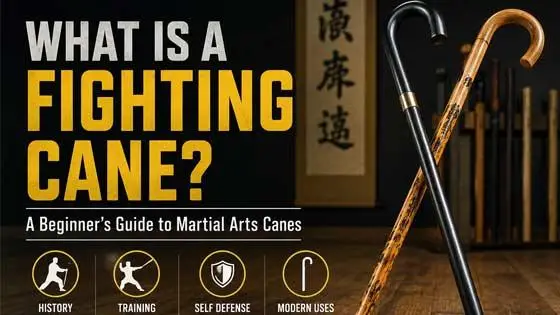
What Is a Fighting Cane? A Beginner's Guide to Martial Arts Canes
May 27th, 2026
Fighting canes have been around for centuries, but a lot of people are surprised to learn they are still practiced in martial arts today. At first glance, a fighting cane might just look like an ordinary walking cane, but its shape, durability, and hooked handle make it surprisingly versatile for training, control techniques, and self defense. Some people train with martial arts canes because they enjoy traditional weapons systems, while others appreciate that a cane can feel more approachable and practical than many other martial arts tools.
If you are new to the idea, it is easy to assume a fighting cane is just for older martial artists or people who actually need a mobility aid. In reality, martial arts cane training attracts a wide range of people, from self defense enthusiasts to students interested in Filipino martial arts, Hapkido, cane fu, and other traditional systems. The curved handle creates unique control options that are very different from straight sticks or staffs, making the fighting cane an interesting weapon to learn and practice with.
In this beginner's guide, we will break down what a fighting cane is, how it is used in martial arts, what makes it different from a regular walking cane, and why so many people continue to train with them today.
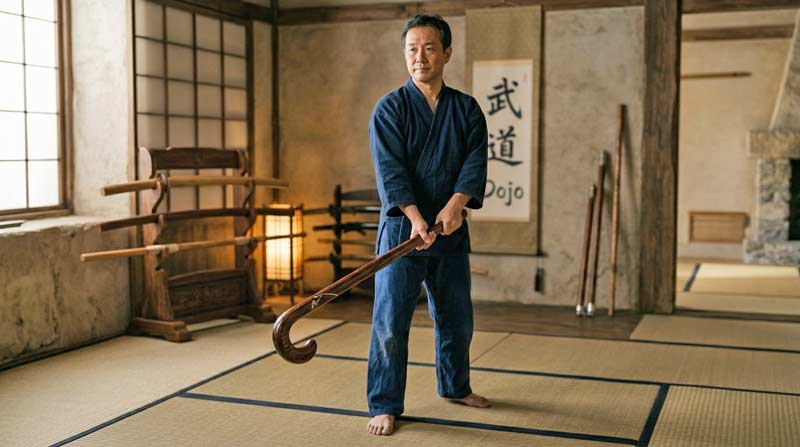
A fighting cane, sometimes called a martial arts cane or combat cane, is a specially designed walking cane that can be used for martial arts training, self defense techniques, and control-based movements. While it looks similar to a regular walking cane, a fighting cane is usually made from stronger materials like hardwood, polypropylene, aluminum, or reinforced composites so it can handle repeated training and impact.
What makes a fighting cane unique is the curved handle. Unlike a straight stick or baton, the hooked portion of the cane creates opportunities for trapping, pulling, redirecting, and controlling an opponent's movement. Martial artists often practice using the crook of the cane to hook limbs, off-balance an attacker, or create distance while staying mobile.
One of the reasons fighting canes remain popular is that they blend practicality with martial arts training. For someone who already uses a walking cane, the transition into cane-based self defense may feel more natural than learning a completely different weapon. At the same time, many people who have no need for a mobility aid still train with martial arts canes simply because the techniques are unique, challenging, and rooted in traditional systems.
Today, fighting canes are used in several martial arts styles and self defense systems. Some schools focus on practical defensive movements, while others treat cane training as part of a larger traditional weapons curriculum alongside staffs, sticks, and other impact tools.
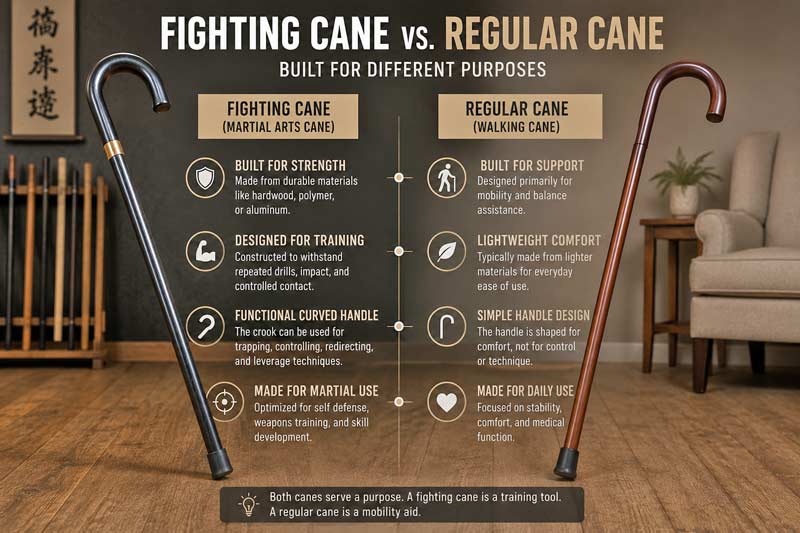
At a glance, a fighting cane can look a lot like an ordinary walking cane, which is part of what makes it interesting. The biggest differences usually come down to strength, construction, and intended use. A standard mobility cane is designed primarily for support and everyday walking assistance, while a martial arts cane is typically built to handle training, repeated movement, and controlled impact.
Many fighting canes are made from durable materials like hardwood, reinforced polymers, or aircraft-grade aluminum. These materials help the cane hold up during practice drills without bending or cracking as easily as a lightweight medical cane might. Some also feature slightly thicker shafts, reinforced tips, or specially shaped handles designed for better grip and control.
The curved handle also plays a much bigger role than many people realize. In martial arts training, the crook of the cane can be used to redirect movement, create distance, control positioning, or practice leverage-based techniques. That versatility is one reason many practitioners enjoy training with self defense canes, especially when compared to straight sticks or staffs.
Of course, not every cane is designed for martial arts use. If someone genuinely relies on a walking cane for mobility, comfort and medical function should always come first. Martial arts canes are simply a specialized variation built for training and skill development within certain systems and self defense disciplines.
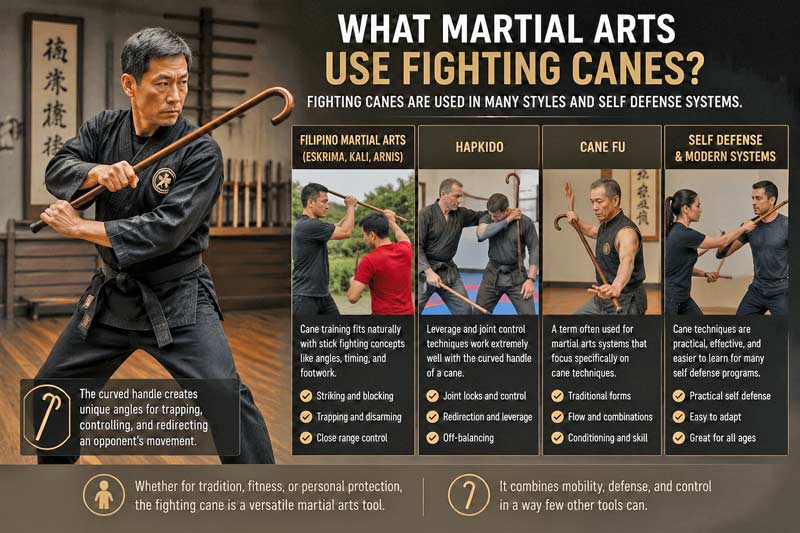
Fighting canes are used in several martial arts systems, though the training methods can vary quite a bit depending on the style. One of the most common places you will see cane training is in Filipino martial arts such as Eskrima, Kali, and Arnis. Since these systems already focus heavily on stick fighting, angles, footwork, and control techniques, adapting movements to a curved cane often feels very natural.
Cane training is also popular in some Hapkido schools, where practitioners use leverage, joint control, and redirection techniques that pair well with a hooked cane handle. The curved top of the cane can create opportunities for trapping, pulling, and controlling movement in ways that a straight stick cannot. Some instructors also incorporate cane techniques into broader self defense programs because the mechanics can be easier to learn than more complicated traditional weapons systems.
You may also hear the term "Cane Fu," which is a nickname often used for martial arts systems built around cane training. While the name sounds modern, many of the techniques are rooted in older martial arts concepts adapted specifically for the shape and function of a cane.
Today, people train with fighting canes for many different reasons. Some enjoy the traditional martial arts aspect, while others are drawn to them because they feel more practical and approachable than many other self defense weapons. For people interested in mobility-friendly training or unique martial arts tools, the fighting cane offers something very different from sticks, staffs, or batons.
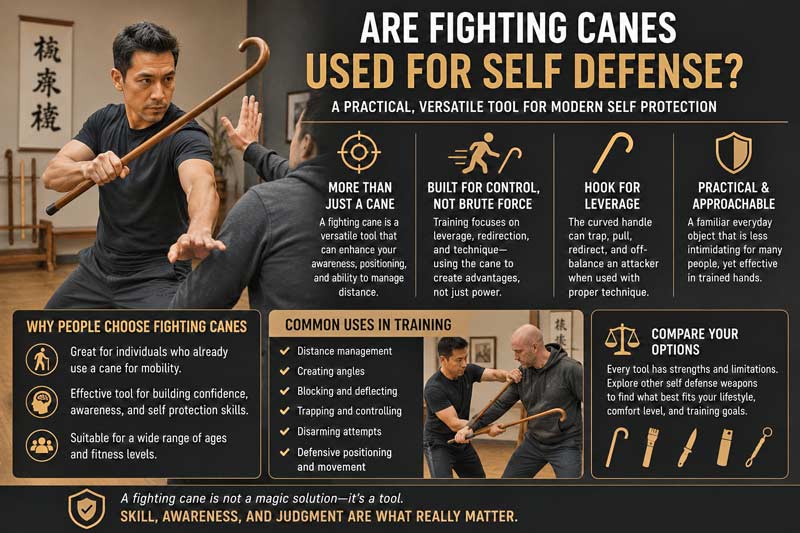
One reason many people become interested in fighting canes is that they are often viewed as a more practical and approachable tool than many traditional martial arts weapons. Unlike swords, staffs, or specialty training gear, a cane is something most people immediately recognize, which is part of why it has remained relevant in martial arts and personal protection discussions for so long.
That said, the way fighting canes are used in training is usually very different from how people imagine them in real-world situations. Martial arts instruction tends to focus on positioning, awareness, movement, distance management, and control rather than brute force. The hooked handle can be used for leverage and redirection drills, while the shaft allows practitioners to practice spacing and defensive positioning.
For many people, the appeal comes from practicality. Someone who already carries a cane for mobility may naturally be curious about learning defensive concepts that work with an object they already use every day. Others simply enjoy the idea of training with a tool that feels less intimidating than knives or impact weapons while still being part of a broader self protection mindset.
If you are exploring different personal protection tools, it may also be worth comparing a fighting cane to other self defense weapons to better understand what fits your lifestyle, comfort level, and training goals. Every tool has strengths and limitations, and what works best for one person may not be ideal for someone else.
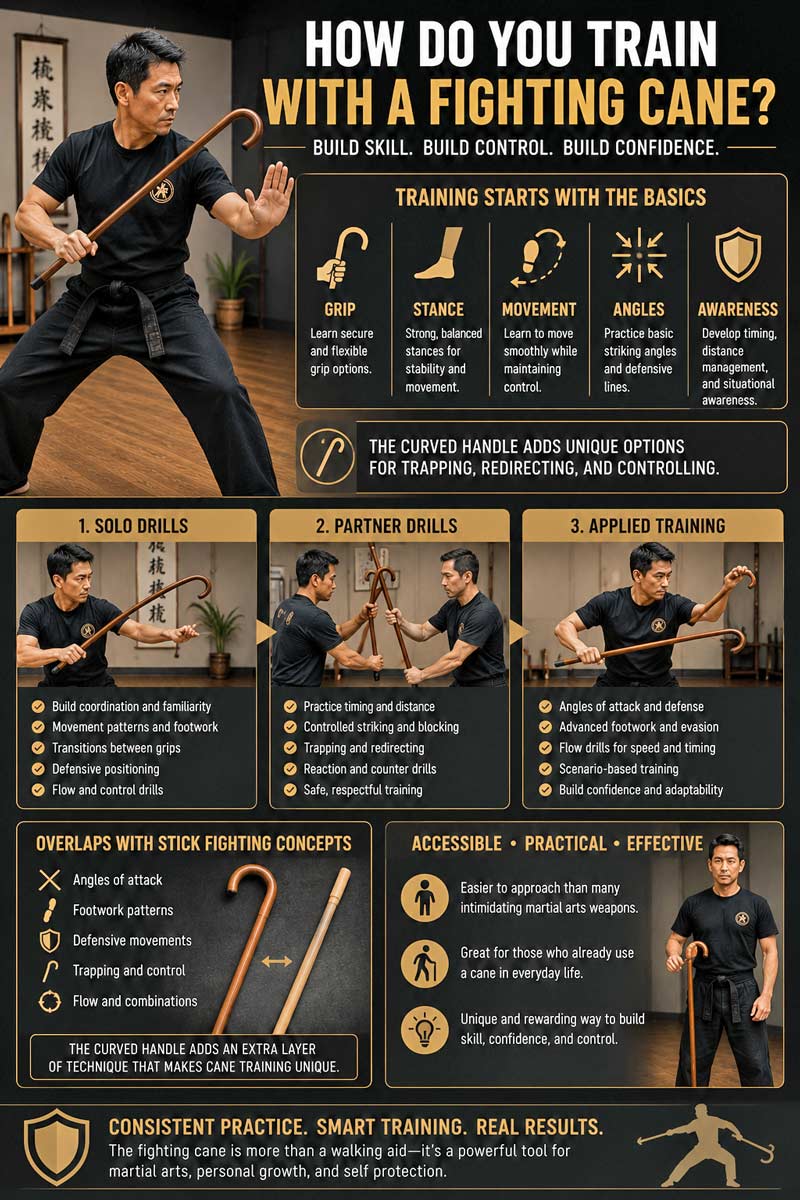
Training with a fighting cane usually starts with the basics, just like any other martial arts weapon. Beginners often learn proper grip, stance, movement, and simple striking angles before moving into more advanced techniques. Since the cane has a hooked handle, training also includes unique movements that are not possible with a straight stick or staff, such as trapping, redirecting, and controlling motion.
Many martial arts schools begin with solo drills to help students build coordination and familiarity with the cane. These drills may focus on movement patterns, defensive positioning, transitions between grips, and learning how to move naturally while holding the cane. As students gain confidence, partner drills are sometimes introduced to practice timing, distance, and controlled reactions.
In some systems, fighting cane training overlaps heavily with stick fighting concepts. Students may practice angles of attack, footwork patterns, defensive movements, and flow drills that build speed and coordination over time. The curved handle simply adds another layer of technique that makes cane training feel different from more traditional straight weapons.
For many people, one of the biggest advantages is accessibility. Compared to more intimidating martial arts weapons, the cane often feels easier to approach and less overwhelming for beginners. Some people are interested because they already use a cane in everyday life, while others simply enjoy learning something unique that blends traditional martial arts with practical movement skills.
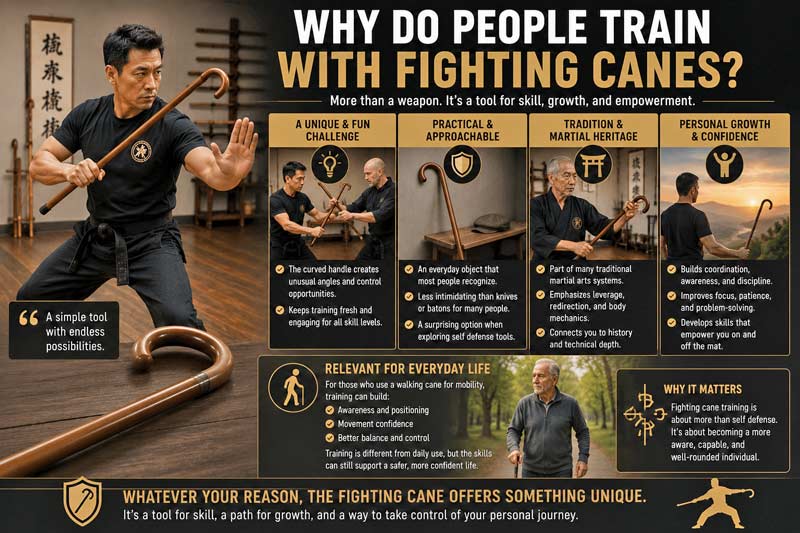
People train with fighting canes for a lot of different reasons, and not all of them have to do with self defense. For some martial artists, cane training is simply a fun and unique challenge that feels different from more common weapons like sticks, staffs, or nunchaku. The curved handle creates unusual angles and control opportunities, which can make training feel fresh even for experienced practitioners.
Others are drawn to fighting canes because they feel practical and approachable. Unlike many traditional martial arts weapons, a cane is an everyday object that most people immediately recognize. For someone interested in personal protection, the idea of learning skills with a familiar tool can feel less intimidating than training with knives, batons, or more specialized equipment. Some people exploring the best self defense weapons for everyday carry are often surprised to learn that martial arts cane systems even exist.
There is also a strong traditional aspect to cane training. Many martial arts schools incorporate fighting canes as part of a broader weapons curriculum, especially in systems that emphasize leverage, redirection, and body mechanics. Practitioners may enjoy the historical connection, the technical challenge, or simply the satisfaction of learning something that feels different from typical striking drills.
For people who already use a walking cane for mobility, training can also feel especially relevant. While martial arts instruction is very different from everyday movement, some students appreciate learning awareness, positioning, and movement concepts with a tool they already carry. For others, it is simply an interesting way to build coordination, confidence, and martial arts skills in a new format.
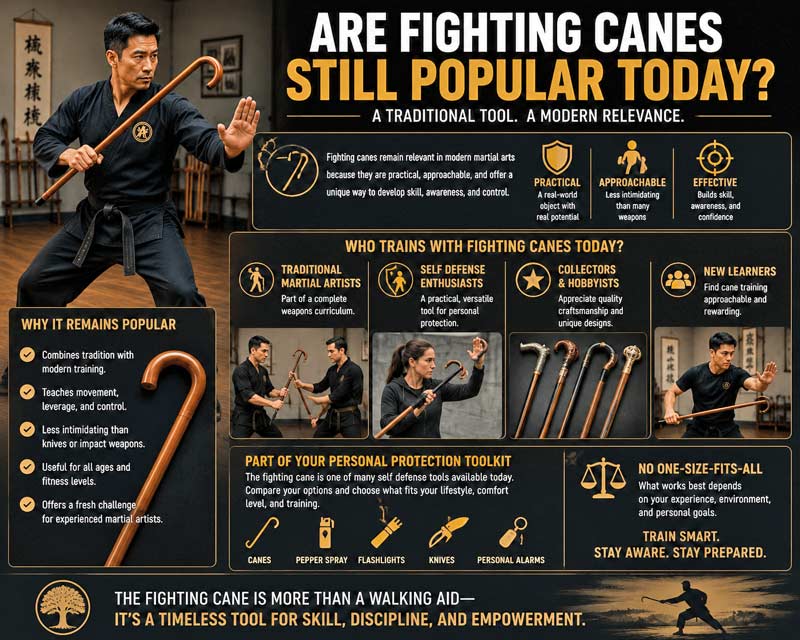
Even though fighting canes are rooted in traditional martial arts, they still have a place in modern training. Some practitioners enjoy them because they offer a completely different experience from more common martial arts weapons, while others appreciate the practical connection to a real-world object. For many students, the fighting cane feels more approachable than swords, knives, or impact tools, especially when learning basic movement and coordination.
Modern interest in fighting canes comes from several different groups. Traditional martial artists often train with them as part of a broader weapons curriculum, especially in Filipino martial arts and Hapkido systems. Self defense enthusiasts may be drawn to the cane because it feels practical and versatile, while collectors sometimes appreciate the craftsmanship and unique design of well-made canes.
For people exploring personal protection options, the fighting cane is often viewed as one of many possible tools rather than a one-size-fits-all answer. Some people prefer more compact or modern options, while others enjoy the idea of a defensive tool that feels less aggressive and more familiar. If you are curious about other approaches, it can be helpful to compare different everyday self defense options and see what makes the most sense for your experience level and lifestyle.
At the end of the day, the fighting cane remains popular because it offers something unique. It combines traditional martial arts concepts, movement skills, and practical training into a format that many people find both interesting and rewarding to learn.
Fighting canes may not be the first thing people think of when discussing martial arts weapons, but that is exactly what makes them so interesting. They offer a unique combination of movement, leverage, control, and traditional training that feels very different from more common martial arts tools. Whether someone is interested in historical martial arts systems, practical movement skills, or simply learning something new, cane training offers a different perspective on how martial arts techniques can be applied.
For some people, a fighting cane feels approachable because it is based on an everyday object. Others enjoy the technical challenge that comes from the hooked handle and the unusual angles it creates. Some practitioners simply like expanding their skills by exploring weapons and training methods outside the basics.
If you are curious about getting started, exploring different martial arts cane options can help you better understand the styles, materials, and designs available today. You may also find it useful to compare them with other personal protection tools to see what best fits your interests, comfort level, and training goals.
At the end of the day, fighting canes are still around for a reason. They are practical, versatile, and deeply rooted in martial arts tradition, while still offering something that feels surprisingly relevant in modern training.
In this beginner's guide, we will break down what a fighting cane is, how it is used in martial arts, what makes it different from a regular walking cane, and why so many people continue to train with them today.
What Is a Fighting Cane?
A fighting cane, sometimes called a martial arts cane or combat cane, is a specially designed walking cane that can be used for martial arts training, self defense techniques, and control-based movements. While it looks similar to a regular walking cane, a fighting cane is usually made from stronger materials like hardwood, polypropylene, aluminum, or reinforced composites so it can handle repeated training and impact.
What makes a fighting cane unique is the curved handle. Unlike a straight stick or baton, the hooked portion of the cane creates opportunities for trapping, pulling, redirecting, and controlling an opponent's movement. Martial artists often practice using the crook of the cane to hook limbs, off-balance an attacker, or create distance while staying mobile.
One of the reasons fighting canes remain popular is that they blend practicality with martial arts training. For someone who already uses a walking cane, the transition into cane-based self defense may feel more natural than learning a completely different weapon. At the same time, many people who have no need for a mobility aid still train with martial arts canes simply because the techniques are unique, challenging, and rooted in traditional systems.
Today, fighting canes are used in several martial arts styles and self defense systems. Some schools focus on practical defensive movements, while others treat cane training as part of a larger traditional weapons curriculum alongside staffs, sticks, and other impact tools.
What Makes a Fighting Cane Different From a Regular Cane?
At a glance, a fighting cane can look a lot like an ordinary walking cane, which is part of what makes it interesting. The biggest differences usually come down to strength, construction, and intended use. A standard mobility cane is designed primarily for support and everyday walking assistance, while a martial arts cane is typically built to handle training, repeated movement, and controlled impact.
Many fighting canes are made from durable materials like hardwood, reinforced polymers, or aircraft-grade aluminum. These materials help the cane hold up during practice drills without bending or cracking as easily as a lightweight medical cane might. Some also feature slightly thicker shafts, reinforced tips, or specially shaped handles designed for better grip and control.
The curved handle also plays a much bigger role than many people realize. In martial arts training, the crook of the cane can be used to redirect movement, create distance, control positioning, or practice leverage-based techniques. That versatility is one reason many practitioners enjoy training with self defense canes, especially when compared to straight sticks or staffs.
Of course, not every cane is designed for martial arts use. If someone genuinely relies on a walking cane for mobility, comfort and medical function should always come first. Martial arts canes are simply a specialized variation built for training and skill development within certain systems and self defense disciplines.
What Martial Arts Use Fighting Canes?
Fighting canes are used in several martial arts systems, though the training methods can vary quite a bit depending on the style. One of the most common places you will see cane training is in Filipino martial arts such as Eskrima, Kali, and Arnis. Since these systems already focus heavily on stick fighting, angles, footwork, and control techniques, adapting movements to a curved cane often feels very natural.
Cane training is also popular in some Hapkido schools, where practitioners use leverage, joint control, and redirection techniques that pair well with a hooked cane handle. The curved top of the cane can create opportunities for trapping, pulling, and controlling movement in ways that a straight stick cannot. Some instructors also incorporate cane techniques into broader self defense programs because the mechanics can be easier to learn than more complicated traditional weapons systems.
You may also hear the term "Cane Fu," which is a nickname often used for martial arts systems built around cane training. While the name sounds modern, many of the techniques are rooted in older martial arts concepts adapted specifically for the shape and function of a cane.
Today, people train with fighting canes for many different reasons. Some enjoy the traditional martial arts aspect, while others are drawn to them because they feel more practical and approachable than many other self defense weapons. For people interested in mobility-friendly training or unique martial arts tools, the fighting cane offers something very different from sticks, staffs, or batons.
Are Fighting Canes Used for Self Defense?
One reason many people become interested in fighting canes is that they are often viewed as a more practical and approachable tool than many traditional martial arts weapons. Unlike swords, staffs, or specialty training gear, a cane is something most people immediately recognize, which is part of why it has remained relevant in martial arts and personal protection discussions for so long.
That said, the way fighting canes are used in training is usually very different from how people imagine them in real-world situations. Martial arts instruction tends to focus on positioning, awareness, movement, distance management, and control rather than brute force. The hooked handle can be used for leverage and redirection drills, while the shaft allows practitioners to practice spacing and defensive positioning.
For many people, the appeal comes from practicality. Someone who already carries a cane for mobility may naturally be curious about learning defensive concepts that work with an object they already use every day. Others simply enjoy the idea of training with a tool that feels less intimidating than knives or impact weapons while still being part of a broader self protection mindset.
If you are exploring different personal protection tools, it may also be worth comparing a fighting cane to other self defense weapons to better understand what fits your lifestyle, comfort level, and training goals. Every tool has strengths and limitations, and what works best for one person may not be ideal for someone else.
How Do You Train With a Fighting Cane?
Training with a fighting cane usually starts with the basics, just like any other martial arts weapon. Beginners often learn proper grip, stance, movement, and simple striking angles before moving into more advanced techniques. Since the cane has a hooked handle, training also includes unique movements that are not possible with a straight stick or staff, such as trapping, redirecting, and controlling motion.
Many martial arts schools begin with solo drills to help students build coordination and familiarity with the cane. These drills may focus on movement patterns, defensive positioning, transitions between grips, and learning how to move naturally while holding the cane. As students gain confidence, partner drills are sometimes introduced to practice timing, distance, and controlled reactions.
In some systems, fighting cane training overlaps heavily with stick fighting concepts. Students may practice angles of attack, footwork patterns, defensive movements, and flow drills that build speed and coordination over time. The curved handle simply adds another layer of technique that makes cane training feel different from more traditional straight weapons.
For many people, one of the biggest advantages is accessibility. Compared to more intimidating martial arts weapons, the cane often feels easier to approach and less overwhelming for beginners. Some people are interested because they already use a cane in everyday life, while others simply enjoy learning something unique that blends traditional martial arts with practical movement skills.
Why Do People Train With Fighting Canes?
People train with fighting canes for a lot of different reasons, and not all of them have to do with self defense. For some martial artists, cane training is simply a fun and unique challenge that feels different from more common weapons like sticks, staffs, or nunchaku. The curved handle creates unusual angles and control opportunities, which can make training feel fresh even for experienced practitioners.
Others are drawn to fighting canes because they feel practical and approachable. Unlike many traditional martial arts weapons, a cane is an everyday object that most people immediately recognize. For someone interested in personal protection, the idea of learning skills with a familiar tool can feel less intimidating than training with knives, batons, or more specialized equipment. Some people exploring the best self defense weapons for everyday carry are often surprised to learn that martial arts cane systems even exist.
There is also a strong traditional aspect to cane training. Many martial arts schools incorporate fighting canes as part of a broader weapons curriculum, especially in systems that emphasize leverage, redirection, and body mechanics. Practitioners may enjoy the historical connection, the technical challenge, or simply the satisfaction of learning something that feels different from typical striking drills.
For people who already use a walking cane for mobility, training can also feel especially relevant. While martial arts instruction is very different from everyday movement, some students appreciate learning awareness, positioning, and movement concepts with a tool they already carry. For others, it is simply an interesting way to build coordination, confidence, and martial arts skills in a new format.
Are Fighting Canes Still Popular Today?
Even though fighting canes are rooted in traditional martial arts, they still have a place in modern training. Some practitioners enjoy them because they offer a completely different experience from more common martial arts weapons, while others appreciate the practical connection to a real-world object. For many students, the fighting cane feels more approachable than swords, knives, or impact tools, especially when learning basic movement and coordination.
Modern interest in fighting canes comes from several different groups. Traditional martial artists often train with them as part of a broader weapons curriculum, especially in Filipino martial arts and Hapkido systems. Self defense enthusiasts may be drawn to the cane because it feels practical and versatile, while collectors sometimes appreciate the craftsmanship and unique design of well-made canes.
For people exploring personal protection options, the fighting cane is often viewed as one of many possible tools rather than a one-size-fits-all answer. Some people prefer more compact or modern options, while others enjoy the idea of a defensive tool that feels less aggressive and more familiar. If you are curious about other approaches, it can be helpful to compare different everyday self defense options and see what makes the most sense for your experience level and lifestyle.
At the end of the day, the fighting cane remains popular because it offers something unique. It combines traditional martial arts concepts, movement skills, and practical training into a format that many people find both interesting and rewarding to learn.
Is a Fighting Cane Right for You?
Fighting canes may not be the first thing people think of when discussing martial arts weapons, but that is exactly what makes them so interesting. They offer a unique combination of movement, leverage, control, and traditional training that feels very different from more common martial arts tools. Whether someone is interested in historical martial arts systems, practical movement skills, or simply learning something new, cane training offers a different perspective on how martial arts techniques can be applied.
For some people, a fighting cane feels approachable because it is based on an everyday object. Others enjoy the technical challenge that comes from the hooked handle and the unusual angles it creates. Some practitioners simply like expanding their skills by exploring weapons and training methods outside the basics.
If you are curious about getting started, exploring different martial arts cane options can help you better understand the styles, materials, and designs available today. You may also find it useful to compare them with other personal protection tools to see what best fits your interests, comfort level, and training goals.
At the end of the day, fighting canes are still around for a reason. They are practical, versatile, and deeply rooted in martial arts tradition, while still offering something that feels surprisingly relevant in modern training.
You May Also Be Interested In:
- The Complete Guide to Martial Arts Staffs: A Beginner-Friendly Breakdown
- What Size Bo Staff Should You Use? A Beginner's Guide
- What Is a Karambit Knife? Beginner Guide to Karambits
- What Is a Balisong? Beginner Guide to Butterfly Knives
- What Is a Bo Staff? Beginner Guide to History, Sizes, and Training
- The 7 Most Misunderstood Martial Arts Weapons
- Were Martial Arts Weapons Really Farm Tools?
- Why Some Martial Arts Weapons Are Illegal in Certain Places
- 7 Weird Martial Arts Weapons That Actually Existed
- What Is the Hardest Martial Arts Weapon to Master? We Ranked Them
Leave a Reply