




Why Some Martial Arts Weapons Are Illegal in Certain Places
June 10th, 2026
At first glance, martial arts weapon laws can feel completely random.
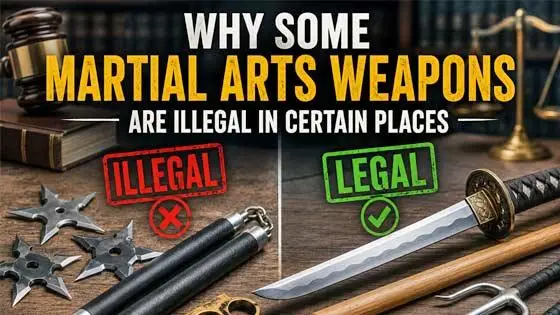
In some places, you can legally own a full-size sword but get into trouble for carrying a small throwing star. Nunchaku might be restricted in one state, completely legal in another, and barely regulated somewhere else. Meanwhile, certain compact self-defense tools are banned in places where larger weapons are perfectly acceptable.
In some places, you can legally own a full-size sword but get into trouble for carrying a small throwing star. Nunchaku might be restricted in one state, completely legal in another, and barely regulated somewhere else. Meanwhile, certain compact self-defense tools are banned in places where larger weapons are perfectly acceptable.
It seems inconsistent because, honestly, sometimes it is.
But there are usually reasons behind these laws, even when they seem strange from the outside. Concerns about concealability, public fear, media influence, injury risk, criminal misuse, and even old political reactions have all played a role in why certain martial arts weapons became restricted over time.
The interesting part is that many of these laws have less to do with how dangerous a weapon actually is and more to do with how lawmakers and the public perceived it at a particular moment in history.
So why are some martial arts weapons illegal in certain places while others are not? The answer turns out to be much stranger than most people expect.
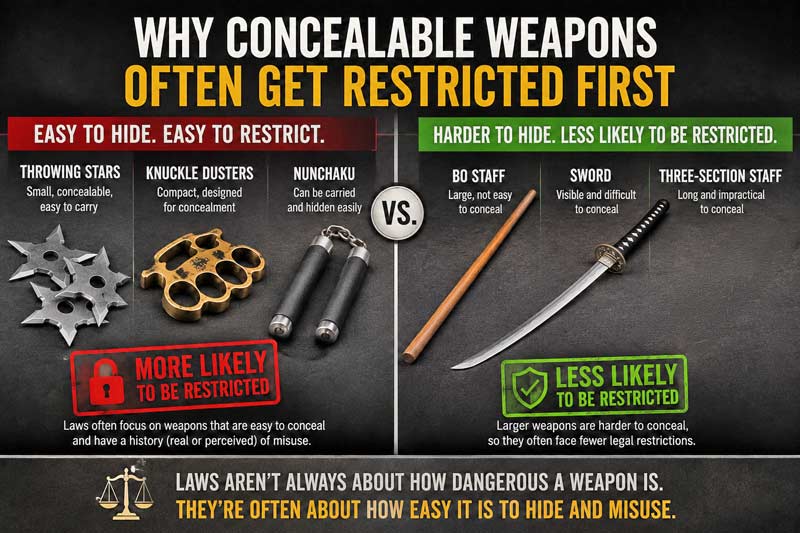
If you look at weapon laws closely, one pattern shows up again and again: governments tend to get nervous about small weapons that are easy to hide.
That might sound strange at first. After all, a full-size sword or long staff can look far more intimidating than something small enough to fit in a pocket.
But lawmakers do not always focus on what looks most dangerous.
They often focus on what feels easiest to misuse.
This is one reason compact martial arts weapons frequently attract legal attention. Throwing stars, knuckle dusters, compact batons, and similar tools are easier to conceal, easier to carry unnoticed, and historically have been associated, fairly or unfairly, with criminal use. Once a weapon develops that reputation, restrictions often follow.
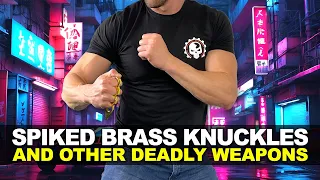
Brass knuckles are probably one of the clearest examples. In many places, laws became stricter because officials viewed them as weapons designed almost entirely for close-range violence and concealment. Whether that reputation is completely fair is still debated, but perception matters more than people realize when laws get written. If you are curious about how these tools evolved, our breakdown of the real history of brass knuckles explains how they developed over time. You can also learn what brass knuckles actually are and why opinions around them remain so divided.
Interestingly, this logic can create laws that feel inconsistent from the outside. A larger weapon may technically be legal because carrying it discreetly is impractical, while a much smaller object ends up restricted because it can disappear into a pocket.
That is part of why martial arts weapon laws sometimes feel confusing. They are not always built around raw danger. Sometimes they are built around concealability, public perception, and fear of misuse.
When a weapon is compact, concealable, and easy for lawmakers to associate with criminal behavior, restrictions often become much more likely.
Few martial arts weapons have had a stranger public reputation than throwing stars.
On paper, they are relatively small pieces of metal. In movies, though, they somehow transformed into silent, impossibly accurate weapons capable of ending a fight instantly from across the room. Over time, that image stuck.
And once public perception shifts, laws often follow.
This is one reason throwing stars, also known as shuriken, became restricted in certain places despite not necessarily being the most dangerous weapon available. The concern was often not just injury potential. It was concealability, media attention, and the growing association with crime or sensationalized violence.
Ironically, many larger martial arts weapons attracted less concern simply because they looked harder to hide or less likely to be carried casually. A sword might appear more intimidating, but few people are slipping one into a jacket pocket. Throwing stars, fairly or unfairly, ended up caught in a different category of public fear.
There is also an important historical detail movies usually ignore: "shuriken" does not only mean the classic star shape most people imagine. Traditional designs varied widely, and many were far less dramatic than Hollywood made them seem. If you want a deeper look, our guide explaining what a shuriken actually is breaks down how these weapons were traditionally understood. You can also explore the evolution of the shuriken and whether throwing stars are actually effective weapons to better understand how perception and reality often drifted apart.
The funny thing is that controversy sometimes makes a weapon more famous. Restrictions and movie myths helped turn ninja stars into cultural icons, even if most people's understanding of them became heavily exaggerated in the process.
For readers curious about the broader world of traditional throwing stars and related ninja weapons, history tends to be much more nuanced than movies suggest.
Weapons that become culturally associated with fear, crime, or media panic often attract restrictions faster, even when they are not necessarily the most dangerous option available.
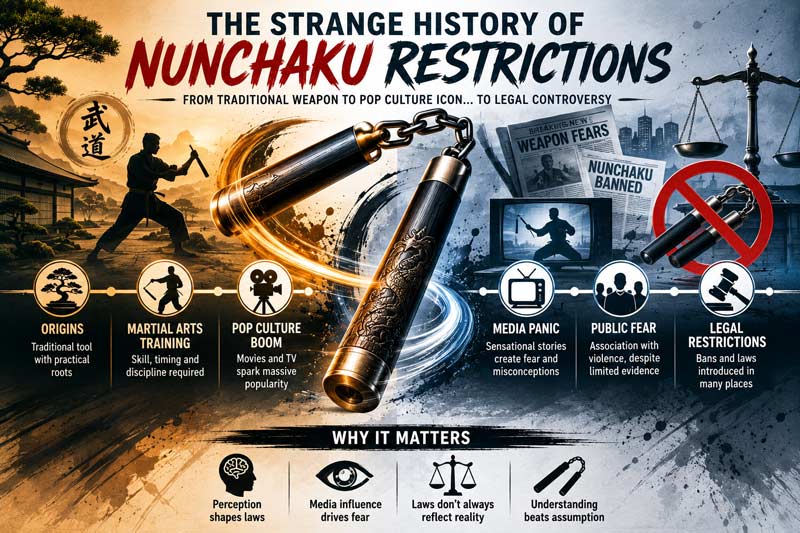
Of all martial arts weapons that ended up restricted in certain places, nunchaku might have one of the strangest stories.
Because for a long time, the debate was not really about crime statistics or historical use.
It was about fear.
More specifically, fear fueled by visibility.
In the 1970s and 1980s, martial arts exploded in popularity. Movies, television, and pop culture suddenly made nunchaku impossible to ignore. A huge part of that came from Bruce Lee, whose incredible speed and charisma turned the weapon into something iconic almost overnight.
The problem was that popularity made lawmakers nervous.
In some places, concerns grew that nunchaku were becoming fashionable among young people or associated with street violence, even when evidence for widespread misuse was often debated. Media attention amplified those fears, and several governments responded with restrictions or outright bans. Interestingly, some of those laws were later challenged or overturned after courts questioned whether the restrictions actually made sense.
What makes the story strange is that nunchaku are not especially easy weapons to use well. Movies make them look intuitive, but beginners usually discover quickly that timing and control matter a lot more than confidence. In many ways, public perception shaped restrictions just as much as actual risk.
If you want to understand where the weapon really came from, our guide on the real history of nunchaku explores how it evolved long before movies transformed it into a pop culture symbol. You can also browse different styles of nunchaku to see how training versions vary from what Hollywood often portrays.
Ironically, attempts to restrict nunchaku may have made them even more famous. Few things spark curiosity faster than telling people something suddenly feels dangerous or forbidden.
Sometimes martial arts weapon laws are shaped less by historical danger and more by cultural moments, media attention, and public anxiety.
One of the strangest things about weapon laws is how inconsistent they can feel from the outside.
In some places, you can legally carry pepper spray but get into legal trouble for carrying brass knuckles. A collapsible baton may be restricted, while another self-defense tool is perfectly acceptable. At first glance, the logic can seem completely random.
Usually, though, lawmakers are weighing a few specific questions.
How easily can the weapon be concealed? How likely is it to be viewed as purely offensive? Does it have an obvious defensive purpose? Is accidental misuse less likely? Fair or not, these questions often shape laws more than raw effectiveness alone.
Pepper spray is a good example of this logic. In many places, it remains legal because it is generally viewed as a defensive tool with a non-lethal purpose. It creates distance, helps someone escape danger, and is less likely to cause permanent injury compared to many impact weapons. That does not mean laws are always consistent, but public perception matters.
Compact striking tools tend to face a different challenge. Weapons like brass knuckles or batons are often viewed through the lens of concealability and offensive potential, even when someone intends them for personal protection. Once a weapon becomes culturally associated with crime, restrictions tend to follow much faster.
This debate is also part of a larger question that has existed for decades: where should society draw the line between self-defense and public safety? Our article on whether self-defense weapons should be legal explores some of the arguments on both sides. You can also browse different categories of self-defense weapons or learn more about defensive options like pepper spray to see how different tools are viewed and regulated.
Ironically, the legal line is not always based on what seems most dangerous. Sometimes it comes down to perception, historical panic, and how easy lawmakers think something is to misuse.
Weapons viewed as defensive or non-lethal often face fewer restrictions, while compact tools associated with concealment or criminal misuse tend to attract more legal scrutiny.
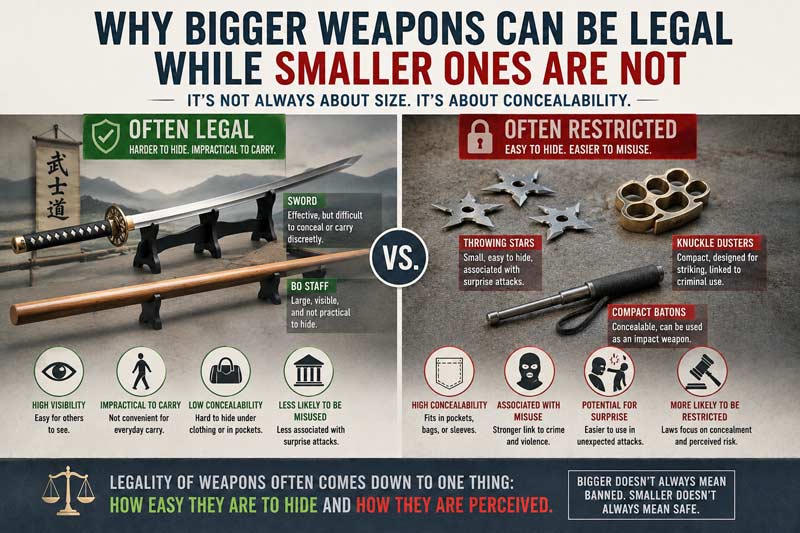
This is the part that confuses people the most.
How can a full-size sword be legal in one place while something small enough to fit in your pocket gets banned?
At first glance, it feels backwards.
After all, larger weapons often look more intimidating.
But intimidation and legality are not always the same thing.
In many cases, lawmakers worry more about practicality than appearance. A large sword, bo staff, or oversized training weapon may technically be dangerous, but they are difficult to conceal, awkward to carry casually, and far less likely to appear in everyday public situations. That alone changes how laws often treat them.
Smaller martial arts weapons face a different problem. Throwing stars, compact batons, knuckle dusters, and similar tools can disappear into a pocket or bag. Whether fair or not, lawmakers often see concealability as increasing the chance of misuse. Once a weapon becomes associated with surprise attacks, criminal behavior, or public fear, restrictions tend to follow much faster.
This creates one of the strangest contradictions in weapon laws: something objectively larger or potentially more damaging may remain legal simply because it is impractical to carry discreetly, while something smaller becomes heavily regulated because it feels easier to misuse.
You can see similar patterns across many traditional ninja weapons, compact striking tools like knuckle dusters, and even expandable batons, where concealability often plays a larger role than raw power.
The weird part is that laws often end up reflecting what people fear carrying in public more than what looks most dangerous in theory.
Martial arts weapon laws are often shaped by visibility and concealability. Larger weapons may look scarier, but smaller weapons are frequently restricted because they are easier to hide and easier for lawmakers to associate with misuse.
After looking at throwing stars, nunchaku, brass knuckles, and compact self-defense tools, a pattern starts to emerge.
Most martial arts weapon laws are not based on one single factor.
There is usually a combination of things happening at once.
A weapon becomes highly visible in pop culture. News coverage creates fear. Lawmakers worry about concealability. A few high-profile incidents happen, whether common or rare, and suddenly pressure builds to "do something." Before long, restrictions appear, even if the weapon itself has existed for generations without major attention.
This is partly why martial arts weapon laws can feel inconsistent. One weapon becomes politically controversial while another, arguably just as dangerous, attracts almost no attention. Public perception often moves faster than careful analysis.
There is also an uncomfortable truth here: legality does not always equal danger level.
Some restricted weapons are relatively difficult to use effectively. Others remain legal largely because they are impractical to conceal or unlikely to appear in everyday situations. In many cases, laws end up reflecting cultural fear, historical timing, and public visibility as much as actual risk.
That does not mean restrictions are always unreasonable. Some laws were created in response to genuine safety concerns or criminal misuse. The point is simply that weapon legality tends to be more complicated and sometimes stranger than people expect.
If you want to explore the broader debate, our article on whether self-defense weapons should be legal takes a deeper look at where people disagree on balancing personal safety and public concern.
Ironically, the more you learn about martial arts weapon laws, the less random they seem, even if they still occasionally feel contradictory.
Martial arts weapons usually become restricted because of a mix of concealability, public fear, media influence, criminal association, and historical timing, not simply because they are the most dangerous tools available.
Even after understanding the logic behind many restrictions, there is one frustrating truth people keep running into:
Martial arts weapon laws can still feel wildly inconsistent.
In one place, carrying pepper spray might be perfectly acceptable while nunchaku are restricted. Somewhere else, throwing stars are banned but swords remain legal. Move to a different city, state, or country, and the rules can change all over again.
Part of that inconsistency comes from timing.
Many weapon laws were created decades apart, often in response to completely different concerns. Some were written during spikes in public fear. Others followed media attention or isolated criminal incidents. A few restrictions were heavily influenced by cultural trends that no longer exist, but the laws remained anyway.
There is also a practical problem lawmakers face: weapons do not fit neatly into categories. Is something primarily a martial arts training tool? A collector's item? A self-defense tool? A concealed weapon? Depending on how a government answers those questions, the legal outcome can look very different.
This is one reason people are often surprised to discover that laws surrounding traditional ninja weapons, compact striking tools, or even self-defense weapons vary so dramatically from one location to another. The legal system is often responding to history, politics, perception, and practicality all at once.
The strange part is that inconsistency does not necessarily mean there is no logic. It usually means different places prioritized different fears at different times.
If there is one lesson here, it is probably this: before assuming a martial arts weapon is legal or illegal everywhere, it is worth checking local laws carefully. Assumptions are where people tend to get themselves into trouble.
Martial arts weapon laws often feel inconsistent because they were shaped by different fears, cultural moments, and priorities depending on where and when the laws were created.
After looking at throwing stars, nunchaku, brass knuckles, batons, and other martial arts weapons, one thing becomes pretty clear:
These laws are rarely just about danger.
If they were, the legal line would probably look much more straightforward. Instead, martial arts weapon restrictions are often shaped by a strange mix of history, public fear, concealability, politics, media attention, and timing. A weapon becomes popular at the wrong moment, gets tied to public anxiety, or develops a reputation lawmakers dislike, and suddenly restrictions start appearing.
That does not necessarily make every law unreasonable. Some rules came from genuine safety concerns or real criminal misuse. But it does explain why weapon laws can sometimes feel contradictory from the outside. A large sword may remain legal while a much smaller object becomes heavily restricted. A martial arts tool that existed quietly for generations suddenly becomes controversial after a burst of pop culture attention.
In many ways, martial arts weapon laws tell us just as much about public perception as they do about the weapons themselves.
The strange part is that once you understand the history behind these laws, they stop feeling completely random, even if they still occasionally leave you scratching your head.
This usually comes down to concealability and public perception rather than size alone. A sword may look more intimidating, but it is difficult to hide and impractical to carry casually. Throwing stars, on the other hand, are compact, easy to conceal, and became heavily associated with crime and pop culture fear over time. Whether fair or not, lawmakers often treat smaller weapons differently because they are viewed as easier to misuse.
If you want to understand the history behind the controversy, our guide on what a shuriken actually is explains how throwing stars were traditionally understood and why Hollywood changed public perception so dramatically.
Nunchaku restrictions were often influenced by cultural fear as much as actual misuse. During the martial arts boom of the 1970s and 1980s, movies and television made nunchaku incredibly popular. As visibility increased, some lawmakers worried they were becoming associated with violence or criminal behavior, particularly among younger audiences. In several places, those concerns led to restrictions or outright bans, even though debates continued over whether the laws were truly justified.
Interestingly, some of those restrictions were later challenged or overturned after courts questioned whether nunchaku deserved special treatment compared to other martial arts training tools. If you want to understand where the weapon actually came from, our guide on the real history of nunchaku explores how its story became much more complicated than most people realize.
No, and this is where weapon laws start getting especially confusing.
Brass knuckles are legal in some places, restricted in others, and completely prohibited elsewhere. Much of that variation comes down to how governments classify them. Because they are compact, easy to conceal, and often viewed as tools designed primarily for close-range force, lawmakers tend to scrutinize them more heavily than larger martial arts weapons.
Public perception also plays a major role. Over time, brass knuckles became culturally associated with street violence and criminal activity, whether that reputation is always fair or not. Once a weapon develops that kind of image, restrictions often become much more likely.
If you want a deeper look, our guide on what brass knuckles actually are explains how they work, while the real history of brass knuckles explores how they evolved over time and why opinions around them remain so divided.
Sometimes, but it depends heavily on where you live and what specific weapon you are talking about.
Some self-defense tools, like pepper spray, are widely legal because they are generally viewed as defensive and non-lethal. Others, especially compact striking weapons or concealed tools, may face restrictions even if someone intends to carry them purely for personal protection. Local laws often focus on concealability, intended use, and how a weapon is classified legally.
This is one reason assumptions can get people into trouble. Something that is perfectly legal in one state or country may be restricted somewhere else. If you are exploring personal protection options, it is worth understanding how different self-defense weapons are viewed and why tools like pepper spray are often regulated differently from impact weapons or concealed martial arts tools.
For a deeper discussion on the bigger debate, our article on whether self-defense weapons should be legal explores the arguments from both perspectives.
Because most weapon laws were created at different times, under different political pressures, and in response to different fears.
One city or state may have passed restrictions after a period of public concern, while another never saw the same issue as a priority. Some laws were influenced by media attention, crime fears, or cultural trends that have long since faded, while others stayed on the books simply because nobody revisited them later.
There is also the problem of classification. One government may view something as a martial arts training tool, while another sees the same object as a concealed weapon or public safety risk. That difference alone can dramatically change whether something is legal, restricted, or outright banned.
The strange part is that once you start comparing laws side by side, you quickly realize there is rarely one universal standard. Martial arts weapon legality often says just as much about local history and politics as it does about the weapon itself.
There is no universal list because laws vary so much, but certain weapons tend to face restrictions more often than others.
Compact, easily concealed weapons usually attract the most scrutiny. Throwing stars, brass knuckles, expandable batons, switchblades, and certain chain-based weapons are common examples. In many cases, the concern is not simply how dangerous the weapon is, but how easy it is to hide, carry discreetly, or associate with criminal misuse.
Interestingly, larger martial arts weapons like staffs or swords are sometimes treated more leniently despite looking more intimidating. That often comes down to practicality. A long weapon is harder to conceal and less likely to appear in everyday situations, which changes how lawmakers think about risk.
The confusing part is that a weapon restricted in one place may be completely legal somewhere else. That is why it is always worth checking local laws before assuming something is legal based on what you saw online or in another state.
This usually comes down to concealability and perceived misuse.
A weapon that fits in a pocket often raises more legal concern than something large and obvious to carry in public. Even if a larger weapon could theoretically cause more harm, lawmakers frequently focus on what feels easier to hide, easier to carry discreetly, or more likely to be used unexpectedly.
That is why laws can sometimes feel backwards. A large sword or training staff may remain legal while compact tools like throwing stars, brass knuckles, or expandable batons face restrictions. In many cases, the law is responding less to raw danger and more to practicality, public fear, and historical reputation.
The weird part is that once a weapon develops a certain image, whether through crime reports, movies, or public anxiety, restrictions often become much more likely, even if the actual risk is more complicated than people assume.
Not always, and this is where things become surprisingly complicated.
Many martial arts weapons are restricted less because they are objectively more dangerous and more because of how they are perceived. Concealability, cultural reputation, media attention, and historical panic often influence laws just as much as raw effectiveness. In some cases, a weapon became controversial simply because lawmakers believed it could be misused easily or associated it with criminal activity.
There are also practical considerations. A weapon designed primarily for training may be treated differently than one viewed as having little purpose outside of combat or self-defense. Public visibility matters too. Weapons that became popular through movies or news coverage sometimes attracted legal attention much faster than older, less visible tools.
Ironically, some martial arts weapons that look intimidating are perfectly legal in many places, while smaller tools with less obvious power face tighter restrictions. That contradiction is exactly why martial arts weapon laws often feel confusing from the outside.
Because laws often reflect the fears and priorities of a particular moment in history.
A weapon that sparked public concern decades ago may not carry the same reputation today. In some cases, restrictions were introduced during periods of media panic, rising crime concerns, or cultural trends that made certain weapons suddenly seem threatening. Years later, courts or lawmakers sometimes revisit those laws and decide they no longer make sense.
Nunchaku are one of the better-known examples. In several places, restrictions were later challenged after people argued the laws unfairly targeted martial arts training tools rather than addressing real public safety concerns. Other weapons have followed similar patterns as attitudes shifted and legal systems reexamined older rules.
The interesting part is that weapon laws rarely stay frozen forever. Public perception changes, court rulings happen, and what seemed controversial decades ago can eventually start looking outdated.
The safest answer is simple: check your local laws first.
One of the biggest mistakes people make is assuming that if a weapon is legal somewhere else, it must also be legal where they live. Martial arts weapon laws can vary dramatically between states, cities, and countries, sometimes in ways that feel completely unexpected.
It is also worth thinking about intended use. A training tool kept at home, a collector's item, and something carried for self-defense may be treated very differently depending on local regulations. Even how a weapon is transported or stored can matter in some places.
If you are exploring different options, understanding the background and intended purpose of traditional ninja weapons, compact tools like knuckle dusters, or broader categories of self-defense weapons can make the legal landscape feel a lot less confusing.
At the end of the day, spending a few minutes checking the law is a lot easier than accidentally finding out you misunderstood it later.
But there are usually reasons behind these laws, even when they seem strange from the outside. Concerns about concealability, public fear, media influence, injury risk, criminal misuse, and even old political reactions have all played a role in why certain martial arts weapons became restricted over time.
The interesting part is that many of these laws have less to do with how dangerous a weapon actually is and more to do with how lawmakers and the public perceived it at a particular moment in history.
So why are some martial arts weapons illegal in certain places while others are not? The answer turns out to be much stranger than most people expect.
Why Concealable Weapons Often Get Restricted First
If you look at weapon laws closely, one pattern shows up again and again: governments tend to get nervous about small weapons that are easy to hide.
That might sound strange at first. After all, a full-size sword or long staff can look far more intimidating than something small enough to fit in a pocket.
But lawmakers do not always focus on what looks most dangerous.
They often focus on what feels easiest to misuse.
This is one reason compact martial arts weapons frequently attract legal attention. Throwing stars, knuckle dusters, compact batons, and similar tools are easier to conceal, easier to carry unnoticed, and historically have been associated, fairly or unfairly, with criminal use. Once a weapon develops that reputation, restrictions often follow.
Brass knuckles are probably one of the clearest examples. In many places, laws became stricter because officials viewed them as weapons designed almost entirely for close-range violence and concealment. Whether that reputation is completely fair is still debated, but perception matters more than people realize when laws get written. If you are curious about how these tools evolved, our breakdown of the real history of brass knuckles explains how they developed over time. You can also learn what brass knuckles actually are and why opinions around them remain so divided.
Interestingly, this logic can create laws that feel inconsistent from the outside. A larger weapon may technically be legal because carrying it discreetly is impractical, while a much smaller object ends up restricted because it can disappear into a pocket.
That is part of why martial arts weapon laws sometimes feel confusing. They are not always built around raw danger. Sometimes they are built around concealability, public perception, and fear of misuse.
The Bigger Pattern
When a weapon is compact, concealable, and easy for lawmakers to associate with criminal behavior, restrictions often become much more likely.
Why Throwing Stars Became So Controversial
Few martial arts weapons have had a stranger public reputation than throwing stars.
On paper, they are relatively small pieces of metal. In movies, though, they somehow transformed into silent, impossibly accurate weapons capable of ending a fight instantly from across the room. Over time, that image stuck.
And once public perception shifts, laws often follow.
This is one reason throwing stars, also known as shuriken, became restricted in certain places despite not necessarily being the most dangerous weapon available. The concern was often not just injury potential. It was concealability, media attention, and the growing association with crime or sensationalized violence.
Ironically, many larger martial arts weapons attracted less concern simply because they looked harder to hide or less likely to be carried casually. A sword might appear more intimidating, but few people are slipping one into a jacket pocket. Throwing stars, fairly or unfairly, ended up caught in a different category of public fear.
There is also an important historical detail movies usually ignore: "shuriken" does not only mean the classic star shape most people imagine. Traditional designs varied widely, and many were far less dramatic than Hollywood made them seem. If you want a deeper look, our guide explaining what a shuriken actually is breaks down how these weapons were traditionally understood. You can also explore the evolution of the shuriken and whether throwing stars are actually effective weapons to better understand how perception and reality often drifted apart.
The funny thing is that controversy sometimes makes a weapon more famous. Restrictions and movie myths helped turn ninja stars into cultural icons, even if most people's understanding of them became heavily exaggerated in the process.
For readers curious about the broader world of traditional throwing stars and related ninja weapons, history tends to be much more nuanced than movies suggest.
The Bigger Pattern
Weapons that become culturally associated with fear, crime, or media panic often attract restrictions faster, even when they are not necessarily the most dangerous option available.
The Surprisingly Strange History of Nunchaku Restrictions
Of all martial arts weapons that ended up restricted in certain places, nunchaku might have one of the strangest stories.
Because for a long time, the debate was not really about crime statistics or historical use.
It was about fear.
More specifically, fear fueled by visibility.
In the 1970s and 1980s, martial arts exploded in popularity. Movies, television, and pop culture suddenly made nunchaku impossible to ignore. A huge part of that came from Bruce Lee, whose incredible speed and charisma turned the weapon into something iconic almost overnight.
The problem was that popularity made lawmakers nervous.
In some places, concerns grew that nunchaku were becoming fashionable among young people or associated with street violence, even when evidence for widespread misuse was often debated. Media attention amplified those fears, and several governments responded with restrictions or outright bans. Interestingly, some of those laws were later challenged or overturned after courts questioned whether the restrictions actually made sense.
What makes the story strange is that nunchaku are not especially easy weapons to use well. Movies make them look intuitive, but beginners usually discover quickly that timing and control matter a lot more than confidence. In many ways, public perception shaped restrictions just as much as actual risk.
If you want to understand where the weapon really came from, our guide on the real history of nunchaku explores how it evolved long before movies transformed it into a pop culture symbol. You can also browse different styles of nunchaku to see how training versions vary from what Hollywood often portrays.
Ironically, attempts to restrict nunchaku may have made them even more famous. Few things spark curiosity faster than telling people something suddenly feels dangerous or forbidden.
The Bigger Pattern
Sometimes martial arts weapon laws are shaped less by historical danger and more by cultural moments, media attention, and public anxiety.
Why Some Self-Defense Weapons Stay Legal While Others Don't
One of the strangest things about weapon laws is how inconsistent they can feel from the outside.
In some places, you can legally carry pepper spray but get into legal trouble for carrying brass knuckles. A collapsible baton may be restricted, while another self-defense tool is perfectly acceptable. At first glance, the logic can seem completely random.
Usually, though, lawmakers are weighing a few specific questions.
How easily can the weapon be concealed? How likely is it to be viewed as purely offensive? Does it have an obvious defensive purpose? Is accidental misuse less likely? Fair or not, these questions often shape laws more than raw effectiveness alone.
Pepper spray is a good example of this logic. In many places, it remains legal because it is generally viewed as a defensive tool with a non-lethal purpose. It creates distance, helps someone escape danger, and is less likely to cause permanent injury compared to many impact weapons. That does not mean laws are always consistent, but public perception matters.
Compact striking tools tend to face a different challenge. Weapons like brass knuckles or batons are often viewed through the lens of concealability and offensive potential, even when someone intends them for personal protection. Once a weapon becomes culturally associated with crime, restrictions tend to follow much faster.
This debate is also part of a larger question that has existed for decades: where should society draw the line between self-defense and public safety? Our article on whether self-defense weapons should be legal explores some of the arguments on both sides. You can also browse different categories of self-defense weapons or learn more about defensive options like pepper spray to see how different tools are viewed and regulated.
Ironically, the legal line is not always based on what seems most dangerous. Sometimes it comes down to perception, historical panic, and how easy lawmakers think something is to misuse.
The Bigger Pattern
Weapons viewed as defensive or non-lethal often face fewer restrictions, while compact tools associated with concealment or criminal misuse tend to attract more legal scrutiny.
Why Bigger Weapons Are Sometimes Legal While Smaller Ones Are Not
This is the part that confuses people the most.
How can a full-size sword be legal in one place while something small enough to fit in your pocket gets banned?
At first glance, it feels backwards.
After all, larger weapons often look more intimidating.
But intimidation and legality are not always the same thing.
In many cases, lawmakers worry more about practicality than appearance. A large sword, bo staff, or oversized training weapon may technically be dangerous, but they are difficult to conceal, awkward to carry casually, and far less likely to appear in everyday public situations. That alone changes how laws often treat them.
Smaller martial arts weapons face a different problem. Throwing stars, compact batons, knuckle dusters, and similar tools can disappear into a pocket or bag. Whether fair or not, lawmakers often see concealability as increasing the chance of misuse. Once a weapon becomes associated with surprise attacks, criminal behavior, or public fear, restrictions tend to follow much faster.
This creates one of the strangest contradictions in weapon laws: something objectively larger or potentially more damaging may remain legal simply because it is impractical to carry discreetly, while something smaller becomes heavily regulated because it feels easier to misuse.
You can see similar patterns across many traditional ninja weapons, compact striking tools like knuckle dusters, and even expandable batons, where concealability often plays a larger role than raw power.
The weird part is that laws often end up reflecting what people fear carrying in public more than what looks most dangerous in theory.
The Bigger Pattern
Martial arts weapon laws are often shaped by visibility and concealability. Larger weapons may look scarier, but smaller weapons are frequently restricted because they are easier to hide and easier for lawmakers to associate with misuse.
What Actually Causes a Martial Arts Weapon to Become Illegal?
After looking at throwing stars, nunchaku, brass knuckles, and compact self-defense tools, a pattern starts to emerge.
Most martial arts weapon laws are not based on one single factor.
There is usually a combination of things happening at once.
A weapon becomes highly visible in pop culture. News coverage creates fear. Lawmakers worry about concealability. A few high-profile incidents happen, whether common or rare, and suddenly pressure builds to "do something." Before long, restrictions appear, even if the weapon itself has existed for generations without major attention.
This is partly why martial arts weapon laws can feel inconsistent. One weapon becomes politically controversial while another, arguably just as dangerous, attracts almost no attention. Public perception often moves faster than careful analysis.
There is also an uncomfortable truth here: legality does not always equal danger level.
Some restricted weapons are relatively difficult to use effectively. Others remain legal largely because they are impractical to conceal or unlikely to appear in everyday situations. In many cases, laws end up reflecting cultural fear, historical timing, and public visibility as much as actual risk.
That does not mean restrictions are always unreasonable. Some laws were created in response to genuine safety concerns or criminal misuse. The point is simply that weapon legality tends to be more complicated and sometimes stranger than people expect.
If you want to explore the broader debate, our article on whether self-defense weapons should be legal takes a deeper look at where people disagree on balancing personal safety and public concern.
Ironically, the more you learn about martial arts weapon laws, the less random they seem, even if they still occasionally feel contradictory.
The Big Takeaway
Martial arts weapons usually become restricted because of a mix of concealability, public fear, media influence, criminal association, and historical timing, not simply because they are the most dangerous tools available.
Why Weapon Laws Still Feel So Inconsistent
Even after understanding the logic behind many restrictions, there is one frustrating truth people keep running into:
Martial arts weapon laws can still feel wildly inconsistent.
In one place, carrying pepper spray might be perfectly acceptable while nunchaku are restricted. Somewhere else, throwing stars are banned but swords remain legal. Move to a different city, state, or country, and the rules can change all over again.
Part of that inconsistency comes from timing.
Many weapon laws were created decades apart, often in response to completely different concerns. Some were written during spikes in public fear. Others followed media attention or isolated criminal incidents. A few restrictions were heavily influenced by cultural trends that no longer exist, but the laws remained anyway.
There is also a practical problem lawmakers face: weapons do not fit neatly into categories. Is something primarily a martial arts training tool? A collector's item? A self-defense tool? A concealed weapon? Depending on how a government answers those questions, the legal outcome can look very different.
This is one reason people are often surprised to discover that laws surrounding traditional ninja weapons, compact striking tools, or even self-defense weapons vary so dramatically from one location to another. The legal system is often responding to history, politics, perception, and practicality all at once.
The strange part is that inconsistency does not necessarily mean there is no logic. It usually means different places prioritized different fears at different times.
If there is one lesson here, it is probably this: before assuming a martial arts weapon is legal or illegal everywhere, it is worth checking local laws carefully. Assumptions are where people tend to get themselves into trouble.
The Big Takeaway
Martial arts weapon laws often feel inconsistent because they were shaped by different fears, cultural moments, and priorities depending on where and when the laws were created.
The Real Reason Martial Arts Weapon Laws Feel So Strange
After looking at throwing stars, nunchaku, brass knuckles, batons, and other martial arts weapons, one thing becomes pretty clear:
These laws are rarely just about danger.
If they were, the legal line would probably look much more straightforward. Instead, martial arts weapon restrictions are often shaped by a strange mix of history, public fear, concealability, politics, media attention, and timing. A weapon becomes popular at the wrong moment, gets tied to public anxiety, or develops a reputation lawmakers dislike, and suddenly restrictions start appearing.
That does not necessarily make every law unreasonable. Some rules came from genuine safety concerns or real criminal misuse. But it does explain why weapon laws can sometimes feel contradictory from the outside. A large sword may remain legal while a much smaller object becomes heavily restricted. A martial arts tool that existed quietly for generations suddenly becomes controversial after a burst of pop culture attention.
In many ways, martial arts weapon laws tell us just as much about public perception as they do about the weapons themselves.
The strange part is that once you understand the history behind these laws, they stop feeling completely random, even if they still occasionally leave you scratching your head.
Frequently Asked Questions
Why are throwing stars illegal in some places but swords are legal?
This usually comes down to concealability and public perception rather than size alone. A sword may look more intimidating, but it is difficult to hide and impractical to carry casually. Throwing stars, on the other hand, are compact, easy to conceal, and became heavily associated with crime and pop culture fear over time. Whether fair or not, lawmakers often treat smaller weapons differently because they are viewed as easier to misuse.
If you want to understand the history behind the controversy, our guide on what a shuriken actually is explains how throwing stars were traditionally understood and why Hollywood changed public perception so dramatically.
Why were nunchaku illegal in some places?
Nunchaku restrictions were often influenced by cultural fear as much as actual misuse. During the martial arts boom of the 1970s and 1980s, movies and television made nunchaku incredibly popular. As visibility increased, some lawmakers worried they were becoming associated with violence or criminal behavior, particularly among younger audiences. In several places, those concerns led to restrictions or outright bans, even though debates continued over whether the laws were truly justified.
Interestingly, some of those restrictions were later challenged or overturned after courts questioned whether nunchaku deserved special treatment compared to other martial arts training tools. If you want to understand where the weapon actually came from, our guide on the real history of nunchaku explores how its story became much more complicated than most people realize.
Are brass knuckles illegal everywhere?
No, and this is where weapon laws start getting especially confusing.
Brass knuckles are legal in some places, restricted in others, and completely prohibited elsewhere. Much of that variation comes down to how governments classify them. Because they are compact, easy to conceal, and often viewed as tools designed primarily for close-range force, lawmakers tend to scrutinize them more heavily than larger martial arts weapons.
Public perception also plays a major role. Over time, brass knuckles became culturally associated with street violence and criminal activity, whether that reputation is always fair or not. Once a weapon develops that kind of image, restrictions often become much more likely.
If you want a deeper look, our guide on what brass knuckles actually are explains how they work, while the real history of brass knuckles explores how they evolved over time and why opinions around them remain so divided.
Can you legally carry martial arts weapons for self-defense?
Sometimes, but it depends heavily on where you live and what specific weapon you are talking about.
Some self-defense tools, like pepper spray, are widely legal because they are generally viewed as defensive and non-lethal. Others, especially compact striking weapons or concealed tools, may face restrictions even if someone intends to carry them purely for personal protection. Local laws often focus on concealability, intended use, and how a weapon is classified legally.
This is one reason assumptions can get people into trouble. Something that is perfectly legal in one state or country may be restricted somewhere else. If you are exploring personal protection options, it is worth understanding how different self-defense weapons are viewed and why tools like pepper spray are often regulated differently from impact weapons or concealed martial arts tools.
For a deeper discussion on the bigger debate, our article on whether self-defense weapons should be legal explores the arguments from both perspectives.
Why do martial arts weapon laws vary so much from place to place?
Because most weapon laws were created at different times, under different political pressures, and in response to different fears.
One city or state may have passed restrictions after a period of public concern, while another never saw the same issue as a priority. Some laws were influenced by media attention, crime fears, or cultural trends that have long since faded, while others stayed on the books simply because nobody revisited them later.
There is also the problem of classification. One government may view something as a martial arts training tool, while another sees the same object as a concealed weapon or public safety risk. That difference alone can dramatically change whether something is legal, restricted, or outright banned.
The strange part is that once you start comparing laws side by side, you quickly realize there is rarely one universal standard. Martial arts weapon legality often says just as much about local history and politics as it does about the weapon itself.
What martial arts weapons are most commonly restricted?
There is no universal list because laws vary so much, but certain weapons tend to face restrictions more often than others.
Compact, easily concealed weapons usually attract the most scrutiny. Throwing stars, brass knuckles, expandable batons, switchblades, and certain chain-based weapons are common examples. In many cases, the concern is not simply how dangerous the weapon is, but how easy it is to hide, carry discreetly, or associate with criminal misuse.
Interestingly, larger martial arts weapons like staffs or swords are sometimes treated more leniently despite looking more intimidating. That often comes down to practicality. A long weapon is harder to conceal and less likely to appear in everyday situations, which changes how lawmakers think about risk.
The confusing part is that a weapon restricted in one place may be completely legal somewhere else. That is why it is always worth checking local laws before assuming something is legal based on what you saw online or in another state.
Why do lawmakers sometimes ban small weapons but allow larger ones?
This usually comes down to concealability and perceived misuse.
A weapon that fits in a pocket often raises more legal concern than something large and obvious to carry in public. Even if a larger weapon could theoretically cause more harm, lawmakers frequently focus on what feels easier to hide, easier to carry discreetly, or more likely to be used unexpectedly.
That is why laws can sometimes feel backwards. A large sword or training staff may remain legal while compact tools like throwing stars, brass knuckles, or expandable batons face restrictions. In many cases, the law is responding less to raw danger and more to practicality, public fear, and historical reputation.
The weird part is that once a weapon develops a certain image, whether through crime reports, movies, or public anxiety, restrictions often become much more likely, even if the actual risk is more complicated than people assume.
Are martial arts weapons illegal because they are more dangerous than regular weapons?
Not always, and this is where things become surprisingly complicated.
Many martial arts weapons are restricted less because they are objectively more dangerous and more because of how they are perceived. Concealability, cultural reputation, media attention, and historical panic often influence laws just as much as raw effectiveness. In some cases, a weapon became controversial simply because lawmakers believed it could be misused easily or associated it with criminal activity.
There are also practical considerations. A weapon designed primarily for training may be treated differently than one viewed as having little purpose outside of combat or self-defense. Public visibility matters too. Weapons that became popular through movies or news coverage sometimes attracted legal attention much faster than older, less visible tools.
Ironically, some martial arts weapons that look intimidating are perfectly legal in many places, while smaller tools with less obvious power face tighter restrictions. That contradiction is exactly why martial arts weapon laws often feel confusing from the outside.
Why do some martial arts weapon laws change over time?
Because laws often reflect the fears and priorities of a particular moment in history.
A weapon that sparked public concern decades ago may not carry the same reputation today. In some cases, restrictions were introduced during periods of media panic, rising crime concerns, or cultural trends that made certain weapons suddenly seem threatening. Years later, courts or lawmakers sometimes revisit those laws and decide they no longer make sense.
Nunchaku are one of the better-known examples. In several places, restrictions were later challenged after people argued the laws unfairly targeted martial arts training tools rather than addressing real public safety concerns. Other weapons have followed similar patterns as attitudes shifted and legal systems reexamined older rules.
The interesting part is that weapon laws rarely stay frozen forever. Public perception changes, court rulings happen, and what seemed controversial decades ago can eventually start looking outdated.
What should you do before buying or carrying a martial arts weapon?
The safest answer is simple: check your local laws first.
One of the biggest mistakes people make is assuming that if a weapon is legal somewhere else, it must also be legal where they live. Martial arts weapon laws can vary dramatically between states, cities, and countries, sometimes in ways that feel completely unexpected.
It is also worth thinking about intended use. A training tool kept at home, a collector's item, and something carried for self-defense may be treated very differently depending on local regulations. Even how a weapon is transported or stored can matter in some places.
If you are exploring different options, understanding the background and intended purpose of traditional ninja weapons, compact tools like knuckle dusters, or broader categories of self-defense weapons can make the legal landscape feel a lot less confusing.
At the end of the day, spending a few minutes checking the law is a lot easier than accidentally finding out you misunderstood it later.
You May Also Be Interested In:
- The 7 Most Misunderstood Martial Arts Weapons
- 7 Weird Martial Arts Weapons That Actually Existed
- Were Martial Arts Weapons Really Farm Tools?
- The Biggest Lies Movies Told You About Martial Arts Weapons
- What Is the Hardest Martial Arts Weapon to Master? We Ranked Them
- The Evolution of the Shuriken: From Samurai to Modern Martial Arts
- What Is a Fighting Cane? A Beginner's Guide to Martial Arts Canes
- The Complete Guide to Martial Arts Staffs: A Beginner-Friendly Breakdown
- The Fastest Weapon in Martial Arts? Why Kali Practitioners Move So Differently
- The Real History of Escrima Sticks: From Battlefield Weapon to Modern Martial Art
Leave a Reply