




The Incredible Story Behind the Gravity Knife
June 30th, 2026
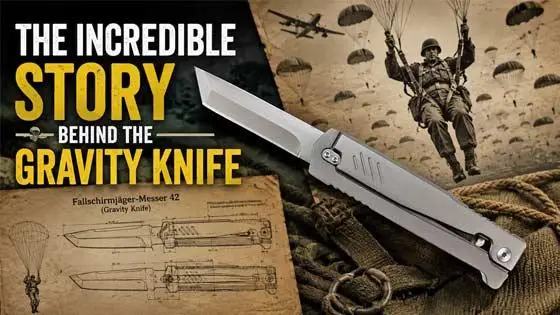
For decades, the gravity knife has been surrounded by mystery, controversy, and misunderstanding. It's often grouped together with switchblades and other fast-opening knives, giving many people the impression that it was invented as a weapon or made famous by criminals. The real story couldn't be more different. The gravity knife was born from a practical problem high above the battlefield during World War II, where German paratroopers needed a dependable tool that could be opened with one hand while suspended in a tangled parachute. From those unlikely beginnings, it would go on to become one of the world's most misunderstood knives.
In this article, we'll uncover the gravity knife's surprising military origins, explore how its reputation changed over the decades, and separate historical fact from the myths that still surround this fascinating piece of engineering today.
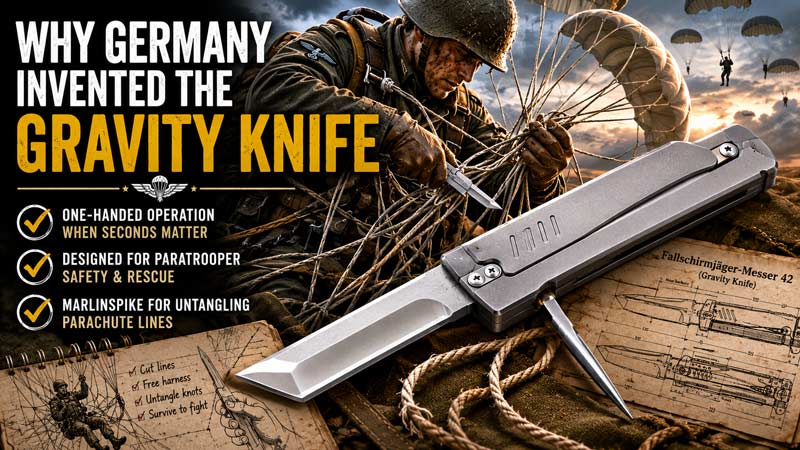
The gravity knife wasn't created for soldiers charging across the battlefield. It was invented to solve a dangerous problem faced by German paratroopers during World War II. After landing, parachute lines could become tangled around a soldier's harness or snag on trees, buildings, or other obstacles. In those situations, every second mattered. A knife that could be opened quickly with one hand could mean the difference between escaping safely and remaining trapped in a vulnerable position.
Traditional folding knives were often difficult to open while wearing gloves or when one hand was occupied holding parachute lines. Fixed blade knives solved that problem but were bulkier to carry and could become hazardous during airborne operations. German engineers instead developed a knife whose blade could slide straight out of the front of the handle using gravity after releasing a locking mechanism. The design was simple, dependable, and fast to operate, even under stressful conditions.
Another feature set the original Fallschirmjagermesser apart from almost every other military knife of its era: a folding marlinspike. While it looked unusual, the pointed tool wasn't intended for fighting. It allowed paratroopers to untie stubborn knots in wet parachute cord, separate tangled lines, and perform equipment repairs without damaging the rope. That practical detail perfectly reflected the knife's original purpose as a rescue and utility tool rather than a dedicated combat weapon.
Ironically, one of history's most misunderstood knives began life as a specialized piece of lifesaving equipment. Its military origins are rarely discussed today, overshadowed by decades of myths and confusion. Readers interested in other remarkable stories behind famous blades may also enjoy our article on the world's most famous knives and the stories behind them, where several other iconic designs have equally surprising beginnings.
One of the biggest misconceptions about the gravity knife is that it was created as a close-quarters combat weapon. In reality, the original Fallschirmjagermesser was designed primarily as a rescue and utility tool. Its one-handed operation wasn't intended to give soldiers an advantage in a fight. It allowed paratroopers to free themselves from tangled parachute lines while the other hand steadied their body or held onto nearby equipment.
That practical purpose influenced nearly every aspect of the knife's design. The blade slid out of the front of the handle using gravity rather than a spring, making the mechanism relatively simple and dependable. The integrated marlinspike was equally important, giving soldiers a way to loosen tight knots, separate cords, and repair gear without cutting valuable parachute lines. Everything about the knife reflected function over intimidation.
Ironically, many people today assume the gravity knife belongs in the same category as switchblades or other rapid-deployment weapons. While all of these knives can be opened quickly, they operate very differently. A true gravity knife relies on the force of gravity to deploy its blade, unlike an automatic knife that uses a spring-powered mechanism. If you're curious about how those systems compare, our guide explaining how automatic knives actually work breaks down the engineering behind modern automatic designs.
Understanding the gravity knife's original purpose changes the way its history is viewed. Rather than being invented to fight wars, it was created to help soldiers survive them. That distinction is one of the biggest reasons the knife remains so misunderstood today.
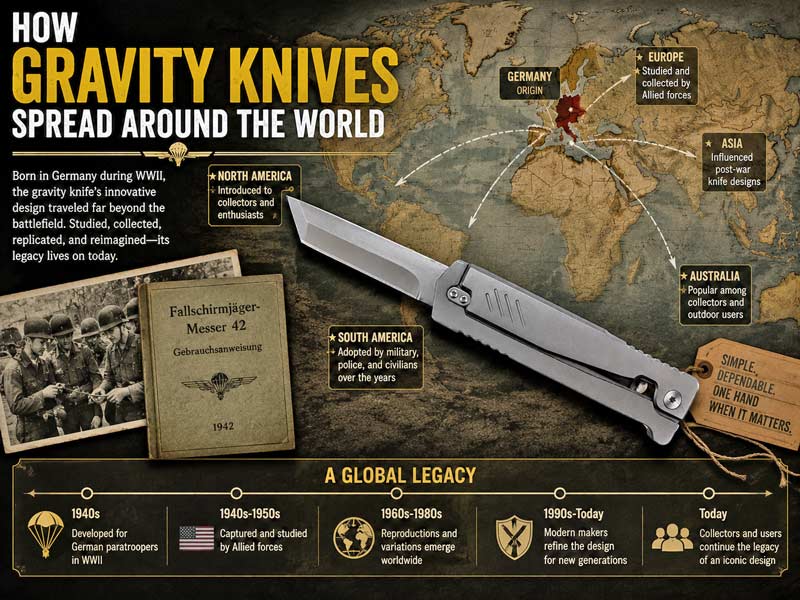
Although the gravity knife was developed for German paratroopers during World War II, its influence didn't end with the war. Allied forces carefully studied captured military equipment, and the gravity knife quickly earned a reputation as an ingenious solution to a very specific problem. While relatively few countries adopted the design as standard military equipment, it became well known among collectors, survival enthusiasts, and knife makers fascinated by its unusual deployment system.
As the decades passed, manufacturers experimented with their own interpretations of the concept. Some stayed remarkably close to the original Fallschirmjagermesser, while others introduced modern materials, revised locking mechanisms, and updated blade shapes. These newer designs helped introduce the gravity knife to people who had little knowledge of its military origins but appreciated its distinctive engineering and one-handed operation.
Along the way, the gravity knife also became tangled in a web of mistaken identities. Many people assumed any knife with a blade that emerged from the front of the handle must be a gravity knife, even when it actually used a spring-assisted or automatic mechanism. That confusion persists today, despite important mechanical differences between gravity knives and modern out-the-front designs. If you've ever wondered how those front-opening knives differ, our guide explaining what an OTF knife is explores the unique engineering behind true out-the-front automatic knives.
Today, authentic gravity knives remain a fascinating chapter in knife history, while modern interpretations continue to attract collectors who appreciate both their historical significance and their distinctive mechanics. Even a contemporary gravity knife still reflects the same core idea that inspired the original design more than eighty years ago: simple, dependable operation when one hand isn't enough.
For years, the gravity knife was viewed as a specialized military tool with a fairly limited audience. That began to change as more one-handed opening knives appeared on the civilian market during the second half of the twentieth century. To the average person, any knife that opened quickly looked similar, even though the mechanisms behind them were often completely different.
The confusion largely came from appearances rather than engineering. A true gravity knife depends on the weight of its blade to deploy after a locking mechanism is released. A switchblade, on the other hand, uses a spring to propel the blade open at the push of a button or lever. Modern out-the-front knives rely on yet another system, using an internal spring and track to extend and retract the blade. While these knives may seem alike at first glance, their internal mechanics are fundamentally different.
As public awareness faded, those distinctions became increasingly blurred. News reports, television programs, and even legal discussions frequently used the terms interchangeably, reinforcing the misconception that all rapidly opening knives belonged to the same category. Before long, many people had never even heard of the gravity knife's military origins, assuming it was simply another version of a switchblade.
That misunderstanding still exists today. Although gravity knives, automatic knives, and other specialized designs each have their own history and engineering, they continue to be grouped together by people unfamiliar with the differences. If you're interested in how one of those misconceptions developed, our article on how switchblades became the most feared knives in America explores how media attention shaped public opinion for an entirely different type of knife.
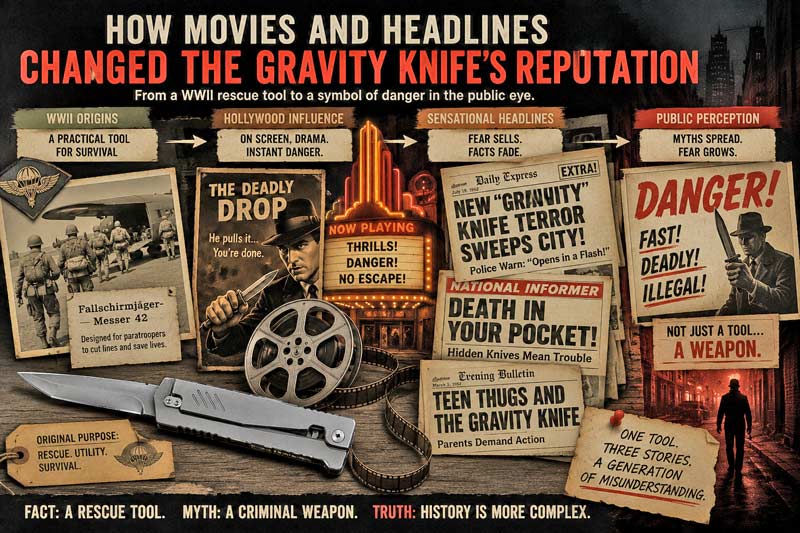
For much of its early history, the gravity knife remained a relatively obscure military tool. That changed as movies, television, and sensational news stories began portraying fast-opening knives as symbols of crime and danger. To audiences unfamiliar with knife mechanics, the distinction between a gravity knife, a switchblade, and an automatic knife simply didn't matter. They all became part of the same cultural image.
Hollywood helped reinforce that perception. Villains were frequently shown producing knives with dramatic one-handed openings, while newspapers often used broad terms that lumped multiple knife designs together. Over time, the gravity knife inherited a reputation that had little to do with its original purpose. A rescue tool designed for airborne troops was gradually transformed into something many people associated with criminal activity.
This shift in public perception demonstrates how easily a tool's history can be overshadowed by popular culture. The gravity knife itself had changed very little since World War II, but the story surrounding it had changed dramatically. As generations passed, the myths became far more widely known than the facts.
Today, historians and knife enthusiasts often find themselves correcting misconceptions that have circulated for decades. Understanding the gravity knife means looking beyond its reputation and examining why it was created in the first place. Once that original story is understood, it's much easier to see how one of history's most practical military tools became one of its most misunderstood knives.
Despite decades of research and countless articles explaining its history, the gravity knife continues to be one of the most misunderstood knife designs ever created. Much of that confusion comes from the fact that relatively few people have handled an authentic gravity knife, while movies and television have exposed millions of viewers to fictional portrayals of fast-opening blades. As a result, myths have often spread faster than facts.
Adding to the confusion is the wide variety of modern knife designs now available. Gravity knives, automatic knives, out-the-front knives, and even some manual-opening designs are frequently grouped together simply because they can all be opened quickly. In reality, each uses a different operating mechanism and was developed to solve different problems. Understanding those differences is one of the easiest ways to appreciate the unique place the gravity knife occupies in knife history. Readers interested in comparing other unconventional designs may also enjoy our article explaining what a balisong is, another knife that has inspired its share of myths over the years.
Modern manufacturers have also helped preserve the gravity knife's legacy by producing updated versions using improved steels, tighter machining, and more refined construction techniques. While these knives retain the distinctive front-deploying design that made the original famous, they benefit from advances in manufacturing that simply weren't available during World War II. The materials may have changed, but the underlying concept remains remarkably faithful to the original.
Perhaps that's the gravity knife's greatest legacy. It reminds us that history is often more complicated than popular culture suggests. What began as a practical rescue tool for paratroopers eventually became the subject of myths, confusion, and debate. Yet beneath all of those stories lies an ingenious piece of engineering whose real history is every bit as fascinating as the legends that grew around it.
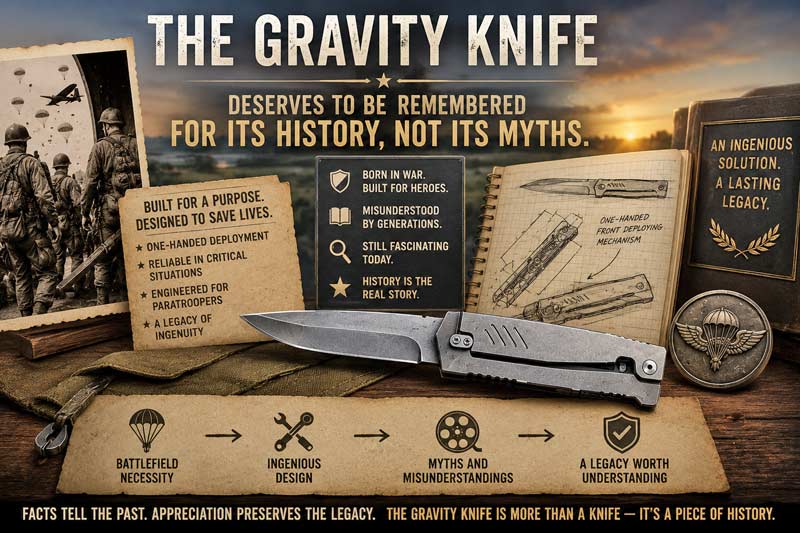
Few knives have traveled a stranger path through history than the gravity knife. Designed as a practical solution for German paratroopers, it gradually evolved from a specialized rescue tool into one of the most misunderstood knives ever created. Along the way, its true purpose became overshadowed by Hollywood portrayals, sensational headlines, and decades of mistaken identity.
Yet the gravity knife's real legacy has nothing to do with fear or controversy. It represents a clever engineering solution to a genuine battlefield problem, demonstrating how necessity often drives innovation. Its simple, one-handed deployment system and practical design continue to fascinate historians, collectors, and knife enthusiasts more than eighty years after it first appeared.
Whether you're interested in military history or simply appreciate unusual knife designs, the gravity knife offers a reminder that the stories behind famous blades are often far more interesting than the myths surrounding them. If you'd like to explore more unique designs, browse our collection of knives, where history and modern craftsmanship continue to meet in fascinating ways.
No. Although they're often confused with one another, gravity knives and switchblades use completely different opening mechanisms. A true gravity knife relies on gravity to extend the blade after a locking mechanism is released, while a switchblade uses a spring that automatically propels the blade open with the press of a button or lever. Their similar speed of deployment has caused decades of misunderstanding, but mechanically they are very different designs.
The confusion became even greater as modern out-the-front knives entered the market. Because all three designs can deploy a blade from the front or open quickly with one hand, many people assume they're variations of the same knife. In reality, each was developed for different purposes and uses a distinct operating system. Understanding those differences is one of the keys to appreciating the gravity knife's unique place in knife history.
Yes, the basic concept remains remarkably similar. Modern gravity knives still deploy the blade by releasing a locking mechanism and allowing gravity to extend it from the front of the handle before locking it into place. While today's versions often feature improved machining, tighter tolerances, and higher-quality materials, the underlying operating principle has changed very little since the original Fallschirmjagermesser was developed for German paratroopers during World War II.
The biggest differences are found in manufacturing rather than function. Modern steels offer better edge retention and corrosion resistance, while precision machining creates smoother operation and more consistent lockup. Even so, the gravity knife remains one of the few knife designs whose original engineering was so effective that it has required surprisingly few changes over the decades, a testament to the ingenuity of its original designers.
The gravity knife became controversial largely because it was repeatedly confused with other fast-opening knives. As public concern over switchblades and similar designs grew during the mid-twentieth century, gravity knives were often grouped into the same conversations despite having a different history and operating mechanism. Over time, the distinctions between these knives became blurred in popular culture, leading many people to believe they were essentially the same thing.
Ironically, the original gravity knife was never designed as a weapon of intimidation or crime. It was created as a practical rescue tool for military paratroopers who needed a dependable one-handed knife in emergency situations. That contrast between its intended purpose and its later public reputation is one of the reasons the gravity knife remains such a fascinating piece of knife history. Understanding where it came from helps separate decades of myth from the remarkably practical engineering that inspired its creation.
Why Germany Invented the Gravity Knife
The gravity knife wasn't created for soldiers charging across the battlefield. It was invented to solve a dangerous problem faced by German paratroopers during World War II. After landing, parachute lines could become tangled around a soldier's harness or snag on trees, buildings, or other obstacles. In those situations, every second mattered. A knife that could be opened quickly with one hand could mean the difference between escaping safely and remaining trapped in a vulnerable position.
Traditional folding knives were often difficult to open while wearing gloves or when one hand was occupied holding parachute lines. Fixed blade knives solved that problem but were bulkier to carry and could become hazardous during airborne operations. German engineers instead developed a knife whose blade could slide straight out of the front of the handle using gravity after releasing a locking mechanism. The design was simple, dependable, and fast to operate, even under stressful conditions.
Another feature set the original Fallschirmjagermesser apart from almost every other military knife of its era: a folding marlinspike. While it looked unusual, the pointed tool wasn't intended for fighting. It allowed paratroopers to untie stubborn knots in wet parachute cord, separate tangled lines, and perform equipment repairs without damaging the rope. That practical detail perfectly reflected the knife's original purpose as a rescue and utility tool rather than a dedicated combat weapon.
Ironically, one of history's most misunderstood knives began life as a specialized piece of lifesaving equipment. Its military origins are rarely discussed today, overshadowed by decades of myths and confusion. Readers interested in other remarkable stories behind famous blades may also enjoy our article on the world's most famous knives and the stories behind them, where several other iconic designs have equally surprising beginnings.
It Was Never Designed as a Fighting Knife
One of the biggest misconceptions about the gravity knife is that it was created as a close-quarters combat weapon. In reality, the original Fallschirmjagermesser was designed primarily as a rescue and utility tool. Its one-handed operation wasn't intended to give soldiers an advantage in a fight. It allowed paratroopers to free themselves from tangled parachute lines while the other hand steadied their body or held onto nearby equipment.
That practical purpose influenced nearly every aspect of the knife's design. The blade slid out of the front of the handle using gravity rather than a spring, making the mechanism relatively simple and dependable. The integrated marlinspike was equally important, giving soldiers a way to loosen tight knots, separate cords, and repair gear without cutting valuable parachute lines. Everything about the knife reflected function over intimidation.
Ironically, many people today assume the gravity knife belongs in the same category as switchblades or other rapid-deployment weapons. While all of these knives can be opened quickly, they operate very differently. A true gravity knife relies on the force of gravity to deploy its blade, unlike an automatic knife that uses a spring-powered mechanism. If you're curious about how those systems compare, our guide explaining how automatic knives actually work breaks down the engineering behind modern automatic designs.
Understanding the gravity knife's original purpose changes the way its history is viewed. Rather than being invented to fight wars, it was created to help soldiers survive them. That distinction is one of the biggest reasons the knife remains so misunderstood today.
How Gravity Knives Spread Around the World
Although the gravity knife was developed for German paratroopers during World War II, its influence didn't end with the war. Allied forces carefully studied captured military equipment, and the gravity knife quickly earned a reputation as an ingenious solution to a very specific problem. While relatively few countries adopted the design as standard military equipment, it became well known among collectors, survival enthusiasts, and knife makers fascinated by its unusual deployment system.
As the decades passed, manufacturers experimented with their own interpretations of the concept. Some stayed remarkably close to the original Fallschirmjagermesser, while others introduced modern materials, revised locking mechanisms, and updated blade shapes. These newer designs helped introduce the gravity knife to people who had little knowledge of its military origins but appreciated its distinctive engineering and one-handed operation.
Along the way, the gravity knife also became tangled in a web of mistaken identities. Many people assumed any knife with a blade that emerged from the front of the handle must be a gravity knife, even when it actually used a spring-assisted or automatic mechanism. That confusion persists today, despite important mechanical differences between gravity knives and modern out-the-front designs. If you've ever wondered how those front-opening knives differ, our guide explaining what an OTF knife is explores the unique engineering behind true out-the-front automatic knives.
Today, authentic gravity knives remain a fascinating chapter in knife history, while modern interpretations continue to attract collectors who appreciate both their historical significance and their distinctive mechanics. Even a contemporary gravity knife still reflects the same core idea that inspired the original design more than eighty years ago: simple, dependable operation when one hand isn't enough.
How Gravity Knives Became Confused with Switchblades
For years, the gravity knife was viewed as a specialized military tool with a fairly limited audience. That began to change as more one-handed opening knives appeared on the civilian market during the second half of the twentieth century. To the average person, any knife that opened quickly looked similar, even though the mechanisms behind them were often completely different.
The confusion largely came from appearances rather than engineering. A true gravity knife depends on the weight of its blade to deploy after a locking mechanism is released. A switchblade, on the other hand, uses a spring to propel the blade open at the push of a button or lever. Modern out-the-front knives rely on yet another system, using an internal spring and track to extend and retract the blade. While these knives may seem alike at first glance, their internal mechanics are fundamentally different.
As public awareness faded, those distinctions became increasingly blurred. News reports, television programs, and even legal discussions frequently used the terms interchangeably, reinforcing the misconception that all rapidly opening knives belonged to the same category. Before long, many people had never even heard of the gravity knife's military origins, assuming it was simply another version of a switchblade.
That misunderstanding still exists today. Although gravity knives, automatic knives, and other specialized designs each have their own history and engineering, they continue to be grouped together by people unfamiliar with the differences. If you're interested in how one of those misconceptions developed, our article on how switchblades became the most feared knives in America explores how media attention shaped public opinion for an entirely different type of knife.
How Movies and Headlines Changed the Gravity Knife's Reputation
For much of its early history, the gravity knife remained a relatively obscure military tool. That changed as movies, television, and sensational news stories began portraying fast-opening knives as symbols of crime and danger. To audiences unfamiliar with knife mechanics, the distinction between a gravity knife, a switchblade, and an automatic knife simply didn't matter. They all became part of the same cultural image.
Hollywood helped reinforce that perception. Villains were frequently shown producing knives with dramatic one-handed openings, while newspapers often used broad terms that lumped multiple knife designs together. Over time, the gravity knife inherited a reputation that had little to do with its original purpose. A rescue tool designed for airborne troops was gradually transformed into something many people associated with criminal activity.
This shift in public perception demonstrates how easily a tool's history can be overshadowed by popular culture. The gravity knife itself had changed very little since World War II, but the story surrounding it had changed dramatically. As generations passed, the myths became far more widely known than the facts.
Today, historians and knife enthusiasts often find themselves correcting misconceptions that have circulated for decades. Understanding the gravity knife means looking beyond its reputation and examining why it was created in the first place. Once that original story is understood, it's much easier to see how one of history's most practical military tools became one of its most misunderstood knives.
Why the Gravity Knife Is Still Misunderstood Today
Despite decades of research and countless articles explaining its history, the gravity knife continues to be one of the most misunderstood knife designs ever created. Much of that confusion comes from the fact that relatively few people have handled an authentic gravity knife, while movies and television have exposed millions of viewers to fictional portrayals of fast-opening blades. As a result, myths have often spread faster than facts.
Adding to the confusion is the wide variety of modern knife designs now available. Gravity knives, automatic knives, out-the-front knives, and even some manual-opening designs are frequently grouped together simply because they can all be opened quickly. In reality, each uses a different operating mechanism and was developed to solve different problems. Understanding those differences is one of the easiest ways to appreciate the unique place the gravity knife occupies in knife history. Readers interested in comparing other unconventional designs may also enjoy our article explaining what a balisong is, another knife that has inspired its share of myths over the years.
Modern manufacturers have also helped preserve the gravity knife's legacy by producing updated versions using improved steels, tighter machining, and more refined construction techniques. While these knives retain the distinctive front-deploying design that made the original famous, they benefit from advances in manufacturing that simply weren't available during World War II. The materials may have changed, but the underlying concept remains remarkably faithful to the original.
Perhaps that's the gravity knife's greatest legacy. It reminds us that history is often more complicated than popular culture suggests. What began as a practical rescue tool for paratroopers eventually became the subject of myths, confusion, and debate. Yet beneath all of those stories lies an ingenious piece of engineering whose real history is every bit as fascinating as the legends that grew around it.
The Gravity Knife Deserves to Be Remembered for Its History, Not Its Myths
Few knives have traveled a stranger path through history than the gravity knife. Designed as a practical solution for German paratroopers, it gradually evolved from a specialized rescue tool into one of the most misunderstood knives ever created. Along the way, its true purpose became overshadowed by Hollywood portrayals, sensational headlines, and decades of mistaken identity.
Yet the gravity knife's real legacy has nothing to do with fear or controversy. It represents a clever engineering solution to a genuine battlefield problem, demonstrating how necessity often drives innovation. Its simple, one-handed deployment system and practical design continue to fascinate historians, collectors, and knife enthusiasts more than eighty years after it first appeared.
Whether you're interested in military history or simply appreciate unusual knife designs, the gravity knife offers a reminder that the stories behind famous blades are often far more interesting than the myths surrounding them. If you'd like to explore more unique designs, browse our collection of knives, where history and modern craftsmanship continue to meet in fascinating ways.
Are Gravity Knives and Switchblades the Same Thing?
No. Although they're often confused with one another, gravity knives and switchblades use completely different opening mechanisms. A true gravity knife relies on gravity to extend the blade after a locking mechanism is released, while a switchblade uses a spring that automatically propels the blade open with the press of a button or lever. Their similar speed of deployment has caused decades of misunderstanding, but mechanically they are very different designs.
The confusion became even greater as modern out-the-front knives entered the market. Because all three designs can deploy a blade from the front or open quickly with one hand, many people assume they're variations of the same knife. In reality, each was developed for different purposes and uses a distinct operating system. Understanding those differences is one of the keys to appreciating the gravity knife's unique place in knife history.
Do Modern Gravity Knives Still Work Like the Original WWII Versions?
Yes, the basic concept remains remarkably similar. Modern gravity knives still deploy the blade by releasing a locking mechanism and allowing gravity to extend it from the front of the handle before locking it into place. While today's versions often feature improved machining, tighter tolerances, and higher-quality materials, the underlying operating principle has changed very little since the original Fallschirmjagermesser was developed for German paratroopers during World War II.
The biggest differences are found in manufacturing rather than function. Modern steels offer better edge retention and corrosion resistance, while precision machining creates smoother operation and more consistent lockup. Even so, the gravity knife remains one of the few knife designs whose original engineering was so effective that it has required surprisingly few changes over the decades, a testament to the ingenuity of its original designers.
Why Did the Gravity Knife Become So Controversial?
The gravity knife became controversial largely because it was repeatedly confused with other fast-opening knives. As public concern over switchblades and similar designs grew during the mid-twentieth century, gravity knives were often grouped into the same conversations despite having a different history and operating mechanism. Over time, the distinctions between these knives became blurred in popular culture, leading many people to believe they were essentially the same thing.
Ironically, the original gravity knife was never designed as a weapon of intimidation or crime. It was created as a practical rescue tool for military paratroopers who needed a dependable one-handed knife in emergency situations. That contrast between its intended purpose and its later public reputation is one of the reasons the gravity knife remains such a fascinating piece of knife history. Understanding where it came from helps separate decades of myth from the remarkably practical engineering that inspired its creation.
You May Also Be Interested In:
- Why Every Day Should Be an EDC Knife Day: How a Simple Knife Can Make Your Life Easier and Safer
- Best EDC Knife: How to Choose the Right Everyday Carry Knife
- Bowie Knife vs Hunting Knife: What's the Difference?
- What Is a Kukri Knife and What Is It Used For?
- What Is a Stiletto Knife and Why Is It So Popular?
- What Is the Ring on a Karambit Knife For?
- Why Is the Karambit Knife Curved?
- The History and Evolution of the Karambit Knife
- Switchblade vs Automatic Knife: What's the Difference?
- Different Types of Knife Steels Explained
Leave a Reply