





Why Was the Khopesh Shaped Like That?
August 14th, 2026
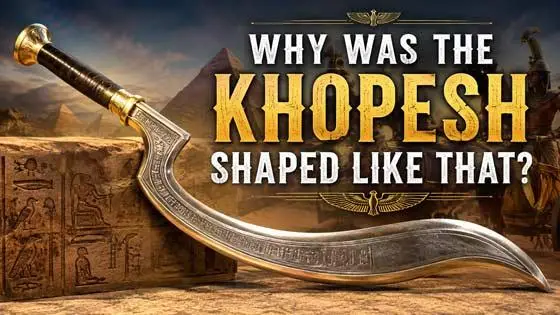
Few ancient weapons are as instantly recognizable as the khopesh. With a blade that sweeps forward into a dramatic crescent, it looks almost as if an ordinary sword were deliberately bent into the shape of a sickle. But the khopesh was not created simply to look intimidating. Its unusual profile developed from much older weapons, and the same curve that makes it so distinctive may have offered practical advantages in combat. To understand why Egyptian warriors carried swords shaped unlike almost anything used today, we have to go back to a time when the line between a battle axe and a sword was not nearly as clear as it seems.
The Khopesh Did Not Begin as a Sword
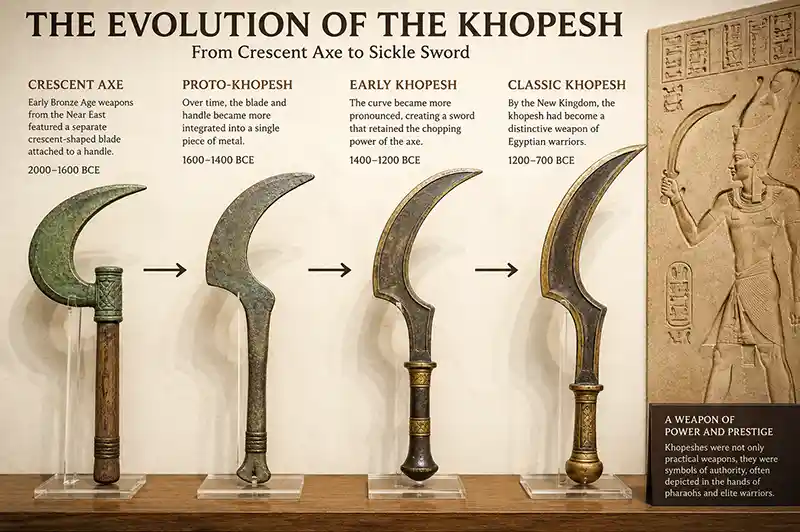
The strange curve of the khopesh makes much more sense once you realize that its ancestors were not really swords at all. The weapon appears to have developed from crescent-shaped axes used in the ancient Near East, where a curved cutting edge was mounted to a separate handle. Over time, metalworkers began creating weapons in which the handle and curved striking portion formed a more continuous piece of metal. The result gradually moved away from the axe and toward the distinctive sickle-shaped sword we now recognize as the khopesh.
Egyptians were not the original inventors of this basic weapon form. Related curved weapons existed elsewhere in the Near East before the khopesh became strongly associated with Egypt. Egyptian forces likely encountered versions of them through warfare and contact with neighboring peoples, eventually adopting and developing the weapon for their own use. By Egypt's New Kingdom period, the khopesh had become prominent enough to appear repeatedly in royal and military imagery.
That ancestry also explains one of the strangest things about the khopesh. Instead of placing the main cutting edge along a relatively straight blade like most later swords, the weapon concentrated much of its working edge along the outside of its forward curve. In that sense, the khopesh retained some of the chopping character of the axe even after it had evolved into something much closer to a sword.
Modern reproductions make this unusual geometry particularly easy to see. A modern Egyptian khopesh sword still has the unmistakable forward-sweeping profile that reveals just how different its ancestry was from that of the straight swords that would eventually dominate much of the ancient world.
The Curve Put More Metal Behind the Strike
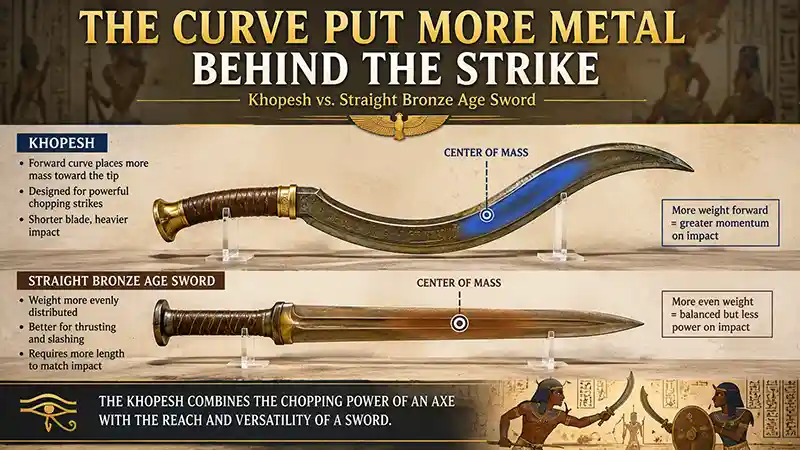
The khopesh's forward-curving blade was not just a leftover from its axe-like ancestors. It also changed how the weapon behaved when swung. Much of the blade's mass sat farther forward than it would on a conventional straight sword, giving the weapon a weight distribution suited to powerful chopping strikes. Instead of behaving purely like a long cutting blade, the khopesh retained some of the forceful striking characteristics of the axes that came before it.
That did not necessarily mean every khopesh was an exceptionally heavy weapon. Surviving examples vary considerably in size, construction, and apparent purpose. The important difference was where the metal was positioned. The widened outer portion of the curve could place useful mass near the working end of the weapon, allowing a relatively short blade to deliver a committed blow without requiring the proportions of a much larger sword.
The curve may also have helped the cutting edge maintain contact as the weapon traveled through a strike. Rather than presenting one long straight edge, the khopesh brought a sweeping convex edge into the target. Exactly how individual examples were sharpened remains an important complication, since some surviving khopeshes appear unsharpened and may have served ceremonial purposes. Still, the geometry of functional examples reveals a weapon that remained closely related to the chopping tradition from which it developed.
That combination of sword and axe characteristics is one reason the khopesh belongs among history's most recognizable exotic weapons. Its strange silhouette was not simply decorative. The shape itself tells the story of how one type of ancient weapon gradually transformed into another.
The Hook Could Do More Than Cut
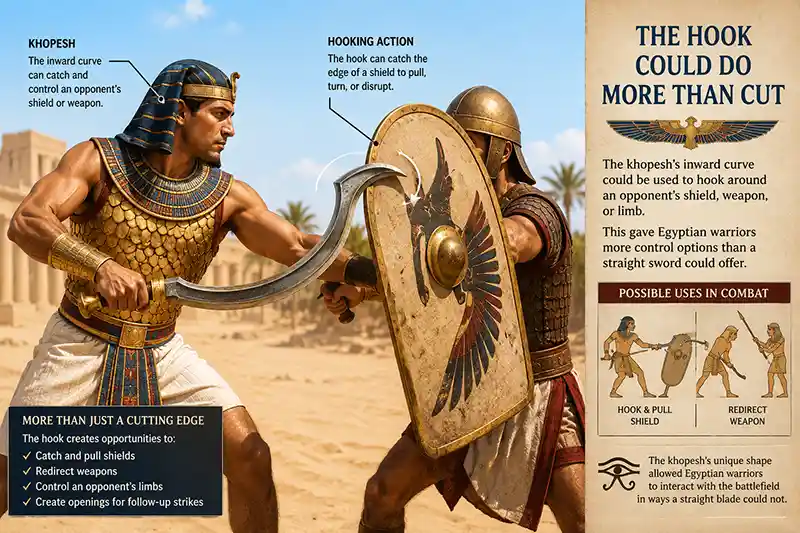
The outside edge of the khopesh gets most of the attention, but the weapon's concave inner curve may have given its wielder another useful option. The hooked profile could potentially catch around an opponent's shield, weapon, or limb in ways that a straight blade could not. Instead of every movement ending with a cut, the khopesh could also be used to pull, redirect, or interfere with whatever stood in front of it.
This is where it is important not to turn possibility into certainty. Ancient Egyptian artwork clearly shows khopeshes being carried and wielded, but it does not provide a detailed combat manual explaining every technique. Modern claims that the khopesh was specifically designed to hook shields away from opponents are therefore difficult to prove. The geometry certainly makes hooking and controlling actions possible, but exactly how commonly Egyptian soldiers used them is another question.
Even so, the shape created opportunities unavailable to most straight swords. A curved section placed behind an object could apply force from a different direction, potentially disturbing a shield or controlling another weapon long enough to create an opening. In close combat, even a momentary disruption could matter.
This helps explain why reducing the khopesh to an unusually shaped chopping sword misses part of what made the design interesting. Its curve changed not only how the weapon struck, but also how it could interact with everything it encountered.
The Khopesh Was Built for a Different Kind of Battlefield
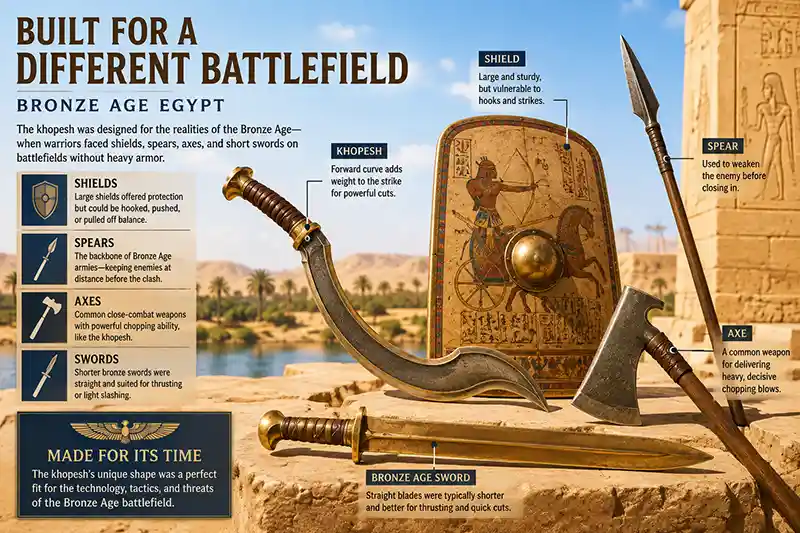
Judging the khopesh against later iron and steel swords can make its design seem unnecessarily strange. But the weapon belonged to the Bronze Age, when soldiers faced a very different collection of shields, armor, spears, axes, and relatively short swords. Heavy plate armor was still thousands of years away, and bronze imposed its own limitations on how long and thin a practical blade could be made.
The khopesh turned some of those limitations into strengths. Its relatively compact dimensions made it manageable at close range, while the forward-curving section provided a substantial striking surface without requiring an extremely long blade. A warrior could carry a weapon capable of powerful cuts while still fighting alongside troops equipped with shields and long spears.
This also helps explain why the khopesh should not be viewed simply as an inferior ancestor of later swords. Its unusual geometry made sense within the military technology of its own era. As metallurgy, armor, and battlefield tactics changed, other sword designs eventually became more advantageous, but that does not mean the khopesh had been poorly designed. It had been designed for a battlefield that was disappearing.
The Khopesh Was Probably Not Sharp Everywhere
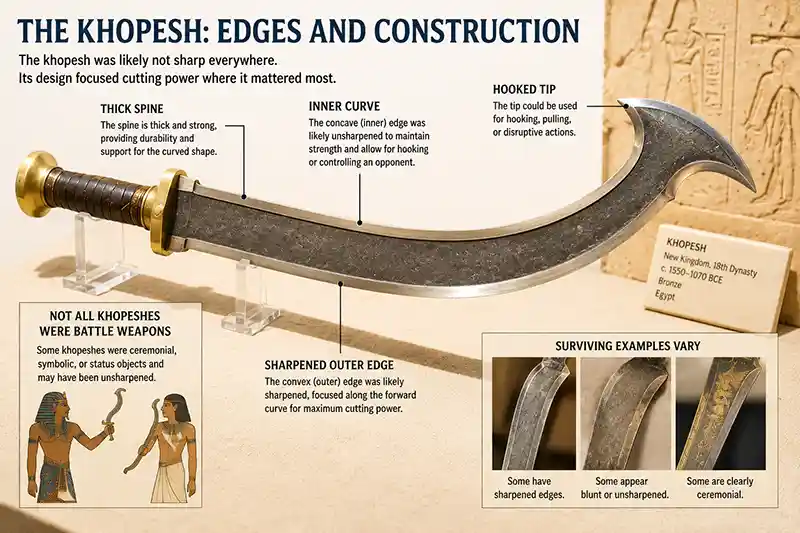
One of the easiest mistakes to make when looking at a khopesh is assuming that every exposed edge was sharpened like a modern knife. Surviving examples suggest a more complicated picture. Some khopeshes appear to have had a sharpened outer cutting edge concentrated around the curved forward portion of the blade, while other sections could remain comparatively thick or blunt.
That arrangement makes sense when you consider the weapon's shape. The convex outer curve is the portion most naturally presented during a chopping strike, so sharpening that area provided a useful cutting surface without requiring the entire weapon to function like a conventional sword blade. The concave inner portion, meanwhile, could retain enough thickness to help support the distinctive hooked geometry.
There is another complication: not every surviving khopesh necessarily represents a battlefield weapon. Some examples appear to have been ceremonial, symbolic, or otherwise unsuitable for serious fighting. Ancient Egyptian rulers were frequently depicted holding khopeshes as symbols of military power, and weapons could also be produced as prestige objects or placed in elite burials. An unsharpened archaeological specimen therefore does not automatically prove that combat khopeshes were blunt.
This distinction matters because the khopesh existed as more than one thing. It could be a functional weapon, but its unmistakable silhouette also became a visual symbol of authority and victory. Few ancient weapons managed to turn their unusual shape into such a recognizable statement of power.
The Khopesh Became a Symbol of Royal Power
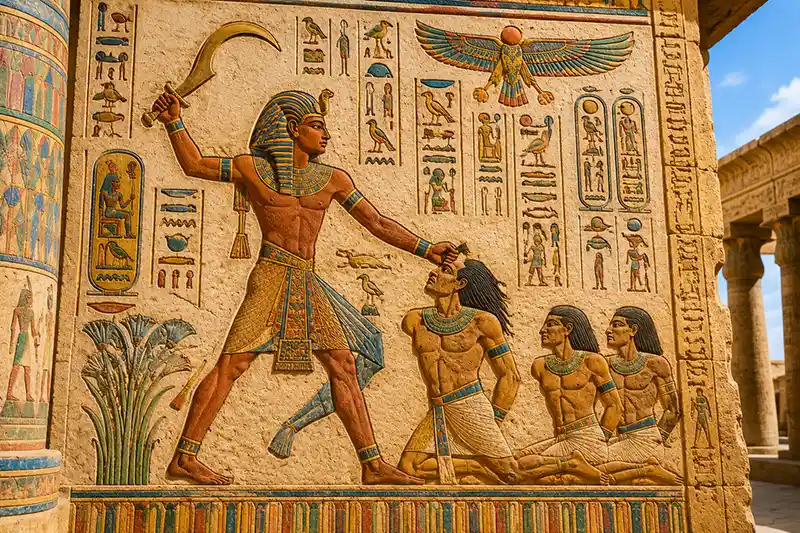
Eventually, the khopesh became important for reasons that went beyond what it could accomplish in a fight. Egyptian art repeatedly places the weapon in the hands of pharaohs, where its unmistakable curved silhouette became associated with military strength, conquest, and royal authority. A weapon that had evolved for practical reasons had also become a powerful political symbol.
This is particularly visible in Egyptian reliefs depicting the pharaoh defeating foreign enemies. In these carefully constructed scenes, the ruler is often shown dramatically larger than everyone around him, sometimes raising a weapon over defeated captives. Such images were not intended as literal snapshots of individual battles. They communicated a broader message: the pharaoh was the victorious protector of Egypt, capable of crushing disorder and defeating the kingdom's enemies.
The khopesh fit that message exceptionally well. Unlike a generic spear or straight blade, its unusual outline could be recognized immediately. Ceremonial examples and khopeshes associated with elite burials further demonstrate how the weapon's meaning extended beyond ordinary battlefield equipment. Two khopeshes, for example, were found among the objects in the tomb of Tutankhamun.
By this point, the strange curve had acquired a second purpose that its earliest makers probably never anticipated. It did not merely make the khopesh function differently from other weapons. It made the weapon unmistakable, helping transform a Bronze Age fighting tool into one of ancient Egypt's enduring symbols of power.
Why the Khopesh Eventually Disappeared
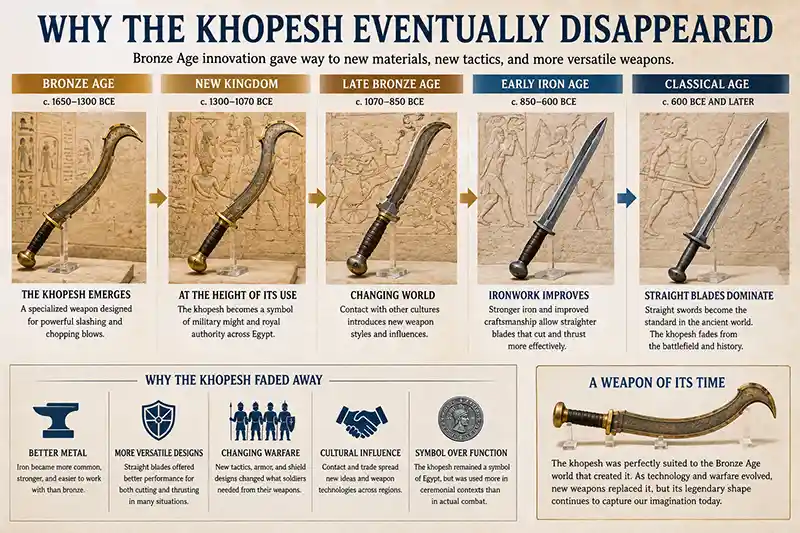
For a weapon with such an iconic shape, the khopesh had a surprisingly limited lifespan. It flourished during the Bronze Age and remained prominent in Egypt through much of the New Kingdom, but by the first millennium BCE it was fading from practical use. The reason was not that warriors suddenly discovered the curve did not work. The military world around the khopesh was changing.
Ironworking became increasingly important across the eastern Mediterranean and Near East, while sword designs continued to evolve. Straighter blades could provide efficient cutting and thrusting performance in a simpler form, and improvements in metallurgy made longer and more versatile weapons increasingly practical. The specialized combination of axe-like chopping power and hooked geometry that had helped define the khopesh was no longer as compelling as it had been centuries earlier.
Changing armies mattered too. Weapons do not evolve in isolation. Shields, armor, formations, manufacturing methods, and the weapons carried by neighboring cultures all influence what soldiers need. As those conditions changed, the khopesh gradually gave way to other designs rather than undergoing an obvious transformation into a later Egyptian sword.
That disappearance makes the khopesh especially interesting today. Unlike weapon families that evolved through countless recognizable descendants, the khopesh remains strongly associated with one particular era of warfare. Modern interpretations such as the Modern Combat Khopesh preserve its extraordinary silhouette, but the original weapon belongs unmistakably to the Bronze Age world that created it.
The Khopesh Was Not Really an Egyptian Invention
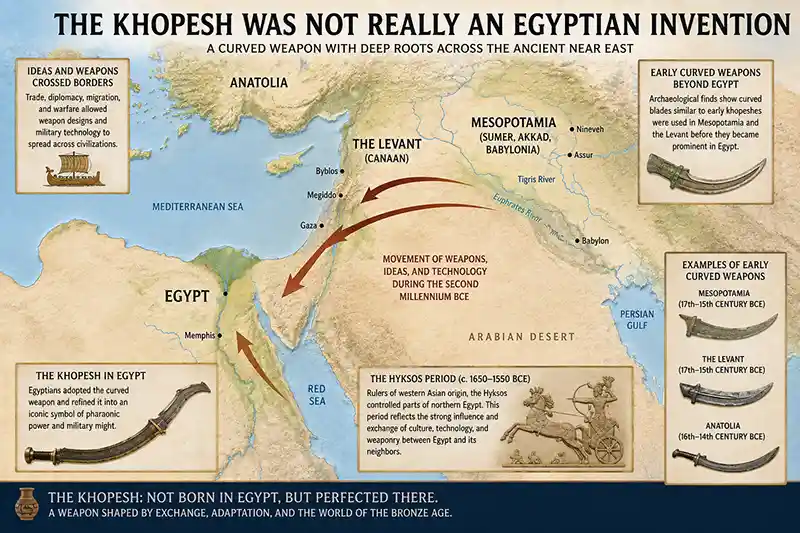
The khopesh is so closely associated with ancient Egypt that it is easy to assume Egyptian weapon makers invented it. Archaeological evidence, however, points farther east. Curved weapons resembling early khopeshes were already being used in Mesopotamia and the Levant before the form became prominent in Egypt.
Egypt's adoption of the weapon appears to have been part of a much larger exchange of military technology between neighboring civilizations. During the second millennium BCE, Egypt had extensive contact with peoples of the eastern Mediterranean and Near East through trade, diplomacy, migration, and warfare. Weapons, chariots, armor, and tactical ideas could move between cultures along with everything else.
The Hyksos period is frequently mentioned when discussing this exchange because rulers of western Asian origin controlled parts of northern Egypt during the Second Intermediate Period. It is tempting to credit the Hyksos with simply introducing the khopesh to Egypt, but the historical picture is more complicated than a single moment of invention or adoption. What is clear is that the curved weapon tradition existed outside Egypt and that Egyptians eventually made the khopesh distinctly their own.
That distinction makes the weapon's history even more interesting. The khopesh became one of the most recognizable symbols of Egyptian warfare despite having deeper roots beyond Egypt's borders. It is a reminder that some of history's most iconic weapons were not isolated inventions, but products of cultures exchanging ideas across ancient battlefields.
Not Every Khopesh Had the Same Shape
The familiar silhouette of the khopesh can make it seem as though ancient smiths were working from a standardized design. Surviving examples tell a different story. Khopeshes vary in overall length, width, curvature, handle construction, and the proportions of the forward section. Some have relatively gentle curves, while others sweep much more dramatically toward the tip.
Those differences are important because the khopesh existed across centuries and was produced in different regions and workshops. Ancient weapons were handmade objects, not identical products emerging from a modern factory. Smiths could alter proportions according to available materials, local traditions, intended use, and the preferences of whoever commissioned the weapon.
Some examples also blur the boundary between sword and axe more noticeably than others. A broad forward section can make one khopesh look almost like an axe head stretched into a blade, while a slimmer example may appear much closer to a conventional curved sword. This variation helps explain why modern attempts to define one exact "correct" khopesh profile can be misleading.
Modern interpretations often exaggerate those proportions even further. The Egyptian Khopesh Sword would be one example of how the ancient silhouette can inspire contemporary designs, but the archaeological record itself shows that there was never just one khopesh shape.
The Khopesh Was More Than a Weapon for Ordinary Soldiers
Although the khopesh is frequently imagined hanging from the belt of every Egyptian warrior, surviving evidence suggests we should be cautious about treating it as a universal infantry weapon. Bronze was valuable, producing a substantial blade required skilled labor, and Egyptian armies relied heavily on less expensive weapons such as spears, bows, axes, and other equipment that could be issued on a much larger scale.
The khopesh appears especially often in elite and royal contexts. Pharaohs are depicted carrying it, decorated examples were created as prestige objects, and khopeshes accompanied high-status individuals into their tombs. That does not mean functional versions were absent from the battlefield, but it does suggest that ownership could communicate status as well as provide a practical weapon.
Its appearance probably helped. The khopesh was visually unmistakable in a way that an ordinary spear or simple axe was not. A beautifully finished bronze weapon with that sweeping crescent profile could immediately communicate military authority, particularly when carried by a ruler whose public image depended on being seen as Egypt's victorious warrior.
The khopesh therefore occupied an unusual position in Egyptian culture. It could be a real fighting weapon while simultaneously functioning as a symbol of rank, conquest, and royal power. That dual identity is one reason the weapon survived so vividly in Egyptian art long after the battles in which practical khopeshes were actually carried had been forgotten.
The Curve Was Not Designed to Slice Like a Scimitar
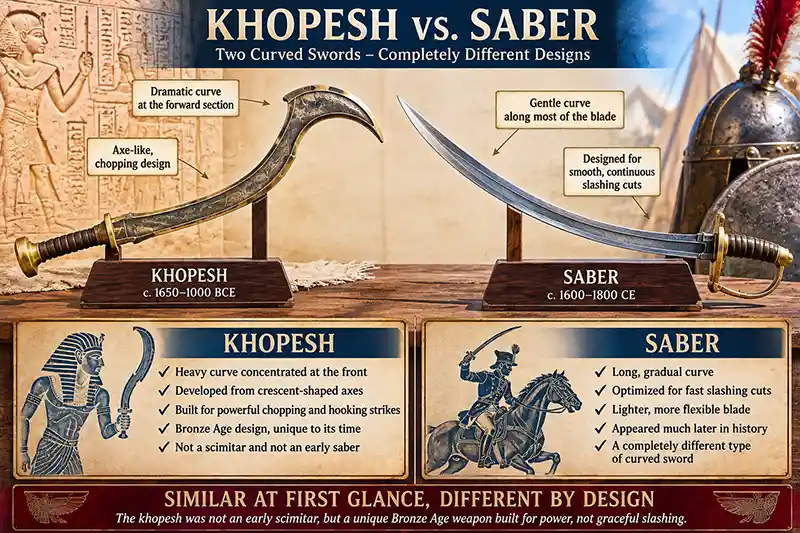
Modern viewers sometimes group the khopesh together with later curved swords such as sabers and scimitars simply because none of them has a straight blade. Mechanically, however, they are very different ideas. A saber typically curves gradually along much of its length, creating a long cutting edge that can move smoothly across a target during a slashing strike. The khopesh concentrates its much more dramatic change in shape toward the forward portion of the weapon.
That difference reflects the khopesh's unusual ancestry. Rather than beginning as a straight sword that gradually became curved, it developed from weapons related to crescent-shaped axes. Its profile retained the forward weight and pronounced working section of that older design even as it evolved into something that could reasonably be described as a sword.
This is also why calling the khopesh an "ancient Egyptian scimitar" can create the wrong impression. The two weapons emerged in completely different periods and technological traditions. Their curves may look superficially related, but they arrived at those shapes for different reasons.
The khopesh is better understood on its own terms: not as an early version of the curved swords that appeared much later, but as one of the Bronze Age's most unusual solutions to the problem of combining reach, cutting ability, and the forceful strike of an axe in a single weapon.
Why Bronze Was Well Suited to the Khopesh
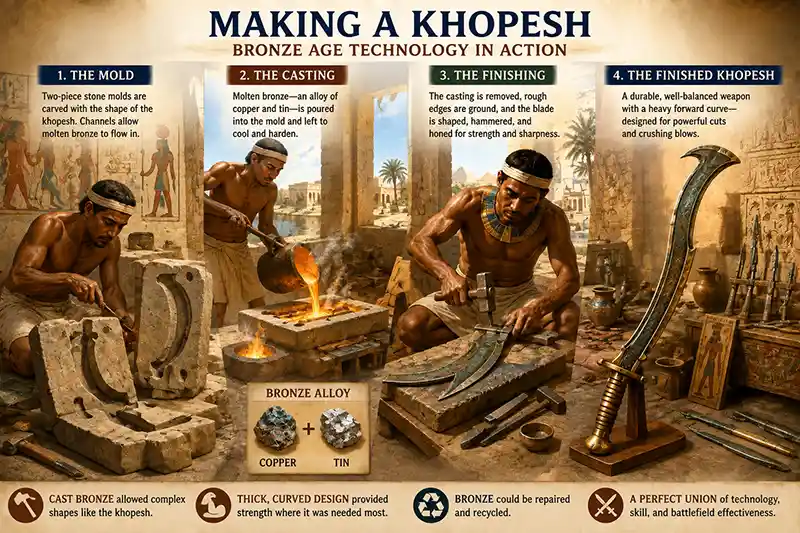
The khopesh is closely tied to the Bronze Age for more than chronological reasons. Bronze could be cast into complex forms, allowing ancient metalworkers to create the weapon's sweeping curve and widened forward section as a single piece. That was particularly useful for a design whose effectiveness depended heavily on its unusual geometry.
Bronze also behaves differently from the hardened steels used in much later swords. A very long, narrow bronze blade could be vulnerable to bending or damage, so Bronze Age sword makers often worked with relatively compact and substantial blade profiles. The khopesh fit comfortably within those constraints. Its thick construction and broad curved section provided plenty of material around the portion of the weapon expected to endure hard impacts.
Casting did not mean a khopesh simply emerged from a mold ready for battle. Producing a good weapon required control over the copper and tin alloy, careful casting, and extensive finishing afterward. Edges could be worked and hardened through hammering, while damaged bronze weapons could sometimes be repaired or recycled into new objects. Bronze was valuable enough that discarded metal rarely needed to remain discarded forever.
The khopesh therefore represents something more interesting than an unusual sword made from an obsolete material. Its famous shape and the technology used to manufacture it belonged to the same world. Bronze did not merely limit what ancient weapon makers could create. In the hands of skilled craftsmen, it helped make a weapon as unconventional as the khopesh possible.
The Khopesh Was Shorter Than It Looks
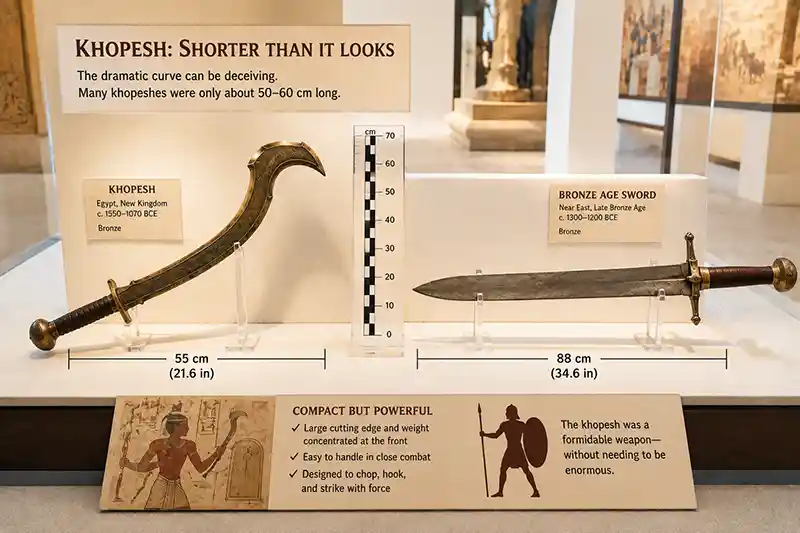
The dramatic curve of the khopesh can make the weapon appear enormous in photographs and artwork, but surviving examples were generally much more compact than many later swords. Khopeshes varied considerably, yet many were roughly half a meter to somewhat over 60 centimeters long. That put them closer to the dimensions of a short sword than the sweeping fantasy weapons their shape sometimes inspires today.
The compact size makes sense when the khopesh is considered alongside the rest of a Bronze Age warrior's equipment. Spears and bows provided reach, while shields occupied one hand and protected soldiers as formations closed with the enemy. A shorter sidearm could be drawn when fighting became too close for a spear or when another weapon was lost or damaged.
Its forward curve also allowed the khopesh to put a substantial working edge and useful mass near the end of the weapon without requiring a very long blade. The result was something that could deliver powerful chopping strikes while remaining manageable in confined fighting around shields, other soldiers, and tightly packed formations.
Modern depictions often enlarge the khopesh because its silhouette becomes even more dramatic at oversized proportions. The archaeological examples tell a more interesting story. The original khopesh did not need to be enormous to be intimidating. Much of what made it formidable came from how cleverly its relatively compact amount of bronze was shaped.
Could a Khopesh Really Break a Sword?
The khopesh's heavy forward section has helped create a modern reputation for it as a weapon capable of smashing straight through other swords. It is an appealing idea, especially when the khopesh is portrayed as something halfway between a sword and an axe. But there is little reason to believe that breaking enemy blades was a primary purpose of the design.
Bronze weapons could certainly be damaged in combat. Edges could deform, blades could bend, and sufficiently severe impacts could cause more serious failures. That does not mean a khopesh could reliably chop another sword in half. Deliberately striking edge against edge would also risk damaging the khopesh itself, making it a questionable tactic with an expensive weapon.
The more interesting advantage was probably control rather than destruction. Its curved profile could potentially catch or redirect an opponent's weapon, while its forward-weighted construction remained useful for powerful strikes when an opening appeared. Deflecting a blade long enough to attack the person holding it would have been far more valuable than trying to destroy the blade itself.
The myth nevertheless reveals why the khopesh continues to fascinate people. Its unusual shape looks as though it must possess some secret capability that ordinary swords lack. The reality is less spectacular but more believable: the curve gave the weapon different mechanical options, not supernatural cutting power.
The Khopesh Was Probably Not a Primary Weapon
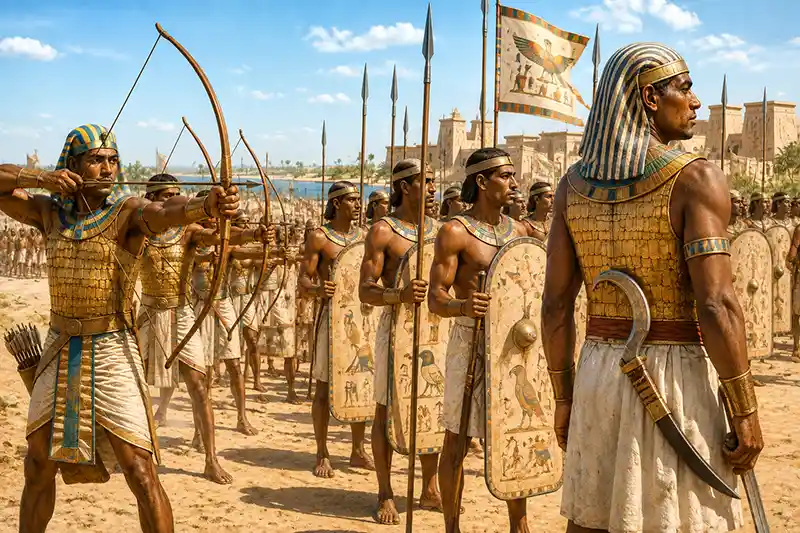
The fame of the khopesh can distort how we imagine Egyptian warfare. In modern artwork, an Egyptian warrior is often identified by the curved sword in his hand. On an actual Bronze Age battlefield, however, the weapons doing much of the work were likely far less exotic. Bows and spears gave soldiers something the khopesh could never provide: reach.
Egyptian armies made extensive use of archers, spearmen, and chariot forces. A spear allowed an infantryman to threaten an enemy before entering sword range, while a bow could attack from dramatically farther away. The khopesh became useful once that distance collapsed, particularly as a close-range weapon that could cut, strike, and potentially manipulate shields or other weapons.
That makes the khopesh easier to understand as part of a larger fighting system rather than as the centerpiece of Egyptian warfare. A warrior did not need one weapon to solve every battlefield problem. Long-range weapons could begin the fight, spears could dominate the approach, shields could provide protection, and a compact weapon like the khopesh could become valuable when combat turned chaotic and close.
Ironically, the weapon that became one of the strongest visual symbols of Egyptian warfare may not have been the weapon responsible for most battlefield casualties. Its extraordinary shape simply made it far more memorable than the ordinary spear.
The Khopesh Was Not Designed to Fight Heavy Armor
The khopesh is sometimes described as an armor-breaking weapon, but that description can be misleading. The weapon emerged in a period when battlefield protection looked very different from the iron and steel armor of later centuries. Egyptian soldiers were not swinging khopeshes at opponents encased in medieval plate.
Bronze Age warriors could certainly wear protective equipment. Shields were widespread, while helmets, textile protection, and various forms of scale armor were available in some armies, particularly among wealthier or better-equipped troops. But large portions of the body could still remain exposed, making a powerful cutting weapon valuable without requiring it to penetrate heavy metal armor.
Against substantial armor, the khopesh's chopping ability did not magically turn bronze into an armor-piercing material. Its curved profile may have provided other possibilities, however. An opponent's shield could potentially be hooked or disturbed, and exposed areas around the arms, legs, or head remained vulnerable. The goal did not have to be cutting directly through the strongest protection when the weapon could be directed somewhere else.
This is another case where the khopesh makes the most sense when placed back into its own era. Its shape was adapted to Bronze Age opponents, Bronze Age defenses, and Bronze Age metallurgy. Expecting it to solve the problems faced by warriors thousands of years later gives the weapon a job it was never designed to perform.
The Khopesh May Have Been as Intimidating as It Was Practical
Weapons are designed to injure opponents, but their appearance can matter too. The khopesh possessed a psychological advantage that is difficult to measure yet impossible to ignore: it looked unlike almost anything else on the battlefield. Its sweeping forward curve created an unmistakable silhouette, particularly when raised above a shield or carried openly by a warrior.
That does not mean ancient smiths deliberately curved the khopesh simply to frighten people. As we have seen, the shape had much deeper technological roots and practical consequences. But once the design existed, its appearance undoubtedly contributed to the weapon's identity. Egyptian artists repeatedly took advantage of that recognizable profile when depicting rulers as conquerors and military leaders.
The effect may have been particularly powerful when the khopesh was carried by elite troops or commanders. Weapons have always communicated information about the people carrying them, from rank and wealth to military role. A polished bronze khopesh required considerably more craftsmanship and material than a simple wooden spear, making it capable of projecting status before it was ever swung.
That combination of function and visual presence helps explain why the khopesh remains so compelling among unusual historical weapons today. Many ancient weapons were effective. Far fewer possessed a shape distinctive enough to remain recognizable more than three thousand years after they disappeared from the battlefield.
The Khopesh Was a Weapon Shaped by Its Time
The most important thing about the khopesh's strange shape is that no single advantage explains it. The curve was the product of evolution. It inherited characteristics from earlier crescent-shaped weapons, concentrated useful mass toward the front, created a powerful chopping surface, and offered hooking possibilities that straight blades could not easily reproduce.
Just as importantly, the design made sense within the limitations and opportunities of Bronze Age technology. Ancient smiths were working with bronze, soldiers commonly carried shields and spears, and battlefield armor was very different from the protection encountered by warriors in later centuries. The khopesh developed within that specific environment rather than according to some timeless ideal of what a sword should look like.
That is ultimately why its shape tells us so much. The khopesh looks strange to modern eyes because the world that produced it has disappeared. Once the weapon is placed back alongside the axes it descended from, the bronze technology used to make it, and the armies that carried it, that bizarre curve suddenly stops looking bizarre at all.
Modern versions and interpretations continue to celebrate that unmistakable profile, including weapons inspired by the ancient design in Modern Combat Khopesh and Other Deadly Weapons. Thousands of years later, the same curve that once reflected the practical realities of Bronze Age warfare remains the feature that makes the khopesh impossible to mistake for anything else.
Why the Khopesh Shape Made Sense
From a modern perspective, the khopesh can look like someone took a sword and bent the blade into an unnecessarily complicated shape. Its history reveals almost the opposite. The curve was not an eccentric departure from ordinary sword design. It was the result of generations of weapon development stretching back to the crescent-shaped axes of the ancient Near East.
That ancestry gave the khopesh a combination of characteristics that few later swords shared. It could concentrate force toward its forward cutting section, deliver powerful chopping blows, and potentially use its hooked profile to manipulate shields or weapons. At the same time, its compact proportions suited the close-range fighting conditions of a Bronze Age battlefield.
Eventually, metallurgy, weapons, and armies changed enough that the advantages of the khopesh were no longer worth preserving. The weapon disappeared, but its silhouette did not. More than three thousand years later, the khopesh remains one of the easiest ancient weapons to recognize, largely because the feature that once made it practical also made it unforgettable.
Was the Khopesh Used for Stabbing?
The khopesh was primarily suited to cutting and chopping rather than the kind of direct thrusting associated with straight, sharply pointed swords. Its forward-curving blade did not naturally align the point with the wielder's hand during a straight thrust, making it less efficient for stabbing than many later sword designs.
That does not mean the tip was useless. Individual khopeshes varied considerably, and a pointed end could potentially be driven into an exposed target from certain angles. Still, stabbing was probably not the weapon's defining strength. The khopesh's geometry devoted far more of the weapon to its sweeping outer edge, forward-weighted strike, and distinctive hooked profile.
This specialization helps explain why the khopesh should not be judged by the standards of later multipurpose swords. It sacrificed some thrusting efficiency in exchange for characteristics that made sense within the fighting traditions from which it developed.
How Heavy Was a Khopesh?
There was no standard weight for a khopesh because surviving examples differ considerably in size and construction. Despite its broad forward curve, however, the khopesh should not be imagined as an enormously heavy fantasy weapon. Functional examples had to remain light enough to control with one hand, particularly when the wielder was also carrying a shield.
The more important characteristic was weight distribution. By placing a substantial portion of the blade toward the curved forward section, a khopesh could feel more blade-heavy than a similarly sized straight sword. That helped give chopping strikes authority without requiring the entire weapon to be exceptionally massive.
Modern reproductions can vary even more dramatically because they may use steel, thicker blades, and proportions that differ from archaeological examples. Their weight therefore should not automatically be treated as evidence for how an ancient bronze khopesh would have handled.
Were Khopeshes Actually Used in Battle?
Yes. Although some surviving khopeshes were clearly ceremonial or prestige objects, the weapon was not merely a symbol carried by pharaohs for artwork and religious displays. Archaeological examples with practical construction, combined with depictions of the weapon in military contexts, support the conclusion that functional khopeshes were genuine fighting weapons.
The confusion comes partly from the spectacular examples associated with royalty. Elaborately decorated or unsharpened khopeshes could serve ceremonial purposes, and Egyptian art transformed the weapon into a symbol of victory and royal authority. Those examples should not be assumed to represent every khopesh that existed.
It is more accurate to think of the khopesh as a weapon that occupied several roles. Some were made for combat, others carried ceremonial significance, and particularly impressive examples could communicate wealth and status. The same basic shape could therefore appear both on a battlefield and among the treasures of an Egyptian tomb.
Did Egyptian Pharaohs Carry Khopeshes?
Yes, the khopesh became strongly associated with Egyptian pharaohs, although royal examples were not necessarily ordinary battlefield weapons. Pharaohs were frequently depicted holding khopeshes as symbols of military victory, authority, and their role as protectors of Egypt.
Physical examples reinforce that connection. Two khopeshes were discovered in the tomb of Tutankhamun, demonstrating that the weapon could have an important place among the possessions of Egyptian royalty. Such weapons could carry ceremonial and symbolic meaning in addition to whatever practical function their design allowed.
Royal imagery should not always be interpreted literally. Egyptian reliefs showing a pharaoh personally destroying groups of enemies were carefully constructed statements of power rather than documentary records of individual moments in battle. The khopesh was particularly effective in these scenes because its unmistakable curved shape immediately identified it as a weapon of conquest.
What Does the Word Khopesh Mean?
The ancient Egyptian word usually transliterated as "khopesh" was connected with the idea of a foreleg, particularly the foreleg of an animal such as an ox. The association makes sense when the weapon's distinctive shape is considered. Its bent profile resembles the curved outline of an animal's leg.
The same basic term could appear in Egyptian contexts referring to an animal foreleg rather than a weapon, so the name was descriptive rather than simply a specialized military label. Ancient Egyptians were effectively identifying the sword by the physical shape that made it so unusual.
That makes the name especially appropriate for a weapon remembered almost entirely because of its geometry. Thousands of years later, we still identify the khopesh by essentially the same characteristic that ancient Egyptians noticed when they named it: that unmistakable bend in the blade.
Was the Khopesh Used With a Shield?
Yes. The relatively compact size and one-handed design of the khopesh made it compatible with a shield, an important consideration on Bronze Age battlefields where protection from arrows, spears, and other hand weapons could be essential.
Using the two together also helps explain why the khopesh did not need the reach of a much longer sword. The shield could protect the warrior while closing distance, while the khopesh provided a powerful close-range weapon once opponents were within striking range. Its curved profile may also have offered opportunities to interfere with the edges of enemy shields, although exactly how frequently such techniques were used cannot be established with certainty.
The familiar image of a warrior carrying only a giant khopesh therefore gives a misleading impression of how the weapon would have functioned. Like most battlefield weapons, the khopesh made the most sense as one component of a larger fighting system rather than as a weapon intended to accomplish everything by itself.
Could a Khopesh Hook an Opponents Shield?
The curved shape of the khopesh makes hooking the edge of a shield mechanically possible, and this is frequently cited as one of the weapon's advantages. By reaching around an exposed edge, the inner curve could potentially be used to pull or redirect a shield and briefly expose the person behind it.
What we do not have is an ancient Egyptian fighting manual confirming that shield hooking was a standard khopesh technique. Surviving artwork establishes that khopeshes and shields belonged to the same military world, but detailed claims about exactly how the weapon was manipulated in combat often rely on modern experimentation and interpretation.
It is therefore reasonable to say that the khopesh could be used for hooking and controlling actions, but much harder to claim that this was the primary reason its blade was curved. The shape originated from a much older family of crescent-shaped weapons, so its ability to hook objects was likely one useful consequence of the design rather than the entire explanation for it.
Was the Khopesh a Sword or an Axe?
The khopesh is generally classified as a sword, but its ancestry makes the answer more interesting than that label suggests. The weapon developed from earlier crescent-shaped axes of the ancient Near East, and its broad forward section retained some of the chopping characteristics associated with those weapons.
Unlike an axe, however, a mature khopesh had a continuous metal blade extending from the handle rather than a separate axe head mounted to a shaft. Its usable cutting edge, length, and one-handed construction made it function much more like a sword, even though its unusual weight distribution preserved part of its axe-like heritage.
Calling the khopesh a hybrid between a sword and an axe is therefore useful as a description of how it behaved, but not as a precise archaeological classification. It was a sword whose distinctive shape preserved visible evidence of the weapon family from which it evolved.
What Were Khopeshes Made Of?
Most surviving khopeshes were made from bronze, the dominant weapon-making metal during the period when the khopesh flourished. Bronze is primarily an alloy of copper and tin, and skilled metalworkers could cast it into the weapon's distinctive curved profile before hammering, grinding, polishing, and finishing the blade.
Bronze was valuable, which also helps explain why khopeshes could represent wealth and status. Producing a substantial bronze weapon required raw materials, fuel, specialized equipment, and considerable skill. Damaged or obsolete bronze objects could also be melted down and recycled, making surviving battlefield weapons only a fraction of those that once existed.
The khopesh eventually declined during the transition toward increasingly widespread iron weaponry, although the change from bronze to iron was gradual rather than an overnight technological revolution.
How Long Was a Typical Khopesh?
Khopeshes varied considerably in size, but many surviving examples measure roughly 50 to 60 centimeters, or about 20 to 24 inches, in overall length. Some examples fall outside that range, so there was no single standardized khopesh size used throughout its history.
That makes the original weapon considerably more compact than many modern fantasy depictions suggest. Its dramatic forward curve can create the impression of a huge sword, but the historical khopesh was generally a manageable one-handed weapon that could be carried alongside a shield.
Its relatively short length also suited its role as a close-range weapon. Egyptian soldiers had bows and spears when greater reach was required, leaving a compact weapon like the khopesh particularly useful once fighting moved into much closer quarters.
Why Did the Khopesh Stop Being Used?
The khopesh gradually disappeared as the military technology surrounding it changed. Ironworking became increasingly widespread, sword designs evolved, and armies adopted weapons that offered different combinations of reach, cutting ability, thrusting performance, and ease of manufacture.
This does not mean the khopesh suddenly became ineffective. Weapons exist within larger military systems, and changes in armor, shields, tactics, metallurgy, and neighboring cultures can make once-successful designs less desirable. The specialized advantages of the khopesh simply became less important as the Bronze Age world that had produced it disappeared.
By the first millennium BCE, other sword forms had largely replaced it. The khopesh survived in imagery and archaeology, but its period as an important battlefield weapon had effectively come to an end.
Are There Any Surviving Khopeshes Today?
Yes. Archaeologists have recovered a number of surviving khopeshes, including examples associated with ancient Egyptian royalty. Perhaps the most famous are the two khopeshes discovered in the tomb of Tutankhamun, which provide remarkable physical evidence of the weapon's importance in elite Egyptian culture.
Surviving khopeshes vary considerably. Some appear suitable for practical use, while others may have served ceremonial, funerary, or symbolic purposes. Differences in size, curvature, construction, and sharpening also show why historians should be cautious about describing every khopesh as though it followed one standardized design.
These surviving weapons are particularly valuable because Egyptian artwork can exaggerate proportions or use the khopesh symbolically. Archaeological examples allow us to examine what actual khopeshes looked like, how they were constructed, and just how unusual their famous curved blades really were.
You May Also Be Interested In:
Leave a Reply