




Why Are Throwing Knives Shaped Differently From Regular Knives?
August 21st, 2026
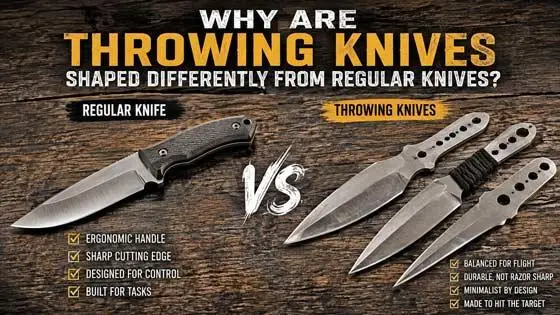
Most knives are designed around the hand. They have comfortable handles, sharpened cutting edges, finger guards, and blade shapes meant to give the user as much control as possible. Throwing knives seem to ignore many of those rules. Some have almost no handle at all, others are little more than a single piece of sharpened steel, and many have strange symmetrical shapes that would make little sense on an ordinary knife. None of this is accidental. The moment a knife leaves your hand, ergonomics stop being the only priority and balance, rotation, durability, and predictable flight suddenly become much more important. That simple change in purpose explains why a good throwing knife can look strangely primitive compared with a regular knife, while actually being highly specialized for the one thing it was built to do.
A Throwing Knife Has to Survive the Throw
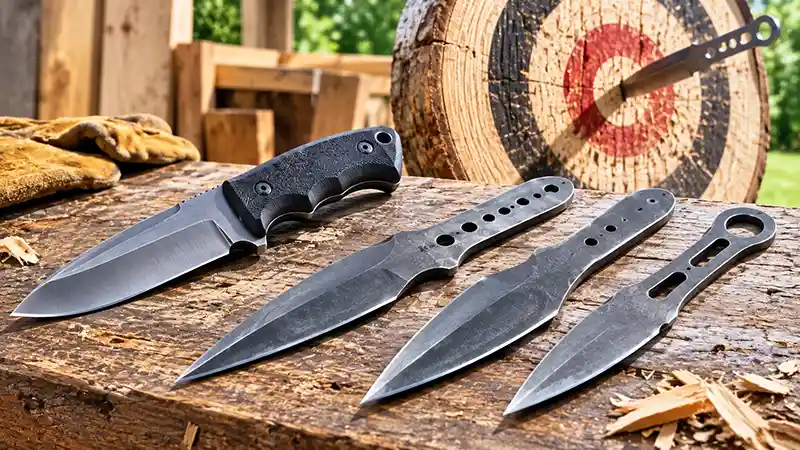
The biggest difference between a throwing knife and an ordinary knife begins with something that has nothing to do with flight. Throwing knives are expected to hit things badly. A normal knife is generally designed around controlled contact with its cutting edge or point. A throwing knife may strike its target point-first, sideways, handle-first, or at an awkward angle that sends it bouncing onto the ground.
That completely changes the design priorities. Thin edges, delicate tips, decorative handle scales, and other features that work perfectly well on an ordinary knife can become liabilities when the entire weapon is repeatedly hurled at a target. A throwing knife needs enough toughness to survive unsuccessful throws as well as successful ones. That is one reason many throwing knives use relatively simple, substantial one-piece construction.
This also explains why throwing knives can look strangely unfinished beside conventional knives. The absence of elaborate handles and extremely fine cutting edges is not necessarily evidence of a cheaper design. Every unnecessary component creates another potential point of failure. Handle scales can loosen. Fasteners can work free. Thin tips can bend. Fine edges can chip or roll when they hit something they were never intended to strike.
A throwing knife therefore starts with almost the opposite assumption of an ordinary knife. Instead of asking how comfortably and efficiently a blade can perform while controlled by the hand, its designer has to ask what will happen after the hand lets go. Once repeated impacts become part of the job description, simplicity stops looking primitive and starts looking remarkably practical.
Balance Determines How Predictably a Throwing Knife Rotates
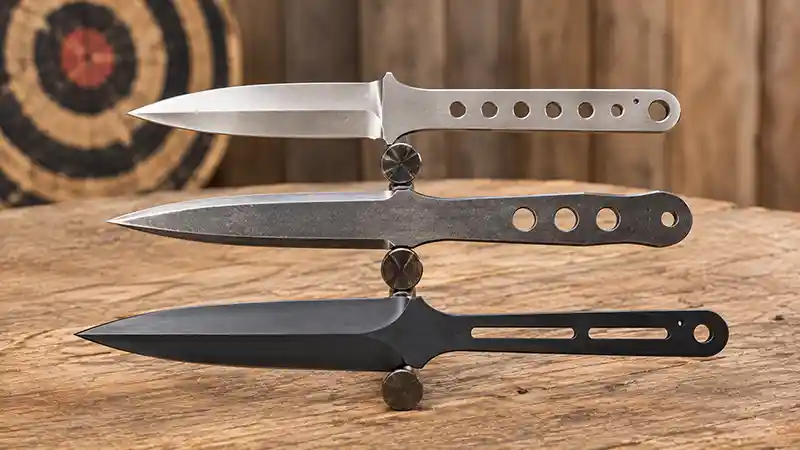
Once a throwing knife leaves the hand, the thrower can no longer correct what it is doing. The knife has to travel toward the target while rotating at a predictable rate, which makes its weight distribution far more important than it would be on many ordinary knives. A knife that feels comfortable for slicing or cutting is not necessarily a knife that behaves consistently while spinning through the air.
Throwing knives can be designed with different balance points. Some are approximately center-balanced, while others carry more weight toward the blade or handle. None of these arrangements automatically guarantees an accurate throw. Instead, balance affects how the knife feels during release and how naturally it works with particular throwing techniques.
This is one reason the simple outline of a throwing knife can be deceptive. Removing bulky handle scales, guards, pommels, and other components makes it easier for the designer to control where the mass is distributed along the entire weapon. The shape of the steel itself can determine the balance rather than having that balance altered by several separate pieces attached afterward.
That concern is shared with other throwing weapons, although each solves the problem differently. Whether something is a knife, axe, or another purpose-built projectile, its behavior after release depends heavily on the relationship between shape, mass, balance, and rotation. For a throwing knife, what looks like an unusually plain piece of steel can actually be a carefully controlled distribution of weight.
A Throwing Knife Does Not Need a Razor-Sharp Edge
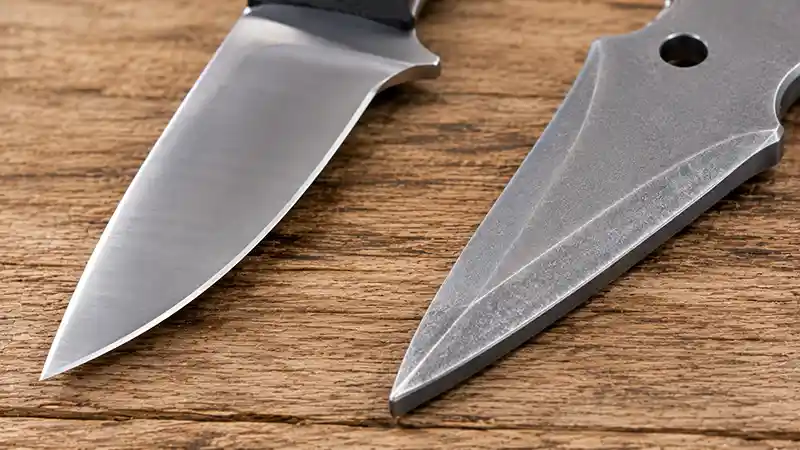
This may be the strangest difference of all. We normally judge a knife partly by how well it cuts, so deliberately leaving a knife less than razor sharp sounds like poor design. But a throwing knife has a completely different job. Its primary objective is to strike the target with its point and penetrate deeply enough to remain embedded. A shaving-sharp cutting edge contributes surprisingly little to accomplishing that.
In fact, an extremely fine edge can become a disadvantage. Throwing knives repeatedly experience impacts that ordinary cutting knives are never supposed to endure. A missed throw might send the blade sideways into a wooden target, another knife, the ground, or a surrounding object. A very thin cutting edge is more vulnerable to rolling, chipping, and other damage under that kind of abuse.
A less aggressive edge also makes sense because throwers frequently handle the knife by areas that would normally be considered part of the blade. Depending on the throwing style and the design of the knife, a practitioner may grip the handle for one throw and the blade section for another. A razor edge would make that unnecessarily hazardous and would provide little benefit once the knife was airborne.
This is where understanding different types of knife steels becomes useful. An ordinary cutting knife often balances edge retention, corrosion resistance, toughness, and ease of sharpening. A throwing knife shifts the priorities toward toughness and resistance to repeated impact. The ability to maintain an exceptionally fine slicing edge simply matters less when the knife is expected to spend its life crashing into targets.
The result is another feature that can make a throwing knife look crude when judged by ordinary knife standards. Its edge may be comparatively thick and unimpressive as a cutting tool, but that is because it was never designed to win a slicing contest. For a throwing knife, the point does the important work.
Why Throwing Knives Often Have Bare Metal Handles
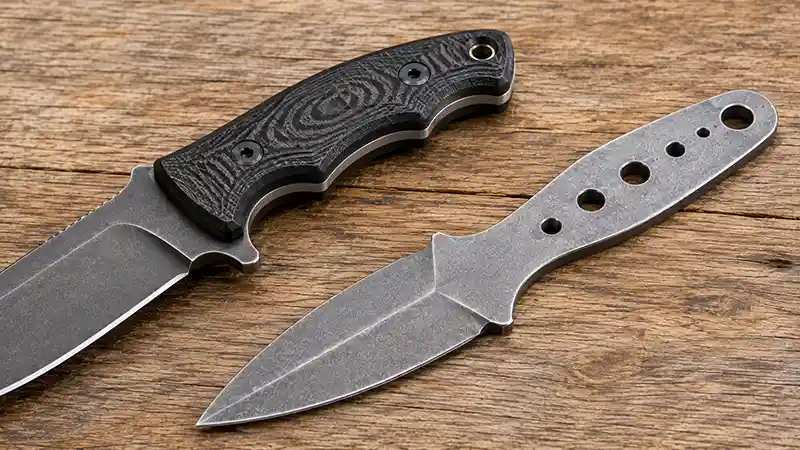
Pick up an ordinary fixed-blade knife and the handle is usually one of its most carefully designed features. Contoured scales, textured rubber, finger grooves, guards, and other ergonomic details help keep the knife comfortable and controllable during cutting. A throwing knife often strips almost all of that away, leaving nothing but the same piece of steel that forms the blade.
There is a practical reason for this simplicity. Every time a throwing knife misses its ideal landing, the handle may slam directly into the target, ground, or another hard surface. Traditional handle scales can crack, loosen, or separate after enough repeated impacts. Screws and other hardware introduce additional components that can eventually work loose. A solid piece of steel eliminates most of those potential failure points.
A thin, relatively uniform handle can also make the knife easier to release consistently. Throwing depends heavily on repeating the same grip and release, so a bulky ergonomic handle designed to lock securely into the palm is not necessarily an advantage. Features that make an ordinary knife comfortable during prolonged cutting can interfere with the clean, predictable release expected from a purpose-built throwing knife.
Some throwing knives add cord wrapping or simple texturing to the handle, but even these treatments tend to remain far more minimal than the handles found on conventional knives. The goal is not to make the knife comfortable during hours of cutting. It is to provide enough purchase for a controlled throw without adding unnecessary complexity, bulk, or vulnerable components.
This is why the bare handle of a throwing knife should not be mistaken for a missing feature. The lack of a conventional handle is often a feature itself. Once a knife is designed to leave the hand rather than remain securely inside it, many of the ergonomic solutions used on ordinary knives suddenly become unnecessary.
Symmetry Can Make a Throwing Knife Easier to Control
Many throwing knives have a strangely symmetrical appearance. The blade and handle may be similar in width, the point may sit directly along the centerline, and the entire knife can look almost like a sharpened steel bar rather than a conventional cutting tool. That simplicity is useful because throwing places a premium on consistency.
An ordinary knife can afford to be dramatically asymmetrical. Its handle might curve downward, the blade may sweep upward, and the spine and cutting edge can follow completely different profiles. None of that is necessarily a problem because the knife remains in the user's hand. The person holding it continuously controls its orientation.
Once the knife is thrown, however, its geometry becomes part of its behavior in flight. A relatively straight, predictable shape can complement balanced weight distribution and make the knife easier to grip consistently from repeated positions. It also allows the point to remain aligned with the main axis of the knife, which is exactly where the force needs to travel when the point reaches the target.
This is why throwing knives often favor spear-point-like or other centered profiles rather than many of the shapes found on everyday knives. Conventional pocket knife blade shapes are usually designed around cutting performance, piercing ability, tip strength, utility, or some combination of those jobs. Throwing knives are solving a different problem, so their geometry naturally evolves in a different direction.
Not every throwing knife is perfectly symmetrical, and symmetry alone does not make a knife throw well. But when the goal is repeatable rotation followed by a point-first impact, many of the curves and ergonomic features that make an ordinary knife useful simply stop providing much benefit. The throwing knife can become simpler because its job has become much more specialized.
Why Throwing Knives Are Often Thicker Than They Look
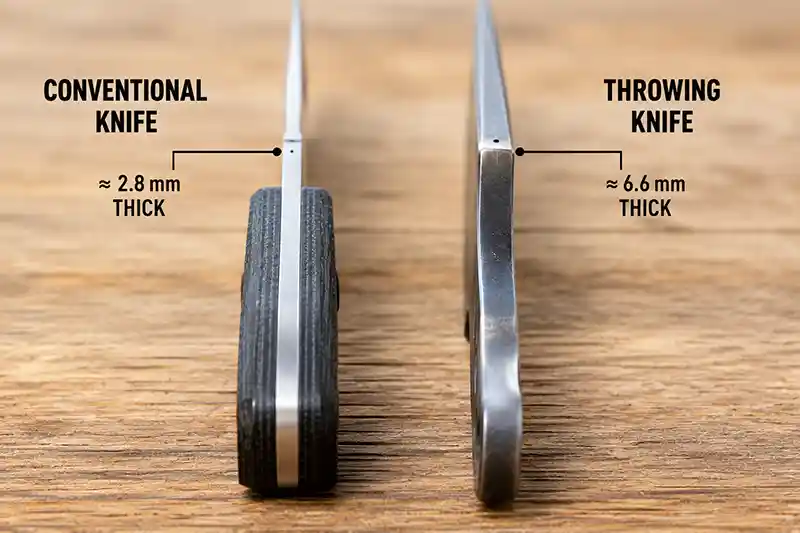
A conventional knife can benefit from a relatively thin blade because thinner geometry generally improves cutting performance. A throwing knife faces almost the opposite set of demands. Since slicing efficiency is secondary, designers can devote more steel to making the knife resistant to the bending, twisting, and repeated impacts that come with being thrown.
That extra thickness becomes especially important during bad landings. A perfect throw sends the point into the target along the knife's length, but imperfect throws are inevitable. The knife may strike at an angle, hit with its side, bounce from the target, or land somewhere unintended. Each of those impacts can place considerable stress on the blade and particularly on the transition between the blade and handle.
A thicker one-piece construction helps the knife tolerate those stresses without relying on bulky reinforcement. This is another reason throwing knives can have such unusual proportions. Compared with an ordinary cutting knife of similar length, the throwing knife may look extremely simple, yet the steel itself can be substantially built because durability matters more than creating the thinnest possible cutting geometry.
There is a limit, of course. Adding steel also adds weight, and excessive weight changes how quickly the knife can be accelerated and how it feels during release. Designers therefore have to balance thickness against overall mass, just as they balance the amount of steel distributed toward the blade and handle.
This helps explain why throwing-knife design is less primitive than it first appears. Removing handle scales and fine cutting edges does not mean removing engineering considerations. Instead, the material is concentrated where the knife needs it most, creating a deceptively simple object built to withstand an unusually abusive life.
The Point Matters More Than the Cutting Edge
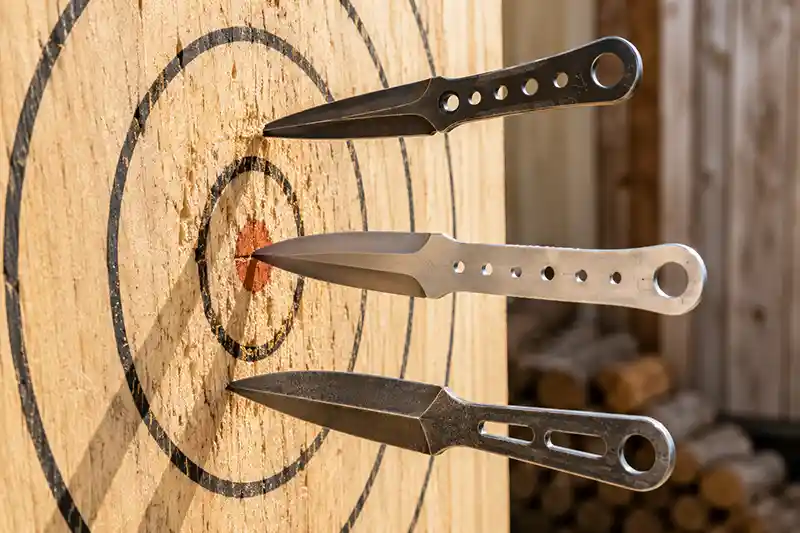
If a throwing knife does not need to slice particularly well, the point becomes the most important part of the blade. A successful throw concentrates the knife's forward momentum into a very small area at the tip, allowing it to penetrate the target and remain embedded. That makes point geometry one of the clearest examples of how throwing knives are designed around a different purpose from ordinary knives.
Many conventional knives have points shaped as a compromise. The tip may need to pierce, but the rest of the blade still needs to slice, carve, chop, or perform everyday utility work. Throwing knives can sacrifice much of that versatility. Their profiles often taper aggressively toward a centered point because penetration at the moment of impact matters more than having a long, efficient cutting belly.
But an extremely thin needle-like point would create another problem. Every throw does not land perfectly. A delicate tip that penetrates beautifully under ideal conditions could bend or break when the knife strikes at an angle. Designers therefore have to balance penetration against durability, producing a point narrow enough to enter the target but substantial enough to survive repeated mistakes.
This same tension between shape and purpose appears throughout the history of knives. Military designs, utility knives, fighting knives, and specialized tools have all evolved around different priorities, which is why looking at how different cultures shaped the world's most famous knives reveals such enormous variation. Throwing knives simply take that specialization in an unusual direction: almost everything about the design is built around what happens during the fraction of a second when the point meets the target.
That is why a throwing knife can have a mediocre cutting edge and still be exceptionally well designed. Judge it as a conventional knife and it may seem compromised. Judge it by whether its point repeatedly survives impacts and sticks reliably, and those strange proportions suddenly begin to make much more sense.
Why So Many Throwing Knives Have Holes in the Handle
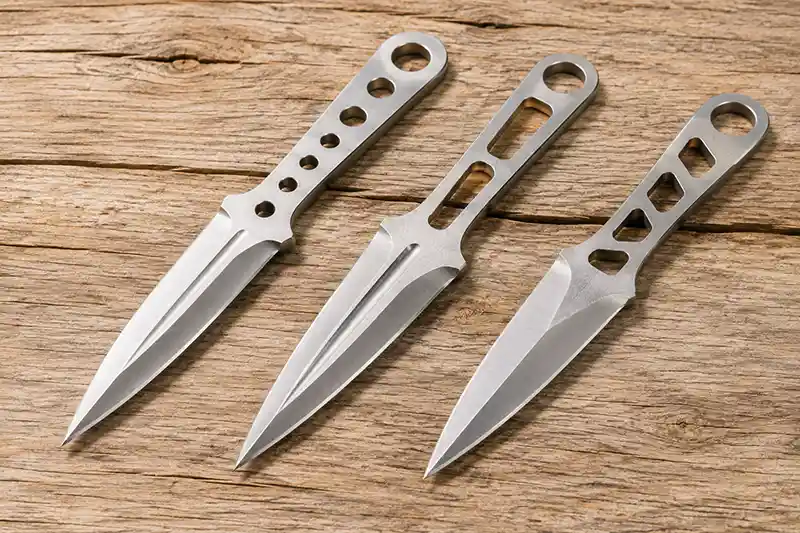
Those rows of circular holes found in many throwing knives are not just there to make the knife look aggressive. Removing small amounts of steel gives designers another way to adjust the weight of the knife without dramatically changing its overall dimensions. Because even relatively small changes in mass distribution can affect how a throwing knife feels and rotates, strategically placed cutouts can help fine-tune the design.
The location of those holes matters. Removing material from the handle shifts a greater percentage of the remaining mass toward the blade. Removing steel closer to the center has a different effect. Designers can therefore alter the relationship between blade weight, handle weight, and overall balance while still maintaining the long, simple profile expected from a throwing knife.
Cutouts can also reduce total weight. A thick piece of steel provides the durability a throwing knife needs, but thickness comes with a penalty: more mass. Removing material from areas that do not require maximum strength can help compensate for that extra steel. It is essentially a way of keeping the knife substantial where impacts matter while avoiding unnecessary weight elsewhere.
Not every hole is strictly about balance. A larger opening near the end of the handle may provide an attachment point, and some cutouts are undoubtedly incorporated for appearance as well. Nor does a throwing knife need holes to perform properly. Plenty of excellent designs use completely solid handles.
But those distinctive skeletonized handles illustrate something important about throwing-knife design. What looks decorative can also influence the physical properties of the knife. On an ordinary knife, designers often add material to make the handle more comfortable. On a throwing knife, they may deliberately remove it to get the weight distribution they want.
Why Throwing Knives Usually Avoid Finger Guards
On a conventional fixed-blade knife, a finger guard can be an important part of the design. It helps prevent the hand from sliding forward toward the cutting edge and can provide additional control during demanding tasks. Look at many purpose-built throwing knives, however, and the prominent guard is either dramatically reduced or missing altogether.
The reason becomes obvious when you think about what happens at release. A throwing knife needs to leave the hand cleanly and consistently. Large guards, hooks, deep finger grooves, and other protrusions create additional surfaces that can interfere with that release. A feature that improves security while holding a knife can become an unnecessary complication when the goal is to smoothly let go of it.
A streamlined transition between blade and handle can also make different grips more practical. Depending on the knife and throwing style, the user may hold the weapon from different portions of its length. Removing a pronounced guard leaves fewer abrupt obstacles along the profile and gives the knife the simple, uninterrupted geometry commonly associated with purpose-built throwers.
Compare that with many of the most popular military knives, where guards often make perfect sense. Those knives were designed to remain in the hand during use, so protecting the fingers and maintaining a secure grip were much higher priorities. Throwing knives solve almost the opposite problem: they need to be held predictably and then released without interference.
It is another example of a familiar knife feature disappearing because the job has changed. A throwing knife is not necessarily missing its finger guard because the design is incomplete. In many cases, there simply is not enough benefit to justify putting one there.
Length Changes the Timing of the Rotation
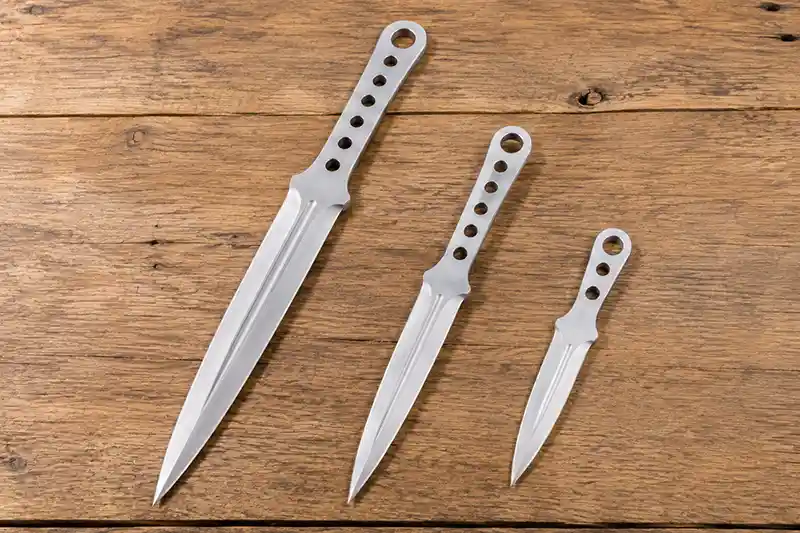
Two throwing knives can have similar weights and balance points yet behave noticeably differently if one is several inches longer than the other. Length changes how the knife's mass is distributed around its center of rotation, which affects how it feels as it turns through the air. This is one reason throwing knives are often longer than people expect when seeing them online without anything nearby for scale.
A longer knife can feel more deliberate during rotation, while a very short knife can feel quicker and less forgiving of small inconsistencies. That does not mean longer is automatically better. The knife still has to work comfortably with the thrower's preferred technique, distance, grip, and release. What matters most is predictability.
Length also gives designers more room to distribute mass without making the knife excessively wide or thick. A long, relatively narrow piece of steel can provide useful overall weight while maintaining the streamlined profile common to throwing knives. That helps explain why some purpose-built throwers resemble elongated spikes or narrow daggers rather than compact utility knives.
This becomes especially interesting when compared with other projectile weapons. A throwing star, for example, distributes its mass around a completely different shape and is not simply a miniature throwing knife. Both are intended to travel after leaving the hand, but their geometry creates fundamentally different behavior.
So when a throwing knife looks unusually long for such a simple object, the extra length is not necessarily wasted material. The designer is working with another variable that ordinary knife makers rarely need to prioritize in the same way. With a throwing knife, dimensions influence not only how the weapon feels in your hand, but what it does after your hand is no longer touching it.
Throwing Knives Are Built to Rotate, Not Fly Like Darts
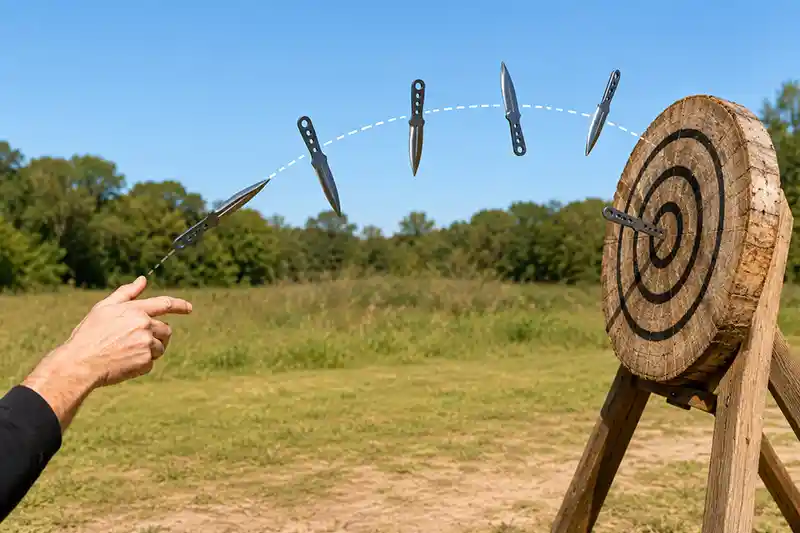
One of the biggest misconceptions about throwing knives comes from the way they are portrayed in movies. A knife does not normally leave the hand with its point aimed at the target and simply remain in that orientation throughout the flight. With conventional rotational throwing, the entire knife turns end over end as it travels toward the target.
That rotation has enormous consequences for the design. The knife needs a predictable relationship between its length, weight, balance, and overall shape so that its movement remains consistent from throw to throw. The thrower can then account for that rotation through technique and distance rather than expecting the knife to somehow stabilize itself point-first in the air.
This is fundamentally different from an arrow or dart, where aerodynamic features help keep the point oriented forward. Adding fins or fletching to a throwing knife would completely change the object. Instead, the simple steel profile allows the knife to rotate naturally, with its design focused on making that rotation manageable and repeatable.
There are specialized techniques that can greatly reduce rotation, often described as no-spin or instinctive throwing, but even those do not turn a knife into a tiny arrow. The thrower is still controlling an object whose mass and geometry determine how it behaves after release. The unusual proportions of a purpose-built throwing knife make much more sense once you stop imagining it flying perfectly point-first through the air.
This also helps explain why throwing knives evolved so differently from objects such as the kunai. The historical tool behind the kunai legend acquired an enormous association with throwing through popular culture, but a modern purpose-built throwing knife can be designed from the beginning around repeated recreational throwing. Its strange shape is not trying to make it look like a conventional knife. It is solving the physics problem created the instant the knife leaves the hand.
Why Throwing Knives Rarely Have Folding Mechanisms
Folding knives solve an important problem for everyday carry: they allow a useful blade to fit into a much smaller package. But the hinge that makes a folding knife convenient also introduces exactly the kind of complexity a purpose-built throwing knife generally tries to eliminate. When a knife is repeatedly slammed into a target, simplicity becomes a form of durability.
A folding knife concentrates enormous importance into its pivot and locking mechanism. Those components are designed to handle the forces associated with ordinary knife use, not repeated impacts from being hurled through the air. Even if the lock remained secure, every hard landing would subject the pivot, stop surfaces, handle structure, and other components to stresses that a solid piece of steel simply does not have to deal with.
One-piece construction eliminates the entire problem. There is no hinge to develop play, no lock to absorb repeated shocks, and no separate handle structure surrounding the blade. The throwing knife can essentially behave as one continuous piece from point to handle, allowing its thickness and shape to provide the necessary strength.
This is another reason throwing knives can look almost ancient compared with modern pocket knives. The simpler design is not necessarily technologically backward. It is the logical result of removing mechanisms that provide little advantage for the task while creating additional opportunities for damage.
A throwing knife therefore represents an interesting reversal of normal knife design. Conventional knives have accumulated increasingly sophisticated locks, pivots, handle materials, and mechanisms because those features make them more useful in the hand. Throwing knives often become better at their specialized job by stripping nearly all of those innovations away.
Throwing Axes Solve the Same Problem in a Completely Different Way
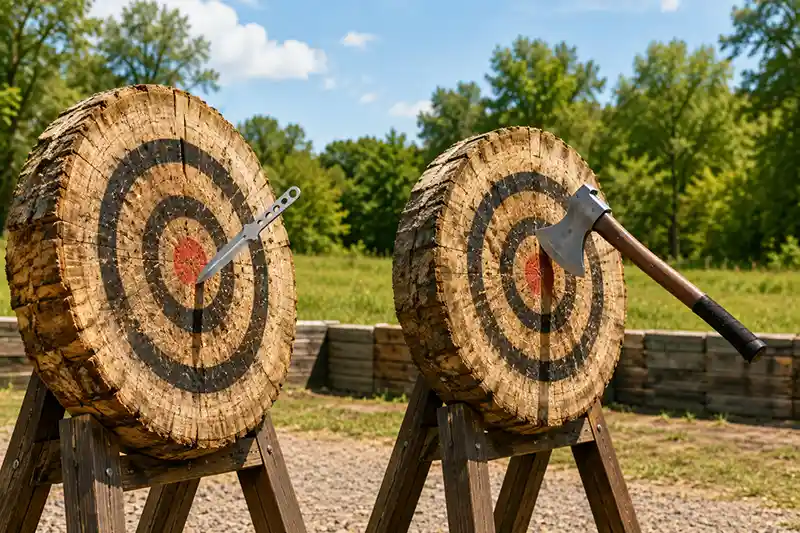
Throwing knives are not the only handheld tools that become strange once they are designed to rotate through the air. Throwing axes face many of the same basic challenges: they must survive repeated impacts, rotate predictably, and reach the target at an orientation that allows them to stick. Yet the shape used to accomplish those goals could hardly be more different.
An axe concentrates much of its mass in the head, far away from the opposite end of the handle. A throwing knife can distribute its weight much more evenly along its length. That means two objects intended for a similar activity can have dramatically different centers of mass and rotational characteristics.
This is part of what makes the axes and hatchets comparison so useful. It demonstrates that there is no universal "throwing weapon shape." Designers have to work with the basic architecture of the object. A knife starts as a long piece of steel, while an axe typically combines a concentrated head with a much lighter handle. Each requires a different solution to predictable rotation.
The comparison also helps explain why simply adding weight to the front of a throwing knife does not automatically improve it. More forward mass changes the way the knife feels during release and alters its rotational behavior. Depending on the design and technique, a more neutral distribution of weight may be preferable. The objective is not to make one end as heavy as possible, but to create a knife whose behavior the thrower can reproduce consistently.
That is why purpose-built throwing knives can appear almost boring next to axes, tomahawks, and other projectile weapons. Their straight profiles and relatively even distribution of steel are part of the solution. The simplicity allows the knife to rotate around its balance point without needing the dramatically uneven architecture that defines a throwing axe.
Throwing Knives Need to Survive Each Other Too
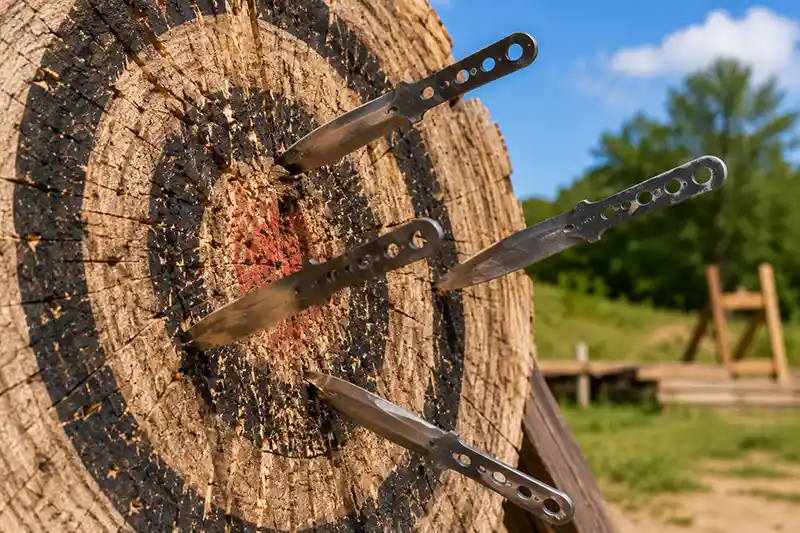
The target is not always the only thing a throwing knife hits. During repeated practice, several knives may be thrown at the same relatively small area of wood. Eventually, one knife can collide with another that is already embedded in the target. That possibility creates yet another reason delicate construction makes little sense for a purpose-built thrower.
Knife-on-knife contact can be particularly unforgiving. Instead of striking relatively soft wood, the incoming knife may hit hardened steel. Tips can be damaged, edges can deform, finishes can become scratched, and the impact can send one or both knives bouncing away from the target. A throwing knife therefore benefits from being tough enough to tolerate occasional collisions without depending on fragile components or extremely thin geometry.
This also helps explain why cosmetic perfection is a strange standard for throwing equipment. A knife intended for repeated target practice is going to accumulate scratches, scuffs, dents, and other signs of use. The polished finish that might be prized on a collectible knife offers little practical advantage once the knife has been thrown hundreds of times.
There is an interesting parallel with the history of the tomahawk. Modern recreational throwing has turned very different types of objects into equipment expected to withstand repeated target impacts. Whether the projectile is a knife or an axe, durability becomes inseparable from performance when the same object is expected to be thrown again and again.
A good throwing knife is therefore designed not merely for the perfect throw, but for all the imperfect things that happen between perfect throws. It will hit targets sideways, bounce, fall, get scratched, and occasionally collide with something harder than wood. The strange simplicity of the design starts making even more sense when you realize how abusive its normal working life actually is.
Why Throwing Knives Usually Have Such Simple Blade Shapes
Throwing knives rarely need the sweeping bellies, recurves, serrations, clip points, or other specialized geometry found on conventional knives. Those features exist primarily to improve particular cutting tasks. A throwing knife spends very little of its working life cutting anything, so complicated blade geometry can add manufacturing complexity without providing much benefit.
A straight or gently tapered profile also helps keep the knife's mass predictable. Every dramatic curve removes steel from one area or adds it to another, potentially changing the balance and rotational characteristics of the knife. Simple geometry gives designers a straightforward way to control how much material sits on either side of the balance point.
Durability provides another reason to keep things simple. Deep notches, extremely narrow sections, and delicate projections can create areas where stresses become concentrated during hard impacts. A broad transition between the blade and handle allows the knife to remain substantial through one of the areas that can experience considerable stress during an imperfect landing.
This does not mean every throwing knife has to look identical. Some resemble narrow daggers, others use broad spear-point profiles, and still others have shapes that blur the distinction between blade and handle almost completely. What they tend to share is an absence of features that exist primarily to make an ordinary knife better at slicing, carving, or other hand-controlled tasks.
The result can look almost crude beside a sophisticated modern knife, but that simplicity is deceptive. A throwing knife has been stripped of many features because its job is unusually narrow. When a knife only needs to leave the hand predictably, survive the trip, and arrive point-first, every unnecessary curve has to justify why it is there.
Throwing Knives Are Designed Around Repetition
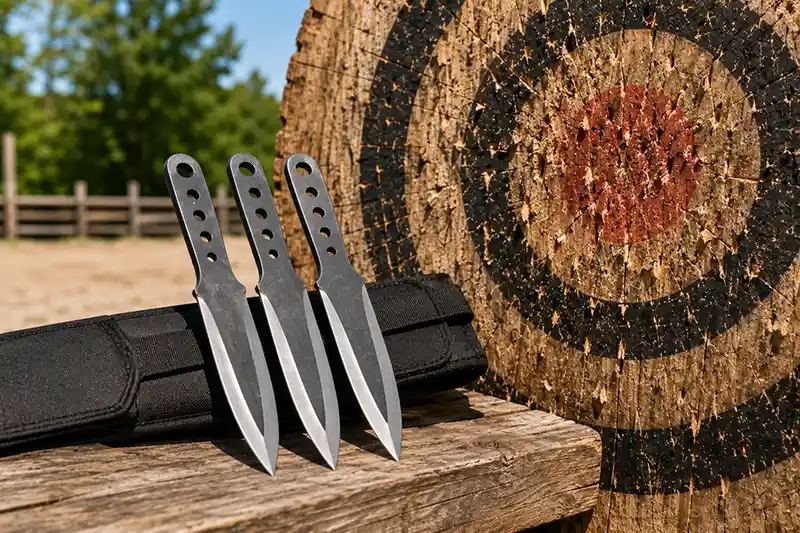
A conventional knife may perform hundreds of different jobs during its lifetime. It might open packages, cut rope, prepare food, carve wood, or handle countless other everyday tasks. A throwing knife is almost the opposite. It performs essentially the same unusual sequence over and over again: leave the hand, rotate through the air, strike something, get retrieved, and do it again.
That repetition has a major influence on the design. A throwing knife needs to feel consistent every time it is picked up. Its balance should not shift because a handle scale has loosened. Its grip should not depend on delicate contours. Its point needs to tolerate repeated impacts, and its construction has to survive thousands of cycles that would be considered abuse for most ordinary knives.
This also explains why throwing knives are commonly sold and practiced with in matched sets. When several knives have nearly identical dimensions, weights, and balance points, the thrower can repeat the same basic movement without having to adapt to a completely different object after every throw. Consistency becomes part of the equipment itself.
The concept is not unique to knives. Other traditional projectile weapons were also shaped by the need for repeatable handling. Japanese shuriken, for example, developed in numerous forms, but their specialized shapes make far more sense when viewed as purpose-built projectiles rather than miniature versions of conventional handheld weapons.
This may be the most important clue to understanding why throwing knives look the way they do. They are not ordinary knives that happen to be throwable. The best purpose-built designs start with throwing as the primary job and remove, reinforce, or reshape everything according to that requirement. What remains is a remarkably specialized tool disguised as a very simple piece of steel.
The Strange Shape Makes Sense Once You Stop Treating It Like a Normal Knife
At first glance, a purpose-built throwing knife can seem like an oddly incomplete version of a conventional knife. It may have no real handle, little emphasis on a razor-sharp edge, no substantial guard, a surprisingly thick body, and holes punched through sections that would normally be covered with comfortable handle scales. Judged purely as a cutting tool, many of those decisions would seem like compromises.
But throwing knives are not compromised conventional knives. They are specialized objects built around a completely different set of priorities. Predictable rotation matters more than slicing efficiency. Impact resistance matters more than edge retention. A clean release matters more than an ergonomic grip, and a simple piece of steel that can survive repeated crashes may be preferable to a sophisticated multi-part construction.
That distinction also separates the modern throwing knife from many historical blades that have acquired reputations as projectile weapons. The kunai is a perfect example. Popular culture transformed it into an iconic throwing weapon, even though its historical origins and uses were much broader. A purpose-built modern throwing knife does not need that mythology. Its unusual appearance can be explained simply by the job it was designed to perform.
In a strange way, throwing knives demonstrate one of the most interesting principles in weapon design: specialization often makes an object look simpler rather than more complicated. Remove everything that does not help it survive impacts, rotate predictably, release cleanly, or arrive point-first, and you are left with something that can look almost primitive.
Yet that simplicity is precisely what makes the design work. Throwing knives are shaped differently from regular knives because the moment they leave the hand, almost everything we normally expect a knife to do stops mattering.
Are throwing knives actually different from regular knives?
Yes. Although almost any knife could theoretically be thrown, purpose-built throwing knives are designed around a very different set of priorities. Regular knives are primarily intended to remain in the hand while cutting, slicing, piercing, or performing utility tasks. Throwing knives have to behave predictably after they leave the hand and survive repeated impacts with a target.
That is why purpose-built throwing knives often have thicker steel, simpler blade profiles, minimal handles, reinforced points, and relatively uncomplicated one-piece construction. These features may offer little advantage on an everyday cutting knife, but they make considerably more sense when the knife is expected to rotate through the air and repeatedly strike a wooden target.
Can you throw a regular knife like a throwing knife?
A regular knife can sometimes be thrown, but that does not mean it is well suited to repeated throwing. Conventional knives may have handle scales, guards, folding mechanisms, thin tips, or finely sharpened edges that were designed for controlled use in the hand rather than repeated impacts against a target.
Purpose-built throwing knives eliminate many of those potential weaknesses while using their shape, weight, and balance to provide more consistent handling. For someone practicing knife throwing regularly, a dedicated throwing knife is therefore fundamentally different from simply taking an ordinary knife and using it for a job it was never designed to perform.
Why are throwing knives not razor sharp?
Many purpose-built throwing knives do not need razor-sharp cutting edges because their primary job is to penetrate a target with the point. An extremely fine edge provides little advantage during the throw while creating another relatively delicate part of the knife that can be damaged by repeated impacts.
A less aggressive edge can also make sense because some throwing techniques involve gripping different portions of the knife. What matters most is having a durable point, suitable balance, and construction capable of surviving repeated target impacts. A throwing knife can therefore be excellent at its intended purpose even if it would be unimpressive as an everyday cutting knife.
Why do throwing knives have holes in the handles?
The holes found in many throwing-knife handles can remove unnecessary steel and help designers adjust the overall weight and balance of the knife. Because throwing knives are often made from relatively thick pieces of steel for durability, strategically placed cutouts can reduce mass without requiring the entire knife to be made thinner.
Handle cutouts can also influence weight distribution by removing material from particular areas of the knife. Some holes may serve additional purposes, such as providing attachment points or simply contributing to the appearance of the design. They are not required for a good throwing knife, however, which is why many purpose-built throwers use completely solid handles instead.
Do throwing knives have to be perfectly balanced?
No. Throwing knives do not have to balance exactly at their geometric center to perform well. Some designs are relatively center-balanced, while others deliberately carry more weight toward the blade or handle. Each arrangement changes how the knife feels during the grip, release, and rotation.
What matters more is consistency. A thrower can adapt to the balance characteristics of a particular knife as long as its behavior is predictable from one throw to the next. This is also why matched sets of throwing knives are useful: similar weight, dimensions, and balance allow the same movements to be repeated without constantly adjusting to a different knife.
Why are throwing knives usually made from one piece of steel?
One-piece construction eliminates many of the components that could become damaged or loosen after repeated impacts. There are no handle scales to crack, screws to work loose, or separate handle materials to shift after the knife strikes a target awkwardly or falls to the ground.
Making the knife from a single piece of steel also allows its thickness, shape, and weight distribution to be controlled across the entire design. This simplicity is particularly useful for equipment expected to endure thousands of throws. What may look like basic construction is actually well suited to the unusually repetitive punishment a throwing knife experiences.
Why are throwing knives often heavier than they look?
Throwing knives can be surprisingly heavy for their simple appearance because many are made from relatively thick pieces of steel. That extra material helps the knife withstand repeated impacts, awkward landings, and the stresses placed on the point and body during regular target practice.
Weight also influences how the knife feels during release and rotation, so designers have to balance durability against handling. A throwing knife that is excessively light may behave very differently from a more substantial design, while adding too much weight can make it cumbersome. This is why thickness, length, cutouts, and overall shape often work together to create the desired mass without making the knife unnecessarily bulky.
How far away should you stand when throwing a knife?
There is no single correct throwing distance because it depends on the knife, throwing technique, grip, and amount of rotation used. With rotational throwing, changing the distance changes how far the knife rotates before reaching the target, which is why a knife that arrives point-first from one distance may arrive at the wrong angle from another.
This relationship between distance and rotation is also why consistency matters so much in knife throwing. Practitioners typically learn how a particular set of knives behaves and adjust their technique and position accordingly rather than expecting every throwing knife to rotate identically. No-spin and reduced-spin techniques approach the problem differently, but the knife's dimensions, balance, and weight still influence its behavior after release.
Do throwing knives always spin through the air?
No. Conventional knife throwing commonly uses controlled end-over-end rotation, but there are also reduced-spin and no-spin techniques designed to limit how much the knife rotates before reaching the target. The name "no-spin" can be slightly misleading because the knife may still experience some movement in flight, but the goal is to prevent the full rotations associated with traditional rotational throwing.
This does not eliminate the importance of throwing-knife design. Length, weight distribution, balance, and overall geometry still affect how the knife responds after release. Different throwing techniques simply manage those characteristics in different ways, which is another reason a purpose-built throwing knife can perform very differently from an ordinary knife of similar size.
What makes a good throwing knife?
A good throwing knife is usually built around consistency, durability, and predictable handling rather than the qualities people normally associate with a good cutting knife. A substantial one-piece construction, durable point, comfortable overall weight, and relatively simple profile can all help the knife withstand the repeated impacts involved in target throwing.
Balance is important, but a throwing knife does not necessarily need to be perfectly center-balanced. Blade-heavy, handle-heavy, and center-balanced designs can all work with appropriate techniques. More important is that the knife behaves consistently from one throw to the next. This is why a seemingly simple throwing knife can actually be highly specialized even though it lacks the elaborate handle, fine cutting edge, and complex blade geometry found on many conventional knives.
Why do professional throwing knives look so simple?
Professional throwing knives often look simple because most of the features found on conventional knives would provide little benefit during repeated target throwing. Comfortable handle scales, pronounced finger guards, elaborate blade curves, folding mechanisms, and extremely fine cutting edges can add complexity without improving how consistently the knife behaves after release.
A simple design also makes it easier to prioritize the characteristics that actually matter, including predictable weight distribution, a durable point, sufficient thickness, and resistance to repeated impacts. In this case, simplicity is not necessarily a sign of a basic or inexpensive knife. It can be the result of removing everything that does not contribute to the knife's specialized purpose.
Are throwing knives supposed to stick every time?
No. Even a well-designed throwing knife will not stick on every attempt. Whether the point enters the target depends on several factors, including the knife's orientation at impact, the throwing technique, the distance from the target, and the target material itself. A knife that arrives too early or too late in its rotation may strike with the handle or side instead of the point.
This is actually another reason throwing knives are built so differently from regular knives. Missed throws are expected. A purpose-built throwing knife needs to tolerate bouncing off the target, striking at awkward angles, and falling to the ground without being treated as though something has gone terribly wrong. Durability is not merely protection against accidents. It is part of designing a knife for the normal trial and error of repeated throwing practice.
Can throwing knives be used for no-spin throwing?
Yes. Many purpose-built throwing knives can be used with no-spin or reduced-spin techniques as well as conventional rotational throwing. The ideal design can vary depending on the technique, however, because length, weight, balance, and overall geometry influence how the knife behaves after it leaves the hand.
No-spin throwing does not make those design characteristics irrelevant. The knife still needs to leave the hand consistently and maintain a predictable orientation during its short flight toward the target. A simple, durable throwing knife with suitable proportions can therefore work with multiple throwing styles, even though the technique used to control its movement may be very different.
What is the best length for a throwing knife?
There is no single ideal length for every throwing knife because the best size depends on the knife's weight, balance, design, and the throwing technique being used. Longer knives can feel more deliberate as they rotate, while shorter knives may feel quicker and less forgiving of small inconsistencies in the release.
What matters most is predictable behavior. A well-designed throwing knife should have dimensions that work together with its weight and balance rather than simply being as long or short as possible. This is also why switching between throwing knives of dramatically different lengths can require an adjustment even when the basic throwing technique remains the same.
Are heavier throwing knives easier to throw?
Not necessarily, although additional weight can make a throwing knife feel more substantial and less easily influenced by small disturbances during its flight. A heavier knife also carries more momentum once moving, but the thrower must accelerate and control that additional mass in the first place.
A knife that is excessively heavy can become tiring or uncomfortable to throw repeatedly, while an extremely light knife may feel less forgiving of inconsistencies. Rather than looking for the heaviest possible design, experienced throwers generally benefit more from a knife whose weight, length, and balance work well together and feel predictable from one throw to the next.
Why do throwing knives have spear-point shapes?
Spear-point-like profiles are common on throwing knives because they place the tip close to the centerline of the weapon. This creates a straightforward path from the body of the knife toward the point and allows the overall shape to remain relatively symmetrical.
A centered point also fits the specialized job of a throwing knife. Unlike a conventional blade that may need a curved belly for slicing or a specialized tip for utility work, a throwing knife primarily needs a durable point capable of penetrating a target. The simple tapered geometry accomplishes that without adding unnecessary curves or removing excessive material from one side of the knife.
Why do throwing knives come in sets of three?
Sets of three are common because knife-throwing practice involves repetition. Having several matching knives allows a thrower to make multiple attempts before walking to the target to retrieve them, making practice more efficient than repeatedly throwing and retrieving a single knife.
Matched sets can also provide greater consistency. When the knives have similar dimensions, weights, and balance points, the thrower can repeat the same basic movement without adapting to a substantially different knife each time. There is nothing inherently necessary about having exactly three, however. It is simply a practical and convenient quantity for many throwing-knife sets.
Do throwing knives need to be sharpened?
Throwing knives generally do not require the kind of razor-sharp cutting edge expected from an everyday knife. Because the point performs most of the important work when the knife reaches a target, maintaining an extremely fine edge can provide little benefit while making that edge more vulnerable to damage during repeated impacts.
The condition of the point is considerably more relevant, although it does not necessarily need to be needle-thin. A throwing knife needs a point capable of entering an appropriate target while remaining durable enough to withstand repeated use. If a throwing knife becomes damaged, maintenance should follow the manufacturer's recommendations rather than treating it exactly like a conventional cutting knife.
You May Also Be Interested In:
- How Different Cultures Shaped the World's Most Famous Knives
- The Deadliest Throwing Knives for Modern Combat! Knife Testing and Review
- Why Trench Knives Became the Most Feared Knives of World War I
- The Fastest Weapon in Martial Arts? Why Kali Practitioners Move So Differently
- Why Was the Khopesh Shaped Like That?
- 12 Fixed Blade Knives You Should Know About
- Why Karambit Knives Are So Effective
- Are OTF Knives Actually Reliable, or Just Cool?
- The Truth About Ballistic Knives
- Can Butterfly Knives be used for Combat?
Leave a Reply