




Why Trench Knives Became the Most Feared Knives of World War I
July 27th, 2026
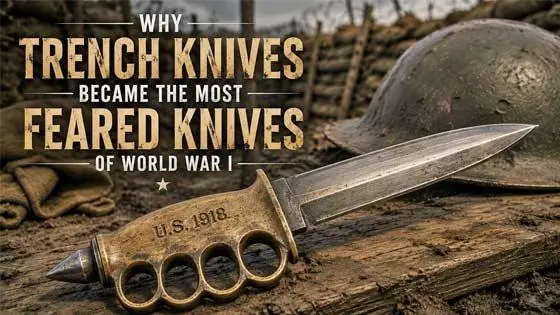
World War I changed warfare forever, but it also changed the weapons soldiers carried into battle. As armies became trapped in miles of narrow, muddy trenches, long rifles with fixed bayonets suddenly became awkward and impractical during brutal hand-to-hand fighting. Soldiers needed something smaller, faster, and devastating at arm's length. The answer was the trench knife, a weapon designed specifically for the terrifying reality of close-quarters combat. Over a century later, trench knives remain some of the most recognizable and controversial fighting knives ever made. But how did they earn such a fearsome reputation, and were they really as effective as history remembers?
What Was a Trench Knife?
A trench knife wasn't simply a military knife with a more intimidating name. It was a weapon designed from the ground up for one purpose: surviving the brutal, close-range fighting that defined World War I. Unlike traditional combat knives, trench knives were compact enough to maneuver inside narrow trenches while remaining sturdy enough to withstand violent hand-to-hand combat. Their design reflected the harsh realities soldiers faced when rifles became too long to swing and there was no room to reload or fix a bayonet.
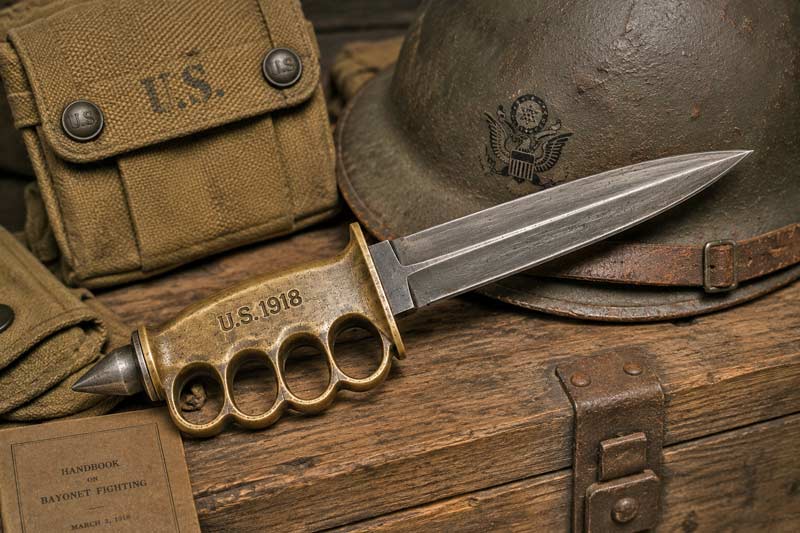
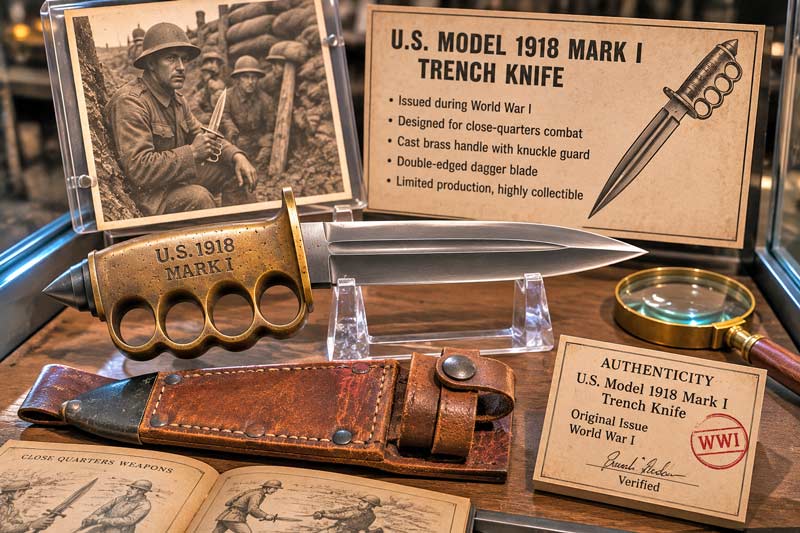
While many countries developed their own versions, the most famous was the American Model 1918 Mark I Trench Knife. It featured a double-edged dagger blade attached to a cast bronze handle with an integrated four-finger knuckle guard. The guard protected the user's hand while also providing additional striking power during close encounters. A pointed steel pommel at the end of the handle could also be used as an impact weapon, making the knife effective even when the blade wasn't being used.
Not every trench knife looked like the iconic Mark I, however. Earlier American models used long triangular blades designed primarily for thrusting, while British, French, and German soldiers often carried a wide variety of fighting knives, many of which were improvised from bayonets, tool steel, or even metal stakes. Despite their differences, they all shared one goal: giving soldiers a weapon they could rely on when combat became too close and too chaotic for firearms.
The trench knife quickly became a symbol of one of history's most unforgiving battlefields. It represented an era when victory often depended not on advanced technology, but on whichever soldier could react first in the confined darkness of a muddy trench.
Why World War I Needed a New Kind of Knife
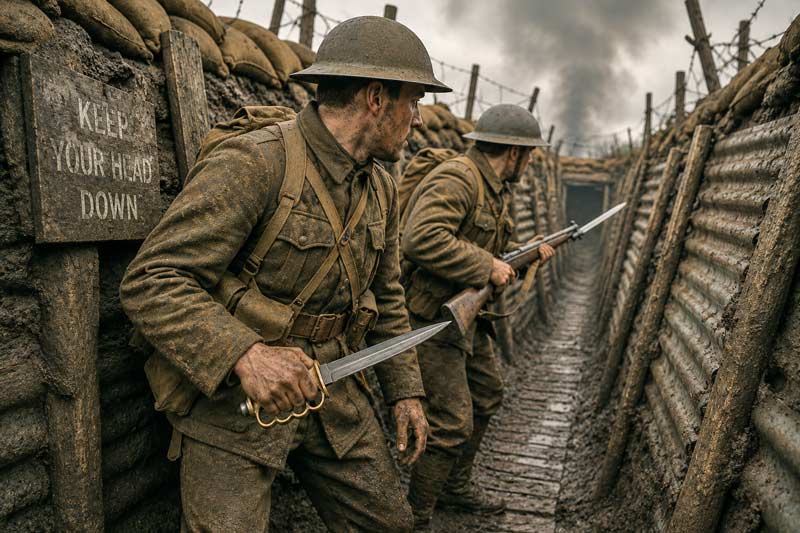
When World War I began in 1914, military leaders expected fast-moving battles similar to those of previous wars. Instead, the conflict quickly turned into a brutal stalemate. Vast networks of trenches stretched across Europe, and soldiers often found themselves fighting in narrow, muddy passages where visibility was poor and every corner could hide an enemy. Weapons that worked well in open fields suddenly became awkward in these cramped conditions.
The standard infantry rifle of the era was long, especially with a fixed bayonet attached. While effective during charges across open ground, these weapons were difficult to maneuver inside a trench that was often only a few feet wide. Swinging a rifle around a sharp corner or using it against an opponent just inches away could be nearly impossible. Soldiers needed something they could draw quickly and use without worrying about the length of the weapon.
As a result, many troops began improvising. They modified bayonets into shorter fighting knives, sharpened entrenching tools, and even created crude weapons from steel rods, metal stakes, or discarded equipment. These homemade trench weapons reflected the desperate reality of trench warfare. If a soldier found something that worked better than his issued equipment, it was often carried into the next raid.
Military planners soon realized that purpose-built close-combat weapons were necessary. Several countries responded by developing official trench knives designed specifically for hand-to-hand fighting. These knives emphasized durability, quick handling, and powerful thrusting ability over the utility features found on traditional field knives. Some designs even incorporated reinforced guards or knuckle grips to protect the user's hand during violent encounters.
The emergence of the trench knife wasn't driven by innovation for its own sake. It was a direct response to one of the harshest combat environments in modern history. Every feature, from the compact blade to the reinforced handle, was shaped by the unforgiving realities of fighting in the muddy trenches of the Western Front.
The Iconic U.S. Model 1918 Mark I Trench Knife
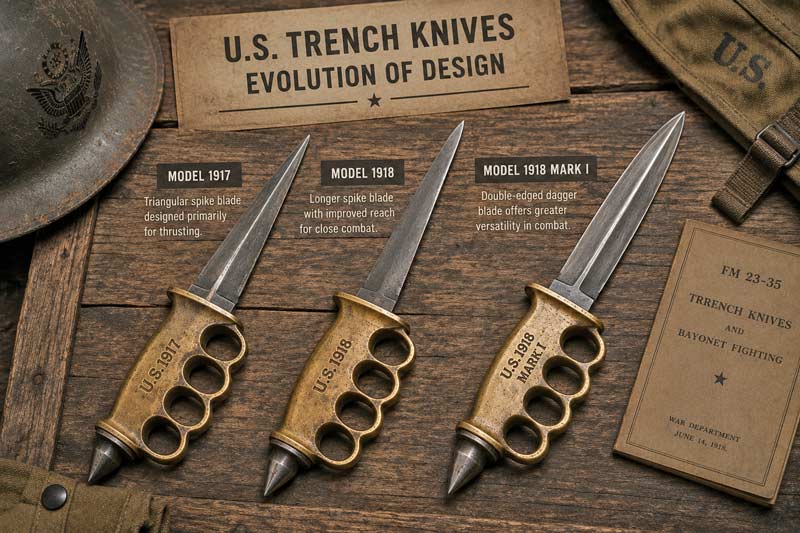
Of all the weapons associated with trench warfare, few are as instantly recognizable as the U.S. Model 1918 Mark I trench knife. Its appearance was unlike anything carried by most soldiers at the time. The narrow double-edged blade was paired with a cast metal handle that wrapped around the fingers, creating a weapon that looked part dagger and part knuckle weapon.
The four-finger guard served more than one purpose. It helped protect the hand during close combat, gave the user a more secure grip in wet or muddy conditions, and allowed the handle itself to be used as an impact weapon. At the opposite end, the pointed pommel added another striking surface, meaning nearly every part of the knife had a combat function.
The Mark I was also a major improvement over earlier American trench knives. The Model 1917 and Model 1918 designs used long triangular spike blades that were effective for thrusting but had little cutting ability. The Mark I replaced that spike with a conventional double-edged dagger blade, making it far more versatile while preserving the aggressive knuckle-guard design.
Despite becoming the most famous American trench knife of the war, the Mark I arrived late. Large-scale production did not begin until near the end of World War I, and many examples never reached the front before the fighting stopped in November 1918. Its reputation would ultimately grow more from its intimidating design, later military use, and popularity among collectors than from widespread action in the trenches.
That timing created one of the great ironies of the Mark I. It became the defining image of the World War I trench knife even though simpler knives, sharpened tools, modified bayonets, and earlier spike designs likely saw far more actual combat.
How Trench Knives Earned Their Fearsome Reputation
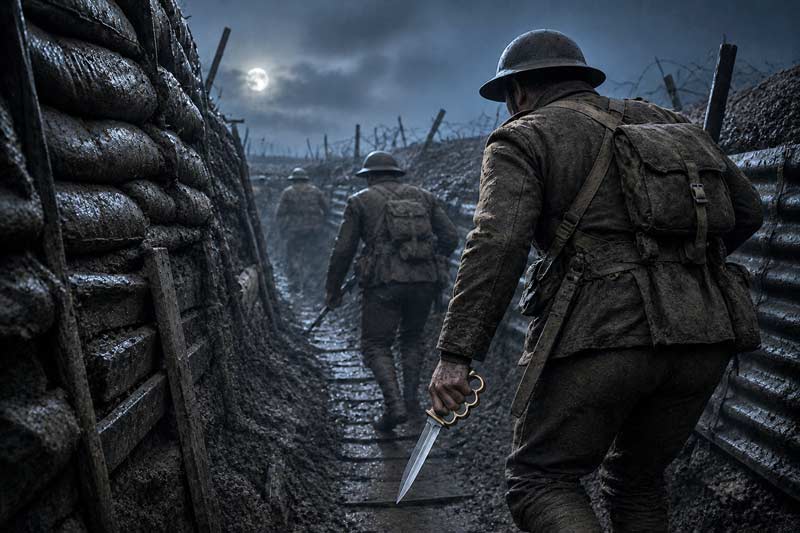
The trench knife became feared not because it was the most advanced weapon of World War I, but because of where and how it was used. Trench raids often happened at night, when small groups of soldiers crossed no man's land and entered enemy positions with little warning. In the darkness and confusion, rifles could be too slow, too loud, or too cumbersome. A compact knife offered something firearms could not: silence, speed, and complete freedom of movement inside the narrow trench walls.
Its appearance also contributed to its reputation. The Model 1918 Mark I combined a dagger blade, a four-finger knuckle guard, and a pointed pommel in a single weapon. Even before it was used, the design looked brutally purposeful. Unlike a field knife that could also cut rope or prepare food, the Mark I left little doubt about what it had been created to do.
The fear surrounding trench knives was also psychological. Soldiers already lived under constant threat from artillery, snipers, gas attacks, and sudden raids. The thought of an enemy silently entering the trench with a dedicated close-combat weapon added another layer of terror. In that environment, reputation mattered almost as much as actual performance.
Stories from the war often blurred the line between fact and legend. Homemade clubs, sharpened shovels, bayonets, and improvised knives were all used during trench raids, but the most dramatic accounts tended to focus on specially designed fighting knives. Over time, those stories helped turn the trench knife into a symbol of the war's most savage moments.
Ironically, the most recognizable trench knife may not have been the one soldiers encountered most often. The Mark I arrived late and was produced in limited numbers compared with simpler fighting knives and improvised weapons. Yet its aggressive design was so memorable that it came to represent an entire category of weapons and one of the darkest forms of combat from World War I.
Did Trench Knives Actually Work Well?
Trench knives were effective within the narrow role they were designed to fill, but they were far from perfect. In confined spaces, their compact size made them easier to maneuver than a rifle or bayonet. They could be drawn quickly, used with one hand, and carried without interfering with other equipment. For soldiers moving through tight trenches, dugouts, and underground positions, those advantages were real.
The Mark I's knuckle guard also gave the user a secure grip and helped prevent the knife from slipping in wet or muddy conditions. The pointed pommel and heavy metal handle gave the weapon more versatility at extremely close range. On paper, it was an efficient design that combined several close-combat functions into one compact weapon.
In practice, however, the same features that made the Mark I intimidating also created problems. The cast metal grip was heavy and uncomfortable during prolonged use. Its finger openings could restrict movement, especially for soldiers wearing gloves or those with larger hands. If the handle became damaged, bent, or clogged with mud, it could be harder to grip or release quickly.
The double-edged blade also offered less utility than a conventional field knife. It could perform basic cutting tasks, but its narrow dagger shape was optimized for combat rather than opening crates, cutting rope, preparing food, or handling daily camp chores. Soldiers often preferred a simpler knife that could serve both as a weapon and as a practical tool.
The trench knife worked best as a specialized weapon for a specific kind of fighting. It was compact, durable, and frighteningly direct, but it was never the ideal all-purpose knife. That tradeoff explains why later military designs moved away from integrated knuckle guards and toward more versatile fixed-blade knives that could handle both combat and field use.
Why Trench Knives Disappeared After the War
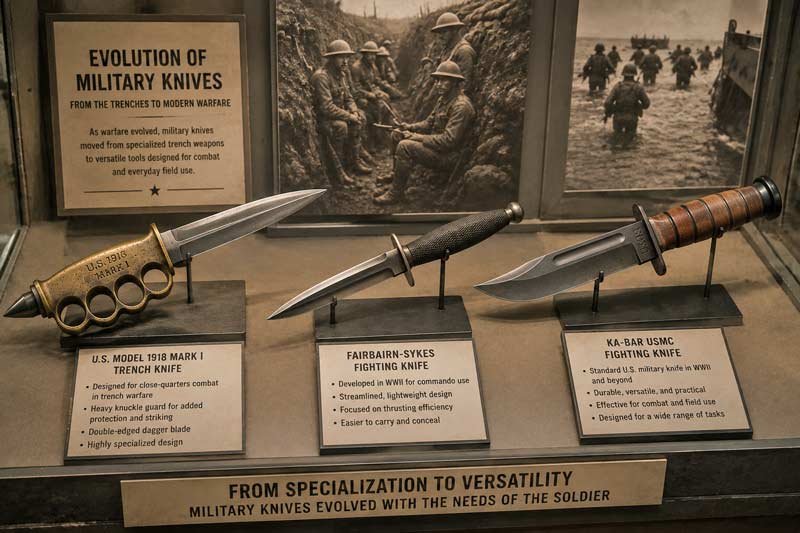
When World War I ended, so did the unique battlefield conditions that had inspired the trench knife. The vast networks of muddy trenches that stretched across Europe gradually disappeared, and military planners began preparing for a more mobile style of warfare. As tactics evolved, soldiers once again needed equipment that could perform a variety of tasks instead of excelling at only one.
That shift exposed the trench knife's biggest weakness: it was highly specialized. The heavy knuckle guard and double-edged dagger blade worked well during close-quarters fighting, but they added weight without improving the knife's usefulness for everyday military chores. Opening ammunition crates, cutting rope, preparing food, and countless other camp tasks were all easier with a conventional field knife.
Military designers took notice. By World War II, most armies favored simpler fighting knives that balanced combat effectiveness with practical utility. Knives such as the American KA-BAR and the British Fairbairn-Sykes fighting knife demonstrated two different approaches, but both abandoned the bulky integrated knuckle guard of the Mark I. These newer designs were lighter, easier to manufacture, and more versatile in a wide range of environments.
The trench knife never completely disappeared, however. Many veterans kept theirs as souvenirs, while collectors became fascinated by their unusual appearance and limited production numbers. Original Model 1918 Mark I trench knives are now among the most sought-after military knives from World War I, with well-preserved examples often commanding impressive prices among collectors.
Today, the trench knife survives less as a battlefield weapon and more as a symbol of one of history's harshest conflicts. Its unmistakable silhouette continues to represent the desperate, close-range fighting that defined the trenches of World War I, ensuring its legacy long after its military role came to an end.
Why Collectors Still Love Trench Knives Today
Trench knives have long outlived the battlefield conditions that created them, but their appeal has only grown. To collectors, they represent more than an unusual military weapon. They capture a specific moment in history when armies were forced to adapt quickly to a form of warfare no one had fully anticipated. Every feature of the design tells part of that story.
The Model 1918 Mark I is especially desirable because of its unmistakable appearance. The cast metal knuckle guard, dagger blade, and pointed pommel make it one of the easiest military knives to recognize. Even people with little knowledge of historic weapons can usually tell that it was built for a very specific purpose.
Scarcity also plays a major role. Original examples were produced during a narrow period, and many were lost, damaged, modified, or heavily worn after the war. Complete knives with their original scabbards, clear manufacturer markings, and minimal restoration are far harder to find. Those details can make a major difference in authenticity and collector value.
That popularity has also created a market filled with reproductions. Some are clearly sold as modern replicas, while others are artificially aged or given misleading markings. Experienced collectors study handle construction, blade shape, stamps, materials, and scabbard details carefully before assuming a trench knife is original.
Ultimately, the fascination comes from the combination of history and design. The trench knife is compact, visually dramatic, and closely tied to one of the most infamous battlefields ever created. Few weapons communicate their era and intended purpose as clearly, which is why they continue to attract military historians and knife collectors more than a century after World War I ended.
Why the Trench Knife Still Defines World War I Combat
The trench knife did not win battles, replace the rifle, or transform military strategy. Its importance came from something more unsettling. It was created for the moment when modern warfare stopped feeling modern, when artillery, machine guns, and barbed wire gave way to soldiers confronting one another at arm's length inside a narrow trench.
That is why its reputation has endured. The trench knife represents the deeply personal side of a war usually remembered for weapons that killed from a distance. Its compact blade, reinforced grip, and aggressive design reflected a battlefield where hesitation could be fatal and conventional equipment was not always enough.
The famous Model 1918 Mark I may have arrived too late to become the dominant weapon of the trenches, but its appearance captured the nature of trench warfare better than almost any other object. It looked improvised and industrial at the same time, combining a dagger, hand guard, and striking pommel into one uncompromising design.
In reality, soldiers carried many different close-combat weapons, including modified bayonets, clubs, sharpened tools, and simpler fighting knives. Yet none became as closely associated with the trenches as the Mark I. Its legacy was shaped as much by symbolism as battlefield use.
More than a century later, trench knives remain feared, collected, and instantly recognizable because they reveal what World War I demanded from the soldiers trapped inside its battlefields. They were not elegant weapons created for ceremony or tradition. They were desperate tools built for one of the most brutal environments in military history.
Did soldiers actually use trench knives in World War I?
Yes. Soldiers from several countries carried trench knives during World War I, although not all of them were official military issue. Many troops used improvised fighting knives made from shortened bayonets, metal spikes, or workshop-made blades, while others received purpose-built trench knives from their armies. The famous U.S. Model 1918 Mark I became the best-known design, but because it entered production late in the war, simpler trench knives and homemade weapons likely saw more combat than the iconic Mark I itself.
Were trench knives legal under the rules of war?
The legality of trench knives has been debated for decades. During World War I, there was no specific international treaty that banned trench knives themselves. However, Germany protested several weapons, including the American Model 1918 Mark I, arguing that its knuckle guard and specialized design caused unnecessary suffering. The United States rejected those objections, noting that the knife was simply another close-combat weapon used during a conflict in which soldiers already faced bayonets, clubs, entrenching tools, and improvised fighting weapons. Although the controversy added to the trench knife's fearsome reputation, there is no evidence that it was ever formally outlawed under the laws of war.
Why did trench knives have brass knuckle handles?
The integrated knuckle guard wasn't included simply to make the knife look intimidating. It served several practical purposes. First, it protected the user's fingers during close combat, reducing the chance of the hand slipping onto the blade or being injured during a strike. Second, the heavy metal guard provided a more secure grip in wet, muddy conditions that were common in the trenches. Finally, it allowed the knife to function as an impact weapon if there wasn't enough room to use the blade effectively. While this multi-purpose design was innovative for its time, it also made the knife heavier and less practical for everyday military tasks, which is one reason later combat knives abandoned the integrated knuckle guard.
Are original World War I trench knives valuable today?
Yes. Authentic World War I trench knives, especially original U.S. Model 1918 Mark I examples, are highly sought after by military collectors. Their value depends on factors such as condition, originality, manufacturer markings, and whether the original scabbard is included. Because relatively few survived in excellent condition, well-preserved examples can command significant prices. Collectors should be cautious, however, because reproduction trench knives are common, and some have been artificially aged to resemble genuine World War I artifacts. Learning how to identify original markings and construction details is one of the best ways to avoid purchasing a fake.
Did other countries use trench knives besides the United States?
Absolutely. While the U.S. Model 1918 Mark I is the most recognizable trench knife today, it was far from the only design used during World War I. British, French, German, Italian, and other armies all developed or issued close-combat knives suited for trench fighting. Some were factory-produced military weapons, while others were improvised from shortened bayonets, old tool blades, or locally made daggers. The designs varied widely, but they all reflected the same battlefield reality: soldiers needed compact, dependable weapons that could be used quickly in the cramped, chaotic conditions of trench warfare.
Can you legally own a trench knife today?
In many places, yes, but the laws vary widely depending on where you live. Some states and countries treat trench knives like ordinary fixed-blade knives, while others regulate or prohibit them because of features such as the integrated knuckle guard. In some jurisdictions, the brass knuckle-style handle may be restricted even if the blade itself would otherwise be legal. If you're considering purchasing or carrying a trench knife, it's important to check your local and state laws before doing so. Collecting an antique for display may also be subject to different rules than carrying one for self-defense or everyday use.
What is the difference between a trench knife and a combat knife?
Although the terms are sometimes used interchangeably, they describe different types of military knives. A trench knife was designed specifically for the close-quarters fighting common during World War I, where soldiers often battled in narrow trenches with very little room to maneuver. These knives frequently featured reinforced guards, knuckle grips, or striking pommels to maximize effectiveness at extremely short range. Combat knives, on the other hand, evolved into more versatile field tools. Later military designs emphasized lighter weight, better balance, and the ability to perform everyday tasks such as cutting rope, preparing equipment, and general utility work, while still serving as effective fighting knives when necessary.
You May Also Be Interested In:
- How Switchblades Became the Most Feared Knives in America
- The World's Most Famous Knives and the Stories Behind Them
- How Different Cultures Shaped the World's Most Famous Knives
- Why Are Throwing Knives Shaped Differently From Regular Knives?
- Military Trench Cleaver and Other Dangerous Weapons
- A Brief History of the Push Dagger: From Trench Warfare to Modern EDC
- 12 Fixed Blade Knives You Should Know About
- Why Karambit Knives Are So Effective
- 6 Unusual Folding Knives
- Can Butterfly Knives be used for Combat?
Leave a Reply