




The World's Most Famous Knives and the Stories Behind Them
June 10th, 2026
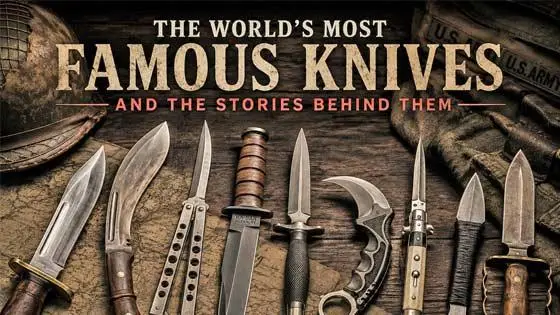
Some knives are just tools. Others become something bigger.
Over time, a handful of blades have managed to build reputations that stretch far beyond their original purpose. Some earned legendary status on battlefields. Others became symbols of survival, self-defense, rebellion, or craftsmanship. A few gained worldwide fame through movies, military history, or stories so dramatic that separating fact from myth has become almost impossible.
Over time, a handful of blades have managed to build reputations that stretch far beyond their original purpose. Some earned legendary status on battlefields. Others became symbols of survival, self-defense, rebellion, or craftsmanship. A few gained worldwide fame through movies, military history, or stories so dramatic that separating fact from myth has become almost impossible.
From the massive Bowie knife carried on the American frontier to the curved kukri associated with Gurkha warriors, famous knives often tell us just as much about the people who carried them as the blades themselves. Even modern designs like automatic and OTF knives have developed loyal followings and larger-than-life reputations, sometimes helped along by pop culture and plenty of misconceptions.
In this guide, we're looking at some of the world's most famous knives, how they became iconic, and the stories that turned simple blades into legends.
Thousands of knife designs have existed throughout history, yet only a small number become household names. Most disappear into obscurity, remembered only by collectors or historians. The knives people still recognize decades or even centuries later usually earned their reputations through something much bigger than cutting ability alone.
Sometimes a knife becomes famous because it changed warfare. The Roman gladius helped shape an empire. The kukri became closely associated with the fearsome reputation of Gurkha soldiers. Military knives often gain legendary status because of the stories carried home by the people who depended on them in life-or-death situations.
Other blades rise to fame through culture and mythology. The Bowie knife became a symbol of the American frontier long before modern knives existed. Butterfly knives gained an almost rebellious mystique thanks to movies, martial arts culture, and endless rumors about their speed and danger. Even modern designs like automatic knives and OTF knives owe part of their popularity to public fascination, curiosity, and more than a little misunderstanding. If you have ever wondered what an OTF knife actually is or how they became so iconic, their story is surprisingly complicated.
As we go through this list, one thing becomes clear: the world's most famous knives are rarely just tools. They become symbols of survival, power, craftsmanship, military service, or sometimes pure myth. And no knife may represent that better than the blade that helped define the American frontier.
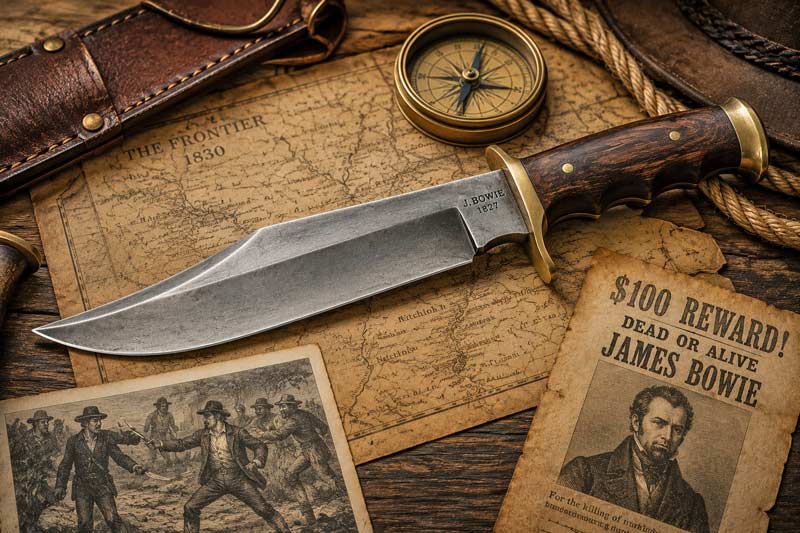
Few knives carry the kind of reputation attached to the Bowie knife. Even people with little interest in knives have usually heard the name. That kind of recognition is rare, especially for a design that dates back nearly 200 years.
The Bowie knife traces its origins to the early 1800s and the famously larger-than-life frontiersman Jim Bowie. While historians still debate the exact details of who designed the original knife, one thing is clear: Bowie's reputation exploded after the infamous Sandbar Fight in 1827, a violent duel-turned-brawl in Mississippi where he reportedly survived multiple gunshots and stab wounds while fighting back with a massive blade. Newspapers turned the event into legend, and suddenly people across America wanted a "Bowie knife."
That popularity quickly transformed the knife into something bigger than a weapon. During the American frontier era, a Bowie knife represented self-reliance. Hunters carried them. Travelers packed them for protection. Soldiers brought them into combat. Blacksmiths began crafting wildly different versions, from oversized fighting knives to practical camp blades.
Part of what makes Bowie knives so fascinating is that there has never been one exact definition. Some have clip points, some are enormous, and others resemble oversized hunting knives. The common thread is a large fixed blade built for serious use. Today, the debate about what truly counts as a Bowie knife is still alive, especially when comparing them to traditional hunting knives. We actually break down some of those differences in our guide to Bowie knife vs. hunting knife.
Despite being nearly two centuries old, Bowie knives remain incredibly popular. In fact, many modern knife enthusiasts still collect and carry them because they combine history, rugged utility, and unmistakable style in a way few blades can match. If you want to see how the design evolved over time, you can browse modern Bowie knives here and see just how many interpretations of the classic blade now exist.
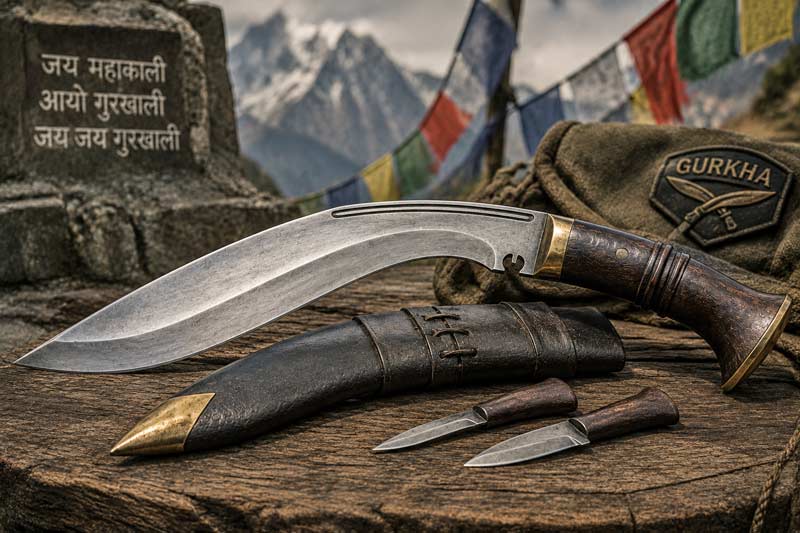
Some knives become famous because of movies. Others earn their reputation through centuries of real-world use. The kukri falls firmly into the second category.
Recognizable almost instantly by its forward-curving blade, the kukri has long been associated with the Gurkhas of Nepal, elite soldiers whose battlefield reputation borders on legendary. Stories about Gurkha fighters spread throughout the 19th and 20th centuries, especially during British military campaigns, where tales of courage, toughness, and brutal close-quarters combat made the kukri nearly as famous as the soldiers who carried it.
What makes the kukri so fascinating is that it was never designed as a dedicated fighting knife. In Nepal, it served as an everyday tool long before becoming a military icon. Farmers used it for clearing brush, chopping wood, preparing food, and general work around villages. That practical design turned out to be surprisingly effective in combat. The blade's forward weight gives it chopping power that feels almost closer to a hatchet than a traditional knife.
Over time, stories about the kukri took on an almost mythical quality. One rumor you still hear today claims that a kukri cannot be returned to its sheath without drawing blood. While dramatic, historians generally view that idea as folklore rather than military reality. Still, myths like that helped build the blade's intimidating reputation.
Today, kukris remain popular among collectors, outdoors enthusiasts, and people who appreciate blades with real historical roots. If you have ever wondered why the shape looks so different from most knives, we take a deeper look at what a kukri knife is and what it is used for, including why its unusual curve makes more sense than it first appears.
The kukri is proof that some legendary knives are not famous because they looked impressive. They became famous because people trusted them in situations where failure was not an option.
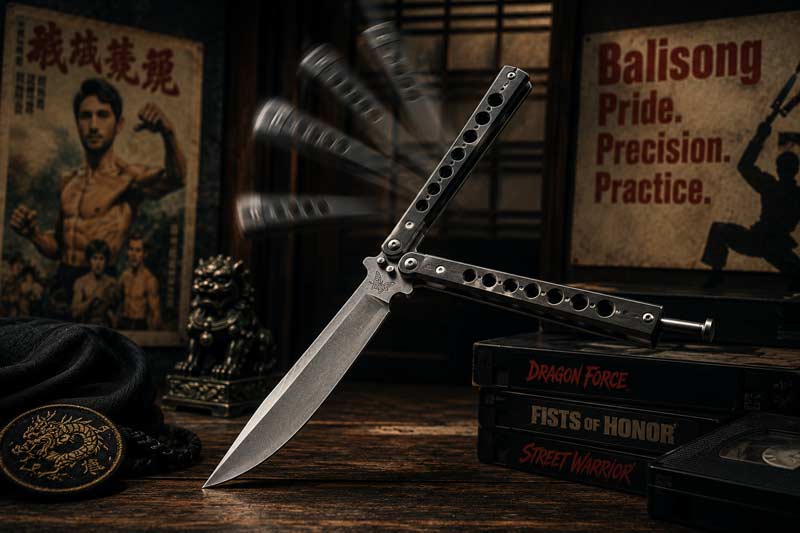
Few knives have a reputation quite like the butterfly knife. Also known as a balisong, it somehow managed to become equal parts martial arts icon, movie prop, collector's item, and subject of public controversy. Even people who know very little about knives usually recognize one the moment they see the handles flipping around a blade.
The butterfly knife traces its roots back to the Philippines, although exactly where the design originated is still debated. Some historians believe early versions were used as practical utility tools, while others argue that much of the popular origin story has been exaggerated over time. Like many famous knives, separating fact from folklore is part of what makes the history so interesting.
Its modern reputation, however, came from somewhere else entirely: speed and spectacle. The balisong's split-handle design allows users to quickly rotate the blade into position using flipping motions that look almost theatrical when done well. Movies, martial arts culture, and internet videos only amplified that mystique. Before long, butterfly knives developed a reputation as something unusually dangerous, even though many knife enthusiasts would argue they are no more inherently threatening than many other folding knives.
That reputation also helped fuel decades of legal restrictions. In some places, butterfly knives became heavily regulated or banned entirely, often grouped together with switchblades and other knives associated with criminal stereotypes. Ironically, many modern enthusiasts are drawn to them less for self-defense and more because they appreciate the skill involved in learning flipping techniques or simply enjoy the engineering behind the design.
If you have ever wondered what technically makes a knife a balisong, or why people use the terms interchangeably, we take a deeper look at what a balisong actually is. And if you want to see how modern designs compare to older styles, you can browse a wide range of butterfly knives here.
For a knife that started as a relatively simple design, the butterfly knife has built one of the biggest personalities in the blade world. Love them or hate them, few knives have left a bigger mark on pop culture.
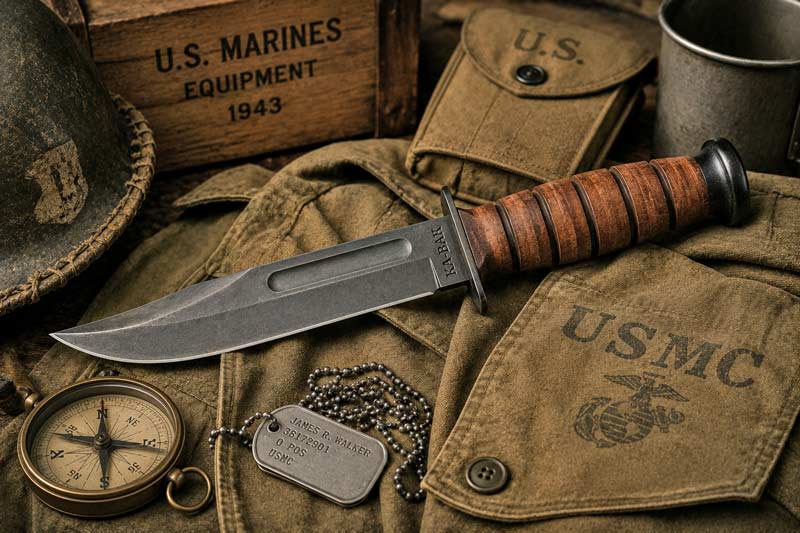
Some famous knives become symbols of a specific era and quietly disappear. The Ka-Bar did the opposite.
Originally adopted by the United States Marine Corps during World War II, the Ka-Bar quickly earned a reputation as one of the toughest combat knives soldiers could carry. Built with a fixed blade, stacked leather handle, and practical clip point design, it was rugged enough for combat while still being useful for the endless day-to-day tasks soldiers faced in the field.
That versatility turned out to be one of the biggest reasons for its staying power. Veterans often described using their Ka-Bar for everything from opening crates and cutting rope to digging, cooking, and survival situations. While officially designed as a fighting knife, it quickly proved itself as an all-purpose field companion.
The knife also benefited from timing. World War II created an entire generation of veterans who came home with stories about the gear they trusted, and the Ka-Bar became deeply tied to the image of American military toughness. Few knives have such a strong connection to a specific branch of service while still remaining instantly recognizable decades later.
Even today, the Ka-Bar still influences countless modern survival and combat knives. If you look at many fixed-blade designs on the market, traces of its DNA are easy to spot. That is one reason military collectors, outdoors enthusiasts, and knife fans still seek them out nearly 80 years after they first gained fame.
Interestingly, the Ka-Bar also highlights a pattern you see with many legendary knives: practical tools often outlast flashy designs. Knives that become trusted in difficult situations tend to build reputations that survive long after trends disappear.
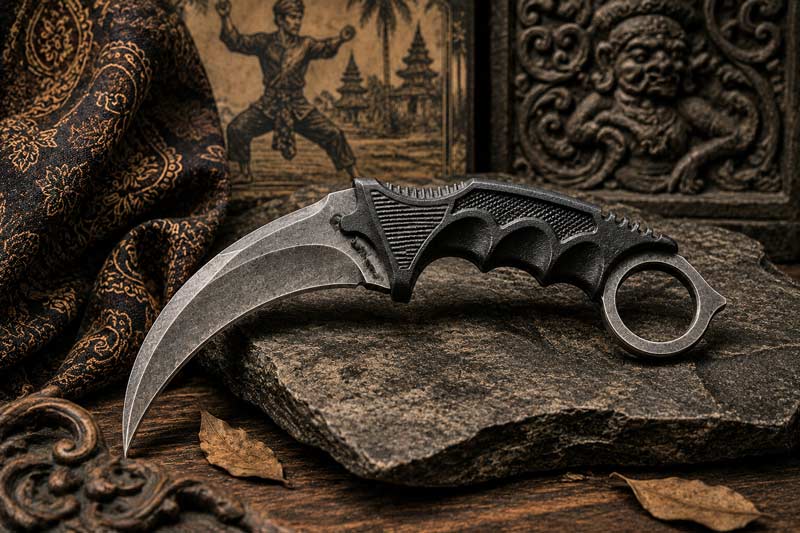
At first glance, the karambit hardly looks practical. The curved blade resembles a claw more than a traditional knife, and the finger ring at the handle makes it look almost futuristic. Yet despite its unusual appearance, the karambit has roots stretching back centuries.
The knife is believed to have originated in Southeast Asia, particularly Indonesia and the Philippines, where early versions were reportedly inspired by the shape and movement of animal claws. Before becoming associated with self-defense or martial arts, the karambit likely served as an agricultural tool used for cutting roots, harvesting crops, and handling smaller precision tasks.
Its reputation changed dramatically once martial arts entered the picture. Systems like Silat helped popularize the karambit as a close-quarters defensive tool, emphasizing controlled movement, retention, and precision. Unlike larger knives designed for chopping or brute force, the karambit became known for maneuverability. The curved blade naturally lends itself to hooking motions, while the finger ring can improve grip retention during fast movement.
Over the last few decades, the karambit has exploded in popularity, helped along by martial arts demonstrations, tactical training, video games, and modern knife culture. Suddenly, a blade that many people had never heard of became instantly recognizable. Today, it sits in an unusual category where historical roots, practical use, and pop culture all overlap.
Of course, popularity also created plenty of myths. Some people assume karambits are purely tactical weapons, while others think they are only useful for martial arts enthusiasts. In reality, like many knife designs, their usefulness depends heavily on context and training. If you are curious about how they evolved and what makes them unique, we go deeper into what a karambit knife actually is and why the shape is so different from most blades.
Whether you see them as functional tools, martial arts equipment, or collectible designs, there is no denying that karambits stand out. Few knives have managed to look this distinctive while still building such a loyal following. You can even see how the design has evolved by browsing modern karambit knives, many of which blend traditional inspiration with modern materials.
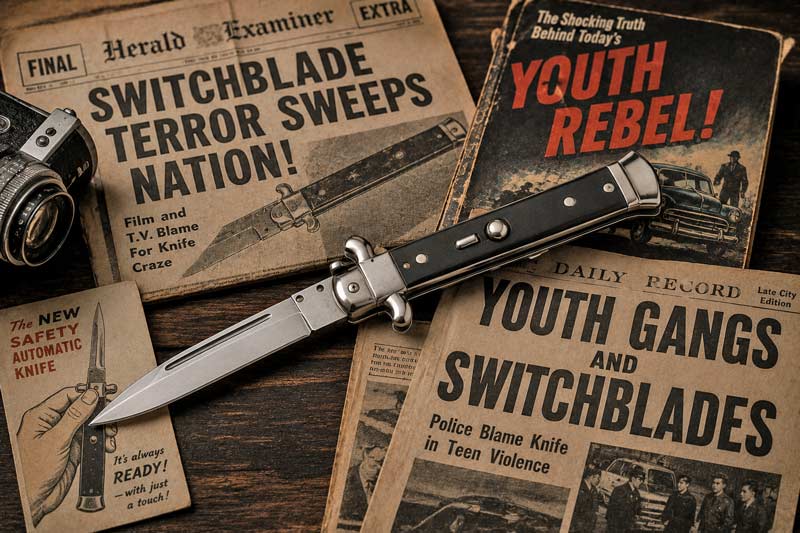
Few knives have experienced a reputation swing quite as dramatic as the switchblade. Depending on who you ask, it is either a practical one-handed tool or one of the most misunderstood knives in modern history.
Automatic knives, often called switchblades, have been around far longer than many people realize. Early spring-assisted designs appeared in Europe during the 1700s, and by the early 20th century, automatic knives were being marketed as useful tools for workers, outdoorsmen, and even people with limited hand mobility who needed easier one-handed opening.
Everything changed in the 1950s.
Suddenly, switchblades became villains in headlines, television, and Hollywood. Sensational stories linked them to youth violence and street gangs, even though the actual connection was often exaggerated. Movies and media turned the knife into a symbol of rebellion, danger, and delinquency. That public fear eventually helped fuel laws restricting switchblades across much of the United States, many of which still influence knife regulations today.
Ironically, modern automatic knives are often appreciated for reasons that have nothing to do with their reputation. Many people simply like the convenience of fast one-handed deployment, especially for everyday tasks. Others enjoy the mechanical precision behind the opening system. If you have ever been curious about the mechanics behind them, we break down how automatic knives actually work and why the spring system is more interesting than many people expect.
The switchblade also helped pave the way for growing interest in modern automatic and OTF knives. While some people still picture outdated stereotypes from old crime dramas, knife enthusiasts tend to see something entirely different: engineering, convenience, and craftsmanship. You can even explore how modern designs evolved by browsing today's automatic knives, many of which look very different from the knives that once caused public panic.
Few blades demonstrate the power of public perception quite like the switchblade. In many ways, its story says just as much about fear and culture as it does about knives themselves.
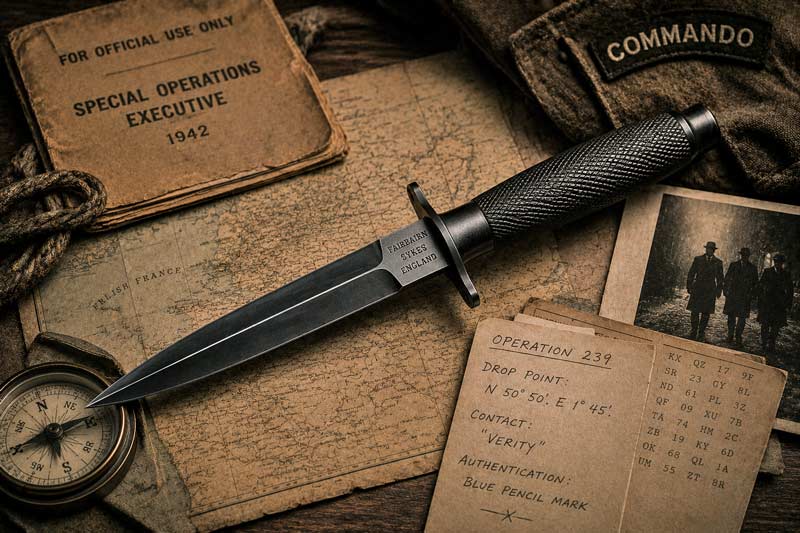
Some famous knives became legends through battlefield survival. Others gained fame because they felt almost mysterious from the beginning. The Fairbairn-Sykes fighting knife belongs firmly in the second category.
Designed during World War II by British military officers William Fairbairn and Eric Sykes, the knife was created with one goal in mind: close-quarters combat. Unlike rugged utility blades such as the Ka-Bar, the Fairbairn-Sykes knife was purpose-built as a fighting weapon. Its slim double-edged blade, narrow profile, and balanced shape were intended for speed and precision rather than chopping or field work.
The knife quickly became associated with elite military units and covert operations. British commandos, special forces, and intelligence operatives carried versions of it during dangerous missions behind enemy lines. Over time, the knife became deeply tied to the image of wartime espionage, sabotage, and secret operations. Even today, it still looks like something pulled straight from a spy novel.
Part of what made the Fairbairn-Sykes knife so memorable was its unmistakable silhouette. Few knives are instantly recognizable from across a room, but the narrow stiletto-like profile helped separate it from the broader survival knives most people picture when they think of military gear. Its design later influenced countless combat daggers and tactical knives that followed.
Interestingly, the knife also highlights an important distinction between famous blades: some are remembered because they were practical tools, while others are remembered because they represented a specific moment in history. The Fairbairn-Sykes knife may not be the most versatile blade ever made, but its connection to wartime strategy and covert operations helped secure its legendary status.
The knife's influence can still be seen in many modern dagger-style blades, especially designs built more for precision than utility. It is proof that sometimes a knife becomes iconic not because millions of people owned one, but because the people who carried it had stories worth remembering.
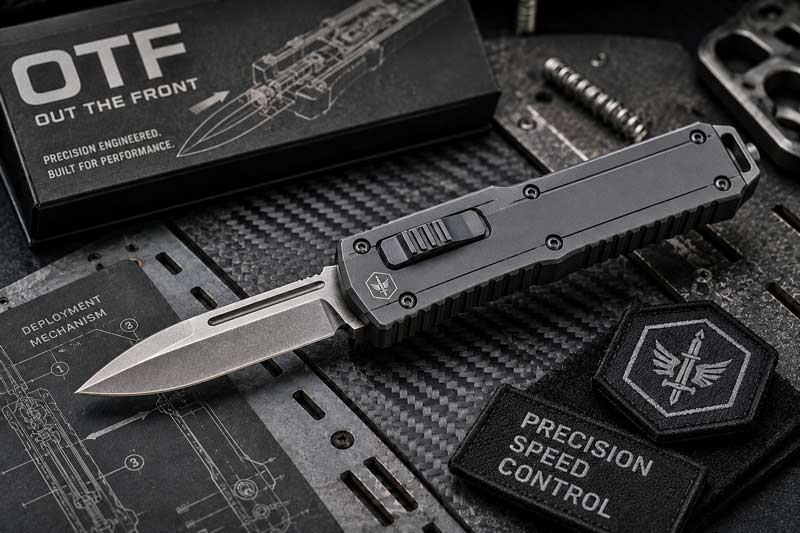
Few knives spark curiosity quite like an OTF knife. Even people who have never handled one usually stop and ask the same question the first time they see it: "How does that even work?"
Short for "out the front," an OTF knife deploys its blade straight out of the handle rather than swinging open like a traditional folding knife. That alone gives it an almost futuristic feel, which is probably one reason it has become one of the most talked-about knife styles in modern times.
Like switchblades before them, OTF knives gained a reputation that often outpaced reality. Movies and television helped turn them into symbols of secret agents, criminals, and tactical professionals, giving many people the impression that they were fragile gimmicks or overly dramatic weapons. In reality, modern OTF knives are often engineered with surprising precision.
One of the biggest misconceptions surrounding OTF knives is reliability. Critics sometimes assume the mechanism makes them too delicate for real-world use, while enthusiasts argue the opposite. The truth falls somewhere in the middle and depends heavily on quality, maintenance, and intended purpose. We take a much deeper look at that debate in our breakdown of whether OTF knives are actually reliable or just cool.
Part of what keeps OTF knives so fascinating is the engineering itself. Springs, locking systems, deployment tracks, and safety mechanisms all work together inside a surprisingly compact space. For many collectors, the appeal has as much to do with the mechanics as the blade itself. If you have ever wondered exactly what separates them from traditional automatics, our guide on what an OTF knife is explains how the design works and why it feels so different from other knives.
The OTF knife may not have centuries of battlefield history behind it like a kukri or Bowie knife, but that has not stopped it from becoming one of the most recognizable blades of the modern era. Sometimes fame comes from history. Sometimes it comes from innovation.
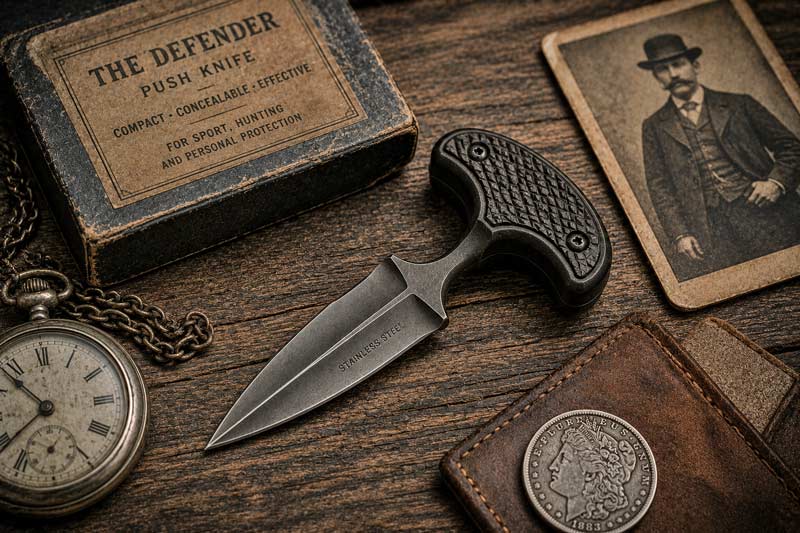
Some knives became famous because armies carried them. Others became symbols of survival or frontier life. The push dagger earned its reputation for a completely different reason: concealment.
Unlike traditional knives, a push dagger is designed with a T-shaped handle that sits in the palm while the blade extends outward between the fingers. It looks unusual at first, especially to people who have never handled one, but the design is intentional. Rather than emphasizing reach or chopping power, push daggers prioritize compactness, retention, and close-range control.
Historically, versions of push daggers gained popularity during the 1800s, particularly in urban settings where compact defensive tools were valued. Small enough to conceal in a pocket or vest, they became associated with personal protection, gamblers, riverboat culture, and occasionally the rougher side of frontier life. That reputation helped fuel both fascination and controversy around the design.
The knife also developed a reputation for practicality in tight spaces. Unlike larger fixed blades, push daggers are compact and difficult to knock from the hand because of the grip position. That design still attracts modern collectors and self-defense enthusiasts today, although opinions about their usefulness vary widely depending on intended purpose and training.
Because they look so different from traditional knives, push daggers often spark curiosity. People tend to either immediately understand the appeal or wonder why anyone would want one in the first place. If you have ever been curious about their design and history, we take a deeper look at what a push dagger actually is and why the unusual handle exists.
The push dagger may never have achieved the mainstream recognition of the Bowie knife or switchblade, but among famous specialty knives, few have built such a distinctive identity. You know one the moment you see it. And that alone says something about how memorable the design became.
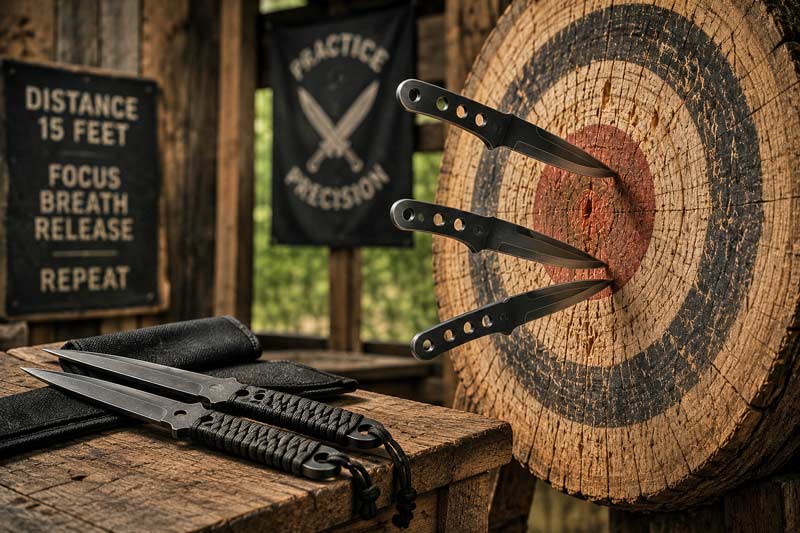
If movies are to be believed, throwing knives are impossibly accurate weapons that can hit targets from across a room with almost supernatural precision. One quick flick of the wrist and somehow the blade lands perfectly every time.
Reality is a little less cinematic.
Throwing knives have existed for centuries in different forms, with historical examples appearing in Africa, Asia, and Europe. Some were designed specifically for throwing, while others doubled as fighting tools. What separates a true throwing knife from an ordinary blade is balance. Most dedicated throwing knives are designed to rotate predictably in flight, giving skilled users a better chance at consistent accuracy.
That word, however, matters: skilled.
Unlike firearms or even traditional knives, throwing knives require repetition, distance control, and patience. Factors like grip, spin, target material, and throwing style all affect whether the blade sticks or harmlessly bounces away. Most beginners discover pretty quickly that real throwing is much harder than Hollywood makes it look.
Even so, throwing knives developed a loyal following because they combine sport, skill, and visual appeal in a way few other blades do. Competitive throwing events exist around the world, and many enthusiasts simply enjoy the challenge of improving accuracy over time. Modern knife throwers often treat it less like combat training and more like a technical hobby similar to archery or axe throwing.
The popularity of ninja culture and action movies also gave throwing knives a huge boost in public awareness. Along the way, many people began lumping all small throwing blades together, including kunai, even though traditional kunai were not originally designed as dedicated throwing weapons. We cover that distinction in our guide to what a kunai actually is and why pop culture changed the way people view them.
For a knife category built around precision, throwing knives have probably suffered more exaggeration than almost any blade on this list. Still, the fascination never really went away. You can see why the hobby continues to attract people by checking out modern throwing knives, many of which are designed specifically for balance and repeatable performance.
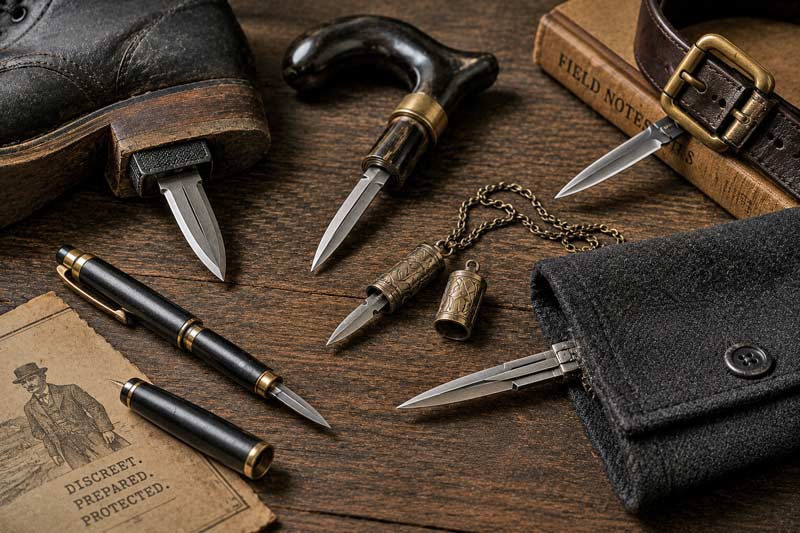
Some knives became famous because soldiers carried them into battle. Others gained popularity through movies or survival culture. Hidden knives occupy a different category entirely. Their reputation comes from mystery.
For centuries, people have found creative ways to conceal blades in plain sight. Small knives hidden in boots, canes, belt buckles, sleeves, necklaces, and even everyday objects have appeared throughout history. In some cases, concealment was practical. Travelers, merchants, and people moving through dangerous areas often wanted a discreet way to protect themselves without carrying an obvious weapon.
Naturally, secrecy helped create fascination. A knife hidden where nobody expects it feels inherently cinematic, which explains why concealed blades became recurring elements in spy stories, martial arts films, and action movies. Whether realistic or exaggerated, the idea of an unexpected defensive tool has always sparked curiosity.
At the same time, hidden knives also picked up a reputation for controversy. Critics often associate them with deception, while collectors tend to appreciate the unusual engineering and creative design involved. The truth, as with many famous knives, depends largely on perspective. Some are novelty pieces, others are practical backup tools, and many simply appeal to people who enjoy unconventional designs.
Modern concealed knives come in countless forms, from compact boot knives to disguised tools built around portability and discretion. If you are curious how creative some of these designs have become, you can browse different styles of hidden knives here and see why the category continues to attract attention.
Hidden knives may never have the battlefield history of a kukri or the cultural recognition of the switchblade, but they tap into something equally powerful: intrigue. Few knife categories make people immediately stop and say, "Wait...that's a knife?"
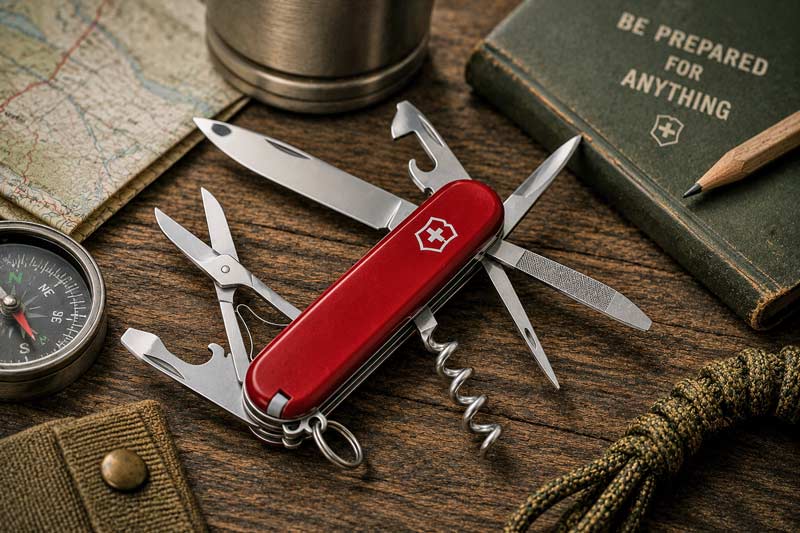
Not every famous knife earned its reputation through war, mystery, or intimidation. Some became legendary because they were simply useful. Few examples prove that better than the Swiss Army knife.
First developed in the late 1800s for Swiss soldiers, the original idea was surprisingly practical. Military recruits needed a compact tool that could help maintain rifles, open food tins, and handle basic camp tasks without carrying a pouch full of separate gear. Instead of creating a specialized fighting knife, designers built something versatile enough for everyday life.
That decision turned out to be brilliant.
Over time, the Swiss Army knife became far more than military equipment. Campers packed them into backpacks. Travelers carried them in luggage. Parents gave them as milestone gifts. Entire generations grew up treating them as a first introduction to knives and basic preparedness. Somewhere along the way, the little red pocketknife stopped being just a tool and became a symbol of resourcefulness.
Its reputation also benefited from something many knives on this list never achieved: universal recognition. Even people who have never owned one understand the phrase "Swiss Army knife" as shorthand for versatility. In fact, people now use the term to describe almost anything that can do multiple jobs, from software to survival gear.
Of course, part of what makes the Swiss Army knife so enduring is that it never tried to be flashy. While many famous blades gained reputations through combat or controversy, this one succeeded because it quietly solved problems. Corkscrew, scissors, screwdriver, blade, tweezers, bottle opener, file, somehow it all worked together in something small enough to fit in your pocket.
In a list filled with intimidating military knives and dramatic stories, the Swiss Army knife stands out for a different reason. It became famous by being dependable, approachable, and endlessly practical. Sometimes legendary status comes from surviving battles. Sometimes it comes from helping people open cans on camping trips for more than a century.
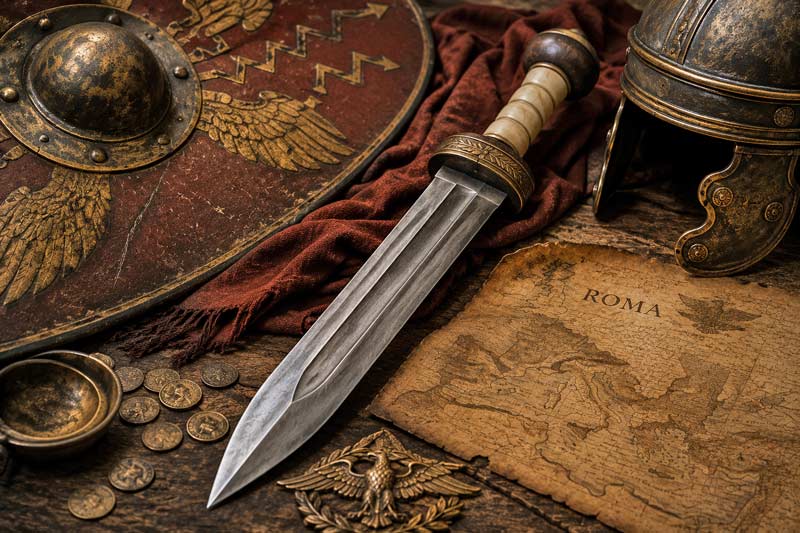
Long before tactical knives, survival blades, or automatic mechanisms existed, one of history's most influential edged weapons was already shaping the world. The Roman gladius may technically fall somewhere between a sword and a very large knife, but its influence is impossible to ignore when talking about famous blades.
Used by Roman soldiers for centuries, the gladius became one of the defining weapons of the Roman Empire. Unlike the long slashing swords many people imagine from movies, the gladius was relatively short and designed for efficiency in close combat. Roman soldiers fought in disciplined formations, often standing shoulder to shoulder behind shields, where shorter blades worked surprisingly well in tight quarters.
What made the gladius so effective was simplicity. Roman fighters were trained to thrust rather than wildly swing, conserving energy while maximizing precision. Historians often credit Roman battlefield discipline as much as the weapon itself, but there is little doubt the gladius played a major role in helping Rome expand across Europe, North Africa, and parts of the Middle East.
The knife also helped establish something that still exists in blade design today: practicality often wins. While enemies sometimes carried larger or more intimidating weapons, the gladius was reliable, compact, and efficient. In many ways, it reflects the same idea behind modern tactical knives, build something dependable that works when conditions are difficult.
Its cultural impact lasted far beyond the battlefield. The gladius became symbolic of Roman military strength, appearing in statues, artwork, films, museums, and historical reenactments for centuries afterward. Even people who know little about Roman history usually recognize the silhouette of a short double-edged blade paired with a shield-bearing soldier.
The Roman gladius reminds us that some famous knives are remembered not because they looked dramatic, but because entire civilizations trusted them. Few blades can claim they helped shape the rise of an empire.
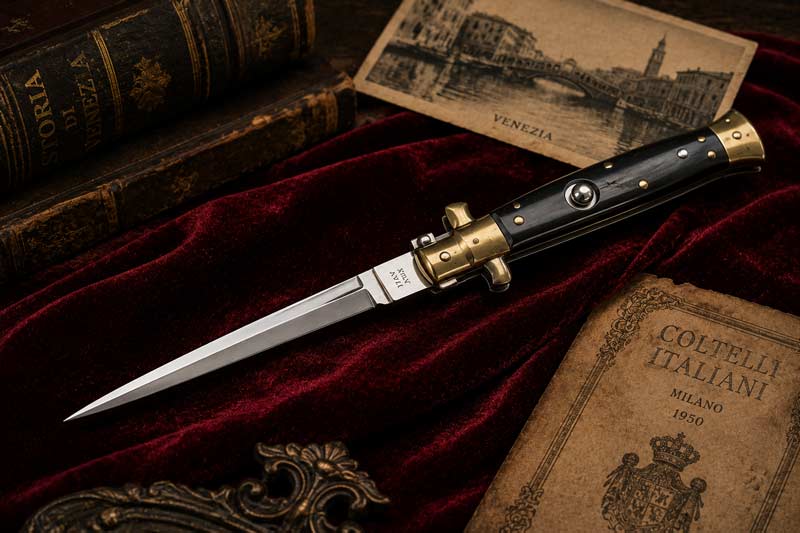
Few knives have managed to look elegant and intimidating at the same time quite like the stiletto. Long, narrow, and sharply pointed, the design feels almost theatrical compared to many of the more rugged utility knives on this list. Yet despite its sleek appearance, the stiletto carries centuries of history and more controversy than most people realize.
The stiletto traces its roots back to Renaissance Italy, where early versions were built primarily for thrusting rather than cutting. Unlike broader utility blades meant for chopping or camp tasks, stilettos emphasized penetration through a slim, needle-like profile. They became associated with duels, personal defense, and political intrigue, particularly during periods when concealed weapons were common in crowded cities.
That dramatic history helped the knife build an almost mythical reputation. By the mid-20th century, stilettos experienced another surge in popularity, especially in automatic form. Italian switchblades with long stiletto blades became symbols of rebellion in movies, newspapers, and pop culture. Suddenly, a knife with centuries-old roots became tied to modern fears about gangs and street crime, helping fuel the same moral panic that surrounded switchblades during the 1950s.
Ironically, much of the stiletto's fame comes from appearance as much as practicality. Knife enthusiasts often admire the sleek profile, traditional craftsmanship, and unmistakable silhouette, while critics sometimes view the design as intimidating or overly dramatic. Few knives trigger such strong reactions before someone even picks one up.
The stiletto also highlights something interesting about famous knives: some become iconic because of function, while others become symbols. Whether appearing in vintage films, collector showcases, or classic Italian knife catalogs, the stiletto developed a personality larger than the blade itself.
For all the controversy surrounding it, the stiletto remains instantly recognizable. In a world full of practical knives, sometimes a blade becomes famous simply because nobody forgets what it looks like.
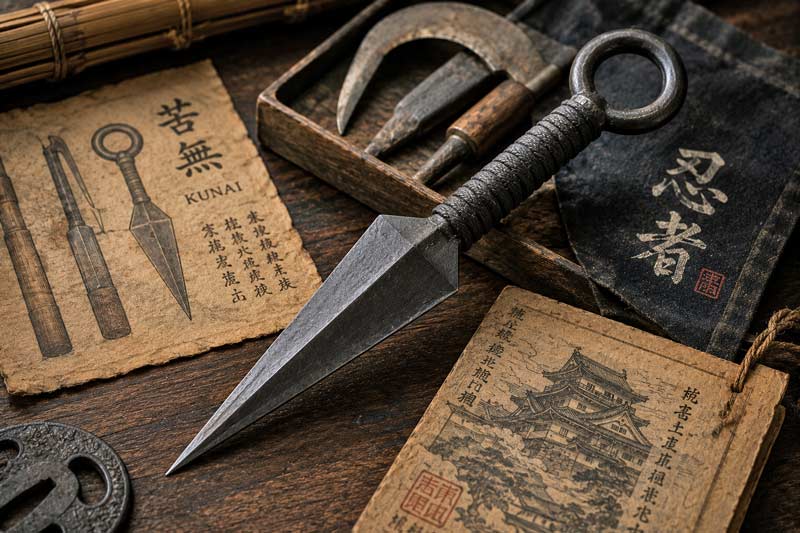
Few blades have been reshaped by pop culture quite like the kunai. Mention the word today and many people immediately picture masked ninjas throwing sleek black daggers with perfect accuracy. The problem is, much of that image has very little to do with the tool's original purpose.
Historically, the kunai was likely much closer to a utility tool than a specialized weapon. Early versions in Japan were simple iron implements used for digging, prying, scraping, and general work. Some historians even compare them to a heavy-duty garden or masonry tool more than a traditional knife. Their blunt practicality is a long way from the dramatic ninja weapon many people imagine today.
That does not mean kunai never had martial applications. Like many everyday tools throughout history, they could certainly be adapted when needed. Their compact size, durable construction, and ringed pommel made them useful in different ways, but the idea that ninjas commonly ran around throwing kunai with pinpoint precision owes much more to movies, comics, and video games than historical evidence.
In fact, modern entertainment probably did more to popularize the kunai than centuries of actual history. Action films, martial arts culture, anime, and gaming transformed a relatively obscure tool into one of the world's most recognizable blade silhouettes. Today, even people with no interest in knives often recognize the distinctive shape immediately.
That gap between myth and reality is part of what makes the kunai so fascinating. Few famous blades highlight the difference between historical use and modern imagination quite as clearly. We actually break down that distinction in more detail in our guide to what a kunai actually is and how it became associated with ninja culture.
The kunai may not have started as the dramatic weapon people picture today, but it still earned a place among famous knives for one simple reason: almost nobody forgets the shape once they have seen it.
After looking at centuries of famous blades, a pattern starts to emerge. The knives people remember are rarely the flashiest or most complicated. More often, they become legendary because they solved a problem, survived history, or developed stories too interesting to forget.
The Bowie knife became tied to the rugged mythology of the American frontier. The kukri earned respect through generations of military use. The Swiss Army knife quietly became one of the most recognizable tools on Earth by simply being useful. Even knives surrounded by controversy, like switchblades and OTF knives, gained fame because public fascination proved stronger than criticism.
Pop culture also plays a surprisingly large role. Movies, television, martial arts, and video games helped transform knives like the butterfly knife, kunai, and karambit into instantly recognizable symbols. In some cases, entertainment amplified reality. In others, it completely reinvented it. Either way, once a blade enters the public imagination, it tends to stay there.
What is especially interesting is how many famous knives balance myth and practicality at the same time. Some designs genuinely earned their reputation through reliability or military use. Others became famous largely because people could not stop telling stories about them. The truth usually lives somewhere in the middle.
And while knife trends come and go, the fascination itself never really disappears. People are naturally drawn to objects with history, craftsmanship, and mystery behind them. That is probably why interest in blades continues to evolve, whether someone is fascinated by historical weapons, practical tools, or modern innovations. If you are curious to explore more styles, you can browse a wide range of modern knives here and see how centuries of blade design still influence what people carry today.
In the end, the world's most famous knives all have one thing in common: they became memorable for reasons bigger than steel. Some shaped empires. Some survived wars. Some inspired movies. And a few became legends simply because nobody ever stopped talking about them.
One of the biggest reasons certain knives become restricted has less to do with how dangerous they actually are and more to do with public perception, historical events, and politics.
Throughout history, knives associated with crime waves, gangs, or sensational media coverage often faced legal scrutiny. Switchblades are probably the best example. During the 1950s, movies, newspapers, and public fear helped turn automatic knives into symbols of youth violence, leading to restrictions in many states even though other knives remained legal.
Design also plays a role. Some lawmakers focus on features like automatic opening mechanisms, concealed carry potential, blade length, or double-edged designs. That is why a perfectly legal folding knife in one state may be restricted somewhere else, while a much larger fixed blade remains completely legal under different circumstances.
The confusing part is that knife laws rarely follow simple logic. Regulations vary dramatically depending on where you live, which means legality often depends more on local laws than the knife itself. A butterfly knife, push dagger, or automatic knife might be legal in one state and heavily restricted in another.
In many cases, famous knives become controversial precisely because they became famous. Once a blade develops a reputation, whether deserved or exaggerated, lawmakers often take notice.
That depends on how you define "famous," but a handful of knives consistently rise to the top.
The Bowie knife is arguably one of the most famous in American history because of its connection to the frontier and Jim Bowie. The Swiss Army knife might be the most universally recognized worldwide thanks to its everyday usefulness and iconic design. From a military perspective, the Ka-Bar became legendary through its connection to World War II and the United States Marine Corps.
Then there are knives famous because of culture rather than battlefield history. The butterfly knife became instantly recognizable through martial arts, movies, and flipping culture. The switchblade built notoriety through decades of headlines and Hollywood portrayals, while the kukri gained worldwide respect through the reputation of Gurkha soldiers.
In truth, there probably is not one definitive answer. The world's most famous knife often depends on whether someone values history, military use, practicality, craftsmanship, or cultural impact most.
One thing is clear, though: the knives people remember tend to have stories attached to them. Famous blades rarely become legendary by accident.
Sometimes yes, but Hollywood often takes creative liberties.
Many famous movie knives are based on real designs that already existed long before cameras got involved. Bowie knives, switchblades, butterfly knives, trench knives, stilettos, and military combat knives all appeared in films because they already carried strong visual identities and cultural reputations.
At the same time, movies frequently exaggerate what knives can realistically do. Oversized survival blades become nearly indestructible. Throwing knives land perfectly every time. Automatic knives open with dramatic sound effects that somehow seem louder than reality. In some cases, filmmakers even combine features from multiple real knives to create something more visually memorable for audiences.
Interestingly, movies can dramatically change public perception. The butterfly knife is a great example. Its appearance in martial arts films and action movies helped transform it from a relatively niche design into one of the most recognizable knives in the world. The same thing happened with switchblades during the mid-20th century, when Hollywood helped fuel public fear around them.
In other words, movies rarely invent knife fame from scratch. More often, they take an existing blade and amplify the legend until it becomes part of pop culture.
Military knives tend to become famous for one simple reason: stories.
When soldiers rely on a specific blade during difficult conditions, whether in war zones, survival situations, or everyday field use, those experiences tend to follow the knife long after the conflict ends. Veterans share stories, collectors preserve history, and over time the knife develops a reputation that feels bigger than the object itself.
The Ka-Bar is a perfect example. It became closely tied to World War II and the U.S. Marine Corps because so many servicemembers depended on it for daily tasks in the field. The kukri gained worldwide recognition through the reputation of Gurkha soldiers, whose battlefield effectiveness helped turn the blade into something almost mythical. Even the Fairbairn-Sykes fighting knife became legendary because of its association with commandos and covert wartime operations.
Practicality matters too. Military knives often become famous because they proved useful under pressure. Flashy designs tend to fade over time, while dependable tools develop loyal followings. A knife trusted in dangerous situations naturally earns credibility that is hard to manufacture through marketing alone.
In many ways, military knives become famous for the same reason historical artifacts do. People are drawn to tools that played a role in real events, especially when those events helped shape history.
There are several strong contenders, but the butterfly knife, kukri, and switchblade probably top the list.
The butterfly knife, also called a balisong, is surrounded by myths about speed, danger, and criminal use. Movies and martial arts culture often made it seem like an unstoppable weapon, while internet debates still argue about its true historical origins and whether many of the common stories are even accurate.
The kukri has its share of legends too. One of the most repeated claims is that a kukri must draw blood before being returned to its sheath. It is a dramatic story, but historians generally view it as folklore rather than a real rule followed by Gurkha soldiers.
Then there is the switchblade, which spent decades portrayed as the preferred weapon of gangs and criminals in movies and headlines. While public fear helped shape knife laws, many enthusiasts argue that much of the panic was exaggerated and driven more by culture than reality.
Interestingly, the knives that develop the most myths are usually the ones people find most fascinating. Once a blade becomes tied to mystery, military history, crime stories, or pop culture, separating fact from fiction gets much harder. In some ways, the myths become part of what keeps the knife famous in the first place.
In this guide, we're looking at some of the world's most famous knives, how they became iconic, and the stories that turned simple blades into legends.
Why Certain Knives Become Famous While Others Are Forgotten
Thousands of knife designs have existed throughout history, yet only a small number become household names. Most disappear into obscurity, remembered only by collectors or historians. The knives people still recognize decades or even centuries later usually earned their reputations through something much bigger than cutting ability alone.
Sometimes a knife becomes famous because it changed warfare. The Roman gladius helped shape an empire. The kukri became closely associated with the fearsome reputation of Gurkha soldiers. Military knives often gain legendary status because of the stories carried home by the people who depended on them in life-or-death situations.
Other blades rise to fame through culture and mythology. The Bowie knife became a symbol of the American frontier long before modern knives existed. Butterfly knives gained an almost rebellious mystique thanks to movies, martial arts culture, and endless rumors about their speed and danger. Even modern designs like automatic knives and OTF knives owe part of their popularity to public fascination, curiosity, and more than a little misunderstanding. If you have ever wondered what an OTF knife actually is or how they became so iconic, their story is surprisingly complicated.
As we go through this list, one thing becomes clear: the world's most famous knives are rarely just tools. They become symbols of survival, power, craftsmanship, military service, or sometimes pure myth. And no knife may represent that better than the blade that helped define the American frontier.
The Bowie Knife: The Blade That Became an American Legend
Few knives carry the kind of reputation attached to the Bowie knife. Even people with little interest in knives have usually heard the name. That kind of recognition is rare, especially for a design that dates back nearly 200 years.
The Bowie knife traces its origins to the early 1800s and the famously larger-than-life frontiersman Jim Bowie. While historians still debate the exact details of who designed the original knife, one thing is clear: Bowie's reputation exploded after the infamous Sandbar Fight in 1827, a violent duel-turned-brawl in Mississippi where he reportedly survived multiple gunshots and stab wounds while fighting back with a massive blade. Newspapers turned the event into legend, and suddenly people across America wanted a "Bowie knife."
That popularity quickly transformed the knife into something bigger than a weapon. During the American frontier era, a Bowie knife represented self-reliance. Hunters carried them. Travelers packed them for protection. Soldiers brought them into combat. Blacksmiths began crafting wildly different versions, from oversized fighting knives to practical camp blades.
Part of what makes Bowie knives so fascinating is that there has never been one exact definition. Some have clip points, some are enormous, and others resemble oversized hunting knives. The common thread is a large fixed blade built for serious use. Today, the debate about what truly counts as a Bowie knife is still alive, especially when comparing them to traditional hunting knives. We actually break down some of those differences in our guide to Bowie knife vs. hunting knife.
Despite being nearly two centuries old, Bowie knives remain incredibly popular. In fact, many modern knife enthusiasts still collect and carry them because they combine history, rugged utility, and unmistakable style in a way few blades can match. If you want to see how the design evolved over time, you can browse modern Bowie knives here and see just how many interpretations of the classic blade now exist.
The Kukri: The Knife That Earned a Fearsome Reputation
Some knives become famous because of movies. Others earn their reputation through centuries of real-world use. The kukri falls firmly into the second category.
Recognizable almost instantly by its forward-curving blade, the kukri has long been associated with the Gurkhas of Nepal, elite soldiers whose battlefield reputation borders on legendary. Stories about Gurkha fighters spread throughout the 19th and 20th centuries, especially during British military campaigns, where tales of courage, toughness, and brutal close-quarters combat made the kukri nearly as famous as the soldiers who carried it.
What makes the kukri so fascinating is that it was never designed as a dedicated fighting knife. In Nepal, it served as an everyday tool long before becoming a military icon. Farmers used it for clearing brush, chopping wood, preparing food, and general work around villages. That practical design turned out to be surprisingly effective in combat. The blade's forward weight gives it chopping power that feels almost closer to a hatchet than a traditional knife.
Over time, stories about the kukri took on an almost mythical quality. One rumor you still hear today claims that a kukri cannot be returned to its sheath without drawing blood. While dramatic, historians generally view that idea as folklore rather than military reality. Still, myths like that helped build the blade's intimidating reputation.
Today, kukris remain popular among collectors, outdoors enthusiasts, and people who appreciate blades with real historical roots. If you have ever wondered why the shape looks so different from most knives, we take a deeper look at what a kukri knife is and what it is used for, including why its unusual curve makes more sense than it first appears.
The kukri is proof that some legendary knives are not famous because they looked impressive. They became famous because people trusted them in situations where failure was not an option.
The Butterfly Knife: From Utility Tool to Pop Culture Legend
Few knives have a reputation quite like the butterfly knife. Also known as a balisong, it somehow managed to become equal parts martial arts icon, movie prop, collector's item, and subject of public controversy. Even people who know very little about knives usually recognize one the moment they see the handles flipping around a blade.
The butterfly knife traces its roots back to the Philippines, although exactly where the design originated is still debated. Some historians believe early versions were used as practical utility tools, while others argue that much of the popular origin story has been exaggerated over time. Like many famous knives, separating fact from folklore is part of what makes the history so interesting.
Its modern reputation, however, came from somewhere else entirely: speed and spectacle. The balisong's split-handle design allows users to quickly rotate the blade into position using flipping motions that look almost theatrical when done well. Movies, martial arts culture, and internet videos only amplified that mystique. Before long, butterfly knives developed a reputation as something unusually dangerous, even though many knife enthusiasts would argue they are no more inherently threatening than many other folding knives.
That reputation also helped fuel decades of legal restrictions. In some places, butterfly knives became heavily regulated or banned entirely, often grouped together with switchblades and other knives associated with criminal stereotypes. Ironically, many modern enthusiasts are drawn to them less for self-defense and more because they appreciate the skill involved in learning flipping techniques or simply enjoy the engineering behind the design.
If you have ever wondered what technically makes a knife a balisong, or why people use the terms interchangeably, we take a deeper look at what a balisong actually is. And if you want to see how modern designs compare to older styles, you can browse a wide range of butterfly knives here.
For a knife that started as a relatively simple design, the butterfly knife has built one of the biggest personalities in the blade world. Love them or hate them, few knives have left a bigger mark on pop culture.
The Ka-Bar: The Military Knife That Refused to Fade Away
Some famous knives become symbols of a specific era and quietly disappear. The Ka-Bar did the opposite.
Originally adopted by the United States Marine Corps during World War II, the Ka-Bar quickly earned a reputation as one of the toughest combat knives soldiers could carry. Built with a fixed blade, stacked leather handle, and practical clip point design, it was rugged enough for combat while still being useful for the endless day-to-day tasks soldiers faced in the field.
That versatility turned out to be one of the biggest reasons for its staying power. Veterans often described using their Ka-Bar for everything from opening crates and cutting rope to digging, cooking, and survival situations. While officially designed as a fighting knife, it quickly proved itself as an all-purpose field companion.
The knife also benefited from timing. World War II created an entire generation of veterans who came home with stories about the gear they trusted, and the Ka-Bar became deeply tied to the image of American military toughness. Few knives have such a strong connection to a specific branch of service while still remaining instantly recognizable decades later.
Even today, the Ka-Bar still influences countless modern survival and combat knives. If you look at many fixed-blade designs on the market, traces of its DNA are easy to spot. That is one reason military collectors, outdoors enthusiasts, and knife fans still seek them out nearly 80 years after they first gained fame.
Interestingly, the Ka-Bar also highlights a pattern you see with many legendary knives: practical tools often outlast flashy designs. Knives that become trusted in difficult situations tend to build reputations that survive long after trends disappear.
The Karambit: From Farming Tool to Martial Arts Icon
At first glance, the karambit hardly looks practical. The curved blade resembles a claw more than a traditional knife, and the finger ring at the handle makes it look almost futuristic. Yet despite its unusual appearance, the karambit has roots stretching back centuries.
The knife is believed to have originated in Southeast Asia, particularly Indonesia and the Philippines, where early versions were reportedly inspired by the shape and movement of animal claws. Before becoming associated with self-defense or martial arts, the karambit likely served as an agricultural tool used for cutting roots, harvesting crops, and handling smaller precision tasks.
Its reputation changed dramatically once martial arts entered the picture. Systems like Silat helped popularize the karambit as a close-quarters defensive tool, emphasizing controlled movement, retention, and precision. Unlike larger knives designed for chopping or brute force, the karambit became known for maneuverability. The curved blade naturally lends itself to hooking motions, while the finger ring can improve grip retention during fast movement.
Over the last few decades, the karambit has exploded in popularity, helped along by martial arts demonstrations, tactical training, video games, and modern knife culture. Suddenly, a blade that many people had never heard of became instantly recognizable. Today, it sits in an unusual category where historical roots, practical use, and pop culture all overlap.
Of course, popularity also created plenty of myths. Some people assume karambits are purely tactical weapons, while others think they are only useful for martial arts enthusiasts. In reality, like many knife designs, their usefulness depends heavily on context and training. If you are curious about how they evolved and what makes them unique, we go deeper into what a karambit knife actually is and why the shape is so different from most blades.
Whether you see them as functional tools, martial arts equipment, or collectible designs, there is no denying that karambits stand out. Few knives have managed to look this distinctive while still building such a loyal following. You can even see how the design has evolved by browsing modern karambit knives, many of which blend traditional inspiration with modern materials.
The Switchblade: The Knife That Sparked a Moral Panic
Few knives have experienced a reputation swing quite as dramatic as the switchblade. Depending on who you ask, it is either a practical one-handed tool or one of the most misunderstood knives in modern history.
Automatic knives, often called switchblades, have been around far longer than many people realize. Early spring-assisted designs appeared in Europe during the 1700s, and by the early 20th century, automatic knives were being marketed as useful tools for workers, outdoorsmen, and even people with limited hand mobility who needed easier one-handed opening.
Everything changed in the 1950s.
Suddenly, switchblades became villains in headlines, television, and Hollywood. Sensational stories linked them to youth violence and street gangs, even though the actual connection was often exaggerated. Movies and media turned the knife into a symbol of rebellion, danger, and delinquency. That public fear eventually helped fuel laws restricting switchblades across much of the United States, many of which still influence knife regulations today.
Ironically, modern automatic knives are often appreciated for reasons that have nothing to do with their reputation. Many people simply like the convenience of fast one-handed deployment, especially for everyday tasks. Others enjoy the mechanical precision behind the opening system. If you have ever been curious about the mechanics behind them, we break down how automatic knives actually work and why the spring system is more interesting than many people expect.
The switchblade also helped pave the way for growing interest in modern automatic and OTF knives. While some people still picture outdated stereotypes from old crime dramas, knife enthusiasts tend to see something entirely different: engineering, convenience, and craftsmanship. You can even explore how modern designs evolved by browsing today's automatic knives, many of which look very different from the knives that once caused public panic.
Few blades demonstrate the power of public perception quite like the switchblade. In many ways, its story says just as much about fear and culture as it does about knives themselves.
The Fairbairn-Sykes Fighting Knife: The Blade Built for Secret Missions
Some famous knives became legends through battlefield survival. Others gained fame because they felt almost mysterious from the beginning. The Fairbairn-Sykes fighting knife belongs firmly in the second category.
Designed during World War II by British military officers William Fairbairn and Eric Sykes, the knife was created with one goal in mind: close-quarters combat. Unlike rugged utility blades such as the Ka-Bar, the Fairbairn-Sykes knife was purpose-built as a fighting weapon. Its slim double-edged blade, narrow profile, and balanced shape were intended for speed and precision rather than chopping or field work.
The knife quickly became associated with elite military units and covert operations. British commandos, special forces, and intelligence operatives carried versions of it during dangerous missions behind enemy lines. Over time, the knife became deeply tied to the image of wartime espionage, sabotage, and secret operations. Even today, it still looks like something pulled straight from a spy novel.
Part of what made the Fairbairn-Sykes knife so memorable was its unmistakable silhouette. Few knives are instantly recognizable from across a room, but the narrow stiletto-like profile helped separate it from the broader survival knives most people picture when they think of military gear. Its design later influenced countless combat daggers and tactical knives that followed.
Interestingly, the knife also highlights an important distinction between famous blades: some are remembered because they were practical tools, while others are remembered because they represented a specific moment in history. The Fairbairn-Sykes knife may not be the most versatile blade ever made, but its connection to wartime strategy and covert operations helped secure its legendary status.
The knife's influence can still be seen in many modern dagger-style blades, especially designs built more for precision than utility. It is proof that sometimes a knife becomes iconic not because millions of people owned one, but because the people who carried it had stories worth remembering.
The OTF Knife: A Modern Blade Surrounded by Curiosity
Few knives spark curiosity quite like an OTF knife. Even people who have never handled one usually stop and ask the same question the first time they see it: "How does that even work?"
Short for "out the front," an OTF knife deploys its blade straight out of the handle rather than swinging open like a traditional folding knife. That alone gives it an almost futuristic feel, which is probably one reason it has become one of the most talked-about knife styles in modern times.
Like switchblades before them, OTF knives gained a reputation that often outpaced reality. Movies and television helped turn them into symbols of secret agents, criminals, and tactical professionals, giving many people the impression that they were fragile gimmicks or overly dramatic weapons. In reality, modern OTF knives are often engineered with surprising precision.
One of the biggest misconceptions surrounding OTF knives is reliability. Critics sometimes assume the mechanism makes them too delicate for real-world use, while enthusiasts argue the opposite. The truth falls somewhere in the middle and depends heavily on quality, maintenance, and intended purpose. We take a much deeper look at that debate in our breakdown of whether OTF knives are actually reliable or just cool.
Part of what keeps OTF knives so fascinating is the engineering itself. Springs, locking systems, deployment tracks, and safety mechanisms all work together inside a surprisingly compact space. For many collectors, the appeal has as much to do with the mechanics as the blade itself. If you have ever wondered exactly what separates them from traditional automatics, our guide on what an OTF knife is explains how the design works and why it feels so different from other knives.
The OTF knife may not have centuries of battlefield history behind it like a kukri or Bowie knife, but that has not stopped it from becoming one of the most recognizable blades of the modern era. Sometimes fame comes from history. Sometimes it comes from innovation.
The Push Dagger: Small Blade, Big Reputation
Some knives became famous because armies carried them. Others became symbols of survival or frontier life. The push dagger earned its reputation for a completely different reason: concealment.
Unlike traditional knives, a push dagger is designed with a T-shaped handle that sits in the palm while the blade extends outward between the fingers. It looks unusual at first, especially to people who have never handled one, but the design is intentional. Rather than emphasizing reach or chopping power, push daggers prioritize compactness, retention, and close-range control.
Historically, versions of push daggers gained popularity during the 1800s, particularly in urban settings where compact defensive tools were valued. Small enough to conceal in a pocket or vest, they became associated with personal protection, gamblers, riverboat culture, and occasionally the rougher side of frontier life. That reputation helped fuel both fascination and controversy around the design.
The knife also developed a reputation for practicality in tight spaces. Unlike larger fixed blades, push daggers are compact and difficult to knock from the hand because of the grip position. That design still attracts modern collectors and self-defense enthusiasts today, although opinions about their usefulness vary widely depending on intended purpose and training.
Because they look so different from traditional knives, push daggers often spark curiosity. People tend to either immediately understand the appeal or wonder why anyone would want one in the first place. If you have ever been curious about their design and history, we take a deeper look at what a push dagger actually is and why the unusual handle exists.
The push dagger may never have achieved the mainstream recognition of the Bowie knife or switchblade, but among famous specialty knives, few have built such a distinctive identity. You know one the moment you see it. And that alone says something about how memorable the design became.
The Throwing Knife: A Weapon Surrounded by Myth
If movies are to be believed, throwing knives are impossibly accurate weapons that can hit targets from across a room with almost supernatural precision. One quick flick of the wrist and somehow the blade lands perfectly every time.
Reality is a little less cinematic.
Throwing knives have existed for centuries in different forms, with historical examples appearing in Africa, Asia, and Europe. Some were designed specifically for throwing, while others doubled as fighting tools. What separates a true throwing knife from an ordinary blade is balance. Most dedicated throwing knives are designed to rotate predictably in flight, giving skilled users a better chance at consistent accuracy.
That word, however, matters: skilled.
Unlike firearms or even traditional knives, throwing knives require repetition, distance control, and patience. Factors like grip, spin, target material, and throwing style all affect whether the blade sticks or harmlessly bounces away. Most beginners discover pretty quickly that real throwing is much harder than Hollywood makes it look.
Even so, throwing knives developed a loyal following because they combine sport, skill, and visual appeal in a way few other blades do. Competitive throwing events exist around the world, and many enthusiasts simply enjoy the challenge of improving accuracy over time. Modern knife throwers often treat it less like combat training and more like a technical hobby similar to archery or axe throwing.
The popularity of ninja culture and action movies also gave throwing knives a huge boost in public awareness. Along the way, many people began lumping all small throwing blades together, including kunai, even though traditional kunai were not originally designed as dedicated throwing weapons. We cover that distinction in our guide to what a kunai actually is and why pop culture changed the way people view them.
For a knife category built around precision, throwing knives have probably suffered more exaggeration than almost any blade on this list. Still, the fascination never really went away. You can see why the hobby continues to attract people by checking out modern throwing knives, many of which are designed specifically for balance and repeatable performance.
The Hidden Knife: Why Concealed Blades Never Lost Their Appeal
Some knives became famous because soldiers carried them into battle. Others gained popularity through movies or survival culture. Hidden knives occupy a different category entirely. Their reputation comes from mystery.
For centuries, people have found creative ways to conceal blades in plain sight. Small knives hidden in boots, canes, belt buckles, sleeves, necklaces, and even everyday objects have appeared throughout history. In some cases, concealment was practical. Travelers, merchants, and people moving through dangerous areas often wanted a discreet way to protect themselves without carrying an obvious weapon.
Naturally, secrecy helped create fascination. A knife hidden where nobody expects it feels inherently cinematic, which explains why concealed blades became recurring elements in spy stories, martial arts films, and action movies. Whether realistic or exaggerated, the idea of an unexpected defensive tool has always sparked curiosity.
At the same time, hidden knives also picked up a reputation for controversy. Critics often associate them with deception, while collectors tend to appreciate the unusual engineering and creative design involved. The truth, as with many famous knives, depends largely on perspective. Some are novelty pieces, others are practical backup tools, and many simply appeal to people who enjoy unconventional designs.
Modern concealed knives come in countless forms, from compact boot knives to disguised tools built around portability and discretion. If you are curious how creative some of these designs have become, you can browse different styles of hidden knives here and see why the category continues to attract attention.
Hidden knives may never have the battlefield history of a kukri or the cultural recognition of the switchblade, but they tap into something equally powerful: intrigue. Few knife categories make people immediately stop and say, "Wait...that's a knife?"
The Swiss Army Knife: The Blade That Became a Global Icon
Not every famous knife earned its reputation through war, mystery, or intimidation. Some became legendary because they were simply useful. Few examples prove that better than the Swiss Army knife.
First developed in the late 1800s for Swiss soldiers, the original idea was surprisingly practical. Military recruits needed a compact tool that could help maintain rifles, open food tins, and handle basic camp tasks without carrying a pouch full of separate gear. Instead of creating a specialized fighting knife, designers built something versatile enough for everyday life.
That decision turned out to be brilliant.
Over time, the Swiss Army knife became far more than military equipment. Campers packed them into backpacks. Travelers carried them in luggage. Parents gave them as milestone gifts. Entire generations grew up treating them as a first introduction to knives and basic preparedness. Somewhere along the way, the little red pocketknife stopped being just a tool and became a symbol of resourcefulness.
Its reputation also benefited from something many knives on this list never achieved: universal recognition. Even people who have never owned one understand the phrase "Swiss Army knife" as shorthand for versatility. In fact, people now use the term to describe almost anything that can do multiple jobs, from software to survival gear.
Of course, part of what makes the Swiss Army knife so enduring is that it never tried to be flashy. While many famous blades gained reputations through combat or controversy, this one succeeded because it quietly solved problems. Corkscrew, scissors, screwdriver, blade, tweezers, bottle opener, file, somehow it all worked together in something small enough to fit in your pocket.
In a list filled with intimidating military knives and dramatic stories, the Swiss Army knife stands out for a different reason. It became famous by being dependable, approachable, and endlessly practical. Sometimes legendary status comes from surviving battles. Sometimes it comes from helping people open cans on camping trips for more than a century.
The Roman Gladius: The Knife That Helped Build an Empire
Long before tactical knives, survival blades, or automatic mechanisms existed, one of history's most influential edged weapons was already shaping the world. The Roman gladius may technically fall somewhere between a sword and a very large knife, but its influence is impossible to ignore when talking about famous blades.
Used by Roman soldiers for centuries, the gladius became one of the defining weapons of the Roman Empire. Unlike the long slashing swords many people imagine from movies, the gladius was relatively short and designed for efficiency in close combat. Roman soldiers fought in disciplined formations, often standing shoulder to shoulder behind shields, where shorter blades worked surprisingly well in tight quarters.
What made the gladius so effective was simplicity. Roman fighters were trained to thrust rather than wildly swing, conserving energy while maximizing precision. Historians often credit Roman battlefield discipline as much as the weapon itself, but there is little doubt the gladius played a major role in helping Rome expand across Europe, North Africa, and parts of the Middle East.
The knife also helped establish something that still exists in blade design today: practicality often wins. While enemies sometimes carried larger or more intimidating weapons, the gladius was reliable, compact, and efficient. In many ways, it reflects the same idea behind modern tactical knives, build something dependable that works when conditions are difficult.
Its cultural impact lasted far beyond the battlefield. The gladius became symbolic of Roman military strength, appearing in statues, artwork, films, museums, and historical reenactments for centuries afterward. Even people who know little about Roman history usually recognize the silhouette of a short double-edged blade paired with a shield-bearing soldier.
The Roman gladius reminds us that some famous knives are remembered not because they looked dramatic, but because entire civilizations trusted them. Few blades can claim they helped shape the rise of an empire.
The Stiletto Knife: The Blade That Became a Symbol of Style and Suspicion
Few knives have managed to look elegant and intimidating at the same time quite like the stiletto. Long, narrow, and sharply pointed, the design feels almost theatrical compared to many of the more rugged utility knives on this list. Yet despite its sleek appearance, the stiletto carries centuries of history and more controversy than most people realize.
The stiletto traces its roots back to Renaissance Italy, where early versions were built primarily for thrusting rather than cutting. Unlike broader utility blades meant for chopping or camp tasks, stilettos emphasized penetration through a slim, needle-like profile. They became associated with duels, personal defense, and political intrigue, particularly during periods when concealed weapons were common in crowded cities.
That dramatic history helped the knife build an almost mythical reputation. By the mid-20th century, stilettos experienced another surge in popularity, especially in automatic form. Italian switchblades with long stiletto blades became symbols of rebellion in movies, newspapers, and pop culture. Suddenly, a knife with centuries-old roots became tied to modern fears about gangs and street crime, helping fuel the same moral panic that surrounded switchblades during the 1950s.
Ironically, much of the stiletto's fame comes from appearance as much as practicality. Knife enthusiasts often admire the sleek profile, traditional craftsmanship, and unmistakable silhouette, while critics sometimes view the design as intimidating or overly dramatic. Few knives trigger such strong reactions before someone even picks one up.
The stiletto also highlights something interesting about famous knives: some become iconic because of function, while others become symbols. Whether appearing in vintage films, collector showcases, or classic Italian knife catalogs, the stiletto developed a personality larger than the blade itself.
For all the controversy surrounding it, the stiletto remains instantly recognizable. In a world full of practical knives, sometimes a blade becomes famous simply because nobody forgets what it looks like.
The Kunai: The Knife Hollywood Completely Reinvented
Few blades have been reshaped by pop culture quite like the kunai. Mention the word today and many people immediately picture masked ninjas throwing sleek black daggers with perfect accuracy. The problem is, much of that image has very little to do with the tool's original purpose.
Historically, the kunai was likely much closer to a utility tool than a specialized weapon. Early versions in Japan were simple iron implements used for digging, prying, scraping, and general work. Some historians even compare them to a heavy-duty garden or masonry tool more than a traditional knife. Their blunt practicality is a long way from the dramatic ninja weapon many people imagine today.
That does not mean kunai never had martial applications. Like many everyday tools throughout history, they could certainly be adapted when needed. Their compact size, durable construction, and ringed pommel made them useful in different ways, but the idea that ninjas commonly ran around throwing kunai with pinpoint precision owes much more to movies, comics, and video games than historical evidence.
In fact, modern entertainment probably did more to popularize the kunai than centuries of actual history. Action films, martial arts culture, anime, and gaming transformed a relatively obscure tool into one of the world's most recognizable blade silhouettes. Today, even people with no interest in knives often recognize the distinctive shape immediately.
That gap between myth and reality is part of what makes the kunai so fascinating. Few famous blades highlight the difference between historical use and modern imagination quite as clearly. We actually break down that distinction in more detail in our guide to what a kunai actually is and how it became associated with ninja culture.
The kunai may not have started as the dramatic weapon people picture today, but it still earned a place among famous knives for one simple reason: almost nobody forgets the shape once they have seen it.
Why Certain Knives Become Legends While Others Disappear
After looking at centuries of famous blades, a pattern starts to emerge. The knives people remember are rarely the flashiest or most complicated. More often, they become legendary because they solved a problem, survived history, or developed stories too interesting to forget.
The Bowie knife became tied to the rugged mythology of the American frontier. The kukri earned respect through generations of military use. The Swiss Army knife quietly became one of the most recognizable tools on Earth by simply being useful. Even knives surrounded by controversy, like switchblades and OTF knives, gained fame because public fascination proved stronger than criticism.
Pop culture also plays a surprisingly large role. Movies, television, martial arts, and video games helped transform knives like the butterfly knife, kunai, and karambit into instantly recognizable symbols. In some cases, entertainment amplified reality. In others, it completely reinvented it. Either way, once a blade enters the public imagination, it tends to stay there.
What is especially interesting is how many famous knives balance myth and practicality at the same time. Some designs genuinely earned their reputation through reliability or military use. Others became famous largely because people could not stop telling stories about them. The truth usually lives somewhere in the middle.
And while knife trends come and go, the fascination itself never really disappears. People are naturally drawn to objects with history, craftsmanship, and mystery behind them. That is probably why interest in blades continues to evolve, whether someone is fascinated by historical weapons, practical tools, or modern innovations. If you are curious to explore more styles, you can browse a wide range of modern knives here and see how centuries of blade design still influence what people carry today.
In the end, the world's most famous knives all have one thing in common: they became memorable for reasons bigger than steel. Some shaped empires. Some survived wars. Some inspired movies. And a few became legends simply because nobody ever stopped talking about them.
FAQ: Why Are Some Knives Illegal While Others Are Not?
One of the biggest reasons certain knives become restricted has less to do with how dangerous they actually are and more to do with public perception, historical events, and politics.
Throughout history, knives associated with crime waves, gangs, or sensational media coverage often faced legal scrutiny. Switchblades are probably the best example. During the 1950s, movies, newspapers, and public fear helped turn automatic knives into symbols of youth violence, leading to restrictions in many states even though other knives remained legal.
Design also plays a role. Some lawmakers focus on features like automatic opening mechanisms, concealed carry potential, blade length, or double-edged designs. That is why a perfectly legal folding knife in one state may be restricted somewhere else, while a much larger fixed blade remains completely legal under different circumstances.
The confusing part is that knife laws rarely follow simple logic. Regulations vary dramatically depending on where you live, which means legality often depends more on local laws than the knife itself. A butterfly knife, push dagger, or automatic knife might be legal in one state and heavily restricted in another.
In many cases, famous knives become controversial precisely because they became famous. Once a blade develops a reputation, whether deserved or exaggerated, lawmakers often take notice.
FAQ: What Is the Most Famous Knife in History?
That depends on how you define "famous," but a handful of knives consistently rise to the top.
The Bowie knife is arguably one of the most famous in American history because of its connection to the frontier and Jim Bowie. The Swiss Army knife might be the most universally recognized worldwide thanks to its everyday usefulness and iconic design. From a military perspective, the Ka-Bar became legendary through its connection to World War II and the United States Marine Corps.
Then there are knives famous because of culture rather than battlefield history. The butterfly knife became instantly recognizable through martial arts, movies, and flipping culture. The switchblade built notoriety through decades of headlines and Hollywood portrayals, while the kukri gained worldwide respect through the reputation of Gurkha soldiers.
In truth, there probably is not one definitive answer. The world's most famous knife often depends on whether someone values history, military use, practicality, craftsmanship, or cultural impact most.
One thing is clear, though: the knives people remember tend to have stories attached to them. Famous blades rarely become legendary by accident.
FAQ: Are Movie Knives Usually Real Designs?
Sometimes yes, but Hollywood often takes creative liberties.
Many famous movie knives are based on real designs that already existed long before cameras got involved. Bowie knives, switchblades, butterfly knives, trench knives, stilettos, and military combat knives all appeared in films because they already carried strong visual identities and cultural reputations.
At the same time, movies frequently exaggerate what knives can realistically do. Oversized survival blades become nearly indestructible. Throwing knives land perfectly every time. Automatic knives open with dramatic sound effects that somehow seem louder than reality. In some cases, filmmakers even combine features from multiple real knives to create something more visually memorable for audiences.
Interestingly, movies can dramatically change public perception. The butterfly knife is a great example. Its appearance in martial arts films and action movies helped transform it from a relatively niche design into one of the most recognizable knives in the world. The same thing happened with switchblades during the mid-20th century, when Hollywood helped fuel public fear around them.
In other words, movies rarely invent knife fame from scratch. More often, they take an existing blade and amplify the legend until it becomes part of pop culture.
FAQ: Why Do Military Knives Become So Famous?
Military knives tend to become famous for one simple reason: stories.
When soldiers rely on a specific blade during difficult conditions, whether in war zones, survival situations, or everyday field use, those experiences tend to follow the knife long after the conflict ends. Veterans share stories, collectors preserve history, and over time the knife develops a reputation that feels bigger than the object itself.
The Ka-Bar is a perfect example. It became closely tied to World War II and the U.S. Marine Corps because so many servicemembers depended on it for daily tasks in the field. The kukri gained worldwide recognition through the reputation of Gurkha soldiers, whose battlefield effectiveness helped turn the blade into something almost mythical. Even the Fairbairn-Sykes fighting knife became legendary because of its association with commandos and covert wartime operations.
Practicality matters too. Military knives often become famous because they proved useful under pressure. Flashy designs tend to fade over time, while dependable tools develop loyal followings. A knife trusted in dangerous situations naturally earns credibility that is hard to manufacture through marketing alone.
In many ways, military knives become famous for the same reason historical artifacts do. People are drawn to tools that played a role in real events, especially when those events helped shape history.
FAQ: What Knife Has the Most Myths Surrounding It?
There are several strong contenders, but the butterfly knife, kukri, and switchblade probably top the list.
The butterfly knife, also called a balisong, is surrounded by myths about speed, danger, and criminal use. Movies and martial arts culture often made it seem like an unstoppable weapon, while internet debates still argue about its true historical origins and whether many of the common stories are even accurate.
The kukri has its share of legends too. One of the most repeated claims is that a kukri must draw blood before being returned to its sheath. It is a dramatic story, but historians generally view it as folklore rather than a real rule followed by Gurkha soldiers.
Then there is the switchblade, which spent decades portrayed as the preferred weapon of gangs and criminals in movies and headlines. While public fear helped shape knife laws, many enthusiasts argue that much of the panic was exaggerated and driven more by culture than reality.
Interestingly, the knives that develop the most myths are usually the ones people find most fascinating. Once a blade becomes tied to mystery, military history, crime stories, or pop culture, separating fact from fiction gets much harder. In some ways, the myths become part of what keeps the knife famous in the first place.
You May Also Be Interested In:
- How Different Cultures Shaped the World's Most Famous Knives
- Why Trench Knives Became the Most Feared Knives of World War I
- The Most Famous Knife Fight in American History
- 10 Weapons Hollywood Made Famous That Would Be Terrible in Real Combat
- Why Are Throwing Knives Shaped Differently From Regular Knives?
- 12 Fixed Blade Knives You Should Know About
- Why Karambit Knives Are So Effective
- 6 Unusual Folding Knives
- Why Automatic Knives Belong in Your EDC
- How Automatic Knives Actually Work
Leave a Reply