




What Is a Push Dagger? History, Design, and Modern Uses
May 14th, 2026
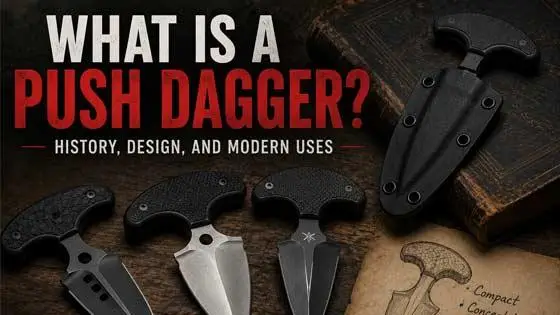
Push daggers are one of the most distinctive knife designs ever created because of their unusual T-shaped handle and compact blade profile. Unlike traditional knives that extend straight out from the grip, a push dagger is designed so the blade projects outward between the fingers while the handle rests securely inside the palm. That unique grip style gives push daggers a very recognizable appearance and has helped them remain popular among collectors, knife enthusiasts, and fans of specialty blade designs for many years.
Historically, push daggers have been associated with personal defense, concealed carry designs, and compact backup knives because of their small size and easy-to-carry shape. Over time, many different styles evolved ranging from simple traditional designs to highly stylized modern versions built for collecting, display, or recreational use. Today, modern push daggers are available in a wide variety of blade shapes, handle materials, and compact configurations that appeal to both knife collectors and people interested in unique blade designs.
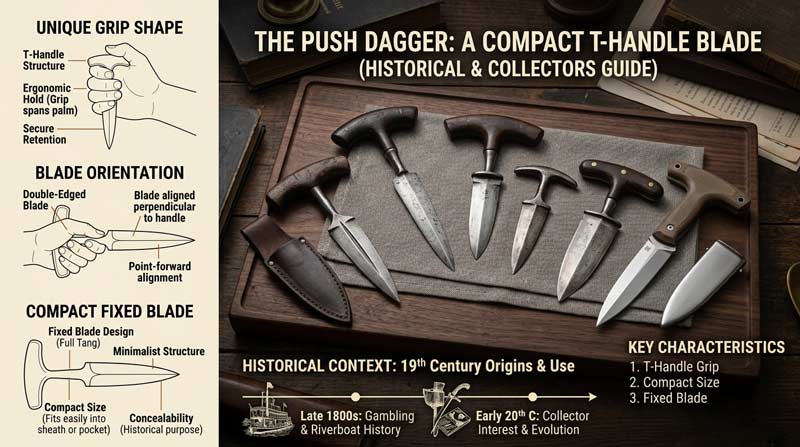
A push dagger is a compact knife designed with a T-shaped handle that allows the blade to extend outward between the fingers while the grip rests inside the palm. This handle configuration is what separates push daggers from most traditional knife designs. Instead of holding the knife with the blade extending forward from the fist, the user grips the horizontal handle while the blade projects straight outward from the center of the hand.
Push daggers are usually small, lightweight, and easy to carry, which helped make them popular as compact backup knives and specialty blade designs over the years. Many feature double-edged spear point blades, although modern versions are available in many different shapes and styles. Some designs prioritize concealment and portability, while others focus more on decorative appearance, collectibility, or modern styling.
The T-handle design creates a very secure grip that feels different from most conventional knife styles. Because the handle rests across the palm, many users find push daggers comfortable to hold and easy to control despite their compact size. That unusual grip style is one of the main reasons push daggers remain so recognizable among collectors and fans of specialty knives.
Today, push daggers are commonly appreciated for collecting, display, historical interest, and unique design appeal. Many knife enthusiasts who enjoy compact fixed blade designs are also drawn to specialized fixed blade knives because of their durability, simplicity, and wide range of blade styles.
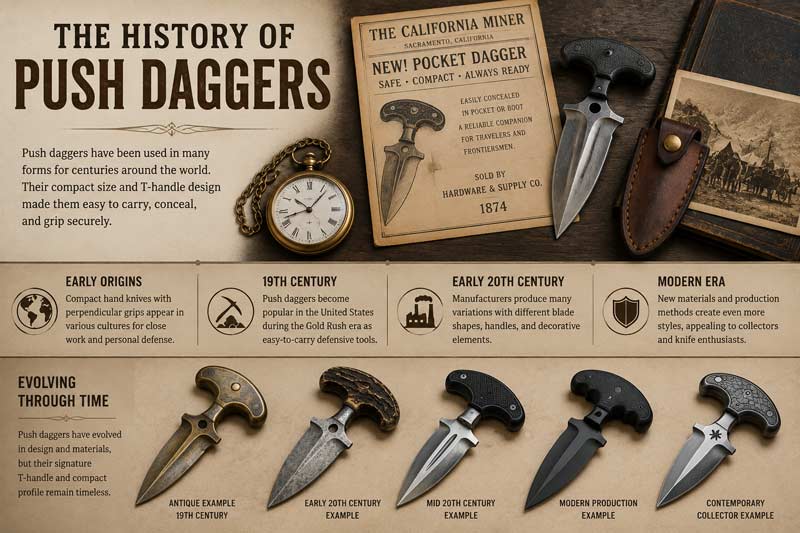
Push daggers have existed in various forms for hundreds of years and have appeared in several different cultures throughout history. Early versions were often designed as compact close-range blades that could be carried discreetly while still providing a secure grip. Because of their unusual handle design and small size, push daggers became associated with concealed carry knives, backup blades, and personal protection tools in different parts of the world.
One of the most commonly discussed historical versions is the 19th-century push dagger style that became popular in the United States during the Gold Rush era. Compact T-handle knives were sometimes marketed as easy-to-carry defensive blades because they could fit into pockets, boots, or small sheaths without taking up much space. Their compact profile made them practical for people who wanted a discreet backup knife while traveling or working in crowded environments.
Over time, push dagger designs evolved into many different shapes and configurations. Some featured simple spear point blades, while others used decorative guards, finger grooves, or ornate handles. As knife manufacturing advanced, modern materials such as stainless steel, molded polymers, and textured grip surfaces helped create even more variations aimed at collectors and specialty knife enthusiasts.
Today, push daggers are appreciated more for their historical interest, compact design, and collectible appeal than for practical everyday use. Many people interested in unique blade styles and compact specialty knives continue to be drawn to push daggers because of their unusual shape, historical background, and recognizable T-handle design.
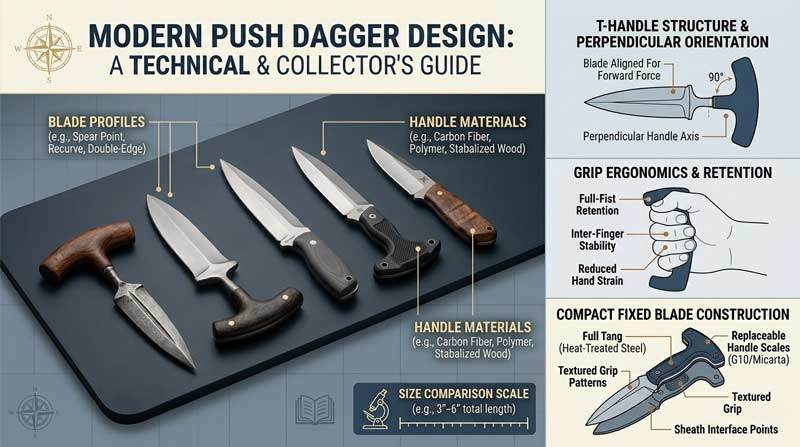
Push daggers are designed very differently from most traditional knives because the handle sits perpendicular to the blade instead of directly behind it. This T-shaped configuration allows the user to grip the handle inside the palm while the blade extends outward between the fingers. The result is a compact knife with a very secure and stable grip that feels noticeably different from standard fixed blade designs.
Most push daggers use short fixed blades with symmetrical spear point or dagger-style profiles, although modern variations can include tanto points, curved edges, or decorative fantasy-inspired shapes. Many designs also feature finger grooves, textured grip panels, or ergonomic contours that improve comfort and control during handling. Because the blade and handle are compact, push daggers are often smaller and easier to carry than many larger knife styles.
Blade materials and handle construction can vary significantly depending on the intended style and price range. Traditional versions were often made from simple forged steel and wood, while modern push daggers may use stainless steel, G10, polymer grips, or coated finishes for durability and visual appeal. Some modern models are highly minimalist, while others focus heavily on decorative styling and collectible aesthetics.
Modern knife enthusiasts often appreciate push daggers because they stand out from more conventional knife designs. Their unusual handle orientation, compact structure, and recognizable silhouette make them one of the most visually distinctive fixed blade styles available today.
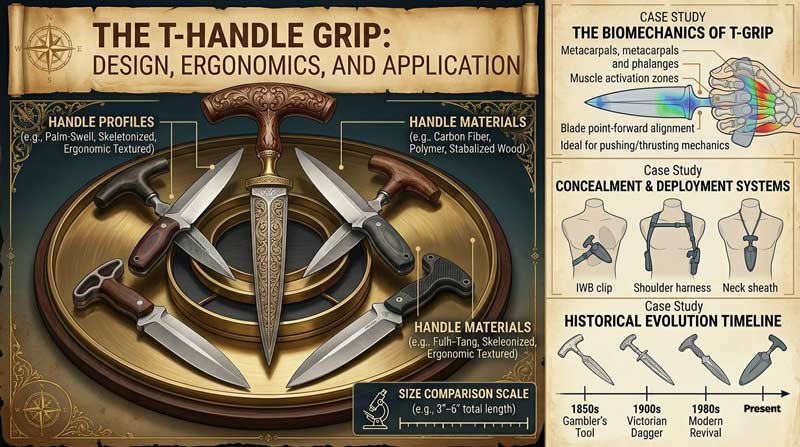
The T-handle grip is what makes push daggers instantly recognizable compared to almost every other knife design. Instead of wrapping the hand around a straight handle positioned behind the blade, the user grips a horizontal handle that rests across the palm while the blade projects outward between the fingers. This creates a very different feel during handling and gives push daggers a compact, secure grip that many knife enthusiasts find distinctive and comfortable.
One advantage of the T-handle design is that it allows the knife to fit naturally inside the hand without requiring a long handle or oversized frame. Because of this compact layout, many push daggers are relatively easy to carry and store compared to larger fixed blade designs. The grip also tends to feel stable because the pressure of the hand is distributed across the palm rather than concentrated entirely behind the blade.
Modern push dagger designs often include textured grip materials, finger grooves, or ergonomic shaping that improve comfort and control even further. Some models focus on minimalist designs with very slim profiles, while others use oversized guards, sculpted handles, or decorative styling intended more for collecting and visual appeal. Compact concealed push dagger designs are especially popular among collectors who appreciate discreet blade profiles and unusual handle configurations.
Because the grip style feels so different from traditional knives, many collectors and knife enthusiasts are drawn to push daggers simply because they offer something unique. Their compact shape, unusual handling characteristics, and recognizable T-handle construction continue to make them stand out among modern specialty blade designs.
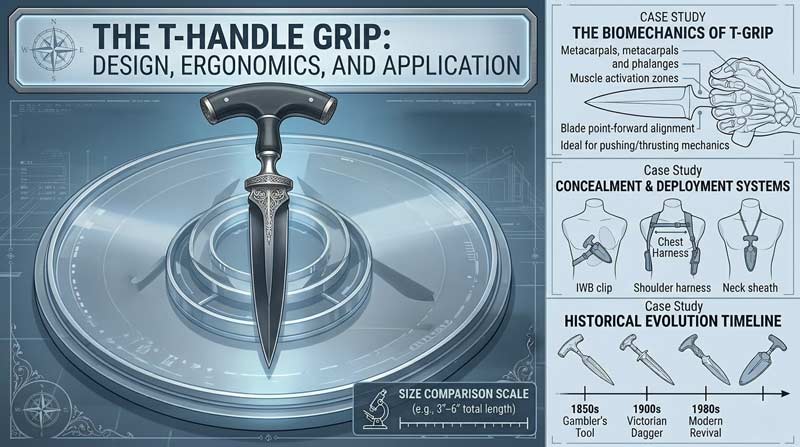
Modern push daggers are available in a wide range of styles that vary in size, blade shape, materials, and overall appearance. While traditional push daggers were usually fairly simple in design, many modern versions are built with more specialized aesthetics and materials aimed at collectors, knife enthusiasts, and fans of compact fixed blades. Some models stay close to historical designs, while others use highly stylized shapes inspired by tactical gear, fantasy artwork, or modern knife trends.
One of the most common modern variations is the compact concealed design. These models are typically built with shorter blades and slimmer profiles that make them easier to carry or display discreetly. Many knife enthusiasts appreciate smaller push daggers because they combine unusual handle ergonomics with compact dimensions that stand out from traditional straight-handle knives.
Modern materials have also expanded the variety of push dagger styles available today. Stainless steel blades, textured G10 scales, molded polymer handles, and coated finishes all contribute to more durable and visually distinctive designs. Some models emphasize lightweight minimalist construction, while others focus heavily on decorative engraving, oversized guards, or aggressive blade styling intended mainly for collecting and display.
Many collectors who enjoy compact specialty blades are also interested in unique personal protection tools and modern fixed blade designs because of their portability and distinctive appearance. That overlap has helped push daggers remain popular among knife enthusiasts looking for something visually different from standard folding or straight-handle knives.
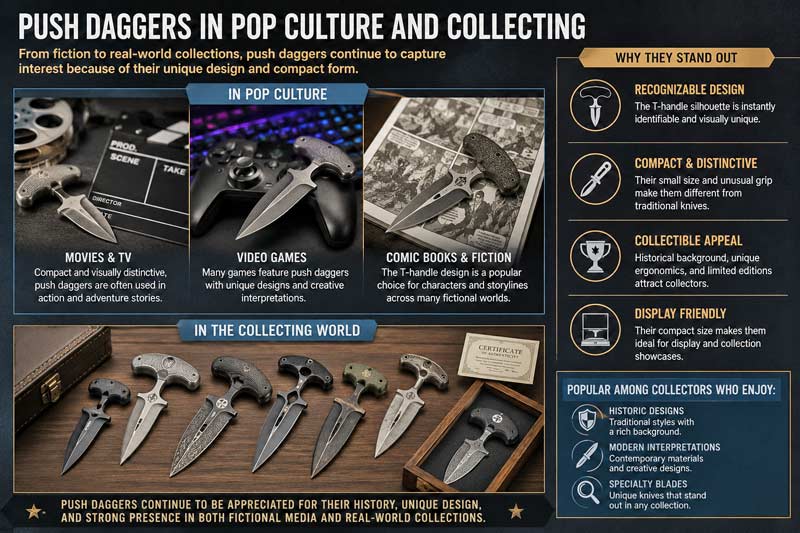
Push daggers have appeared in movies, comic books, video games, and action-themed entertainment for decades, which helped make their unusual T-handle design recognizable even to people who are not deeply involved in knife collecting or martial arts. Their compact size and distinctive silhouette give them a very different appearance compared to traditional knives, making them visually memorable in fictional settings and collectible displays.
Many modern video games and action movies feature compact specialty blades inspired by real push dagger designs, often with exaggerated styling or fantasy-inspired details. Some fictional versions use oversized guards, unusual blade shapes, or futuristic materials that differ significantly from historical examples. Despite those creative variations, the recognizable T-handle layout usually remains one of the defining visual features.
Collectors are often drawn to push daggers because of their historical background, unusual ergonomics, and compact construction. Some enthusiasts prefer traditional designs that resemble older concealed carry knives, while others enjoy modern interpretations with decorative finishes, engraved blades, or minimalist styling. Their small size also makes them popular display pieces among collectors who appreciate specialty blade designs.
Modern collectors interested in compact blade styles often explore other categories of specialty fixed blades alongside push daggers because of the shared focus on durability, compact construction, and distinctive handling characteristics. That continued collector interest is one reason push daggers remain popular among knife enthusiasts and modern blade communities today.
Push daggers remain one of the most visually distinctive knife styles ever created because of their compact size, unusual T-handle grip, and long history as specialty fixed blades. While their design differs significantly from traditional straight-handle knives, that uniqueness is exactly what continues to attract collectors, knife enthusiasts, and fans of historical blade designs today.
Modern push daggers are appreciated for many different reasons including collecting, historical interest, compact carry designs, and unique ergonomics. Some enthusiasts prefer traditional-inspired styles that resemble older concealed blades, while others enjoy highly modernized versions with upgraded materials, decorative finishes, and specialized handle designs. That variety has helped keep push daggers relevant across multiple generations of knife collectors.
Collectors interested in compact push knife designs are often drawn to the balance between portability, simplicity, and visual uniqueness that these knives offer. Their recognizable silhouette and unusual grip construction help them stand apart from many conventional blade styles found in modern knife collections.
Whether someone is interested in knife history, collecting, compact blade designs, or specialty fixed blades, push daggers continue to hold a unique place in the world of modern knives and historical edged weapons. Their combination of compact form, recognizable design, and collector appeal has helped them remain popular for generations.
What Is a Push Dagger?
A push dagger is a compact knife designed with a T-shaped handle that allows the blade to extend outward between the fingers while the grip rests inside the palm. This handle configuration is what separates push daggers from most traditional knife designs. Instead of holding the knife with the blade extending forward from the fist, the user grips the horizontal handle while the blade projects straight outward from the center of the hand.
Push daggers are usually small, lightweight, and easy to carry, which helped make them popular as compact backup knives and specialty blade designs over the years. Many feature double-edged spear point blades, although modern versions are available in many different shapes and styles. Some designs prioritize concealment and portability, while others focus more on decorative appearance, collectibility, or modern styling.
The T-handle design creates a very secure grip that feels different from most conventional knife styles. Because the handle rests across the palm, many users find push daggers comfortable to hold and easy to control despite their compact size. That unusual grip style is one of the main reasons push daggers remain so recognizable among collectors and fans of specialty knives.
Today, push daggers are commonly appreciated for collecting, display, historical interest, and unique design appeal. Many knife enthusiasts who enjoy compact fixed blade designs are also drawn to specialized fixed blade knives because of their durability, simplicity, and wide range of blade styles.
The History of Push Daggers
Push daggers have existed in various forms for hundreds of years and have appeared in several different cultures throughout history. Early versions were often designed as compact close-range blades that could be carried discreetly while still providing a secure grip. Because of their unusual handle design and small size, push daggers became associated with concealed carry knives, backup blades, and personal protection tools in different parts of the world.
One of the most commonly discussed historical versions is the 19th-century push dagger style that became popular in the United States during the Gold Rush era. Compact T-handle knives were sometimes marketed as easy-to-carry defensive blades because they could fit into pockets, boots, or small sheaths without taking up much space. Their compact profile made them practical for people who wanted a discreet backup knife while traveling or working in crowded environments.
Over time, push dagger designs evolved into many different shapes and configurations. Some featured simple spear point blades, while others used decorative guards, finger grooves, or ornate handles. As knife manufacturing advanced, modern materials such as stainless steel, molded polymers, and textured grip surfaces helped create even more variations aimed at collectors and specialty knife enthusiasts.
Today, push daggers are appreciated more for their historical interest, compact design, and collectible appeal than for practical everyday use. Many people interested in unique blade styles and compact specialty knives continue to be drawn to push daggers because of their unusual shape, historical background, and recognizable T-handle design.
How Push Daggers Are Designed
Push daggers are designed very differently from most traditional knives because the handle sits perpendicular to the blade instead of directly behind it. This T-shaped configuration allows the user to grip the handle inside the palm while the blade extends outward between the fingers. The result is a compact knife with a very secure and stable grip that feels noticeably different from standard fixed blade designs.
Most push daggers use short fixed blades with symmetrical spear point or dagger-style profiles, although modern variations can include tanto points, curved edges, or decorative fantasy-inspired shapes. Many designs also feature finger grooves, textured grip panels, or ergonomic contours that improve comfort and control during handling. Because the blade and handle are compact, push daggers are often smaller and easier to carry than many larger knife styles.
Blade materials and handle construction can vary significantly depending on the intended style and price range. Traditional versions were often made from simple forged steel and wood, while modern push daggers may use stainless steel, G10, polymer grips, or coated finishes for durability and visual appeal. Some modern models are highly minimalist, while others focus heavily on decorative styling and collectible aesthetics.
Modern knife enthusiasts often appreciate push daggers because they stand out from more conventional knife designs. Their unusual handle orientation, compact structure, and recognizable silhouette make them one of the most visually distinctive fixed blade styles available today.
Why the T-Handle Grip Is Unique
The T-handle grip is what makes push daggers instantly recognizable compared to almost every other knife design. Instead of wrapping the hand around a straight handle positioned behind the blade, the user grips a horizontal handle that rests across the palm while the blade projects outward between the fingers. This creates a very different feel during handling and gives push daggers a compact, secure grip that many knife enthusiasts find distinctive and comfortable.
One advantage of the T-handle design is that it allows the knife to fit naturally inside the hand without requiring a long handle or oversized frame. Because of this compact layout, many push daggers are relatively easy to carry and store compared to larger fixed blade designs. The grip also tends to feel stable because the pressure of the hand is distributed across the palm rather than concentrated entirely behind the blade.
Modern push dagger designs often include textured grip materials, finger grooves, or ergonomic shaping that improve comfort and control even further. Some models focus on minimalist designs with very slim profiles, while others use oversized guards, sculpted handles, or decorative styling intended more for collecting and visual appeal. Compact concealed push dagger designs are especially popular among collectors who appreciate discreet blade profiles and unusual handle configurations.
Because the grip style feels so different from traditional knives, many collectors and knife enthusiasts are drawn to push daggers simply because they offer something unique. Their compact shape, unusual handling characteristics, and recognizable T-handle construction continue to make them stand out among modern specialty blade designs.
Modern Push Dagger Styles
Modern push daggers are available in a wide range of styles that vary in size, blade shape, materials, and overall appearance. While traditional push daggers were usually fairly simple in design, many modern versions are built with more specialized aesthetics and materials aimed at collectors, knife enthusiasts, and fans of compact fixed blades. Some models stay close to historical designs, while others use highly stylized shapes inspired by tactical gear, fantasy artwork, or modern knife trends.
One of the most common modern variations is the compact concealed design. These models are typically built with shorter blades and slimmer profiles that make them easier to carry or display discreetly. Many knife enthusiasts appreciate smaller push daggers because they combine unusual handle ergonomics with compact dimensions that stand out from traditional straight-handle knives.
Modern materials have also expanded the variety of push dagger styles available today. Stainless steel blades, textured G10 scales, molded polymer handles, and coated finishes all contribute to more durable and visually distinctive designs. Some models emphasize lightweight minimalist construction, while others focus heavily on decorative engraving, oversized guards, or aggressive blade styling intended mainly for collecting and display.
Many collectors who enjoy compact specialty blades are also interested in unique personal protection tools and modern fixed blade designs because of their portability and distinctive appearance. That overlap has helped push daggers remain popular among knife enthusiasts looking for something visually different from standard folding or straight-handle knives.
Push Daggers in Pop Culture and Collecting
Push daggers have appeared in movies, comic books, video games, and action-themed entertainment for decades, which helped make their unusual T-handle design recognizable even to people who are not deeply involved in knife collecting or martial arts. Their compact size and distinctive silhouette give them a very different appearance compared to traditional knives, making them visually memorable in fictional settings and collectible displays.
Many modern video games and action movies feature compact specialty blades inspired by real push dagger designs, often with exaggerated styling or fantasy-inspired details. Some fictional versions use oversized guards, unusual blade shapes, or futuristic materials that differ significantly from historical examples. Despite those creative variations, the recognizable T-handle layout usually remains one of the defining visual features.
Collectors are often drawn to push daggers because of their historical background, unusual ergonomics, and compact construction. Some enthusiasts prefer traditional designs that resemble older concealed carry knives, while others enjoy modern interpretations with decorative finishes, engraved blades, or minimalist styling. Their small size also makes them popular display pieces among collectors who appreciate specialty blade designs.
Modern collectors interested in compact blade styles often explore other categories of specialty fixed blades alongside push daggers because of the shared focus on durability, compact construction, and distinctive handling characteristics. That continued collector interest is one reason push daggers remain popular among knife enthusiasts and modern blade communities today.
Final Thoughts on Push Daggers
Push daggers remain one of the most visually distinctive knife styles ever created because of their compact size, unusual T-handle grip, and long history as specialty fixed blades. While their design differs significantly from traditional straight-handle knives, that uniqueness is exactly what continues to attract collectors, knife enthusiasts, and fans of historical blade designs today.
Modern push daggers are appreciated for many different reasons including collecting, historical interest, compact carry designs, and unique ergonomics. Some enthusiasts prefer traditional-inspired styles that resemble older concealed blades, while others enjoy highly modernized versions with upgraded materials, decorative finishes, and specialized handle designs. That variety has helped keep push daggers relevant across multiple generations of knife collectors.
Collectors interested in compact push knife designs are often drawn to the balance between portability, simplicity, and visual uniqueness that these knives offer. Their recognizable silhouette and unusual grip construction help them stand apart from many conventional blade styles found in modern knife collections.
Whether someone is interested in knife history, collecting, compact blade designs, or specialty fixed blades, push daggers continue to hold a unique place in the world of modern knives and historical edged weapons. Their combination of compact form, recognizable design, and collector appeal has helped them remain popular for generations.
You May Also Be Interested In:
- A Brief History of the Push Dagger: From Trench Warfare to Modern EDC
- The Strange History of the Push Dagger
- Karambit vs Push Dagger: Which Blade Would You Bet Your Life On?
- The History of the Monkey Fist: From Sailing Knot to Modern Tool
- The Real History of Escrima Sticks: From Battlefield Weapon to Modern Martial Art
- Modern Combat Khopesh and Other Deadly Weapons!
- A Practical Guide to Modern Self-Defense Weapons
- The Evolution of the Shuriken: From Samurai to Modern Martial Arts
- The Deadliest Throwing Knives for Modern Combat! Knife Testing and Review
- The Strange History of the Blackjack
Leave a Reply