




Are OTF Knives Actually Reliable, or Just Cool?
June 4th, 2026
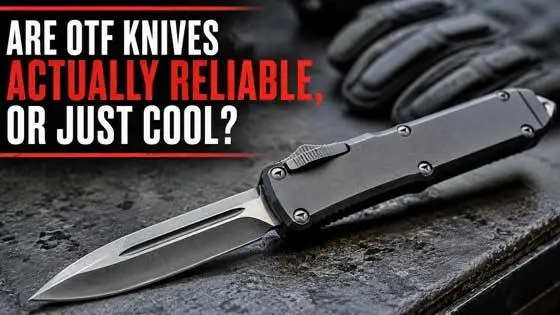
OTF knives definitely look cool. With the push of a button, the blade deploys in a way that feels fast, futuristic, and almost too smooth to be practical. But that same design also raises an obvious question: are OTF knives actually reliable, or are they mostly just flashy gadgets? Some people assume the mechanism makes them fragile or prone to failure, while others swear by them for everyday carry. The truth is more nuanced than most people expect. Like many tools, reliability often depends on quality, maintenance, expectations, and understanding what OTF knives are actually designed to do.
Why OTF Knives Get a Reputation for Being Unreliable
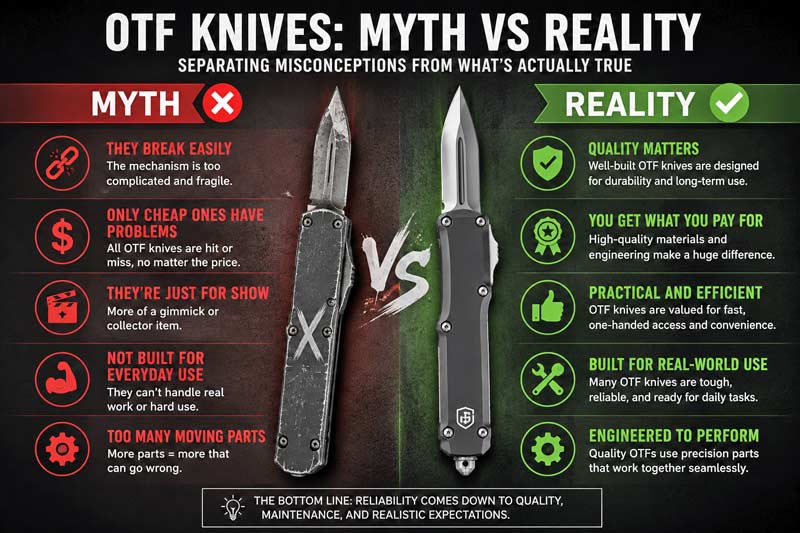
One of the biggest criticisms people make about OTF knives is reliability. The moment many people see a blade shoot out with the push of a button, they immediately assume the mechanism must be fragile or prone to failure. Compared to a traditional folding knife with fewer moving parts, the design can definitely look more complicated at first glance.
Part of that reputation comes from cheap OTF knives flooding the market over the years. Low-quality versions often develop blade play, weak springs, inconsistent deployment, or mechanical problems that reinforce the idea that all OTF knives are unreliable. For someone whose only experience comes from a bargain-bin automatic knife, it is easy to assume the entire category works the same way.
Movies and internet videos have not helped either. OTF knives often get treated like flashy gadgets or "cool factor" collectibles rather than practical tools. That creates the impression they are mostly novelty items, even though many people carry them for everyday tasks because they value fast one-handed access and convenience.
The reality is more nuanced. Like most gear, reliability often depends heavily on build quality, expectations, and how someone actually uses the tool. A well-built OTF knife designed for everyday use tends to feel very different than a cheap imitation built primarily to look impressive.
That raises a more interesting question: are OTF knives actually less reliable than traditional folders, or do they simply get judged more harshly because the mechanism looks more complicated?
Cheap OTF Knives Are Usually the Reason People Think They Are Unreliable
If someone believes OTF knives are unreliable, there is a decent chance their opinion came from using a cheap one. Over the years, low-quality OTF knives flooded the market, and many of them developed the same problems repeatedly: inconsistent deployment, weak springs, blade wiggle, lockup issues, or mechanisms that stopped feeling smooth after only limited use. Experiences like that naturally shape how people view the entire category.
The problem is that many people assume all OTF knives are built the same way. They are not. Material quality, internal tolerances, spring systems, machining, and overall construction vary dramatically between budget models and better-built designs. A poorly made OTF knife may feel unreliable very quickly, while a well-built one often feels much more solid and consistent in everyday use.
This is not unique to OTF knives either. Most gear categories work the same way. Cheap flashlights fail more often than quality ones. Cheap folding knives develop problems faster than premium designs. Even traditional manual knives vary significantly depending on materials and construction. OTF knives simply tend to get judged more harshly because the mechanism looks more complicated from the outside.
Another thing people overlook is intended use. Most OTF knives are designed for everyday cutting tasks, convenience, and one-handed accessibility, not unrealistic abuse tests seen online. When expectations stay realistic and build quality improves, reliability conversations tend to look very different.
That raises another interesting question: are OTF knives actually less durable than traditional folding knives, or is that another assumption people make because of how the mechanism looks?
Are OTF Knives Actually Less Durable Than Folding Knives?
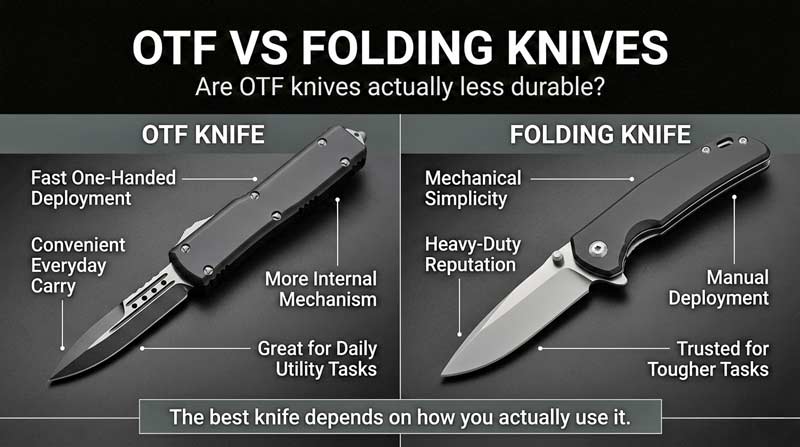
This is probably one of the biggest questions people have about OTF knives. Since the blade deploys through the front and relies on an internal mechanism, many people automatically assume a traditional folding knife must be tougher. On the surface, that assumption sounds reasonable. More moving parts usually sounds like more opportunities for something to go wrong.
The reality is more nuanced. Traditional folding knives absolutely have strengths, especially when it comes to heavy-duty use and mechanical simplicity. But many people underestimate how durable well-built OTF knives can be for normal everyday carry tasks. Opening packages, cutting rope, handling utility work, and general daily use usually fall well within what quality OTF knives are designed to handle.
Part of the confusion comes from unrealistic comparisons. People sometimes judge OTF knives by extreme internet tests involving abuse, prying, or impacts that most people will never encounter in normal life. But everyday carry tools are usually judged by how practical and reliable they feel during everyday situations, not by whether they survive intentionally destructive stress tests.
That does not mean OTF knives replace every folding knife. Someone doing demanding outdoor work or heavy-duty cutting may still prefer a manual folder depending on the task. But for convenience, one-handed deployment, accessibility, and daily utility, many people find quality OTF knives surprisingly dependable.
If you are curious how they compare side by side, this breakdown of OTF vs folding knives goes much deeper into the tradeoffs people consider when choosing between them.
How OTF Knife Mechanisms Actually Work, and Why That Matters for Reliability
Part of the reason people question OTF reliability is simple: most do not really understand how the mechanism works. Since the blade slides out of the front instead of rotating open like a traditional folder, many assume there must be delicate springs constantly under tension or complicated internal parts waiting to fail. The reality is usually much less dramatic than people imagine.
Most OTF knives rely on an internal spring and track system designed to deploy and retract the blade with the push of a switch. Many modern designs also include safety features that stop the blade if it encounters resistance during deployment. That means if something interrupts the blade path, the knife often disengages rather than forcing the mechanism forward. For many users, that actually adds confidence rather than reducing it.
Another thing people misunderstand is maintenance. Some assume OTF knives require constant upkeep to stay functional, but many quality models simply benefit from occasional cleaning and keeping debris out of the mechanism. Like any tool, dirt, pocket lint, or neglect can affect performance over time, but that does not automatically make the design unreliable.
Understanding how the mechanism actually works often changes people's opinion quickly. What initially looks fragile or overly complicated tends to feel much more practical once someone understands the design intention behind it. For people curious about the mechanics, this guide explaining how automatic knives actually work gives a more detailed breakdown of what happens inside the mechanism.
In many ways, reliability conversations improve once expectations become realistic. OTF knives are not magic, but they are also not nearly as fragile as internet myths sometimes make them sound.
Most OTF Knife Failures Happen Because of Unrealistic Expectations
Sometimes the biggest problem with OTF knife reliability is not the knife at all. It is expectations. Many people unconsciously expect an OTF knife to behave like a heavy-duty fixed blade, survival tool, pry bar, and everyday utility knife all at once. When the knife struggles under unrealistic use, people often blame the mechanism instead of the mismatch between expectations and intended purpose.
At the end of the day, most OTF knives are designed for convenience, accessibility, and everyday cutting tasks. Opening packages, cutting cord, utility work, quick one-handed access, and daily carry are where many quality OTF knives tend to shine. They were never really intended to replace specialized tools for extreme abuse or heavy prying.
The internet sometimes makes this confusion worse. Videos showing people stabbing through metal, prying open objects, hammering on blades, or intentionally trying to break knives create an unrealistic benchmark for reliability. Those tests may be entertaining, but they rarely reflect how most people actually use knives during everyday life.
This is also why many OTF owners end up becoming surprisingly loyal to them. Once people stop treating them like movie props and start viewing them as practical everyday tools, reliability conversations tend to shift quickly. For many users, fast one-handed deployment and convenience become hard to give up after carrying one regularly.
If you are curious why so many people end up carrying them daily, this article on why automatic knives belong in your EDC explains why automatic designs continue growing in popularity for everyday carry.
Why Many People End Up Trusting OTF Knives More Than They Expected
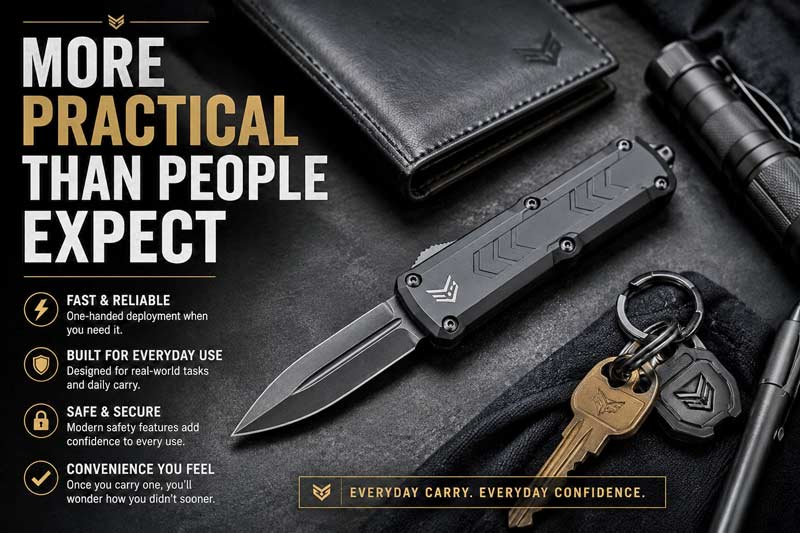
One interesting thing happens once people start carrying a quality OTF knife regularly: many end up trusting it far more than they expected. People often go into the experience assuming the mechanism will feel gimmicky, fragile, or unreliable. Then everyday use starts changing that perception. Quick one-handed access, convenience, and consistent deployment tend to matter more than many first-time owners anticipate.
Part of that trust comes from repetition. The more someone uses an OTF knife for normal daily tasks, the more confidence they build in how the mechanism feels. Opening packages, cutting rope, handling utility work, or using the knife around the house starts reinforcing a simple reality: a well-built tool often feels much different than internet assumptions suggest.
Another reason perceptions shift is because many people compare OTF knives to exaggerated myths rather than actual experience. Before carrying one, some expect constant failures or delicate internals. But once they understand what the knife is designed for, and what it is not, reliability conversations usually become much more realistic.
This does not mean OTF knives are perfect for everyone. Some people will still prefer traditional folders because of simplicity, familiarity, or heavier-duty preferences. But for users who prioritize speed, accessibility, and everyday convenience, many find OTF knives surprisingly practical after spending time with one.
For people still learning the basics, understanding what an OTF knife actually is often helps clear up many of the misconceptions surrounding reliability in the first place.
Why Fast One-Handed Access Is a Bigger Advantage Than Most People Expect
One reason many people become loyal to OTF knives has very little to do with "cool factor." It comes down to convenience. Once someone gets used to fast, one-handed deployment, it can be surprisingly difficult to go back. Everyday situations often involve one hand already being occupied, carrying boxes, holding tools, managing gear, or simply needing quick access without awkward repositioning.
That practicality is one reason automatic designs have stayed popular for everyday carry despite misconceptions about reliability. For many users, the appeal is not about speed for the sake of speed. It is about simplicity. Push the switch, use the knife, retract it, and move on. That smooth process becomes especially noticeable during repetitive everyday tasks.
Another thing people underestimate is accessibility. Traditional folding knives can absolutely be excellent tools, but some require two hands or more deliberate movement depending on the opening style. Many OTF users simply appreciate the consistency and convenience that comes with quick deployment, especially when multitasking or working with limited hand availability.
Of course, practicality depends on expectations. Someone looking for a heavy-duty outdoor knife may prioritize different features than someone focused on everyday utility. But for people interested in convenience and quick access, many find OTF knives surprisingly practical after regular use.
If you are curious why so many people include automatic knives in their daily setup, this guide on why automatic knives belong in your EDC explains why fast access and convenience matter more than many people expect.
Do OTF Knives Require More Maintenance Than People Think?
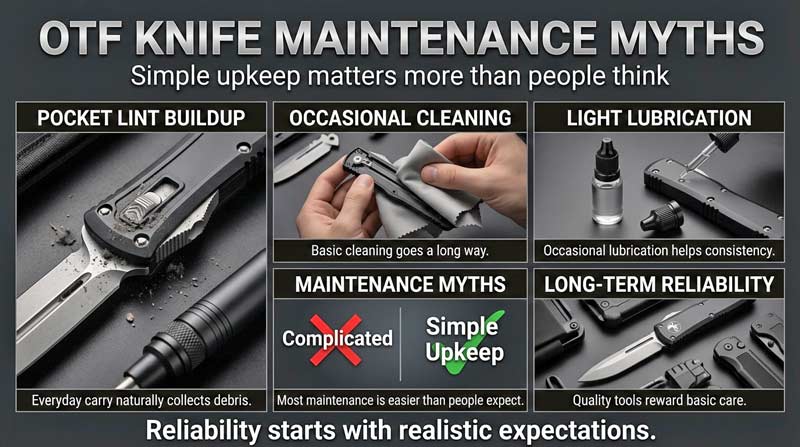
Another reason people sometimes question OTF reliability comes down to maintenance. Since the blade deploys through the front of the handle and uses an internal mechanism, many assume OTF knives must require constant cleaning or complicated upkeep to stay functional. In reality, maintenance is usually much simpler than people expect.
Like any everyday carry tool, OTF knives benefit from occasional attention. Pocket lint, dust, dirt, and debris can gradually work their way into the mechanism over time, especially for people who carry one daily. But for many owners, maintenance is often as simple as basic cleaning and occasional lubrication depending on how heavily the knife gets used.
Part of the misconception comes from people expecting perfection. If an OTF knife occasionally misfires after collecting lint or debris for months, some assume the design itself is flawed. But most everyday tools become less reliable when neglected. Flashlights need batteries. Folding knives need occasional cleaning. Even manual tools work better with basic upkeep.
Interestingly, many modern OTF designs are built with reliability in mind, including safety features that help prevent internal damage if deployment is interrupted. That engineering is one reason many users find quality OTF knives much more dependable than they expected before actually carrying one.
For people curious about what is happening inside the mechanism, learning how automatic knives work often helps explain why maintenance tends to be much less intimidating than people imagine.
Why OTF Knives Are Not Just "Fancy Switchblades"
Another reason people question OTF knife reliability is because of confusion around terminology. Many people hear the words "automatic knife," "switchblade," and "OTF knife" and assume they all mean exactly the same thing. That misunderstanding often creates unrealistic assumptions before someone even handles one.
Technically, OTF knives fall under the broader category of automatic knives because the blade deploys using a spring-assisted mechanism activated by a switch. But not every automatic knife is an OTF knife. Traditional side-opening automatic knives deploy more like a folding knife, while OTF knives slide the blade straight out of the front of the handle. That difference in design changes how they feel, carry, and function during everyday use.
Part of why this matters for reliability is expectations. Someone imagining an OTF knife as a movie-style gimmick or exaggerated "switchblade" may go into the experience assuming it will feel fragile or overly dramatic. In reality, many people end up treating them more like practical everyday utility tools once they understand how the mechanism actually works.
This is also one reason OTF knives continue growing in popularity among everyday carry enthusiasts. Once people separate movie myths from real-world function, conversations tend to shift from "Are these gimmicks?" to "Why did I wait so long to try one?"
If you are still unclear about terminology, understanding the difference between a switchblade vs automatic knife helps explain why OTF knives often get misunderstood in the first place.
So, Are OTF Knives Actually Reliable, or Just Cool?
After all the myths, debates, and internet opinions, the answer is probably less dramatic than many people expect: OTF knives can absolutely be reliable, but quality and expectations matter. Cheap versions often create bad first impressions, while better-built models tend to feel much more dependable during normal everyday use. Like most tools, reliability usually comes down to construction, maintenance, and understanding what the tool is actually designed to do.
Part of the confusion comes from appearance. Since OTF knives look more mechanical and futuristic than traditional folders, many people automatically assume they must be fragile. But once people start carrying a quality OTF knife for everyday tasks, opinions often change quickly. Convenience, fast one-handed access, and practical daily use tend to matter more than people expect beforehand.
That does not mean OTF knives are perfect for everyone. Someone needing a heavy-duty outdoor knife or extreme-use tool may prefer a fixed blade or traditional folder depending on the situation. But for everyday carry, utility work, accessibility, and convenience, many people find OTF knives surprisingly practical once they spend real time using one.
In many ways, OTF knives suffer from the same problem as many misunderstood tools: people judge them based on movies, cheap knockoffs, or assumptions instead of actual experience. Once expectations become realistic, reliability conversations tend to become much more balanced.
If you are curious about exploring different styles, learning more about automatic knives or browsing different everyday carry knives can help clarify what feels most practical for your needs.
OTF Knives Are More Practical Than Most People Expect
OTF knives definitely have a strong cool factor. There is no getting around that. Fast deployment, sleek design, and the way the blade slides out of the handle naturally grab attention. But reducing them to flashy gadgets misses a much bigger point. For many people, the appeal comes down to convenience, accessibility, and everyday practicality far more than novelty.
The truth is that OTF knife reliability depends heavily on quality and expectations. Cheap models often reinforce stereotypes about weak mechanisms or inconsistent deployment, while better-built knives tend to feel much more dependable during normal everyday carry tasks. Like most tools, understanding intended use matters. OTF knives are usually designed for convenience and utility, not unrealistic abuse tests or internet stunts.
What surprises many first-time owners is how quickly the mechanism starts feeling normal. Fast one-handed access, smooth deployment, and practicality often become more important than the "cool factor" people originally focused on. Once expectations shift from movie myths to real-world use, reliability conversations usually become much more balanced.
That does not mean OTF knives are automatically the best choice for everyone. Some people will still prefer traditional folders, fixed blades, or simpler manual designs depending on how they actually use a knife day to day. But for many everyday carry enthusiasts, OTF knives end up being far more practical, and far more reliable, than they expected.
If you are still exploring options, learning more about what an OTF knife actually is or comparing different automatic knife styles can help make the decision feel much more straightforward.
Do OTF Knives Break More Easily Than Regular Knives?
This is probably the biggest concern people have before buying an OTF knife. Since the blade deploys through the front of the handle using an internal mechanism, many assume they must be more fragile than traditional folding knives. The reality is more nuanced than most people expect.
A quality OTF knife designed for everyday carry can be surprisingly dependable for normal daily tasks like opening packages, cutting rope, utility work, and general use. Where people sometimes run into problems is expecting an OTF knife to behave like a heavy-duty fixed blade or survive unrealistic abuse tests they saw online. Like most tools, reliability usually depends on matching expectations to intended use.
Another reason this misconception exists is because many people's first experience comes from cheaper OTF knives. Low-quality models often develop blade play, inconsistent deployment, or spring issues, which unfairly shapes opinions about the entire category. A well-built OTF knife tends to feel dramatically different in terms of consistency and confidence.
In many ways, OTF knives are judged more harshly simply because the mechanism looks more complicated. Once people actually carry a quality model and use it regularly, reliability concerns often become much less dramatic than expected.
Do OTF Knives Misfire More Than People Realize?
Sometimes, but usually not for the reasons people expect. One thing that surprises new OTF owners is that occasional deployment interruptions are not always a sign the knife is broken. Many OTF knives are intentionally designed with safety mechanisms that stop the blade if it encounters resistance during deployment. That feature helps protect the internal mechanism instead of forcing the knife open aggressively.
In everyday life, small things like pocket lint, dirt, debris, or even accidentally blocking the blade path can sometimes affect deployment. For someone unfamiliar with OTF knives, that moment can feel like a mechanical failure when it is often a quick reset rather than a serious problem.
Build quality matters here too. Cheaper OTF knives tend to misfire more often because of weaker springs, looser tolerances, or lower-quality internals. Better-built models usually feel far more consistent during regular everyday carry and utility tasks.
The good news is that many minor interruptions are easy to correct, and understanding how the mechanism works tends to remove a lot of unnecessary concern. For many users, what initially feels intimidating becomes surprisingly normal after carrying one for a while.
Are OTF Knives Legal to Carry Everywhere?
This is one area where things can get confusing quickly. Many people assume OTF knives follow the same rules everywhere, but laws can vary depending on location. Some places treat OTF knives similarly to other automatic knives, while others have restrictions related to blade length, concealed carry, ownership, or how the knife is classified under local law.
Part of the confusion comes from terminology. Some people casually call all automatic knives "switchblades," while laws sometimes define things differently depending on wording and location. That can create misunderstandings for people researching what is actually allowed where they live or travel.
The good news is that automatic knife laws have become more relaxed in many areas over time. Still, legality is one topic where assumptions can cause problems, especially for people traveling between states or relying on outdated information they found online years ago.
Because laws change and vary significantly depending on location, it is always smart to check current local regulations before carrying any automatic knife. A knife that is perfectly legal somewhere else may be treated differently depending on where you are.
If you are still learning how these knives fit into the broader category, understanding switchblade vs automatic knife terminology often clears up a lot of confusion around how people talk about OTF designs.
Why Do OTF Knives Have Blade Play, and Is That a Problem?
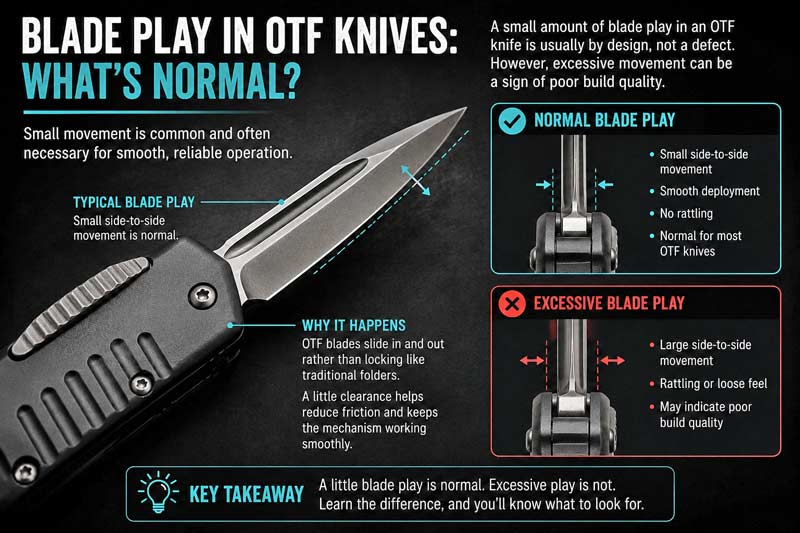
One thing that surprises first-time OTF owners is blade play. Someone opens the knife, wiggles the blade slightly, and immediately assumes something must be wrong. But small amounts of movement are actually very common in many OTF designs, even on higher-quality knives.
The reason comes down to mechanics. Since the blade slides in and out of the handle instead of locking the same way a traditional folding knife does, a tiny amount of movement often helps the mechanism function smoothly and reliably. In many cases, a knife with absolutely zero movement would actually create more friction and potentially reduce deployment consistency over time.
That said, there is a difference between normal movement and poor construction. Excessive looseness, rattling, weak lockup, or inconsistent deployment may point to lower build quality. But small blade play by itself is usually much more normal than many people expect, especially for people new to OTF knives.
For many owners, this ends up being one of those things that feels concerning at first but quickly stops mattering during everyday use. Once people understand how the mechanism works, what initially seemed like a flaw often starts feeling completely normal.
Are OTF Knives Actually Good for Everyday Carry?
For a lot of people, yes, and that is one reason OTF knives have become so popular in everyday carry communities. While some people first notice the "cool factor," many long-term owners end up sticking with OTF knives for a much simpler reason: convenience. Fast one-handed access tends to feel surprisingly useful once someone starts carrying one regularly.
Everyday carry usually comes down to practicality. Opening packages, cutting cord, handling quick utility tasks, or needing a knife while one hand is occupied are situations where many people appreciate automatic deployment. What initially feels like a novelty often starts feeling genuinely convenient after repeated daily use.
That said, the best everyday carry knife still depends on the person. Someone doing heavy outdoor work or demanding cutting tasks may prefer a traditional folder or fixed blade. Others prioritize speed, accessibility, and pocket convenience, which is where OTF knives often stand out.
For many owners, the biggest surprise is how quickly the knife becomes part of a routine. Once fast deployment and easy access become normal, some people find it surprisingly hard to go back. If you are curious why so many enthusiasts carry them daily, this guide on why automatic knives belong in your EDC explains why they continue growing in popularity.
Can Dirt or Pocket Lint Really Affect an OTF Knife?
Surprisingly, yes, though usually not in the dramatic way people imagine. Since OTF knives deploy through the front of the handle, everyday carry naturally exposes the mechanism to things like pocket lint, dust, dirt, and debris over time. For someone carrying an OTF knife daily, that buildup can occasionally affect how smooth the mechanism feels if ignored long enough.
The good news is that this usually is not a major problem. In many cases, occasional cleaning and basic upkeep are enough to keep a quality OTF knife working consistently. People sometimes assume OTF knives require complicated maintenance schedules, but many owners find upkeep much simpler than expected.
This is also one reason build quality matters. Better-built OTF knives tend to handle everyday use and wear much more consistently than cheap versions with weaker internals or looser tolerances. A small amount of maintenance usually goes a long way toward reliability.
For many owners, this ends up being one of those concerns that sounds bigger online than it feels in real life. Once someone carries an OTF knife for a while, occasional upkeep tends to feel pretty normal, no different than cleaning a flashlight, sharpening a blade, or maintaining any other everyday carry tool.
Do Movies Make OTF Knives Look More Dangerous Than They Really Are?
Honestly, yes. Movies love dramatic knife scenes, and OTF knives often get cast as futuristic, intimidating "bad guy" tools because the blade deploys quickly and looks visually dramatic. That reputation creates a lot of assumptions before people ever handle one in real life.
The reality is usually much less dramatic. For many owners, an OTF knife functions like any other everyday utility knife. Opening packages, cutting cord, handling small daily tasks, and convenience tend to matter much more than the movie-style image surrounding them.
In many ways, OTF knives suffer from a branding problem. People often judge them based on appearance rather than everyday practicality, which helps explain why opinions tend to shift so quickly once someone actually carries one.
You May Also Be Interested In:
- Why Are Throwing Knives Shaped Differently From Regular Knives?
- Why Trench Knives Became the Most Feared Knives of World War I
- 6 Unusual Folding Knives
- Why Automatic Knives Belong in Your EDC
- How Automatic Knives Actually Work
- Can Butterfly Knives be used for Combat?
- OTF vs Folding Knives: What's the Difference and Which Is Better?
- The Truth About Ballistic Knives
- 12 Fixed Blade Knives You Should Know About
- Why Karambit Knives Are So Effective
Leave a Reply