




What Is an OTF Knife? How Out-the-Front Knives Work
May 19th, 2026
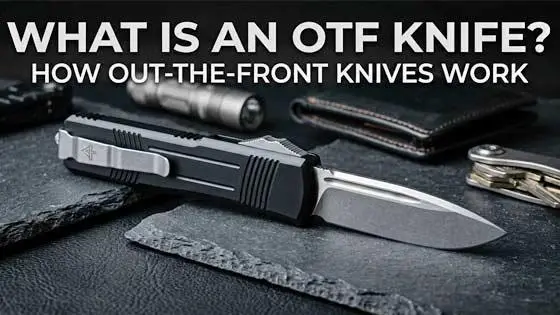
OTF knives have become one of the most popular knife styles for collectors, everyday carry enthusiasts, and anyone who appreciates fast, convenient deployment. Unlike traditional folding knives that swing open from the side, an OTF knife pushes its blade straight out the front of the handle with the press of a switch. They look sleek, feel modern, and often spark a lot of curiosity, especially for people seeing one for the first time. But what exactly is an OTF knife, how does it work, and why do so many people prefer them over standard folders?
In this guide, we'll break down what OTF knives are, how the mechanism works, the difference between single-action and double-action models, and whether an OTF knife makes sense for everyday carry or collection purposes.
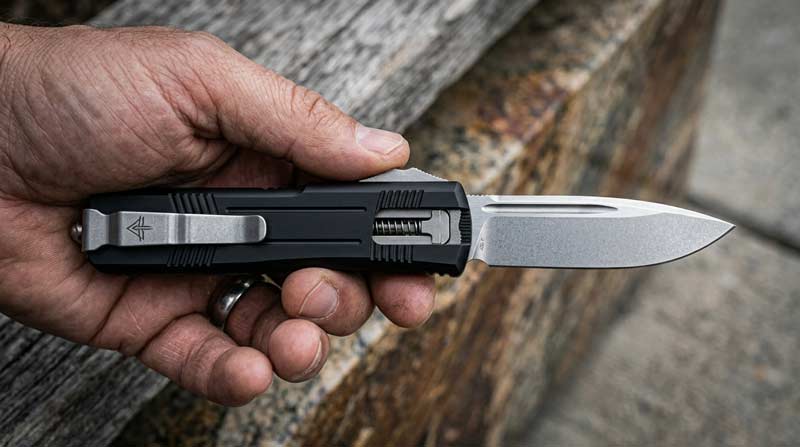
An OTF knife, short for out-the-front knife, is a type of knife where the blade deploys straight out of the front of the handle instead of swinging open from the side like a traditional folding knife. With the push of a thumb slide or button, the blade extends quickly and locks into place, making OTF knives one of the fastest and most convenient knife styles available.
Most people recognize OTF knives because of their smooth, mechanical action. Instead of using thumb studs, flippers, or nail pulls, the blade travels along an internal track inside the handle. That unique design gives them a sleek, modern feel and is a big reason why they have become so popular among knife enthusiasts and everyday carry fans.
Although OTF knives sometimes get lumped together with switchblades, there are actually several different styles of automatic knives. Some open from the side like a traditional pocket knife, while OTF models deploy straight forward. If you want to see how other styles compare, check out these automatic knives to see the different opening mechanisms and designs available.
Many people are drawn to OTF knives because they combine speed, compact size, and a futuristic look in a way that feels different from traditional folders. Whether someone wants a practical utility knife, an addition to their everyday carry gear, or simply enjoys the engineering behind the mechanism, OTF knives tend to stand out immediately.
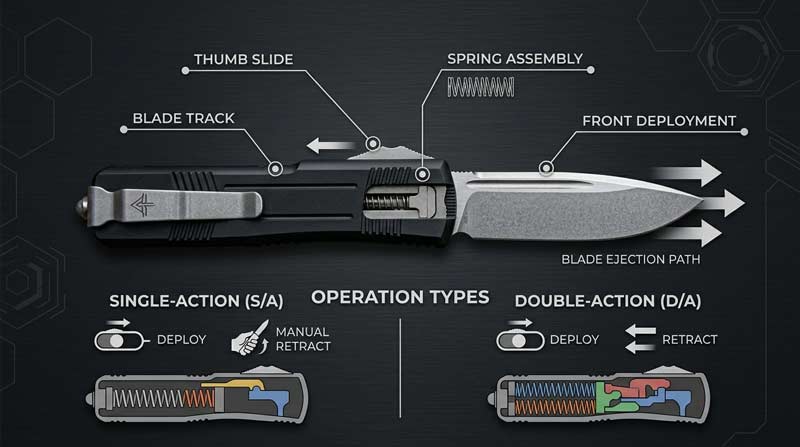
At first glance, an OTF knife can seem complicated, but the basic idea is actually pretty simple. Inside the handle is a spring-loaded mechanism connected to the blade. When you push the thumb slide forward, the internal spring helps launch the blade out the front of the handle and lock it into place. On many models, pulling the slide back retracts the blade into the handle just as quickly.
The biggest thing that makes OTF knives different from traditional folders is the deployment path. A normal pocket knife pivots open from the side on a hinge, while an OTF knife moves straight forward along an internal track. That forward motion is what gives OTF knives their smooth, satisfying action and distinct mechanical feel.
There are two main styles of OTF knives: single-action and double-action. Single-action OTF knives fire the blade out automatically, but you usually need to manually reset or cock the mechanism to retract it. Double-action OTF knives are more convenient because the same thumb slide both deploys and retracts the blade, making them much more practical for daily use.
If you want a deeper breakdown of springs, locking systems, and deployment mechanics, we have a full guide explaining how automatic knives work and what makes different opening systems unique.
One thing many people do not realize is that most OTF knives are designed with safety in mind. Many modern models include mechanisms that stop the blade if it hits resistance during deployment, helping reduce accidental damage or misfires. That mechanical engineering is part of what makes OTF knives so interesting to collectors and knife enthusiasts.
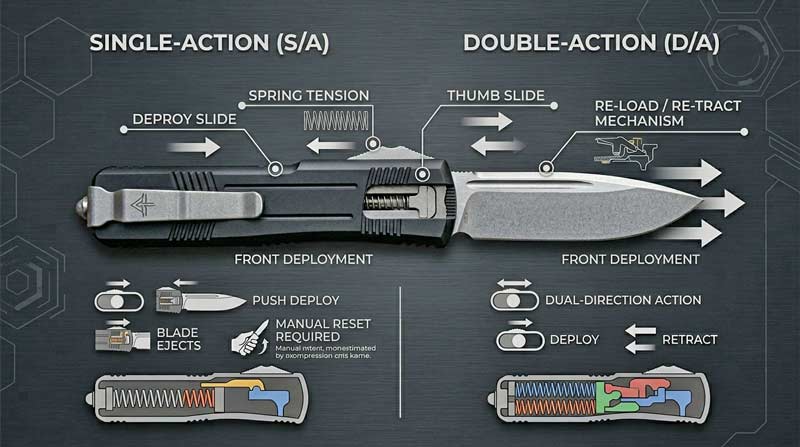
One of the biggest differences between OTF knives comes down to how the blade deploys and retracts. Most OTF knives fall into one of two categories: single-action or double-action. While they may look similar from the outside, the way they operate can feel very different in everyday use.
A single-action OTF knife automatically fires the blade out the front of the handle when activated, but retracting it usually requires manually resetting the mechanism. In many cases, this means pulling a charging handle, lever, or other component to re-cock the spring before the knife is ready to deploy again. Because of that extra step, single-action models tend to appeal more to collectors and enthusiasts who enjoy the mechanics behind the design.
A double-action OTF knife, on the other hand, is much more convenient for practical use. With a simple push of the thumb slide, the blade deploys out the front. Pull the same switch back, and the blade retracts into the handle. That smooth, one-handed operation is one reason many people prefer double-action models for daily carry and utility tasks.
If you are exploring different knife styles beyond OTF models, browsing a broader selection of knives can give you a better idea of how deployment systems, blade shapes, and handle designs compare across different categories.
For most people, a double-action OTF knife tends to be the easier and more practical option, while single-action models often appeal to people who appreciate unique mechanisms or enjoy collecting unusual knife designs. Neither is necessarily better, it just depends on how you plan to use it.
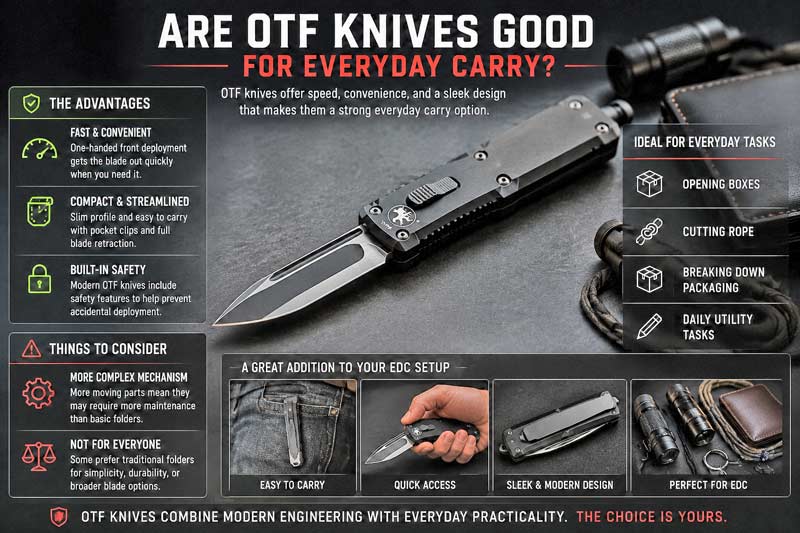
For many people, an OTF knife can make an excellent everyday carry option. Their biggest advantage is speed and convenience. Since the blade deploys straight out of the handle with one hand, they are quick to access when opening boxes, cutting rope, breaking down packaging, or handling other small daily tasks. That ease of use is a big reason why OTF knives have become increasingly popular among EDC enthusiasts.
Another advantage is how compact many OTF knives feel in the pocket. Because the blade retracts fully inside the handle, they often have a slim, streamlined design that carries comfortably without taking up much space. Many models also include pocket clips and safety features that help prevent accidental deployment while being carried.
That said, OTF knives are not automatically the best choice for everyone. Some people prefer traditional folding knives because they are simpler mechanically, easier to clean, or come in a wider range of blade styles. The right option usually depends on personal preference, intended use, and what feels most comfortable in your hand.
If you are still deciding what style makes the most sense for daily carry, this guide to choosing an EDC knife breaks down what to consider when picking the right blade for everyday use.
For people who appreciate quick access, modern engineering, and a sleek design, OTF knives can be a very practical part of an everyday carry setup. Whether you prefer them over traditional folders usually comes down to how you plan to use your knife day to day.
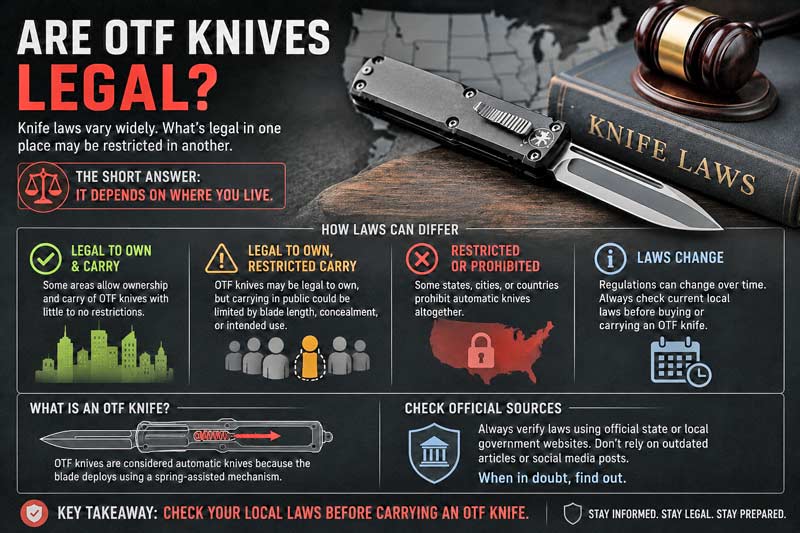
One of the most common questions people ask about OTF knives is whether they are legal to own or carry. The short answer is: it depends on where you live. Knife laws can vary significantly depending on the country, state, or even city, and regulations surrounding automatic knives are often more restrictive than standard folding knives.
In some places, owning an OTF knife is completely legal, but carrying one in public may have restrictions based on blade length, concealment, or intended use. Other areas allow ownership and carry with few limitations, while some locations restrict automatic knives altogether. Because laws change over time, it is always a good idea to check current local regulations before buying or carrying any automatic knife.
OTF knives are often grouped into the broader category of automatic knives because the blade deploys using a spring-assisted mechanism rather than manual opening. If you want to compare different styles and features, browsing these automatic knives can help give you a better understanding of how OTF models fit into the larger category.
Rather than relying on outdated articles or social media posts, it is always smartest to verify laws using official state or local government sources. Knife regulations can change, and what is legal in one state may not be legal in another.
For most people, the key takeaway is simple: check your local laws before carrying an OTF knife. Doing a quick bit of research can help you avoid unnecessary problems and make sure you stay compliant wherever you live.
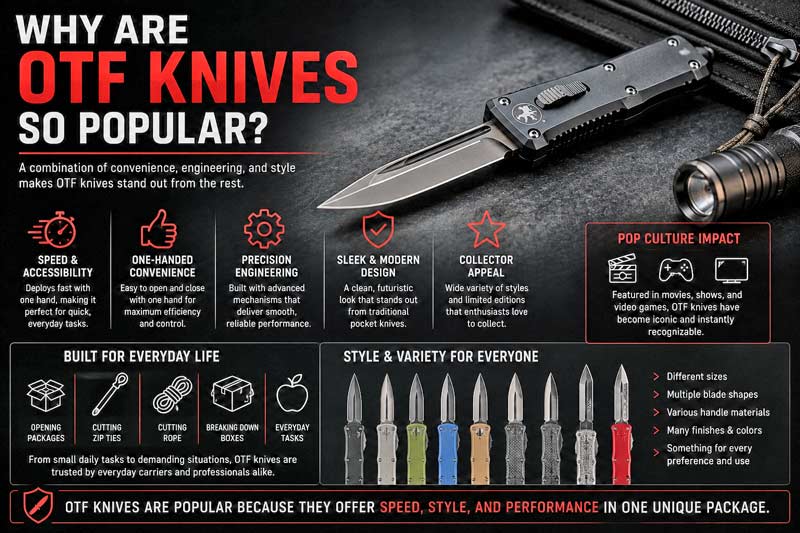
OTF knives have grown in popularity over the years for a simple reason: people genuinely enjoy the combination of convenience, engineering, and style. There is something undeniably satisfying about pressing a switch and watching the blade smoothly deploy out the front of the handle. For many knife enthusiasts, the action alone makes OTF knives feel different from traditional folders.
Speed and accessibility are also major reasons people gravitate toward them. Since many OTF knives can be opened and closed with one hand, they are convenient for small everyday cutting tasks like opening packages, cutting zip ties, slicing rope, or breaking down boxes. That ease of use makes them appealing to people who carry knives regularly.
Another reason for their popularity is simply variety. OTF knives come in a wide range of sizes, blade shapes, handle materials, and finishes. Some people prefer sleek, minimalist designs for everyday utility, while others enjoy larger or more aggressive styles for collecting. If you are curious about different designs and blade styles, browsing a wider selection of knives can give you a better idea of what fits your preferences.
Movies, video games, and pop culture have also played a role in making OTF knives feel iconic. Their fast deployment and futuristic look tend to grab attention, which naturally creates curiosity among people who may not even be serious knife collectors. At the same time, longtime enthusiasts often appreciate the craftsmanship and precision engineering involved in making the mechanism work smoothly and reliably.
At the end of the day, OTF knives are popular because they offer something unique. They combine modern mechanics, fast deployment, and a distinct style that stands apart from traditional pocket knives, which is exactly why so many people continue to be fascinated by them.
OTF knives have earned their popularity for good reason. They offer a unique combination of fast deployment, sleek design, and impressive engineering that stands apart from traditional folding knives. Whether someone is interested in everyday utility, collecting, or simply appreciates well-designed gear, there is a lot to like about the way an OTF knife functions and feels in hand.
For some people, an OTF knife becomes a practical everyday tool thanks to its quick one-handed operation and compact profile. Others are drawn to the mechanical design, variety of styles, and satisfying action that makes deploying the blade feel smooth and precise. Like most knives, the right choice comes down to personal preference, intended use, and what feels comfortable to carry.
If you are considering an OTF knife, taking time to compare features, opening mechanisms, blade shapes, and handle styles can help you find the right fit. Whether you prefer something compact for everyday carry or simply enjoy learning about modern knife designs, there are plenty of interesting options worth exploring.
As with any automatic knife, make sure to check your local laws before carrying one and choose a model that matches how you realistically plan to use it. For many enthusiasts, OTF knives offer a unique blend of convenience, style, and engineering that is hard to beat.
What Is an OTF Knife?
An OTF knife, short for out-the-front knife, is a type of knife where the blade deploys straight out of the front of the handle instead of swinging open from the side like a traditional folding knife. With the push of a thumb slide or button, the blade extends quickly and locks into place, making OTF knives one of the fastest and most convenient knife styles available.
Most people recognize OTF knives because of their smooth, mechanical action. Instead of using thumb studs, flippers, or nail pulls, the blade travels along an internal track inside the handle. That unique design gives them a sleek, modern feel and is a big reason why they have become so popular among knife enthusiasts and everyday carry fans.
Although OTF knives sometimes get lumped together with switchblades, there are actually several different styles of automatic knives. Some open from the side like a traditional pocket knife, while OTF models deploy straight forward. If you want to see how other styles compare, check out these automatic knives to see the different opening mechanisms and designs available.
Many people are drawn to OTF knives because they combine speed, compact size, and a futuristic look in a way that feels different from traditional folders. Whether someone wants a practical utility knife, an addition to their everyday carry gear, or simply enjoys the engineering behind the mechanism, OTF knives tend to stand out immediately.
How Does an OTF Knife Work?
At first glance, an OTF knife can seem complicated, but the basic idea is actually pretty simple. Inside the handle is a spring-loaded mechanism connected to the blade. When you push the thumb slide forward, the internal spring helps launch the blade out the front of the handle and lock it into place. On many models, pulling the slide back retracts the blade into the handle just as quickly.
The biggest thing that makes OTF knives different from traditional folders is the deployment path. A normal pocket knife pivots open from the side on a hinge, while an OTF knife moves straight forward along an internal track. That forward motion is what gives OTF knives their smooth, satisfying action and distinct mechanical feel.
There are two main styles of OTF knives: single-action and double-action. Single-action OTF knives fire the blade out automatically, but you usually need to manually reset or cock the mechanism to retract it. Double-action OTF knives are more convenient because the same thumb slide both deploys and retracts the blade, making them much more practical for daily use.
If you want a deeper breakdown of springs, locking systems, and deployment mechanics, we have a full guide explaining how automatic knives work and what makes different opening systems unique.
One thing many people do not realize is that most OTF knives are designed with safety in mind. Many modern models include mechanisms that stop the blade if it hits resistance during deployment, helping reduce accidental damage or misfires. That mechanical engineering is part of what makes OTF knives so interesting to collectors and knife enthusiasts.
Single-Action vs Double-Action OTF Knives
One of the biggest differences between OTF knives comes down to how the blade deploys and retracts. Most OTF knives fall into one of two categories: single-action or double-action. While they may look similar from the outside, the way they operate can feel very different in everyday use.
A single-action OTF knife automatically fires the blade out the front of the handle when activated, but retracting it usually requires manually resetting the mechanism. In many cases, this means pulling a charging handle, lever, or other component to re-cock the spring before the knife is ready to deploy again. Because of that extra step, single-action models tend to appeal more to collectors and enthusiasts who enjoy the mechanics behind the design.
A double-action OTF knife, on the other hand, is much more convenient for practical use. With a simple push of the thumb slide, the blade deploys out the front. Pull the same switch back, and the blade retracts into the handle. That smooth, one-handed operation is one reason many people prefer double-action models for daily carry and utility tasks.
If you are exploring different knife styles beyond OTF models, browsing a broader selection of knives can give you a better idea of how deployment systems, blade shapes, and handle designs compare across different categories.
For most people, a double-action OTF knife tends to be the easier and more practical option, while single-action models often appeal to people who appreciate unique mechanisms or enjoy collecting unusual knife designs. Neither is necessarily better, it just depends on how you plan to use it.
Are OTF Knives Good for Everyday Carry?
For many people, an OTF knife can make an excellent everyday carry option. Their biggest advantage is speed and convenience. Since the blade deploys straight out of the handle with one hand, they are quick to access when opening boxes, cutting rope, breaking down packaging, or handling other small daily tasks. That ease of use is a big reason why OTF knives have become increasingly popular among EDC enthusiasts.
Another advantage is how compact many OTF knives feel in the pocket. Because the blade retracts fully inside the handle, they often have a slim, streamlined design that carries comfortably without taking up much space. Many models also include pocket clips and safety features that help prevent accidental deployment while being carried.
That said, OTF knives are not automatically the best choice for everyone. Some people prefer traditional folding knives because they are simpler mechanically, easier to clean, or come in a wider range of blade styles. The right option usually depends on personal preference, intended use, and what feels most comfortable in your hand.
If you are still deciding what style makes the most sense for daily carry, this guide to choosing an EDC knife breaks down what to consider when picking the right blade for everyday use.
For people who appreciate quick access, modern engineering, and a sleek design, OTF knives can be a very practical part of an everyday carry setup. Whether you prefer them over traditional folders usually comes down to how you plan to use your knife day to day.
Are OTF Knives Legal?
One of the most common questions people ask about OTF knives is whether they are legal to own or carry. The short answer is: it depends on where you live. Knife laws can vary significantly depending on the country, state, or even city, and regulations surrounding automatic knives are often more restrictive than standard folding knives.
In some places, owning an OTF knife is completely legal, but carrying one in public may have restrictions based on blade length, concealment, or intended use. Other areas allow ownership and carry with few limitations, while some locations restrict automatic knives altogether. Because laws change over time, it is always a good idea to check current local regulations before buying or carrying any automatic knife.
OTF knives are often grouped into the broader category of automatic knives because the blade deploys using a spring-assisted mechanism rather than manual opening. If you want to compare different styles and features, browsing these automatic knives can help give you a better understanding of how OTF models fit into the larger category.
Rather than relying on outdated articles or social media posts, it is always smartest to verify laws using official state or local government sources. Knife regulations can change, and what is legal in one state may not be legal in another.
For most people, the key takeaway is simple: check your local laws before carrying an OTF knife. Doing a quick bit of research can help you avoid unnecessary problems and make sure you stay compliant wherever you live.
Why Are OTF Knives So Popular?
OTF knives have grown in popularity over the years for a simple reason: people genuinely enjoy the combination of convenience, engineering, and style. There is something undeniably satisfying about pressing a switch and watching the blade smoothly deploy out the front of the handle. For many knife enthusiasts, the action alone makes OTF knives feel different from traditional folders.
Speed and accessibility are also major reasons people gravitate toward them. Since many OTF knives can be opened and closed with one hand, they are convenient for small everyday cutting tasks like opening packages, cutting zip ties, slicing rope, or breaking down boxes. That ease of use makes them appealing to people who carry knives regularly.
Another reason for their popularity is simply variety. OTF knives come in a wide range of sizes, blade shapes, handle materials, and finishes. Some people prefer sleek, minimalist designs for everyday utility, while others enjoy larger or more aggressive styles for collecting. If you are curious about different designs and blade styles, browsing a wider selection of knives can give you a better idea of what fits your preferences.
Movies, video games, and pop culture have also played a role in making OTF knives feel iconic. Their fast deployment and futuristic look tend to grab attention, which naturally creates curiosity among people who may not even be serious knife collectors. At the same time, longtime enthusiasts often appreciate the craftsmanship and precision engineering involved in making the mechanism work smoothly and reliably.
At the end of the day, OTF knives are popular because they offer something unique. They combine modern mechanics, fast deployment, and a distinct style that stands apart from traditional pocket knives, which is exactly why so many people continue to be fascinated by them.
Final Thoughts on OTF Knives
OTF knives have earned their popularity for good reason. They offer a unique combination of fast deployment, sleek design, and impressive engineering that stands apart from traditional folding knives. Whether someone is interested in everyday utility, collecting, or simply appreciates well-designed gear, there is a lot to like about the way an OTF knife functions and feels in hand.
For some people, an OTF knife becomes a practical everyday tool thanks to its quick one-handed operation and compact profile. Others are drawn to the mechanical design, variety of styles, and satisfying action that makes deploying the blade feel smooth and precise. Like most knives, the right choice comes down to personal preference, intended use, and what feels comfortable to carry.
If you are considering an OTF knife, taking time to compare features, opening mechanisms, blade shapes, and handle styles can help you find the right fit. Whether you prefer something compact for everyday carry or simply enjoy learning about modern knife designs, there are plenty of interesting options worth exploring.
As with any automatic knife, make sure to check your local laws before carrying one and choose a model that matches how you realistically plan to use it. For many enthusiasts, OTF knives offer a unique blend of convenience, style, and engineering that is hard to beat.
You May Also Be Interested In:
- How Automatic Knives Actually Work
- How Do Automatic Knives Work? Inside the Mechanism
- The Deadliest Throwing Knives for Modern Combat! Knife Testing and Review
- What Is a Telescoping Baton and How Does It Work
- How Stun Guns Work and How to Choose One
- Non Lethal Self Defense Weapons That Actually Work
- Cat Keychain Self Defense: Do They Work and Are They Legal
- Stun Gun Brass Knuckles: How They Work and Are They Effective?
- Why Every Day Should Be an EDC Knife Day: How a Simple Knife Can Make Your Life Easier and Safer
- Best EDC Knife: How to Choose the Right Everyday Carry Knife
Leave a Reply