





What Is a Karambit Knife? Beginner Guide to Karambits
May 14th, 2026
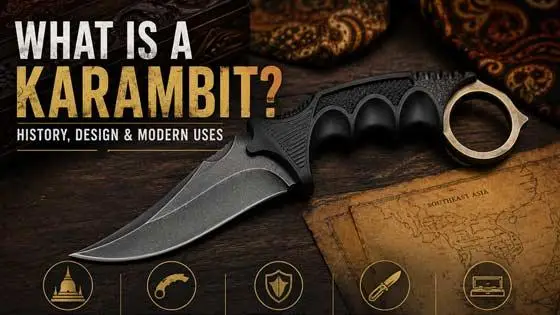
Karambits are some of the most recognizable specialty knives in the world because of their curved blade shape and distinctive finger ring handle design. Originally developed in Southeast Asia, the karambit has a long history connected to traditional martial arts, utility work, and agricultural tools before eventually evolving into the modern knife style many people recognize today. Their curved profile and compact size helped them stand out from more conventional knife designs, especially among collectors and martial arts enthusiasts.
Modern karambits now come in a wide range of styles including traditional fixed blades, folding designs, training versions, and highly stylized collector pieces. Some stay close to historical Southeast Asian-inspired designs, while others use modern materials and tactical styling for a more contemporary appearance. Whether someone is interested in traditional martial arts history, unique blade ergonomics, or modern karambit knives, understanding the origins and design of the karambit helps explain why this unusual curved blade continues to remain so popular around the world today.
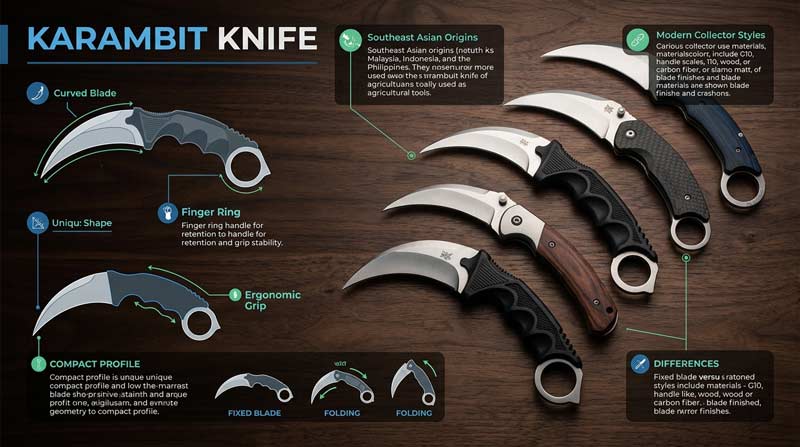
A karambit is a curved knife originally associated with Southeast Asian martial arts and traditional utility work. Its most recognizable features are the sharply curved blade and the finger ring located at the end of the handle. That combination gives karambits a very different appearance and handling style compared to most conventional knife designs, which is one reason they have become so popular among collectors and martial arts enthusiasts around the world.
Traditional karambits were often relatively small and compact, with curved blades designed for controlled cutting motions and close-range utility tasks. Over time, the design evolved into many different variations including larger fixed blades, folding models, training versions, and highly stylized modern collector pieces. Some modern karambits stay close to traditional Southeast Asian-inspired designs, while others use aggressive modern styling and upgraded materials for a more contemporary look.
The finger ring is one of the most distinctive parts of the karambit design because it helps create a secure grip and gives the knife a unique ergonomic feel during handling. Many users find the curved blade and ring combination comfortable and visually striking compared to more traditional straight-handle knives. That unusual grip style has helped karambits stand out among other specialty knife designs for many years.
Today, karambits are commonly appreciated for collecting, martial arts training, display, and modern knife culture. Their distinctive curved shape, compact size, and strong connection to martial arts history continue to make them one of the most recognizable specialty blade styles in the world.
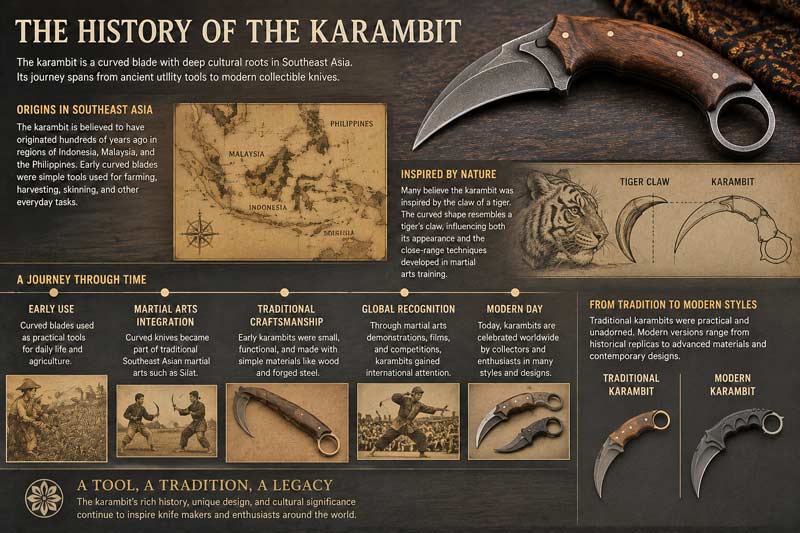
The karambit is believed to have originated in Southeast Asia, particularly in regions that are now part of Indonesia, Malaysia, and the Philippines. Historians commonly trace its roots back hundreds of years, where early curved blade tools were used for agricultural work, harvesting, and everyday utility tasks. Over time, the design evolved beyond simple farming tools and became associated with traditional martial arts systems throughout the region.
One popular theory is that the karambit was inspired by the shape of a tiger's claw. The deeply curved blade resembles a claw-like hook, which likely influenced both the knife's appearance and the techniques developed around it in martial arts training. Traditional Southeast Asian martial arts systems such as silat often incorporated curved blades into their training because of their compact size and unique handling characteristics.
Early karambits were usually fairly small and practical in design, often featuring wooden handles and simple forged blades. Unlike many modern versions, traditional karambits were not heavily stylized or designed for visual impact. Their focus was primarily on utility, portability, and versatility during everyday use and martial arts practice.
As martial arts spread internationally through demonstrations, movies, competitions, and modern knife culture, the karambit gradually became popular outside Southeast Asia. Today, collectors and enthusiasts appreciate karambits for their historical background, unique ergonomics, and recognizable curved blade shape. Modern fixed blade knife styles inspired by traditional karambits now appear in a wide variety of designs ranging from historical replicas to highly modernized collector pieces.
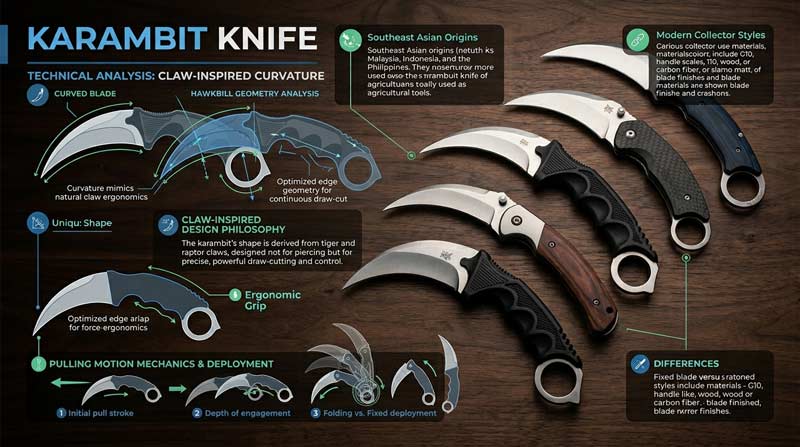
One of the most recognizable features of a karambit is its deeply curved blade shape. Unlike straight-edge knives that rely on direct slicing motions, the curved profile of a karambit creates a very different feel during handling and cutting movements. The hook-like shape allows the blade to maintain contact more naturally during curved or pulling motions, which is one reason the design has remained popular for both utility work and martial arts training over the years.
The curved design also gives karambits a very distinctive appearance compared to most traditional knife styles. Many collectors are drawn to the aggressive claw-like silhouette because it stands out visually from conventional straight blades and folding knives. Some people even compare the blade shape to an animal claw, especially since traditional karambit designs are often associated with tiger claw-inspired martial arts concepts in Southeast Asia.
Modern karambits now come in many different blade variations including compact utility designs, highly curved hawkbill-inspired shapes, and larger tactical-inspired collector models. Some feature simple plain edges, while others use serrations, textured finishes, or decorative blade grinds to create a more modern appearance. Folding versions have also become increasingly popular among enthusiasts interested in compact folding knife designs with unusual ergonomics and distinctive blade shapes.
Because the curved profile feels so different from standard knives, karambits continue to attract collectors and knife enthusiasts who want something visually unique and mechanically interesting. Their unusual blade shape is one of the biggest reasons they remain one of the most recognizable specialty knife styles in the world today.
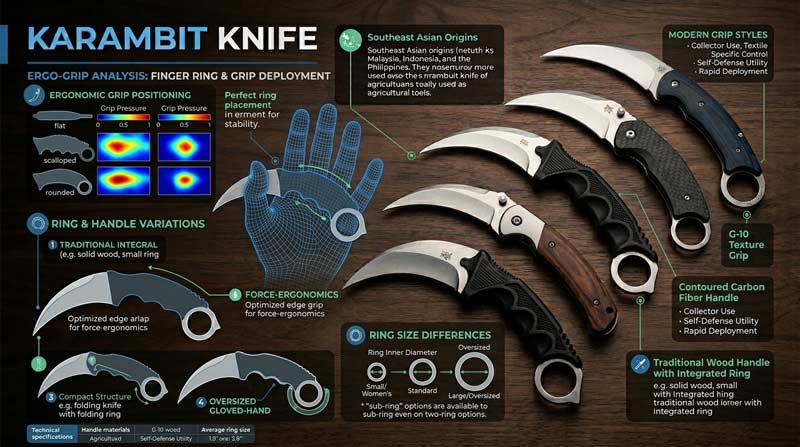
The finger ring is one of the most distinctive features of the karambit and plays a major role in both its appearance and handling characteristics. Located at the end of the handle, the ring allows the user to insert a finger through the opening to create a more secure grip. This design helps the knife feel stable in the hand and gives karambits a very different ergonomic feel compared to most conventional knife styles.
Traditional karambits often used relatively simple ring designs, but modern versions now come in many different sizes and shapes depending on the intended style and grip preference. Some rings are large and rounded for comfort, while others are smaller or more angular to create a more aggressive visual appearance. Many collectors are drawn to karambits specifically because the finger ring gives them such a recognizable silhouette.
The ring also contributes to the compact feel of the knife by helping secure the hand position without requiring a large handle. Because of this, many karambits remain relatively compact even when paired with larger curved blades. Folding designs, training versions, and highly stylized collector pieces often keep the ring as a core visual feature even when other parts of the knife design change significantly.
Knife enthusiasts who enjoy unusual ergonomics and compact specialty blades are often also interested in other unique designs such as push dagger styles because both knife types stand out from traditional straight-handle designs. The unusual grip characteristics of karambits are a major reason they continue to remain popular among collectors and modern knife enthusiasts today.
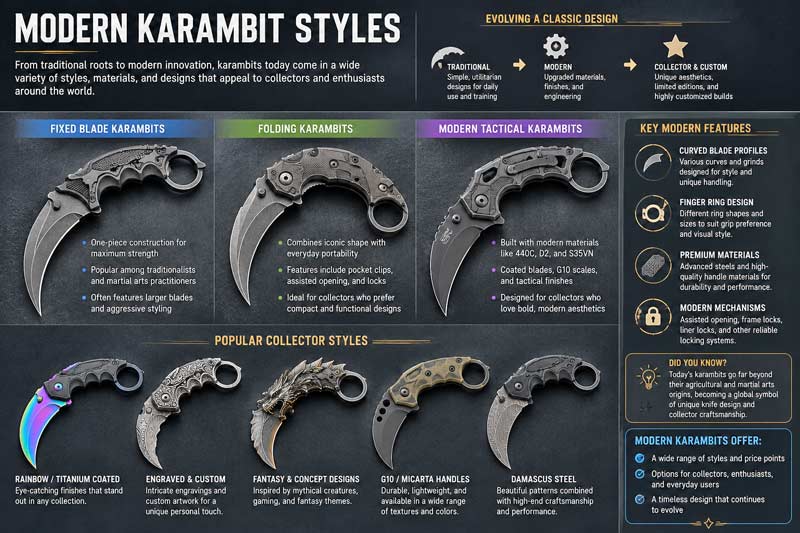
Modern karambits are available in a huge variety of styles that range from traditional Southeast Asian-inspired designs to highly modernized collector pieces. While early karambits were usually simple fixed blades made for utility and martial arts use, many modern versions now focus heavily on specialized materials, unique finishes, folding mechanisms, and visually aggressive styling that appeals to knife enthusiasts and collectors.
Fixed blade karambits remain popular among collectors who prefer traditional construction and solid one-piece designs. These models often feature larger curved blades, textured grip materials, and durable handle construction designed for stability and visual impact. Some stay close to older martial arts-inspired shapes, while others use modern styling elements such as coated blades, angular grinds, and oversized finger rings.
Folding karambits have also become extremely popular because they combine the distinctive curved blade design with more compact portability. Many modern folding versions use pocket clips, assisted opening systems, or locking mechanisms that make them very different from traditional Southeast Asian karambits. Collectors interested in modern compact folding knives are often drawn to karambits because of their recognizable shape and unusual ergonomics.
Some modern collector models focus almost entirely on visual appearance and customization. Decorative finishes, colored handle scales, engraved blades, and fantasy-inspired designs are now very common in the karambit market. Unique models such as the modern tactical karambit show how the design has evolved far beyond its original agricultural and martial arts roots while still maintaining the signature curved blade and finger ring shape that define the karambit style.
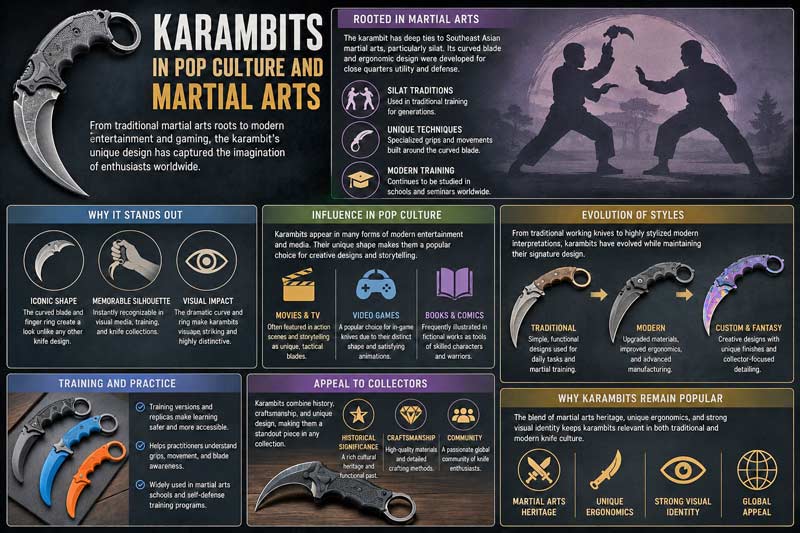
Karambits became significantly more popular worldwide through martial arts demonstrations, movies, video games, and modern knife culture. Their curved blade shape and finger ring design give them a very recognizable appearance that stands out immediately in action scenes and visual media. Because of that unique silhouette, karambits eventually grew beyond their Southeast Asian origins and became widely recognized among collectors, gamers, martial arts enthusiasts, and specialty knife fans around the world.
Traditional Southeast Asian martial arts systems such as silat helped introduce the karambit to international audiences through demonstrations and martial arts training videos. As interest in martial arts expanded globally, many people became fascinated by the knife's unusual handling style and curved blade mechanics. Modern training versions and collector models helped increase the popularity of karambits even further among enthusiasts interested in martial arts-inspired blade designs.
Movies and video games also played a major role in turning karambits into one of the most recognizable specialty knives in modern pop culture. Many fictional characters use stylized curved knives inspired by karambit designs because the hooked blade and finger ring create a visually dramatic appearance. Some versions stay relatively close to traditional designs, while others become highly exaggerated with fantasy-inspired shapes, oversized curves, or futuristic styling.
Collectors interested in unique curved blade knives are often drawn to karambits because they combine martial arts history, unusual ergonomics, and strong visual appeal into one distinctive design. Their continued popularity across movies, gaming, martial arts, and modern knife collecting is a major reason karambits remain one of the most recognizable specialty knife styles today.
Karambits remain one of the most recognizable specialty knife styles in the world because of their curved blade shape, finger ring grip, and strong connection to Southeast Asian martial arts history. While modern versions now come in countless styles and configurations, the core design has remained surprisingly consistent for generations. That combination of historical roots and modern evolution is a major reason karambits continue to attract collectors, martial artists, and knife enthusiasts worldwide.
One of the biggest reasons karambits remain popular is that they feel completely different from most conventional knives. The curved blade profile, compact size, and ring-based grip create a very distinctive handling experience that stands out immediately among modern knife designs. Many enthusiasts are drawn to karambits simply because they offer something visually and ergonomically unique compared to traditional straight-blade styles.
Modern karambit knife styles now range from traditional fixed blades and folding designs to highly stylized collector pieces inspired by martial arts, gaming, and modern knife culture. That wide variety of styles has helped the karambit remain relevant across multiple generations of collectors and specialty knife enthusiasts.
Whether someone is interested in martial arts history, unusual ergonomics, collectible blades, or modern knife design, the karambit continues to stand out as one of the most distinctive and recognizable specialty knives ever created. Its combination of historical background, curved blade mechanics, and modern visual appeal has helped secure its place in both martial arts culture and the broader world of specialty knives.
What Is a Karambit?
A karambit is a curved knife originally associated with Southeast Asian martial arts and traditional utility work. Its most recognizable features are the sharply curved blade and the finger ring located at the end of the handle. That combination gives karambits a very different appearance and handling style compared to most conventional knife designs, which is one reason they have become so popular among collectors and martial arts enthusiasts around the world.
Traditional karambits were often relatively small and compact, with curved blades designed for controlled cutting motions and close-range utility tasks. Over time, the design evolved into many different variations including larger fixed blades, folding models, training versions, and highly stylized modern collector pieces. Some modern karambits stay close to traditional Southeast Asian-inspired designs, while others use aggressive modern styling and upgraded materials for a more contemporary look.
The finger ring is one of the most distinctive parts of the karambit design because it helps create a secure grip and gives the knife a unique ergonomic feel during handling. Many users find the curved blade and ring combination comfortable and visually striking compared to more traditional straight-handle knives. That unusual grip style has helped karambits stand out among other specialty knife designs for many years.
Today, karambits are commonly appreciated for collecting, martial arts training, display, and modern knife culture. Their distinctive curved shape, compact size, and strong connection to martial arts history continue to make them one of the most recognizable specialty blade styles in the world.
The History of the Karambit
The karambit is believed to have originated in Southeast Asia, particularly in regions that are now part of Indonesia, Malaysia, and the Philippines. Historians commonly trace its roots back hundreds of years, where early curved blade tools were used for agricultural work, harvesting, and everyday utility tasks. Over time, the design evolved beyond simple farming tools and became associated with traditional martial arts systems throughout the region.
One popular theory is that the karambit was inspired by the shape of a tiger's claw. The deeply curved blade resembles a claw-like hook, which likely influenced both the knife's appearance and the techniques developed around it in martial arts training. Traditional Southeast Asian martial arts systems such as silat often incorporated curved blades into their training because of their compact size and unique handling characteristics.
Early karambits were usually fairly small and practical in design, often featuring wooden handles and simple forged blades. Unlike many modern versions, traditional karambits were not heavily stylized or designed for visual impact. Their focus was primarily on utility, portability, and versatility during everyday use and martial arts practice.
As martial arts spread internationally through demonstrations, movies, competitions, and modern knife culture, the karambit gradually became popular outside Southeast Asia. Today, collectors and enthusiasts appreciate karambits for their historical background, unique ergonomics, and recognizable curved blade shape. Modern fixed blade knife styles inspired by traditional karambits now appear in a wide variety of designs ranging from historical replicas to highly modernized collector pieces.
Why the Curved Blade Design Is Unique
One of the most recognizable features of a karambit is its deeply curved blade shape. Unlike straight-edge knives that rely on direct slicing motions, the curved profile of a karambit creates a very different feel during handling and cutting movements. The hook-like shape allows the blade to maintain contact more naturally during curved or pulling motions, which is one reason the design has remained popular for both utility work and martial arts training over the years.
The curved design also gives karambits a very distinctive appearance compared to most traditional knife styles. Many collectors are drawn to the aggressive claw-like silhouette because it stands out visually from conventional straight blades and folding knives. Some people even compare the blade shape to an animal claw, especially since traditional karambit designs are often associated with tiger claw-inspired martial arts concepts in Southeast Asia.
Modern karambits now come in many different blade variations including compact utility designs, highly curved hawkbill-inspired shapes, and larger tactical-inspired collector models. Some feature simple plain edges, while others use serrations, textured finishes, or decorative blade grinds to create a more modern appearance. Folding versions have also become increasingly popular among enthusiasts interested in compact folding knife designs with unusual ergonomics and distinctive blade shapes.
Because the curved profile feels so different from standard knives, karambits continue to attract collectors and knife enthusiasts who want something visually unique and mechanically interesting. Their unusual blade shape is one of the biggest reasons they remain one of the most recognizable specialty knife styles in the world today.
The Finger Ring and Grip Style
The finger ring is one of the most distinctive features of the karambit and plays a major role in both its appearance and handling characteristics. Located at the end of the handle, the ring allows the user to insert a finger through the opening to create a more secure grip. This design helps the knife feel stable in the hand and gives karambits a very different ergonomic feel compared to most conventional knife styles.
Traditional karambits often used relatively simple ring designs, but modern versions now come in many different sizes and shapes depending on the intended style and grip preference. Some rings are large and rounded for comfort, while others are smaller or more angular to create a more aggressive visual appearance. Many collectors are drawn to karambits specifically because the finger ring gives them such a recognizable silhouette.
The ring also contributes to the compact feel of the knife by helping secure the hand position without requiring a large handle. Because of this, many karambits remain relatively compact even when paired with larger curved blades. Folding designs, training versions, and highly stylized collector pieces often keep the ring as a core visual feature even when other parts of the knife design change significantly.
Knife enthusiasts who enjoy unusual ergonomics and compact specialty blades are often also interested in other unique designs such as push dagger styles because both knife types stand out from traditional straight-handle designs. The unusual grip characteristics of karambits are a major reason they continue to remain popular among collectors and modern knife enthusiasts today.
Modern Karambit Styles
Modern karambits are available in a huge variety of styles that range from traditional Southeast Asian-inspired designs to highly modernized collector pieces. While early karambits were usually simple fixed blades made for utility and martial arts use, many modern versions now focus heavily on specialized materials, unique finishes, folding mechanisms, and visually aggressive styling that appeals to knife enthusiasts and collectors.
Fixed blade karambits remain popular among collectors who prefer traditional construction and solid one-piece designs. These models often feature larger curved blades, textured grip materials, and durable handle construction designed for stability and visual impact. Some stay close to older martial arts-inspired shapes, while others use modern styling elements such as coated blades, angular grinds, and oversized finger rings.
Folding karambits have also become extremely popular because they combine the distinctive curved blade design with more compact portability. Many modern folding versions use pocket clips, assisted opening systems, or locking mechanisms that make them very different from traditional Southeast Asian karambits. Collectors interested in modern compact folding knives are often drawn to karambits because of their recognizable shape and unusual ergonomics.
Some modern collector models focus almost entirely on visual appearance and customization. Decorative finishes, colored handle scales, engraved blades, and fantasy-inspired designs are now very common in the karambit market. Unique models such as the modern tactical karambit show how the design has evolved far beyond its original agricultural and martial arts roots while still maintaining the signature curved blade and finger ring shape that define the karambit style.
Karambits in Pop Culture and Martial Arts
Karambits became significantly more popular worldwide through martial arts demonstrations, movies, video games, and modern knife culture. Their curved blade shape and finger ring design give them a very recognizable appearance that stands out immediately in action scenes and visual media. Because of that unique silhouette, karambits eventually grew beyond their Southeast Asian origins and became widely recognized among collectors, gamers, martial arts enthusiasts, and specialty knife fans around the world.
Traditional Southeast Asian martial arts systems such as silat helped introduce the karambit to international audiences through demonstrations and martial arts training videos. As interest in martial arts expanded globally, many people became fascinated by the knife's unusual handling style and curved blade mechanics. Modern training versions and collector models helped increase the popularity of karambits even further among enthusiasts interested in martial arts-inspired blade designs.
Movies and video games also played a major role in turning karambits into one of the most recognizable specialty knives in modern pop culture. Many fictional characters use stylized curved knives inspired by karambit designs because the hooked blade and finger ring create a visually dramatic appearance. Some versions stay relatively close to traditional designs, while others become highly exaggerated with fantasy-inspired shapes, oversized curves, or futuristic styling.
Collectors interested in unique curved blade knives are often drawn to karambits because they combine martial arts history, unusual ergonomics, and strong visual appeal into one distinctive design. Their continued popularity across movies, gaming, martial arts, and modern knife collecting is a major reason karambits remain one of the most recognizable specialty knife styles today.
Final Thoughts on Karambits
Karambits remain one of the most recognizable specialty knife styles in the world because of their curved blade shape, finger ring grip, and strong connection to Southeast Asian martial arts history. While modern versions now come in countless styles and configurations, the core design has remained surprisingly consistent for generations. That combination of historical roots and modern evolution is a major reason karambits continue to attract collectors, martial artists, and knife enthusiasts worldwide.
One of the biggest reasons karambits remain popular is that they feel completely different from most conventional knives. The curved blade profile, compact size, and ring-based grip create a very distinctive handling experience that stands out immediately among modern knife designs. Many enthusiasts are drawn to karambits simply because they offer something visually and ergonomically unique compared to traditional straight-blade styles.
Modern karambit knife styles now range from traditional fixed blades and folding designs to highly stylized collector pieces inspired by martial arts, gaming, and modern knife culture. That wide variety of styles has helped the karambit remain relevant across multiple generations of collectors and specialty knife enthusiasts.
Whether someone is interested in martial arts history, unusual ergonomics, collectible blades, or modern knife design, the karambit continues to stand out as one of the most distinctive and recognizable specialty knives ever created. Its combination of historical background, curved blade mechanics, and modern visual appeal has helped secure its place in both martial arts culture and the broader world of specialty knives.
You May Also Be Interested In:
- Are Karambits Actually Practical or Just an Overhyped Knife?
- What Size Bo Staff Should You Use? A Beginner's Guide
- What Is a Balisong? Beginner Guide to Butterfly Knives
- What Is a Bo Staff? Beginner Guide to History, Sizes, and Training
- What Is a Fighting Cane? A Beginner's Guide to Martial Arts Canes
- The Complete Guide to Martial Arts Staffs: A Beginner-Friendly Breakdown
- What Is the Ring on a Karambit Knife For?
- Why Is the Karambit Knife Curved?
- 10 Things You Didn't Know About the Karambit Knife
- The History and Evolution of the Karambit Knife
Leave a Reply