




Are Karambits Actually Practical or Just an Overhyped Knife?
June 19th, 2026
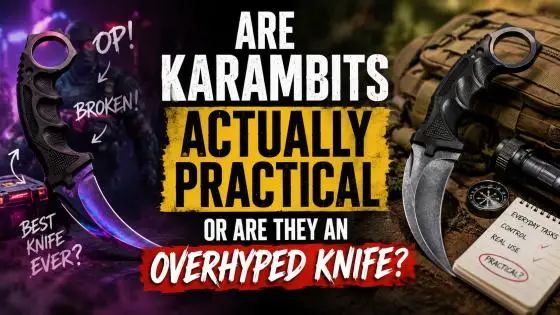
Karambit knives have one of the most recognizable designs in the knife world. Their curved blades appear in movies, video games, martial arts demonstrations, and countless social media videos. To some people, they represent the pinnacle of knife design. To others, they look like a specialty tool that gets far more attention than it deserves.
That raises an interesting question: are karambits genuinely practical, or has their reputation outgrown their real-world usefulness? The answer depends largely on how you define practicality. A knife that excels in one situation may be a poor choice in another, and few designs demonstrate that reality better than the karambit. While its unusual shape can seem intimidating or even gimmicky at first glance, there are very specific reasons this design has survived for centuries while countless others have faded into history.
To separate fact from hype, it's worth looking beyond the dramatic appearance and examining what karambits were originally designed to do, where they shine today, and where their limitations become impossible to ignore.
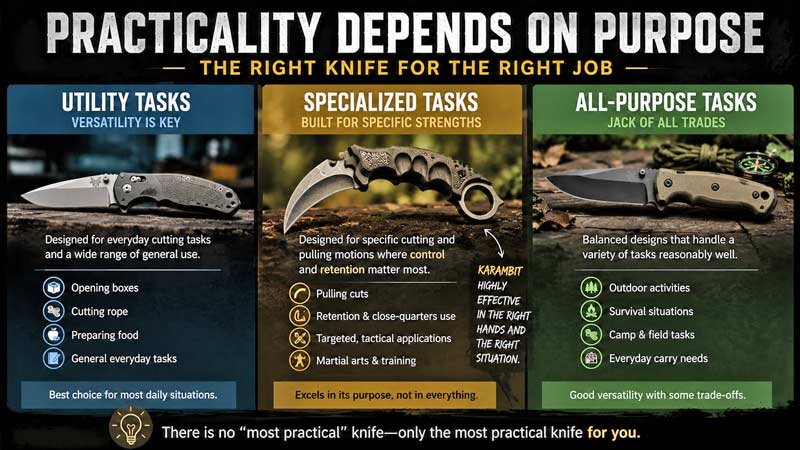
One reason the karambit debate never seems to end is that people often use the word "practical" to mean completely different things. For some knife owners, practicality means having a tool that can handle a wide variety of everyday cutting tasks. For others, it means comfort, retention, portability, or confidence in the hand. A knife that scores highly in one category may perform poorly in another.
If your definition of practicality is opening boxes, cutting rope, slicing food, and handling general utility tasks, a traditional folding knife will usually be the more versatile option. Straight blades and drop-point designs tend to excel at the broadest range of everyday jobs. That is one reason they remain so popular among people looking for a single knife to carry every day.
The karambit was never designed to be a general-purpose utility knife. Its roots can be traced back to Southeast Asia, where its curved shape evolved for specific cutting and pulling motions. As we explored in our article on why karambit knives are curved, the blade shape wasn't created to look intimidating. It was created to perform certain tasks exceptionally well.
That distinction matters because specialized tools are often judged unfairly against tools built for entirely different purposes. Nobody criticizes a chef's knife for being difficult to carry in a pocket, and nobody expects a pocketknife to replace a machete. Yet people frequently evaluate karambits as if they were intended to do everything a standard everyday carry knife can do.
A better question might be this: does the karambit perform the jobs it was designed for better than most alternatives? Once you start looking at the knife through that lens, the conversation becomes much more interesting.
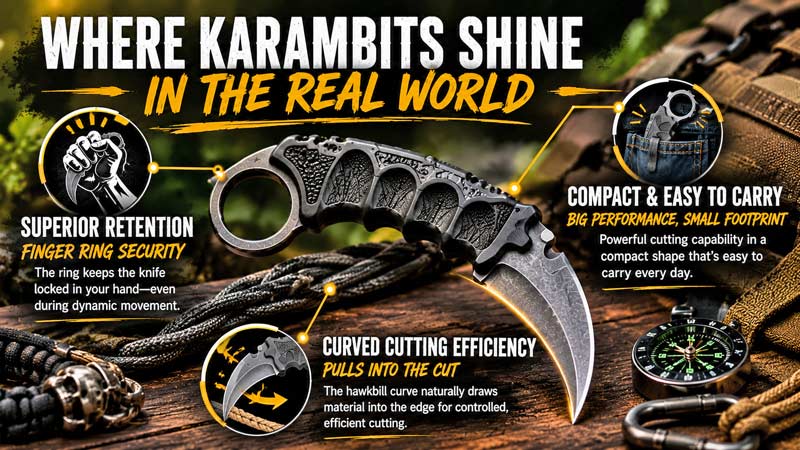
If the goal is to determine whether karambits are practical, it's important to start with the situations where they genuinely excel. While they are not designed to replace every type of knife, there are several characteristics that have helped the design remain relevant for generations.
One of the biggest advantages is retention. The finger ring provides a level of security that many traditional knife designs simply cannot match. Even if the user's grip shifts during movement, the knife remains connected to the hand. That feature is so important that we dedicated an entire article to explaining what the ring on a karambit knife is for. Far from being decorative, it serves a very practical purpose.
The curved blade is another strength. Rather than relying primarily on straight slicing motions, a karambit naturally pulls material into the edge during a cut. This can make certain cutting tasks feel surprisingly efficient. It is one reason the design has remained popular among martial artists and knife enthusiasts who appreciate specialized tools.
Many owners also find that the compact shape makes a karambit easier to carry than larger fixed-blade knives. Despite the aggressive appearance, the cutting edge is often packaged into a relatively small footprint. For people who value compact gear, that can be a meaningful advantage.
These strengths help explain why karambits continue to attract dedicated followers. As discussed in our article on why karambit knives are so effective, the design offers capabilities that many conventional knives do not. The question is whether those advantages outweigh the tradeoffs, and that's where the debate usually begins.
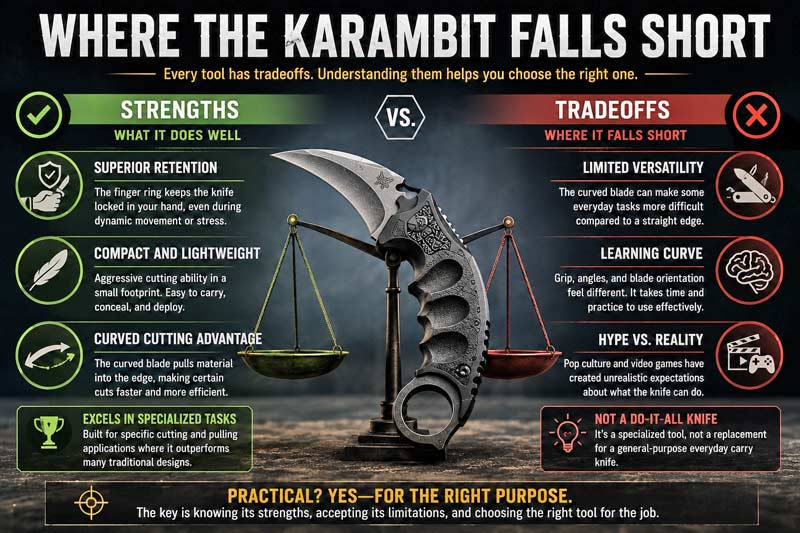
A fair evaluation of the karambit has to include its weaknesses. This is where many enthusiasts and critics tend to talk past each other. Supporters focus on what the design does exceptionally well, while detractors focus on the situations where it struggles. Both sides have valid points.
The biggest limitation is versatility. If someone wants a knife that can handle everything from opening packages to preparing food at a campsite, a traditional folding knife will usually be the more practical choice. The curved blade that gives a karambit its unique strengths can also make certain everyday tasks more awkward than they would be with a straight edge.
There is also a learning curve. Most people can pick up a conventional pocketknife and immediately understand how to use it. A karambit feels different. The grip, cutting angles, and blade orientation often require an adjustment period. That doesn't mean the knife is difficult to use, but it does mean the design rewards familiarity more than some alternatives.
Another challenge is expectation. Thanks to movies, social media clips, and video games, many people assume a karambit is some kind of ultimate knife that outperforms every other design. That expectation sets the knife up for criticism because no knife excels at everything. As we discussed in our article about why karambit knives became so popular in video games, much of the knife's modern fame comes from its appearance rather than its utility.
This doesn't make the karambit overhyped. It simply means that hype and practicality are not the same thing. A specialized tool can be extremely effective while still being the wrong choice for many people's daily needs. Understanding that distinction is the key to judging the design fairly.
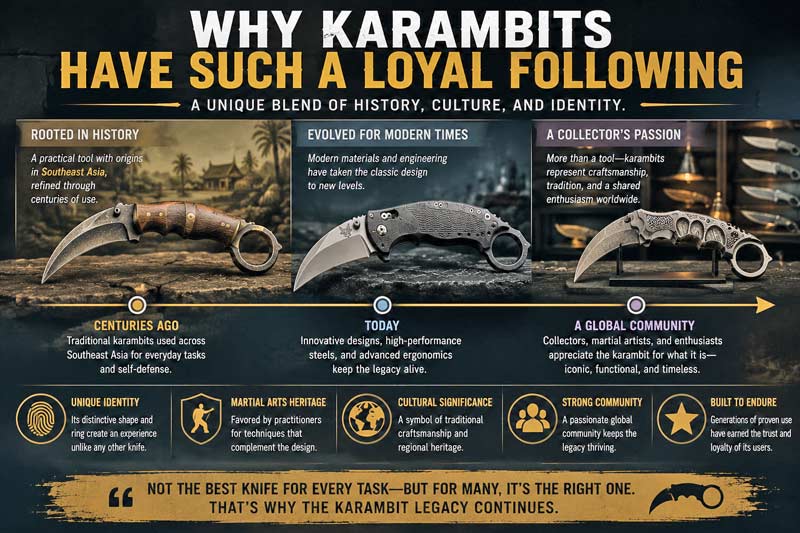
If karambits have obvious limitations, why do so many people continue to carry, collect, and train with them? The answer goes beyond performance alone. Few knife designs create the same combination of function, history, and identity.
Part of the appeal comes from the fact that a karambit feels different from almost every other knife. The ring, the curved blade, and the distinctive grip create an experience that stands apart from a standard pocketknife. For enthusiasts, that uniqueness is part of the attraction. Owning a karambit feels less like owning another tool and more like owning a piece of a long tradition.
Its history also contributes to its popularity. Unlike many modern knife designs, the karambit has roots that stretch back centuries. The design evolved through practical use long before it became known to collectors and enthusiasts around the world. If you're interested in that journey, our article on what a karambit knife is explores the origins of the design in greater detail.
The knife's reputation has also been reinforced by martial arts. Many practitioners appreciate the way the design complements certain movements and techniques. In that respect, the karambit belongs to the same category as several other tools that are often misunderstood because people only see their appearance rather than their intended purpose. We touched on that idea in our article about the most misunderstood martial arts weapons.
Perhaps most importantly, people tend to form strong attachments to tools that do something exceptionally well. Even if a karambit is not the best knife for every task, many owners value its strengths enough that they are willing to accept its weaknesses. That tradeoff helps explain why the design has survived for centuries while countless other knife styles have come and gone.
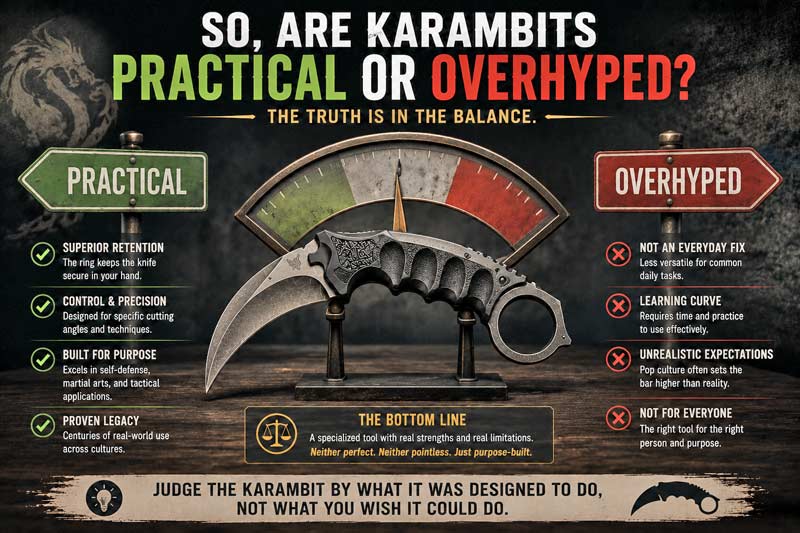
The most accurate answer is that karambits are practical for the people and purposes they were designed for, but they are often overhyped by people who expect them to be something they were never meant to be.
A karambit is not the ultimate everyday knife. If someone needs a single blade for opening packages, preparing food, outdoor chores, and general utility work, there are plenty of designs that offer greater versatility. Judged by that standard alone, a traditional pocketknife will usually come out ahead.
However, practicality is not the same as versatility. Many of the world's most respected tools are highly specialized. A chainsaw is less versatile than a pocketknife, yet nobody would call it impractical. The same principle applies here. The karambit was built around retention, control, and a distinctive cutting style, and it continues to perform those functions remarkably well centuries after its creation.
That is one reason the design has remained relevant despite changing trends. Whether you're examining the knife's origins, its unique blade geometry, or its modern popularity, the same conclusion keeps appearing: the karambit exists because it solves certain problems effectively. As discussed in our article on the history and evolution of the karambit knife, designs that survive for centuries usually do so for a reason.
Perhaps the biggest misconception is that a knife must either be perfect or overrated. In reality, most successful tools live somewhere in the middle. The karambit has genuine strengths, genuine limitations, and a devoted following because many people find those strengths worth the tradeoffs. That doesn't make it the right knife for everyone. It simply makes it a knife that deserves to be judged on what it was designed to do, rather than on what people imagine it should do.
For those who appreciate specialized designs, there's a reason karambits continue to stand out among the many options available in today's knife market. You can explore a variety of modern designs in our collection of karambit knives and decide for yourself whether the design lives up to the hype.
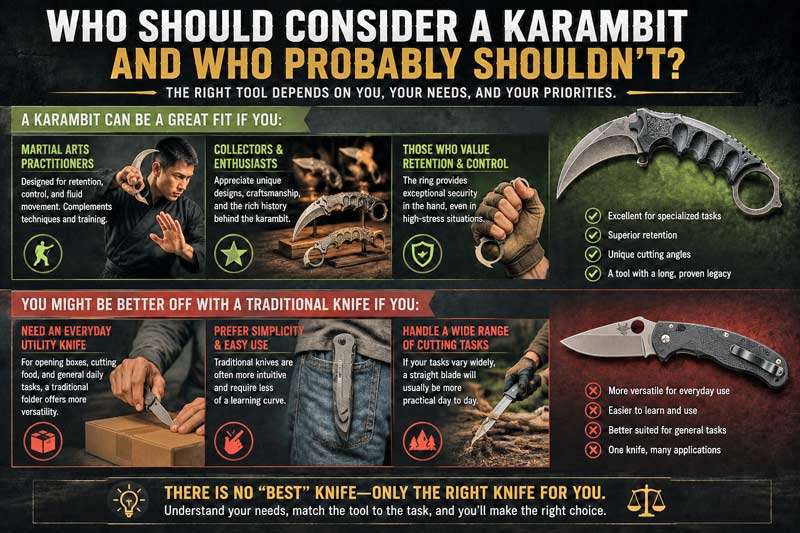
One of the easiest ways to determine whether a karambit is practical is to stop asking whether it's a good knife and start asking whether it's a good knife for you. That distinction matters because the answer can vary dramatically from one person to the next.
People who appreciate specialized tools often find a lot to like about the karambit. Martial arts practitioners, knife collectors, enthusiasts of unusual designs, and those who value the knife's unique retention features are often drawn to it for good reason. The design offers capabilities that few other knives can replicate in quite the same way.
On the other hand, someone looking for a simple everyday utility knife may be happier with a more conventional design. If your primary tasks involve opening packages, cutting food, performing outdoor chores, and handling a wide range of general cutting jobs, a traditional folder will usually provide more flexibility. In that sense, the karambit occupies a different niche than many of the knives featured in our guide to 12 fixed-blade knives you should know about.
That doesn't make one type of knife better than another. It simply highlights an important truth that applies to almost every tool. The best choice depends on the job, the user, and the priorities involved. A knife can be highly practical for one person and completely unnecessary for someone else.
Perhaps that's why the debate continues. The karambit is neither the miracle tool its biggest fans sometimes claim nor the gimmick its harshest critics describe. It is a specialized design with a long history, a loyal following, and a set of strengths that continue to earn respect from people who understand what it was built to do.
Yes, although they represent a relatively small portion of everyday knife users. Most people who carry a karambit daily do so because they specifically appreciate its retention, compact size, or distinctive handling characteristics. While traditional pocketknives remain more common, there are plenty of enthusiasts who prefer a karambit's unique combination of control and portability. As with most tools, personal preference plays a major role in what people choose to carry.
If karambits are so effective at certain tasks, why didn't they become the dominant knife design? The answer is versatility. Most people need a knife that can handle a wide variety of everyday jobs, and traditional pocketknives tend to perform well across the broadest range of tasks. Karambits survived for centuries because they excel in specific situations, not because they were designed to replace every other knife. Their continued popularity proves that specialization still has value, even in a world that often favors all-purpose tools.
For most beginners, a traditional folding knife is the easier starting point. The blade shape is generally more versatile, the handling feels familiar, and there is very little learning curve. Karambits tend to appeal more to enthusiasts who are specifically interested in the design, history, or handling characteristics. That doesn't mean a beginner can't enjoy a karambit, but someone looking for their first everyday knife will usually find a traditional folder easier to adapt to.
To separate fact from hype, it's worth looking beyond the dramatic appearance and examining what karambits were originally designed to do, where they shine today, and where their limitations become impossible to ignore.
What Most People Mean When They Say a Knife Is "Practical"
One reason the karambit debate never seems to end is that people often use the word "practical" to mean completely different things. For some knife owners, practicality means having a tool that can handle a wide variety of everyday cutting tasks. For others, it means comfort, retention, portability, or confidence in the hand. A knife that scores highly in one category may perform poorly in another.
If your definition of practicality is opening boxes, cutting rope, slicing food, and handling general utility tasks, a traditional folding knife will usually be the more versatile option. Straight blades and drop-point designs tend to excel at the broadest range of everyday jobs. That is one reason they remain so popular among people looking for a single knife to carry every day.
The karambit was never designed to be a general-purpose utility knife. Its roots can be traced back to Southeast Asia, where its curved shape evolved for specific cutting and pulling motions. As we explored in our article on why karambit knives are curved, the blade shape wasn't created to look intimidating. It was created to perform certain tasks exceptionally well.
That distinction matters because specialized tools are often judged unfairly against tools built for entirely different purposes. Nobody criticizes a chef's knife for being difficult to carry in a pocket, and nobody expects a pocketknife to replace a machete. Yet people frequently evaluate karambits as if they were intended to do everything a standard everyday carry knife can do.
A better question might be this: does the karambit perform the jobs it was designed for better than most alternatives? Once you start looking at the knife through that lens, the conversation becomes much more interesting.
Where Karambits Shine in the Real World
If the goal is to determine whether karambits are practical, it's important to start with the situations where they genuinely excel. While they are not designed to replace every type of knife, there are several characteristics that have helped the design remain relevant for generations.
One of the biggest advantages is retention. The finger ring provides a level of security that many traditional knife designs simply cannot match. Even if the user's grip shifts during movement, the knife remains connected to the hand. That feature is so important that we dedicated an entire article to explaining what the ring on a karambit knife is for. Far from being decorative, it serves a very practical purpose.
The curved blade is another strength. Rather than relying primarily on straight slicing motions, a karambit naturally pulls material into the edge during a cut. This can make certain cutting tasks feel surprisingly efficient. It is one reason the design has remained popular among martial artists and knife enthusiasts who appreciate specialized tools.
Many owners also find that the compact shape makes a karambit easier to carry than larger fixed-blade knives. Despite the aggressive appearance, the cutting edge is often packaged into a relatively small footprint. For people who value compact gear, that can be a meaningful advantage.
These strengths help explain why karambits continue to attract dedicated followers. As discussed in our article on why karambit knives are so effective, the design offers capabilities that many conventional knives do not. The question is whether those advantages outweigh the tradeoffs, and that's where the debate usually begins.
Where the Karambit Falls Short
A fair evaluation of the karambit has to include its weaknesses. This is where many enthusiasts and critics tend to talk past each other. Supporters focus on what the design does exceptionally well, while detractors focus on the situations where it struggles. Both sides have valid points.
The biggest limitation is versatility. If someone wants a knife that can handle everything from opening packages to preparing food at a campsite, a traditional folding knife will usually be the more practical choice. The curved blade that gives a karambit its unique strengths can also make certain everyday tasks more awkward than they would be with a straight edge.
There is also a learning curve. Most people can pick up a conventional pocketknife and immediately understand how to use it. A karambit feels different. The grip, cutting angles, and blade orientation often require an adjustment period. That doesn't mean the knife is difficult to use, but it does mean the design rewards familiarity more than some alternatives.
Another challenge is expectation. Thanks to movies, social media clips, and video games, many people assume a karambit is some kind of ultimate knife that outperforms every other design. That expectation sets the knife up for criticism because no knife excels at everything. As we discussed in our article about why karambit knives became so popular in video games, much of the knife's modern fame comes from its appearance rather than its utility.
This doesn't make the karambit overhyped. It simply means that hype and practicality are not the same thing. A specialized tool can be extremely effective while still being the wrong choice for many people's daily needs. Understanding that distinction is the key to judging the design fairly.
Why Karambits Have Such a Loyal Following
If karambits have obvious limitations, why do so many people continue to carry, collect, and train with them? The answer goes beyond performance alone. Few knife designs create the same combination of function, history, and identity.
Part of the appeal comes from the fact that a karambit feels different from almost every other knife. The ring, the curved blade, and the distinctive grip create an experience that stands apart from a standard pocketknife. For enthusiasts, that uniqueness is part of the attraction. Owning a karambit feels less like owning another tool and more like owning a piece of a long tradition.
Its history also contributes to its popularity. Unlike many modern knife designs, the karambit has roots that stretch back centuries. The design evolved through practical use long before it became known to collectors and enthusiasts around the world. If you're interested in that journey, our article on what a karambit knife is explores the origins of the design in greater detail.
The knife's reputation has also been reinforced by martial arts. Many practitioners appreciate the way the design complements certain movements and techniques. In that respect, the karambit belongs to the same category as several other tools that are often misunderstood because people only see their appearance rather than their intended purpose. We touched on that idea in our article about the most misunderstood martial arts weapons.
Perhaps most importantly, people tend to form strong attachments to tools that do something exceptionally well. Even if a karambit is not the best knife for every task, many owners value its strengths enough that they are willing to accept its weaknesses. That tradeoff helps explain why the design has survived for centuries while countless other knife styles have come and gone.
So, Are Karambits Practical or Overhyped?
The most accurate answer is that karambits are practical for the people and purposes they were designed for, but they are often overhyped by people who expect them to be something they were never meant to be.
A karambit is not the ultimate everyday knife. If someone needs a single blade for opening packages, preparing food, outdoor chores, and general utility work, there are plenty of designs that offer greater versatility. Judged by that standard alone, a traditional pocketknife will usually come out ahead.
However, practicality is not the same as versatility. Many of the world's most respected tools are highly specialized. A chainsaw is less versatile than a pocketknife, yet nobody would call it impractical. The same principle applies here. The karambit was built around retention, control, and a distinctive cutting style, and it continues to perform those functions remarkably well centuries after its creation.
That is one reason the design has remained relevant despite changing trends. Whether you're examining the knife's origins, its unique blade geometry, or its modern popularity, the same conclusion keeps appearing: the karambit exists because it solves certain problems effectively. As discussed in our article on the history and evolution of the karambit knife, designs that survive for centuries usually do so for a reason.
Perhaps the biggest misconception is that a knife must either be perfect or overrated. In reality, most successful tools live somewhere in the middle. The karambit has genuine strengths, genuine limitations, and a devoted following because many people find those strengths worth the tradeoffs. That doesn't make it the right knife for everyone. It simply makes it a knife that deserves to be judged on what it was designed to do, rather than on what people imagine it should do.
For those who appreciate specialized designs, there's a reason karambits continue to stand out among the many options available in today's knife market. You can explore a variety of modern designs in our collection of karambit knives and decide for yourself whether the design lives up to the hype.
Who Should Consider a Karambit and Who Probably Shouldn't?
One of the easiest ways to determine whether a karambit is practical is to stop asking whether it's a good knife and start asking whether it's a good knife for you. That distinction matters because the answer can vary dramatically from one person to the next.
People who appreciate specialized tools often find a lot to like about the karambit. Martial arts practitioners, knife collectors, enthusiasts of unusual designs, and those who value the knife's unique retention features are often drawn to it for good reason. The design offers capabilities that few other knives can replicate in quite the same way.
On the other hand, someone looking for a simple everyday utility knife may be happier with a more conventional design. If your primary tasks involve opening packages, cutting food, performing outdoor chores, and handling a wide range of general cutting jobs, a traditional folder will usually provide more flexibility. In that sense, the karambit occupies a different niche than many of the knives featured in our guide to 12 fixed-blade knives you should know about.
That doesn't make one type of knife better than another. It simply highlights an important truth that applies to almost every tool. The best choice depends on the job, the user, and the priorities involved. A knife can be highly practical for one person and completely unnecessary for someone else.
Perhaps that's why the debate continues. The karambit is neither the miracle tool its biggest fans sometimes claim nor the gimmick its harshest critics describe. It is a specialized design with a long history, a loyal following, and a set of strengths that continue to earn respect from people who understand what it was built to do.
Do People Actually Carry Karambits Every Day?
Yes, although they represent a relatively small portion of everyday knife users. Most people who carry a karambit daily do so because they specifically appreciate its retention, compact size, or distinctive handling characteristics. While traditional pocketknives remain more common, there are plenty of enthusiasts who prefer a karambit's unique combination of control and portability. As with most tools, personal preference plays a major role in what people choose to carry.
Why Didn't Karambits Replace Traditional Pocket Knives?
If karambits are so effective at certain tasks, why didn't they become the dominant knife design? The answer is versatility. Most people need a knife that can handle a wide variety of everyday jobs, and traditional pocketknives tend to perform well across the broadest range of tasks. Karambits survived for centuries because they excel in specific situations, not because they were designed to replace every other knife. Their continued popularity proves that specialization still has value, even in a world that often favors all-purpose tools.
Would a Beginner Be Better Off With a Karambit or a Traditional Knife?
For most beginners, a traditional folding knife is the easier starting point. The blade shape is generally more versatile, the handling feels familiar, and there is very little learning curve. Karambits tend to appeal more to enthusiasts who are specifically interested in the design, history, or handling characteristics. That doesn't mean a beginner can't enjoy a karambit, but someone looking for their first everyday knife will usually find a traditional folder easier to adapt to.
You May Also Be Interested In:
- What Is a Karambit Knife? Beginner Guide to Karambits
- A Practical Guide to Modern Self-Defense Weapons
- Why Every Day Should Be an EDC Knife Day: How a Simple Knife Can Make Your Life Easier and Safer
- Best EDC Knife: How to Choose the Right Everyday Carry Knife
- Bowie Knife vs Hunting Knife: What's the Difference?
- What Is a Kukri Knife and What Is It Used For?
- What Is the Ring on a Karambit Knife For?
- What Is a Stiletto Knife and Why Is It So Popular?
- Why Is the Karambit Knife Curved?
- What Is an OTF Knife? How Out-the-Front Knives Work
Leave a Reply