




The Forgotten Combat Knives of the Cold War
July 30th, 2026
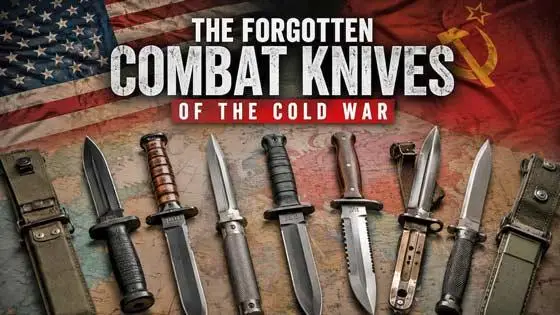
When people think of the Cold War, they usually picture nuclear missiles, espionage, and tense political standoffs between East and West. Yet behind the headlines, soldiers, special forces, and intelligence operatives still carried knives into some of the world's most dangerous conflicts. Whether they were patrolling the jungles of Vietnam, guarding the Iron Curtain, or preparing for missions that might never become public, these blades remained an essential part of military gear.
Some of these knives became legendary, while others quietly disappeared into military surplus warehouses or private collections. Unlike the iconic trench knives of World War I or the famous fighting knives of World War II, many Cold War-era designs never received the recognition they deserved. They were built for survival, utility, and close-quarters combat during a period when every mission carried the risk of escalating into a global conflict.
This forgotten generation of military knives influenced countless modern designs that are still carried today. From rugged survival blades to bayonets that doubled as wire cutters, the Cold War produced some of the most innovative combat knives ever made. Their stories deserve far more attention than they usually receive.
When the Cold War began after World War II, military planners knew future conflicts would look different. Soldiers needed equipment that could handle far more than combat. A knife might be used to cut rope, open ammunition crates, build shelters, prepare food, or serve as a last-resort weapon. As a result, military knives became tougher, more versatile, and more practical than many of the specialized fighting knives that came before them.
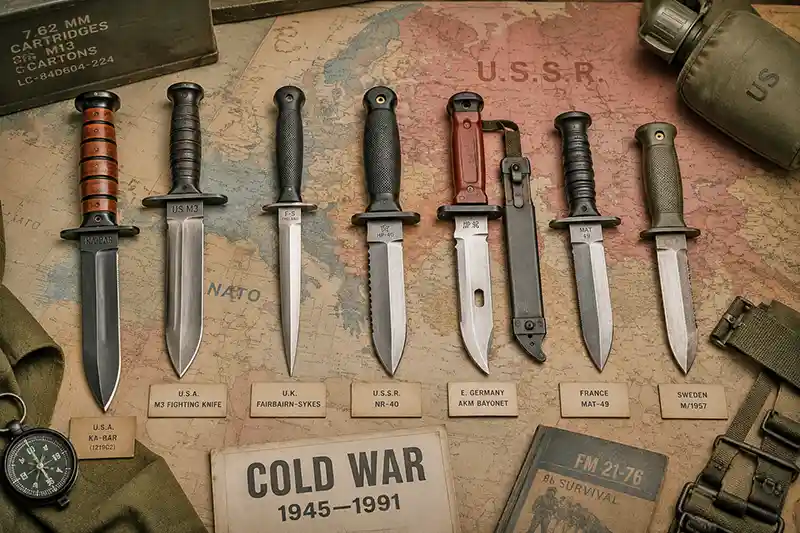
One of the biggest influences was the legendary Ka-Bar. Originally adopted by the U.S. Marine Corps during World War II, its reputation carried well into the Cold War. American troops continued to trust its strong clip-point blade and durable stacked leather handle during conflicts like Korea and Vietnam. Even decades after its introduction, the Ka-Bar remained one of the most respected fixed blade knives ever produced, proving that good designs rarely become obsolete.
Other nations developed their own iconic combat knives. Soviet forces favored rugged field knives and bayonets designed to withstand harsh conditions, while British and NATO special forces continued to refine blades inspired by the famous Fairbairn-Sykes fighting knife. These weapons reflected different military philosophies, but they all shared the same goal: creating a dependable tool that could survive whatever the Cold War demanded.
Although firearms dominated modern battlefields, military planners never abandoned the combat knife. Quiet, reliable, and impossible to jam or run out of ammunition, it remained one of the few tools every soldier hoped never to need, but never wanted to be without.
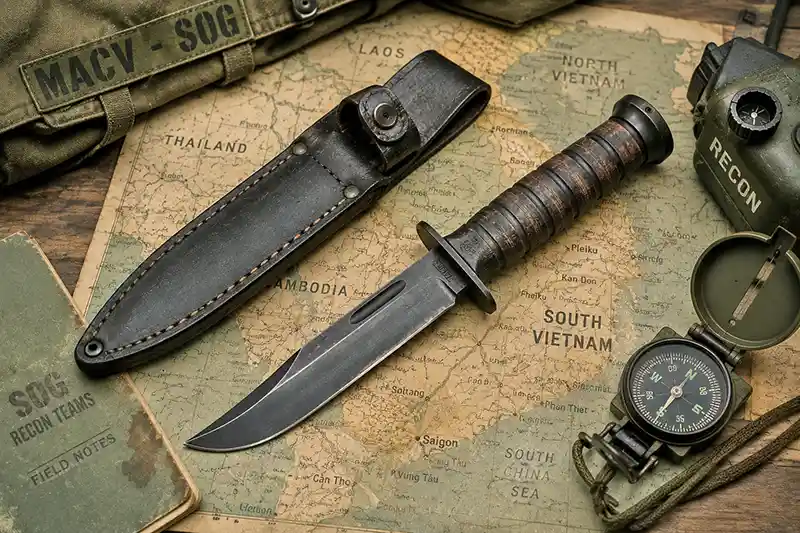
Few Cold War knives carry as much mystery as the blades created for the Military Assistance Command, Vietnam Studies and Observations Group. Better known as MACV-SOG, this highly classified American unit conducted reconnaissance, sabotage, prisoner recovery, and other covert missions throughout Southeast Asia. Its operators often crossed borders into areas where the United States officially denied having troops.
For missions like these, soldiers needed a knife that was strong, compact, and difficult to trace. Early SOG knives were manufactured in Japan and deliberately left without obvious American military markings. If an operator were captured or killed behind enemy lines, the unmarked blade offered one less piece of evidence connecting him to the United States.
The typical SOG knife featured a clip-point blade, a pronounced guard, and a dark stacked-leather handle. It was useful for clearing vegetation, cutting equipment, preparing camps, and handling emergencies, but its menacing profile also made it a capable fighting knife. Unlike ordinary military-issued knives, these blades were closely tied to missions that remained secret for years after the war ended.
Original MACV-SOG knives are now prized by military collectors, but their broader influence is even more important. Modern tactical knife makers still borrow from their simple construction, blackened finishes, and mission-focused design. What began as a nearly anonymous tool for covert operators eventually became one of the most recognizable knife styles to emerge from the Vietnam War.
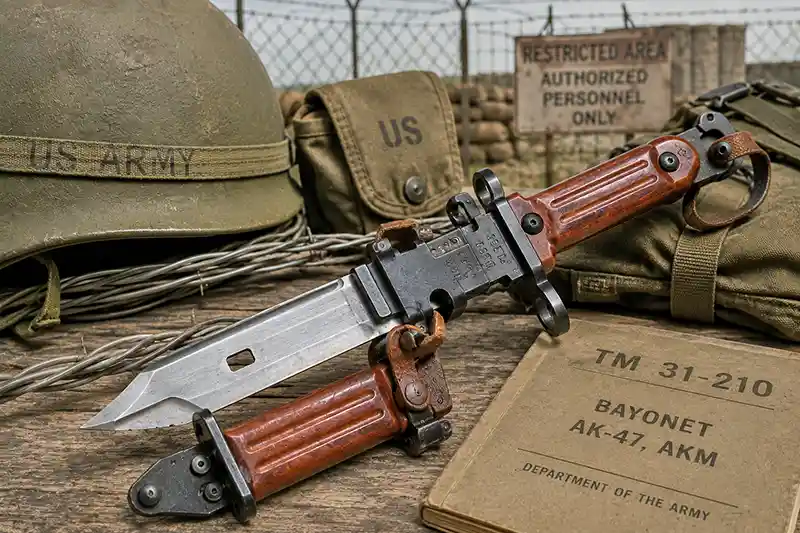
The Cold War transformed the bayonet from a weapon of last resort into one of the military's most versatile field tools. Earlier bayonets were designed primarily for charging enemy positions, but modern warfare demanded something far more practical. Engineers began creating blades that could cut, pry, dig, and even help soldiers survive in remote environments where supplies might be scarce.
One of the best examples was the Soviet AKM bayonet. Introduced during the 1950s and refined over the following decades, it featured a multipurpose scabbard that could combine with the blade to form a wire cutter. This allowed soldiers to slice through fences and obstacles without carrying another specialized tool. Many NATO countries soon adopted similar concepts, recognizing that a combat knife should earn its place on a soldier's belt every single day, not just during combat.
These innovations influenced countless military and civilian designs that followed. Modern survival knives borrowed heavily from Cold War bayonets by adding sawbacks, heavy-duty spines, improved grips, and durable steels capable of standing up to hard use. If you've ever wondered why today's rugged outdoor knives look the way they do, much of the answer can be traced back to this period. You can learn more about how blade materials evolved in our guide to different types of knife steels.
Although fixed blades remained the standard for military service, many soldiers also carried compact folding knives for everyday tasks. Together, these tools reflected a new philosophy: a knife should be more than a weapon. It should be dependable enough to solve dozens of problems before it ever had to save a life.
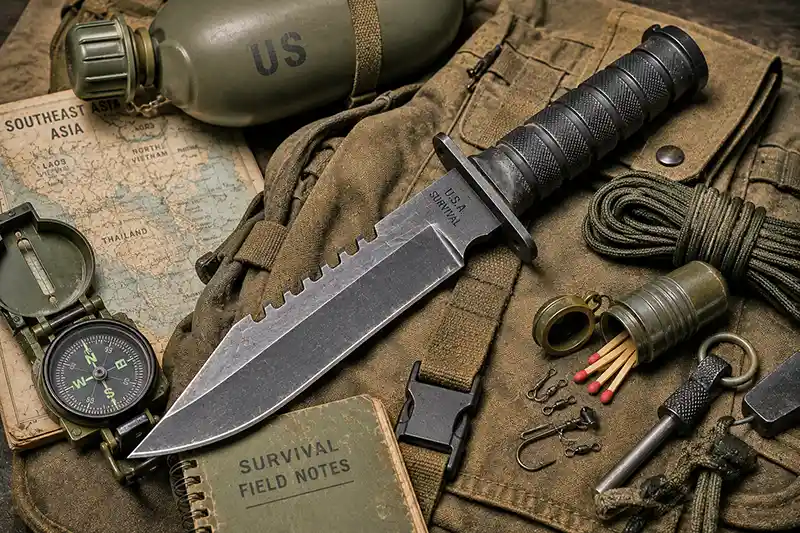
As the Cold War stretched into the 1970s and 1980s, military planners became increasingly concerned about pilots and special operations troops who might find themselves stranded behind enemy lines. A combat knife was no longer expected to serve only as a weapon. It also had to help someone survive for days or even weeks without support. This shift sparked a new generation of rugged survival knives packed with practical features.
Some designs included sawback spines for cutting wood, hollow handles that could store fishing hooks or matches, and heavier blades capable of chopping through branches or splitting kindling. While not every feature proved useful in real-world conditions, these knives reflected a growing belief that a single tool should solve as many problems as possible. The idea influenced military procurement around the world and inspired countless civilian outdoor knives.
Even traditional designs evolved during this period. Manufacturers experimented with stronger alloys, improved heat treatments, and corrosion-resistant finishes to produce blades that would hold an edge in harsh environments. Those advancements eventually found their way into many modern outdoor and tactical knives. If you're interested in why some blades perform better than others, our guide to different types of knife steels explains how modern materials transformed knife performance.
The survival knife boom of the Cold War also shaped public imagination. Soldiers, explorers, and outdoorsmen all wanted the same dependable tool that could cut, pry, build, hunt, and protect. Decades later, many of today's heavy-duty bowie knives and survival blades still carry design elements that first became popular during this era.
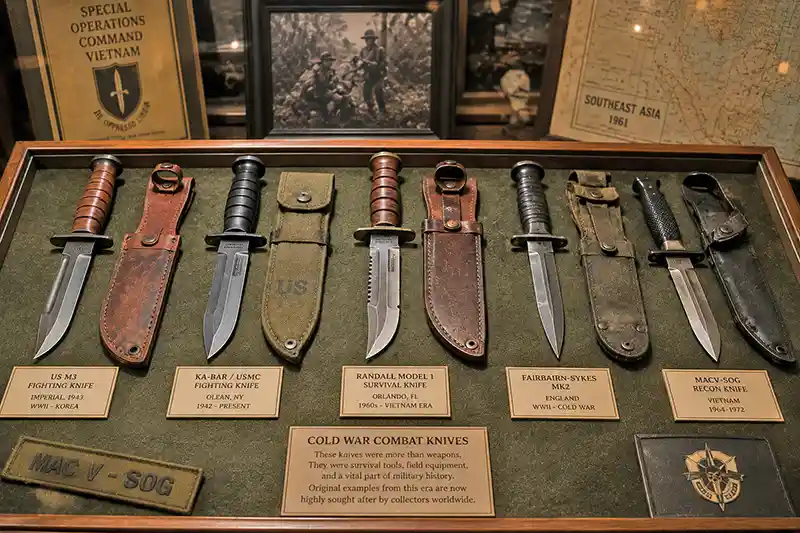
Most military knives were treated as tools, not collectibles. They rode on soldiers' belts through mud, jungle humidity, freezing winters, and countless training exercises. When they wore out, they were replaced. When conflicts ended, many were discarded or modified for civilian use. As a result, truly original Cold War combat knives have become surprisingly scarce.
Collectors are especially interested in knives with documented military service or connections to elite units. Early MACV-SOG knives, prototype bayonets, and limited-production survival knives can command impressive prices at auction, particularly if they retain their original sheaths and factory finishes. Even small details such as manufacturing marks or the style of a guard can dramatically affect a knife's value. If you're interested in famous military blades from other eras, our article on the world's most famous knives and the stories behind them explores several legendary designs that have become highly collectible.
Condition is only part of the story. Provenance often matters even more. A knife with verified military documentation or a known history can be worth many times more than an identical example without any background. Because many Cold War operations remained classified for decades, authentic examples connected to specific missions or units continue to attract tremendous interest from historians and collectors alike.
Not every old military knife is a hidden treasure, but the fascination surrounding these blades continues to grow. As more people discover the history behind them, Cold War combat knives are becoming recognized not just as weapons, but as artifacts from one of the most tense and influential periods in modern history.
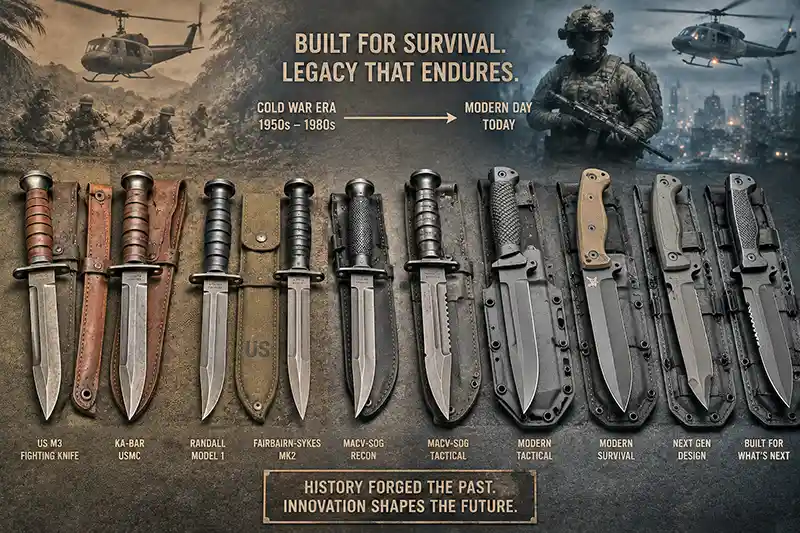
Although the Cold War ended more than three decades ago, the knives developed during that era continue to influence military and civilian blades around the world. Their emphasis on durability, versatility, and real-world performance changed what people expected from a combat knife. Instead of being designed solely for fighting, these knives proved they could serve as survival tools, field equipment, and dependable companions in almost any environment.
Many modern knife makers still borrow ideas that became popular during the Cold War. Clip-point blades, textured grips, corrosion-resistant coatings, full-tang construction, and multipurpose sheaths can all trace part of their evolution back to military requirements from this period. Whether you're looking at a premium survival knife or a rugged field blade, there's a good chance its design owes something to Cold War innovation. Our article on how different cultures shaped the world's most famous knives explores how military and regional traditions have influenced knife design throughout history.
The Cold War also reminds us that history's most important knives are not always the most famous. Many served quietly in the hands of ordinary soldiers, reconnaissance teams, and survival instructors without ever becoming household names. Their stories survived because of the people who carried them, relied on them, and eventually passed them down to collectors who recognized their historical value.
Whether displayed in a museum, preserved in a private collection, or inspiring the next generation of tactical blades, these forgotten combat knives remain lasting symbols of one of history's longest and most uncertain conflicts. Their legacy lives on every time a modern knife is built to perform under the harshest conditions imaginable.
The Cold War produced some of the most practical combat knives ever carried into the field, yet many remain overshadowed by the famous blades of World War II or the tactical knives of today. They were designed during an era when soldiers needed equipment that could perform in jungles, frozen forests, remote mountains, and behind enemy lines. Every feature had a purpose, and every improvement came from real-world experience.
Many of these once-overlooked designs continue to shape the knives carried by military personnel, first responders, outdoorsmen, and collectors around the world. Their influence can be seen in everything from survival knives to modern tactical fixed blades, proving that great designs rarely disappear. If you enjoy exploring the stories behind historic blades, you'll also enjoy our guide to the most common pocket knife blade shapes, which explains how different blade profiles evolved to solve different problems.
Whether you're fascinated by military history, interested in knife collecting, or simply appreciate exceptional craftsmanship, Cold War combat knives offer a unique glimpse into a period when innovation was driven by necessity. They may not have become household names, but their impact on knife design is impossible to ignore. The next time you pick up a modern combat or survival knife, you're holding a piece of that legacy in your hand.
While Cold War combat knives were certainly capable fighting weapons, most were designed to be versatile field tools first. Soldiers relied on them to cut rope, prepare food, build shelters, clear brush, open crates, and perform countless everyday tasks. As the Cold War progressed, military designers increasingly focused on creating knives that could help troops survive in harsh environments, making them just as valuable for utility as they were for self-defense.
No. Each nation developed combat knives that reflected its own military doctrine, environment, and manufacturing capabilities. American forces favored versatile field and survival knives like the Ka-Bar and MACV-SOG designs, while Soviet troops relied heavily on rugged bayonets and utility knives that could withstand harsh conditions. European militaries often adopted their own specialized designs, resulting in a wide variety of Cold War combat knives that shared the same purpose but differed greatly in appearance and features.
World War II combat knives were primarily designed as fighting weapons, while many Cold War knives emphasized versatility. Military planners realized that soldiers needed blades that could handle survival, utility, and engineering tasks in addition to self-defense. This led to innovations such as wire-cutting bayonets, sawback spines, improved corrosion resistance, and stronger blade steels. By the end of the Cold War, combat knives had evolved into true multipurpose tools rather than weapons alone.
Some original Cold War combat knives remain in military service, but most have been replaced by newer designs that use improved materials and manufacturing techniques. Even so, many modern military and survival knives are directly inspired by Cold War-era blades. Features like full-tang construction, durable synthetic handles, corrosion-resistant finishes, and multipurpose sheaths all trace part of their evolution back to the innovations developed during this period.
Yes. Many soldiers carried a standard-issue combat knife alongside a smaller utility or folding knife. The larger blade handled demanding tasks like chopping, digging, and emergency situations, while the smaller knife was more convenient for everyday jobs such as opening rations, cutting cord, or making quick repairs. Carrying two knives gave soldiers greater flexibility without adding much extra weight.
Some of the rarest Cold War combat knives are early MACV-SOG knives and limited-production prototypes that were issued to specialized military units. Because many of these blades were produced in small numbers and used on classified missions, surviving examples with original sheaths and documented histories can be worth thousands of dollars to collectors today.
Blackened blades weren't just for appearance. Dark finishes helped reduce glare that could reveal a soldier's position, while also providing additional protection against rust and corrosion in harsh environments like the jungles of Vietnam. Today, black-coated tactical knives remain popular for many of the same practical reasons.
This forgotten generation of military knives influenced countless modern designs that are still carried today. From rugged survival blades to bayonets that doubled as wire cutters, the Cold War produced some of the most innovative combat knives ever made. Their stories deserve far more attention than they usually receive.
The Knife That Defined the Cold War Soldier
When the Cold War began after World War II, military planners knew future conflicts would look different. Soldiers needed equipment that could handle far more than combat. A knife might be used to cut rope, open ammunition crates, build shelters, prepare food, or serve as a last-resort weapon. As a result, military knives became tougher, more versatile, and more practical than many of the specialized fighting knives that came before them.
One of the biggest influences was the legendary Ka-Bar. Originally adopted by the U.S. Marine Corps during World War II, its reputation carried well into the Cold War. American troops continued to trust its strong clip-point blade and durable stacked leather handle during conflicts like Korea and Vietnam. Even decades after its introduction, the Ka-Bar remained one of the most respected fixed blade knives ever produced, proving that good designs rarely become obsolete.
Other nations developed their own iconic combat knives. Soviet forces favored rugged field knives and bayonets designed to withstand harsh conditions, while British and NATO special forces continued to refine blades inspired by the famous Fairbairn-Sykes fighting knife. These weapons reflected different military philosophies, but they all shared the same goal: creating a dependable tool that could survive whatever the Cold War demanded.
Although firearms dominated modern battlefields, military planners never abandoned the combat knife. Quiet, reliable, and impossible to jam or run out of ammunition, it remained one of the few tools every soldier hoped never to need, but never wanted to be without.
The Secret Knife Made for MACV-SOG
Few Cold War knives carry as much mystery as the blades created for the Military Assistance Command, Vietnam Studies and Observations Group. Better known as MACV-SOG, this highly classified American unit conducted reconnaissance, sabotage, prisoner recovery, and other covert missions throughout Southeast Asia. Its operators often crossed borders into areas where the United States officially denied having troops.
For missions like these, soldiers needed a knife that was strong, compact, and difficult to trace. Early SOG knives were manufactured in Japan and deliberately left without obvious American military markings. If an operator were captured or killed behind enemy lines, the unmarked blade offered one less piece of evidence connecting him to the United States.
The typical SOG knife featured a clip-point blade, a pronounced guard, and a dark stacked-leather handle. It was useful for clearing vegetation, cutting equipment, preparing camps, and handling emergencies, but its menacing profile also made it a capable fighting knife. Unlike ordinary military-issued knives, these blades were closely tied to missions that remained secret for years after the war ended.
Original MACV-SOG knives are now prized by military collectors, but their broader influence is even more important. Modern tactical knife makers still borrow from their simple construction, blackened finishes, and mission-focused design. What began as a nearly anonymous tool for covert operators eventually became one of the most recognizable knife styles to emerge from the Vietnam War.
When Bayonets Became Survival Tools
The Cold War transformed the bayonet from a weapon of last resort into one of the military's most versatile field tools. Earlier bayonets were designed primarily for charging enemy positions, but modern warfare demanded something far more practical. Engineers began creating blades that could cut, pry, dig, and even help soldiers survive in remote environments where supplies might be scarce.
One of the best examples was the Soviet AKM bayonet. Introduced during the 1950s and refined over the following decades, it featured a multipurpose scabbard that could combine with the blade to form a wire cutter. This allowed soldiers to slice through fences and obstacles without carrying another specialized tool. Many NATO countries soon adopted similar concepts, recognizing that a combat knife should earn its place on a soldier's belt every single day, not just during combat.
These innovations influenced countless military and civilian designs that followed. Modern survival knives borrowed heavily from Cold War bayonets by adding sawbacks, heavy-duty spines, improved grips, and durable steels capable of standing up to hard use. If you've ever wondered why today's rugged outdoor knives look the way they do, much of the answer can be traced back to this period. You can learn more about how blade materials evolved in our guide to different types of knife steels.
Although fixed blades remained the standard for military service, many soldiers also carried compact folding knives for everyday tasks. Together, these tools reflected a new philosophy: a knife should be more than a weapon. It should be dependable enough to solve dozens of problems before it ever had to save a life.
The Survival Knife Arms Race
As the Cold War stretched into the 1970s and 1980s, military planners became increasingly concerned about pilots and special operations troops who might find themselves stranded behind enemy lines. A combat knife was no longer expected to serve only as a weapon. It also had to help someone survive for days or even weeks without support. This shift sparked a new generation of rugged survival knives packed with practical features.
Some designs included sawback spines for cutting wood, hollow handles that could store fishing hooks or matches, and heavier blades capable of chopping through branches or splitting kindling. While not every feature proved useful in real-world conditions, these knives reflected a growing belief that a single tool should solve as many problems as possible. The idea influenced military procurement around the world and inspired countless civilian outdoor knives.
Even traditional designs evolved during this period. Manufacturers experimented with stronger alloys, improved heat treatments, and corrosion-resistant finishes to produce blades that would hold an edge in harsh environments. Those advancements eventually found their way into many modern outdoor and tactical knives. If you're interested in why some blades perform better than others, our guide to different types of knife steels explains how modern materials transformed knife performance.
The survival knife boom of the Cold War also shaped public imagination. Soldiers, explorers, and outdoorsmen all wanted the same dependable tool that could cut, pry, build, hunt, and protect. Decades later, many of today's heavy-duty bowie knives and survival blades still carry design elements that first became popular during this era.
Why Many Cold War Combat Knives Are Worth Thousands Today
Most military knives were treated as tools, not collectibles. They rode on soldiers' belts through mud, jungle humidity, freezing winters, and countless training exercises. When they wore out, they were replaced. When conflicts ended, many were discarded or modified for civilian use. As a result, truly original Cold War combat knives have become surprisingly scarce.
Collectors are especially interested in knives with documented military service or connections to elite units. Early MACV-SOG knives, prototype bayonets, and limited-production survival knives can command impressive prices at auction, particularly if they retain their original sheaths and factory finishes. Even small details such as manufacturing marks or the style of a guard can dramatically affect a knife's value. If you're interested in famous military blades from other eras, our article on the world's most famous knives and the stories behind them explores several legendary designs that have become highly collectible.
Condition is only part of the story. Provenance often matters even more. A knife with verified military documentation or a known history can be worth many times more than an identical example without any background. Because many Cold War operations remained classified for decades, authentic examples connected to specific missions or units continue to attract tremendous interest from historians and collectors alike.
Not every old military knife is a hidden treasure, but the fascination surrounding these blades continues to grow. As more people discover the history behind them, Cold War combat knives are becoming recognized not just as weapons, but as artifacts from one of the most tense and influential periods in modern history.
The Legacy of Cold War Combat Knives
Although the Cold War ended more than three decades ago, the knives developed during that era continue to influence military and civilian blades around the world. Their emphasis on durability, versatility, and real-world performance changed what people expected from a combat knife. Instead of being designed solely for fighting, these knives proved they could serve as survival tools, field equipment, and dependable companions in almost any environment.
Many modern knife makers still borrow ideas that became popular during the Cold War. Clip-point blades, textured grips, corrosion-resistant coatings, full-tang construction, and multipurpose sheaths can all trace part of their evolution back to military requirements from this period. Whether you're looking at a premium survival knife or a rugged field blade, there's a good chance its design owes something to Cold War innovation. Our article on how different cultures shaped the world's most famous knives explores how military and regional traditions have influenced knife design throughout history.
The Cold War also reminds us that history's most important knives are not always the most famous. Many served quietly in the hands of ordinary soldiers, reconnaissance teams, and survival instructors without ever becoming household names. Their stories survived because of the people who carried them, relied on them, and eventually passed them down to collectors who recognized their historical value.
Whether displayed in a museum, preserved in a private collection, or inspiring the next generation of tactical blades, these forgotten combat knives remain lasting symbols of one of history's longest and most uncertain conflicts. Their legacy lives on every time a modern knife is built to perform under the harshest conditions imaginable.
History's Forgotten Blades Still Matter
The Cold War produced some of the most practical combat knives ever carried into the field, yet many remain overshadowed by the famous blades of World War II or the tactical knives of today. They were designed during an era when soldiers needed equipment that could perform in jungles, frozen forests, remote mountains, and behind enemy lines. Every feature had a purpose, and every improvement came from real-world experience.
Many of these once-overlooked designs continue to shape the knives carried by military personnel, first responders, outdoorsmen, and collectors around the world. Their influence can be seen in everything from survival knives to modern tactical fixed blades, proving that great designs rarely disappear. If you enjoy exploring the stories behind historic blades, you'll also enjoy our guide to the most common pocket knife blade shapes, which explains how different blade profiles evolved to solve different problems.
Whether you're fascinated by military history, interested in knife collecting, or simply appreciate exceptional craftsmanship, Cold War combat knives offer a unique glimpse into a period when innovation was driven by necessity. They may not have become household names, but their impact on knife design is impossible to ignore. The next time you pick up a modern combat or survival knife, you're holding a piece of that legacy in your hand.
Were Cold War combat knives designed more for fighting or survival?
While Cold War combat knives were certainly capable fighting weapons, most were designed to be versatile field tools first. Soldiers relied on them to cut rope, prepare food, build shelters, clear brush, open crates, and perform countless everyday tasks. As the Cold War progressed, military designers increasingly focused on creating knives that could help troops survive in harsh environments, making them just as valuable for utility as they were for self-defense.
Did every country use the same type of combat knife during the Cold War?
No. Each nation developed combat knives that reflected its own military doctrine, environment, and manufacturing capabilities. American forces favored versatile field and survival knives like the Ka-Bar and MACV-SOG designs, while Soviet troops relied heavily on rugged bayonets and utility knives that could withstand harsh conditions. European militaries often adopted their own specialized designs, resulting in a wide variety of Cold War combat knives that shared the same purpose but differed greatly in appearance and features.
What made Cold War combat knives different from World War II knives?
World War II combat knives were primarily designed as fighting weapons, while many Cold War knives emphasized versatility. Military planners realized that soldiers needed blades that could handle survival, utility, and engineering tasks in addition to self-defense. This led to innovations such as wire-cutting bayonets, sawback spines, improved corrosion resistance, and stronger blade steels. By the end of the Cold War, combat knives had evolved into true multipurpose tools rather than weapons alone.
Are Cold War combat knives still used today?
Some original Cold War combat knives remain in military service, but most have been replaced by newer designs that use improved materials and manufacturing techniques. Even so, many modern military and survival knives are directly inspired by Cold War-era blades. Features like full-tang construction, durable synthetic handles, corrosion-resistant finishes, and multipurpose sheaths all trace part of their evolution back to the innovations developed during this period.
Did Cold War soldiers ever carry more than one knife?
Yes. Many soldiers carried a standard-issue combat knife alongside a smaller utility or folding knife. The larger blade handled demanding tasks like chopping, digging, and emergency situations, while the smaller knife was more convenient for everyday jobs such as opening rations, cutting cord, or making quick repairs. Carrying two knives gave soldiers greater flexibility without adding much extra weight.
What is the rarest Cold War combat knife?
Some of the rarest Cold War combat knives are early MACV-SOG knives and limited-production prototypes that were issued to specialized military units. Because many of these blades were produced in small numbers and used on classified missions, surviving examples with original sheaths and documented histories can be worth thousands of dollars to collectors today.
Why did so many Cold War combat knives have black blades?
Blackened blades weren't just for appearance. Dark finishes helped reduce glare that could reveal a soldier's position, while also providing additional protection against rust and corrosion in harsh environments like the jungles of Vietnam. Today, black-coated tactical knives remain popular for many of the same practical reasons.
You May Also Be Interested In:
- Can Butterfly Knives be used for Combat?
- The Deadliest Throwing Knives for Modern Combat! Knife Testing and Review
- Why Are Throwing Knives Shaped Differently From Regular Knives?
- Why Trench Knives Became the Most Feared Knives of World War I
- Were Nunchucks Ever Actually Used in Real Combat?
- Combat Arm Blades and Other New Weapons
- Combat War Hammer and Other New Weapons
- Combat Folding Kama and Other New Weapons!
- Combat Weapons for Urban Survival
- Combat Spear Sword and Other New Weapons
Leave a Reply