




Why Clip Point Knives Became the Military Standard
July 30th, 2026
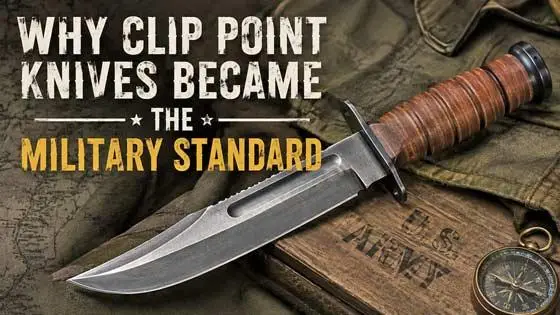
At first glance, the clip point blade doesn't seem particularly unusual. Its distinctive clipped spine creates a sharp, controllable tip that looks both elegant and practical. Yet this simple design has appeared on some of history's most famous military knives, from the legendary Bowie knife to the Ka-Bar carried by generations of American service members. For well over a century, soldiers have trusted the clip point more than almost any other blade shape ever created.
That wasn't an accident. The clip point earned its reputation because it struck a rare balance between strength, precision, and versatility. It could pierce when necessary, slice efficiently, and handle the countless utility tasks soldiers faced every day in the field. As warfare evolved from the American frontier to the trenches of Europe and the jungles of Vietnam, the clip point continued to prove itself where it mattered most.
Today, it remains one of the most recognizable blade profiles in the world. Whether you're a military history enthusiast, a collector, or simply curious why so many combat knives look remarkably similar, the story of the clip point reveals how one practical design became the standard by which countless fighting knives are still judged.
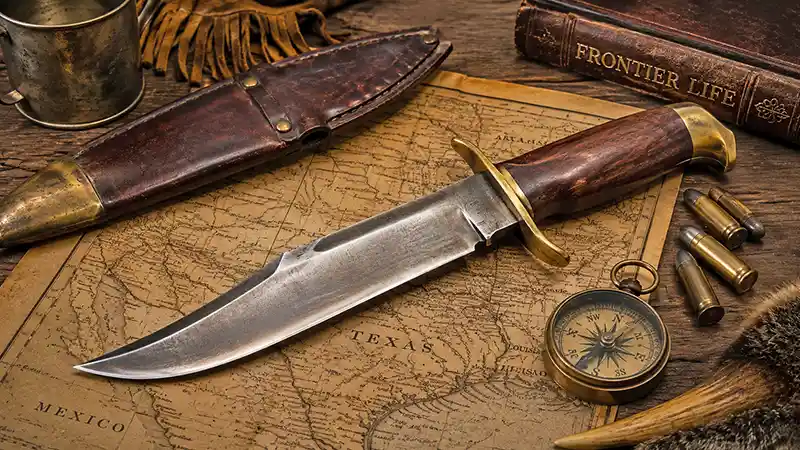
Long before modern militaries began issuing standardized combat knives, the clip point blade had already proven itself on the American frontier. Its rise is closely tied to the legendary Bowie knife, a design that combined a broad cutting edge with a sharply clipped spine. This distinctive profile gave the blade a fine point capable of precise piercing while still retaining enough weight for powerful slicing cuts. It was a practical design that quickly earned a reputation for versatility in harsh environments.
The Bowie knife's fame exploded after Jim Bowie's legendary Sandbar Fight in 1827, where reports of his fighting prowess captured the public's imagination. Although countless variations of the knife followed, one feature remained remarkably consistent: the clip point. Knife makers discovered that removing a portion of the spine near the tip created a blade that was quicker, more agile, and better suited for both utility work and close-quarters combat than many competing designs.
Military officers took notice. Throughout the nineteenth century, privately purchased Bowie knives accompanied soldiers into conflicts ranging from the Mexican-American War to the American Civil War. While they weren't official issue, their popularity demonstrated that soldiers valued a blade that could prepare food, cut rope, clear brush, and still serve as an effective fighting knife if necessary. That versatility would eventually become one of the defining characteristics military planners looked for when designing purpose-built combat knives.
By the time armies around the world began developing standardized fighting knives in the twentieth century, the clip point had already established itself as a battlefield-tested design. Many of the military knives that followed borrowed heavily from the Bowie knife's proven blade profile, refining it rather than replacing it. The clip point wasn't simply fashionable. It had earned its reputation through decades of real-world use.
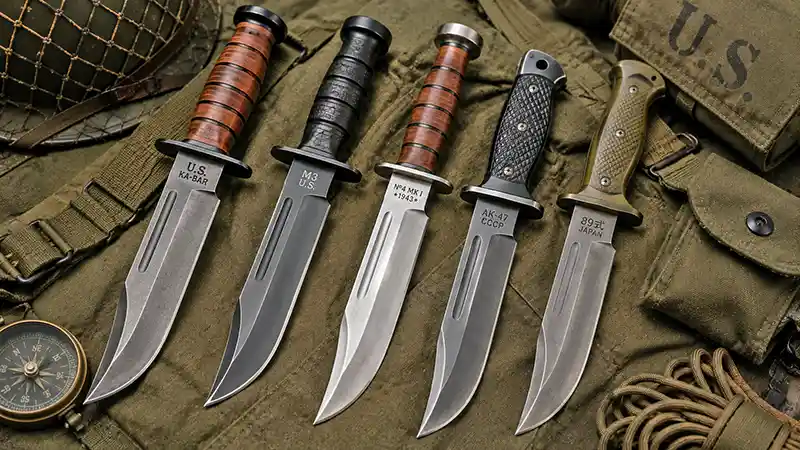
As armies began issuing standardized combat knives in the twentieth century, they faced a difficult challenge. Soldiers didn't need a knife that excelled at just one task. They needed one blade that could perform dozens of jobs under the harshest conditions imaginable. A combat knife might be used to cut rope, open ammunition crates, prepare food, trim branches for camouflage, or serve as a last-resort defensive weapon. Few blade shapes handled such a wide variety of tasks as effectively as the clip point.
One of the clip point's greatest advantages is its exceptional balance. The broad belly provides plenty of cutting surface for everyday utility work, while the clipped spine creates a finer, more controllable tip than many other blade designs. That combination allowed soldiers to perform delicate tasks without sacrificing the durability needed for heavy field use. Even after repeated abuse, the blade remained practical for the countless chores military life demanded.
The design also simplified training. Rather than teaching troops to carry separate utility and fighting knives, militaries could issue a single blade that handled both roles reasonably well. This versatility made clip point fixed blade knives an obvious choice for armies looking to equip thousands of soldiers with dependable, multipurpose tools. Standardization reduced costs while giving service members confidence that their knife would perform whenever it was needed.
Of course, no blade shape is perfect. Drop points generally offer a stronger tip, spear points provide better symmetry for thrusting, and tanto blades excel at piercing hard materials. Yet for an all-around military knife, the clip point consistently delivered one of the best compromises. It wasn't the absolute best at any single task, but it performed almost every task well enough to earn the trust of generations of soldiers around the world.
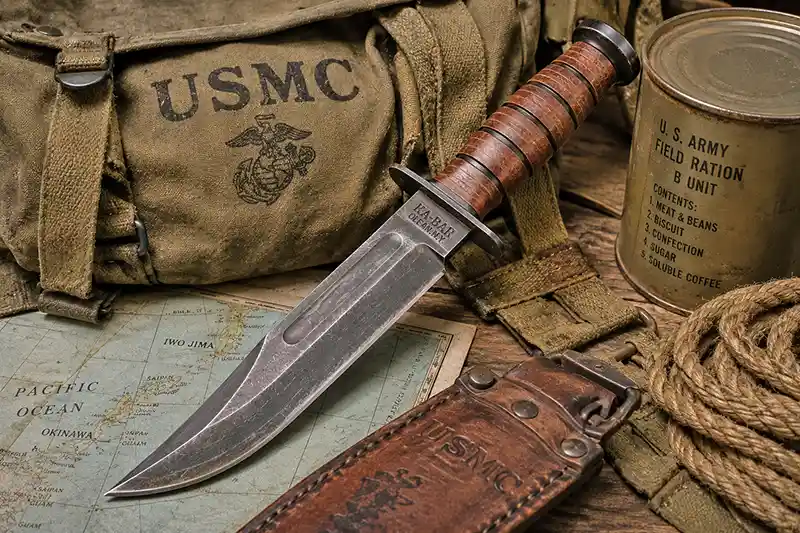
World War I had already shown that soldiers needed something more practical than the specialized stabbing weapons associated with trench warfare. Many early trench knives were fearsome in close combat, but their narrow blades, knuckle guards, and highly specialized designs made them less useful for routine fieldwork. By the beginning of World War II, the ideal military knife was no longer viewed as a weapon alone. It had to function as a dependable tool that could survive constant use far from a supply depot.
The knife that best captured this new philosophy was the American fighting and utility knife commonly known as the Ka-Bar. Authorized by the Marine Corps during World War II, it paired a seven-inch clip point blade with a sturdy guard, full-sized handle, and robust fixed-blade construction. Marines used it for everything from opening ration cans and cutting rope to digging, repairing equipment, and preparing defensive positions. It became famous not because it performed one dramatic task perfectly, but because it remained useful in almost every situation a service member might encounter.
Its clip point was central to that versatility. The long cutting edge handled ordinary camp and utility work, while the clipped spine produced a sharp tip that remained controllable during more precise tasks. The blade was substantial enough to withstand rough treatment without becoming so thick or heavy that it felt clumsy. The result was a knife that carried the basic DNA of the Bowie knife into modern industrial warfare.
The Ka-Bar's success helped cement the clip point as the visual language of the American military knife. It was carried through World War II and continued appearing in Korea, Vietnam, and later conflicts. Even soldiers who had never handled a nineteenth-century Bowie knife could recognize the same basic profile in the fighting knife strapped to their gear. The frontier blade had been refined, standardized, and issued to an entire generation of service members.
After World War II, military planners began looking beyond the traditional fighting knife. Aircraft crews, pilots, and troops operating far from established bases needed blades that could help them survive after an emergency landing or separation from their units. A knife might be called upon to cut through webbing, prepare shelter materials, process food, signal rescuers, or perform basic equipment repairs. Once again, the clip point offered the right balance of capabilities.
This shift produced a new generation of military survival knives. Many retained the recognizable clipped spine of earlier combat blades but added features such as saw teeth, heavier guards, durable leather handles, and reinforced pommels. These additions reflected the changing role of the military knife. It still had to serve as a defensive tool, but its everyday value increasingly came from the practical problems it could solve in the field.
The blade itself also became more specialized. Manufacturers experimented with different heat treatments, protective coatings, and knife steels to improve edge retention and resist corrosion in wet or humid environments. The clip point remained popular because it could be adapted without losing the basic qualities that had made it successful: a useful cutting belly, a precise tip, and enough strength for demanding outdoor work.
By the Cold War, the clip point was no longer associated with a single knife or branch of service. It appeared on pilot survival knives, general-purpose field blades, hunting knives carried by soldiers, and commercial designs purchased privately before deployment. What began as a frontier fighting profile had evolved into one of the military's most trusted survival tools.
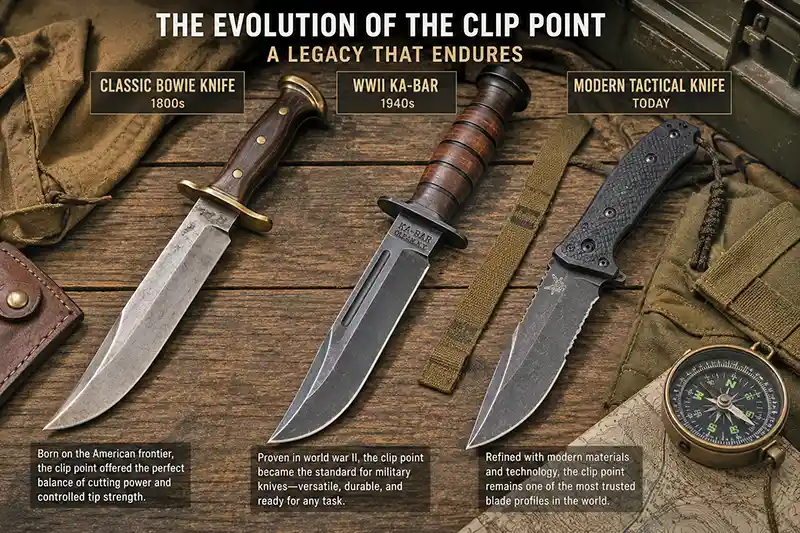
Walk through the catalogs of modern military suppliers, and you'll notice that the clip point no longer dominates the way it once did. Today's armed forces issue a wider variety of blade shapes than ever before, including drop points, spear points, tantos, and hybrid designs developed for specialized missions. Advances in metallurgy, manufacturing, and combat doctrine have given knife designers more freedom to optimize blades for specific roles rather than relying on a single all-purpose profile.
Even so, the clip point has never disappeared. Many soldiers, hunters, outdoorsmen, and survival instructors still prefer it because it remains one of the most versatile blade designs ever created. Whether dressing game, carving wood, preparing camp, or performing everyday cutting tasks, the clip point continues to offer an impressive balance between slicing ability and tip control. Countless modern knives still borrow heavily from the same profile that became famous nearly two centuries ago.
Its influence extends well beyond military service. Popular outdoor, hunting, and tactical knives often feature clip point blades because users appreciate their familiar handling characteristics and dependable performance. Even manufacturers experimenting with modern materials and advanced coatings frequently retain the classic clipped spine, proving that good design rarely goes out of style.
Military knife designs will undoubtedly continue to evolve, but the clip point's legacy is secure. It survived the American frontier, accompanied soldiers through two world wars, adapted to the survival-focused demands of the Cold War, and remains one of the most recognizable blade profiles ever produced. Few knife designs can claim such a long history of earning trust in both combat and everyday use.
The clip point has outlasted countless military trends because it solves a basic problem remarkably well. Soldiers, outdoorsmen, and everyday users often need a blade that can handle rough utility work without giving up precision. The clipped spine reduces unnecessary material near the tip, creating a point that feels responsive and easy to control while preserving a broad cutting edge for more demanding tasks.
That balance has allowed the design to move easily between different worlds. A clip point can appear on a large military field knife, a hunting blade, or a compact pocket knife without losing its defining character. While the proportions may change, the underlying idea remains the same: combine strong slicing performance with a narrow, useful tip. It is one reason the clip point remains among the most recognizable pocket knife blade shapes today.
Tradition has also played a role in its survival. The profile carries visual echoes of the Bowie knife, the Ka-Bar, and generations of military blades that came before it. For many buyers, a clip point simply looks like a serious working knife. That familiarity creates confidence, especially when the design has already proven itself through nearly two centuries of field use.
The clip point may no longer be the only standard available to modern troops, but it remains the benchmark against which many all-purpose knives are judged. New materials and manufacturing methods continue to improve the blade, yet the basic silhouette has required surprisingly little reinvention. Its longevity is not the result of nostalgia alone. It survives because it still works.
Few knife designs have remained relevant for as long as the clip point. From the rough frontier where the Bowie knife first made history to the battlefields of World War II and the survival kits of the Cold War, the same basic profile has repeatedly proven its value. Trends have come and gone, but the clip point has endured because it offers something every good knife should: dependable performance across a wide range of real-world tasks.
Its success wasn't the result of clever marketing or military tradition alone. Generations of soldiers trusted the clip point because it struck an exceptional balance between cutting power, control, durability, and versatility. That same balance continues to appeal to hunters, outdoorsmen, collectors, and anyone looking for a practical working knife today.
Whether you're exploring the history of famous military blades or shopping for your next everyday carry knife, understanding the clip point helps explain why so many iconic knives share a familiar silhouette. After nearly two hundred years, it's clear that some designs don't become classics by accident. They become classics because they continue to outperform expectations, generation after generation.
Military designers have experimented with many blade shapes over the years, but the clip point has remained popular because it offers an excellent balance of cutting ability, tip control, and versatility. A single knife often has to perform dozens of tasks in the field, from cutting rope and preparing shelter materials to opening crates and handling emergency situations. The clip point's combination of a broad cutting edge and a precise tip makes it well suited for that wide range of jobs, which is why it has appeared on so many iconic military knives throughout history.
Neither blade shape is objectively better because each was designed with different priorities in mind. A clip point offers a finer, sharper tip that excels at precision work and controlled piercing, while a drop point has a thicker, stronger tip that is generally better suited for heavy-duty outdoor tasks like skinning game or prying. That's why you'll find both designs on modern military, hunting, and survival knives. If versatility and precision are your priorities, a clip point is often the better choice. If maximum tip strength is more important, a drop point may be the better option.
Not exactly. Knives with clipped spines existed before Jim Bowie became famous, but the Bowie knife popularized the design like no other blade before it. After the Sandbar Fight in 1827, the Bowie knife became one of the most sought-after knives in America, and its distinctive clip point profile was widely copied by knife makers around the world. Over time, that same blade shape found its way onto countless military, hunting, and survival knives, making the Bowie knife the design most responsible for establishing the clip point's legendary reputation.
Yes, although they no longer dominate military issue the way they once did. Many modern armed forces now use a mix of clip point, drop point, spear point, and tanto blades depending on the mission and the intended role of the knife. Even so, clip point designs remain common because they continue to provide an outstanding balance of utility and precision. In fact, many commercial tactical and survival knives carried by today's military personnel still feature clip point blades, proving that the design remains just as practical today as it was generations ago.
The blade shape is only part of what makes a knife perform well. A quality clip point knife should also use durable steel, a comfortable handle, and solid construction that matches how you plan to use it. For everyday carry, a compact folding knife may be the best choice. For camping, hunting, or demanding outdoor work, a full-sized fixed blade is often the better option because it offers greater strength and reliability.
It's also worth considering details like blade length, edge geometry, corrosion resistance, and handle material. A well-designed clip point can serve for decades if it's built from quality materials and maintained properly. While manufacturers continue to introduce new blade shapes, the clip point remains one of the safest choices for anyone looking for a knife that balances precision, versatility, and proven real-world performance.
Although a clip point excels at precision and versatility, it's not ideal for most kitchen tasks. Chefs generally prefer broader blade profiles that provide more knuckle clearance and allow for efficient chopping on a cutting board. The sharp, narrow tip of a clip point is better suited to detailed cutting and field work than repetitive food preparation, which is why you'll rarely see the design in professional kitchens.
Absolutely. While the clip point earned its reputation on battlefields and the frontier, its versatility makes it an excellent choice for everyday carry. The fine tip is useful for detailed cutting tasks, while the curved belly handles everything from opening packages to cutting cord and preparing food. That's one reason the clip point remains one of the most common blade shapes found on modern pocket knives.
Today, it remains one of the most recognizable blade profiles in the world. Whether you're a military history enthusiast, a collector, or simply curious why so many combat knives look remarkably similar, the story of the clip point reveals how one practical design became the standard by which countless fighting knives are still judged.
The Bowie Knife Started It All
Long before modern militaries began issuing standardized combat knives, the clip point blade had already proven itself on the American frontier. Its rise is closely tied to the legendary Bowie knife, a design that combined a broad cutting edge with a sharply clipped spine. This distinctive profile gave the blade a fine point capable of precise piercing while still retaining enough weight for powerful slicing cuts. It was a practical design that quickly earned a reputation for versatility in harsh environments.
The Bowie knife's fame exploded after Jim Bowie's legendary Sandbar Fight in 1827, where reports of his fighting prowess captured the public's imagination. Although countless variations of the knife followed, one feature remained remarkably consistent: the clip point. Knife makers discovered that removing a portion of the spine near the tip created a blade that was quicker, more agile, and better suited for both utility work and close-quarters combat than many competing designs.
Military officers took notice. Throughout the nineteenth century, privately purchased Bowie knives accompanied soldiers into conflicts ranging from the Mexican-American War to the American Civil War. While they weren't official issue, their popularity demonstrated that soldiers valued a blade that could prepare food, cut rope, clear brush, and still serve as an effective fighting knife if necessary. That versatility would eventually become one of the defining characteristics military planners looked for when designing purpose-built combat knives.
By the time armies around the world began developing standardized fighting knives in the twentieth century, the clip point had already established itself as a battlefield-tested design. Many of the military knives that followed borrowed heavily from the Bowie knife's proven blade profile, refining it rather than replacing it. The clip point wasn't simply fashionable. It had earned its reputation through decades of real-world use.
Why Militaries Chose the Clip Point
As armies began issuing standardized combat knives in the twentieth century, they faced a difficult challenge. Soldiers didn't need a knife that excelled at just one task. They needed one blade that could perform dozens of jobs under the harshest conditions imaginable. A combat knife might be used to cut rope, open ammunition crates, prepare food, trim branches for camouflage, or serve as a last-resort defensive weapon. Few blade shapes handled such a wide variety of tasks as effectively as the clip point.
One of the clip point's greatest advantages is its exceptional balance. The broad belly provides plenty of cutting surface for everyday utility work, while the clipped spine creates a finer, more controllable tip than many other blade designs. That combination allowed soldiers to perform delicate tasks without sacrificing the durability needed for heavy field use. Even after repeated abuse, the blade remained practical for the countless chores military life demanded.
The design also simplified training. Rather than teaching troops to carry separate utility and fighting knives, militaries could issue a single blade that handled both roles reasonably well. This versatility made clip point fixed blade knives an obvious choice for armies looking to equip thousands of soldiers with dependable, multipurpose tools. Standardization reduced costs while giving service members confidence that their knife would perform whenever it was needed.
Of course, no blade shape is perfect. Drop points generally offer a stronger tip, spear points provide better symmetry for thrusting, and tanto blades excel at piercing hard materials. Yet for an all-around military knife, the clip point consistently delivered one of the best compromises. It wasn't the absolute best at any single task, but it performed almost every task well enough to earn the trust of generations of soldiers around the world.
The Ka-Bar Proved the Formula in World War II
World War I had already shown that soldiers needed something more practical than the specialized stabbing weapons associated with trench warfare. Many early trench knives were fearsome in close combat, but their narrow blades, knuckle guards, and highly specialized designs made them less useful for routine fieldwork. By the beginning of World War II, the ideal military knife was no longer viewed as a weapon alone. It had to function as a dependable tool that could survive constant use far from a supply depot.
The knife that best captured this new philosophy was the American fighting and utility knife commonly known as the Ka-Bar. Authorized by the Marine Corps during World War II, it paired a seven-inch clip point blade with a sturdy guard, full-sized handle, and robust fixed-blade construction. Marines used it for everything from opening ration cans and cutting rope to digging, repairing equipment, and preparing defensive positions. It became famous not because it performed one dramatic task perfectly, but because it remained useful in almost every situation a service member might encounter.
Its clip point was central to that versatility. The long cutting edge handled ordinary camp and utility work, while the clipped spine produced a sharp tip that remained controllable during more precise tasks. The blade was substantial enough to withstand rough treatment without becoming so thick or heavy that it felt clumsy. The result was a knife that carried the basic DNA of the Bowie knife into modern industrial warfare.
The Ka-Bar's success helped cement the clip point as the visual language of the American military knife. It was carried through World War II and continued appearing in Korea, Vietnam, and later conflicts. Even soldiers who had never handled a nineteenth-century Bowie knife could recognize the same basic profile in the fighting knife strapped to their gear. The frontier blade had been refined, standardized, and issued to an entire generation of service members.
The Clip Point Became a Survival Tool
After World War II, military planners began looking beyond the traditional fighting knife. Aircraft crews, pilots, and troops operating far from established bases needed blades that could help them survive after an emergency landing or separation from their units. A knife might be called upon to cut through webbing, prepare shelter materials, process food, signal rescuers, or perform basic equipment repairs. Once again, the clip point offered the right balance of capabilities.
This shift produced a new generation of military survival knives. Many retained the recognizable clipped spine of earlier combat blades but added features such as saw teeth, heavier guards, durable leather handles, and reinforced pommels. These additions reflected the changing role of the military knife. It still had to serve as a defensive tool, but its everyday value increasingly came from the practical problems it could solve in the field.
The blade itself also became more specialized. Manufacturers experimented with different heat treatments, protective coatings, and knife steels to improve edge retention and resist corrosion in wet or humid environments. The clip point remained popular because it could be adapted without losing the basic qualities that had made it successful: a useful cutting belly, a precise tip, and enough strength for demanding outdoor work.
By the Cold War, the clip point was no longer associated with a single knife or branch of service. It appeared on pilot survival knives, general-purpose field blades, hunting knives carried by soldiers, and commercial designs purchased privately before deployment. What began as a frontier fighting profile had evolved into one of the military's most trusted survival tools.
Is the Clip Point Still the Military Standard?
Walk through the catalogs of modern military suppliers, and you'll notice that the clip point no longer dominates the way it once did. Today's armed forces issue a wider variety of blade shapes than ever before, including drop points, spear points, tantos, and hybrid designs developed for specialized missions. Advances in metallurgy, manufacturing, and combat doctrine have given knife designers more freedom to optimize blades for specific roles rather than relying on a single all-purpose profile.
Even so, the clip point has never disappeared. Many soldiers, hunters, outdoorsmen, and survival instructors still prefer it because it remains one of the most versatile blade designs ever created. Whether dressing game, carving wood, preparing camp, or performing everyday cutting tasks, the clip point continues to offer an impressive balance between slicing ability and tip control. Countless modern knives still borrow heavily from the same profile that became famous nearly two centuries ago.
Its influence extends well beyond military service. Popular outdoor, hunting, and tactical knives often feature clip point blades because users appreciate their familiar handling characteristics and dependable performance. Even manufacturers experimenting with modern materials and advanced coatings frequently retain the classic clipped spine, proving that good design rarely goes out of style.
Military knife designs will undoubtedly continue to evolve, but the clip point's legacy is secure. It survived the American frontier, accompanied soldiers through two world wars, adapted to the survival-focused demands of the Cold War, and remains one of the most recognizable blade profiles ever produced. Few knife designs can claim such a long history of earning trust in both combat and everyday use.
Why the Clip Point Refuses to Disappear
The clip point has outlasted countless military trends because it solves a basic problem remarkably well. Soldiers, outdoorsmen, and everyday users often need a blade that can handle rough utility work without giving up precision. The clipped spine reduces unnecessary material near the tip, creating a point that feels responsive and easy to control while preserving a broad cutting edge for more demanding tasks.
That balance has allowed the design to move easily between different worlds. A clip point can appear on a large military field knife, a hunting blade, or a compact pocket knife without losing its defining character. While the proportions may change, the underlying idea remains the same: combine strong slicing performance with a narrow, useful tip. It is one reason the clip point remains among the most recognizable pocket knife blade shapes today.
Tradition has also played a role in its survival. The profile carries visual echoes of the Bowie knife, the Ka-Bar, and generations of military blades that came before it. For many buyers, a clip point simply looks like a serious working knife. That familiarity creates confidence, especially when the design has already proven itself through nearly two centuries of field use.
The clip point may no longer be the only standard available to modern troops, but it remains the benchmark against which many all-purpose knives are judged. New materials and manufacturing methods continue to improve the blade, yet the basic silhouette has required surprisingly little reinvention. Its longevity is not the result of nostalgia alone. It survives because it still works.
A Blade Shape That Earned Its Reputation
Few knife designs have remained relevant for as long as the clip point. From the rough frontier where the Bowie knife first made history to the battlefields of World War II and the survival kits of the Cold War, the same basic profile has repeatedly proven its value. Trends have come and gone, but the clip point has endured because it offers something every good knife should: dependable performance across a wide range of real-world tasks.
Its success wasn't the result of clever marketing or military tradition alone. Generations of soldiers trusted the clip point because it struck an exceptional balance between cutting power, control, durability, and versatility. That same balance continues to appeal to hunters, outdoorsmen, collectors, and anyone looking for a practical working knife today.
Whether you're exploring the history of famous military blades or shopping for your next everyday carry knife, understanding the clip point helps explain why so many iconic knives share a familiar silhouette. After nearly two hundred years, it's clear that some designs don't become classics by accident. They become classics because they continue to outperform expectations, generation after generation.
Why do so many military knives use a clip point blade?
Military designers have experimented with many blade shapes over the years, but the clip point has remained popular because it offers an excellent balance of cutting ability, tip control, and versatility. A single knife often has to perform dozens of tasks in the field, from cutting rope and preparing shelter materials to opening crates and handling emergency situations. The clip point's combination of a broad cutting edge and a precise tip makes it well suited for that wide range of jobs, which is why it has appeared on so many iconic military knives throughout history.
Are clip point knives better than drop point knives?
Neither blade shape is objectively better because each was designed with different priorities in mind. A clip point offers a finer, sharper tip that excels at precision work and controlled piercing, while a drop point has a thicker, stronger tip that is generally better suited for heavy-duty outdoor tasks like skinning game or prying. That's why you'll find both designs on modern military, hunting, and survival knives. If versatility and precision are your priorities, a clip point is often the better choice. If maximum tip strength is more important, a drop point may be the better option.
Did the Bowie knife invent the clip point blade?
Not exactly. Knives with clipped spines existed before Jim Bowie became famous, but the Bowie knife popularized the design like no other blade before it. After the Sandbar Fight in 1827, the Bowie knife became one of the most sought-after knives in America, and its distinctive clip point profile was widely copied by knife makers around the world. Over time, that same blade shape found its way onto countless military, hunting, and survival knives, making the Bowie knife the design most responsible for establishing the clip point's legendary reputation.
Are clip point knives still used by modern militaries?
Yes, although they no longer dominate military issue the way they once did. Many modern armed forces now use a mix of clip point, drop point, spear point, and tanto blades depending on the mission and the intended role of the knife. Even so, clip point designs remain common because they continue to provide an outstanding balance of utility and precision. In fact, many commercial tactical and survival knives carried by today's military personnel still feature clip point blades, proving that the design remains just as practical today as it was generations ago.
What should you look for in a good clip point knife?
The blade shape is only part of what makes a knife perform well. A quality clip point knife should also use durable steel, a comfortable handle, and solid construction that matches how you plan to use it. For everyday carry, a compact folding knife may be the best choice. For camping, hunting, or demanding outdoor work, a full-sized fixed blade is often the better option because it offers greater strength and reliability.
It's also worth considering details like blade length, edge geometry, corrosion resistance, and handle material. A well-designed clip point can serve for decades if it's built from quality materials and maintained properly. While manufacturers continue to introduce new blade shapes, the clip point remains one of the safest choices for anyone looking for a knife that balances precision, versatility, and proven real-world performance.
Why don't kitchen knives use clip point blades?
Although a clip point excels at precision and versatility, it's not ideal for most kitchen tasks. Chefs generally prefer broader blade profiles that provide more knuckle clearance and allow for efficient chopping on a cutting board. The sharp, narrow tip of a clip point is better suited to detailed cutting and field work than repetitive food preparation, which is why you'll rarely see the design in professional kitchens.
Can a clip point knife be a good everyday carry knife?
Absolutely. While the clip point earned its reputation on battlefields and the frontier, its versatility makes it an excellent choice for everyday carry. The fine tip is useful for detailed cutting tasks, while the curved belly handles everything from opening packages to cutting cord and preparing food. That's one reason the clip point remains one of the most common blade shapes found on modern pocket knives.
You May Also Be Interested In:
- The Most Popular Military Knives of All Time
- Military Trench Cleaver and Other Dangerous Weapons
- Why Are Throwing Knives Shaped Differently From Regular Knives?
- Why Trench Knives Became the Most Feared Knives of World War I
- OTF vs Folding Knives: What's the Difference and Which Is Better?
- 6 Unusual Folding Knives
- Can Butterfly Knives be used for Combat?
- 12 Fixed Blade Knives You Should Know About
- Why Karambit Knives Are So Effective
- Why Automatic Knives Belong in Your EDC
Leave a Reply