




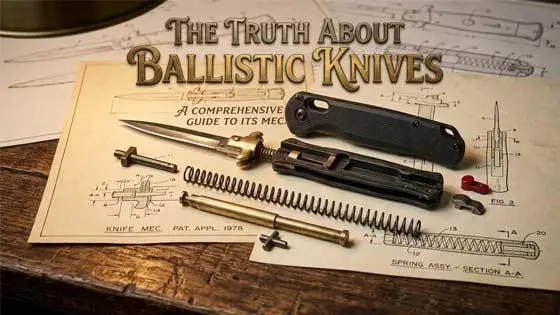
The Truth About Ballistic Knives
July 27th, 2026
Millions of people have heard the term "ballistic knife," but surprisingly few know what one actually is. Depending on who you ask, it's either a Cold War superweapon capable of firing its blade across a room or nothing more than an urban legend invented by action movies. The truth falls somewhere in between. Ballistic knives are very real, but much of what people believe about them has been exaggerated, misunderstood, or completely fabricated over the years. In this article, we'll separate fact from fiction, explore how ballistic knives actually work, uncover their unusual history, and explain why they've become one of the most mysterious knives ever created.
What Is a Ballistic Knife?
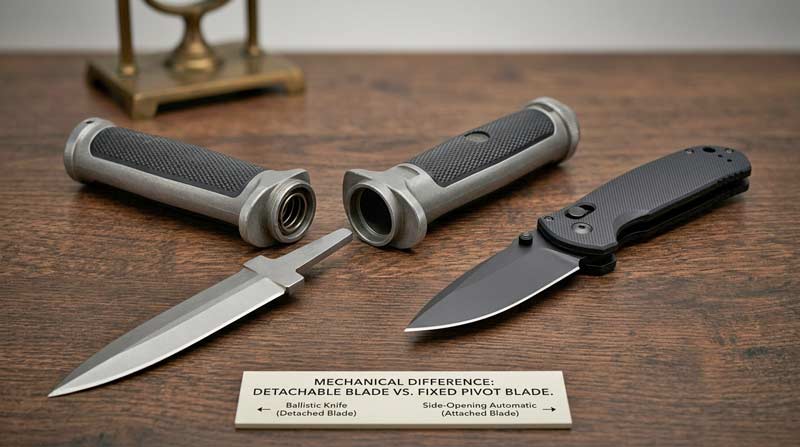
A ballistic knife is a specialized knife that can launch its blade from the handle using a powerful spring or compressed gas mechanism. Unlike an automatic knife, where the blade remains attached to the handle after deployment, a ballistic knife is designed so the entire blade separates and travels forward as a projectile. Once fired, the blade can be reinserted into the handle and reloaded for another use.
This unusual design is what gave ballistic knives their name. The word "ballistic" refers to an object traveling through the air under its own momentum. That distinction is important because people often confuse ballistic knives with switchblades, out-the-front (OTF) knives, and other automatic knives. While those knives deploy quickly, the blade never leaves the handle. A ballistic knife is built around an entirely different concept.
The idea sounds almost futuristic, which is one reason these knives have attracted so much attention over the years. Stories about secret military programs, Cold War espionage, and elite special forces have helped turn ballistic knives into legendary weapons. In reality, they were produced in relatively small numbers, and many of the claims surrounding their effectiveness have grown far beyond the available evidence.
If you've ever wondered whether a ballistic knife is simply another type of automatic knife, the answer is no. The two share certain mechanical concepts, but they operate in fundamentally different ways. Understanding that difference is the first step toward separating the myths from the facts.
How Does a Ballistic Knife Actually Work?
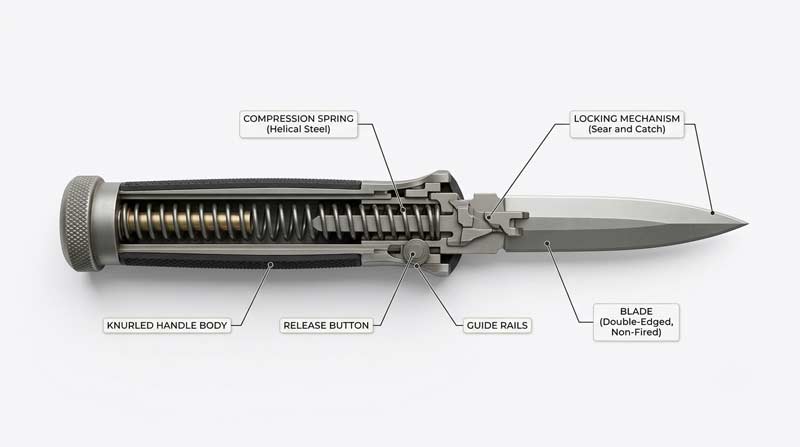
At first glance, a ballistic knife doesn't look much different from a conventional knife. The biggest difference is hidden inside the handle, where a powerful spring or compressed gas system stores enough energy to propel the blade forward when the release mechanism is activated. Instead of simply swinging or sliding into place like an automatic knife, the blade completely separates from the handle and travels independently.
When the knife is "loaded," the blade locks securely into the handle against the tension of the spring or gas mechanism. Pressing the release disengages that lock, allowing the stored energy to launch the blade forward in a straight line. After firing, the user must manually retrieve the blade, place it back into the handle, and compress the mechanism again before it can be used a second time.
Although the concept sounds incredibly powerful, reality is less dramatic than many movies suggest. Ballistic knives are generally effective only over very short distances, and factors such as air resistance, blade stability, and limited stored energy reduce both accuracy and penetration. Unlike a firearm, they were never capable of reliably striking distant targets with precision.
This is one reason so many myths have developed around ballistic knives. Films and television often portray them as silent, long-range assassination weapons capable of incredible feats. In practice, the technology has significant limitations, which explains why it never became widely adopted despite decades of fascination. Much like the myths surrounding out-the-front knives, the legend has often become far more famous than the actual tool.
Were Ballistic Knives Really Used by the Military?
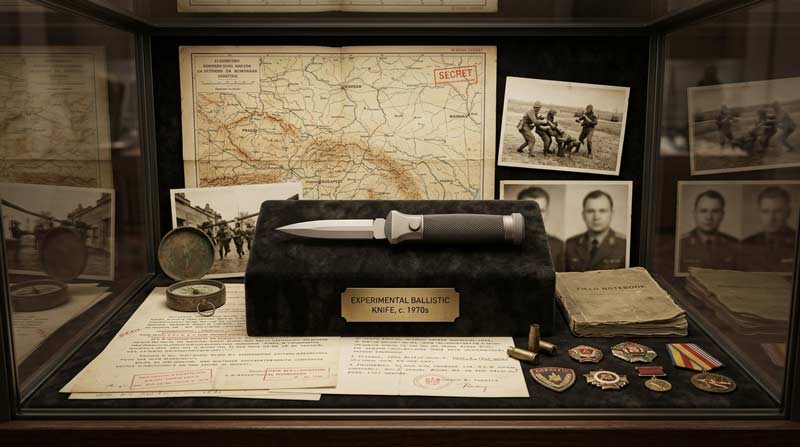
One of the biggest reasons ballistic knives became so famous is the widespread belief that they were standard equipment for elite military units during the Cold War. Stories circulated for decades claiming Soviet special forces carried them on secret missions, using them as silent weapons that could eliminate enemies without revealing the operator's position. Those stories sounded believable enough that many people accepted them as historical fact.
There is some truth behind the legend. Ballistic knives were developed in the Soviet Union during the late Cold War, and examples are known to have existed. However, credible evidence that they were widely issued or regularly used in combat is surprisingly limited. Most historians believe they were experimental or highly specialized tools rather than standard military equipment.
Part of the confusion comes from the secrecy surrounding many Soviet weapons programs. Because official information was scarce, rumors often filled the gaps. Western media, military publications, and knife enthusiasts repeated increasingly dramatic claims until it became difficult to separate documented history from speculation. Much like the stories surrounding the gravity knife, the mystery surrounding ballistic knives often became more interesting than the facts themselves.
Even if ballistic knives were occasionally evaluated by specialized units, they had several practical drawbacks. After firing, the user was left without a blade unless they could recover and reload it. The mechanism also added complexity, weight, and maintenance requirements compared to a conventional combat knife. Those disadvantages likely outweighed any limited tactical advantage the design offered.
Today, ballistic knives are remembered less for their military service and more for the legends that grew around them. They remain fascinating pieces of Cold War engineering, but their reputation has been shaped as much by rumor and popular culture as by documented history.
Why Ballistic Knives Became So Mysterious
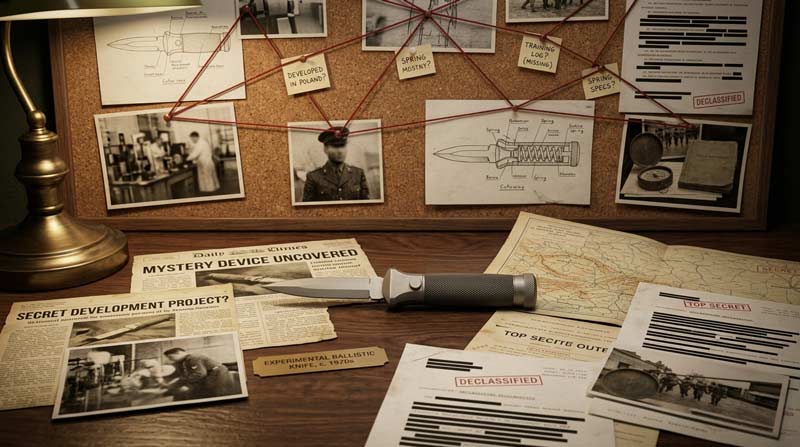
Few knives have accumulated as many rumors as the ballistic knife. Unlike famous military knives that saw widespread use and were thoroughly documented, ballistic knives appeared at a time when Cold War secrecy was at its peak. Reliable information was scarce, and that lack of information created the perfect environment for speculation. Every new rumor seemed more believable simply because so few people could verify the facts.
Movies and television only added to the mystery. Ballistic knives were often portrayed as silent superweapons capable of incredible accuracy and power, reinforcing the idea that they were the preferred choice of spies and elite commandos. Those fictional portrayals reached millions of viewers, while the real history of the knife remained largely unknown. Over time, Hollywood's version became more familiar than reality.
Another reason for the confusion is that many people mistakenly lump ballistic knives together with other unusual knife designs. Switchblades, gravity knives, and out-the-front knives all have unconventional opening mechanisms, so it's easy to assume they belong to the same family. In reality, each was designed for a completely different purpose. If you're interested in another knife that's surrounded by decades of misconceptions, our article on how automatic knives really work explains why many popular beliefs about switchblades are also inaccurate.
Collectors have also helped preserve the mystique. Because authentic ballistic knives are relatively uncommon, original examples often generate significant interest whenever they appear in private collections or museums. Their rarity has made them seem even more exotic, encouraging stories that sometimes stretch far beyond the documented evidence.
Perhaps the biggest lesson is that mystery has a way of growing over time. When reliable information is limited, imagination fills the gaps. That's exactly what happened with ballistic knives. Their unusual design made them memorable, but the legends surrounding them ultimately became far more famous than the knives themselves.
Hollywood vs. Reality: What Movies Got Wrong
If you learned about ballistic knives from action movies instead of history books, you probably came away with a very different impression of what they can do. For decades, filmmakers have portrayed them as nearly unstoppable secret weapons that can launch a blade with pinpoint accuracy across a room, making them the perfect tool for spies, assassins, and elite commandos. It's an exciting concept, but it's also one of the biggest reasons the public misunderstands these unusual knives.
In reality, ballistic knives were never the silent, long-range weapons Hollywood made them out to be. The blade loses speed quickly after leaving the handle, accuracy drops off rapidly with distance, and the knife must be manually reloaded after every shot. Those limitations make it far less practical than the fictional versions that seem capable of hitting any target with ease.
Movies also tend to exaggerate the knife's power. Scenes often show blades punching through thick materials or traveling incredible distances, even though the spring-powered mechanism simply doesn't generate that kind of energy. The laws of physics place real limits on how much force a compact spring can produce, regardless of how dramatic the screenplay may be.
This isn't unique to ballistic knives. Many famous blades have acquired larger-than-life reputations thanks to television and film. Our article on the world's most famous knives explores how several iconic designs became legends through a combination of history, storytelling, and popular culture.
Ironically, Hollywood's exaggerations may have accomplished something even more lasting than any real military use. They transformed an obscure experimental knife into one of the most recognizable and misunderstood weapons ever featured on screen. Today, many people know the myth of the ballistic knife far better than the history behind it.
Why Ballistic Knives Disappeared
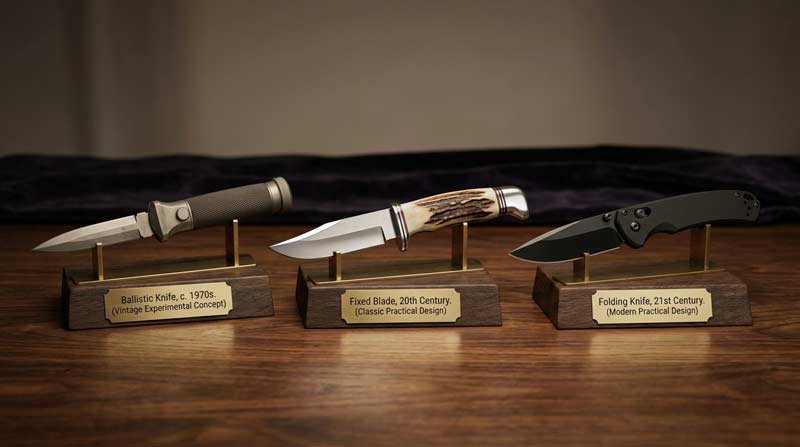
For all the attention they received, ballistic knives never became common military tools or everyday knives. Their unusual design attracted curiosity, but it also introduced practical problems that were difficult to overcome. As knife technology evolved, manufacturers and users increasingly favored simpler, more reliable designs that offered greater versatility without the added complexity.
One of the biggest drawbacks was that firing the blade immediately left the user without a functional knife. Unless the blade could be recovered and reloaded, the handle became little more than an empty shell. Traditional fixed blades and modern folding knives didn't suffer from that limitation, making them far more dependable for real-world use. For most situations, reliability proved far more valuable than novelty.
The complicated firing mechanism also made ballistic knives more difficult to manufacture and maintain. Springs, locking systems, and precise internal tolerances meant there were more components that could wear out or fail over time. By comparison, a quality fixed blade knife has very few moving parts, while even modern folding knives are remarkably durable thanks to decades of engineering improvements.
Legal restrictions also played a significant role in the knife's disappearance. Because ballistic knives launch their blades as projectiles, they attracted far more regulatory attention than conventional knives in many places. Whether or not those restrictions reflected the knife's actual effectiveness, they dramatically reduced commercial interest and limited production. As a result, genuine ballistic knives became increasingly rare outside of private collections and museums.
Today, ballistic knives occupy a unique place in knife history. They represent an ambitious engineering experiment that captured the public's imagination, even if the design never lived up to its legendary reputation. While collectors still seek authentic examples, the practical lessons of the ballistic knife helped reinforce an idea that remains true today: the simplest designs are often the ones that stand the test of time.
Could Ballistic Knives Ever Make a Comeback?
From an engineering standpoint, it's always possible to imagine a more advanced version of the ballistic knife. Modern materials are lighter, stronger, and more durable than those available during the Cold War, and manufacturing techniques have become far more precise. On paper, those improvements could solve some of the reliability issues that plagued earlier designs.
The bigger question isn't whether engineers could improve the concept, but whether there's any practical reason to do so. Today's knife buyers generally prioritize reliability, simplicity, ease of maintenance, and versatility. Those qualities have driven the success of everything from everyday carry folders to premium fixed blades. Compared to those proven designs, a knife built around a single-shot launching mechanism still offers relatively few real-world advantages.
Collectors, however, are a different story. Unusual designs have always attracted enthusiasts, and ballistic knives remain one of the most talked-about curiosities in knife history. Their rarity, combined with decades of Cold War folklore, ensures they'll continue to fascinate collectors long after their practical usefulness has faded. Much like the stories behind history's most famous knife fights, the legend has become part of the appeal.
In many ways, the ballistic knife has already secured its place in history. It represents a fascinating experiment that challenged conventional knife design, even if the concept never became mainstream. While future engineers may continue exploring unusual mechanisms, the ballistic knife will likely remain a reminder that not every innovative idea becomes a lasting success.
Its legacy isn't defined by battlefield use or commercial popularity. Instead, it's remembered because it captured people's imagination. Few knives have inspired as many myths, debates, and Hollywood exaggerations, and that's exactly why the ballistic knife continues to be discussed decades after most examples disappeared from production.
The Truth About Ballistic Knives
After decades of rumors, action movies, and Cold War legends, the ballistic knife remains one of the most misunderstood knives ever created. It wasn't an unstoppable superweapon, nor was it simply a fictional invention. Ballistic knives were real, but their reputation grew far beyond what the technology could actually deliver.
Their unusual design made them memorable, and their mysterious origins ensured that speculation would follow for decades. Add in Hollywood's tendency to exaggerate unusual weapons, and it's easy to see how myth eventually overshadowed reality. Many people today recognize the name "ballistic knife" without ever knowing how one actually worked or why it was developed.
Perhaps that's what makes the ballistic knife so fascinating. It serves as a reminder that some of history's most famous weapons earned their reputation not through widespread use, but through the stories told about them. While collectors continue to admire these rare mechanical curiosities, most modern knife users have embraced simpler, more practical designs that have proven themselves over time.
Whether you view the ballistic knife as an engineering experiment, a Cold War curiosity, or a pop culture icon, one thing is certain: its legend will probably outlive the knife itself. And sometimes, that's exactly what transforms an obscure invention into a lasting piece of knife history.
Are ballistic knives still manufactured today?
Authentic ballistic knives are extremely uncommon today. While a small number of collectible examples still exist, they are no longer widely manufactured or sold. Their complex design, limited practical advantages, and legal restrictions in many areas have made them far less common than traditional fixed blades, folding knives, and automatic knives. Most people encounter ballistic knives today through museums, private collections, historical articles, or movies rather than in everyday use.
Why are ballistic knives illegal in some places?
Ballistic knives are regulated more heavily than most other knives because they launch their blades as projectiles rather than simply deploying them. That unique design has led lawmakers in some jurisdictions to classify them differently from conventional knives, regardless of how commonly they were actually used. As a result, ownership, sale, or possession may be restricted depending on where you live. If you're considering purchasing any unusual or collectible knife, it's always a good idea to check your local laws before doing so.
Were ballistic knives ever actually effective?
Ballistic knives were capable of launching a blade, but their real-world effectiveness was much more limited than popular culture suggests. They worked only over very short distances, required the blade to be manually recovered and reloaded after each shot, and offered little advantage over a conventional combat knife. While the concept was certainly innovative, most experts believe the design's complexity and practical limitations prevented it from becoming a widely adopted military or survival tool. Today, ballistic knives are remembered more for their unusual engineering and the myths surrounding them than for any significant role they played in history.
Can a ballistic knife be reloaded after it's fired?
Yes. One of the defining features of a ballistic knife is that the blade can be reinserted into the handle and the firing mechanism reset after it has been launched. However, reloading is not instantaneous. The blade must first be retrieved, placed back into the handle, and the internal spring or gas mechanism compressed before the knife is ready to fire again. This slow reload process was one of the design's biggest disadvantages and a major reason it never replaced more conventional knife designs.
Are ballistic knives the same as out-the-front (OTF) knives?
No. Although the two are often confused, they work in very different ways. An out-the-front (OTF) knife deploys its blade straight out of the front of the handle, but the blade always remains attached to the knife. A ballistic knife, on the other hand, is designed so the entire blade separates from the handle and is propelled forward by a spring or compressed gas mechanism. Aside from sharing a forward-deploying concept, the two designs have little in common, which is why it's important not to confuse them.
You May Also Be Interested In:
- Why Are Throwing Knives Shaped Differently From Regular Knives?
- Why Trench Knives Became the Most Feared Knives of World War I
- 6 Unusual Folding Knives
- Why Automatic Knives Belong in Your EDC
- How Automatic Knives Actually Work
- Are OTF Knives Actually Reliable, or Just Cool?
- Can Butterfly Knives be used for Combat?
- OTF vs Folding Knives: What's the Difference and Which Is Better?
- 12 Fixed Blade Knives You Should Know About
- Why Karambit Knives Are So Effective
Leave a Reply