




The Strange History of the Push Dagger
July 30th, 2026
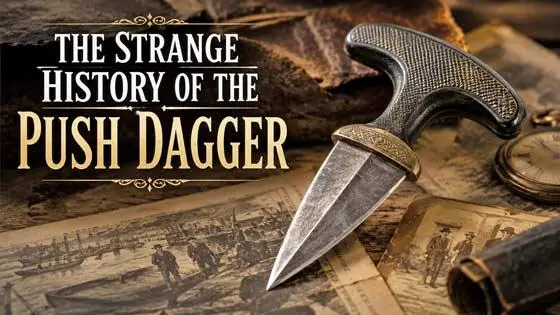
Many knives have earned fearsome reputations throughout history, but few have remained as mysterious as the push dagger. With its distinctive T-shaped handle and compact blade, it looks unlike almost any other knife ever made. Over the years, it has been linked to gamblers, soldiers, riverboat gamblers, Victorian gentlemen, and even secretive criminals, creating an image that's equal parts history and legend. But where did the push dagger actually come from, and why was its unusual design so effective? The real story stretches back centuries and reveals a weapon that was shaped by necessity, ingenuity, and changing ideas about personal defense rather than the myths that often surround it.
The Earliest Push Daggers Didn't Come from America
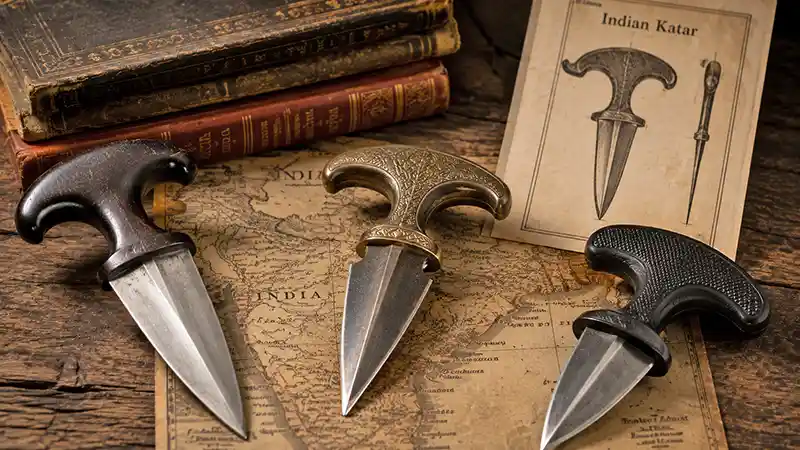
Many people assume the push dagger is an American invention, largely because it became famous during the nineteenth century. In reality, the concept of a knife with a perpendicular grip is much older. Variations of the design appeared in India centuries earlier, where a weapon known as the katar used a horizontal handle that allowed the blade to extend naturally from the user's fist. Although the katar and the modern push dagger are not identical, they share the same basic principle: delivering powerful thrusts while keeping the wrist in a strong, stable position.
As trade routes expanded and military ideas spread across continents, compact thrusting knives evolved in different parts of the world. Rather than copying a single design outright, craftsmen adapted existing concepts to meet local needs. This constant evolution is one reason knife historians often point to the push dagger as an example of how different cultures independently arrived at similar solutions for personal defense. If you're interested in seeing how this happened with other iconic blades, it's worth exploring how different cultures shaped the world's most famous knives.
By the early 1800s, the push dagger had begun taking on the familiar T-shaped form recognized today. It was smaller than many fixed blade knives, easy to conceal, and designed to generate surprising force from a compact package. That combination would eventually make it one of history's most recognizable personal defense knives, but its journey was only beginning.
How the Push Dagger Found Its Place in 19th Century America
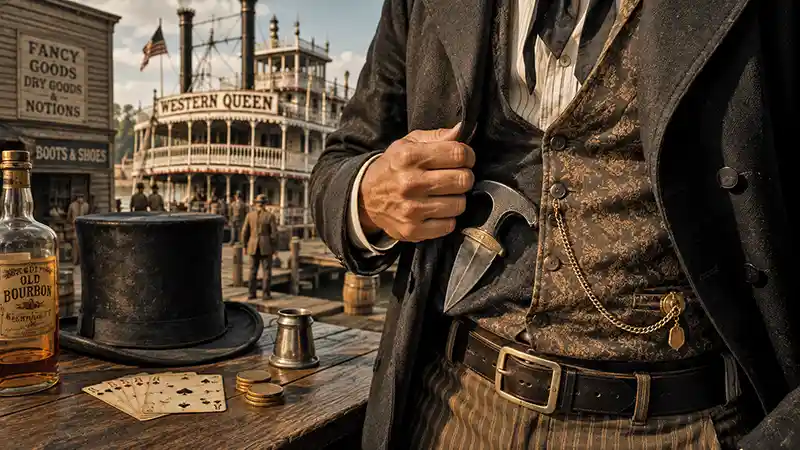
Although the push dagger's roots stretch back much farther, it was in nineteenth-century America that the weapon earned its enduring reputation. As cities grew, river travel expanded, and the frontier pushed westward, many people wanted a compact knife that could be carried discreetly while remaining immediately accessible. The push dagger fit that role perfectly. Small enough to disappear into a pocket or vest, it offered an effective means of personal protection without the bulk of larger blades like Bowie knives.
Manufacturers quickly recognized the demand. By the mid-1800s, American cutlery companies were producing push daggers in a variety of styles, from simple working knives to ornate models with decorative handles and engraved sheaths. Many were marketed as personal defense weapons for civilians rather than military equipment, reflecting the realities of life in an era when carrying a knife was commonplace.
The push dagger became especially popular among gamblers, merchants, travelers, and others who carried valuables or frequently found themselves in unfamiliar places. Its compact size made it easy to conceal, while its T-shaped grip allowed even inexperienced users to deliver powerful thrusting motions. That combination of concealability and effectiveness helped distinguish it from many other hidden knives of the era, cementing its reputation as one of America's most recognizable self-defense blades.
By the end of the nineteenth century, the push dagger had become more than just another knife. It had evolved into a symbol of personal protection during one of the most rapidly changing periods in American history, ensuring its place in collections and historical records long after the frontier had disappeared.
Why Riverboat Gamblers Became Linked to the Push Dagger
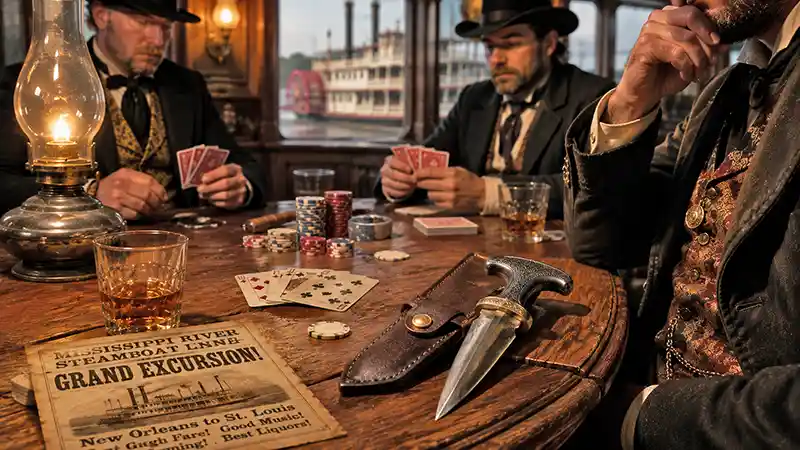
Few images are more closely tied to the push dagger than the nineteenth-century riverboat gambler. During the height of steamboat travel, floating saloons carried passengers, merchants, professional card players, and large amounts of cash along the Mississippi River. Games could last for hours, tempers could flare quickly, and accusations of cheating were not uncommon. In that setting, a compact weapon that could be carried discreetly had obvious appeal.
The connection between gamblers and push daggers was probably strengthened by sensational newspaper stories and dime novels as much as by real life. Writers loved the idea of a sharply dressed card player hiding a deadly blade beneath his coat, and the image fit perfectly with the dangerous reputation of riverboat gambling. Over time, fact and fiction blended together until the push dagger became almost inseparable from the mythology of the American gambling frontier.
Its design also suited the environment. A long knife would have been awkward in a crowded cabin or at a packed card table, while a push dagger could be drawn quickly from a vest, belt, or concealed sheath. Unlike a knife built for slashing, it was meant for close-range thrusting, which made it especially intimidating in confined spaces.
That reputation helped transform the push dagger from a practical personal defense tool into a cultural symbol. Like many of the world's most famous knives and the stories behind them, its legend grew because the people associated with it were just as memorable as the weapon itself.
How World War I Gave the Push Dagger a New Purpose
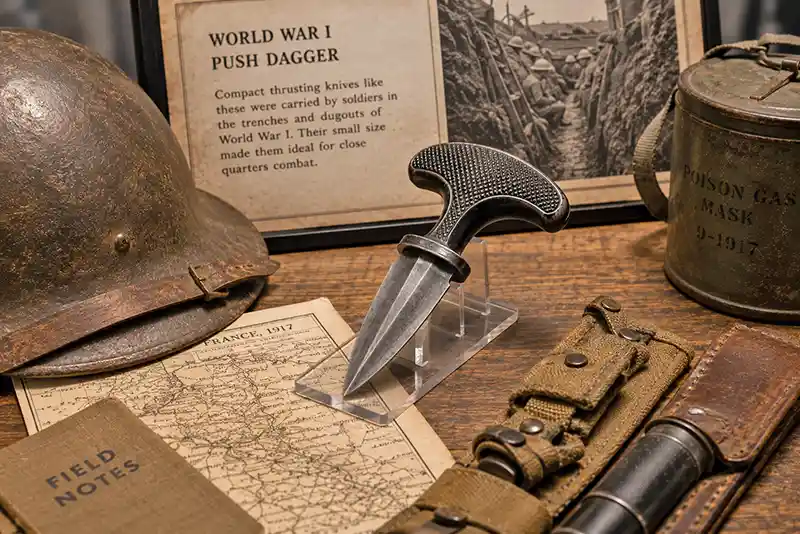
By the time World War I began, the push dagger had already faded from everyday American fashion. Trench warfare gave the design an entirely new relevance. Soldiers fighting in cramped dugouts and narrow passageways needed compact tools that could be carried without interfering with rifles, packs, and other equipment.
Some armies and private manufacturers responded by producing short thrusting knives with perpendicular or knuckle-style grips. These weapons were not always officially issued, but examples were carried by soldiers from several nations during the war. Their compact construction made them better suited to confined trenches than the long bayonets designed for open battle.
One of the best-known examples came from Robbins of Dudley, an English company that produced unusual private-purchase trench knives. Its compact push-style designs could be gripped securely even when conditions were wet, muddy, or chaotic. Although these knives differed from the classic American push dagger, they relied on the same principle of positioning the blade in line with the user's fist.
The association with trench warfare added another dark chapter to the weapon's history. The push dagger was no longer remembered only as a gambler's concealed defense knife. It had become connected to the brutal close-quarters conditions that made trench knives some of the most feared weapons of World War I.
What Made the Push Dagger So Different from Other Knives?
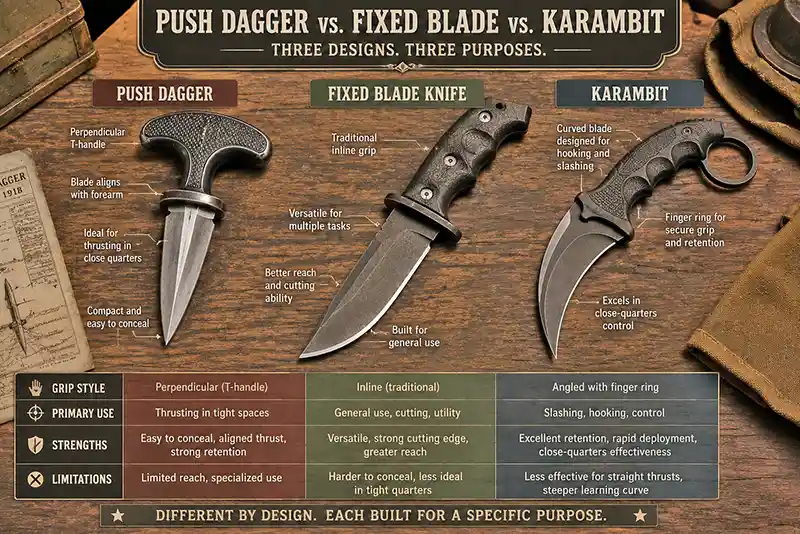
The defining feature of a push dagger is its perpendicular handle. Instead of gripping the knife in line with the blade, the user closes a fist around a T-shaped or curved handle while the blade projects between the fingers. This keeps the blade aligned with the forearm and allows the wrist to remain in a relatively natural position.
That design gave the push dagger a very different feel from conventional knives. Most blades require the user to maintain a firm wrist angle during a thrust, but the push dagger places much of the force directly behind the blade. Its compact shape also made it easier to retain than a knife with a narrow handle, particularly in stressful or unstable conditions.
The design came with limitations as well. Push daggers were specialized tools built primarily for close-range thrusting, so they lacked the versatility of larger utility knives. Their short blades offered limited reach, and their unusual grips made them poorly suited for many everyday cutting tasks. Anyone unfamiliar with the basic construction can learn more about what defines a push dagger and how its design differs from ordinary knives.
That specialization is what made the weapon so memorable. Like the karambit, the push dagger was built around a distinctive grip that immediately separated it from more conventional blades. A closer comparison between karambits and push daggers shows how two compact knives can achieve very different goals through radically different designs.
Why Push Daggers Disappeared from Everyday Carry
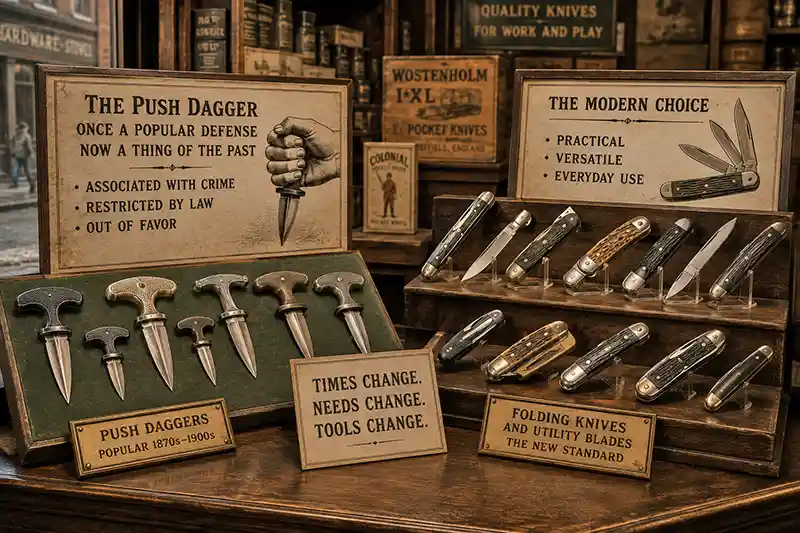
By the early twentieth century, the push dagger's popularity had begun to decline. Changing social attitudes, stricter weapon laws, and the growing availability of compact firearms all reduced the demand for small concealed knives. What had once been marketed openly as a personal defense tool was increasingly viewed as a weapon associated with criminals, gambling halls, and violent confrontations.
Several cities and states began restricting the possession or concealed carry of push daggers and similar knives. Their compact size and unusual grip made them especially easy to conceal, which attracted the attention of lawmakers already concerned about switchblades, dirks, and other purpose-built fighting knives. These restrictions varied widely, but they helped push the design out of mainstream civilian life.
The knife industry changed as well. Manufacturers focused more heavily on folding knives, outdoor blades, and practical utility tools that appealed to a broader market. Compared with versatile designs or recreational blades like throwing knives, the push dagger had a narrow purpose that made it harder to market as an everyday tool.
The design never disappeared completely. Collectors, historians, and specialized manufacturers continued to preserve it, while modern versions introduced new steels, synthetic handles, and compact sheaths. Anyone interested in exploring the range of designs still available today can see how modern push daggers continue to reinterpret a knife with centuries of history behind it.
How Modern Knife Makers Revived the Push Dagger
Although the push dagger disappeared from everyday civilian carry, it never vanished from the knife world. Modern manufacturers eventually returned to the design, updating it with stronger steels, molded handles, and compact synthetic sheaths. These changes made contemporary versions lighter, more durable, and easier to carry than many of their nineteenth-century predecessors.
The revival was driven partly by collectors who appreciated the weapon's unusual history and partly by buyers drawn to its compact, unmistakable shape. Unlike traditional hunting or utility knives, the push dagger has almost no chance of being mistaken for anything else. Its silhouette instantly connects modern designs to riverboat gamblers, trench warfare, and the long history of concealed defensive blades.
Modern push daggers also reflect how knife design continues to evolve around specialized purposes. Some feature narrow spear-point blades, while others use broader profiles, partial serrations, or heavily textured grips. These variations follow the same pattern seen with unusual concepts like ballistic knives, where the reputation of the weapon often becomes just as fascinating as its actual construction.
That continued reinvention helps explain why the push dagger remains popular with collectors long after its original era ended. Readers who want a closer look at how the design changed over time can explore the broader history of the push dagger, from its early inspirations to the modern versions still produced today.
Why the Push Dagger Still Fascinates People Today
Few knives have a silhouette as instantly recognizable as the push dagger. Even people with little interest in knives can usually identify its distinctive T-shaped handle at a glance. That unusual appearance, combined with centuries of history, has helped the design remain a favorite among collectors, historians, and martial arts enthusiasts long after its practical role faded from everyday life.
Part of the fascination comes from the stories attached to it. The push dagger has been linked to frontier gamblers, Victorian gentlemen, World War I soldiers, and countless fictional characters. Some of those connections are well documented, while others have been exaggerated over time. Separating fact from legend is one of the reasons the knife continues to inspire books, museum exhibits, and historical discussions.
Its influence can also be seen in the broader history of knife design. Although few modern knives copy the push dagger directly, its emphasis on compactness, concealability, and specialized purpose reflects the same design philosophy found in many iconic blades throughout history. Whether examining military knives, utility blades, or unusual fighting knives, the push dagger remains an important chapter in the evolution of edged weapons.
More than anything, the push dagger reminds us that history's most memorable weapons are often remembered because of the people and events surrounding them, not simply because of their appearance. Its story is one of innovation, adaptation, and myth, making it one of the most intriguing knives ever created.
Frequently Asked Questions About Push Daggers
Were push daggers actually common in the Old West?
Yes, but not nearly as common as movies and novels often suggest. During the mid-to-late 1800s, push daggers were sold by American cutlery companies and carried by some gamblers, merchants, travelers, and civilians who wanted a compact means of personal protection. However, they were far less widespread than pocket knives, Bowie knives, or other everyday blades. Their reputation has grown over time thanks to sensational stories that blurred the line between history and legend.
What's the Difference Between a Push Dagger and a Katar?
Although they're often compared, the push dagger and the Indian katar are two distinct weapons. The katar originated in India centuries before the modern push dagger became popular in America. It typically features a wide H-shaped grip with two parallel bars, allowing the user to hold the weapon between the forearm and fist, whereas a push dagger uses a compact T-shaped handle that fits directly in the palm.
Both designs position the blade in line with the user's forearm, making thrusting more natural and efficient. That's why historians often view the katar as an important predecessor that inspired later push-style knives, even though the two weapons evolved independently and were used in very different cultures.
The similarities have led many people to assume they're the same weapon, but their construction, historical context, and intended users are quite different. Understanding that distinction helps explain how the push dagger developed into its own unique design rather than simply becoming a copy of an older Indian weapon.
Were Push Daggers Ever Issued to Soldiers?
Generally, no. While push daggers saw military use during conflicts such as World War I, they were rarely standard-issue weapons. Most examples were privately purchased by individual soldiers or produced by commercial manufacturers who recognized the demand for compact trench weapons. Official military forces typically relied on bayonets, trench knives, or other combat knives that were issued as part of a soldier's standard equipment.
That said, some military-style push daggers became popular because they were easy to carry and effective in confined spaces. Soldiers often bought them from private outfitters before deployment or acquired them through personal channels while overseas. Their compact size made them a practical backup weapon rather than a replacement for a rifle or bayonet.
Today, surviving military push daggers are highly sought after by collectors. Authentic examples from the early twentieth century, especially those with documented military connections, can be valuable historical artifacts that offer a glimpse into the realities of close-quarters combat during one of history's most brutal wars.
Are Push Daggers Legal to Own?
The answer depends entirely on where you live. In many places, owning a push dagger is perfectly legal, while other states or countries regulate them in the same way as other concealed or specialty knives. Laws can differ not only between states but sometimes between cities or municipalities, making it important to check your local regulations before purchasing or carrying one.
Legal restrictions have also changed over time. Many jurisdictions that once banned certain knife styles have updated or repealed those laws in recent years, reflecting broader changes in how knives are viewed under the law. Because legislation continues to evolve, information that was accurate just a few years ago may no longer apply today.
If you're interested in owning a push dagger, the safest approach is to verify the current laws where you live and understand any rules regarding carrying, transporting, or concealing the knife. Staying informed helps ensure that an interesting piece of knife history doesn't become an unexpected legal issue.
Why Does the Push Dagger Have a T-Shaped Handle?
The T-shaped handle is what makes the push dagger unique. Instead of gripping it like a traditional knife, the user wraps their fingers around the crossbar while the blade extends straight out from the front of the fist. This places the blade in line with the forearm, creating a natural and stable grip that requires very little wrist movement.
This design also helps prevent the knife from twisting during use. Because the handle fills the palm, force is distributed across the hand rather than concentrated in the fingers. That makes the push dagger feel very different from conventional fixed-blade knives, even though it is usually much smaller.
The unusual grip is also why the push dagger has remained one of the easiest knives to recognize. While countless blade shapes have come and gone throughout history, the simple T-handle has changed very little for more than a century, making it one of the most distinctive knife designs ever created.
Why Didn't the Push Dagger Become More Popular?
Despite its distinctive design, the push dagger was always a niche weapon. Unlike pocket knives, which could be used for everyday tasks, or larger fixed-blade knives that served both utility and outdoor purposes, the push dagger was built with a very specialized role in mind. That limited its appeal to the average person, who usually preferred a knife that could handle a wider variety of jobs.
Changing technology also worked against it. As reliable revolvers became more common during the nineteenth century and military equipment evolved throughout the twentieth century, there was less demand for compact backup blades designed solely for close-quarters defense. Many knife buyers simply found more practical options that better fit their everyday needs.
Ironically, that limited popularity is part of what makes the push dagger so interesting today. Because it never became an ordinary household knife, it has retained an air of mystery that continues to attract collectors and historians. Its unusual appearance and colorful history ensure that it remains one of the most recognizable specialty knives ever created.
You May Also Be Interested In:
- What Is a Push Dagger? History, Design, and Modern Uses
- A Brief History of the Push Dagger: From Trench Warfare to Modern EDC
- Karambit vs Push Dagger: Which Blade Would You Bet Your Life On?
- The Strange History of the Blackjack
- The Strange History of the Tomahawk
- The Strange History of Cane Swords
- The Strange History of Belt Buckle Knives
- The History and Evolution of the Karambit Knife
- History and Evolution of Self-Defense Keychains
- The Most Famous Knife Fight in American History
Leave a Reply