




The Strange History of the Blackjack
August 10th, 2026
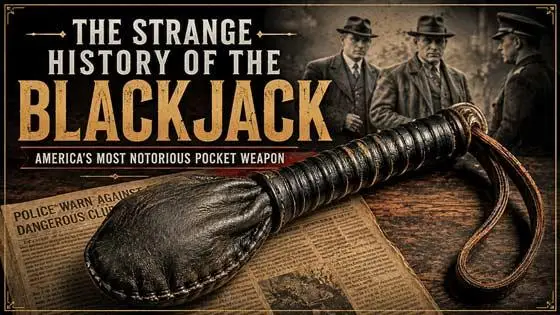
Small enough to disappear into a pocket and heavy enough to end a fight with a single swing, the blackjack became one of the most notorious weapons carried on American streets. For decades, these compact impact weapons were associated with everyone from police officers and private detectives to criminals and hired muscle. Yet the blackjack was not simply a crude club. Its flexible construction gave it a very different feel from a traditional baton, and its ability to deliver tremendous force from such a small package helped keep it in use long after more primitive clubs had disappeared. The story of how this unassuming leather weapon became both a law-enforcement tool and an icon of the criminal underworld is far stranger than its simple appearance suggests.
What Exactly Is a Blackjack?
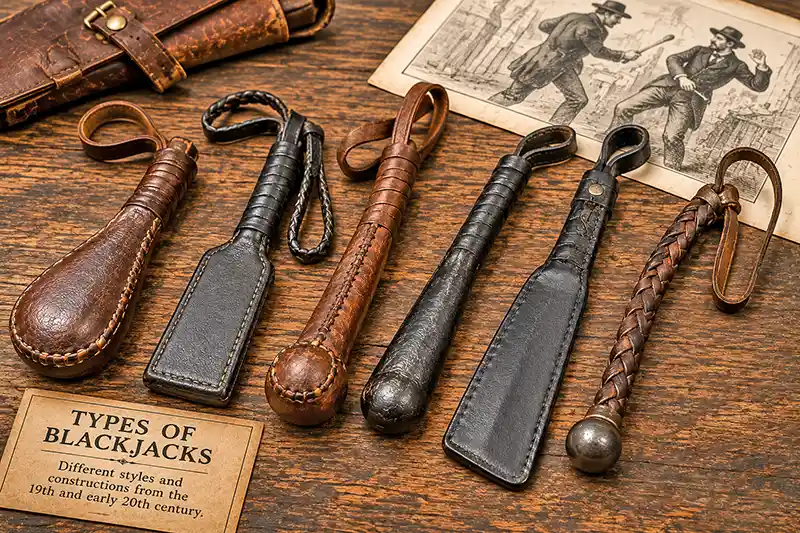
At first glance, a blackjack barely looks like a weapon. Most traditional versions were short, flat, and covered in leather, making them easy to mistake for an unusual wallet or small pouch. Hidden inside, however, was a dense striking head typically made from lead or another heavy material. A flexible or semi-flexible handle connected the weighted end to the user's hand, creating something very different from an ordinary wooden club.
That flexibility was the blackjack's defining feature. Instead of behaving like a completely rigid baton, the weighted head could accelerate independently as the weapon was swung. The result was a compact impact weapon capable of producing surprising force despite being only a fraction of the size of a conventional club.
Blackjacks also came in numerous shapes and constructions. Some had broad, rounded striking heads, while others were narrow and almost paddle-shaped. Leather coverings helped protect the internal weight while giving the weapon its distinctive appearance. Many also included a wrist strap or reinforced grip, features that reflected the blackjack's origins as a weapon intended to be carried regularly rather than retrieved only during an emergency.
That combination of small size, substantial weight, and an innocent-looking exterior would eventually make the blackjack popular with two groups that rarely found themselves on the same side of the law: the people enforcing it and the people breaking it.
From Sailors' Clubs to the City Streets
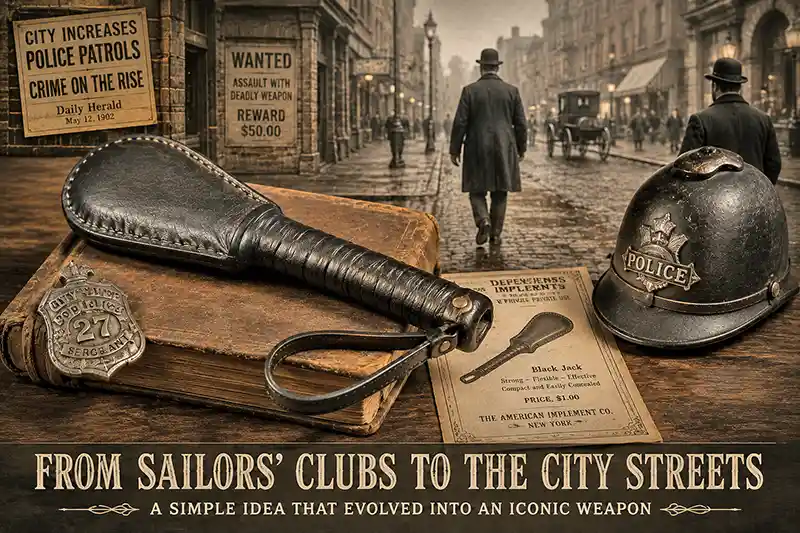
The blackjack did not appear out of nowhere. Its basic idea belonged to a much older family of compact weighted weapons that included sailors' clubs, loaded canes, and the notorious slungshot. During the 19th century, sailors sometimes carried short pieces of rope with heavy knots or weights at the end, tools that could serve practical purposes aboard ship but could also become formidable improvised clubs during a fight.
As American cities grew larger and more crowded, compact weapons became particularly attractive. A full-size club was conspicuous, but a short weighted weapon could disappear beneath a coat. Manufacturers gradually refined the concept into something easier to carry, replacing exposed rope and metal with stitched leather, springy internal supports, and carefully shaped weighted heads. The result was the recognizable blackjack.
By the late 1800s and early 1900s, blackjacks and closely related sap weapons had become fixtures of urban life. They appeared in police equipment, private security work, newspaper crime reports, and the pockets of people who wanted a compact means of protection. Different designs were often lumped together under names such as sap, blackjack, and slapjack, even though their construction could vary considerably.
That ambiguity still causes confusion today. A blackjack generally featured a compact weighted striking end, while a traditional slapjack was often flatter and more flexible. The distinction was not always consistent historically, which helps explain why old catalogs, newspapers, and police records sometimes seem to use the names almost interchangeably.
What began as a simple idea, putting substantial weight into a small flexible object, had evolved into a purpose-built weapon perfectly suited to the crowded streets of a rapidly changing America.
Why Police Officers Started Carrying Blackjacks
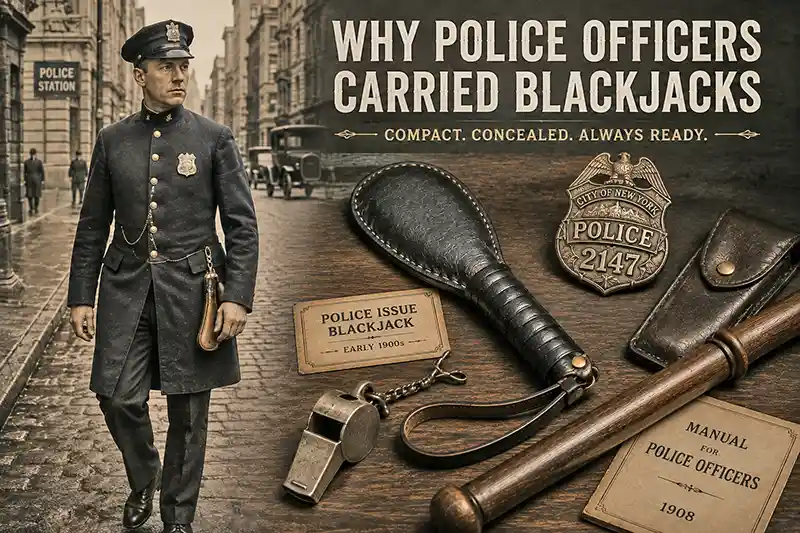
By the early 20th century, the blackjack had found an unlikely place in American law enforcement. Police officers already had full-size wooden clubs available, but those were impossible to ignore. A blackjack offered something different: it was compact, easy to carry during a long patrol, and useful in the extremely close quarters officers often encountered while making arrests. Historical accounts show that blackjacks and related saps remained associated with police work for decades.
That portability mattered in an era when many officers spent their entire shifts walking crowded city streets. A blackjack could ride inside a coat pocket or alongside other equipment without the bulk of a traditional baton. Some designs became so closely associated with law enforcement that the leather sap and blackjack eventually developed an unmistakable "old-school cop" image that still survives in movies and crime fiction today.
The blackjack was also part of a much larger family of police impact weapons. Billy clubs, nightsticks, flat saps, and flexible weighted clubs all competed for a place on an officer's belt or in his pocket. If you look at the police weapon most people forgot ever existed, it becomes clear just how many different impact weapons once occupied the role now associated with the modern police baton.
Eventually, however, the very qualities that had made blackjacks effective began working against them. Police training increasingly recognized the severe risk of serious injury from blows delivered with compact weighted impact weapons, particularly strikes to the head. By the late 20th century, blackjacks and traditional saps had largely disappeared from standard police equipment as departments shifted toward more standardized batons and different use-of-force practices.
For much of the blackjack's history, though, seeing one tucked into a police officer's pocket would have seemed completely ordinary. That official acceptance gave the weapon legitimacy, but it also helped spread its reputation far beyond the police station.
How the Blackjack Became a Criminal Underworld Favorite
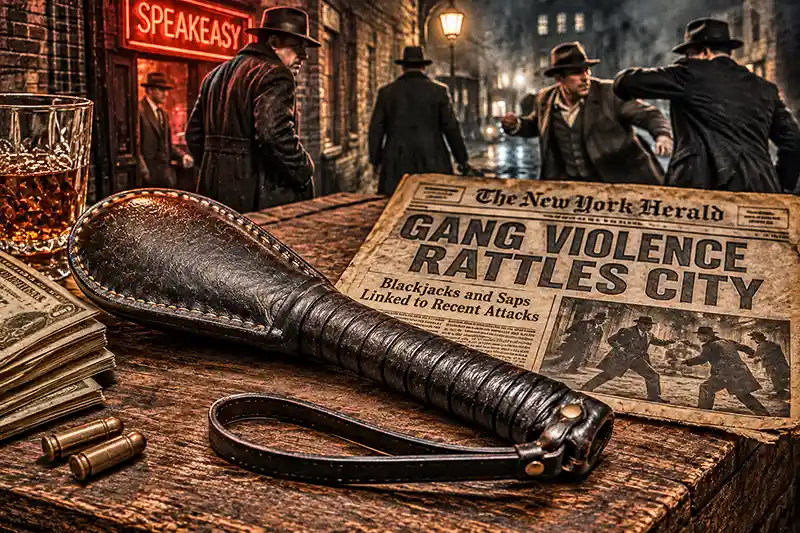
The same qualities that made the blackjack attractive to police officers also made it appealing on the other side of the law. It was small, relatively easy to conceal, and far less conspicuous than carrying a full-size club through a crowded neighborhood. By the early 20th century, blackjacks and similar weighted saps had become closely associated with street gangs, hired muscle, and organized crime.
Newspaper accounts from the era helped build that reputation. Reports of robberies, assaults, labor disputes, and gang violence frequently mentioned blackjacks, saps, and other compact impact weapons. In an age before television, these stories gave readers a vivid picture of the weapons supposedly lurking in coat pockets throughout America's growing cities.
The blackjack also fit perfectly into the mythology of the professional strong-arm man. Unlike a knife or firearm, it did not immediately announce itself as a weapon. A small leather object could remain hidden until a confrontation began, which made the blackjack particularly intimidating in crime stories. That reputation eventually became almost as important as the weapon itself.
It was hardly the only compact weapon associated with this period. Knives, knuckle dusters, small clubs, and other easily carried everyday carry weapons occupied the same murky world where personal protection, legitimate tools, and criminal use frequently overlapped.
Hollywood later exaggerated the image, but it did not invent it. Film noir detectives, gangsters, corrupt cops, and hired enforcers carrying blackjacks were drawing from a reputation the weapon had already earned on real American streets. By then, the blackjack was no longer simply a compact club. It had become a symbol of the darker side of urban America.
Blackjack vs. Slapjack: Why the Names Get Confused
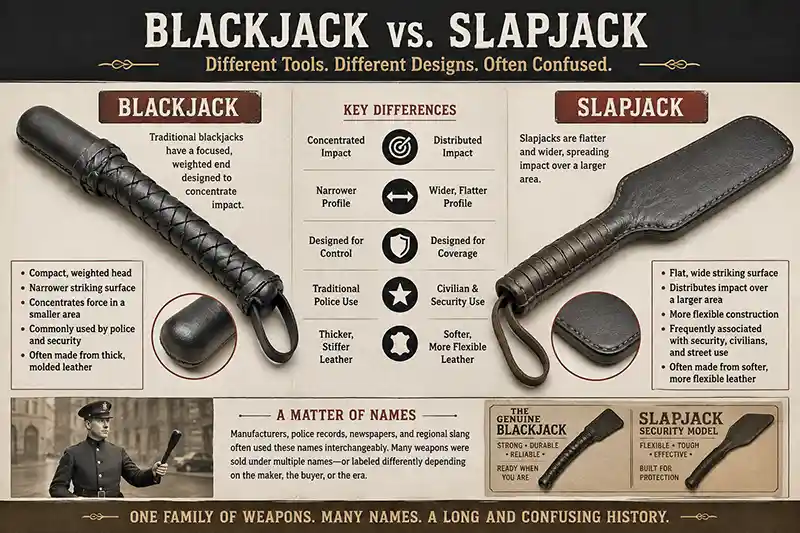
Even people who know what a blackjack looks like often use the words blackjack, sap, and slapjack as though they mean the same thing. Historically, that was not always a mistake. Manufacturers, police departments, newspapers, and civilians often used overlapping names for compact leather impact weapons, especially when the differences between models were subtle.
In general, a traditional blackjack tended to have a more concentrated weighted head attached to a comparatively narrow handle. A slapjack was usually flatter, broader, and more flexible, often resembling a short leather paddle. Saps could fall somewhere in between, depending on the maker and the period.
That is why comparing a traditional blackjack design with a larger slapjack makes the distinction easier to see. The blackjack emphasizes a compact weighted end, while the slapjack spreads its mass across a flatter striking surface.
The terminology becomes even messier when you look at old advertisements and police records. One company might sell nearly identical weapons under two different names, while another might label a flat sap as a blackjack. Regional slang added another layer of confusion.
If you want a deeper side-by-side breakdown, our guide to slapjacks vs. blackjacks explains how the designs differ and why the names are still mixed up today.
That confusion is actually part of the blackjack's strange history. It was never one perfectly standardized object. It was a family of closely related designs that evolved alongside one another and often borrowed each other's names.
Why Such a Small Weapon Could Have Such a Big Reputation
The blackjack's reputation seems almost out of proportion to its size. Many examples were short enough to carry discreetly, especially compared with the wooden nightsticks and clubs of the same era. Yet much of the weapon's notoriety came from the fact that its compact appearance concealed considerably more weight than someone might expect.
The secret was hidden beneath the leather. Traditional blackjacks typically concentrated a dense weight inside the enlarged end of the weapon, while the narrower handle provided flexibility between the hand and the weighted section. That unusual construction helped distinguish the blackjack from an ordinary rigid club.
The photograph above also shows another characteristic found on many blackjack designs: the wrist loop. Combined with the wrapped leather grip and reinforced body, these details reveal that the blackjack was not simply an improvised object. It evolved into a deliberately manufactured piece of equipment, with makers experimenting with different lengths, shapes, weights, and handle constructions.
Its compact dimensions also placed it among a much broader category of self-defense weapons designed around portability. That was a major part of the blackjack's appeal throughout its history. It offered the presence of a substantial impact weapon without requiring someone to carry a conspicuous full-size club.
That combination created the contradiction at the heart of the blackjack's reputation. It looked simple, almost mundane, yet generations of police officers, criminals, security personnel, and civilians treated it as something far more serious.
Why the Blackjack Eventually Disappeared From Police Duty
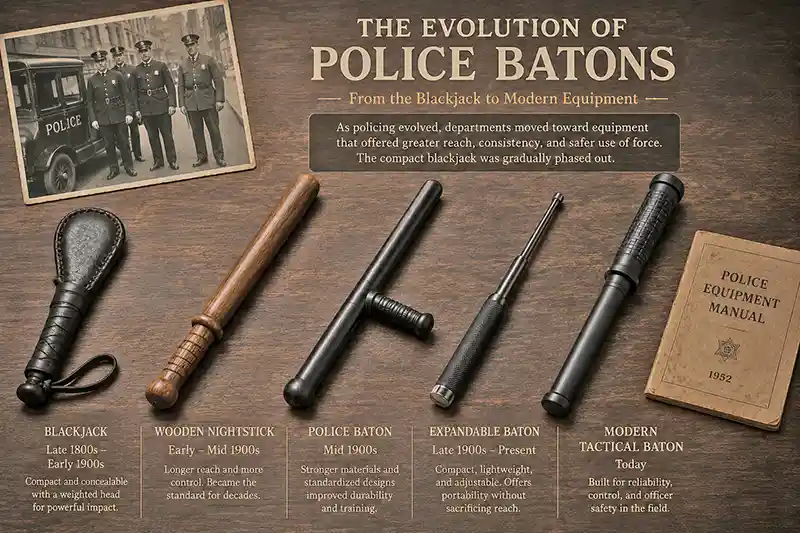
For decades, the blackjack occupied a strange position in American law enforcement. It was compact, familiar, and easy for an officer to carry, but attitudes toward police equipment were changing. Departments gradually became more concerned with standardized training, accountability, and the amount of force different weapons could produce.
The blackjack had a particular problem: its innocent appearance disguised how serious an impact weapon it could be. A dense weighted head concentrated force into a relatively small area, and strikes to vulnerable parts of the body could cause severe injuries. As police agencies developed more formal use-of-force policies during the 20th century, that unpredictability became increasingly difficult to justify.
Equipment was changing too. Longer batons gave officers greater reach and could be incorporated into standardized defensive training. Later, expandable batons offered portability without relying on the blackjack's flexible weighted construction. As those alternatives became more common, the little leather club that had once been a familiar part of police work began quietly disappearing.
There was no single moment when every police department abandoned the blackjack. Policies varied widely, and older equipment sometimes remained in service long after newer options appeared. Its decline was gradual, which is one reason the weapon seems to have vanished from public memory rather than ending with a dramatic ban or replacement.
Today, seeing an antique police blackjack can feel almost surprising. A weapon once familiar enough to ride in an officer's pocket is now more likely to turn up in a collection, museum display, or old photograph. Few pieces of police equipment have gone from commonplace to nearly forgotten quite so completely.
Why Blackjacks Became Collectors Items
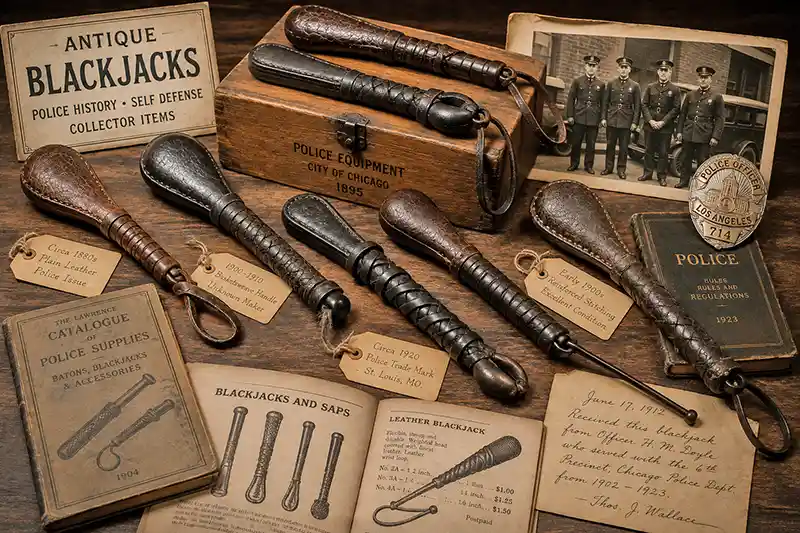
Once blackjacks disappeared from everyday police work, something interesting happened. Instead of vanishing completely, they began showing up in antique shops, militaria collections, police memorabilia displays, and estate sales. Old examples suddenly had value not because they were still being issued, but because they represented a type of equipment that had almost completely disappeared from modern life.
Collectors are often drawn to the enormous variety of surviving designs. Some blackjacks were plain and utilitarian, while others featured elaborate stitching, braided leather handles, embossed markings, unusual shapes, or manufacturer stamps. Police-issued examples can be especially interesting when they still have department markings, provenance, or documentation connecting them to a particular era.
Age also gives many surviving blackjacks a distinctive appearance. Leather darkens, stitching wears smooth, and handles develop the polished look that comes from decades of use. Unlike mass-produced modern equipment, many older pieces have subtle construction differences that make each one feel slightly unique.
The history attached to them is just as important as the object itself. A single blackjack can connect several very different chapters of American history: early urban policing, organized crime, private security, self-defense culture, and the gradual professionalization of law enforcement equipment.
That is probably why blackjacks remain so fascinating today. They are small enough to fit in one hand, yet they carry an unusually large amount of history with them. Few weapons so simple in appearance have managed to become symbols of both the law and the criminal underworld at the same time.
Why the Blackjack Still Has Such a Dark Reputation
The blackjack has been out of mainstream police use for decades, yet its reputation has barely faded. That is partly because the weapon became more than a piece of equipment. It turned into a symbol. In old crime stories, detective novels, gangster films, and police dramas, the sight of a small leather club immediately suggested intimidation, corruption, or violence lurking just beneath the surface.
Its appearance helped build that image. A blackjack does not look dramatic in the same way a sword or firearm does. It is compact, plain, and almost anonymous. That makes it more unsettling in a different way. The weapon seems designed to disappear until the moment it is needed, and that association with concealment became central to its mythology.
There is also the contradiction at the heart of its history. The same object was carried by police officers, private guards, criminals, and civilians. Few weapons crossed those lines so completely. Depending on who held it, a blackjack could represent authority, protection, coercion, or outright criminal violence.
That blurred identity is one reason the weapon still attracts interest from collectors and enthusiasts today. It belongs to a period when compact personal defense weapons occupied a much more visible place in everyday life, even if many of them have since disappeared from public view.
The blackjack may be simple, but its history is anything but. It survived long enough to become part of policing, organized crime, popular culture, and collecting, and that is why this little leather weapon still carries such an outsized reputation today.
Are Blackjacks Illegal to Own?
Blackjack laws vary considerably depending on where you live. Some states and local jurisdictions specifically restrict blackjacks, saps, slungshots, and similar impact weapons, while others may allow ownership but regulate carrying them in public or carrying them concealed.
The terminology in older weapons laws can make things even more confusing. A statute might mention a "blackjack," "sap," "slungshot," or "sand club" without clearly defining how those weapons differ. Because modern blackjack designs can overlap with several of these categories, the exact wording of state and local law matters.
Anyone considering purchasing or carrying a blackjack should therefore check the current laws in their own jurisdiction rather than assuming that rules applying in one state apply everywhere.
What Is Inside a Blackjack Weapon?
Traditional blackjacks typically contain a dense weight inside the enlarged striking end, surrounded by a durable leather covering. Depending on the period and manufacturer, the internal weight could be made from lead, steel, or another heavy material.
The handle was usually constructed to provide some flexibility rather than behaving like a completely rigid club. Many examples also featured wrapped leather grips, internal springs or flexible supports, and wrist straps. Because blackjacks were produced by numerous manufacturers over many decades, their exact construction varied considerably.
Why Is It Called a Blackjack?
The exact origin of the name "blackjack" is surprisingly difficult to pin down. The term was already being used for several unrelated objects before it became firmly associated with the compact leather impact weapon, including drinking vessels and other items that were typically dark or black in appearance.
For the weapon, the name was likely influenced by the black leather commonly used to cover early examples. "Jack" was also historically attached to various tools, devices, and everyday objects, making blackjack a fitting nickname for a small, practical piece of equipment.
Whatever its precise origin, the name proved remarkably durable. Even after police departments largely stopped carrying them, "blackjack" remained the term most people recognized, helping preserve the weapon's identity long after it disappeared from everyday use.
Did Detectives Really Carry Blackjacks?
Yes. Blackjacks and similar leather saps became closely associated with plainclothes law enforcement during the late 19th and early 20th centuries. Their compact size made them particularly practical for detectives who did not wear the traditional uniform or openly carry the same equipment as a patrol officer.
That association eventually became a staple of detective fiction and film noir, where the blackjack was almost as recognizable as the trench coat and fedora. Hollywood exaggerated plenty of details, but the connection itself had a basis in real law-enforcement history.
Detectives were not the only plainclothes professionals who carried them. Private security personnel, guards, and others working in occupations where a full-size baton would have been inconvenient also used compact saps and blackjacks during different periods.
What Is the Difference Between a Blackjack and a Billy Club?
The biggest difference is their construction. A traditional billy club is a rigid baton, usually made from wood, rubber, or another solid material. A blackjack is much shorter and typically combines a flexible or semi-flexible handle with a dense weighted end covered in leather.
Their size also reflects how they were historically carried. Billy clubs were often worn openly by uniformed police officers, while compact blackjacks could be carried far less conspicuously. This helped make blackjacks particularly popular with plainclothes officers and detectives.
Both belonged to the same broad family of impact weapons, but they represented very different approaches to the same basic idea: the billy club emphasized reach and rigidity, while the blackjack emphasized compactness and portability.
When Were Blackjacks Most Popular?
Blackjacks were most strongly associated with the late 19th century through the middle decades of the 20th century. During this period, compact impact weapons were carried by police officers, detectives, private guards, civilians, and criminals throughout the United States.
Their popularity was especially noticeable during the early 1900s, when rapidly growing cities created a demand for police equipment that could be carried comfortably during long foot patrols. Blackjacks also became deeply connected with the Prohibition and organized-crime era, helping cement their sinister reputation in American popular culture.
By the second half of the 20th century, changing police policies and newer equipment gradually pushed the blackjack out of mainstream use. What had once been an ordinary piece of equipment eventually became something most people encountered only in old photographs, crime movies, and collections.
Are Blackjacks and Saps the Same Thing?
The terms are often used interchangeably, but they do not always describe exactly the same weapon. Historically, "sap" became a broad name for small, leather-covered impact weapons, while "blackjack" more commonly referred to a design with a concentrated weighted head and a narrower flexible handle.
The problem is that manufacturers never followed one universal naming system. Old police catalogs sometimes called similar designs saps, blackjacks, or slapjacks depending on the company selling them. Regional terminology made the distinction even less consistent.
As a result, two antique weapons with nearly identical construction might have been sold under completely different names. When identifying an old example today, its actual shape and construction can often tell you more than the name printed in a century-old catalog.
Why Did Blackjacks Have Wrist Straps?
Many traditional blackjacks included a leather loop or wrist strap at the end of the handle. Its primary purpose was retention. Because the weapon was compact and often had a relatively heavy head, the strap helped keep it attached to the carrier's hand rather than being accidentally dropped or lost.
Wrist straps were also common on other police impact weapons of the period, including certain nightsticks and billy clubs. For officers who spent hours walking patrols, small practical details like secure grips and retention loops mattered almost as much as the weapon's basic design.
Today, those straps are one of the easiest features to spot on surviving antique blackjacks. Along with stitched leather bodies and wrapped handles, they contribute to the distinctive appearance that separates a traditional blackjack from an ordinary club.
Were Blackjacks Ever Standard Police-Issue Equipment?
In some departments, blackjacks and closely related saps were officially authorized or issued equipment, while in others they were personally purchased by officers from police-supply companies. There was never one universal blackjack carried by every American police department.
This explains why surviving police blackjacks show so much variety. Different manufacturers offered their own lengths, leather coverings, handle designs, internal construction, and weighted heads. Officers and departments could select equipment according to local policies and preferences.
Old police-supply catalogs are especially interesting because they show just how ordinary these weapons once were. What now looks like an unusual antique could once be advertised alongside badges, handcuffs, whistles, flashlights, and other routine law-enforcement equipment.
Why Were Blackjacks Covered in Leather?
Leather was durable, flexible, and well suited to wrapping the weighted internal components of a blackjack. It created a compact exterior that could withstand regular carrying while keeping the weapon's internal structure enclosed.
Leather also allowed manufacturers to create wrapped grips, stitched edges, wrist loops, and flexible joints without adding much bulk. Over time, the dark stitched leather exterior became one of the blackjack's most recognizable characteristics.
How Old Is the Blackjack Weapon?
The recognizable blackjack emerged during the 19th century, although its basic concept was considerably older. Sailors, travelers, and civilians had long used compact weighted clubs, loaded sticks, and flexible weapons that relied on many of the same principles.
What changed during the 1800s was the refinement of that idea into a purpose-built leather weapon. By the late 19th and early 20th centuries, commercially manufactured blackjacks and related saps were appearing in police equipment catalogs and becoming increasingly associated with American urban life.
Did Gangsters Really Carry Blackjacks?
Yes, blackjacks and similar saps were genuinely associated with criminals and hired muscle during the late 19th and early 20th centuries. Their compact dimensions made them far less conspicuous than a full-size club, and contemporary newspaper reports frequently mentioned such weapons in connection with robberies and assaults.
The association became especially powerful during the organized-crime era. Later gangster movies and detective stories exaggerated the image, but they were drawing on a reputation the blackjack had already developed in the real world.
Were Blackjacks Used Outside the United States?
Yes. Compact weighted clubs and closely related flexible impact weapons existed in several countries, although the classic leather blackjack became particularly associated with American police and crime history.
Other countries developed their own small police truncheons, weighted clubs, and concealable impact weapons. Because terminology differed from place to place, historical examples are not always described specifically as "blackjacks" even when their construction followed a similar principle.
Why Did Police Carry Both a Blackjack and a Nightstick?
The two weapons served different practical roles. A traditional nightstick provided greater reach and was normally carried openly, making it well suited to uniformed patrol work. A blackjack was dramatically smaller and easier to carry when a full-size club would have been inconvenient.
Not every officer carried both, and equipment policies varied between departments. However, historical police equipment included a surprising variety of impact weapons, with officers sometimes choosing different designs according to their assignment, department, and era.
Are Antique Police Blackjacks Valuable?
Some antique blackjacks can be collectible, particularly examples connected to known police departments, manufacturers, officers, or historically significant periods. Original markings, unusual construction, documentation, and provenance can all make an old blackjack more interesting to collectors.
Condition matters as well, although an old blackjack does not necessarily need to look new to be desirable. Genuine wear, aged leather, and original stitching can help preserve the character of a historical piece. As with most antiques, authenticity and provenance are generally more meaningful than age alone.
You May Also Be Interested In:
- The Strange History of the Tomahawk
- The Strange History of the Push Dagger
- The Strange History of Cane Swords
- The Strange History of Belt Buckle Knives
- Slapjack vs Blackjack: What's the Difference Between These Classic Impact Weapons?
- History and Evolution of Self-Defense Keychains
- The History and Evolution of the Karambit Knife
- Why Were Nunchucks Actually Invented? (The Real History Might Surprise You)
- What Is a Push Dagger? History, Design, and Modern Uses
- The Most Famous Knife Fight in American History
Leave a Reply