




The Strange History of Belt Buckle Knives
August 5th, 2026
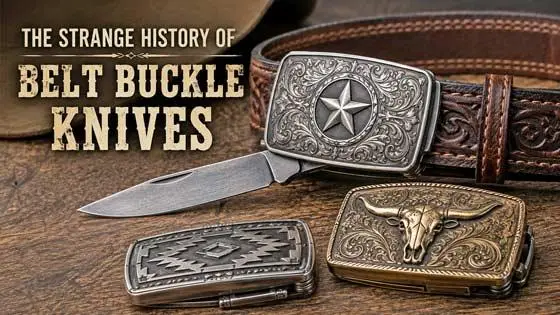
At first glance, a belt buckle seems like one of the least likely places to hide a knife. Yet for decades, inventive designers found ways to conceal small blades inside ordinary-looking buckles, creating one of history's most recognizable disguised weapons. Some were practical tools carried by outdoorsmen and travelers, while others became collectibles, novelty items, or symbols of rugged Western culture. Along the way, belt buckle knives developed a reputation that was often far more dramatic than their actual history. In this article, we'll uncover where belt buckle knives really came from, separate fact from fiction, and explore why these unusual concealed blades continue to fascinate collectors and knife enthusiasts today.
Why Someone Put a Knife Inside a Belt Buckle
The idea of hiding a knife inside a belt buckle may sound unusual today, but it grew from the same practical thinking that inspired many other concealed weapons throughout history. People have long looked for ways to carry useful tools without adding extra bulk or drawing unnecessary attention. Since nearly everyone already wore a belt, the buckle offered an unexpected place to hide a small blade while making use of an object that was always within reach.
Early belt buckle knives were never intended to replace full-sized hunting or fighting knives. Instead, they served as compact utility tools that could handle small cutting tasks or provide an emergency backup if a larger knife was unavailable. Their discreet design also appealed to people who appreciated clever engineering and multifunctional equipment, making them as much a conversation piece as a practical tool.
As concealed weapon designs became more sophisticated during the 20th century, inventors experimented with hiding blades inside all kinds of everyday objects. Belt buckles joined cane swords, disguised pens, and other ingenious hidden knives that blurred the line between ordinary accessories and concealed tools. While some designs proved genuinely useful, others were created simply because the engineering challenge captured people's imagination.
That combination of practicality, novelty, and craftsmanship explains why belt buckle knives have remained popular for generations. Even people who never intended to carry one often admired the cleverness behind transforming an everyday belt buckle into a functional concealed blade.
Did Cowboys Really Carry Belt Buckle Knives?
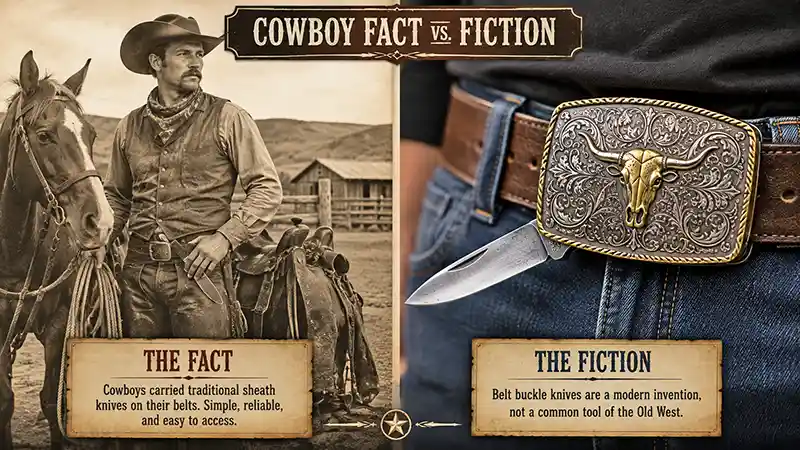
Belt buckle knives are so closely associated with Western imagery that many people assume they were common on the American frontier. The engraved silver buckles, longhorn designs, and rugged leather belts certainly look like they belong in an Old West saloon. However, there is little reliable evidence that cowboys routinely carried knives concealed inside their belt buckles.
Cowboys already relied on ordinary belt knives, pocketknives, and other visible tools that were easier to use and maintain. A complicated buckle mechanism offered few advantages when a conventional knife could be carried in a sheath. The large decorative Western buckle itself also became especially prominent through rodeo culture and later Western fashion, helping modern belt buckle knives acquire a frontier identity that was more stylistic than historical.
Surviving museum examples and documented belt buckle knife designs point much more strongly toward the modern era. One patented design from the early 1980s describes a folding knife secured directly inside a buckle, while museum collections preserve concealed buckle knives made from modern materials. These examples suggest that the familiar belt buckle knife is largely a 20th-century invention rather than a forgotten tool of frontier cowboys.
That does not make the design any less interesting. Like the elegant weapons explored in the strange history of cane swords, belt buckle knives succeeded because they transformed a familiar accessory into something unexpected. Their Western appearance may owe more to movies, rodeos, and modern collecting than authentic cowboy history, but that mythology became an important part of their story.
How Belt Buckle Knives Actually Work
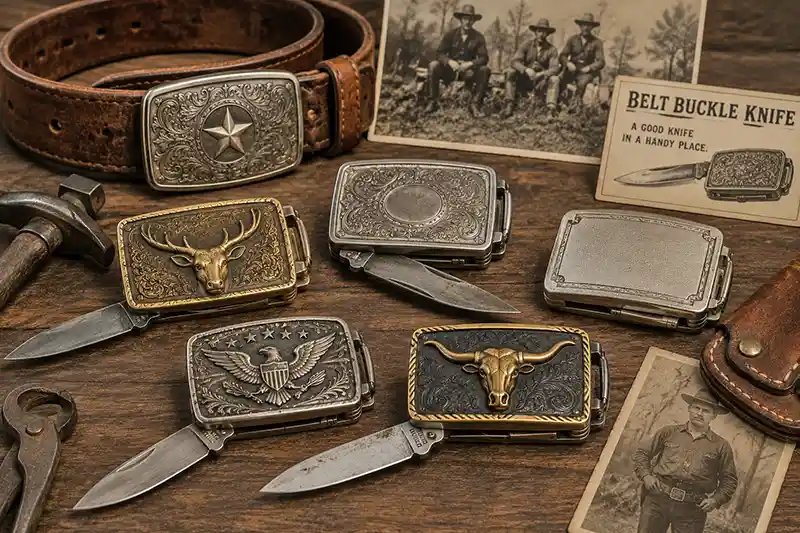
Belt buckle knives have been produced in several different styles, but most rely on the same basic idea: the buckle doubles as both a decorative faceplate and a secure holder for a compact blade. The knife remains locked against or inside the buckle until the wearer releases it using a latch, sliding mechanism, or pivoting mount.
Some designs use a small folding blade attached directly to the buckle. The blade swings outward much like a pocketknife, while a locking mechanism keeps it closed during normal wear. Other versions allow the entire knife to detach from the buckle, revealing a short handle hidden behind the decorative face. A few designs use removable cartridges or recessed channels that keep the blade almost completely concealed when viewed from the front.
Building a functional knife into a buckle creates several engineering challenges. The mechanism must remain thin enough to wear comfortably, strong enough to hold the belt securely, and resistant to opening accidentally. Designers also have to prevent the blade from rubbing against clothing or shifting as the wearer moves. These limitations explain why most belt buckle knives use relatively short blades and compact handles.
The mechanism is what separates a true belt buckle knife from an ordinary knife carried behind a decorative buckle. Like many other hidden weapons, its appeal comes from the way an everyday object performs a second, unexpected function. Even when the blade itself is simple, fitting it into a reliable wearable system requires surprisingly thoughtful design.
Why Belt Buckle Knives Took Off in the Late 20th Century
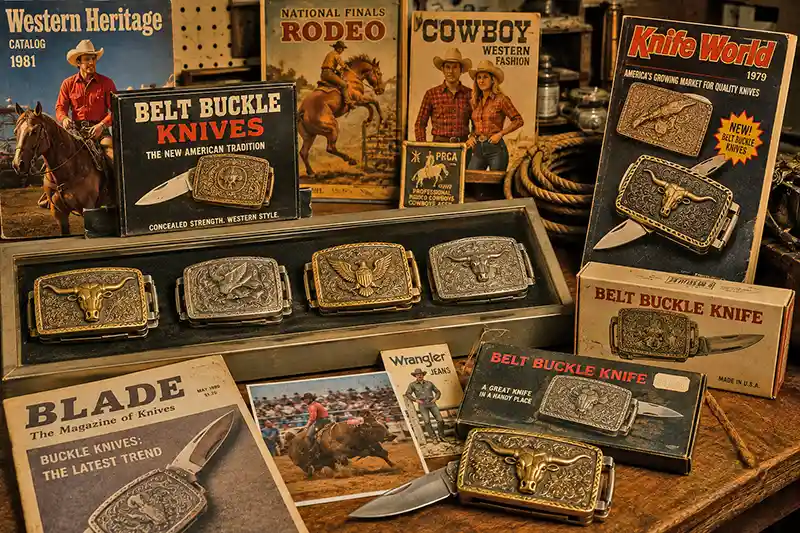
Although belt buckle knives are often marketed with Old West imagery, their real rise came much later. During the 1970s and early 1980s, American knife makers were experimenting with compact blades, unconventional carry systems, and products that doubled as conversation pieces. Patent records from this period document several buckle-mounted and belt-concealed knife designs, showing that inventors were actively refining the concept for a modern market.
The timing was ideal. Oversized decorative buckles had become closely associated with rodeos, motorcycle culture, country music, and Western fashion. By placing a small knife inside one, manufacturers could sell something that felt rugged and traditional while still appearing inventive. The buckle was useful, the blade was unexpected, and the combination was unusual enough to attract collectors even when they had little intention of carrying it regularly.
These knives also benefited from the era's enthusiasm for novelty gadgets and multifunctional gear. Products that concealed tools inside familiar objects felt clever and futuristic, especially before compact modern everyday carry weapons became widely available. Some belt buckle knives were marketed as practical backup tools, while others leaned heavily into engraved artwork, Western themes, and limited-edition collectibility.
By the 1980s, the belt buckle knife had developed an identity that blended Western nostalgia with modern mechanical design. It may not have originated on the frontier, but manufacturers understood that cowboy imagery gave it a story people immediately recognized. That carefully cultivated mythology helped turn a niche concealed knife into one of the most memorable novelty blades of the late 20th century.
From Novelty Item to Collector's Piece
As the popularity of belt buckle knives peaked during the late 20th century, many people began buying them less for everyday use and more for their unique appearance. Manufacturers responded by producing an incredible variety of designs, featuring everything from longhorn skulls and eagles to wildlife scenes, military emblems, Native American-inspired patterns, and intricate Western scrollwork. Limited production runs and commemorative editions quickly became favorites among collectors.
Unlike ordinary pocketknives, belt buckle knives were often displayed as much as they were carried. Many owners kept them in presentation boxes, showcased them alongside other knives, or added them to collections of Western memorabilia. Their appeal came from more than the blade itself. The artistry of the buckle was often just as important, turning each piece into a miniature work of functional metal craftsmanship.
Collectors also appreciate how belt buckle knives capture a unique moment in knife-making history. They represent an era when designers enthusiastically experimented with hiding tools inside everyday objects, producing some of the most inventive hidden blades and discreet tools ever sold to the public. While many of these products were marketed as practical, they also reflected the creativity and mechanical ingenuity that defined knife design during the 1970s and 1980s.
Today, vintage belt buckle knives continue to appear at antique stores, knife shows, estate sales, and online auctions. Whether admired as historical curiosities, collectible artifacts, or examples of clever engineering, they remain one of the most recognizable concealed knife designs ever produced.
Why Belt Buckle Knives Still Fascinate People Today
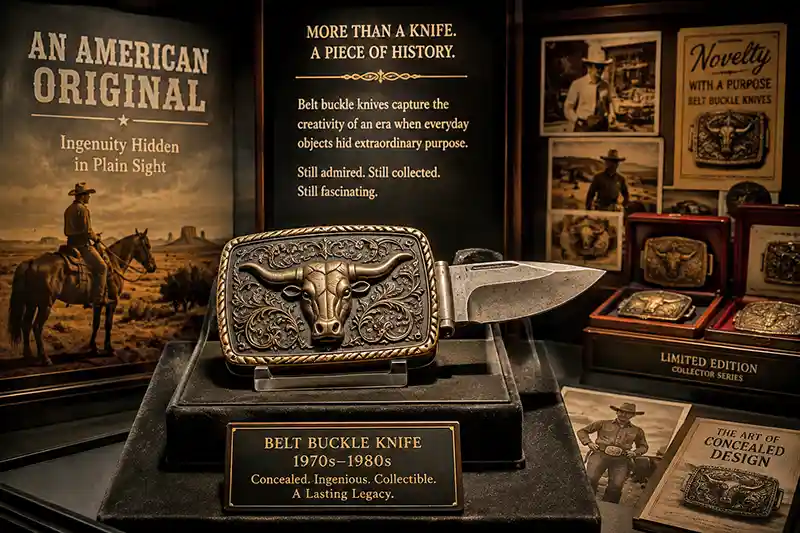
Most concealed weapons eventually fade into obscurity, remembered only by historians and collectors. Belt buckle knives have proven to be an exception. Decades after their popularity peaked, they continue to capture people's curiosity because they combine practical engineering with an element of surprise. Even someone with no interest in knives often pauses to admire the ingenuity of hiding a functional blade inside an ordinary belt buckle.
Part of their lasting appeal comes from the stories surrounding them. Movies, television shows, Western culture, and collector folklore have all helped blur the line between historical fact and popular myth. As a result, many people assume belt buckle knives were common on the American frontier when they were actually products of a much later era. Separating those myths from reality only makes their true history more interesting.
Belt buckle knives also represent a broader fascination with concealed design. Whether it's a cane sword, a disguised pen knife, or one of the many ingenious hidden weapons that could save your life, people have always been intrigued by ordinary objects that secretly serve another purpose. Belt buckle knives stand as one of the most recognizable examples of that enduring idea.
Although they're no longer a mainstream product, vintage examples remain highly collectible and modern versions continue to be produced for enthusiasts who appreciate their unique blend of craftsmanship, history, and mechanical creativity. Few concealed knives have earned such an enduring place in popular culture, proving that sometimes the most memorable designs are also the most unexpected.
Were belt buckle knives really used in the Old West?
There is little reliable evidence that belt buckle knives were commonly carried by cowboys or frontiersmen. Most people on the American frontier relied on ordinary sheath knives and pocketknives because they were simpler, stronger, and easier to use. The Western identity of belt buckle knives developed much later through rodeo culture, decorative buckles, movies, and late-20th-century marketing.
Why are most belt buckle knives so small?
The size of a belt buckle naturally limits how large the blade can be. Designers had to fit a functional knife inside a buckle that remained comfortable to wear, securely fastened a belt, and didn't look unusually bulky. As a result, most belt buckle knives feature short blades intended for light utility work or as backup tools rather than replacing a full-sized knife.
Were belt buckle knives ever issued to the military?
No major military has ever adopted belt buckle knives as standard-issue equipment. While a few specialty or novelty versions have been marketed with military styling, armed forces have traditionally preferred fixed-blade knives and folding knives that are stronger, easier to access, and better suited for field use. Belt buckle knives remained primarily commercial products, valued more for their clever concealed design than for widespread military practicality.
Are belt buckle knives legal to own?
The answer depends entirely on where you live. Laws regarding belt buckle knives vary between countries, states, and local jurisdictions, and some places classify them as concealed or disguised weapons. Before purchasing, carrying, or collecting a belt buckle knife, it's important to review the laws that apply in your area to ensure you remain in compliance with local regulations.
What's the difference between a belt buckle knife and a buckle knife?
The terms are often used interchangeably, but they can describe slightly different designs. A belt buckle knife is built into or attached directly to a wearable belt buckle, allowing it to function as part of a belt. A buckle knife may refer more broadly to any knife incorporated into a buckle-like design, including novelty or collectible versions that are not intended to be worn. In everyday conversation, however, most people use both terms to describe the same type of concealed knife.
You May Also Be Interested In:
- The Strange History of the Tomahawk
- The Strange History of the Blackjack
- The Strange History of the Push Dagger
- The Strange History of Cane Swords
- The Real History of the Balisong: How Butterfly Knives Evolved Through Time
- Why Are Throwing Knives Shaped Differently From Regular Knives?
- Why Trench Knives Became the Most Feared Knives of World War I
- The History and Evolution of the Karambit Knife
- History and Evolution of Self-Defense Keychains
- What Is a Push Dagger? History, Design, and Modern Uses
Leave a Reply