





The Most Clever Hidden Knives Ever Invented
August 5th, 2026
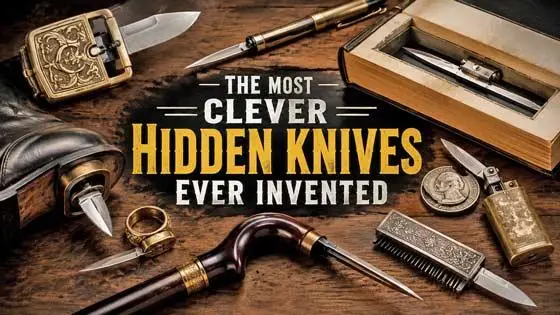
Some knives were never meant to be seen until the exact moment they were needed. Hidden inside belt buckles, walking canes, boots, books, pens, and even everyday pocket items, these ingenious designs blurred the line between ordinary objects and concealed weapons. While some were created for espionage, others were built for personal protection, military use, or simple novelty, but all of them reveal just how far inventors have gone to hide a blade in plain sight. In this article, we'll uncover the fascinating stories behind some of the most clever hidden knives ever invented and explore why these unusual designs continue to capture the imagination of collectors and history enthusiasts alike.
Hidden Knives Are Much Older Than Most People Think
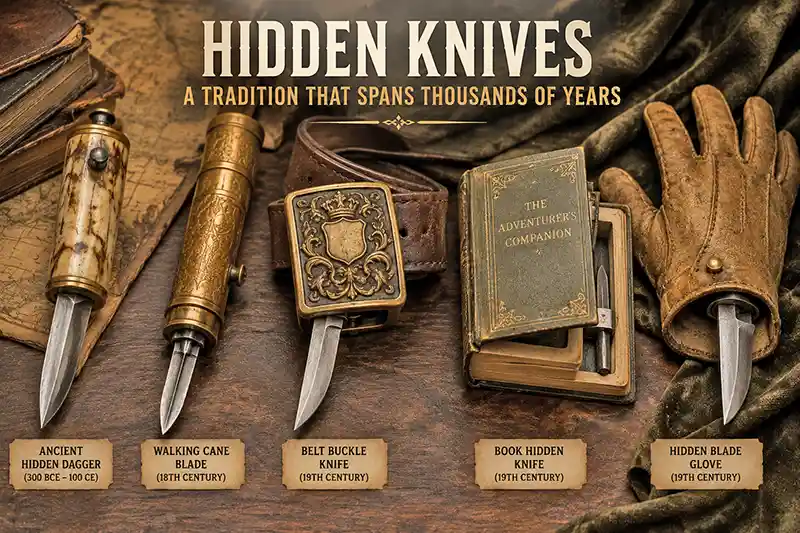
When people think of hidden knives, they often imagine modern spy gadgets or clever self-defense tools sold in novelty shops. In reality, the idea of disguising a blade is thousands of years old. Throughout history, people have concealed knives inside ordinary objects for reasons ranging from personal protection to political intrigue and military survival.
Some of the earliest concealed blades appeared in ancient civilizations, where small knives were hidden beneath robes, tucked into walking staffs, or carried inside everyday tools. A visible sword could draw unwanted attention, but a hidden blade offered a discreet way to defend yourself without appearing armed. Merchants traveling dangerous roads, nobles navigating political rivalries, and ordinary citizens living under weapon restrictions all found value in weapons that stayed out of sight until they were absolutely needed.
As craftsmanship improved, so did the creativity of these hidden designs. Metalworkers began disguising knives inside canes, belt buckles, hair accessories, and other seemingly harmless objects. Some were practical survival tools, while others were ingenious mechanical creations designed as much to impress as to protect. These early inventions laid the foundation for many of the concealed knives that would become famous centuries later.
Today, hidden knives continue to fascinate collectors because they combine history, engineering, and craftsmanship into a single object. Every concealed blade tells a story, not just about the knife itself, but about the people who carried it and the world that inspired its creation.
The Belt Buckle Knife Hid a Blade in Plain Sight
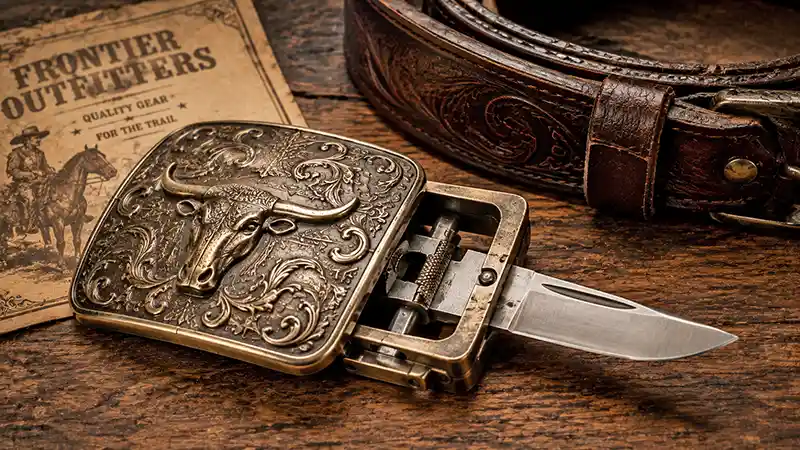
Few concealed weapons are as immediately fascinating as the belt buckle knife. At first glance, it looks like an oversized decorative buckle, often covered with western designs, engraved metalwork, or bold symbols. Hidden behind that ornament, however, is a compact blade designed to slide, pivot, or detach from the buckle itself.
The appeal was simple. A belt was already part of everyday clothing, so turning the buckle into a concealed sheath allowed the wearer to carry a knife without adding another visible object to the body. Unlike a boot knife or sleeve dagger, it did not require loose clothing or a specialized harness. The weapon was built directly into something almost everyone wore.
Belt buckle knives became especially associated with the American West, although many of the versions sold today are modern interpretations rather than authentic frontier weapons. Their engraved buckles, brass finishes, and cowboy imagery created such a convincing connection to the Old West that the design eventually developed a history of its own. Whether carried as a novelty, collectible, or discreet backup blade, the belt buckle knife became one of the most recognizable forms of hidden knife ever created.
What makes the design so clever is the way it uses expectation as camouflage. People naturally notice a large belt buckle, but they rarely assume it contains anything beyond decoration. The weapon is not hidden because it is invisible. It is hidden because it looks exactly like something ordinary.
Book Knives and Other Weapons Hidden in Everyday Objects
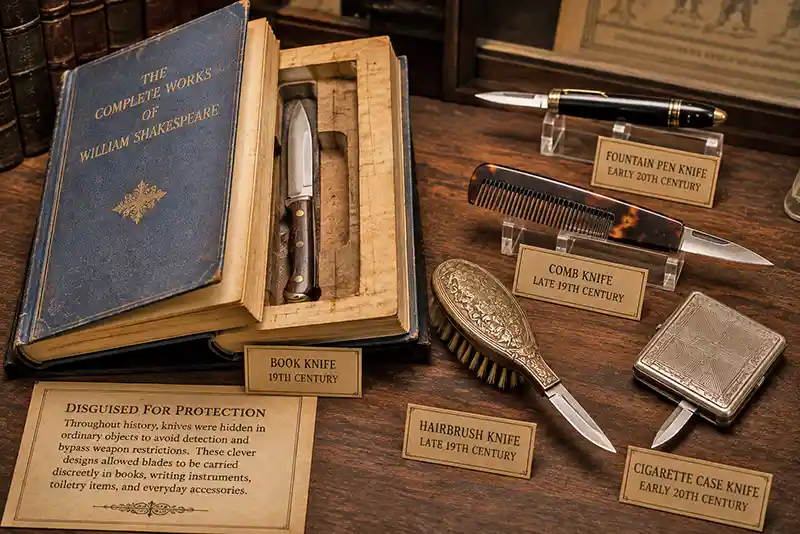
Long before modern spy movies popularized disguised weapons, inventors were finding clever ways to hide knives inside ordinary objects that rarely attracted suspicion. Books, pens, hairbrushes, combs, and even walking sticks were all transformed into secret hiding places for compact blades. The goal was never to make the knife invisible. It was to make people overlook it completely.
One of the most ingenious examples was the book knife. From the outside, it appeared to be an ordinary hardcover book sitting on a shelf or tucked into a satchel. Inside, however, a carefully carved compartment concealed a small knife that could be accessed in seconds. Whether intended for personal protection, espionage, or simple novelty, the design demonstrated how everyday objects could become surprisingly effective hiding places.
Inventors continued experimenting with countless disguises throughout the 19th and 20th centuries. Some concealed blades were built into fountain pens, while others were hidden inside combs, cigarette cases, or decorative desk accessories. Many of these inventions were never widely adopted, but they reflected an enduring fascination with combining practical craftsmanship and deception into a single object.
Today, these unusual designs are prized by collectors because they represent far more than hidden blades. They are snapshots of an era when clever engineering and subtle concealment often mattered more than the size of the weapon itself. Many of the same ideas can still be seen in modern hidden weapons, where everyday objects continue to inspire innovative methods of discreet carry.
Cane Swords Turned a Gentleman's Accessory Into a Secret Weapon
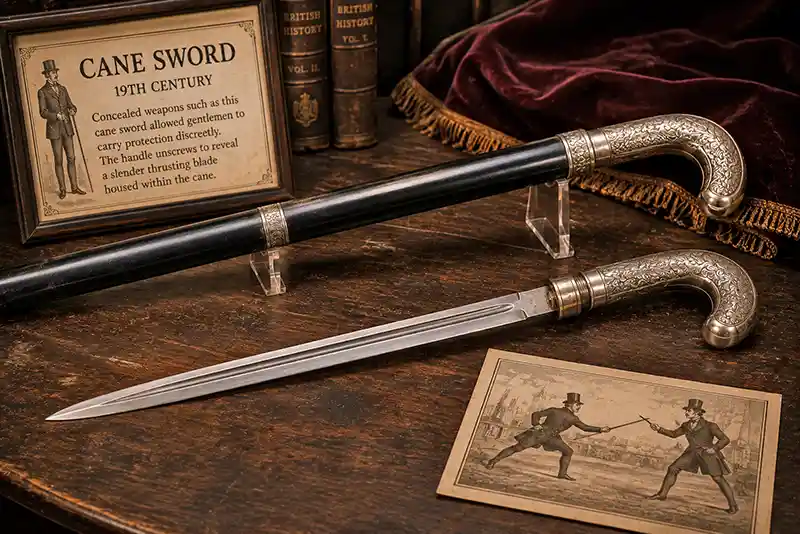
For centuries, a walking cane was more than a mobility aid. It was a symbol of status, refinement, and social position. That made it the perfect disguise for a concealed blade. A gentleman could carry a cane almost anywhere without attracting suspicion, even when the shaft contained a narrow sword hidden beneath the handle.
The concept was brilliantly simple. The cane's outer body acted as a sheath, while the handle served as the sword's grip. With a quick pull, the two pieces separated and revealed a slim blade designed for thrusting rather than heavy cutting. Some examples were plain and practical, while others featured silver handles, carved wood, engraved fittings, and luxurious materials that made them look more like fashion accessories than weapons.
Cane swords became especially fashionable in Europe during periods when carrying a visible sword was becoming less socially acceptable. They allowed nobles, travelers, and wealthy civilians to retain a measure of protection without appearing openly armed. Their popularity also reflected a changing world in which personal weapons were becoming smaller, more discreet, and easier to blend into everyday life.
Modern self-defense canes usually rely on strong construction, reinforced handles, or tactical design rather than concealed blades, but the underlying idea remains similar. A familiar object can provide protection without immediately announcing itself as a weapon. For readers interested in the practical side of the concept, our guide to the best canes for self-defense explores how today's designs differ from their more secretive ancestors.
Boot Knives Made Concealment Simple
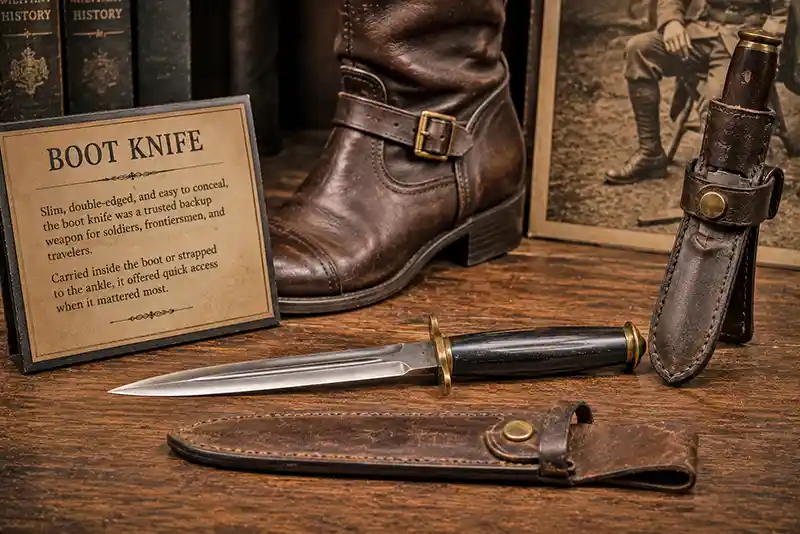
Not every hidden knife needed an elaborate mechanism. Sometimes the most effective design was simply a compact blade placed where few people would think to look. That was the logic behind the boot knife, a narrow fixed blade carried inside a tall boot, strapped to the ankle, or tucked beneath a trouser leg.
Boot knives became popular because they were easy to access while remaining mostly hidden from view. Soldiers, frontiersmen, gamblers, and travelers could carry one as a backup weapon without relying on a complicated sheath or disguised handle. The boot itself provided both concealment and support, keeping the knife close to the body while freeing the belt for larger tools or weapons.
The best examples were slim, double-edged, and designed for thrusting. Their compact size made them easier to hide than a conventional fighting knife, but it also meant they were usually intended as a last resort rather than a primary weapon. In dangerous environments, that hidden backup could make the difference between being disarmed and still having one option left.
The same principle survives in other compact carry designs today. A neck knife, for example, uses a small blade and an unconventional carry position to remain accessible without occupying a pocket or belt sheath. The details have changed, but the appeal is much the same: keep a useful blade close without making it the first thing anyone notices.
Ring Knives, Pen Knives, and Tiny Blades With Big Ideas
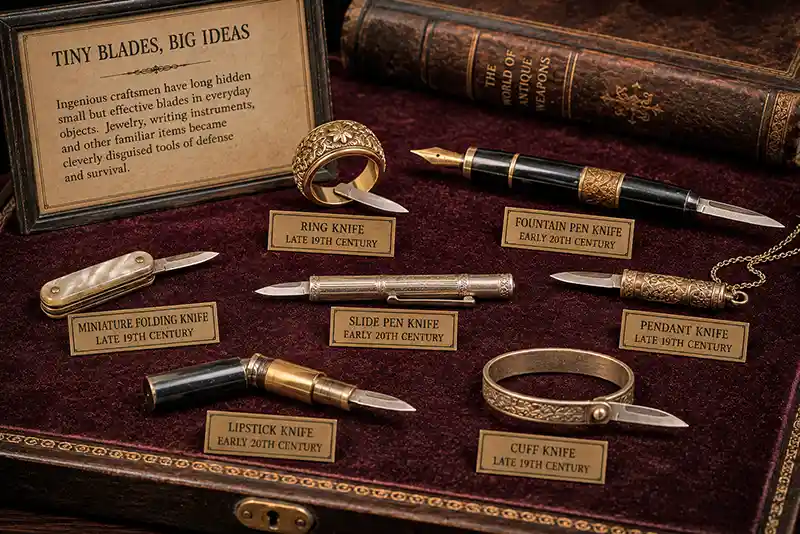
Some of the most ingenious hidden knives were also the smallest. Rather than concealing a full-sized blade, inventors focused on creating miniature weapons that could disappear into jewelry, writing instruments, or other everyday accessories. These tiny designs sacrificed reach and power in exchange for exceptional concealment, proving that cleverness often mattered more than size.
Ring knives are among the most unusual examples. At first glance, they resemble oversized decorative rings worn on a finger. With a quick movement, however, a tiny blade folds or pivots outward, transforming an ordinary-looking piece of jewelry into a functional cutting tool. While many surviving examples were produced as curiosities or collector's pieces, the concept demonstrated just how creative weapon designers could become when concealment was the primary goal.
Pen knives followed a similar philosophy. Although the term originally referred to the small folding knives once used for sharpening quill pens, later inventors took the idea much further by building actual blades inside fountain pens and other writing instruments. These disguised designs were often associated with espionage stories and detective fiction, even if relatively few saw widespread practical use.
Today, miniature concealed knives remain popular largely because of their craftsmanship and ingenuity. Collectors appreciate the precision required to fit a working blade inside an object no one would suspect, while modern enthusiasts often prefer practical alternatives found among today's everyday carry (EDC) weapons, where compact size and discreet carry are still highly valued without relying on elaborate disguises.
Hidden Knives Found Their Way Into Espionage and Special Operations
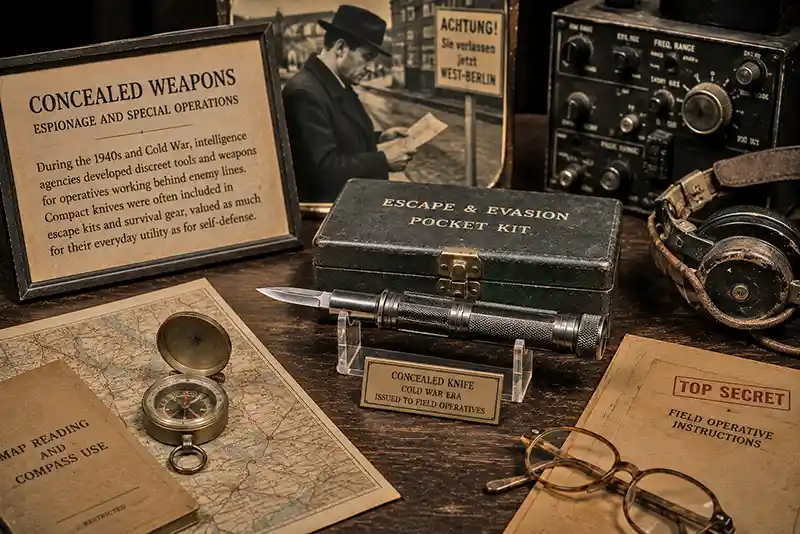
Few subjects have fueled more myths than concealed weapons in the world of espionage. Popular culture often portrays spies carrying elaborate gadgets with hidden blades tucked inside umbrellas, fountain pens, or briefcases. While many of those fictional inventions were exaggerated for dramatic effect, intelligence agencies and special operations units have experimented with discreet weapons throughout history when secrecy was more valuable than firepower.
During the Second World War and throughout the Cold War, specialized equipment was developed for agents operating behind enemy lines. Escape-and-evasion kits sometimes included compact knives that could be hidden inside clothing or survival gear, allowing operatives to cut restraints, prepare food, or perform countless everyday tasks without carrying a large, obvious blade. In many cases, the knife's utility proved far more valuable than its use as a weapon.
Some of the most inventive concealed designs never made it beyond the prototype stage, while others became collector's items because of their unusual engineering rather than widespread military adoption. The stories surrounding these devices have only added to their mystique, inspiring generations of books, films, and collectors fascinated by the intersection of craftsmanship, secrecy, and survival.
Today, the fascination continues because hidden knives represent more than clever disguises. They embody the idea that preparation often depends on subtlety rather than size. Many people looking for practical options now choose modern hidden blades and discreet tools that emphasize compact design and everyday utility instead of elaborate concealment, reflecting how the concept has evolved for the modern era.
Hidden Knives Haven't Disappeared, They've Evolved
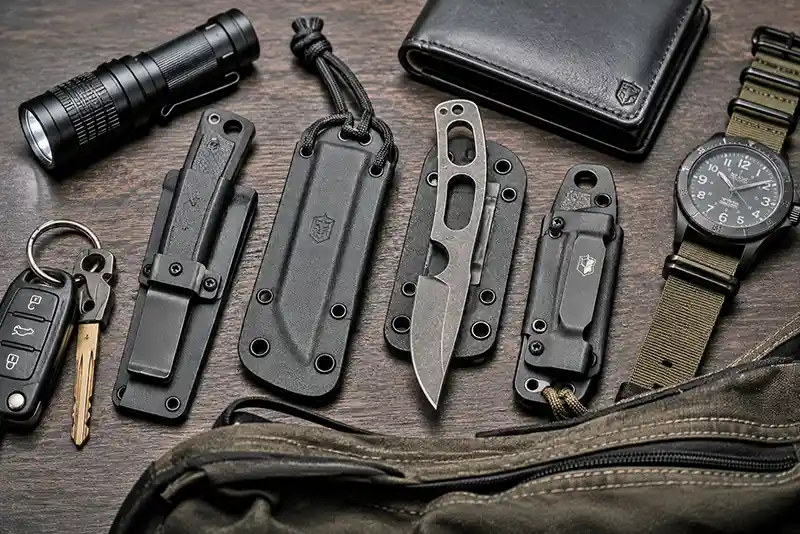
While antique cane swords and belt buckle knives capture the imagination, most modern concealed knives are designed with practicality rather than deception in mind. Advances in materials, manufacturing, and carry systems have shifted the focus away from elaborate disguises and toward compact, lightweight knives that are easy to carry every day without attracting unnecessary attention.
Today's concealed knives often feature slim profiles, low-profile sheaths, skeletonized handles, and discreet mounting systems that keep them comfortably hidden beneath clothing or attached inside a pocket. Instead of pretending to be another object, they simply minimize their footprint while remaining quick to access when needed. This approach has made them popular among outdoor enthusiasts, collectors, and people who appreciate thoughtfully designed self-defense weapons for lawful everyday carry.
The same philosophy extends to many modern self-defense blades. Designers prioritize comfort, reliability, and ease of carry over mechanical gimmicks, recognizing that a well-designed knife is often more useful than one hidden inside an elaborate disguise. The result is a new generation of compact blades that borrow the spirit of historical concealed weapons without trying to imitate them exactly.
Whether hidden inside a Victorian walking cane or carried discreetly in a modern sheath, the underlying idea has remained remarkably consistent for centuries. The most successful concealed knives are not the ones with the most complicated mechanisms. They are the ones that balance accessibility, portability, and thoughtful design in a way that fits naturally into everyday life.
Why Hidden Knives Continue to Fascinate Collectors
Most hidden knives were never the fastest, strongest, or most practical blades ever made. Their lasting appeal comes from something far more interesting: the ingenuity behind their design. Every concealed knife represents a creative solution to the same challenge that craftsmen have faced for centuries. How do you hide a useful tool in plain sight without sacrificing its function?
That question produced an astonishing variety of inventions. Some designers hid blades inside belt buckles, books, canes, combs, and pens. Others experimented with jewelry, walking sticks, or compact backup knives that could be carried almost anywhere. Whether they succeeded or not, each design reflects a unique blend of engineering, craftsmanship, and imagination that continues to capture the attention of collectors today.
Many enthusiasts enjoy hidden knives because they offer a glimpse into history rather than simply adding another blade to a collection. A Victorian cane sword tells a story about changing fashions. A boot knife hints at life on the frontier. A disguised pen knife recalls an era fascinated by espionage and mechanical innovation. Each piece provides a small window into the people and cultures that created it.
Modern collectors are just as likely to appreciate practical designs as elaborate disguises. Compact fixed blades, discreet carry systems, and thoughtfully designed everyday tools all continue the tradition in their own way. Whether you're interested in historical curiosities or modern craftsmanship, the world of concealed blades remains one of the most creative corners of knife collecting. The designs may have changed, but the fascination with carrying a blade that's hidden in plain sight shows no sign of disappearing.
Were hidden knives actually used by spies?
Popular culture has greatly exaggerated the role of hidden knives in espionage, but discreet blades were used by some intelligence agencies and special operations units. During World War II and the Cold War, compact knives were sometimes included in escape-and-evasion kits because they were useful for cutting rope, preparing food, repairing equipment, and other survival tasks. While elaborate "spy gadgets" were often fictional, practical concealed knives did play a small role in real covert operations.
Are belt buckle knives historical weapons or modern inventions?
Both. Concealed knives built into belt buckles have existed for well over a century, although many of the ornate western-style versions seen today are modern interpretations. Early designs focused on discreet carry, while later models became popular as collectibles, novelty items, and backup knives. Their unique combination of everyday function and hidden utility has made them one of the most recognizable concealed knife designs ever created.
Why were cane swords eventually banned in many places?
Cane swords became controversial because they combined the appearance of an ordinary walking cane with the concealment of a hidden weapon. As governments introduced laws regulating concealed weapons during the 19th and early 20th centuries, many jurisdictions specifically restricted or prohibited cane swords. While legitimate walking canes remain common today, modern self-defense canes are typically designed as sturdy impact tools rather than disguised swords, making them legal in many places where concealed blades are not.
What is the difference between a hidden knife and a disguised knife?
Although the terms are often used interchangeably, there is a subtle difference. A hidden knife is any blade carried out of sight, such as a boot knife or neck knife concealed beneath clothing. A disguised knife goes a step further by making the knife appear to be an entirely different object, such as a belt buckle, pen, book, or walking cane. Every disguised knife is hidden, but not every hidden knife is disguised.
Are hidden knives still made today?
Yes, although most modern designs focus on discreet carry rather than elaborate disguises. Instead of hiding blades inside everyday objects, today's manufacturers typically produce compact fixed blades, neck knives, and other low-profile hidden knives that are comfortable to carry and easy to access. Modern designs generally prioritize practicality, reliability, and ergonomics over novelty, reflecting how concealed knife technology has evolved over time.
Which hidden knife design is the most famous?
There is no single answer, but a few designs have become especially iconic. Belt buckle knives, cane swords, boot knives, and pen knives are among the best-known concealed blades because each represents a different approach to hiding a weapon in plain sight. Their appearances in historical accounts, museums, films, and popular culture have helped cement their reputation, making them some of the most recognizable hidden knife designs ever created.
Did any famous historical figures carry hidden knives?
Although it is difficult to prove exactly who carried concealed knives, historical records show that nobles, military officers, travelers, gamblers, and even some law enforcement officials carried discreet blades at various times. Cane swords were especially popular among wealthy gentlemen during the 18th and 19th centuries, while compact boot knives became common on the American frontier. The secrecy surrounding concealed weapons means many individual users were never documented, adding to their enduring mystery.
What is the rarest type of hidden knife?
Some of the rarest concealed knives are those disguised as everyday objects that were produced in very limited numbers, such as ring knives, book knives, lipstick knives, and fountain pen knives. Many were handmade by skilled craftsmen rather than mass-produced, making surviving examples highly sought after by collectors today. Their rarity often comes from exceptional craftsmanship rather than military or commercial use.
Were hidden knives ever designed as escape tools?
Yes. Some compact concealed knives were created primarily as survival and escape tools rather than fighting weapons. Small blades hidden inside clothing, survival kits, or personal gear could be used to cut rope, slice fabric, prepare food, or make emergency repairs. Their greatest value often came from their utility, not their ability to serve as weapons.
Why do collectors pay so much for antique hidden knives?
Collectors are often drawn to concealed knives because they combine history, mechanical ingenuity, and skilled craftsmanship. A well-made belt buckle knife or cane sword tells a story about the era in which it was created, while its hidden mechanism showcases the creativity of its maker. Rare examples in excellent condition can command high prices because they are both historical artifacts and remarkable feats of engineering.
You May Also Be Interested In:
- The Most Ingenious Hidden Weapons Ever Invented
- Why Were Nunchucks Actually Invented? (The Real History Might Surprise You)
- Hidden Weapons That Could Save Your Life!
- Hidden Blades and Discreet Tools for Subtle Self Defense
- Hidden Sword Battle Stick and Other Combat Weapons
- Why Are Throwing Knives Shaped Differently From Regular Knives?
- Why Trench Knives Became the Most Feared Knives of World War I
- Why Automatic Knives Belong in Your EDC
- OTF vs Folding Knives: What's the Difference and Which Is Better?
- Can Butterfly Knives be used for Combat?
Leave a Reply