




The Most Brutal Weapons Ever Designed for Close Combat
August 11th, 2026
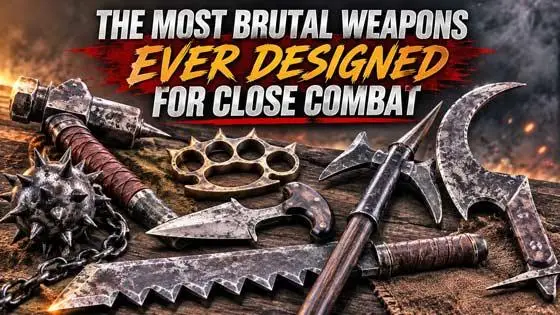
Most weapons give you at least a little distance from the person trying to kill you. The weapons in this article were built for the moment when that distance disappeared. They were made for cramped trenches, crowded ship decks, narrow castle corridors, chaotic streets, and brutal hand-to-hand fighting where hesitation could be fatal. Some crushed armor. Others punched through it. A few were deliberately designed to trap, tear, or overwhelm an opponent before they could react. From vicious trench weapons to medieval designs that look almost too brutal to be real, these are the close combat weapons created for fighting at the most terrifying distance of all: arm's reach.
The Trench Club: Built for the Nightmare of Hand-to-Hand Fighting
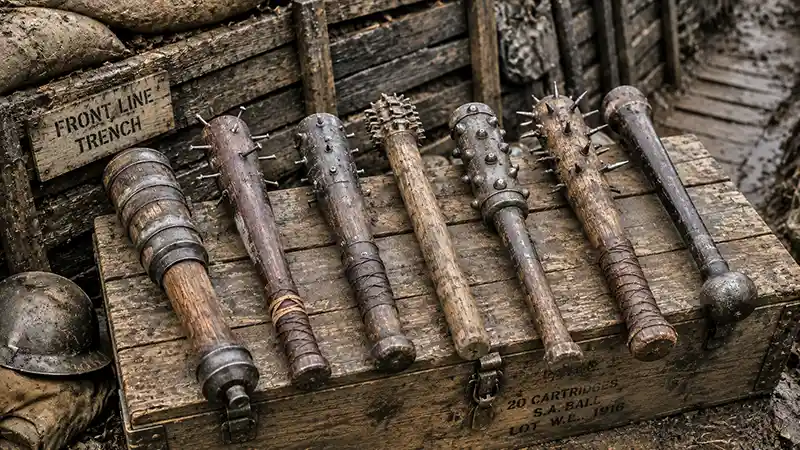
When soldiers climbed into an enemy trench during World War I, a full-length rifle could suddenly become more burden than advantage. Trenches were narrow, crowded, dark, and filled with sharp turns where an opponent might appear only a few feet away. Soldiers needed something compact, fast, and devastating at arm's reach. One of the simplest answers was also one of the most brutal: the trench club.
Unlike standardized military rifles and bayonets, trench clubs were often made locally or improvised by soldiers themselves. Some were little more than heavy wooden clubs. Others were reinforced with metal bands, lead weights, hobnails, spikes, or gear-shaped steel heads. Certain examples resembled medieval maces so closely that they looked as though they had been pulled from an armory hundreds of years earlier.
Their simplicity was part of what made them so effective. A trench club required no ammunition, had virtually nothing that could malfunction, and was short enough to swing in confined spaces. During nighttime trench raids, where surprise and silence could matter enormously, it also offered something a gunshot could not.
The weapon's return during an era of machine guns and artillery revealed something disturbing about modern warfare. Technology had transformed battlefields beyond recognition, yet once opposing soldiers were forced into the same narrow trench, combat could become almost medieval again.
Trench clubs eventually disappeared as the conditions that created them faded, but their legacy survived alongside other specialized close-quarters weapons. The same brutal environment also produced some of the most feared trench knives of World War I, giving soldiers compact weapons for moments when fighting became frighteningly personal.
The Katar: A Dagger Designed to Turn the Fist Into a Blade
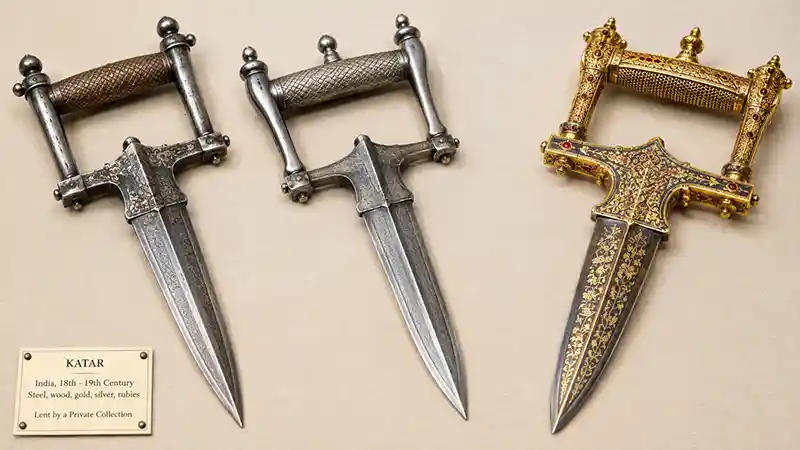
Most daggers extend from the hand in roughly the same direction as a sword. The Indian katar took a completely different approach. Its blade projected directly forward from a horizontal grip held inside a distinctive H-shaped frame, allowing the wielder to deliver a thrust with a punching motion rather than a conventional stabbing motion.
That unusual geometry made the katar one of history's most recognizable close-combat weapons. The side bars helped stabilize the weapon against the forearm, while the transverse grip placed the blade directly in line with the user's fist. Instead of relying primarily on wrist strength, a forceful thrust could put the arm and shoulder behind the point.
Katars appeared in numerous forms across the Indian subcontinent. Some were relatively simple fighting daggers, while others became extraordinary prestige weapons covered in gold decoration and intricate engraving. There were broad-bladed examples, narrow armor-piercing versions, and elaborate ceremonial katars carried by members of the nobility.
One particularly intimidating variation used a reinforced point and rigid blade intended for powerful thrusts against armored opponents. Indian armor could include mail and textile defenses, so concentrating force onto a strong point offered an obvious advantage when fighting at extremely close range.
The basic concept survives today in a different family of weapons. Modern push daggers use the same fundamental idea of positioning a blade perpendicular to the handle so it projects from the fist. The designs may be separated by centuries and continents, but the brutal logic behind them is remarkably similar: when there is almost no room between two opponents, turn the natural punching motion of the arm into the driving force behind the blade.
The Goedendag: A Club Built to Smash and Stab
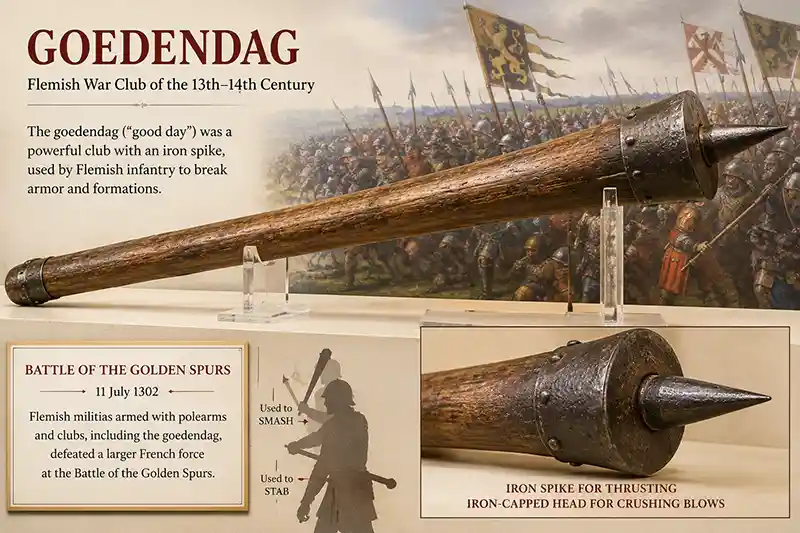
The name sounds almost friendly. In Dutch, "goedendag" means "good day." The weapon carrying that name was anything but. Used by Flemish infantry during the late Middle Ages, the goedendag combined the crushing force of a heavy club with the concentrated point of a short spear.
A typical goedendag consisted of a thick wooden shaft that widened toward the striking end, where it was reinforced with an iron cap and a stout metal spike. This gave its wielder two very different options at extremely close range. The heavy body could deliver powerful clubbing blows, while the spike could be driven forward in a thrust.
Its most famous appearance came during the conflict between Flemish forces and France in the early 14th century. At the Battle of the Golden Spurs in 1302, Flemish infantry famously defeated an army containing large numbers of French knights. Polearms played an important role in the victory, and the goedendag became closely associated with the Flemish citizen militias who fought there.
What makes the weapon particularly interesting is its lack of sophistication. There were no complicated moving parts, elaborate blade geometry, or expensive mechanisms. It was essentially a reinforced piece of hardwood with enough weight to strike hard and enough steel at the end to make a thrust dangerous.
That simplicity made perfect sense for infantry fighting armored opponents at close range. Once a mounted knight had been brought down or a formation collapsed into hand-to-hand combat, a compact weapon capable of both heavy impacts and powerful thrusts became frighteningly practical. The goedendag looked crude because it was crude, but that may have been exactly why it worked so well.
The War Hammer: Built to Defeat Armor Without Cutting Through It
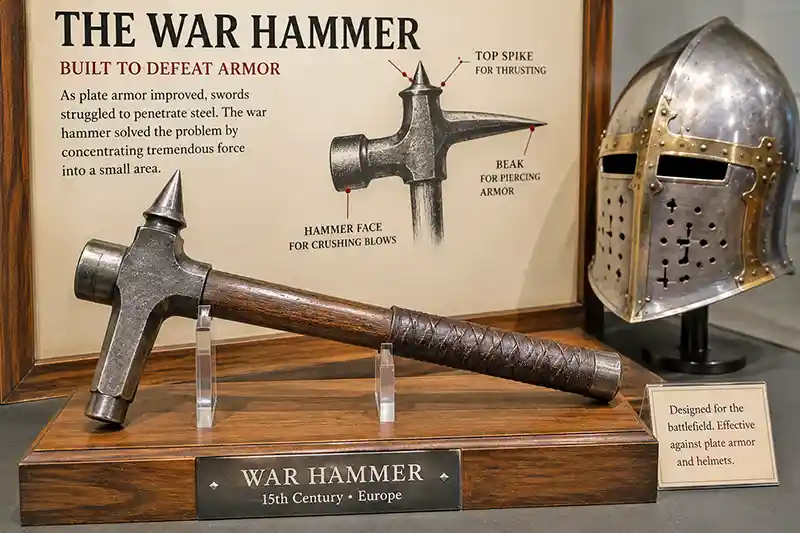
As plate armor improved during the late Middle Ages, the battlefield created a frustrating problem for anyone carrying a sword. A sharp blade could be devastating against an unarmored opponent, but striking hardened steel was another matter entirely. Rather than trying to slice through armor, the war hammer attacked it in a much simpler way: concentrate tremendous force onto a very small area.
Most fighting war hammers were far more compact than the enormous fantasy versions seen in movies and video games. A typical example featured a relatively small hammer face on one side and a narrow spike or beak on the other. That compact head allowed the weapon to be swung quickly while concentrating the impact instead of spreading it across a broad surface.
The hammer face could deliver crushing trauma even when armor prevented direct penetration. The pointed beak offered another option, focusing the energy of the strike onto an even smaller point. Against helmets and other armored surfaces, that combination made the war hammer particularly well suited to the increasingly heavily protected battlefields of medieval Europe.
Some versions also incorporated a spike at the top, giving the wielder another point for thrusting at extremely close range. Longer two-handed forms existed as well, but the compact one-handed war hammer was particularly nasty when fighting had collapsed into a chaotic melee.
What makes the war hammer so brutal is that it was essentially an answer to one question: what do you do when your opponent has covered himself in steel? Instead of building a bigger sword, medieval weapon makers created something that did not need to cut through armor at all.
The Morning Star: A Mace Made Even More Intimidating
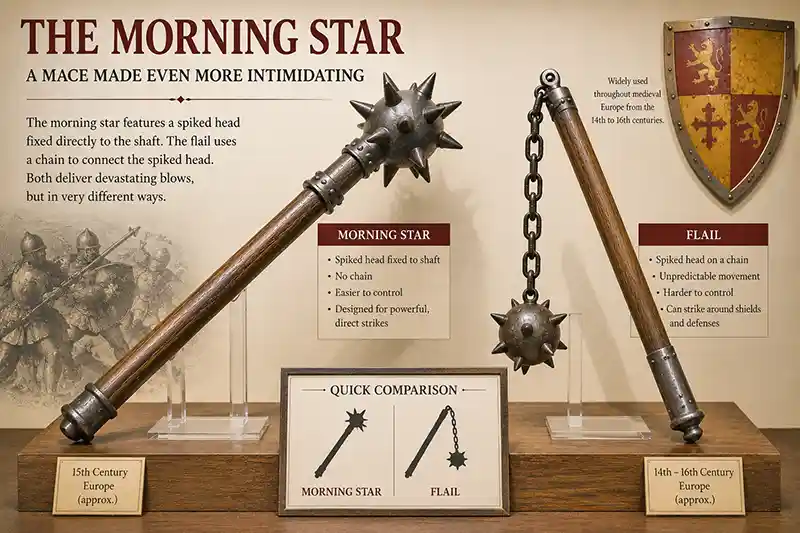
The mace was already a formidable close-combat weapon. Medieval weapon makers found a way to make it look even worse. Instead of a smooth or flanged metal head, the morning star surrounded its striking surface with heavy iron spikes, creating one of the most instantly recognizable weapons of the Middle Ages.
Despite being frequently confused with the flail, a true morning star generally had its spiked head fixed directly to a wooden or metal shaft. There was no chain between the handle and the striking head. That rigid construction made it much easier to control than a chained weapon while still delivering tremendous concentrated force.
The spikes were not simply decorative. A smooth club spreads much of its impact across the surface it strikes. The projecting points of a morning star concentrated portions of that force into much smaller areas. Against lighter protection, the result could be devastating, while heavier armor still had to absorb the tremendous impact of the weapon itself.
Morning stars appeared in several forms across medieval and early modern Europe. Some were relatively compact one-handed weapons, while larger two-handed versions placed a heavily spiked head on a longer shaft. Historical examples also varied considerably in how many spikes they carried and how those spikes were arranged.
Its appearance has become so exaggerated by fantasy that authentic examples can almost seem surprisingly restrained. Medieval fighters did not need a gigantic iron ball covered with dozens of enormous spikes. A manageable weapon that could be swung quickly, recovered after a strike, and used repeatedly at close range was far more practical.
That practicality may be what makes the morning star genuinely frightening. Beneath its almost theatrical appearance was a straightforward close-combat weapon designed around one brutal idea: put a series of hardened points exactly where a heavy mace would otherwise land.
The Bec de Corbin: A Medieval Can Opener for Armor
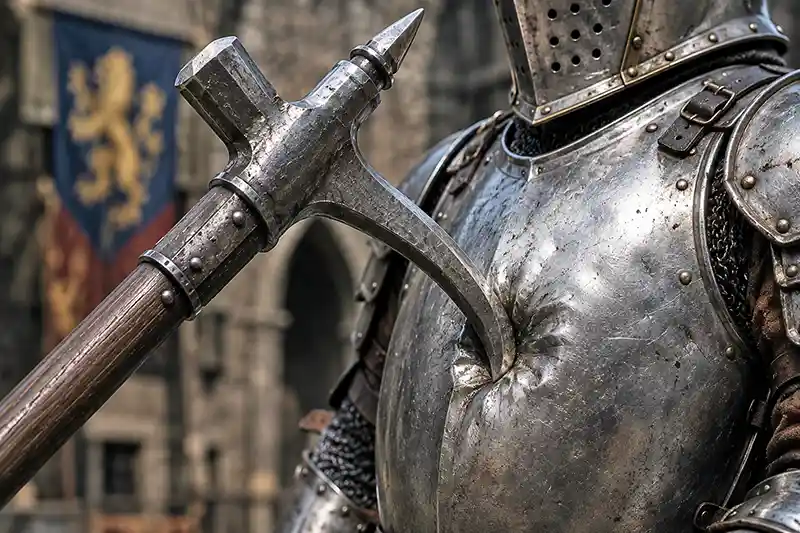
The name bec de corbin means "raven's beak," and one look at the weapon explains why. Its defining feature was a long, curved steel beak designed to concentrate the force of a swing onto an extremely small point. Against an opponent protected by plate armor, that was exactly what a close-combat weapon needed to do.
Rather than attempting to slice through hardened steel, the bec de corbin attacked armor with concentrated impact. A typical example combined the curved beak with a hammer face on the opposite side, giving the wielder two very different striking surfaces. Some versions also incorporated a spike projecting from the top of the head.
The weapon belonged to the same brutal technological arms race that produced increasingly specialized war hammers, poleaxes, and other anti-armor weapons. As armor became harder to defeat with ordinary cutting blows, weapons evolved to crush, puncture, hook, and concentrate force against vulnerable areas.
The hooked beak also gave the weapon possibilities beyond a straightforward strike. Depending on the design and circumstances, hooked weapons could be useful for controlling an opponent or catching equipment during the chaos of close fighting. At that distance, even briefly disrupting an armored fighter's balance could be enormously valuable.
What makes the bec de corbin especially intimidating is how specialized it looks. A sword could serve as a cutting weapon, thrusting weapon, sidearm, and status symbol. The bec de corbin looks like someone studied the problem of fighting a person wrapped in steel and designed a tool specifically to make that protection less reassuring.
The Boarding Axe: Built for Fighting on Crowded Ship Decks
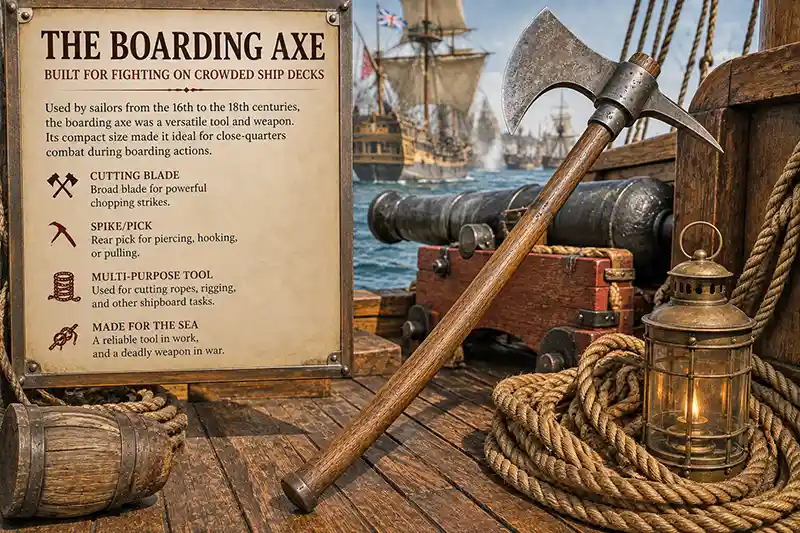
Naval combat created its own version of close-quarters chaos. Once two ships came alongside one another and boarding began, sailors could find themselves fighting among ropes, masts, railings, cannons, and dozens of other men packed onto a relatively small deck. A long weapon could quickly become awkward. The boarding axe was almost perfectly suited to the environment.
Boarding axes generally combined a relatively compact handle with a broad cutting blade and a pointed pick on the opposite side. That gave sailors a weapon capable of delivering powerful chopping blows while remaining short enough to maneuver through the cramped spaces aboard a wooden warship.
But the boarding axe was valuable because it was more than a weapon. Sailors could use axes to cut ropes, damage rigging, break through wooden obstacles, clear debris, and perform emergency work aboard ship. The rear spike could also provide a useful point for striking or hooking.
During a boarding action, those practical qualities suddenly became combat advantages. A tool strong enough to chop through heavy rope and timber could become formidable when fighting moved onto the deck. Unlike highly specialized weapons that served little purpose outside battle, an axe earned its place aboard ship even when nobody was fighting.
This combination of utility and violence helps explain why axes remained closely associated with sailors for centuries. When naval warfare became hand-to-hand, the boarding axe required almost no transformation at all. The same tool used to attack the ship could immediately be turned against the people defending it.
The Knuckle Knife: When a Fighting Knife Was Not Enough
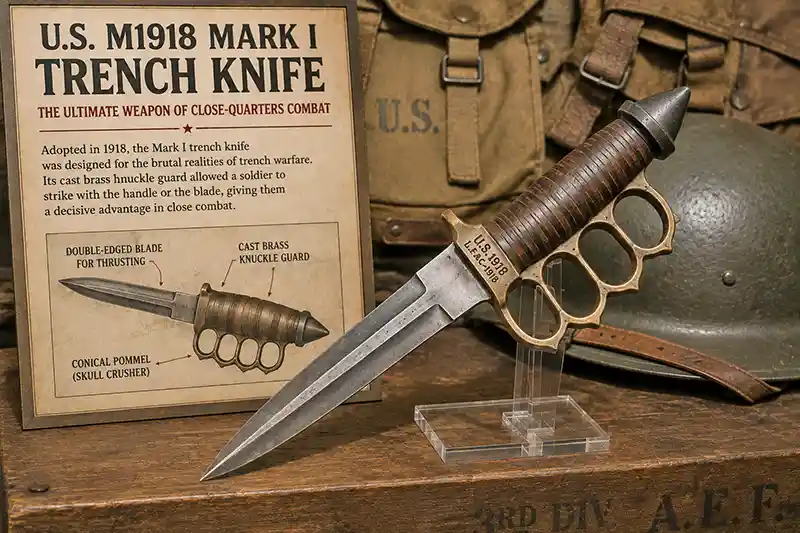
A conventional fighting knife gives its user a blade. A knuckle knife adds a second weapon directly to the handle. By surrounding the fingers with a heavy metal guard, these weapons allowed a soldier to strike with the grip while keeping the blade immediately available for close-range fighting.
The concept became particularly notorious during World War I. The American Mark I trench knife, adopted in 1918, combined a double-edged dagger-style blade with a cast metal knuckle guard. Earlier trench knives had already experimented with reinforced guards, but the Mark I turned the idea into one of the most recognizable close-combat weapons of the war.
The design made sense in the environment for which it was created. Inside a narrow trench, an opponent might be too close for a soldier to comfortably maneuver a rifle or even make a conventional knife thrust. A reinforced knuckle guard gave the hand additional striking capability while also helping protect the fingers.
Knuckle knives also reveal how specialized trench warfare became. Soldiers were fighting in an age of aircraft, machine guns, poison gas, and enormous artillery pieces, yet militaries were simultaneously developing weapons intended for encounters measured in inches rather than hundreds of yards.
The basic idea did not disappear after World War I. Variations of knuckle-handled knives continued to appear, while the reinforced striking concept survives independently in modern knuckle dusters. Few weapons illustrate the mentality of close combat quite as clearly as the knuckle knife: if the blade could not be brought into action immediately, the handle itself was designed to become part of the fight.
The Rondel Dagger: Designed for the Gaps in Medieval Armor
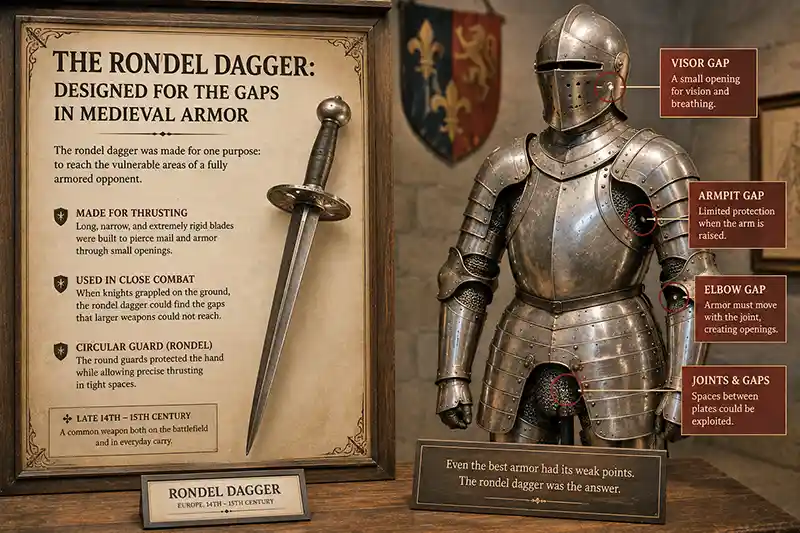
A knight covered in plate armor could be remarkably difficult to injure with an ordinary cutting weapon. But even the finest suit of armor could not be made from one continuous shell of steel. The wearer still needed to bend his elbows, move his shoulders, turn his head, and walk. Those necessities created gaps, and the rondel dagger was particularly well suited to exploiting them.
Popular in Europe during the late Middle Ages, the rondel dagger took its name from the circular guards positioned around the grip. Many examples had long, narrow, extremely rigid blades designed primarily for thrusting rather than cutting. Some blades were triangular or otherwise reinforced in cross section, giving them tremendous stiffness.
The weapon became closely associated with armored combat. When fighting collapsed into grappling range, a knight could attempt to control or knock down his opponent and then use the dagger against less protected areas around the visor, armpits, joints, or other openings in the armor.
That made the rondel dagger very different from the enormous weapons normally associated with medieval warfare. It did not need tremendous reach or a massive striking head. Its advantage appeared only after two armored fighters were already close enough to grab one another.
Rondel daggers were also widely carried outside the battlefield, and surviving examples range from relatively plain weapons to beautifully decorated pieces. But in armored combat, the underlying purpose could be chillingly precise. Plate armor had made broad cutting attacks less effective, so the rondel dagger concentrated everything into a stiff point small enough to attack the places armor could not completely cover.
The Push Dagger: Maximum Force From an Extremely Short Blade
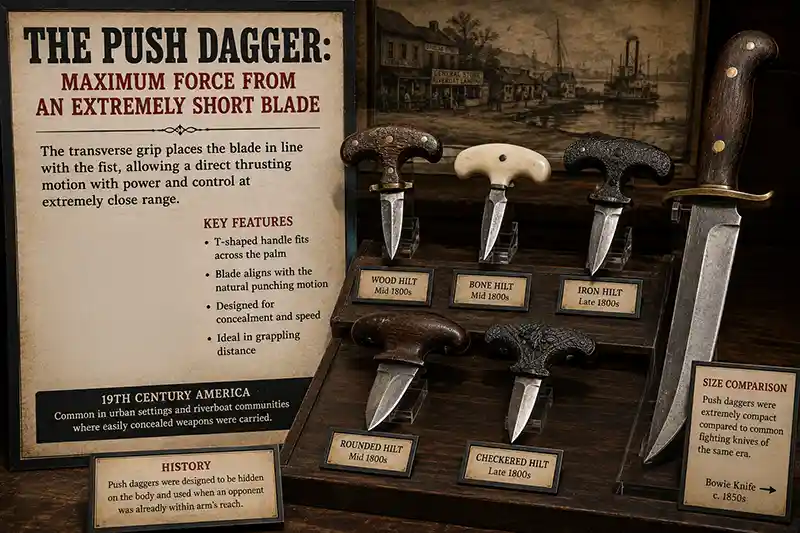
Few weapons are as obviously designed for extremely close-range fighting as the push dagger. Instead of placing the handle directly behind the blade, its grip sits perpendicular to it. The blade projects between the fingers while the handle rests across the palm, creating a compact weapon that essentially becomes an extension of the fist.
Push daggers became particularly associated with 19th-century America, where they were sometimes called push knives or gimlet knives. They gained a notorious reputation in cities and riverboat communities where easily concealed weapons were common. Unlike a full-size fighting knife, a small push dagger could disappear beneath clothing while remaining quickly accessible.
The T-shaped handle also changed the mechanics of the weapon. A conventional knife depends heavily on the hand maintaining its grip along the same axis as the blade. With a push dagger, the handle braces against the palm, allowing the arm to drive directly behind the blade with a punching motion.
That made the design particularly suited to cramped environments where there might be little room for broad movements. Its blade did not need to be especially long because the entire weapon was intended for a distance at which two opponents might already be grappling.
The basic concept is remarkably old. Earlier in this article, we saw the Indian katar use a transverse grip to place a blade directly in front of the fist. Modern push daggers are much smaller and structurally different, but both designs arrived at a similar solution: align the blade with the natural forward motion of the arm.
Of all the weapons on this list, the push dagger may be one of the purest examples of a weapon shaped by fighting distance. Everything unnecessary was stripped away until little remained except a grip, a short blade, and a design intended for the moment when an opponent was already within arm's reach.
The Karambit: A Curved Blade Made for Extremely Close Range
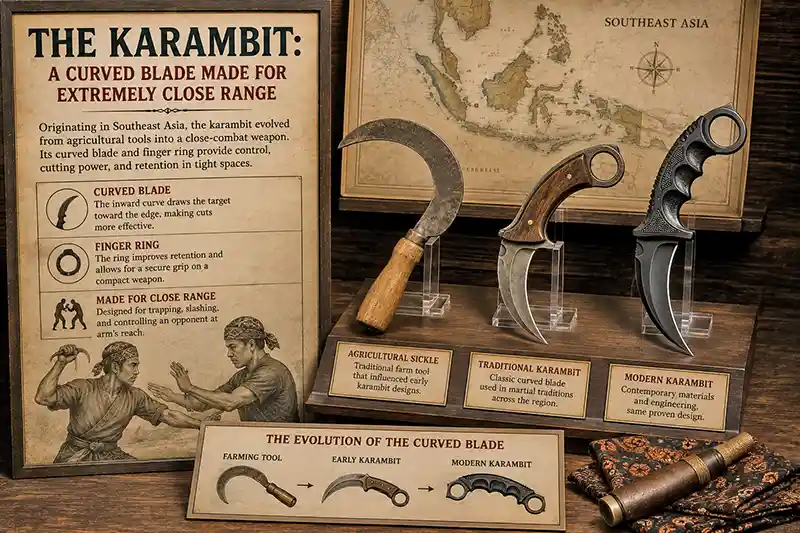
Few knives have a silhouette as distinctive as the karambit. Its sharply curved blade and ring-shaped handle make it instantly recognizable, but those features were not created simply to make the knife look intimidating. The design developed in Southeast Asia, particularly Indonesia, from curved utility blades associated with agricultural work before becoming closely connected with regional martial traditions.
The karambit's claw-like blade behaves differently from the straight blades found on most fighting knives. Its inward curve naturally draws material toward the cutting edge rather than allowing it to slide away as easily. That geometry proved useful for everyday cutting tasks, but it also gave the design obvious potential as a close-combat weapon.
The finger ring is equally important. Placing a finger through the ring can make the knife much harder to lose accidentally and allows the user to maintain control of a relatively small weapon. That helps explain what the ring on a karambit is actually for and why it became such a defining feature of the design.
Traditional karambits varied significantly in size and construction. Some were fixed blades, while modern versions increasingly use folding mechanisms and contemporary materials. The characteristic curve has remained, however, because it is fundamental to the weapon's identity. We have also taken a closer look at why the karambit blade is curved and how that unusual geometry developed.
Unlike a sword or spear, the karambit offers almost no reach advantage. It belongs to precisely the kind of fighting this article is about: the uncomfortable distance where opponents are already within grabbing range. Modern karambit knives may look considerably different from their traditional ancestors, but the compact dimensions, finger ring, and unmistakable curved blade still reveal where the design came from.
The Mace: The Weapon That Made Armor Feel Less Safe
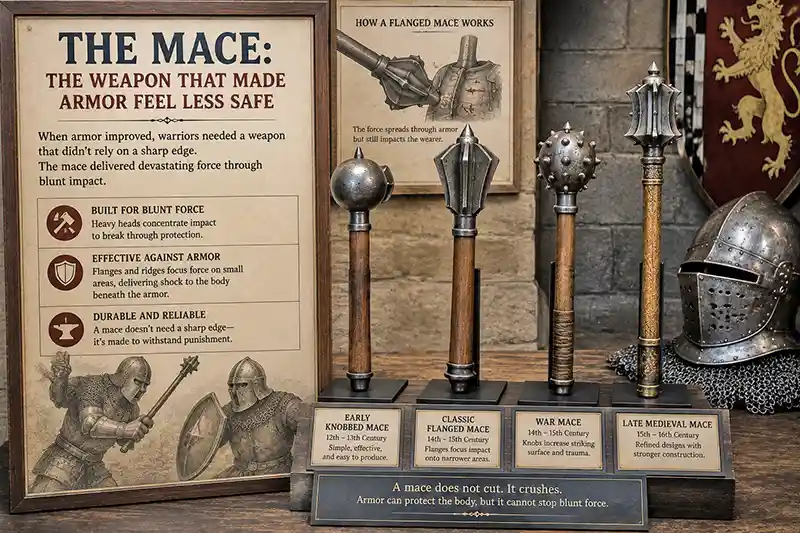
A sword depends heavily on its edge. A mace does not. That simple difference made the mace one of history's most dependable close-combat weapons, particularly when warriors began protecting themselves with increasingly sophisticated armor.
At its simplest, a mace places a heavy striking head on the end of a relatively short shaft. Early versions could be brutally straightforward, but medieval European designs became increasingly specialized. Metal heads appeared with knobs, ridges, and eventually prominent flanges that concentrated the force of a strike onto narrower areas.
The flanged mace was particularly well suited to armored combat. Rather than trying to cut through plate or mail, it delivered tremendous blunt force through the protective surface. Armor might remain intact while the person underneath still absorbed much of the impact.
Maces also had an advantage that is easy to overlook: durability. A finely sharpened sword edge could be damaged by repeated contact with hard armor. A solid steel mace was built for exactly that kind of abuse. Its effectiveness did not depend on maintaining a razor-sharp cutting edge.
Unlike the spiked morning star we covered earlier, many historical maces looked almost restrained. Some consisted of little more than a compact steel head divided into several thick flanges. But that simplicity hid the entire point of the weapon. A mace did not need an elaborate blade or terrifying spikes. It simply needed enough concentrated mass to make being wrapped in metal considerably less comforting.
The Mere: A Short War Club Built for the Closest Kind of Fighting
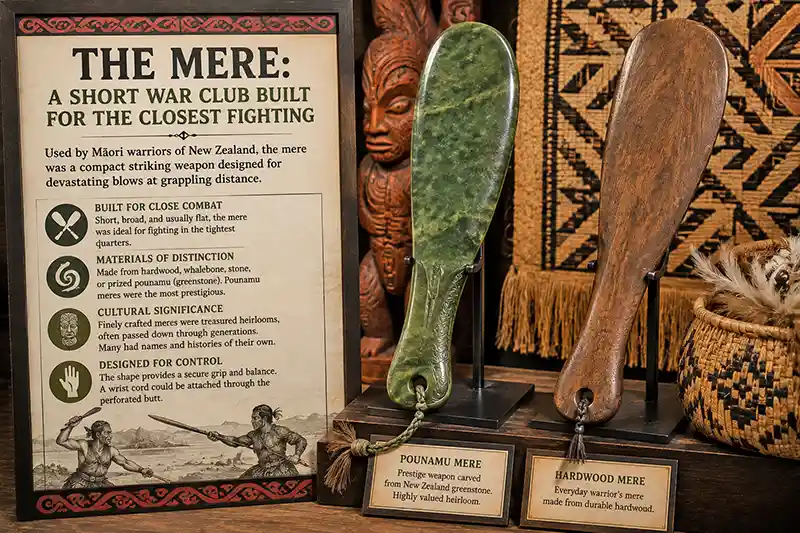
Not every brutal close-combat weapon needed spikes, blades, or complicated metalwork. The Maori mere proved that a carefully shaped hand weapon could be formidable while remaining remarkably simple. Short, broad, and usually flattened into a paddle-like form, the mere was made for fighting at a distance where opponents were already almost within grappling range.
Traditional mere could be made from hardwood, whalebone, or stone, but the most prestigious examples were fashioned from pounamu, the highly valued New Zealand greenstone. Creating one required enormous patience because pounamu is exceptionally tough and had to be shaped and polished using traditional methods without modern machinery.
Unlike a European mace, the mere did not rely on a large weighted head. Its broad body narrowed into a grip, usually ending in a perforated butt through which a wrist cord could be attached. The weapon was compact enough to carry easily yet substantial enough to function as a serious hand weapon.
The mere also held significance far beyond combat. Fine pounamu examples could become treasured heirlooms passed through generations, carrying status, history, and connections to important ancestors. Particularly significant weapons could even acquire names and histories of their own.
That cultural importance makes the mere very different from something like an improvised trench club. Yet both demonstrate the same principle: once fighting becomes extremely close, reach becomes less important than control, durability, and having a weapon that can still be maneuvered when there is almost no space left between two people.
The Kukri: A Heavy Curved Blade Made for Powerful Close Combat
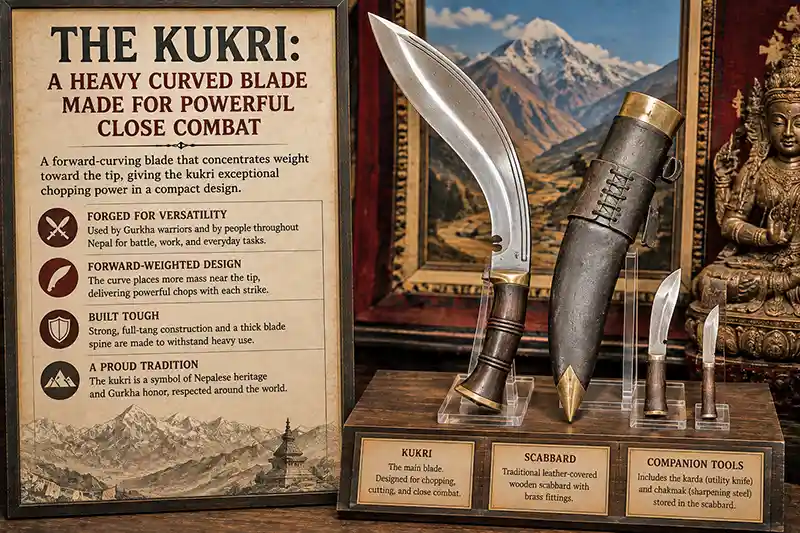
The kukri looks unusual even before you know anything about its history. Its blade curves forward, widening toward the tip so that much of the weapon's weight sits ahead of the hand. That distinctive shape gives the kukri the chopping authority of a much larger weapon while keeping it compact enough to carry at the waist.
The weapon is most famously associated with Nepal and the Gurkhas, whose military service helped make the kukri recognizable around the world. But the kukri was never exclusively a battlefield weapon. In Nepal, similar blades have long served as practical tools for cutting vegetation, processing wood, preparing food, and handling other everyday tasks.
Its forward-weighted design is what makes it particularly interesting as a close-combat weapon. Unlike a straight fighting knife, the kukri places additional mass toward the front of the blade. Once swung, that weight contributes to a powerful chopping action despite the weapon's relatively modest overall length.
Traditional kukris vary enormously. Some are comparatively slender utility blades, while others are thick, broad military or ceremonial examples. Their handles were commonly made from wood or horn, and traditional scabbards often included two smaller implements tucked alongside the main blade.
The kukri also demonstrates a pattern we have seen repeatedly in this article. Some of history's most formidable close-combat weapons were not bizarre inventions created solely for violence. They were practical tools whose shapes happened to translate extraordinarily well to fighting.
At arm's reach, that combination of compact dimensions, forward weight, and a broad chopping blade gave the kukri characteristics few ordinary knives could match. It did not need the reach of a sword because its entire design concentrated tremendous cutting power into a weapon short enough to remain effective when the fighting became crowded.
The Bowie Knife: A Fighting Knife That Became an American Legend
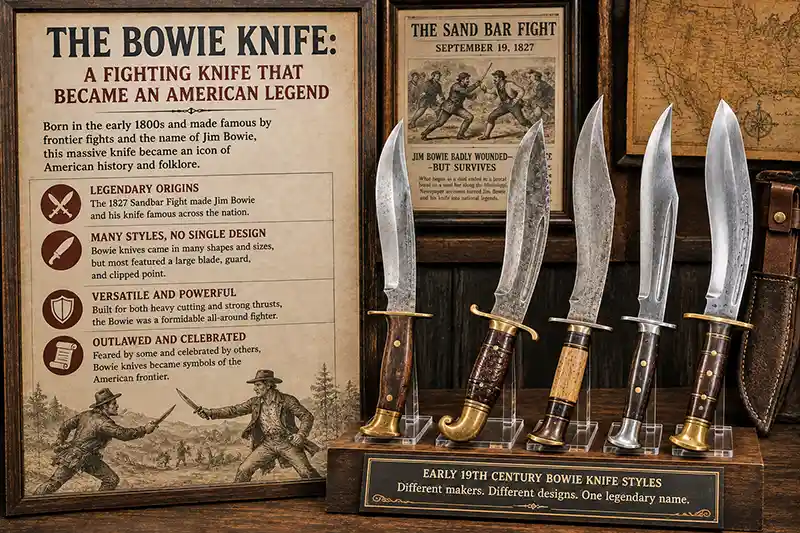
Few close-combat weapons became surrounded by as much mythology as the Bowie knife. Emerging in the United States during the early 19th century, it developed a reputation as an enormous fighting knife associated with frontier violence, personal duels, and the name of Jim Bowie.
The weapon's fame exploded after the infamous Sandbar Fight of 1827. What began as a duel between two other men descended into a chaotic brawl involving their supporters. Bowie was badly wounded during the fight but survived, and newspaper accounts helped transform both him and the large knife he carried into national legends.
There was never one universal historical Bowie knife design. Knifemakers produced countless variations, but many later examples shared recognizable characteristics: a large fixed blade, substantial hand guard, and often a clipped point that provided a strong, controllable tip while retaining a broad cutting edge.
Unlike the rondel dagger or push dagger, the Bowie knife was not optimized almost entirely for thrusting. Its size gave it considerable cutting capability while still allowing powerful thrusts, making it unusually versatile for a weapon that could be carried on the belt.
Its reputation eventually became so notorious that several states attempted to restrict Bowie knives during the 19th century. That only added to their mystique. The knife appeared in newspaper stories, dime novels, military service, and eventually Western films until it became almost inseparable from the popular image of the American frontier.
Modern Bowie knives come in an enormous variety of designs, but their intimidating size and distinctive profile still echo the weapons that became famous nearly two centuries ago. The real history is even stranger than the legend, including the bloody encounter remembered as the most famous knife fight in American history.
The Tomahawk: A Compact Axe That Could Fight at Arm's Reach
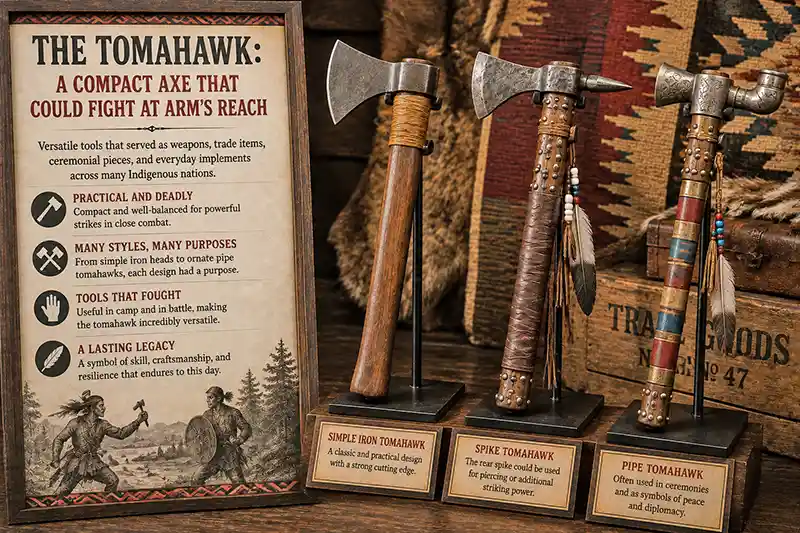
The tomahawk is often portrayed primarily as a throwing weapon, but that reputation can obscure what made it genuinely formidable. Its compact size, relatively light weight, and axe-shaped head made it an extremely practical hand weapon when fighting moved into close quarters.
Early tomahawks developed from interactions between Indigenous peoples of North America and European settlers and traders. The name traces back to Algonquian terms for striking or cutting implements, while European iron axe heads eventually became widely traded and incorporated into new forms. Over time, tomahawks appeared in many different configurations, from simple utilitarian axes to elaborately decorated diplomatic pipe tomahawks.
As a fighting weapon, the tomahawk occupied an interesting space between a knife and a full-sized axe. Its handle provided more reach and leverage than most knives without becoming so long that it was difficult to maneuver in confined spaces. The concentrated weight of the head also allowed substantial force to be delivered from a relatively compact weapon.
Some historical examples included a spike opposite the cutting edge, while others featured a hammer-like poll or the bowl of a smoking pipe. That variety is important because there was never one universal tomahawk design. The weapon evolved across different communities, purposes, and periods rather than following a single military specification.
Although tomahawks certainly could be thrown, treating them exclusively as throwing weapons misses much of their history. Their real versatility came from being useful tools that could also serve as formidable hand weapons. Modern throwing weapons keep the throwing side of that reputation alive, but historically the tomahawk's usefulness extended far beyond hitting a distant target.
That combination of portability, utility, and striking power explains why the basic concept has survived for centuries. In a list filled with specialized weapons designed for one narrow purpose, the tomahawk stands out because something so useful around camp could become remarkably effective once the distance between two opponents disappeared.
The Sap: A Small Weapon With a Surprisingly Long History
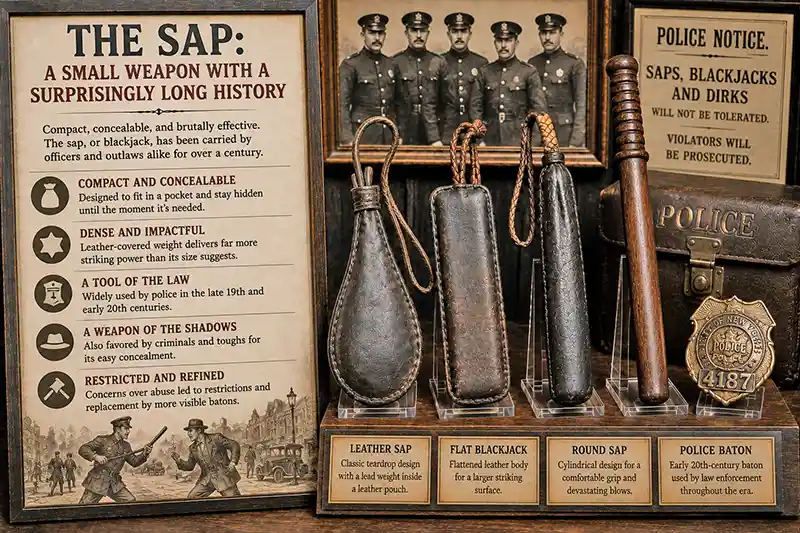
Some close-combat weapons were terrifying because of their blades or spikes. The sap was intimidating for the opposite reason. It could look almost harmless. Usually consisting of a small leather pouch or flattened body containing a dense weight, the sap concentrated considerable striking mass into an object compact enough to fit in a pocket.
Weapons of this general type are also commonly called blackjacks, although historical terminology and construction varied. Many featured leather-covered lead or other dense internal weights attached to a flexible or semi-flexible handle. The result was a short striking weapon that could generate considerably more impact than its modest dimensions suggested.
Saps became especially associated with American law enforcement during the late 19th and early 20th centuries. Police officers in many cities carried them as compact alternatives or companions to larger clubs. Their small size made them convenient to carry, particularly for plainclothes officers who did not want a conspicuous baton hanging from their belt.
That same concealability also contributed to their darker reputation. Saps and blackjacks became associated with criminals, hired muscle, strikebreakers, and the shadowy violence of early 20th-century cities. Unlike an imposing sword or axe, a sap could remain unnoticed until the moment it was used.
Over time, concerns about injuries and excessive force helped push these weapons out of mainstream law-enforcement use, while laws in various jurisdictions restricted their possession or carry. Modern batons represent a very different approach to compact impact weapons, but the old sap remains an intriguing example of just how much striking force designers attempted to package into something small enough to disappear inside a coat pocket.
The sap may be one of the least visually dramatic weapons on this list, yet that is precisely what makes it interesting. It was not designed to look like a battlefield weapon. Its entire advantage came from being compact, dense, and far more formidable than its appearance suggested.
The Smatchet: A World War II Blade Built Specifically for Close Combat
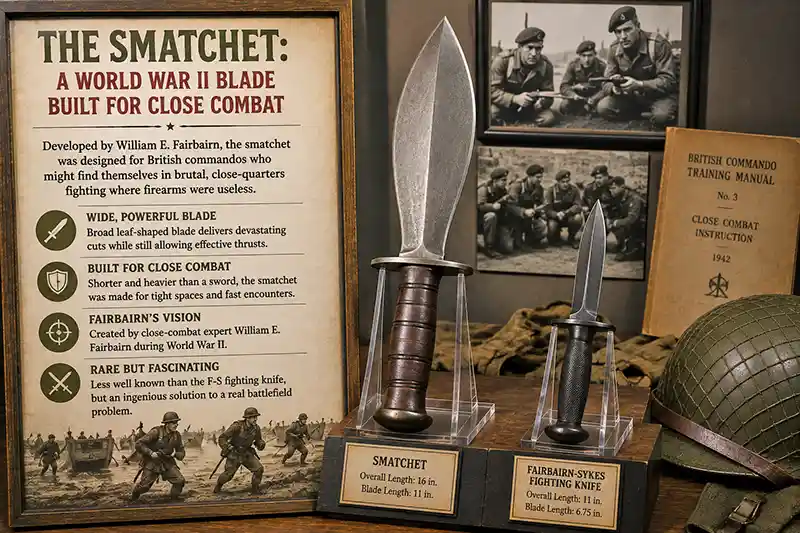
By World War II, firearms dominated the battlefield, but military planners still recognized that soldiers could find themselves fighting at extremely short distances. One of the strangest answers to that problem was the smatchet, a broad-bladed weapon that looked somewhere between a fighting knife, a short sword, and a compact machete.
The smatchet is most closely associated with British close-combat expert William E. Fairbairn, who helped develop specialized fighting methods and weapons during World War II. Fairbairn had spent years with the Shanghai Municipal Police before bringing his experience to wartime commando training. He wanted a weapon that could deliver powerful cuts while remaining short enough for confined fighting.
The resulting smatchet featured an unusually wide, leaf-shaped blade measuring roughly 11 inches, paired with a substantial oval guard and simple grip. Its broad blade gave it considerably more mass than an ordinary fighting knife without requiring the length of a sword or military saber.
That unusual compromise was intentional. A narrow dagger concentrates on thrusting, while a machete generally needs more room to take advantage of its length. The smatchet attempted to provide both cutting and thrusting capability in a package suited to commandos, raiding parties, and other soldiers who might encounter close-range fighting.
It never became as famous as the Fairbairn-Sykes fighting knife, and relatively few people today would recognize one immediately. Yet that obscurity makes the smatchet one of the more fascinating weapons on this list. Unlike farming tools and utility knives that gradually found their way onto battlefields, this strange broad blade was deliberately developed during modern warfare for situations where firearms might suddenly become impractical.
Why Close Combat Produced Some of History's Most Brutal Weapons
The weapons in this list came from different continents, cultures, and centuries, yet many of them were shaped by the same unforgiving problem. Once two opponents were only a few feet apart, there was little room for elaborate tactics or long-range advantages. Weapons had to be compact, controllable, durable, and capable of doing their job immediately.
That pressure produced remarkably different solutions. Medieval armor encouraged the development of crushing maces, war hammers, and armor-piercing daggers. The claustrophobic trenches of World War I brought clubs and knuckle knives back into an age of machine guns. Sailors relied on boarding axes in the cramped environment of wooden warships, while weapons such as the kukri, karambit, tomahawk, and mere evolved within completely different fighting traditions.
Perhaps the most surprising lesson is that the most brutal weapon was not always the largest or most complicated. Many of these designs succeeded because they were simple. A heavy piece of wood, a short reinforced blade, or a carefully positioned spike could become extraordinarily effective when designed for the realities of close combat.
Modern warfare has made many of these weapons obsolete, while others survive as tools, collectibles, ceremonial objects, or descendants of their historical designs. Yet they remain fascinating because each one preserves a physical record of the problem its makers were trying to solve.
Across thousands of years of warfare, technology continually changed the battlefield. But whenever combat became close enough that reach, firearms, or armor stopped providing an easy advantage, weapon designers repeatedly returned to the same brutal principle: at arm's reach, simplicity and effectiveness mattered more than almost anything else.
What was the most brutal close-combat weapon in history?
There is no single weapon that can objectively claim the title, because effectiveness depended heavily on the opponent, armor, environment, and period. However, weapons such as the war hammer, mace, trench club, and rondel dagger rank among the strongest candidates because they were specifically suited to fighting at extremely short distances.
Against heavily armored opponents, the war hammer was particularly formidable because it could concentrate tremendous force onto a small area without needing to cut through the armor itself. In the confined trenches of World War I, however, a short trench club or specialized trench knife could be far more practical than a medieval weapon designed for an open battlefield.
Ultimately, the most brutal close-combat weapons were often those designed around a very specific problem. Rather than trying to do everything well, they concentrated on doing one unpleasant job exceptionally well.
Why were blunt weapons so effective against medieval armor?
Medieval plate armor was remarkably effective at stopping cuts. A sword might strike the surface without penetrating it, which forced weapon makers to find other ways of dealing with increasingly well-protected opponents.
Blunt weapons such as maces and war hammers approached the problem differently. Rather than relying on a sharp edge to slice through steel, they concentrated the energy of a powerful strike onto a relatively small area. Even when the armor remained intact, the force of the impact could still be transferred to the person underneath.
This is why so many late-medieval weapons featured compact hammer faces, flanges, spikes, and pointed beaks. As armor became better at stopping blades, close-combat weapons evolved specifically to deal with the armor itself.
Why did soldiers still carry close-combat weapons after guns became common?
Firearms dramatically changed warfare, but they never guaranteed that every fight would happen at a comfortable distance. Soldiers could still encounter enemies inside buildings, trenches, tunnels, fortifications, and other confined spaces where a long firearm became difficult to maneuver.
Early firearms also had significant limitations. They could be slow to reload, unreliable in poor conditions, and effectively useless once an enemy closed the distance after a shot had been fired. Bayonets, swords, axes, and fighting knives therefore remained important long after gunpowder weapons appeared.
Even during the two World Wars, soldiers carried specialized knives and sometimes improvised clubs for close encounters. The technology of warfare had advanced enormously, but one ancient problem remained unchanged: sometimes the enemy was suddenly only a few feet away.
What close-combat weapon was best against plate armor?
There was no single perfect weapon, but the war hammer was one of the most specialized answers to plate armor. Its compact hammer face concentrated tremendous impact onto a small area, while the pointed beak found on many examples provided another way to attack an armored opponent.
Poleaxes and weapons such as the bec de corbin applied similar principles with longer shafts, while the rondel dagger became especially useful once fighting reached grappling distance. Rather than trying to cut through a steel breastplate, these weapons crushed armor, concentrated force onto small areas, or targeted the gaps that armor could not completely protect.
This is why swords were not always the dominant weapons in heavily armored combat that movies make them appear to be. Once plate armor became highly sophisticated, some of the best weapons for defeating it were the ones specifically designed around the fact that cutting through it was extremely difficult.
Were trench clubs actually used during World War I?
Yes. Trench clubs were genuine weapons used during World War I, particularly during trench raids and other situations where soldiers expected extremely close-range fighting. British, German, Austro-Hungarian, and other forces used various forms, although many were locally manufactured rather than standardized military equipment.
Their designs could be remarkably crude. Wooden handles were sometimes fitted with lead weights, metal bands, nails, studs, or heavy iron heads. Some surviving examples look strikingly similar to medieval maces despite being made during an era of machine guns, aircraft, and heavy artillery.
That strange contrast is what makes trench clubs so fascinating today. World War I introduced some of the most technologically advanced weapons the world had ever seen, yet the conditions inside the trenches could still reduce combat to something resembling warfare from centuries earlier.
What is the difference between a mace and a morning star?
The biggest difference is the striking head. A traditional mace usually has a solid head made from metal or another heavy material, often shaped with knobs or projecting flanges designed to concentrate the force of a blow.
A morning star is generally a type of club or mace with prominent spikes projecting from its head. Despite what movies and video games often show, the classic morning star does not necessarily have a chain. When a spiked striking head is attached to the handle by a chain, the weapon is more accurately described as a type of flail.
The confusion is understandable because all three weapons appear in many variations and historical terminology was not always consistent. But as a simple rule: mace equals solid striking head, morning star equals spiked head, and flail equals a striking head connected by a flexible chain or other linkage.
What made the katar different from an ordinary dagger?
The katar used a completely different grip. Instead of holding the handle in line with the blade like a conventional dagger, the user gripped a horizontal crossbar while the blade projected forward from the fist. This allowed thrusts to be delivered with a punching motion.
Its distinctive frame also helped align the weapon with the forearm, creating a rigid structure that could put much of the arm and shoulder behind a thrust. Some historical katars featured narrow reinforced points, while others had broad blades and elaborate decoration.
The concept is especially interesting because it resembles the basic principle behind the modern push dagger. Both weapons position the blade so that forward pressure can be delivered directly from behind the grip, even though the katar and push dagger developed in very different places and periods.
Why did the kukri become such a famous close-combat weapon?
The kukri's distinctive forward-curving blade places considerable weight toward the front of the weapon. That gives a relatively compact blade powerful chopping characteristics while still keeping it short enough to carry conveniently and maneuver at close range.
Its worldwide reputation is closely connected with Nepalese Gurkha soldiers, who carried kukris during service with British and later other military forces. Their reputation as formidable soldiers helped transform the unusual curved blade into an internationally recognized symbol of the Gurkhas.
What makes the kukri particularly interesting, however, is that it was never merely a fighting weapon. Similar blades have long served practical everyday purposes in Nepal, making the kukri another example of a useful tool whose design also translated remarkably well to close combat.
What was the deadliest close-combat weapon before guns?
There probably was no single deadliest close-combat weapon. Effectiveness depended enormously on the period, the opponent's armor, the environment, and whether the fighter was on foot or horseback. A weapon devastating against an unarmored opponent might perform poorly against someone protected by plate armor.
Swords offered an excellent combination of speed, reach, cutting ability, and thrusting capability, but specialized weapons could outperform them in particular circumstances. Maces and war hammers were formidable against armor, while daggers such as the rondel became valuable once armored combat reached grappling distance.
The better question is therefore not which weapon was universally deadliest, but which weapon was best suited to a particular fight. Throughout history, the answer changed as armor, tactics, and battlefield conditions changed.
Why did medieval weapons have so many spikes and hooks?
Many of the intimidating spikes, beaks, and hooks found on medieval weapons developed in response to increasingly effective armor. A sword edge had difficulty cutting through good plate armor, so weapon makers concentrated force onto smaller and smaller points.
War hammers and bec de corbins used narrow beaks or spikes for this reason. Other polearms incorporated hooks that could help manipulate an opponent, catch equipment, or provide additional options during chaotic close combat.
These features were therefore more than decoration. As defensive technology improved, offensive weapons became increasingly specialized around crushing, puncturing, hooking, and otherwise overcoming protection that ordinary cutting blows struggled to defeat.
Did knights really fight with maces and war hammers?
Yes. Although popular culture tends to make the sword the defining weapon of the medieval knight, historical warriors had access to a much broader arsenal. Maces, war hammers, axes, lances, poleaxes, and daggers could all have important roles depending on the period and circumstances.
Weapons that delivered concentrated impact became particularly valuable as armor improved. A sword remained an important and versatile weapon, but its cutting edge was not ideally suited to defeating hardened plate armor directly.
The heavily armored knight carrying nothing but a sword is therefore largely a simplified modern image. Medieval warriors chose weapons according to what they expected to encounter, and sometimes a hammer or mace was a much better answer than a blade.
Were close-combat weapons more dangerous than swords?
In certain circumstances, absolutely. The sword was exceptionally versatile, but many specialized close-combat weapons were designed to accomplish tasks that swords did poorly.
A war hammer could concentrate tremendous force against armor. A rondel dagger could attack gaps once two armored fighters were grappling. A trench club could be maneuvered inside spaces where a longer weapon became cumbersome. None necessarily made the sword obsolete, but each could offer an important advantage under the right conditions.
This is one reason swords sometimes receive more attention than their battlefield performance alone would justify. They became powerful cultural symbols, while less glamorous weapons such as clubs, maces, hammers, and daggers were often brutally practical solutions to specific combat problems.
Why were so many close-combat weapons so short?
Reach is normally an advantage, but only while there is enough room to use it. Once fighting moved inside a trench, ship, building, fortification, or tightly packed formation, an excessively long weapon could become difficult to maneuver.
Short weapons could also become valuable after opponents began grappling. At that distance, drawing back a long sword or swinging a large polearm might be difficult, while a compact dagger, club, or axe could still be brought into action.
That is why some of history's most specialized close-combat weapons look surprisingly small. They were not designed to win the fight from ten feet away. They were designed for the terrifying moment when ten feet had already become ten inches.
What is the strangest close-combat weapon ever made?
The goedendag deserves serious consideration simply because of its unusual combination of features. Essentially a heavy wooden club reinforced with iron and fitted with a prominent spike, it combined two extremely basic weapons into one intimidating package.
The Indian katar is another strong contender because its horizontal grip placed the blade directly in front of the fist. The World War II smatchet looks equally unusual, occupying an awkward middle ground between a fighting knife, machete, and extremely short sword.
What makes these weapons fascinating is that their strange appearances usually had practical explanations. They were not made unusual simply to intimidate an opponent. Their shapes reflected particular solutions to particular close-combat problems.
Which close-combat weapons are still used by militaries today?
Modern soldiers still carry knives and bayonets, although their roles have changed dramatically from earlier periods. A modern military knife is usually a multipurpose tool first, while a bayonet can provide a close-combat capability without requiring a soldier to carry an entirely separate weapon.
Specialized historical weapons such as trench clubs, rondel daggers, maces, and boarding axes have largely disappeared from military service because modern firearms and equipment have made their original roles obsolete.
Close combat itself has not disappeared, however. Militaries still train soldiers for situations where fighting can occur at extremely short distances, particularly inside buildings and other confined environments. What has changed is that modern forces generally rely on their firearms, knives, and unarmed skills rather than carrying the extraordinary collection of dedicated hand weapons found throughout earlier military history.
You May Also Be Interested In:
- A Visual Guide to Knife Blade Shapes and What They Were Designed For
- Combat War Hammer and Other New Weapons
- Combat Arm Blades and Other New Weapons
- Combat Spear Sword and Other New Weapons
- Combat Weapons for Urban Survival
- Combat Folding Kama and Other New Weapons!
- Unusual Weapons for Urban Combat
- Modern Combat Khopesh and Other Deadly Weapons!
- Hidden Sword Battle Stick and Other Combat Weapons
- Can Butterfly Knives be used for Combat?
Leave a Reply