





A Visual Guide to Knife Blade Shapes and What They Were Designed For
August 28th, 2026
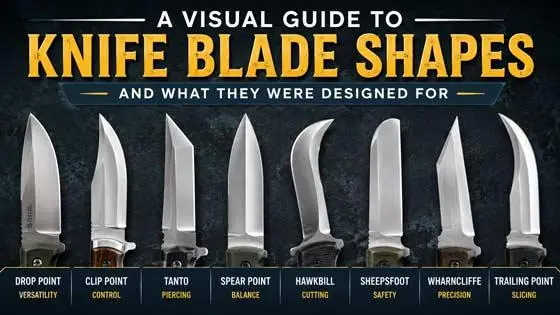
The shape of a knife blade is rarely accidental. Long before modern knives were categorized as drop points, clip points, tanto blades, hawkbills, or trailing points, blade makers were already experimenting with different combinations of curves, points, edges, and thicknesses to make knives better suited to particular jobs. Some shapes favor controlled slicing, others provide a stronger tip, and some evolved for specialized cutting tasks that immediately explain their unusual appearance. In this visual guide, we'll break down the most recognizable knife blade shapes, examine where their designs came from, and look at the practical reasons they developed so differently.
What Exactly Is a Knife Blade Shape?
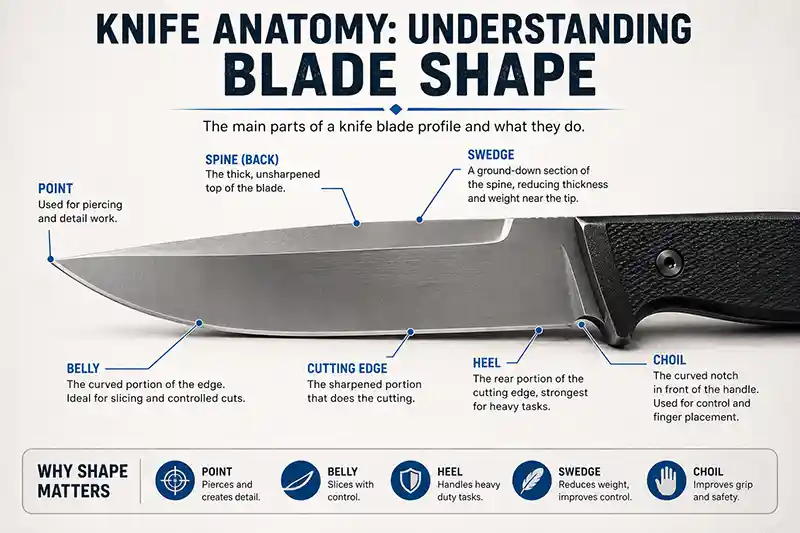
A knife's blade shape is the overall profile created by its cutting edge, spine, and point. At first glance, the differences between two blades can seem surprisingly small. Lower the point, straighten the edge, remove part of the spine, or add more curvature to the belly, however, and the character of the blade can change dramatically. These differences are what separate familiar profiles such as drop points, clip points, spear points, tanto blades, Wharncliffes, and trailing points.
Blade shape should not be confused with every other aspect of blade geometry. Thickness, grind, edge angle, steel, heat treatment, and overall dimensions can all influence how a knife behaves. Two knives with nearly identical profiles can therefore perform quite differently. For a deeper look at some of those other variables, our guide to different types of knife steels explains how the material itself can change edge retention, toughness, corrosion resistance, and sharpening characteristics.
What makes blade profiles especially interesting is that most involve tradeoffs. Moving the point closer to the centerline can change its control and geometry. Leaving more material around the tip can make it more robust, while a pronounced belly can provide a longer curved cutting surface. A nearly straight edge behaves differently again. There is rarely one shape that is simply "better." Instead, designers manipulate the profile according to what they want a particular knife to do.
Modern terminology can make these shapes appear more standardized than they really are. A blade does not have to match one exact template to be considered a drop point or clip point, and manufacturers frequently combine characteristics from several established profiles. That is why modified tantos, reverse tantos, modified Wharncliffes, and other hybrid shapes have become increasingly common. The names are best understood as useful families of blade design rather than rigid blueprints.
Drop Point: The All-Purpose Blade Shape
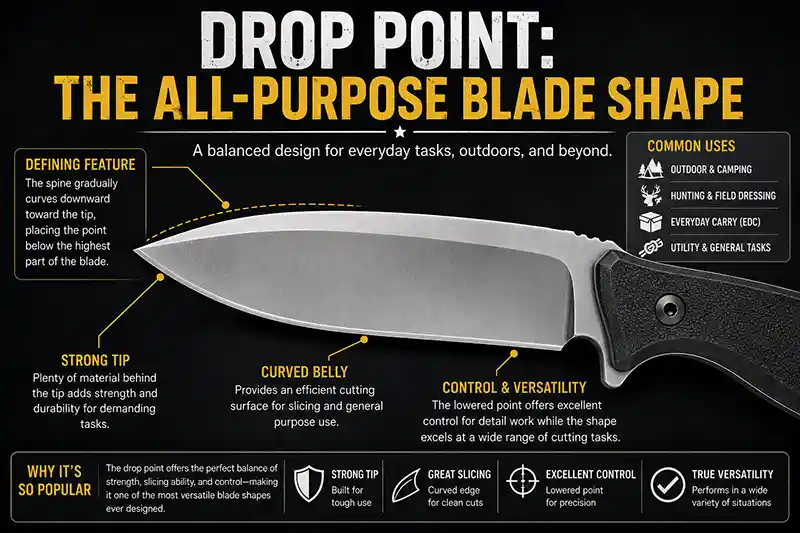
The drop point is one of the most recognizable and widely used knife blade shapes. Its defining feature is a spine that gradually curves downward toward the tip, meeting the cutting edge at a point positioned below the highest part of the blade. The result is a broad profile with plenty of material remaining behind the tip, which helps explain why the design appears on everything from outdoor knives and hunting blades to everyday folding knives.
One of the drop point's greatest strengths is its balance of characteristics rather than dominance in any single area. The curved belly provides useful cutting surface for slicing, while the lowered point can offer good control during detailed work. Because the spine descends gradually instead of removing a large section of material near the tip, a typical drop point also retains a relatively substantial tip compared with more dramatically tapered profiles.
There is considerable variation within the category. Some drop points have a pronounced downward sweep in the spine and a deep belly, while others are so subtle that the blade approaches a straight-back profile. Designers can make the blade broad or narrow, alter the position of the point, and combine the basic shape with different grinds and edge geometries. What ties them together is that characteristic downward transition of the spine toward the tip.
The drop point's versatility is ultimately what made it so common. Instead of being optimized around one highly specialized cutting task, it provides a practical compromise between slicing ability, point control, usable edge length, and tip robustness. That makes it a useful baseline for understanding the more specialized blade shapes that follow.
Clip Point: A Blade With Part of the Spine "Clipped" Away
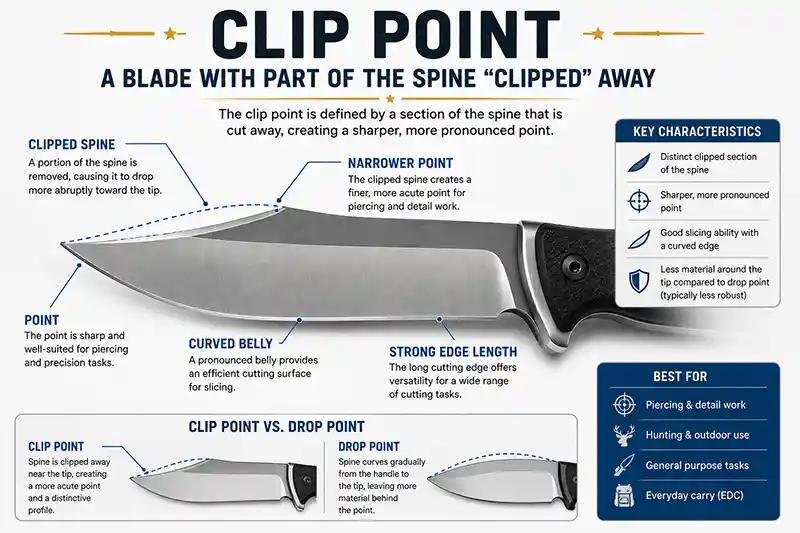
The clip point gets its name from the distinctive section of spine that appears to have been cut or "clipped" away near the tip. That clipped portion may be straight, gently curved, or noticeably concave, but the result is similar: the spine drops toward the point more abruptly than it does on a typical drop-point blade. This creates a narrower, more pronounced tip and gives the clip point its instantly recognizable profile.
Removing material from the spine changes more than the blade's appearance. Compared with a broad drop point of similar dimensions, a clip point generally places less material around the tip and can create a finer point. The cutting edge often retains a substantial belly, allowing the same blade to combine a pronounced point with a curved cutting surface. The tradeoff is that an especially narrow tip may be less robust than the thicker point found on some other blade profiles.
The shape has a particularly strong association with the American Bowie knife. Nineteenth-century Bowie-style knives varied enormously rather than following one standardized pattern, but the dramatic clipped blade eventually became one of the designs most closely associated with them. The profile remained influential long afterward, appearing on hunting knives, military and utility knives, and countless folding knives. Our article on why clip point knives became a military standard takes a closer look at how this distinctive profile became associated with military knife design.
Modern clip points range from subtle designs where only a small portion of the spine is removed to dramatic profiles with a deep concave clip. Some also incorporate a swedge along the clipped section, reducing material near the tip even further. Despite these variations, the basic visual clue remains remarkably consistent: if the upper portion of the blade looks as though a piece near the point has been deliberately removed, you are probably looking at some form of clip point.
Tanto Point: The Angular Blade That Breaks the Usual Rules
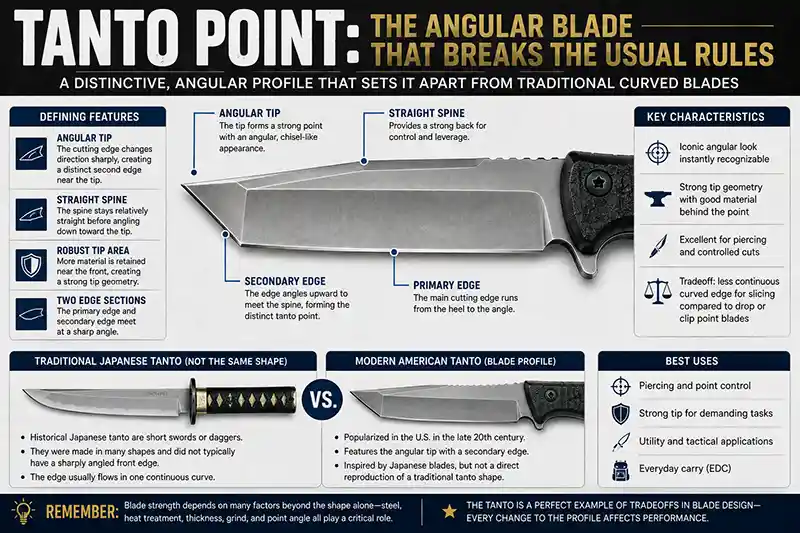
Few modern blade profiles are as immediately recognizable as the tanto point. Instead of using one continuous curve from the heel toward the tip, the cutting edge typically changes direction sharply near the front of the blade, creating two distinct edge sections. The spine often remains relatively straight before descending toward the point, giving the entire blade a geometric, angular appearance that stands apart from the flowing curves of drop points and clip points.
The name can be slightly misleading. Historical Japanese tanto were short swords or daggers produced in numerous blade shapes, and they did not generally have the sharply angled front edge that many people now associate with a "tanto blade." The familiar modern profile is more accurately described as an American tanto, a design popularized in the United States during the late twentieth century and visually inspired by Japanese blades rather than being a direct reproduction of a traditional tanto shape.
One defining characteristic of the modern tanto is the amount of material retained near the front of the blade. Rather than narrowing gradually into a delicate point, many tanto designs maintain substantial blade width before the spine and secondary edge converge. This can produce a robust tip geometry, although actual strength depends on far more than the silhouette alone. Blade thickness, grind, steel, heat treatment, and the exact angle of the point all matter.
The abrupt transition between the primary and secondary cutting edges also changes the way a tanto slices compared with a blade that has a continuous belly. That angular junction can be useful for certain controlled cuts, but it provides less sweeping curvature than profiles designed around a large belly. As a result, the tanto is a good example of the tradeoffs found throughout blade design: changing the profile to emphasize one characteristic inevitably changes others as well.
Spear Point: A Symmetrical Shape Built Around the Centerline
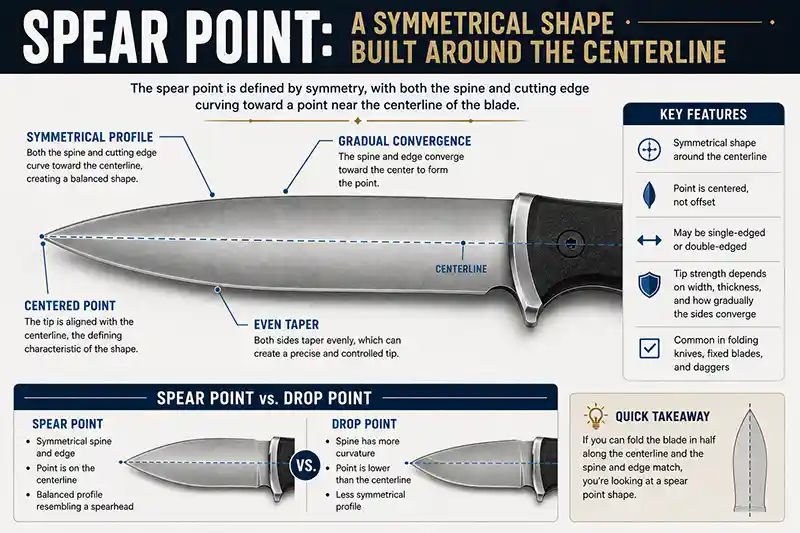
The spear point is defined by symmetry. Both the spine and cutting-edge side of the blade curve toward a point positioned close to the blade's centerline, producing a balanced profile that resembles the head of a spear. This makes it easy to distinguish from a drop point, where most of the curvature occurs along the spine, or a clip point, where a section of the spine appears to have been removed.
A spear-point blade does not necessarily have two sharpened edges. Some versions are double-edged, but others have only one sharpened edge while retaining the same symmetrical overall silhouette. This distinction is important because blade shape describes the profile of the blade, not automatically the number of sharpened edges it carries.
The centered point is the defining characteristic of the design. Because the spine and edge converge toward approximately the same axis, spear points can have a precise, evenly tapered tip. How robust that tip is depends heavily on the width and thickness of the blade and how gradually the two sides converge. A broad spear point can retain considerable material near the tip, while a narrow version may taper much more dramatically.
Spear-point geometry appears on everything from compact folding knives to larger fixed blades, but it is particularly useful for understanding the relationship between blade shape and symmetry. It also provides a natural transition into dagger and needle-point profiles, which can look superficially similar while becoming progressively narrower and more specialized around the point.
Dagger Point: When Symmetry Becomes Even More Pronounced
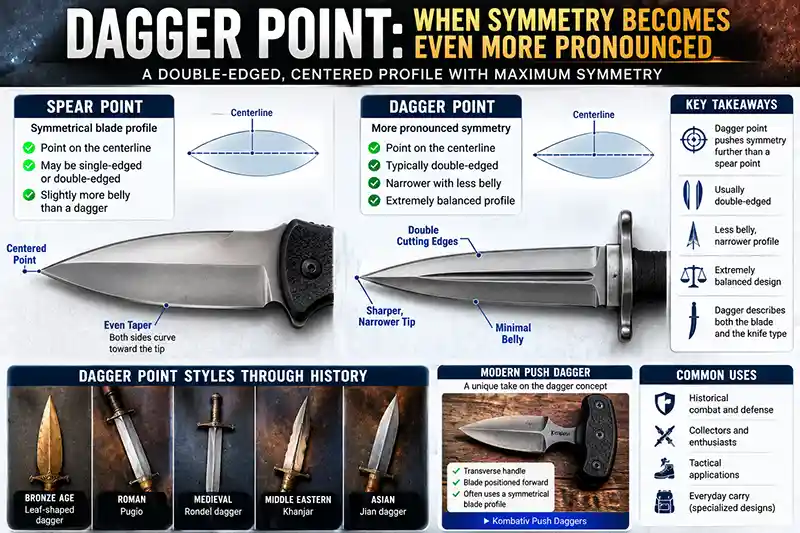
The dagger point takes the symmetry seen in a spear point and usually pushes it further. A typical dagger blade has two edges that taper toward a point positioned directly along the centerline, creating the narrow, balanced profile associated with daggers throughout history. Unlike a spear-point knife, which may have only one sharpened edge, a true dagger is generally double-edged, although modern knife terminology is not always applied consistently.
This distinction also demonstrates why blade shape and knife type are not exactly the same thing. "Spear point" primarily describes a blade profile, while "dagger" can describe the entire weapon as well as its characteristic blade. Many historical cultures developed double-edged daggers independently, so there is no single universal dagger shape. Some are broad and leaf-shaped, others have nearly straight edges, and still others narrow dramatically as they approach the point.
Because both edges converge toward the centerline, dagger blades typically have much less belly than profiles such as the drop point or clip point. Their symmetry instead emphasizes the centered tip and allows either edge to function as a cutting edge when both are sharpened. The exact characteristics still depend heavily on blade width, thickness, grind, and taper, which is why two dagger blades with similar silhouettes can have very different proportions.
Daggers also have an exceptionally long history. Double-edged short blades appeared in numerous civilizations, from ancient bronze weapons to later European, Middle Eastern, and Asian examples. Modern push daggers demonstrate how dramatically the basic concept can be rearranged: rather than placing the grip directly behind the blade, their transverse handle positions the blade forward from the fist. The blade may still retain the symmetrical profile commonly associated with dagger designs, even though the overall knife is constructed very differently.
Trailing Point: Why Some Blades Sweep Upward
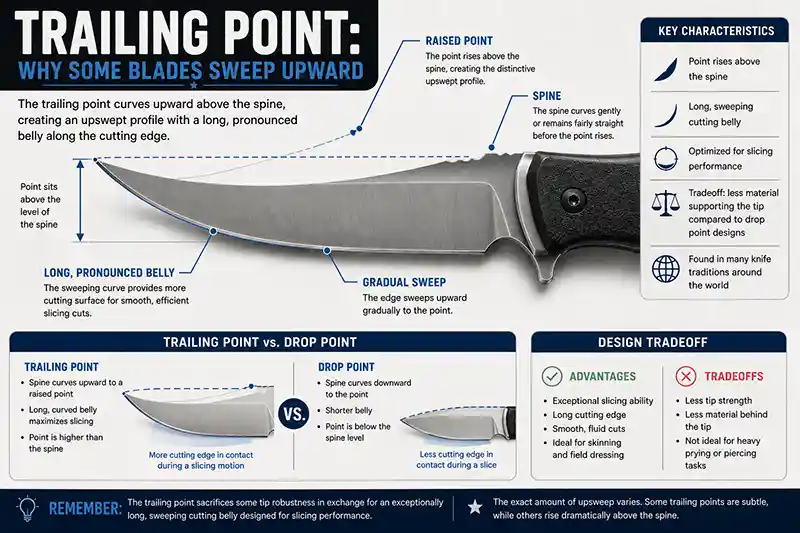
The trailing point is almost the visual opposite of a drop point. Instead of the spine curving downward toward the tip, the point rises above the level of the spine, creating an upswept profile with a long, pronounced belly along the cutting edge. The name comes from the way the point appears to "trail" behind the upward curve of the blade when viewed from the side.
That exaggerated belly is the feature that most strongly defines how a trailing-point blade behaves. A curved edge provides more cutting surface than a straight line connecting the same two points, and the sweeping profile allows progressively different portions of the edge to contact material during a slicing motion. This is why trailing points have traditionally appeared on knives intended to emphasize slicing rather than simply providing the most robust possible tip.
The design comes with an obvious tradeoff. Raising the point and narrowing the blade toward it can leave less material supporting the tip than on broader profiles such as many drop points. How pronounced that difference becomes depends on the individual knife. Some trailing points have only a gentle upsweep, while others curve dramatically enough that the point sits well above the rest of the spine.
Similar upswept profiles have appeared in knife traditions from different parts of the world, demonstrating that trailing point is better understood as a family of blade geometry than as one design invented at a particular moment. Modern hunting, outdoor, and folding knives continue to use variations of the shape, but its unmistakable silhouette makes the underlying design philosophy easy to recognize: sacrifice some tip robustness in exchange for an exceptionally long, sweeping cutting belly.
Straight Back: One of the Simplest Blade Shapes Ever Made
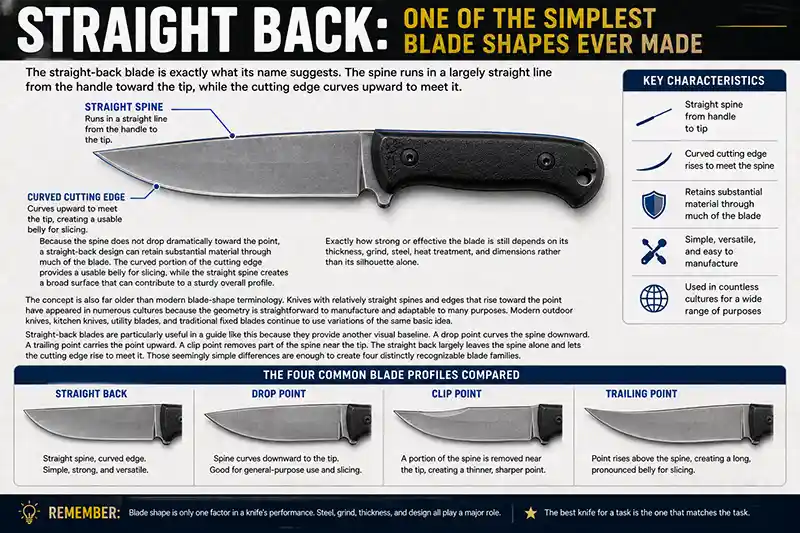
The straight-back blade is exactly what its name suggests. The spine runs in a largely straight line from the handle toward the tip, while the cutting edge curves upward to meet it. Sometimes called a normal blade, this uncomplicated profile is one of the easiest knife shapes to recognize and one of the clearest examples of how little complexity is required to create a practical blade.
Because the spine does not drop dramatically toward the point, a straight-back design can retain substantial material through much of the blade. The curved portion of the cutting edge provides a usable belly for slicing, while the straight spine creates a broad surface that can contribute to a sturdy overall profile. Exactly how strong or effective the blade is still depends on its thickness, grind, steel, heat treatment, and dimensions rather than its silhouette alone.
The concept is also far older than modern blade-shape terminology. Knives with relatively straight spines and edges that rise toward the point have appeared in numerous cultures because the geometry is straightforward to manufacture and adaptable to many purposes. Modern outdoor knives, kitchen knives, utility blades, and traditional fixed blades continue to use variations of the same basic idea.
Straight-back blades are particularly useful in a guide like this because they provide another visual baseline. A drop point curves the spine downward. A trailing point carries the point upward. A clip point removes part of the spine near the tip. The straight back largely leaves the spine alone and lets the cutting edge rise to meet it. Those seemingly simple differences are enough to create four distinctly recognizable blade families.
Sheepsfoot: The Blade Designed Without a Traditional Point
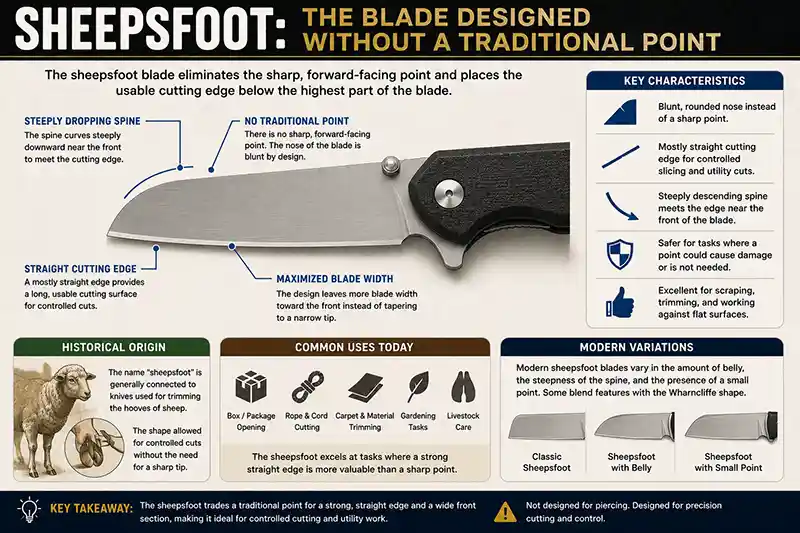
The sheepsfoot stands apart from most of the blade shapes we have covered because its defining feature is something it largely eliminates: a sharp, forward-facing point. Instead of tapering toward the tip from both directions, the spine curves steeply downward near the front of the blade until it meets a mostly straight cutting edge. The resulting profile has a blunt-looking nose and places the usable edge below the highest part of the blade.
Historically, the name is generally connected to knives used for trimming the hooves of sheep. Whether every modern sheepsfoot can trace its ancestry directly to that particular task is less important than the design principle the shape represents. By minimizing the conventional point while retaining a useful cutting edge, the blade could perform controlled cutting tasks where an aggressively pointed tip was unnecessary or undesirable.
The nearly straight cutting edge is another important part of the design. Unlike a drop point or trailing point, which provides a pronounced curved belly, a traditional sheepsfoot concentrates much of its edge along a relatively straight line. This makes the profile well suited to controlled slicing and utility cuts against flat surfaces. The steeply descending spine also leaves considerable blade width toward the front rather than tapering gradually into a narrow tip.
Modern designers have stretched the definition considerably. Some contemporary sheepsfoot blades include more belly, a less abrupt spine, or a small but functional point, while others blend characteristics of the sheepsfoot and Wharncliffe. Even with those variations, the classic sheepsfoot remains easy to identify: a mostly straight cutting edge combined with a spine that drops dramatically to meet it near the front of the blade.
Wharncliffe: The Straight-Edged Blade With a Real Point
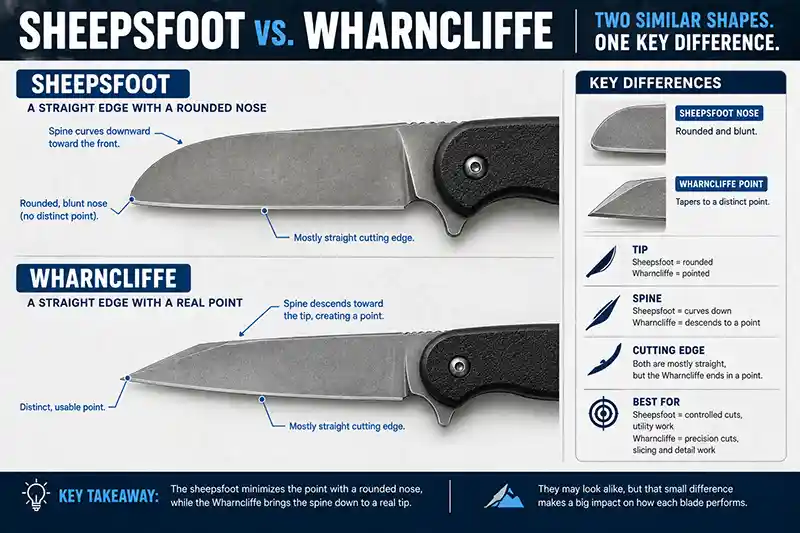
At first glance, a Wharncliffe can look remarkably similar to a sheepsfoot. Both typically feature a mostly straight cutting edge and a spine that descends toward the front of the blade. The crucial difference is what happens at the tip. Instead of ending in the rounded, deliberately subdued nose of a classic sheepsfoot, the Wharncliffe's spine tapers down to meet the cutting edge at a distinct point.
The traditional Wharncliffe profile generally combines that pointed tip with a cutting edge that remains straight or nearly straight for most of its length. Rather than using a large belly to move through material, the edge can maintain consistent contact during controlled cuts. The descending spine simultaneously places the point close to the level of the cutting edge, giving the blade a very different silhouette from a clip point, drop point, or trailing point.
The name has been associated with Lord Wharncliffe in nineteenth-century England, although the precise story behind the blade's origin is less certain than many modern summaries suggest. Folding knives with Wharncliffe-style blades became established during the nineteenth century, and the recognizable profile survived long after the circumstances surrounding its original development faded into history.
Modern Wharncliffes have also become much more diverse. Some retain the long, gradual curve of the traditional spine, while others use abrupt angles, modified points, thicker blades, or small amounts of belly. This has increasingly blurred the boundary between Wharncliffe and sheepsfoot designs. The simplest way to distinguish the classic versions is to look at the front of the blade: a sheepsfoot deliberately minimizes the point, while a Wharncliffe brings the descending spine into a clearly defined tip.
Hawkbill: Why the Cutting Edge Curves Inward
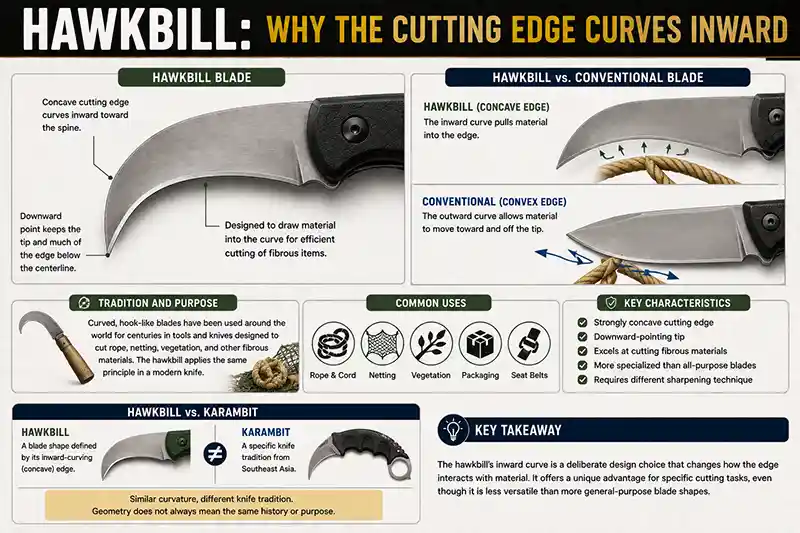
The hawkbill reverses one of the most familiar features of conventional knife design. Instead of the cutting edge bowing outward to form a belly, it curves inward toward the spine, creating a hooked profile reminiscent of a bird of prey's beak. The point is usually carried downward as well, leaving both the tip and much of the cutting edge below the central axis of the blade.
That inward curve changes the way the edge interacts with material. On a conventional outward-curving blade, material can move toward and eventually off the point during a slicing motion. A hawkbill's concave edge tends to draw material deeper into the curve instead. This geometry became particularly useful for specialized cutting tasks involving materials such as rope, cord, netting, vegetation, and other objects that might otherwise slide along a straighter edge.
Hooked blades are far older and more geographically diverse than the modern term "hawkbill knife" might suggest. Curved utility blades and sickle-like cutting tools have appeared in cultures around the world, often because an inward-curving edge is useful when cutting fibrous materials or vegetation. Modern hawkbill knives apply the same fundamental geometric principle in a more compact form.
The profile also helps explain why the karambit is sometimes casually grouped with hawkbill knives. Both use strongly concave cutting edges, but the terms are not interchangeable. The karambit belongs to a distinctive knife tradition associated with Indonesia and the wider Malay world, while hawkbill describes a broader blade-shape concept that appears on many unrelated knife designs. Similar geometry does not necessarily mean identical history or purpose.
The same curve that makes a hawkbill distinctive also makes it more specialized than an all-purpose profile such as a drop point. Its deeply concave edge behaves differently during broad slicing tasks and can require a different approach to sharpening. The hawkbill is therefore another excellent example of a blade shape created around a particular geometric advantage rather than maximum versatility.
Recurve: When a Blade Combines Two Opposing Curves
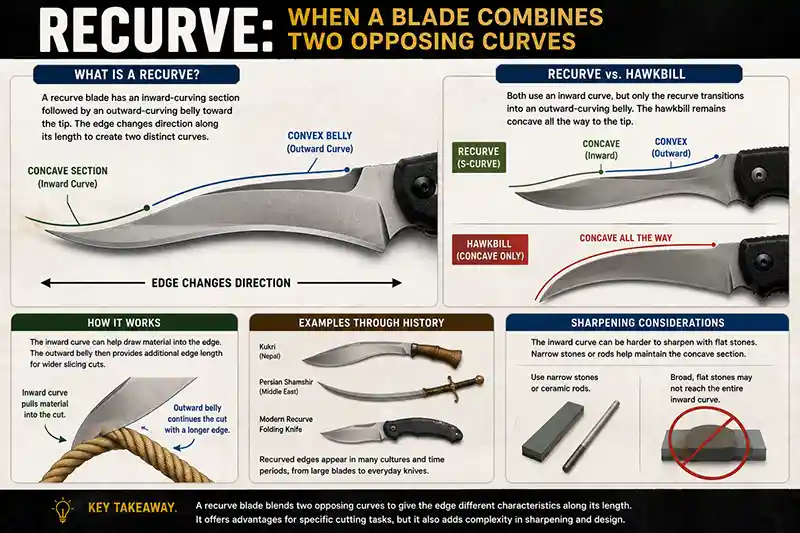
A recurve blade combines an inward-curving section of edge with an outward-curving belly farther toward the tip. Instead of following one continuous arc, the cutting edge changes direction along its length. Viewed from the side, the resulting profile can resemble a shallow wave, with the edge narrowing inward before sweeping outward again toward the front of the blade.
That combination allows different portions of the same edge to present different geometries. The concave section can help keep certain materials engaged with the cutting edge, while the outward-curving belly provides additional edge length for broader slicing motions. How strongly these characteristics are expressed depends on the design. Some recurves have only a subtle inward dip, while others use a deep concave section that becomes one of the blade's most obvious features.
Recurved edges have appeared in many forms throughout history rather than belonging to one particular modern knife design. Large blades such as the kukri demonstrate how dramatic changes in edge curvature can influence the entire silhouette of a weapon, while contemporary folding and fixed-blade knives often use much subtler recurves. Our look at how different cultures shaped some of the worlds most famous knives explores how geography, tradition, and intended purpose produced dramatically different blade forms around the world.
There is a practical tradeoff to the extra geometry. A straight or consistently curved edge can generally be sharpened with relatively simple equipment, while the inward section of a recurve may be more difficult to reach with a broad, flat sharpening stone. Specialized rods or narrower sharpening surfaces can better follow the concave portion of the edge. Once again, a visually distinctive blade shape brings advantages in some areas while adding complexity in others.
Kukri: When the Entire Blade Bends Forward
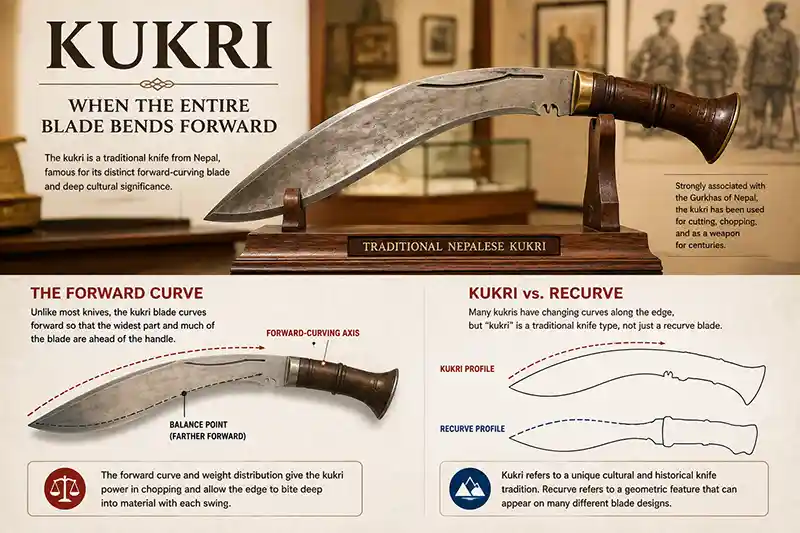
The kukri is difficult to fit neatly into the same categories as a drop point, clip point, or Wharncliffe because its defining feature affects the orientation of the entire blade. Instead of simply curving the cutting edge inward or outward, the characteristic kukri profile bends forward so that much of the blade and its widest section sit ahead of the handle. This forward-curving shape gives the kukri one of the most recognizable silhouettes in the world of traditional knives.
Kukris are most strongly associated with Nepal and particularly with the Gurkhas, although examples vary considerably in dimensions, curvature, weight, and construction. The design has a long history as both a practical cutting tool and a weapon, and it remains an important cultural object in Nepal. Trying to define one exact "correct" kukri profile is therefore difficult because surviving historical examples and modern working kukris show substantial variation.
From a geometric standpoint, the forward curve changes where the blade carries its mass relative to the hand. Many kukris broaden toward the front, concentrating a significant portion of their weight farther along the blade than a conventional straight knife. Their cutting edges can also combine changing curves along their length, but this does not mean that every kukri should simply be classified as a recurve. "Kukri" describes a distinctive traditional knife with its own history, while "recurve" describes a geometric feature that can appear on many unrelated blades.
This distinction is important throughout any discussion of blade shapes. Some names, such as drop point and trailing point, primarily describe geometry. Others, including kukri and karambit, refer to culturally and historically distinct knife traditions whose blades happen to possess recognizable shapes. Treating every unusual traditional knife as nothing more than a modern blade-profile category can erase much of the history that made the design distinctive in the first place.
Karambit: The Claw-Shaped Blade With Southeast Asian Roots
Few knife profiles are as instantly recognizable as the karambit. Its blade curves forward and downward into a pronounced claw-like shape, producing a deeply concave cutting edge and a point that turns back toward the direction of the handle. Most modern karambits also feature a prominent finger ring at the end of the handle, although the knife's identity involves more than either of these features alone.
The karambit is most strongly associated with Indonesia and the wider Malay world, where curved knives developed within a much larger tradition of regional blades. Its precise early history is difficult to reconstruct, and modern accounts frequently repeat claims about its origin that are difficult to document. One popular explanation connects the blade to agricultural tools and the claw of a tiger, but those stories should be treated as traditions and interpretations rather than unquestionable historical facts.
From a blade-shape perspective, the karambit shares obvious similarities with the hawkbill. Both use an inward-curving cutting edge that can draw material into the curve rather than allowing it to move easily toward the tip. Yet calling a karambit simply a hawkbill misses an important distinction. Hawkbill describes a general blade geometry, while karambit refers to a culturally distinct knife tradition with characteristic blade and handle designs. The same principle applies to the kukri: traditional knife types cannot always be reduced to the modern geometric categories they happen to resemble.
Karambit blades also vary considerably. Some have extremely tight curves, while others are much broader and more gradual. Modern interpretations include fixed blades, folding knives, compact designs, and heavily modified profiles that may look quite different from traditional examples. That variation makes the karambit particularly useful in a visual guide because it demonstrates how a recognizable blade concept can evolve while retaining enough of its original silhouette to remain immediately identifiable.
Cleaver: When Blade Height Matters More Than a Sharp Point
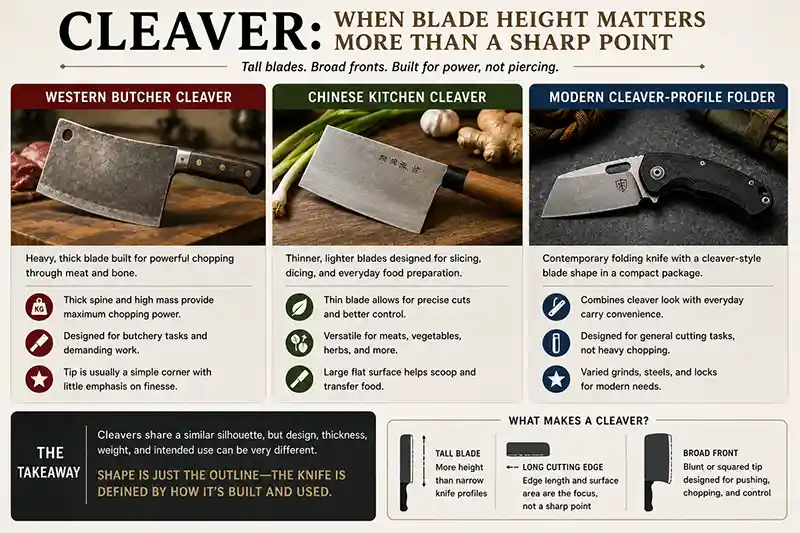
The cleaver takes blade design in almost the opposite direction from narrow profiles such as the clip point or dagger. Instead of tapering aggressively toward a prominent tip, a cleaver typically maintains substantial height across much of the blade and ends in a broad front section. The result is a rectangular or slightly tapered silhouette in which the long cutting edge becomes far more visually important than the point.
Traditional cleavers developed primarily as working tools rather than as one universal blade pattern. Heavy butcher's cleavers use thick, substantial blades suited to forceful chopping, while Chinese kitchen knives that are sometimes called "Chinese cleavers" can be considerably thinner and designed for very different types of food preparation. Similar appearances therefore do not necessarily mean that two cleaver-style blades have the same construction or intended purpose.
The tall blade also creates characteristics that are uncommon among narrower knife profiles. It provides considerable surface area behind the cutting edge and can maintain substantial blade width all the way toward the front. Depending on the design, the tip may be a simple corner, slightly rounded, clipped, or shaped into a more functional point. Modern folding and fixed-blade knives have borrowed this appearance as well, producing compact "cleaver-style" blades that visually resemble traditional cleavers without sharing their dimensions or construction.
This makes the cleaver another useful reminder that silhouette alone never tells the entire story. Two knives may both have tall rectangular blades while differing dramatically in thickness, grind, weight, steel, and intended use. Blade shape provides the outline, but the rest of the knife determines what that outline is actually capable of doing.
Needle Point: When the Blade Narrows Toward an Extremely Fine Tip
The needle point takes the centered geometry of a dagger and stretches it toward an even narrower extreme. Both sides of the blade taper aggressively toward a very fine point, producing a long, slender profile with relatively little belly. Depending on the knife, the edges may be nearly straight as they converge or slightly curved, but the defining characteristic is the dramatic narrowing of the blade toward its tip.
Needle-point geometry is closely related to dagger and spear-point designs, which is why the terms are sometimes confused. A spear point emphasizes a symmetrical overall profile with a point near the centerline. A dagger generally combines that symmetry with two cutting edges. A needle point goes a step further by making the taper particularly long and narrow. These categories can overlap, and historical knives rarely fit perfectly into the terminology used by modern knife manufacturers.
The obvious tradeoff is the amount of material surrounding the tip. A broad drop point or tanto can retain considerable blade width near the front, while a needle point deliberately removes much of that material to create its distinctive slender profile. This makes the shape a particularly clear demonstration of how changing one part of a blade can affect the entire design. Tip geometry, however, still depends on thickness, grind, distal taper, steel, and heat treatment rather than silhouette alone.
Needle-like blades have appeared in various historical daggers and specialized knives, although not every narrow historical dagger should automatically be labeled a modern "needle point." As with several other categories in this guide, the term is most useful as a description of geometry rather than a claim that every blade sharing the shape belongs to one historical family.
Reverse Tanto: A Modern Twist on an Already Modern Blade Shape
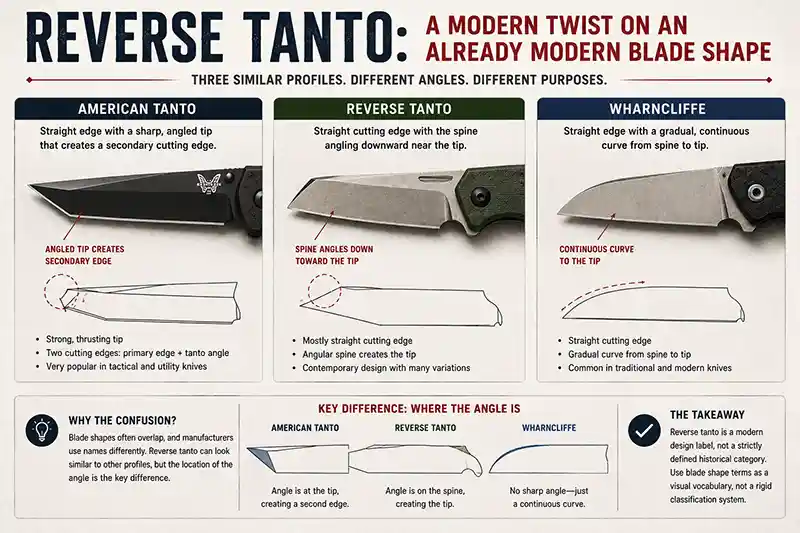
Despite the name, a reverse tanto is not simply an American tanto turned upside down. The term is commonly used for modern blades with a mostly straight cutting edge and a spine that angles sharply downward near the tip. Instead of creating the secondary cutting edge that defines a conventional American tanto, the angular transition occurs primarily along the spine, producing a profile that can resemble a Wharncliffe with a more abrupt, geometric front section.
This is also one of the least standardized names in modern blade terminology. Different manufacturers use "reverse tanto" for noticeably different profiles, and some knives marketed under the name could reasonably be described as modified Wharncliffes or other hybrid designs. Unlike historical knife types with centuries of development behind them, reverse tanto is largely a contemporary design label rather than a precisely defined traditional category.
Many reverse tantos retain considerable blade width until relatively close to the point. The spine then drops at an angle to meet the cutting edge, creating a distinct tip without requiring the long gradual taper seen on a traditional Wharncliffe. Depending on the design, the cutting edge may be almost completely straight or include a modest amount of belly toward the front.
The reverse tanto demonstrates how difficult blade classification becomes once designers begin combining established shapes. A knife can borrow the straight edge of a Wharncliffe, the angular appearance associated with a modern tanto, and proportions unique to the manufacturer while still receiving a single familiar name. Blade-shape terminology is therefore most useful as a visual vocabulary, not a rigid system in which every knife must fit perfectly into one category.
Leaf-Shaped Blades: Why Some Knives Widen Before the Point
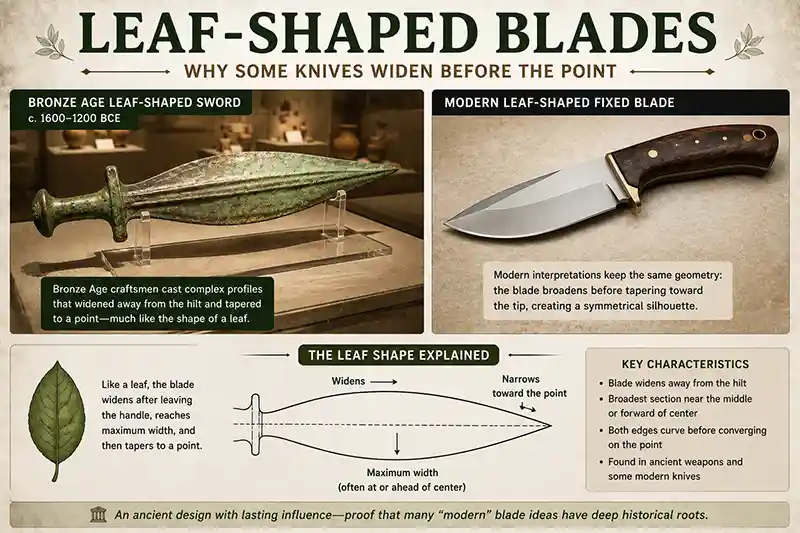
A leaf-shaped blade does something unusual as it moves away from the handle: instead of immediately narrowing toward the point, the blade broadens before tapering again near the tip. This produces the symmetrical or near-symmetrical outline that gives the profile its name. Depending on the design, both the spine and cutting edge may curve outward before converging, creating a wide belly near the middle or forward portion of the blade.
The idea is remarkably old. Leaf-shaped blades appeared prominently during the Bronze Age, particularly on European swords and daggers, although variations of the basic geometry can be found in other places and periods. Bronze weapons could be cast into complex profiles, allowing craftspeople to create blades that widened away from the hilt while still tapering toward a defined point. Some surviving examples make the resemblance to a long leaf unmistakable.
Widening the blade changes both its cutting geometry and the distribution of material along its length. A pronounced leaf shape can create substantial curved cutting edges while retaining a centered point, combining characteristics that are separated in many modern blade categories. The exact effect varies dramatically according to thickness, taper, proportions, and whether the blade is single-edged or double-edged.
Leaf-shaped geometry never disappeared completely. It can still be seen in some modern fixed blades and folding knives, although contemporary versions may be considerably subtler than historical examples. The shape is particularly interesting because it demonstrates that many supposedly "modern" experiments in blade geometry have ancient precedents. Knife makers have been manipulating width, curvature, and point placement for thousands of years.
Modified and Hybrid Blades: When the Categories Start to Break Down
After looking at so many recognizable blade shapes, it would be easy to assume that every knife can be placed neatly into one category. Modern knife design quickly proves otherwise. Manufacturers routinely combine characteristics from established profiles, producing blades that might have the lowered point of a drop point, the straight cutting edge of a Wharncliffe, the angular spine of a reverse tanto, or the inward curve of a recurve all within the same design.
This is why terms such as modified drop point, modified tanto, modified Wharncliffe, and modified sheepsfoot appear so frequently. The word "modified" usually signals that the blade resembles an established profile without following its most traditional geometry. There is no universal formula specifying exactly how much a blade can change before it becomes something else, so classifications sometimes differ between manufacturers, collectors, and knife enthusiasts.
Hybrid designs can also be created for practical reasons rather than simply to look unusual. A designer might add a small amount of belly to a traditionally straight-edged profile, leave additional material behind a narrow point, or alter the spine to change the location of the tip. Modern manufacturing makes it possible to experiment with subtle combinations of curves and angles that would be difficult to communicate using one traditional blade-shape name alone.
For that reason, identifying a blade is often more useful than labeling it. Instead of asking only whether a knife is technically a drop point or a modified Wharncliffe, look at what the geometry is actually doing. Where is the point relative to the centerline? Does the spine rise or fall? Is the cutting edge straight, convex, concave, or a combination? Does the blade widen or narrow as it approaches the tip? Those observations reveal more about the design than the marketing name printed beside it.
Ultimately, blade-shape terminology is a vocabulary rather than a set of laws. The classic profiles in this guide provide useful reference points, but knife makers have been modifying, combining, and reinventing those ideas for centuries. The boundaries between categories are supposed to become blurry because blade design has never stopped evolving.
Knife Blade Shapes at a Glance: Quick Reference Guide
The differences between knife blade shapes become much easier to understand when the profiles are compared side by side. The table below summarizes the defining geometry of the major blade shapes covered in this guide. These descriptions refer to general characteristics rather than strict specifications, since individual manufacturers and historical examples can vary considerably.
| Blade Shape | How to Recognize It | Point Position | Edge Profile | Typical Design Characteristic |
|---|---|---|---|---|
| Drop Point | Spine gradually curves downward toward the tip | Below the spine | Usually convex with moderate belly | Balanced geometry with substantial material near the tip |
| Clip Point | Section of the spine appears clipped away near the tip | Usually near or below the centerline | Often features a pronounced belly | Narrower, more defined point than many drop points |
| American Tanto | Angular transition creates a distinct secondary edge near the tip | Usually near the spine | Two clearly defined edge sections | Maintains considerable blade material toward the front |
| Spear Point | Spine and edge curve toward a centered point | Near the centerline | Symmetrical or nearly symmetrical | Balanced taper toward the point |
| Dagger Point | Two sides taper symmetrically toward the center | On the centerline | Typically double-edged | Strong emphasis on symmetry with relatively little belly |
| Needle Point | Long, narrow blade tapers dramatically toward a very fine tip | On or near the centerline | Usually narrow with minimal belly | Extremely pronounced taper |
| Trailing Point | Tip sweeps upward above the level of the spine | High | Long, strongly convex belly | Maximizes curved cutting-edge length |
| Straight Back | Spine remains largely straight while the edge rises toward it | At the end of the straight spine | Usually convex near the front | Simple profile retaining substantial blade material |
| Sheepsfoot | Spine drops steeply into a rounded or subdued nose | Very low or effectively minimized | Mostly straight | De-emphasizes a traditional pointed tip |
| Wharncliffe | Descending spine meets a mostly straight edge at a distinct point | Low | Straight or nearly straight | Combines a straight cutting edge with a functional point |
| Hawkbill | Blade hooks downward with a strongly inward-curving edge | Low and downward-facing | Concave | Curved edge tends to keep material engaged during a cut |
| Recurve | Cutting edge changes from an inward curve to an outward curve | Varies | Concave followed by convex | Combines two different edge geometries in one blade |
| Kukri | Much of the blade bends forward relative to the handle | Varies by design | Often incorporates changing curves | Forward-curving traditional Nepalese blade with weight carried toward the front |
| Karambit | Pronounced claw-shaped blade, commonly paired with a finger ring | Curves downward and back | Strongly concave | Distinct Southeast Asian knife tradition with recognizable hooked geometry |
| Cleaver | Tall blade maintains substantial height toward a broad front | Usually minimal or formed by a front corner | Long and generally straight or gently curved | Emphasizes blade height and cutting-edge area rather than a narrow point |
| Reverse Tanto | Spine angles sharply downward near the front | Low to moderate | Usually straight or slightly curved | Modern angular profile that often overlaps with modified Wharncliffe designs |
| Leaf Shaped | Blade widens after leaving the handle before narrowing toward the tip | Usually near the centerline | Curved on one or both sides | Maximum blade width occurs near or forward of the middle |
| Modified or Hybrid | Combines recognizable characteristics from multiple established profiles | Varies | Varies | Does not conform neatly to one traditional blade-shape category |
One of the easiest ways to identify an unfamiliar blade is to ignore its name at first and examine four features: the direction of the spine, the location of the point, the curvature of the cutting edge, and how the blade's width changes from heel to tip. Those four characteristics can usually reveal which established profile influenced the design, even when a manufacturer describes it using a different name.
Why Did Knife Blades Evolve Into So Many Different Shapes?
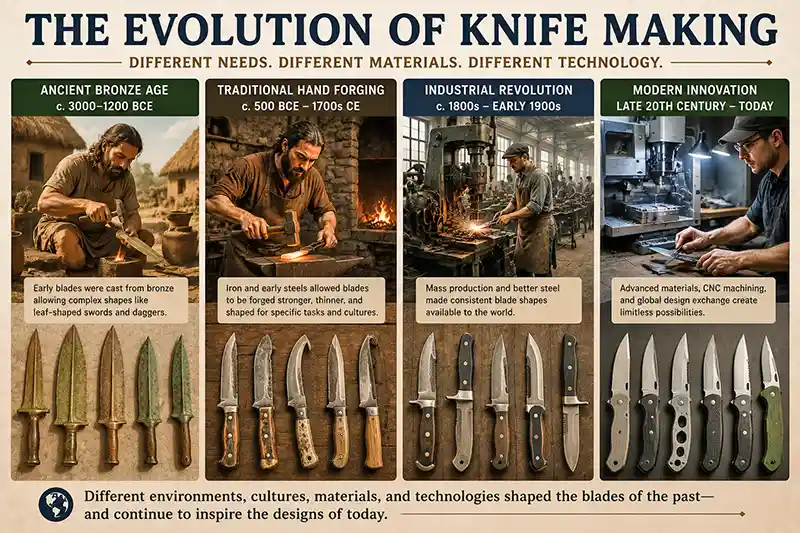
The extraordinary variety of knife blade shapes was not created simply because knife makers wanted their designs to look different. For most of history, a knife was first and foremost a working object. Hunters, sailors, farmers, soldiers, craftspeople, cooks, and countless other users asked their blades to perform different jobs, and generations of makers adjusted their designs accordingly. Change the job, available materials, manufacturing technology, or local traditions, and the ideal blade could change with them.
Environment was one major influence. A blade used frequently around rope, vegetation, hides, wood, or food did not necessarily benefit from the same geometry. This helps explain why hooked blades, broad chopping blades, long slicing edges, narrow points, and compact utility profiles could all prove useful in different circumstances. Sometimes the distinction between a tool and a weapon was not particularly clear either. A practical working knife could become a fighting knife when necessary, while blades associated with combat might still perform ordinary tasks.
Manufacturing technology mattered just as much. Bronze could be cast into shapes that helped produce the distinctive leaf-shaped weapons of the ancient world. Improvements in iron and steel production allowed blades to become thinner, longer, harder, or more specialized. Industrial manufacturing later made highly repeatable profiles practical on an enormous scale, while modern machining has given designers freedom to experiment with complex curves, abrupt angles, and hybrid geometries that would once have required considerably more handwork.
Cultural exchange ensured that these ideas rarely remained isolated. Blades traveled with armies, merchants, explorers, immigrants, and craftspeople. A useful design encountered in one region could influence knife making somewhere else, sometimes being copied closely and sometimes being transformed until it became something distinctly local. That is one reason the history of famous knives is rarely as simple as one person inventing one shape in one place.
Modern knife design adds yet another influence: specialization by choice rather than necessity. A contemporary manufacturer can create several knives for different purposes instead of asking one blade to handle every conceivable task. Designers can therefore emphasize slicing, compactness, edge length, ease of sharpening, tip geometry, appearance, or combinations of those characteristics. Our guide to why throwing knives are shaped differently from regular knives provides an especially clear example of how changing the intended function can transform the entire design.
Ultimately, the enormous variety of blade shapes exists because there has never been one perfect knife. Every profile represents a collection of choices and compromises. The most interesting question is not which blade shape is universally best, but what problem its designer was trying to solve.
Blade Shape Is Only Part of the Equation
A blade's silhouette may be the easiest feature to recognize, but it cannot tell you everything about how a knife will perform. Two knives can share almost identical drop-point profiles while behaving very differently because of their thickness, grind, edge geometry, steel, heat treatment, weight, and overall dimensions. Blade shape determines the outline, but the complete design determines how that outline actually functions.
Blade thickness is one obvious example. A thin blade generally moves through material differently from a much thicker blade with the same profile. The grind matters as well. Flat grinds, hollow grinds, convex grinds, and other geometries determine how the blade transitions from its full thickness toward the cutting edge. Even the final sharpening angle can noticeably change cutting behavior without altering the visible profile at all.
Steel introduces another layer of variables. Different alloys can emphasize characteristics such as toughness, edge retention, corrosion resistance, or ease of sharpening, while heat treatment can significantly affect how a particular steel behaves. That means identifying a knife as a clip point, tanto, or Wharncliffe provides useful information, but it should never be treated as a complete description of the blade.
This is especially important when comparing knives from photographs. A profile can reveal where the point sits, how the edge curves, and how the blade tapers, but it cannot reliably reveal the grind, exact thickness, hardness, or quality of the heat treatment. Understanding blade shapes is therefore best viewed as the first layer of understanding knife design, not the last.
How to Identify an Unknown Knife Blade Shape
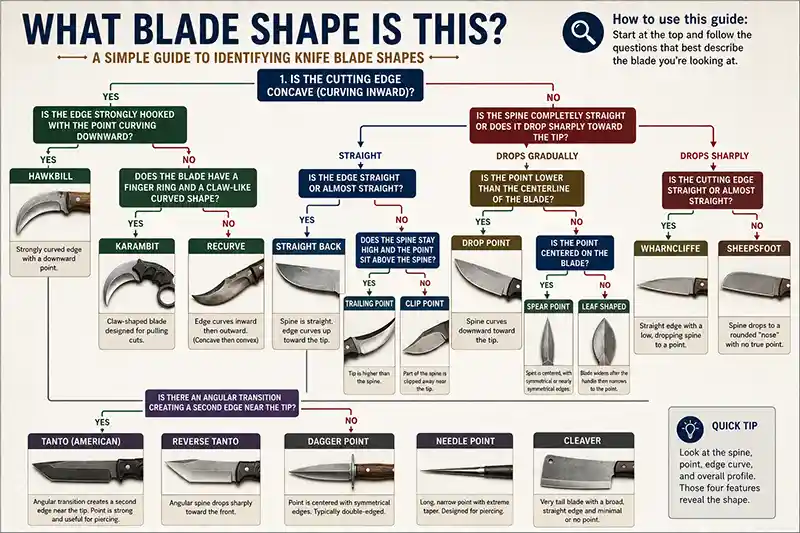
When you encounter a knife whose blade shape you do not recognize, the easiest approach is to ignore the manufacturer's terminology and examine the profile itself. Most blade shapes can be narrowed down by looking at four basic features: the spine, the point, the cutting edge, and the way the blade's width changes from the handle toward the tip.
Start with the spine. If it curves gradually downward, the blade may belong to the drop-point family. If part of the spine appears removed near the tip, look toward a clip point. A spine that remains almost completely straight suggests a straight-back design, while one that descends all the way toward a low point may indicate a Wharncliffe, sheepsfoot, or reverse tanto. The exact path taken by the spine is often the fastest way to eliminate several possibilities.
Next, locate the point relative to the rest of the blade. A centered point suggests profiles such as spear point or dagger, while a point raised above the spine is characteristic of a trailing point. A very low point paired with a straight edge may suggest a Wharncliffe. If there is barely a conventional point at all, a sheepsfoot becomes more likely. An abrupt angular transition near the front, meanwhile, is one of the clearest clues that you may be looking at some form of tanto.
Then examine the cutting edge. Is it mostly straight, continuously convex, strongly concave, or does it change direction? A concave edge immediately narrows the possibilities toward designs such as hawkbills and karambits. An edge that begins concave and transitions into an outward belly suggests a recurve. If the blade itself bends noticeably forward, you may instead be looking at a traditional form such as the kukri rather than a simple geometric profile.
Finally, look at the blade as a whole. Does it widen before tapering toward the point like a leaf-shaped blade? Does it maintain unusual height all the way to a broad front like a cleaver? Does it combine characteristics from several categories? If the answer to that last question is yes, there may be nothing wrong with your identification skills. The knife may simply be a modified or hybrid design.
The goal is not always to find one unquestionably correct label. Blade-shape terminology overlaps, and manufacturers do not use every term consistently. If you can accurately describe what the spine, edge, point, and overall profile are doing, you already understand more about the blade than its name alone can tell you.
The Shape of a Blade Tells a Story
Once you know what to look for, a knife blade stops being simply pointed, curved, or straight. A clipped spine begins to reveal why a clip point looks different from a drop point. A low point and straight edge separate a Wharncliffe from a sheepsfoot. An inward curve distinguishes a hawkbill from more conventional profiles, while the forward sweep of a kukri or claw-like form of a karambit reflects blade traditions with histories much deeper than modern knife terminology.
There is no single blade shape that represents the final evolution of the knife. Every design involves compromises between geometry, materials, dimensions, manufacturing, and intended purpose. A feature that makes sense on one knife may be unnecessary on another, which is exactly why centuries of knife making produced such extraordinary variety instead of converging on one universal profile.
The categories themselves will continue to change. Modern designers routinely combine familiar profiles, revive historical ideas, and create shapes that sit somewhere between established definitions. Future knives will undoubtedly make today's terminology even less tidy. That does not make the terminology useless. It makes understanding the underlying geometry more important than memorizing names.
And that may be the most useful way to look at any unfamiliar blade. Start with its shape, but do not stop there. Look at where the design came from, what materials it uses, how it was constructed, and what its maker intended it to accomplish. Behind every curve, clipped spine, unusual point, and unexpected angle is a design decision, and often a much bigger story about how knives have evolved across cultures and generations.
What Is the Most Common Knife Blade Shape?
The drop point is one of the most common knife blade shapes today, particularly among outdoor knives, hunting knives, fixed blades, and everyday folding knives. Its popularity comes from its relatively balanced geometry. The spine curves downward toward the tip while the cutting edge usually retains enough belly for general slicing, creating a profile that can work well across a wide range of knife designs.
Clip points are also extremely common, particularly on traditional folding knives, Bowie-style knives, and many historical utility and military designs. There is no reliable way to declare one profile the single most common across every type of knife worldwide, but drop point and clip point are two of the most widespread and recognizable blade families.
What Is the Difference Between a Drop Point and a Clip Point?
The easiest way to distinguish a drop point from a clip point is to look at the spine near the tip. On a drop-point blade, the spine gradually curves downward until it meets the cutting edge. On a clip point, part of the spine appears to have been removed or "clipped" away, creating a more abrupt transition toward the point. The clipped section may be straight, curved, or slightly concave depending on the design.
This difference usually gives the two profiles noticeably different tips. Drop points commonly retain more material near the tip, while clip points often taper into a narrower and more pronounced point. Both shapes can have substantial cutting bellies, however, and individual designs vary enough that the distinction is best made by examining the spine rather than judging the cutting edge alone.
What Is the Difference Between a Sheepsfoot and a Wharncliffe Blade?
Sheepsfoot and Wharncliffe blades both typically have a straight or nearly straight cutting edge with a spine that descends toward the front of the blade. The easiest way to tell them apart is to look at the tip. A traditional sheepsfoot has a rounded or subdued nose that minimizes the presence of a sharp point, while a Wharncliffe brings the descending spine down to meet the cutting edge at a distinct point.
Modern versions can make the distinction less obvious. Some modified sheepsfoot blades include a small point, while some contemporary Wharncliffes use more angular profiles than traditional examples. When the categories begin to overlap, the classic difference remains the most useful reference: the sheepsfoot emphasizes a rounded front, while the Wharncliffe retains a clearly defined tip.
Is a Tanto Blade Shape Actually Japanese?
The answer depends on what is meant by "tanto." The historical Japanese tanto is a short blade with centuries of history in Japan, and surviving examples appear in a variety of profiles. However, the sharply angular blade commonly called a tanto on modern folding and fixed-blade knives is generally an American tanto rather than a direct reproduction of the traditional Japanese shape.
The modern American tanto was popularized in the United States during the late twentieth century and drew visual inspiration from Japanese swords and blades while introducing its own distinctive geometry. Its abrupt secondary edge and angular point became so recognizable that "tanto" is now commonly used as shorthand for this modern profile. For that reason, it is useful to distinguish between the historical Japanese tanto as a type of blade and the American tanto as a modern blade-shape category.
What Is the Difference Between a Hawkbill and a Karambit?
Hawkbill and karambit blades can look similar because both commonly feature a strongly inward-curving cutting edge and a downward-hooking point. The important difference is that "hawkbill" primarily describes a blade shape, while "karambit" refers to a distinctive knife tradition associated with Indonesia and the wider Malay world.
A hawkbill blade can appear on many unrelated types of knives and is particularly recognizable for its hooked profile. Karambits commonly share that concave geometry but are also associated with characteristic overall designs, including the curved blade and, on many modern examples, a finger ring at the end of the handle. A karambit can therefore resemble a hawkbill geometrically without the two terms meaning exactly the same thing.
What Is the Difference Between a Recurve and a Hawkbill Blade?
The difference is easiest to see by following the cutting edge from the handle toward the tip. A hawkbill has a predominantly concave edge that curves inward, creating the hooked profile for which the shape is known. A recurve also contains an inward-curving section, but the edge then changes direction and sweeps outward into a convex belly farther along the blade.
This means a recurve combines two opposing curves within the same cutting edge, while a hawkbill emphasizes the inward curve throughout much more of its profile. Some designs blur the distinction, but looking for that transition from concave to convex is usually the quickest way to identify a recurve.
Does Blade Shape Matter More Than Knife Steel?
Neither blade shape nor knife steel can be considered more important in every situation because they influence different characteristics of a knife. Blade shape determines features such as point placement, edge curvature, belly, and the overall distribution of material, while the steel contributes properties such as toughness, edge retention, corrosion resistance, and ease of sharpening.
Performance also depends on factors that neither term describes, including blade thickness, grind, edge geometry, heat treatment, and overall construction. Two knives made from the same steel can behave very differently if their geometry is different, just as two nearly identical blade profiles can perform differently when made from different steels. A useful knife design is therefore the result of these characteristics working together rather than one specification determining everything.
Can the Same Knife Have More Than One Blade Shape?
Yes. Many modern knives combine characteristics from multiple established blade profiles, which is why terms such as modified drop point, modified Wharncliffe, reverse tanto, and hybrid blade are so common. A knife might have the lowered point of one profile, the edge geometry of another, and a spine that does not perfectly match either traditional definition.
Blade-shape categories are descriptive rather than rigid engineering standards, and manufacturers do not always use the terminology consistently. When a knife seems to fit two different categories, examining the actual geometry is often more useful than trying to force it into a single label. The position of the point, direction of the spine, curvature of the edge, and distribution of blade width usually provide a clearer description of the design.
Which Knife Blade Shape Is Best for Everyday Use?
There is no single blade shape that is best for every everyday task, but versatile profiles such as the drop point are popular because they provide a useful balance of cutting edge, belly, point control, and tip robustness. Straight-back, clip-point, and modified Wharncliffe blades can also work well for general utility depending on the size and construction of the knife.
The better approach is to match the blade geometry to the tasks the knife will actually perform. Someone who primarily opens packages and makes controlled utility cuts may prefer a different profile from someone who regularly cuts rope, prepares food, or uses a knife outdoors. Blade shape matters, but size, edge geometry, steel, handle design, and overall construction should be considered alongside it.
Why Are Some Knife Blade Shapes Harder to Sharpen?
Blade shapes with straight or consistently outward-curving edges are generally easier to contact with a conventional flat sharpening stone. Concave edges create a different challenge because a broad, flat stone cannot easily reach the deepest portion of an inward curve. This is why hawkbills, recurves, karambits, and other strongly concave blades may require narrower sharpening surfaces or rods that can follow the curvature of the edge.
Angular profiles introduce another consideration. An American tanto, for example, typically has two distinct cutting-edge sections separated by an abrupt transition. Maintaining that geometry requires treating the sections carefully rather than unintentionally rounding the corner between them. Ultimately, sharpening difficulty depends on more than blade shape, but unusual curves and abrupt changes in edge direction can make certain profiles less straightforward to maintain than a simple straight or gently convex edge.
Are There Any Knife Blade Shapes That Are Completely Modern?
Yes, although determining that a blade shape has absolutely no historical precedent can be difficult. Humans have been making knives for thousands of years, and many profiles that look surprisingly modern have similarities to much older blades. Straight edges, clipped spines, centered points, hooked blades, forward curves, and leaf-shaped profiles all appeared in various forms long before modern knife companies began assigning standardized names to them.
Some categories, however, are strongly associated with modern commercial knife design. The American tanto is a good example because its familiar angular secondary edge was popularized in the late twentieth century rather than being the standard profile of historical Japanese tanto. Terms such as reverse tanto and many "modified" blade classifications are even more clearly products of contemporary knife terminology. Modern designers continue to combine older geometric ideas in new ways, making the evolution of blade shapes an ongoing process rather than a finished chapter of knife history.
Why Do Knife Manufacturers Use Different Names for Similar Blade Shapes?
Knife blade terminology was never created as one universal classification system. Some names developed from historical knife types, others describe the geometry of the blade, and still others became popular through manufacturers, collectors, and the modern knife industry. As a result, two blades with nearly identical profiles may be marketed under different names, while two knives carrying the same blade-shape label may look noticeably different.
Terms such as modified drop point, modified sheepsfoot, reverse tanto, and modified Wharncliffe make the boundaries even less precise. Manufacturers may choose the name that best describes the design, reflects its inspiration, or simply makes sense within their product line. This is why examining the actual spine, point, cutting edge, and overall silhouette is more reliable than assuming a blade must conform perfectly to the name used to describe it.
How Many Different Knife Blade Shapes Are There?
There is no official number of knife blade shapes. Familiar categories such as drop point, clip point, spear point, tanto, trailing point, sheepsfoot, Wharncliffe, and hawkbill provide a useful vocabulary, but they represent only some of the profiles found across historical and modern knives. Traditional regional blades, specialized working knives, and unusual historical designs add many more shapes that do not fit neatly into those categories.
The number becomes effectively impossible to count once modified and hybrid designs are included. Knife makers can change the position of the point, alter the curvature of the spine or cutting edge, adjust blade width, or combine characteristics from several established profiles. It is therefore more useful to understand the major blade-shape families and the geometry that defines them than to search for a definitive list of every blade shape ever created.
What Is the Strongest Knife Blade Shape?
There is no single knife blade shape that can objectively be called the strongest. Profiles that retain substantial material near the point, such as many drop points and American tantos, can have relatively robust tip geometry, but the visible shape is only one factor. Blade thickness, grind, steel, heat treatment, distal taper, and the exact geometry surrounding the tip can matter just as much or more.
This means two knives with the same blade shape can have dramatically different strength characteristics. A thick drop point made from appropriately heat-treated steel is a very different object from an extremely thin drop point designed primarily for slicing. Blade shape can suggest how material is distributed, but strength should never be judged from the silhouette alone.
What Knife Blade Shape Has the Most Cutting Edge?
Blade profiles with pronounced curves can provide more cutting-edge length than a straight edge connecting the same two points. Trailing-point blades are a particularly clear example because their sweeping bellies create a long curved cutting surface. Recurves and other strongly curved profiles can also increase edge length within a relatively compact overall blade.
That does not automatically make a longer cutting edge better. Straight edges can provide excellent control and consistent contact during certain tasks, while deeply curved edges may be more specialized or more difficult to sharpen. Edge length is simply another design variable that knife makers can manipulate depending on what they want the blade to accomplish.
Why Do Some Knife Blades Have a Curved Edge?
Curving a cutting edge changes both its length and the way it contacts material during a cut. An outward-curving belly can provide a longer sweeping cutting surface, which is why pronounced bellies appear on profiles such as trailing points and many drop points. An inward curve behaves differently, tending to draw certain materials deeper into the edge rather than allowing them to slide as easily toward the tip.
Different combinations of curves create even more specialized geometry. Recurves combine concave and convex sections, hawkbills emphasize an inward curve, and traditional knives such as kukris and karambits use curvature as part of much larger culturally distinctive designs. A curved edge is therefore not one feature with one purpose, but a geometric tool that blade makers can apply in very different ways.
What Is the Difference Between Blade Shape and Blade Grind?
Blade shape describes the outline or profile of a blade when viewed from the side. Terms such as drop point, clip point, Wharncliffe, tanto, and trailing point describe features including the spine, cutting edge, point position, and overall silhouette. Blade grind describes how the blade's thickness transitions toward the cutting edge when viewed in cross-section.
Common grinds include flat, hollow, convex, and saber-style grinds, and the same blade shape can be produced with different grinds. A drop-point knife, for example, might use a flat grind on one design and a hollow grind on another. This is why knowing the blade shape alone cannot tell you exactly how a knife will cut. Shape describes the profile, while grind describes another dimension of the blade's geometry.
Can You Identify a Knife Just From Its Blade Shape?
Blade shape can provide useful clues about a knife, but it usually cannot identify the exact knife by itself. Recognizing a clip point, tanto, Wharncliffe, karambit, or other distinctive profile can narrow the possibilities and sometimes suggest a particular knife tradition or general design family. However, countless manufacturers produce knives using similar blade shapes.
Reliable identification usually requires additional details such as the handle, markings, dimensions, materials, locking mechanism, construction, country of origin, and any manufacturer's logo or model number. Historical knives can be even more difficult because similar blade forms sometimes appeared in different cultures and periods. Blade shape is therefore an excellent starting point for identification, but rarely the entire answer.
You May Also Be Interested In:
- A Visual Guide to Knife Grinds: Why Blade Geometry Matters
- The Most Common Pocket Knife Blade Shapes Explained
- The Most Brutal Weapons Ever Designed for Close Combat
- What Is a Karambit Knife? Beginner Guide to Karambits
- 12 Fixed Blade Knives You Should Know About
- Assassin Arm Blade and Other New Weapons
- Karambit vs Push Dagger: Which Blade Would You Bet Your Life On?
- From Garden Tool to Combat Blade: The Evolution of the Kunai
- Why Every Day Should Be an EDC Knife Day: How a Simple Knife Can Make Your Life Easier and Safer
- Best EDC Knife: How to Choose the Right Everyday Carry Knife
Leave a Reply