





The Bizarre Weapons People Once Carried for Self Defense
August 10th, 2026
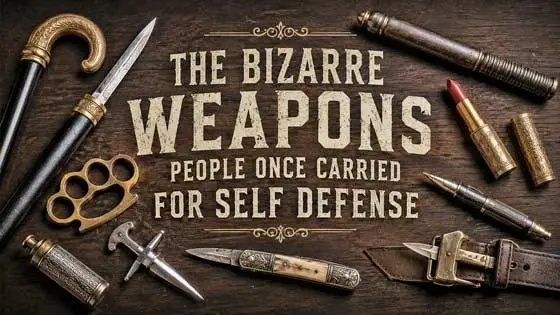
Throughout history, people have carried some surprisingly bizarre objects for protection. Long before modern personal safety devices existed, a walk through a crowded city could mean sharing the street with people carrying sword canes, weighted saps, knuckle dusters, push daggers, disguised knives, and weapons hidden inside seemingly ordinary objects. Some were elegant enough to pass as fashion accessories, while others looked like inventions dreamed up by someone expecting trouble around every corner. What makes these weapons especially fascinating is that many were not created for soldiers or battlefields. They were designed for ordinary people who wanted protection while going about their daily lives. Here are some of the strangest self-defense weapons people actually carried.
The Sword Cane: When a Walking Stick Hid a Blade
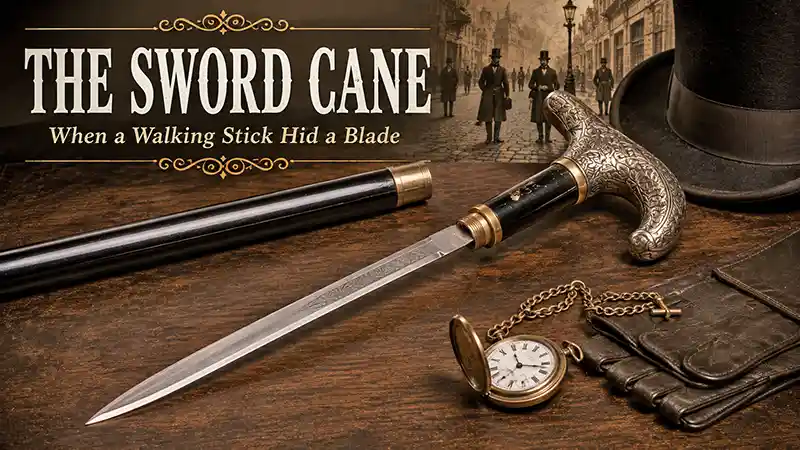
Few self-defense weapons blurred the line between fashion accessory and concealed weapon quite like the sword cane. To anyone passing on the street, it could look like an ordinary walking stick carried by a well-dressed gentleman. Pull the handle away from the shaft, however, and the cane could reveal a long, narrow blade hidden almost completely from view.
Sword canes became especially associated with Europe during the 18th and 19th centuries, when carrying a walking stick was fashionable even for men who did not actually need one for support. That made the cane an ideal object for concealment. Unlike wearing a sword openly, carrying a cane attracted virtually no attention.
Some examples were remarkably elaborate. Wealthy owners could purchase canes with silver handles, carved wood, decorative engraving, or finely made blades. Others were much more utilitarian. The basic idea was always the same: transform an ordinary object into something completely unexpected.
The sword cane was part of a much broader fascination with weapons disguised as everyday objects. Guns were hidden inside canes, blades appeared inside umbrellas, and manufacturers experimented with countless ways to disguise defensive weapons as items someone might normally carry.
What makes the sword cane particularly fascinating is how long the concept survived. Even after openly carrying swords disappeared from everyday fashion, the idea of a walking stick doubling as protection remained appealing. The history behind cane swords reveals just how inventive makers became when turning one of the most ordinary accessories of the era into something far less innocent.
The Push Dagger: A Knife Designed to Disappear Into the Hand
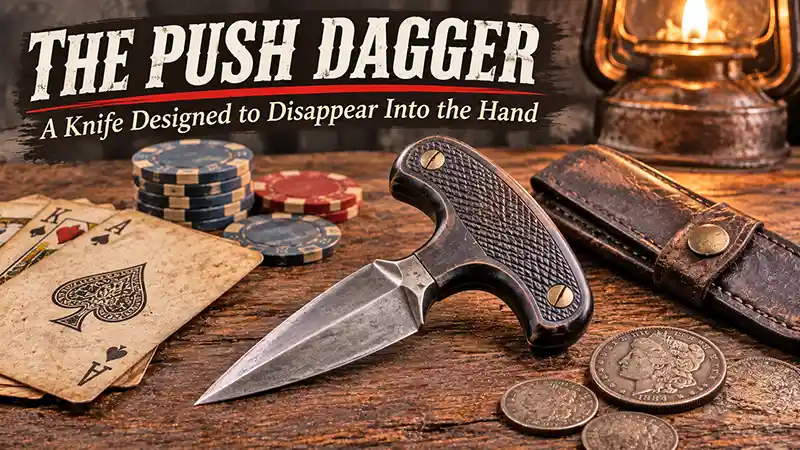
The push dagger looked nothing like the conventional knives most people carried. Instead of placing the handle behind the blade, makers turned it sideways, creating a distinctive T-shaped grip that allowed the blade to project between the fingers when held. When tucked away, the entire weapon could be remarkably compact.
Versions of this unusual design became particularly notorious during the 19th century. Small push daggers were associated with gamblers, travelers, riverboat passengers, and people moving through rough frontier towns where personal protection was often treated as an everyday concern. In some parts of the American South, closely related knives became known as "gimlet knives" because of their unusual shape.
Their popularity made sense in an era when concealability mattered. A long knife required a substantial sheath and was difficult to hide beneath fashionable clothing. A compact push dagger could occupy far less space while still being purpose-built as a defensive weapon.
The design also developed an unusually long life. Push daggers appeared in different forms during the Victorian era, resurfaced in military contexts during the World Wars, and eventually became one of the most recognizable compact knife designs still produced today. Their strange evolution is explored further in the history of the push dagger.
More than almost any other weapon on this list, the push dagger demonstrates what happened when historical weapon makers prioritized one quality above almost everything else: fitting as much defensive capability as possible into an object small enough to carry without attracting attention.
Knuckle Dusters: The Weapon Hidden in a Closed Fist
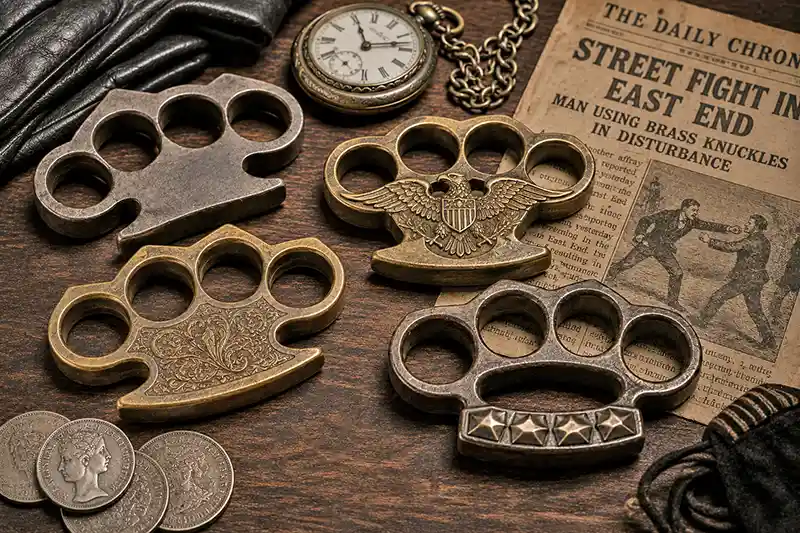
Some historical self-defense weapons relied on disguise. Knuckle dusters relied on something even simpler: size. Small enough to disappear into a coat or trouser pocket, they transformed an object barely larger than the wearer's hand into one of the most recognizable street weapons of the 19th and early 20th centuries.
Metal knuckle weapons existed in various forms long before the Victorian era, but industrial manufacturing made compact brass and iron versions increasingly accessible. Designs ranged from crude cast-metal pieces to surprisingly ornate examples decorated with engraving, scrollwork, skulls, initials, and other personal touches. Some were even incorporated into knives and other combination weapons.
Their portability was a major reason they became associated with civilians, gamblers, criminals, and anyone expecting trouble in crowded urban environments. Unlike a cane or club, knuckle dusters required almost no additional carrying space. They could remain completely out of sight in a pocket until needed.
They also developed an intimidating cultural identity. Brass knuckles became fixtures of newspaper crime reports, bare-knuckle mythology, gang imagery, and eventually movies and popular culture. That reputation has survived so effectively that the silhouette alone is instantly recognizable more than a century later.
Interestingly, the debate surrounding brass knuckles as self-defense weapons continues today. What began as an extraordinarily simple piece of metal became one of history's most enduring examples of a weapon designed around a single requirement: make it small enough to carry almost anywhere.
The Blackjack: The Pocket-Sized Club Carried by Cops and Criminals
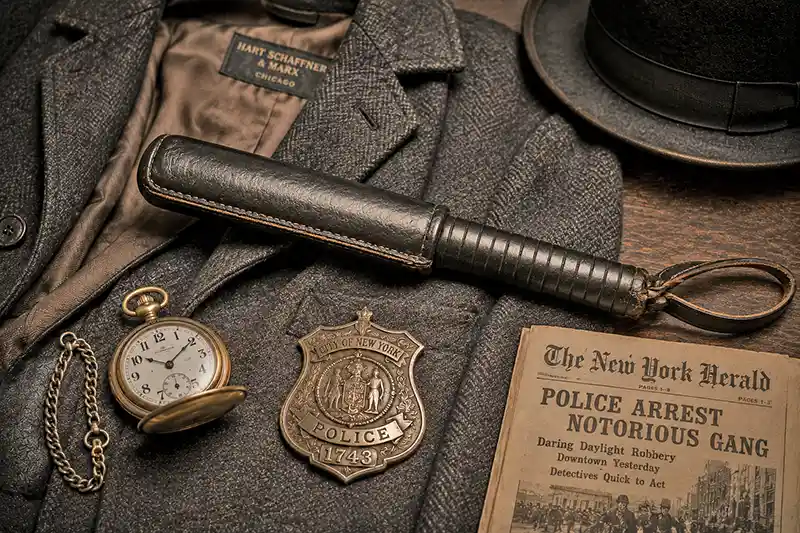
A blackjack could look almost harmless compared with the knives and sword canes on this list. Traditional versions were little more than short leather-covered clubs, often small enough to disappear inside a coat pocket. Hidden beneath that leather, however, was a dense weighted head that made the blackjack far more formidable than its appearance suggested.
By the late 19th and early 20th centuries, blackjacks and closely related leather sap weapons had become particularly associated with American cities. Police officers and detectives carried them because they were compact and convenient, while criminals valued many of the exact same qualities. Few historical weapons became so closely identified with people standing on opposite sides of the law.
The blackjack also fit the changing environment of urban self-defense. A sword was hopelessly conspicuous and even a wooden club could be cumbersome. A blackjack offered something radically different: a purpose-built impact weapon that occupied remarkably little space. Some versions included wrapped grips and wrist loops, while others were shaped almost like small leather paddles.
Its reputation eventually became inseparable from early American policing, organized crime, private security, and detective fiction. The full history of the blackjack is particularly fascinating because the weapon went from commonplace police equipment to something most people today have never seen outside an old movie.
That transformation makes the blackjack one of the strangest weapons on this list. Something once ordinary enough to ride in a police officer's pocket now looks like an artifact from an entirely different world.
The Belt Buckle Knife: A Weapon Hiding in Plain Sight
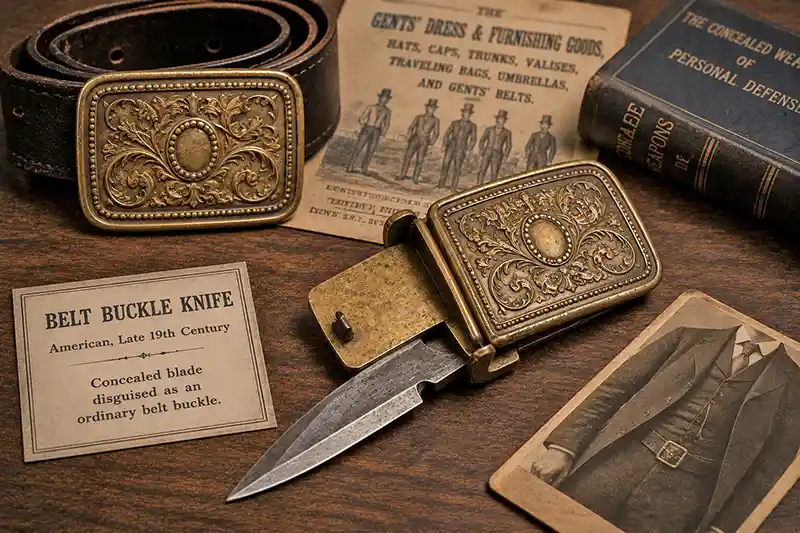
Of all the weapons people have disguised as ordinary clothing, the belt buckle knife may be one of the strangest. At first glance, it could resemble nothing more than an oversized decorative buckle. Hidden within or behind that buckle, however, was a compact blade designed to remain unnoticed while the belt was being worn.
The idea belongs to a much larger tradition of turning everyday accessories into concealed weapons. Belt buckles were particularly well suited to the concept because people already expected them to be made from metal, decorated with unusual shapes, and worn prominently at the waist. A cleverly designed buckle could therefore hide something unusual without necessarily looking out of place.
Different designs approached the problem in remarkably different ways. Some incorporated a small removable knife into the buckle itself, while others used the buckle as a holder for a concealed blade. This variety is part of what makes the history of belt buckle knives so fascinating. There was never just one universal design.
Belt buckle knives also represent the central idea behind many hidden knives: the most effective disguise was often something so ordinary that nobody thought twice about seeing it. Canes, jewelry, writing instruments, clothing accessories, and countless other objects were all adapted around the same principle.
Few examples demonstrate that idea better than the belt buckle knife. Unlike a sword cane, which at least required someone to carry an object in their hand, this weapon could become part of the wearer's clothing itself. It was not merely concealed in a pocket. It was hiding in plain sight.
The Fighting Cane: When the Walking Stick Became the Weapon
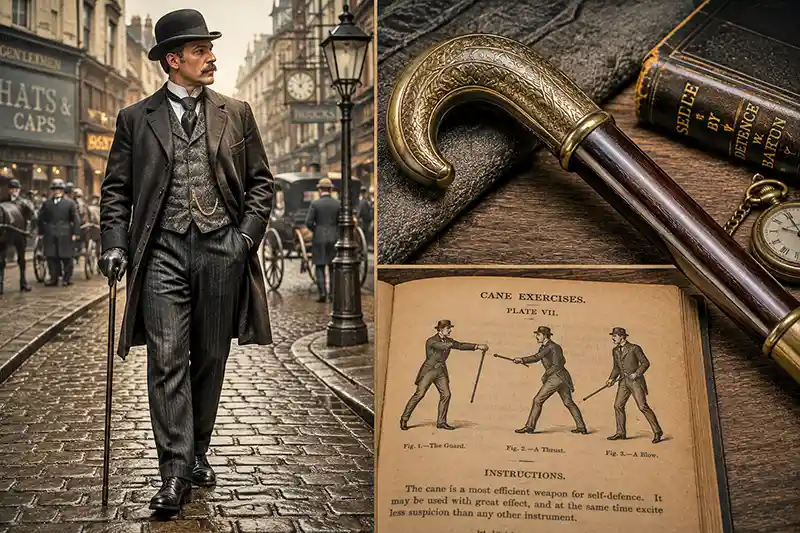
Not every defensive cane needed a hidden blade. In many cases, the cane itself was the weapon. During the 18th and 19th centuries, walking sticks were already common accessories, which meant a sturdy cane could provide both everyday utility and a means of protection without attracting much attention.
Some were designed with unusually heavy handles, reinforced shafts, or hooked grips that made them more useful in a confrontation than an ordinary walking stick. Unlike a sword cane, nothing had to be concealed inside. The object in plain view was already capable of serving a defensive purpose.
That practicality helped inspire entire systems of cane fighting. In Europe, instructors developed methods for striking, blocking, and controlling distance with walking sticks, and by the late 19th century cane defense had even become part of certain formal self-defense systems. The self-defense cane eventually became one of the few historical weapons that could blend so naturally into everyday dress.
The appeal is easy to understand. A cane was socially acceptable, easy to carry, and useful even when no danger was present. That made it very different from most weapons on this list, which had to justify their presence purely as defensive tools.
The tradition still survives in modern martial arts and practical defense training, and the history of the fighting cane shows how something as ordinary as a walking stick could become a surprisingly sophisticated personal-protection tool.
The Apache Revolver: Brass Knuckles, Knife, and Gun in One
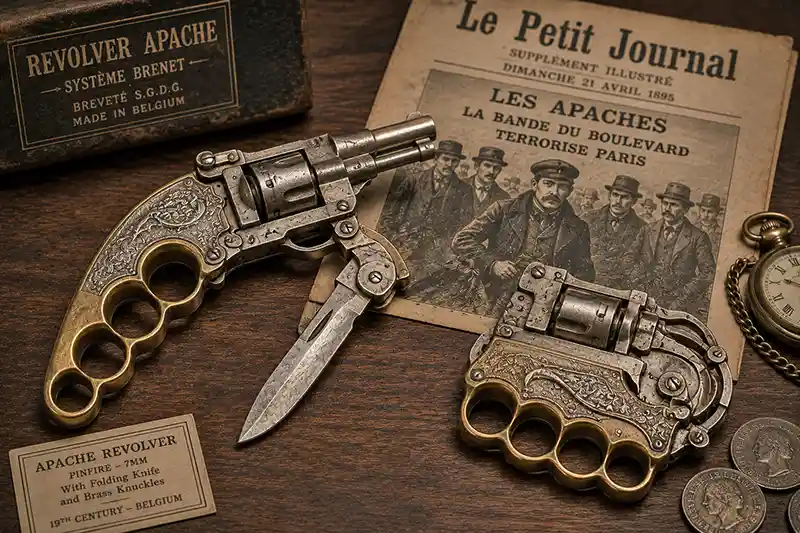
Some historical self-defense weapons were strange because they disguised themselves as ordinary objects. The Apache revolver took the opposite approach. Instead of hiding one weapon inside something harmless, its designers attempted to cram three different weapons into an object small enough to fit inside a pocket.
Developed in Europe during the second half of the 19th century, the best-known examples combined a small pinfire revolver with folding brass knuckles and a short folding blade. When collapsed, the entire contraption formed an unusually compact package. Depending on which component was unfolded, it could function as a firearm, a knife, or a knuckle weapon.
The weapon became popularly associated with the criminal underworld of Belle ??poque Paris, particularly the street gangs that newspapers referred to as "Les Apaches." That connection helped give the unusual combination weapon its enduring nickname, although the popular mythology surrounding exactly who carried these weapons is considerably murkier than their appearance in modern collections might suggest.
What makes the Apache revolver fascinating today is not that it was necessarily better than carrying three separate weapons. In fact, combining so many mechanisms inevitably involved compromises. What makes it fascinating is the sheer ambition of the design. It represents an era when inventors seemed willing to experiment with almost any mechanical solution if it promised to make a defensive weapon smaller, more concealable, or more versatile.
Among all the bizarre personal-protection weapons of the 19th century, few capture that obsession quite like the Apache revolver. Even by Victorian standards, a folding revolver with brass knuckles and a knife attached was an extraordinarily strange thing to put in your pocket.
The Umbrella Sword: The Sword Cane's Even Sneakier Cousin
If hiding a blade inside a walking stick was clever, hiding one inside an umbrella was arguably even more deceptive. During the 19th and early 20th centuries, inventors produced umbrellas and parasols containing concealed blades, turning one of the most ordinary objects on a rainy city street into an unexpected defensive weapon.
The concept worked much like a sword cane. The umbrella's shaft could conceal a long, narrow blade, while the handle served as its grip. With everything assembled, there was little from the outside to suggest that the object was anything other than something intended to keep its owner dry.
Umbrellas offered another advantage as disguises: they were carried by men and women alike. Historical weapon makers were remarkably creative when designing concealed defensive objects, and surviving examples include not only bladed umbrellas but also combination umbrellas incorporating other unusual mechanisms.
These inventions belonged to an era fascinated by ingenious hidden weapons. Makers experimented with everything from weaponized walking sticks to disguised jewelry and clothing accessories, apparently asking the same question again and again: what everyday object could hide something nobody would expect?
The umbrella sword may never have been as widespread as the sword cane, but that almost makes it more fascinating. A sword cane at least looked like an object traditionally associated with personal defense. An umbrella looked like something you carried because the forecast called for rain.
The Hatpin: The Fashion Accessory That Became a Self-Defense Weapon
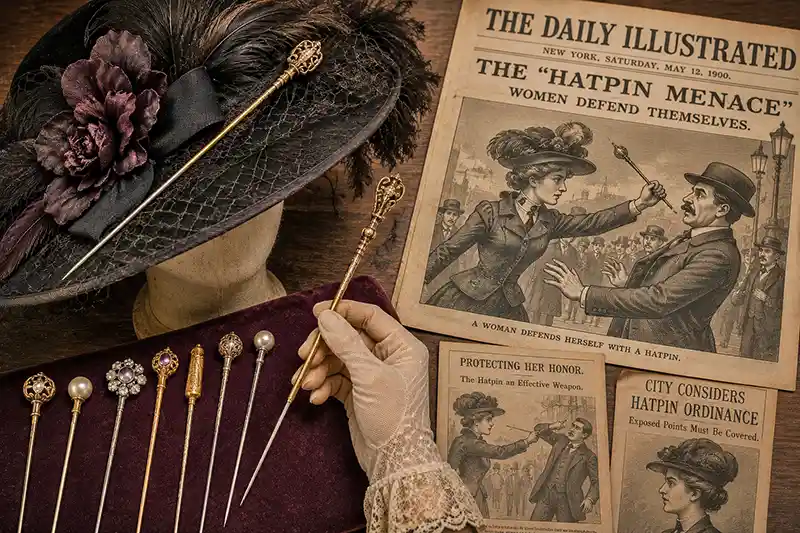
Not every strange self-defense weapon began life as a weapon. Around the turn of the 20th century, enormous decorative hats became fashionable among women in Europe and the United States, and keeping those hats securely attached required something equally dramatic: long metal hatpins that could sometimes extend several inches beyond the hat itself.
The pins were meant to pass through the hat and a woman's hair, but their length and sharp points gave them an unexpected secondary reputation. Newspapers began reporting stories of women using hatpins to defend themselves against aggressive men, thieves, and unwanted advances on crowded streets and public transportation.
The phenomenon became so widely discussed that the hatpin briefly emerged as a symbol of women's independence. Editorial cartoons portrayed women confidently wielding oversized pins, while newspapers debated whether exceptionally long hatpins were themselves a public danger. Several cities eventually considered or enacted restrictions on their length or required exposed points to be covered.
What makes the hatpin especially unusual is that it was never primarily a weapon. It was an ordinary fashion accessory that happened to be sturdy, pointed, and already within reach. In an era when carrying purpose-built personal protection weapons was not practical or socially acceptable for everyone, everyday objects sometimes filled the gap.
Few objects better illustrate how unpredictable the history of self-defense can be. For a brief period, one of the most talked-about defensive objects on city streets was something millions of women were already wearing in their hats.
The Muff Pistol: A Tiny Firearm Hidden in a Fashion Accessory
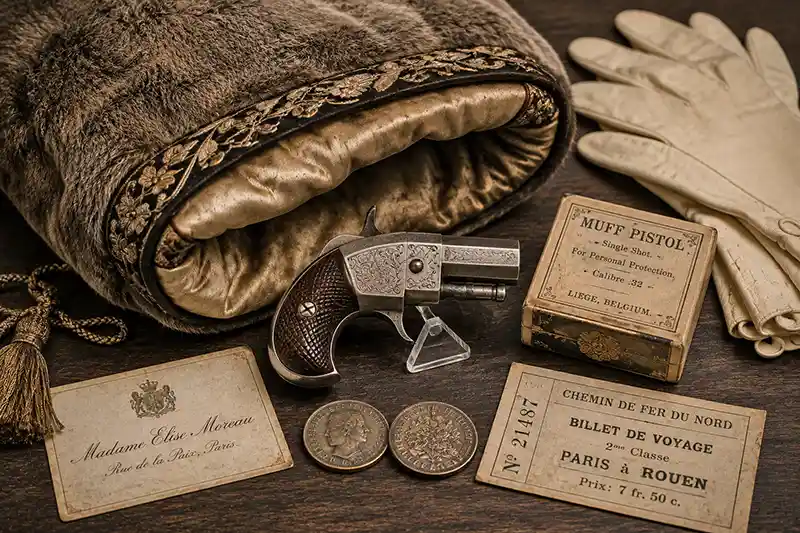
One of the strangest attempts to combine fashion and personal protection appeared in Europe during the 18th and 19th centuries: the muff pistol. These miniature firearms were designed small enough to be carried inside a hand muff, the fur or fabric tube women used to keep their hands warm in cold weather.
Unlike military pistols, muff pistols were built around concealability and convenience. Many were compact single-shot designs with short barrels and folding or minimal grips. Their small size made them easier to carry discreetly in pockets, handbags, or clothing accessories at a time when openly carrying a large pistol would have been impractical for many civilians.
The name can sound almost comical today, but the idea reflected a real concern. Urban travel, stagecoach journeys, and poorly lit streets could be dangerous, and manufacturers responded by creating increasingly compact personal-defense firearms for civilian buyers.
Muff pistols belonged to a broader historical obsession with making everyday carry weapons smaller and easier to conceal. The same instinct later produced pocket pistols, ring guns, disguised knives, and countless other inventions designed to provide protection without the bulk of conventional weapons.
What makes the muff pistol memorable is the contrast. An elegant winter accessory and a tiny firearm seem like objects from completely different worlds, yet for a period of history they could occupy exactly the same pocket of daily life.
The Sleeve Dagger: A Blade Designed to Vanish Beneath Clothing
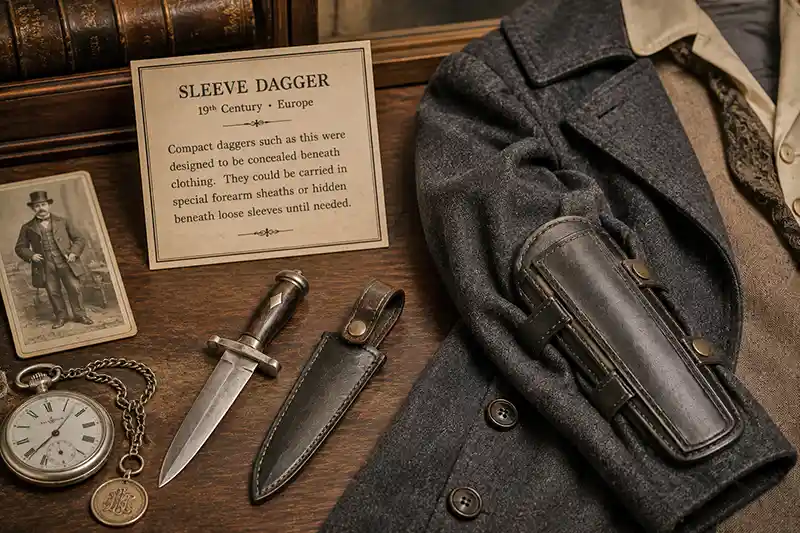
While some concealed weapons were disguised as canes, belt buckles, or jewelry, others relied on an even simpler hiding place: clothing itself. Small daggers and knives could be carried beneath coats, inside specially positioned sheaths, or against the forearm where loose sleeves kept them completely out of sight.
The concept appeared in different cultures and eras rather than belonging to one specific historical weapon. Compact blades were particularly suited to concealed carry because they required little space and could be hidden beneath the layers of clothing common during the 18th and 19th centuries.
Popular fiction eventually transformed the idea into something far more elaborate. Stories, movies, and later games frequently depicted spring-loaded mechanisms that dramatically launched knives into the hand. Historical concealed blades were generally much less theatrical. In most cases, the clever part was simply the sheath, clothing, or method of carry rather than some complicated mechanical deployment system.
That distinction is part of what makes the history of clever concealed knives so interesting. Real weapon makers often favored simple solutions. If a small blade could disappear beneath a sleeve, inside a boot, or behind another ordinary object, an elaborate mechanism was unnecessary.
The sleeve dagger perfectly captures the philosophy behind many historical concealed weapons: sometimes the best hiding place was not inside another object at all. It was simply somewhere nobody expected to look.
The Ring Weapon: When Jewelry Was More Than Decoration
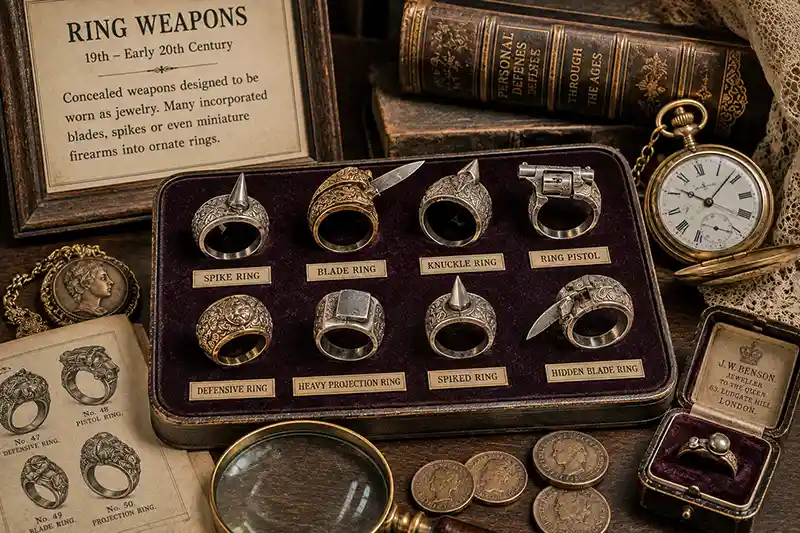
Some of history's smallest defensive weapons were designed to hide in the one place almost nobody would question: on a person's hand. During the 19th and early 20th centuries, inventors experimented with rings that incorporated spikes, blades, heavy metal projections, and even miniature firearm mechanisms.
One particularly unusual category was sometimes described as the defensive or fighting ring. Rather than four finger holes like conventional knuckle dusters, these compact devices could slip over one or two fingers and resemble oversized jewelry. Ornate engraving and decorative metalwork could make some examples look surprisingly fashionable.
Even stranger were so-called ring pistols. A handful of mechanical designs incorporated tiny revolving cylinders or firing mechanisms into objects small enough to be worn or carried like jewelry. These were novelty-sized firearms rather than practical substitutes for conventional pistols, but they demonstrate just how far 19th-century inventors were willing to push the idea of miniaturized personal protection.
These unusual designs belong to the same tradition that produced weapons concealed inside seemingly innocent objects. Watches, rings, belt buckles, canes, and other accessories all attracted inventors looking for increasingly unexpected places to hide defensive devices.
The ring weapon may have been one of the least practical ideas on this list, but it was certainly among the most ingenious. By the late 1800s, apparently even something as small as a piece of jewelry was considered fair game for weapon designers.
The Neck Knife: An Ancient Carrying Idea That Never Really Disappeared
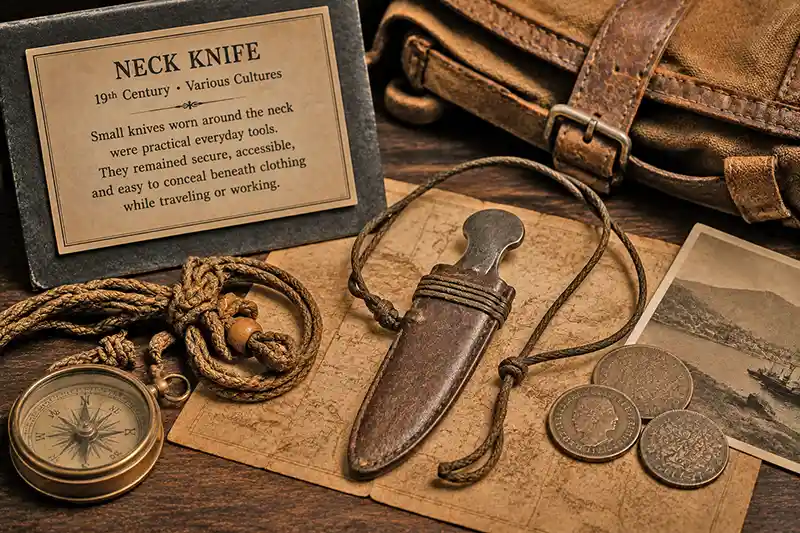
Long before pockets became standard features in clothing, people had to find other ways to keep small tools close at hand. One surprisingly simple solution was to suspend a small knife or sheath from a cord around the neck, placing it beneath clothing or against the chest where it could remain secure while traveling or working.
Neck-carried knives have appeared in different cultures rather than originating from one specific inventor or historical period. Small utility blades were valuable everyday possessions, and wearing one from a cord provided an easy way to prevent it from being lost while keeping it readily accessible.
Unlike the elaborate mechanical weapons elsewhere on this list, the neck knife required no clever engineering. Its effectiveness as a carrying method came from simplicity. A compact blade, a secure sheath, and a cord were essentially all that was necessary.
That same concept survives in modern neck knives, although today's versions often use lightweight synthetic sheaths and modern materials rather than the leather, wood, or other natural materials found historically. The technology changed dramatically while the basic carrying method remained almost identical.
That longevity is what earns the neck knife a place among history's unusual personal-defense weapons. While inventors spent centuries creating increasingly complicated ways to conceal weapons, one of the simplest solutions proved remarkably difficult to improve upon.
The Palm Pistol: A Firearm You Did Not Hold Like a Gun
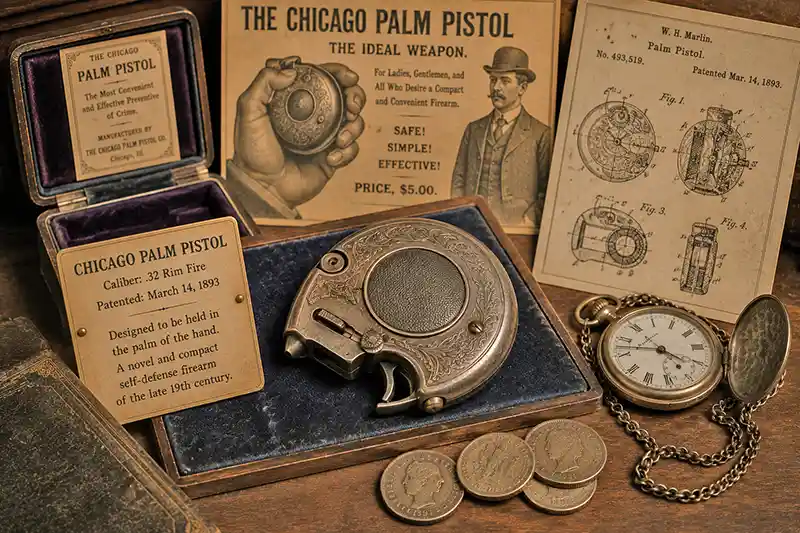
By the late 19th century, inventors had already made pistols small enough to disappear into pockets and purses. Then someone took the idea a step further and designed a firearm that barely resembled a conventional handgun at all. The result was the palm pistol, one of the strangest compact defensive weapons of the era.
Perhaps the most famous example was the Chicago Palm Pistol, patented in the 1890s. Instead of having a traditional grip and trigger, its unusual circular body was designed to sit in the palm of the hand. Its compact shape made it look more like a mechanical gadget than the revolvers most people associated with firearms at the time.
The design reflected an obsession that runs throughout this entire list. Inventors wanted defensive weapons that were smaller, less conspicuous, and easier to carry. Sometimes that meant hiding a blade inside another object. Other times it meant completely rethinking what a weapon was supposed to look like.
Palm pistols never replaced ordinary handguns, and their unconventional shape ultimately became more memorable than their commercial success. Yet that failure is precisely what makes them fascinating today. They represent a period when inventors were willing to experiment with radically different forms in the pursuit of pocket-sized personal protection.
The palm pistol also proves that bizarre historical weapons were not always crude inventions dreamed up in back alleys. Some were patented, manufactured, advertised, and sold to ordinary consumers. The strangest part is imagining someone in the 1890s opening a catalog, seeing one of these peculiar devices, and deciding it was exactly what they wanted to carry.
The Pocket Watch Knife: Hiding a Blade in One of the Most Ordinary Objects
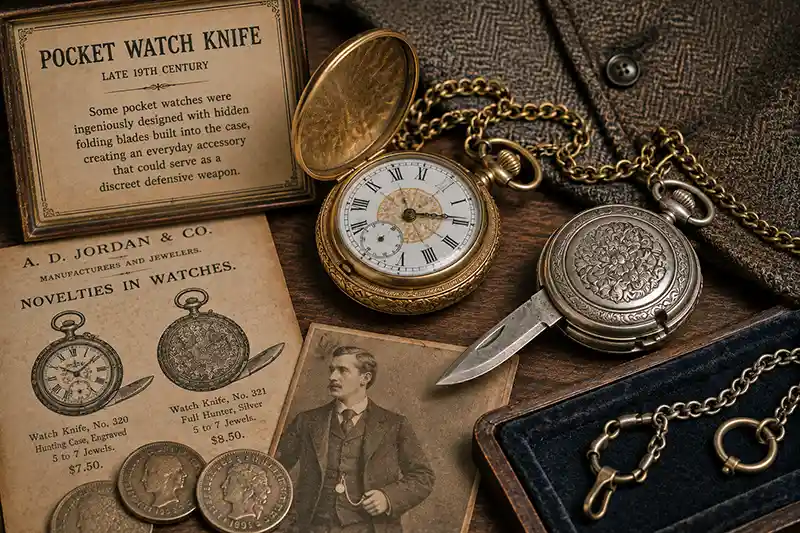
Before wristwatches became commonplace, the pocket watch was one of the most familiar objects a well-dressed person could carry. That familiarity also made watches irresistible to inventors fascinated with concealed weapons. If nobody thought twice about seeing a watch chain hanging from a vest pocket, why not hide something unexpected inside?
Over the years, unusual combination watches appeared with tiny blades, tools, and other mechanisms incorporated into their cases. Some examples blurred the boundary between weapon, novelty, and multipurpose gadget. They were rarely as practical as a conventional pocketknife, but practicality was not always the point.
The appeal was concealment. A small blade integrated into an object already carried every day required no obvious sheath or separate place in a pocket. To an observer, the object could still appear to be an ordinary timepiece until its hidden feature was revealed.
This same obsession produced an astonishing assortment of concealed weapons disguised as accessories. Rings, belt buckles, canes, umbrellas, and other familiar objects all became candidates for experimentation as inventors searched for increasingly clever ways to combine ordinary possessions with personal protection.
The pocket watch knife is especially fascinating because it feels surprisingly modern. Today's manufacturers constantly combine tools into smaller and smaller packages. More than a century ago, weapon makers were already pursuing the same basic idea, except they were doing it with brass cases, mechanical watch movements, and tiny pieces of sharpened steel.
The Pistol Cane: When a Walking Stick Hid Something Other Than a Sword
Sword canes may be the most famous weaponized walking sticks, but 19th-century inventors did not stop with blades. Some concealed compact firearms inside the shafts of otherwise ordinary-looking canes, creating one of the strangest personal-defense inventions of the Victorian era: the pistol cane.
These weapons appeared in numerous configurations. Some incorporated a barrel running through the length of the cane, while cleverly disguised controls could be incorporated near the handle. From the outside, particularly elaborate examples could resemble the fashionable walking sticks routinely carried by gentlemen of the period.
Pistol canes belonged to a much larger family of unusual combination weapons. Inventors experimented with walking sticks containing blades, firearms, tools, compartments, and other mechanisms. Few everyday objects inspired quite as much experimentation as the humble cane.
Their existence also reveals why weaponized canes became so fascinating during the 19th century. Walking sticks were everywhere. That made them unusually convenient platforms for inventors trying to combine an acceptable everyday accessory with something unexpected.
Today, surviving pistol canes are more likely to be encountered in museums and antique collections than on city streets. Yet they remain wonderful examples of the extraordinary lengths inventors once went to in their attempt to make personal-defense weapons less obvious.
The Knife Comb: A Grooming Tool With a Hidden Secret
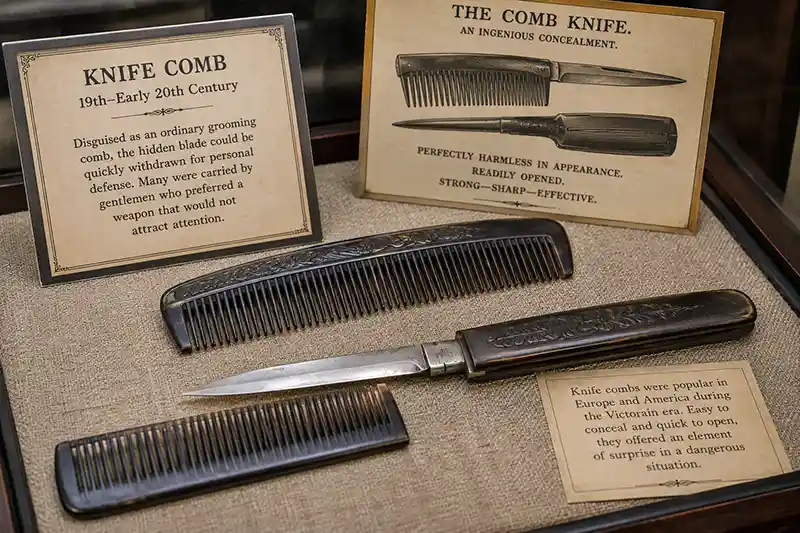
Some concealed weapons worked because they were disguised as objects nobody would normally consider threatening. Few examples demonstrate that idea better than the knife comb, an unusual design that concealed a small blade inside what appeared to be an ordinary grooming accessory.
The concept was remarkably straightforward. The exterior could resemble a conventional pocket comb, while part of the body served as a sheath or handle for a concealed blade. Closed, the object could be mistaken for something carried for completely mundane reasons.
Comb knives belong to a much broader family of disguised blades that appeared in different forms over the years. Manufacturers and individual makers experimented with knives concealed inside pens, belt buckles, walking sticks, jewelry, and other familiar possessions. The more ordinary the disguise appeared, the more intriguing the design became.
That philosophy is still visible in the history of hidden knives. Unlike a conventional knife, where the blade and handle immediately reveal the object's purpose, a disguised knife was designed around surprise. Its appearance was every bit as important as the blade concealed inside.
The knife comb is memorable precisely because the disguise seems almost absurdly mundane. Of all the objects someone might inspect for a hidden blade, a simple pocket comb would probably be fairly low on the list. And that, of course, was the entire point.
The Coin Knife: A Blade Small Enough to Disappear in Your Pocket
The strangest concealed weapons were often the ones designed around objects people already carried without thinking about them. That philosophy eventually produced coin knives, tiny folding blades built into round metal cases that could resemble oversized coins, tokens, or medallions when closed.
Unlike the elaborate sword canes and combination weapons of the 19th century, a coin knife depended on extreme simplicity. The blade folded into the circular body, leaving an object compact enough to slip into a vest pocket or coin purse. Some examples were made primarily as miniature utility knives, while others were marketed around their unusual portability and discreet appearance.
The design is fascinating because it pushed miniaturization almost to its limit. A conventional handle provided plenty of room for a blade and folding mechanism. A circular case did not. Makers therefore had to fit everything into an object barely larger than the blade itself.
Coin knives fit naturally into the long history of unusual everyday carry weapons and tools. Long before modern EDC enthusiasts became obsessed with fitting more functionality into smaller packages, inventors were already experimenting with pocket-sized objects that combined multiple purposes.
They may not have been the most formidable weapons in history, but that is precisely what makes them interesting. The coin knife represents the opposite of an intimidating sword or massive club. Its entire appeal came from being so small and ordinary-looking that someone could easily overlook it completely.
The Pen Knife: When a Writing Instrument Concealed a Blade
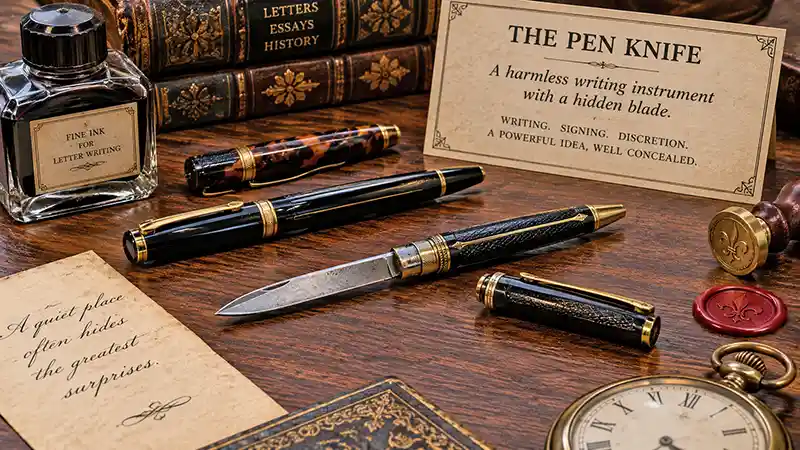
Few objects could look more harmless sitting on a desk than a pen. That made writing instruments another natural target for designers interested in disguised knives. Over time, novelty makers produced pen-shaped objects that concealed narrow blades inside bodies resembling ordinary writing instruments.
The idea should not be confused with the traditional "penknife," a small folding knife originally associated with trimming and sharpening quill pens. A concealed pen knife took the concept much more literally: the writing instrument itself provided the disguise.
Some examples were essentially compact fixed blades with pen-like caps, while others incorporated folding or removable components. Their appearance varied considerably, but the basic principle remained the same. When closed, the object was deliberately shaped so its true purpose was not immediately apparent.
Pen knives belong to the same peculiar family as other cleverly disguised knives hidden inside belt buckles, combs, jewelry, and everyday accessories. Their designers understood that concealment did not necessarily require an elaborate mechanical system. Sometimes an ordinary-looking exterior was enough.
What makes the pen knife such a fitting addition to this list is the contrast between appearance and purpose. A walking stick or heavy belt buckle might at least look substantial. A pen belongs on a desk beside paper and ink. Turning something so mundane into a concealed blade shows just how far the fascination with disguised personal-defense weapons eventually went.
The Key Knife: A Blade Disguised as Something Everyone Carried
Keys were another nearly perfect disguise for a concealed weapon. They were small, made of metal, and expected to be found in a person's pocket. That made the basic shape an obvious candidate for novelty makers who wanted to hide a miniature blade inside an object that would otherwise attract little attention.
Historical and later collectible examples took several forms. Some resembled oversized door keys whose shafts or handles concealed tiny folding blades. Others belonged more to the world of miniature combination tools, using a key-shaped body to disguise or incorporate a cutting edge.
Like many of the smallest weapons in this article, the key knife was limited by the very feature that made it interesting. Making something small enough to resemble an ordinary key left little room for a substantial blade or comfortable handle. The result was ingenious concealment, but considerable compromise.
That tradeoff appears repeatedly throughout the history of hidden weapons. The better an object became at disguising its true purpose, the more its designers often had to sacrifice size, strength, or practicality.
Still, the key knife deserves a place on this list simply because of the audacity of the idea. A cane, umbrella, or belt buckle offered plenty of room to conceal something unexpected. A key offered almost none. Yet inventive makers still found ways to turn one of the smallest objects in a person's pocket into something entirely different.
What Were the Most Common Self-Defense Weapons in the 1800s?
Despite all the bizarre inventions that appeared during the 19th century, most people who carried something for protection relied on far simpler options. Walking sticks, pocket pistols, small knives, clubs, and other compact weapons were considerably more practical than elaborate combination weapons or disguised gadgets.
Many of the strangest weapons that survive in museums today are memorable precisely because they were unusual. An Apache revolver or weapon disguised as an everyday accessory attracts attention in a collection, but that does not mean millions of people were walking around with one.
The historical record therefore reveals an important distinction: the most fascinating self-defense weapons were not necessarily the most popular ones. Often, the ordinary weapons were the ones people actually trusted.
Were Concealed Self-Defense Weapons Actually Common?
Some concealed weapons were genuinely carried, but the historical record can make them seem far more common than they really were. Museums and collectors naturally preserve the strangest examples, which means sword canes, combination weapons, disguised knives, and miniature firearms receive much more attention today than ordinary pocket knives or walking sticks.
There was certainly a market for discreet personal protection, particularly during the 18th and 19th centuries. Manufacturers patented and advertised everything from compact pistols to weapons disguised as fashionable accessories. But many of the most bizarre surviving examples were expensive specialty items, experimental designs, or curiosities rather than objects carried by the average person.
That is part of what makes them so fascinating. These weapons show what inventors believed people might want, even when the designs themselves never became particularly successful.
Why Did So Many Victorian Weapons Look Like Everyday Objects?
Victorian society created an unusual problem for anyone interested in personal protection. Swords were disappearing from everyday fashion, yet walking sticks, umbrellas, watches, jewelry, and other accessories were everywhere. Inventors quickly realized those ordinary objects provided convenient places to conceal something unexpected.
There was also enormous enthusiasm for mechanical invention during the 19th century. Patents were being filed for increasingly clever gadgets, and weapon makers participated enthusiastically. If a blade could be hidden inside a cane, someone inevitably wondered whether one could fit inside a belt buckle, watch, comb, or another everyday possession.
The result was one of the strangest periods in weapon design history. Some inventions were genuinely practical, others were questionable, and a few seem almost absurd today. Together, however, they reveal an era when inventors appeared determined to find out whether virtually anything could be turned into a weapon.
What Is the Strangest Self-Defense Weapon Ever Invented?
The Apache revolver is certainly a contender. This bizarre 19th-century combination weapon managed to incorporate a small revolver, folding blade, and brass knuckles into a single compact device. Even in an era filled with experimental weapon designs, it stood out.
Other strong contenders include ring pistols, palm pistols, pistol canes, and weapons disguised as ordinary clothing accessories. Each represents a different attempt to solve the same problem: how much defensive capability could an inventor squeeze into something small enough to carry discreetly?
There probably is no single winner because "strangest" is subjective. But if a folding revolver attached to brass knuckles and a knife does not qualify, the competition is going to have to be exceptionally weird.
Were Any of These Strange Self-Defense Weapons Actually Effective?
Some were, but many sacrificed practicality in exchange for concealment or novelty. A sturdy fighting cane or conventional pocket knife could be relatively straightforward, while extremely small combination weapons often introduced awkward grips, tiny mechanisms, limited reach, or other compromises.
That is one reason many ingenious designs never replaced conventional weapons. Combining several functions into one object sounded impressive, but every additional mechanism could make the finished device more complicated and less reliable.
In many cases, the greatest achievement was not effectiveness at all. It was engineering. These objects demonstrate just how creative weapon makers could become when challenged to make something smaller, more discreet, or completely unlike the weapons that came before it.
Why Did So Many Strange Self-Defense Weapons Disappear?
Most disappeared for a simple reason: better alternatives existed. As compact firearms, folding knives, and other purpose-built defensive tools improved, there was less reason to rely on complicated combination weapons or elaborate disguises.
Changing fashion mattered too. Sword canes made considerably more sense when gentlemen routinely carried walking sticks, just as a muff pistol belonged to an era when hand muffs were common winter accessories. Once those objects disappeared from everyday life, the weapons designed around them became increasingly conspicuous rather than concealed.
Laws surrounding concealed weapons also changed over time, further reducing the appeal of many designs. What remained were the surviving examples that eventually found their way into museums and private collections.
Ironically, their failure to survive as everyday weapons is part of what makes them so interesting now. They preserve a period when inventors experimented with ideas so unconventional that many seem almost unbelievable today.
Are Strange Historical Self-Defense Weapons Valuable to Collectors?
They certainly can be. Unusual combination weapons, disguised knives, miniature firearms, and other mechanical curiosities often attract collectors because relatively few authentic examples survive. Rarity, condition, craftsmanship, manufacturer, provenance, and historical significance can all have a major effect on value.
The strangest designs can be particularly desirable because they appeal to several collecting communities at once. An unusual Victorian weapon might interest antique-arms collectors, mechanical-device enthusiasts, militaria collectors, or people fascinated by historical oddities.
Authenticity is also extremely important. Reproductions and later novelty versions exist for many famous designs, and an object that looks old is not necessarily an original period piece. For serious collectors, documented provenance and evaluation by a knowledgeable specialist can be considerably more important than appearance alone.
Were These Weapons Legal to Carry?
That depended entirely on the weapon, location, and historical period. Laws governing concealed weapons developed differently from one country, state, and city to another, so there was never a universal rule covering objects such as sword canes, disguised knives, blackjacks, or miniature firearms.
Some jurisdictions became particularly suspicious of weapons designed specifically to conceal their true nature. An ordinary walking stick and a sword cane might look nearly identical from the outside, for example, while being treated very differently under the law.
The same remains true today. Many unusual historical designs are restricted or prohibited in certain jurisdictions even when ordinary knives or other self-defense weapons may be permitted. Anyone interested in owning or carrying one should check the laws that apply where they live rather than assuming that an antique design is automatically legal.
Why Are Disguised Weapons So Fascinating Today?
Part of the fascination comes from the moment of discovery. An antique walking stick is interesting, but realizing that it contains a hidden blade completely changes how you see it. The same is true of a belt buckle, pocket watch, comb, or piece of jewelry that turns out to have a second purpose.
These objects also reveal something about human ingenuity. Weapon makers were solving mechanical problems with limited technology, sometimes fitting surprisingly complicated ideas into objects small enough to disappear inside a pocket or blend into everyday clothing.
Most importantly, they make history feel unpredictable. Museums are filled with swords, armor, and conventional firearms that look exactly like we expect historical weapons to look. The strangest self-defense weapons are memorable because they break those expectations. They remind us that some of history's most interesting inventions were also its weirdest.
Did People Really Carry Weapons Hidden in Their Clothing?
Yes. Clothing provided numerous opportunities for discreetly carrying small weapons, particularly during periods when coats, waistcoats, boots, and layered garments were part of everyday dress. Compact knives, pocket pistols, and other defensive objects could be carried without being immediately visible.
That does not mean elaborate movie-style mechanisms were commonplace. Historical concealment was often surprisingly simple. A small sheath beneath a coat or a compact weapon tucked into a pocket was far more practical than the spring-loaded contraptions popularized by fiction.
In many cases, the clothing itself was not the invention. It simply provided the hiding place.
What Was the Smallest Self-Defense Weapon Ever Made?
There is no definitive winner, but some historical weapons became astonishingly small. Miniature pistols, tiny folding knives, defensive rings, and other palm-sized devices pushed weapon design to extremes during the 19th and early 20th centuries.
Ring pistols are among the strangest contenders. Some designs incorporated extremely small firing mechanisms into devices compact enough to be associated with jewelry. Their tiny size came with enormous practical compromises, however, making them more remarkable as mechanical curiosities than as replacements for conventional weapons.
The race to make weapons smaller eventually reached a point where the engineering was arguably more impressive than the weapon itself.
Were Hidden Weapons Made for Criminals or Ordinary Citizens?
Both groups have been associated with concealed weapons, which is one reason their history is so complicated. Newspapers frequently connected hidden weapons with criminals, assassins, and street gangs, but manufacturers also openly marketed compact defensive weapons to travelers and ordinary civilians concerned about personal protection.
Some weapons acquired particularly sinister reputations that were amplified by sensational newspaper reporting. Others were presented as respectable defensive accessories. The same basic idea could therefore be portrayed as either ingenious personal protection or a dangerous criminal tool depending on who was discussing it.
That tension helped make concealed weapons controversial long before modern debates about them began.
Did Women Carry Different Self-Defense Weapons Than Men?
Sometimes. Fashion and social expectations influenced what men and women could conveniently carry. While a fashionable gentleman might routinely walk with a cane, women had their own everyday accessories that could potentially serve defensive purposes.
Hatpins became the most famous example around the turn of the 20th century. Small pistols were also marketed in compact formats suitable for pockets, purses, and hand muffs. Other everyday objects could become improvised defensive tools when necessary.
These objects are particularly interesting because their history overlaps with changing attitudes toward women's independence and personal safety. The hatpin even became a cultural symbol of a woman capable of defending herself without relying on someone else for protection.
Were Combination Weapons Practical or Mostly Gimmicks?
Usually somewhere in between. Combining multiple weapons into one compact device sounded brilliant, but engineering required compromises. Adding more functions could increase weight, complicate mechanisms, reduce durability, or make each individual component less effective than a purpose-built alternative.
The Apache revolver illustrates the problem perfectly. Combining a revolver, blade, and knuckle weapon produced an unforgettable object, but that did not necessarily make it superior to three conventional tools designed independently.
That helps explain why combination weapons are disproportionately represented in museums rather than in the history of successful military equipment. Their ingenuity made them fascinating. Their compromises often prevented them from becoming mainstream.
What Is the Oldest Concealed Weapon in History?
It is nearly impossible to identify a single "first" concealed weapon because humans were hiding small weapons beneath clothing long before detailed records of weapon design existed. Daggers and compact blades could be concealed beneath robes, cloaks, belts, and other garments thousands of years ago.
Purpose-built disguised weapons are a different matter. These became increasingly sophisticated as craftsmanship improved, eventually producing objects such as sword canes and weapons incorporated into ordinary accessories.
So the basic idea of hiding a weapon is ancient. What changed over time was the ingenuity of the disguise.
Why Were Walking Sticks Turned Into So Many Different Weapons?
Walking sticks offered weapon makers an almost perfect platform. They were long, sturdy, socially acceptable, and already carried in the hand. During periods when fashionable men routinely carried them, simply possessing a cane attracted virtually no attention.
That encouraged an extraordinary range of experimentation. Some walking sticks were reinforced for use as fighting canes, while others concealed blades or incorporated more complicated mechanisms. Craftsmen could also disguise unusual features beneath decorative handles, metal fittings, and ornate shafts.
Few everyday accessories offered such a convenient combination of size and social acceptability. Once inventors recognized that advantage, the humble walking stick became one of history's favorite platforms for unusual weapon designs.
Are There Historical Weapons That Museums Still Cannot Fully Explain?
Absolutely. Museums and private collections contain unusual weapons whose exact makers, dates, intended purposes, or methods of use remain uncertain. Sometimes only a handful of examples survive. In other cases, documentation was never created or disappeared long ago.
This can become particularly complicated with combination and disguised weapons. An unusual mechanism might have been intended for personal defense, hunting, experimentation, novelty, or simply as a demonstration of a craftsman's skill. Without advertisements, patents, correspondence, or other contemporary evidence, modern historians sometimes have to resist the temptation to invent a definitive explanation.
That uncertainty is one of the most fascinating parts of studying strange weapons. Occasionally the artifact survives, but the story explaining why someone made it disappears completely.
You May Also Be Interested In:
- The Weapons People Fear Most (And Whether the Fear Makes Sense)
- What Is a Boot Knife and Why Do People Carry Them?
- Stiletto vs. Switchblade: Why Most People Get Them Confused
- What Is a Neck Knife and Why Do People Carry Them?
- Should Self-Defense Weapons Be Legal?
- Self-Defense Umbrella and Other New Weapons
- The Police Weapon Most People Forgot Ever Existed
- Why Pepper Spray Fails More Often Than People Realize
- 7 Mistakes People Make When Buying Their First Folding Knife
- Non Lethal Self Defense Weapons That Actually Work
Leave a Reply