




Stiletto vs. Switchblade: Why Most People Get Them Confused
July 27th, 2026
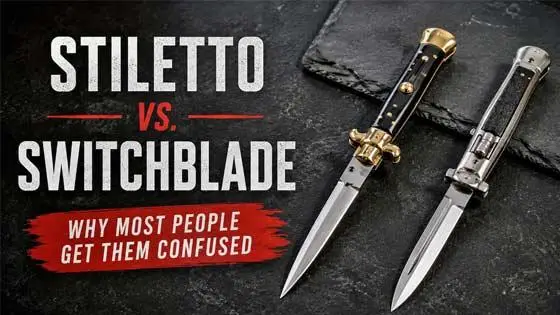
When most people hear the word "stiletto," they picture a switchblade snapping open with the push of a button. Others use the two names interchangeably, assuming they describe the exact same knife. The truth is far more interesting. A stiletto and a switchblade are not competing types of knives at all. One describes a blade's shape and style, while the other describes how the knife opens. Because some famous knives happen to be both, decades of movies, news reports, and everyday conversation have blurred the line between them.
Understanding the difference isn't just about using the correct terminology. It also reveals a fascinating history that stretches from Renaissance Italy to the golden age of Italian automatics and into modern knife design. Once you know what separates a true stiletto from a switchblade, you'll never confuse the two again.
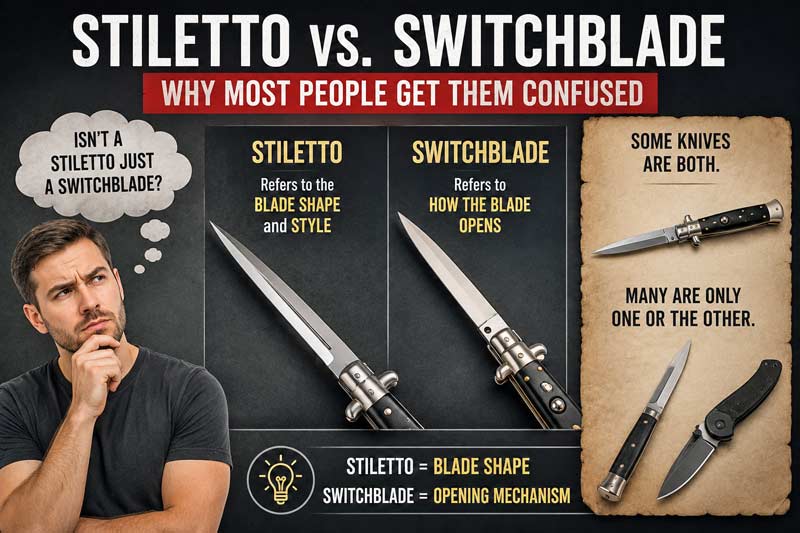
Ask ten people to describe a stiletto knife, and chances are at least half will tell you it's a switchblade. Ask another ten people what a switchblade is, and many will picture the long, needle-like blade of an Italian stiletto. The two names have become so closely linked that they're often treated as if they mean the same thing, even though they describe completely different characteristics of a knife.
The confusion isn't surprising. Some of the most recognizable automatic knives ever made are Italian stilettos, which feature a slender, symmetrical blade and a button that instantly deploys it. For generations, these iconic knives appeared in movies, television shows, and newspaper headlines whenever switchblades were mentioned. Before long, "stiletto" and "switchblade" became interchangeable in the public's mind, even though one refers to a style of blade and the other refers to an opening mechanism.
A simple comparison makes the difference much easier to understand. Imagine describing a sports car. Saying it's a convertible tells you how the roof works, while saying it's a coupe describes its body style. Both descriptions can apply to the same vehicle, but they aren't describing the same feature. Knives work much the same way. A stiletto describes the knife's design, while a switchblade describes how the blade opens. Some knives are both, while many are only one or the other.
This distinction becomes even clearer when you compare a classic stiletto to modern folding knives, fixed blades, and automatic designs. Once you understand the difference, you'll start noticing that many knives commonly labeled as "stilettos" aren't stilettos at all, and plenty of true stilettos aren't switchblades.
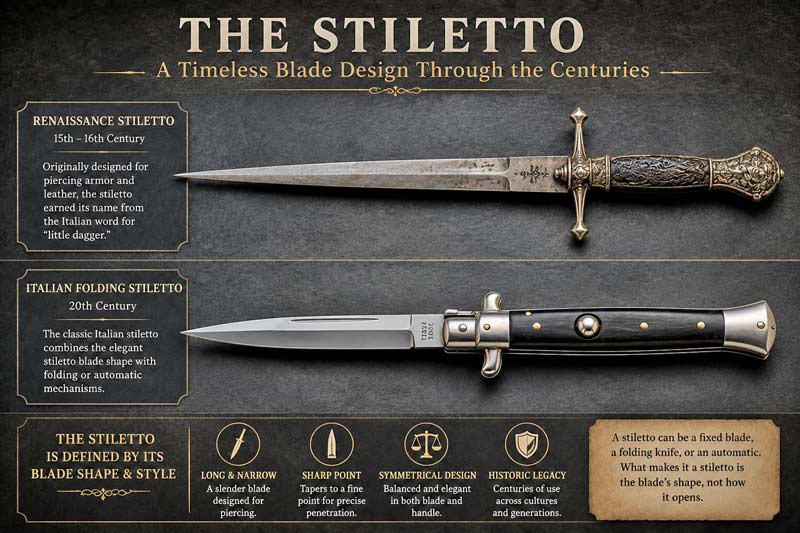
Long before the word "switchblade" entered everyday language, the stiletto had already earned its place in history. The name comes from the Italian word stiletto, meaning "little dagger," and originally referred to a narrow, sharply pointed blade designed for piercing rather than slashing. Early stilettos appeared during the Renaissance, where they were prized for their elegant appearance and their ability to slip through gaps in armor or heavy clothing.
As knife-making evolved, the term "stiletto" continued to describe the knife's distinctive profile rather than how it operated. A traditional stiletto features a long, slender blade that tapers to an exceptionally fine point, often paired with a slim, symmetrical handle. That classic silhouette has remained popular for centuries and is still instantly recognizable today, whether the knife is a fixed blade or a folding design.
This is where many people become confused. A stiletto can be a manual folder, a fixed blade, or an automatic knife. The defining feature is the blade's shape and overall style, not the opening mechanism. In fact, many beautifully crafted fixed blade knives share the same sleek, dagger-like profile as their folding counterparts, while countless modern knives borrow elements of the stiletto design without being true stilettos at all.
Today's collectors are often drawn to Italian-inspired stilettos because they combine timeless craftsmanship with unmistakable elegance. Their influence can even be seen in many of the world's most famous knives, proving that the stiletto is more than just a knife. It's one of history's most enduring blade designs.
Unlike a stiletto, a switchblade isn't defined by its appearance at all. Instead, the name describes a specific type of opening mechanism. A switchblade, also known as an automatic knife, uses an internal spring that deploys the blade when a button, lever, or similar release is activated. Whether the blade is long or short, slender or broad, the defining characteristic is that it opens automatically rather than by hand.
This means a switchblade can take on many different forms. Some resemble the iconic Italian stilettos made famous in films, while others have modern tactical designs, compact everyday carry profiles, or even utility-focused blades. If the knife opens automatically using a spring-powered mechanism, it belongs to the family of automatic knives, regardless of what the blade looks like.
One reason the terminology becomes confusing is that the most famous switchblades ever produced happened to use the classic stiletto blade profile. As those knives grew in popularity during the mid-20th century, many people assumed the words described the same thing. In reality, the mechanism and the blade design are two completely separate features. A knife can have a stiletto blade without being a switchblade, and a switchblade can have a drop point, tanto, clip point, or countless other blade styles.
If you've ever wondered what actually happens inside the handle when the button is pressed, it's worth exploring how automatic knives actually work. Once you see the spring mechanism in action, it becomes much easier to understand why "switchblade" refers to the opening system instead of the knife's shape or style.
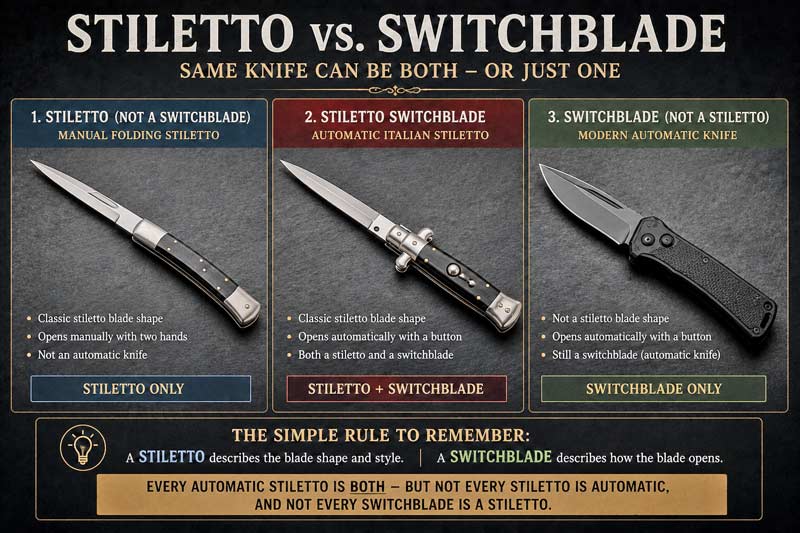
This is where the confusion finally starts to make sense. While a stiletto and a switchblade describe two different things, a single knife can absolutely be both at the same time. In fact, some of the most famous knives ever made fit both definitions perfectly. They feature the classic long, slender stiletto blade while also using an automatic mechanism that deploys the blade with the press of a button.
The best-known examples are the Italian automatic stilettos that became popular after World War II. Their polished bolsters, narrow handles, and spear-point blades gave them a distinctive appearance that stood out from almost every other pocketknife on the market. Because these knives were so widely featured in movies, television shows, and newspapers, many people came to believe that every switchblade looked like a stiletto and that every stiletto was a switchblade.
The reality is much broader. A stiletto can be a manual folder that opens with two hands, while a modern automatic knife may have a completely different blade shape designed for everyday utility. Likewise, many enthusiasts who enjoy classic stiletto knives appreciate them for their timeless styling, whether they're automatic or not. The same is true for collectors interested in the fascinating history of how switchblades became America's most feared knives, where the Italian stiletto played a major role in shaping public perception.
Perhaps the easiest way to remember the difference is this: every automatic stiletto is both a stiletto and a switchblade, but not every stiletto is a switchblade, and not every switchblade is a stiletto. Once you separate the blade's design from the opening mechanism, the terminology becomes surprisingly simple.
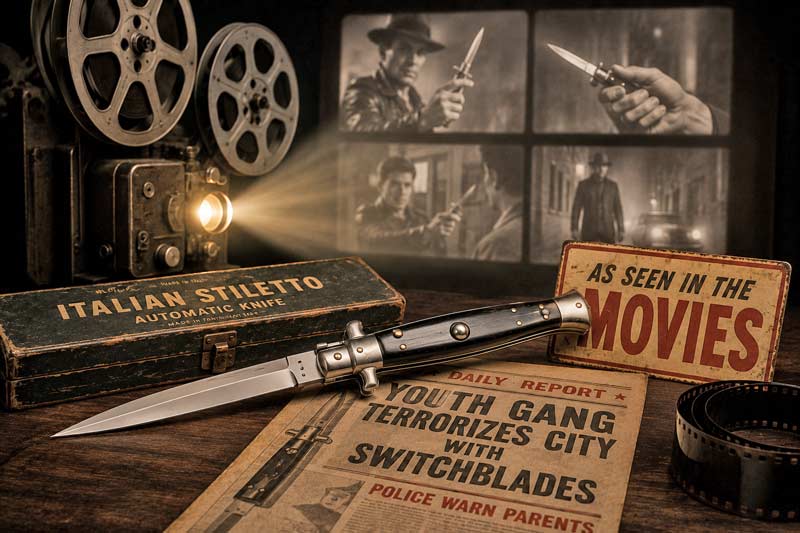
For millions of people, their first introduction to the stiletto did not come from a museum, a knife shop, or a history book. It came from the movies. Hollywood repeatedly placed narrow Italian automatic knives in the hands of gang members, street criminals, and rebellious teenagers. The blade would snap open with a dramatic click, immediately signaling that trouble was about to begin.
Those scenes were memorable, but they quietly erased the distinction between the knife's shape and its mechanism. Because the weapon on screen had a stiletto-style blade and opened automatically, audiences began using "stiletto" and "switchblade" as interchangeable terms. The image became so deeply rooted in popular culture that even people who had never handled either type of knife felt certain they knew exactly what both words meant.
The confusion grew stronger because filmmakers rarely showed the full range of automatic knife designs. Modern switchblades can look rugged, compact, tactical, or surprisingly ordinary, yet the classic Italian profile remained the visual shorthand audiences recognized. Other distinctive folders, including butterfly knives, were given their own exaggerated screen identities, while the automatic stiletto became the universal symbol for every button-operated knife.
This is a perfect example of how culture can reshape the meaning of an object. Knife terminology often develops through a mixture of history, geography, design, and popular storytelling, which is also why different cultures produced such recognizable knife styles. In the case of the stiletto and switchblade, Hollywood did not invent either knife, but it permanently blurred the line between them.
One of the biggest myths surrounding stilettos is that they all have razor-sharp edges on both sides of the blade. While that was true of many historic stilettos carried during the Renaissance, it isn't true of the vast majority of modern knives. Today's stilettos are manufactured with a wide variety of blade grinds, edge configurations, and intended uses.
Many Italian automatic stilettos feature a false edge along the top of the blade. From a distance, it looks like a sharpened second edge, but it's often left unsharpened. This preserves the classic spear-point appearance while making the knife more practical for everyday ownership and use. Some models do feature fully sharpened double edges where legally permitted, but they are far from the standard.
The same flexibility exists with manual stilettos. Since "stiletto" refers to the blade profile rather than a specific construction method, manufacturers can produce single-edge, double-edge, or partially sharpened versions depending on the knife's intended purpose. This is another reminder that blade style and opening mechanism are completely separate characteristics, just as blade style and edge configuration are.
If you're shopping for a stiletto, it's worth looking beyond the name alone. Pay attention to whether the knife is manual or automatic, whether it has a single or double edge, and whether its size and features match how you plan to use it. Those details tell you far more about the knife than the word "stiletto" ever could.
If you're trying to decide between a stiletto and a switchblade, the first question isn't which one is better. It's whether you're choosing a blade style or an opening mechanism. Once you understand that distinction, the decision becomes much easier. A stiletto appeals to people who appreciate classic design and elegant lines, while a switchblade appeals to anyone who values the speed and convenience of automatic deployment.
For collectors, the iconic Italian automatic stiletto remains one of the most recognizable knives ever made. Its polished bolsters, slim profile, and unmistakable silhouette have made it a favorite for generations. If that timeless appearance is what draws you in, you'll likely find yourself browsing a wide selection of stiletto knives before worrying about how they open.
On the other hand, if your priority is practical everyday carry, the opening mechanism may matter more than the blade profile. Modern automatic knives come in dozens of blade shapes that are designed for utility, outdoor use, and general cutting tasks. Many people who want quick one-handed deployment ultimately choose a modern automatic over a traditional Italian design. If you're still comparing options, it's worth learning whether OTF knives are actually reliable before making your decision.
In the end, there's no wrong choice because the two terms aren't competing with one another. A stiletto describes what the blade looks like. A switchblade describes how it opens. Once you separate those two ideas, you'll have no trouble understanding knife descriptions, comparing models, or choosing the one that best fits your collection or everyday needs.
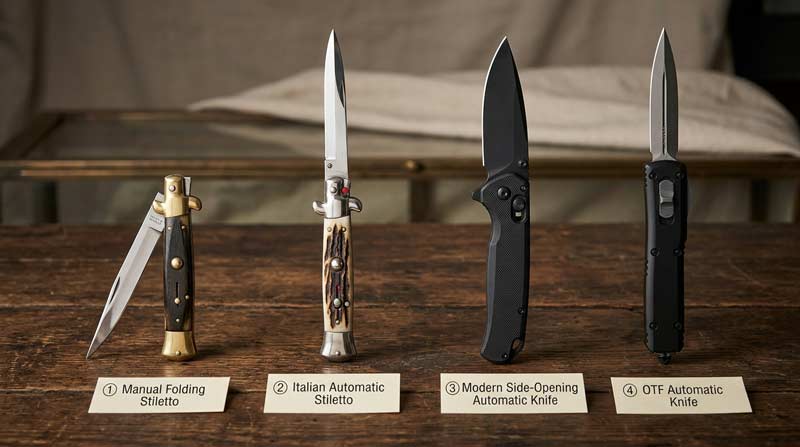
By now, the difference between a stiletto and a switchblade should feel much less mysterious. One describes the blade's shape. The other describes the opening mechanism. If you can remember those two facts, you'll never be confused by knife descriptions again, no matter what you're shopping for or reading about.
An easy way to think about it is to compare knives to cars. Saying a knife is a stiletto is like saying a car is a convertible. It describes the style. Saying a knife is a switchblade is like saying a car has an automatic transmission. It describes how it operates. A convertible can have either a manual or automatic transmission, just as a stiletto can be either manual or automatic.
This same way of thinking applies across the knife world. A Bowie knife describes a particular style of blade. A karambit describes a curved blade shape. An OTF knife describes a front-opening mechanism. Once you stop treating knife names as if they all belong to the same category, the terminology becomes much easier to understand. Whether you're browsing Bowie knives, looking at karambits, or comparing automatic folders, you'll know exactly which names refer to appearance and which refer to function.
The next time someone says, "That's a switchblade," take a second look. Are they describing how the knife opens, or are they simply recognizing the classic silhouette of an Italian stiletto? Chances are, they're making the same mistake that has confused knife enthusiasts and movie fans for decades.
It's easy to see why the terms "stiletto" and "switchblade" became tangled together over the years. The most famous automatic knives ever produced happened to feature classic stiletto blades, and decades of movies, television, and popular culture reinforced the idea that the two words meant the same thing. Once that misconception took hold, it spread far beyond knife enthusiasts and into everyday conversation.
The truth is much simpler. A stiletto is a blade style with a long, narrow profile and pointed tip. A switchblade is a knife that opens automatically using an internal spring. Those two characteristics often appear together, but they don't depend on one another. Understanding that distinction makes it much easier to identify knives accurately and appreciate the design choices behind them.
Whether you're building a collection, searching for your next everyday carry knife, or simply satisfying your curiosity, learning the correct terminology helps you make more informed decisions. It also opens the door to discovering the rich history behind some of the world's most recognizable knives. Once you know what separates blade style from opening mechanism, you'll never look at a stiletto or a switchblade the same way again.
The quickest way is to ask yourself what you're describing. If you're talking about the blade's shape, you're describing a stiletto. If you're talking about how the blade opens, you're describing a switchblade. A knife can be one, the other, or both at the same time.
Yes. A switchblade can have almost any blade shape, including drop point, clip point, tanto, spear point, or even utility-style blades. The defining feature of a switchblade is its automatic opening mechanism, not the shape of the blade. That's why many modern automatic knives look completely different from the classic Italian stilettos that made switchblades famous.
The confusion comes largely from history and popular culture. Many of the most recognizable switchblades made during the 20th century featured classic stiletto blades, especially the iconic Italian automatic knives. As those knives became staples in movies and television, people began treating the two terms as if they meant the same thing. In reality, a stiletto refers to the blade's design, while a switchblade refers to the knife's automatic opening mechanism.
That depends on where you live. Knife laws vary widely between countries, states, and even local jurisdictions. In many places, owning a stiletto with a manual opening is treated differently than owning an automatic switchblade. Blade length, opening mechanism, and how the knife is carried can all affect its legal status. Before purchasing or carrying any knife, it's always a good idea to check the laws that apply in your area.
No. While many of the famous Italian stilettos are automatic switchblades, manufacturers also produce manual-opening stilettos that use traditional back locks, slip joints, or thumb-opening mechanisms. They share the same long, narrow blade profile and classic styling, but they don't use a spring-assisted automatic mechanism. That's why it's important to look at both the blade design and the opening method rather than assuming every Italian stiletto is a switchblade.
The Misunderstanding That Never Goes Away
Ask ten people to describe a stiletto knife, and chances are at least half will tell you it's a switchblade. Ask another ten people what a switchblade is, and many will picture the long, needle-like blade of an Italian stiletto. The two names have become so closely linked that they're often treated as if they mean the same thing, even though they describe completely different characteristics of a knife.
The confusion isn't surprising. Some of the most recognizable automatic knives ever made are Italian stilettos, which feature a slender, symmetrical blade and a button that instantly deploys it. For generations, these iconic knives appeared in movies, television shows, and newspaper headlines whenever switchblades were mentioned. Before long, "stiletto" and "switchblade" became interchangeable in the public's mind, even though one refers to a style of blade and the other refers to an opening mechanism.
A simple comparison makes the difference much easier to understand. Imagine describing a sports car. Saying it's a convertible tells you how the roof works, while saying it's a coupe describes its body style. Both descriptions can apply to the same vehicle, but they aren't describing the same feature. Knives work much the same way. A stiletto describes the knife's design, while a switchblade describes how the blade opens. Some knives are both, while many are only one or the other.
This distinction becomes even clearer when you compare a classic stiletto to modern folding knives, fixed blades, and automatic designs. Once you understand the difference, you'll start noticing that many knives commonly labeled as "stilettos" aren't stilettos at all, and plenty of true stilettos aren't switchblades.
What a Stiletto Really Is
Long before the word "switchblade" entered everyday language, the stiletto had already earned its place in history. The name comes from the Italian word stiletto, meaning "little dagger," and originally referred to a narrow, sharply pointed blade designed for piercing rather than slashing. Early stilettos appeared during the Renaissance, where they were prized for their elegant appearance and their ability to slip through gaps in armor or heavy clothing.
As knife-making evolved, the term "stiletto" continued to describe the knife's distinctive profile rather than how it operated. A traditional stiletto features a long, slender blade that tapers to an exceptionally fine point, often paired with a slim, symmetrical handle. That classic silhouette has remained popular for centuries and is still instantly recognizable today, whether the knife is a fixed blade or a folding design.
This is where many people become confused. A stiletto can be a manual folder, a fixed blade, or an automatic knife. The defining feature is the blade's shape and overall style, not the opening mechanism. In fact, many beautifully crafted fixed blade knives share the same sleek, dagger-like profile as their folding counterparts, while countless modern knives borrow elements of the stiletto design without being true stilettos at all.
Today's collectors are often drawn to Italian-inspired stilettos because they combine timeless craftsmanship with unmistakable elegance. Their influence can even be seen in many of the world's most famous knives, proving that the stiletto is more than just a knife. It's one of history's most enduring blade designs.
What Makes a Knife a Switchblade?
Unlike a stiletto, a switchblade isn't defined by its appearance at all. Instead, the name describes a specific type of opening mechanism. A switchblade, also known as an automatic knife, uses an internal spring that deploys the blade when a button, lever, or similar release is activated. Whether the blade is long or short, slender or broad, the defining characteristic is that it opens automatically rather than by hand.
This means a switchblade can take on many different forms. Some resemble the iconic Italian stilettos made famous in films, while others have modern tactical designs, compact everyday carry profiles, or even utility-focused blades. If the knife opens automatically using a spring-powered mechanism, it belongs to the family of automatic knives, regardless of what the blade looks like.
One reason the terminology becomes confusing is that the most famous switchblades ever produced happened to use the classic stiletto blade profile. As those knives grew in popularity during the mid-20th century, many people assumed the words described the same thing. In reality, the mechanism and the blade design are two completely separate features. A knife can have a stiletto blade without being a switchblade, and a switchblade can have a drop point, tanto, clip point, or countless other blade styles.
If you've ever wondered what actually happens inside the handle when the button is pressed, it's worth exploring how automatic knives actually work. Once you see the spring mechanism in action, it becomes much easier to understand why "switchblade" refers to the opening system instead of the knife's shape or style.
When a Knife Is Both a Stiletto and a Switchblade
This is where the confusion finally starts to make sense. While a stiletto and a switchblade describe two different things, a single knife can absolutely be both at the same time. In fact, some of the most famous knives ever made fit both definitions perfectly. They feature the classic long, slender stiletto blade while also using an automatic mechanism that deploys the blade with the press of a button.
The best-known examples are the Italian automatic stilettos that became popular after World War II. Their polished bolsters, narrow handles, and spear-point blades gave them a distinctive appearance that stood out from almost every other pocketknife on the market. Because these knives were so widely featured in movies, television shows, and newspapers, many people came to believe that every switchblade looked like a stiletto and that every stiletto was a switchblade.
The reality is much broader. A stiletto can be a manual folder that opens with two hands, while a modern automatic knife may have a completely different blade shape designed for everyday utility. Likewise, many enthusiasts who enjoy classic stiletto knives appreciate them for their timeless styling, whether they're automatic or not. The same is true for collectors interested in the fascinating history of how switchblades became America's most feared knives, where the Italian stiletto played a major role in shaping public perception.
Perhaps the easiest way to remember the difference is this: every automatic stiletto is both a stiletto and a switchblade, but not every stiletto is a switchblade, and not every switchblade is a stiletto. Once you separate the blade's design from the opening mechanism, the terminology becomes surprisingly simple.
How Movies Turned Two Different Knives Into One
For millions of people, their first introduction to the stiletto did not come from a museum, a knife shop, or a history book. It came from the movies. Hollywood repeatedly placed narrow Italian automatic knives in the hands of gang members, street criminals, and rebellious teenagers. The blade would snap open with a dramatic click, immediately signaling that trouble was about to begin.
Those scenes were memorable, but they quietly erased the distinction between the knife's shape and its mechanism. Because the weapon on screen had a stiletto-style blade and opened automatically, audiences began using "stiletto" and "switchblade" as interchangeable terms. The image became so deeply rooted in popular culture that even people who had never handled either type of knife felt certain they knew exactly what both words meant.
The confusion grew stronger because filmmakers rarely showed the full range of automatic knife designs. Modern switchblades can look rugged, compact, tactical, or surprisingly ordinary, yet the classic Italian profile remained the visual shorthand audiences recognized. Other distinctive folders, including butterfly knives, were given their own exaggerated screen identities, while the automatic stiletto became the universal symbol for every button-operated knife.
This is a perfect example of how culture can reshape the meaning of an object. Knife terminology often develops through a mixture of history, geography, design, and popular storytelling, which is also why different cultures produced such recognizable knife styles. In the case of the stiletto and switchblade, Hollywood did not invent either knife, but it permanently blurred the line between them.
Do All Stilettos Have Double-Edged Blades?
One of the biggest myths surrounding stilettos is that they all have razor-sharp edges on both sides of the blade. While that was true of many historic stilettos carried during the Renaissance, it isn't true of the vast majority of modern knives. Today's stilettos are manufactured with a wide variety of blade grinds, edge configurations, and intended uses.
Many Italian automatic stilettos feature a false edge along the top of the blade. From a distance, it looks like a sharpened second edge, but it's often left unsharpened. This preserves the classic spear-point appearance while making the knife more practical for everyday ownership and use. Some models do feature fully sharpened double edges where legally permitted, but they are far from the standard.
The same flexibility exists with manual stilettos. Since "stiletto" refers to the blade profile rather than a specific construction method, manufacturers can produce single-edge, double-edge, or partially sharpened versions depending on the knife's intended purpose. This is another reminder that blade style and opening mechanism are completely separate characteristics, just as blade style and edge configuration are.
If you're shopping for a stiletto, it's worth looking beyond the name alone. Pay attention to whether the knife is manual or automatic, whether it has a single or double edge, and whether its size and features match how you plan to use it. Those details tell you far more about the knife than the word "stiletto" ever could.
Which One Should You Buy?
If you're trying to decide between a stiletto and a switchblade, the first question isn't which one is better. It's whether you're choosing a blade style or an opening mechanism. Once you understand that distinction, the decision becomes much easier. A stiletto appeals to people who appreciate classic design and elegant lines, while a switchblade appeals to anyone who values the speed and convenience of automatic deployment.
For collectors, the iconic Italian automatic stiletto remains one of the most recognizable knives ever made. Its polished bolsters, slim profile, and unmistakable silhouette have made it a favorite for generations. If that timeless appearance is what draws you in, you'll likely find yourself browsing a wide selection of stiletto knives before worrying about how they open.
On the other hand, if your priority is practical everyday carry, the opening mechanism may matter more than the blade profile. Modern automatic knives come in dozens of blade shapes that are designed for utility, outdoor use, and general cutting tasks. Many people who want quick one-handed deployment ultimately choose a modern automatic over a traditional Italian design. If you're still comparing options, it's worth learning whether OTF knives are actually reliable before making your decision.
In the end, there's no wrong choice because the two terms aren't competing with one another. A stiletto describes what the blade looks like. A switchblade describes how it opens. Once you separate those two ideas, you'll have no trouble understanding knife descriptions, comparing models, or choosing the one that best fits your collection or everyday needs.
The Simple Trick to Never Confuse Them Again
By now, the difference between a stiletto and a switchblade should feel much less mysterious. One describes the blade's shape. The other describes the opening mechanism. If you can remember those two facts, you'll never be confused by knife descriptions again, no matter what you're shopping for or reading about.
An easy way to think about it is to compare knives to cars. Saying a knife is a stiletto is like saying a car is a convertible. It describes the style. Saying a knife is a switchblade is like saying a car has an automatic transmission. It describes how it operates. A convertible can have either a manual or automatic transmission, just as a stiletto can be either manual or automatic.
This same way of thinking applies across the knife world. A Bowie knife describes a particular style of blade. A karambit describes a curved blade shape. An OTF knife describes a front-opening mechanism. Once you stop treating knife names as if they all belong to the same category, the terminology becomes much easier to understand. Whether you're browsing Bowie knives, looking at karambits, or comparing automatic folders, you'll know exactly which names refer to appearance and which refer to function.
The next time someone says, "That's a switchblade," take a second look. Are they describing how the knife opens, or are they simply recognizing the classic silhouette of an Italian stiletto? Chances are, they're making the same mistake that has confused knife enthusiasts and movie fans for decades.
Final Thoughts
It's easy to see why the terms "stiletto" and "switchblade" became tangled together over the years. The most famous automatic knives ever produced happened to feature classic stiletto blades, and decades of movies, television, and popular culture reinforced the idea that the two words meant the same thing. Once that misconception took hold, it spread far beyond knife enthusiasts and into everyday conversation.
The truth is much simpler. A stiletto is a blade style with a long, narrow profile and pointed tip. A switchblade is a knife that opens automatically using an internal spring. Those two characteristics often appear together, but they don't depend on one another. Understanding that distinction makes it much easier to identify knives accurately and appreciate the design choices behind them.
Whether you're building a collection, searching for your next everyday carry knife, or simply satisfying your curiosity, learning the correct terminology helps you make more informed decisions. It also opens the door to discovering the rich history behind some of the world's most recognizable knives. Once you know what separates blade style from opening mechanism, you'll never look at a stiletto or a switchblade the same way again.
What's the easiest way to tell whether a knife is a stiletto or a switchblade?
The quickest way is to ask yourself what you're describing. If you're talking about the blade's shape, you're describing a stiletto. If you're talking about how the blade opens, you're describing a switchblade. A knife can be one, the other, or both at the same time.
Can a switchblade have a blade shape other than a stiletto?
Yes. A switchblade can have almost any blade shape, including drop point, clip point, tanto, spear point, or even utility-style blades. The defining feature of a switchblade is its automatic opening mechanism, not the shape of the blade. That's why many modern automatic knives look completely different from the classic Italian stilettos that made switchblades famous.
Why do so many people use the words "stiletto" and "switchblade" interchangeably?
The confusion comes largely from history and popular culture. Many of the most recognizable switchblades made during the 20th century featured classic stiletto blades, especially the iconic Italian automatic knives. As those knives became staples in movies and television, people began treating the two terms as if they meant the same thing. In reality, a stiletto refers to the blade's design, while a switchblade refers to the knife's automatic opening mechanism.
Are stilettos and switchblades legal to own?
That depends on where you live. Knife laws vary widely between countries, states, and even local jurisdictions. In many places, owning a stiletto with a manual opening is treated differently than owning an automatic switchblade. Blade length, opening mechanism, and how the knife is carried can all affect its legal status. Before purchasing or carrying any knife, it's always a good idea to check the laws that apply in your area.
Are all Italian stilettos switchblades?
No. While many of the famous Italian stilettos are automatic switchblades, manufacturers also produce manual-opening stilettos that use traditional back locks, slip joints, or thumb-opening mechanisms. They share the same long, narrow blade profile and classic styling, but they don't use a spring-assisted automatic mechanism. That's why it's important to look at both the blade design and the opening method rather than assuming every Italian stiletto is a switchblade.
You May Also Be Interested In:
- Italian Switchblade Stiletto and Other Outlawed Weapons
- What Is a Stiletto Knife and Why Is It So Popular?
- Switchblade vs Automatic Knife: What's the Difference?
- What Is a Boot Knife and Why Do People Carry Them?
- What Is a Neck Knife and Why Do People Carry Them?
- The Bizarre Weapons People Once Carried for Self Defense
- Why Pepper Spray Fails More Often Than People Realize
- The Police Weapon Most People Forgot Ever Existed
- 7 Mistakes People Make When Buying Their First Folding Knife
- The Weapons People Fear Most (And Whether the Fear Makes Sense)
Leave a Reply