





Why Did Some Swords Have Wavy Blades?
August 12th, 2026
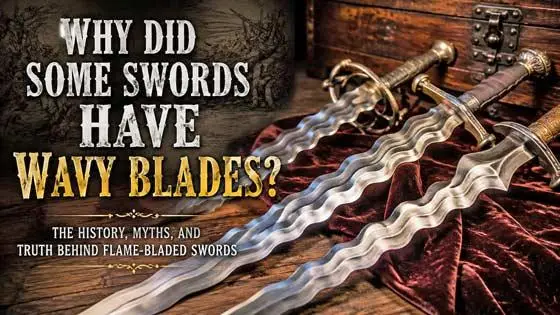
At first glance, a sword with a wavy blade looks like something invented by a fantasy artist. Yet these strange weapons were real, and some of the most dramatic surviving examples were carried in Europe centuries ago. Often described today as flamberges or flame-bladed swords, their rippling edges have inspired claims that they could saw through armor, shatter an opponent's sword, or create violent vibrations when blades collided. The reality is more complicated. Wavy blades appeared on everything from enormous two-handed swords to slender rapiers, and historians still have to separate practical advantages from craftsmanship, intimidation, fashion, and centuries of exaggeration. So why would a swordsmith go through the considerable trouble of forging a blade that looked like fire?
The Wavy Blade Had a Name
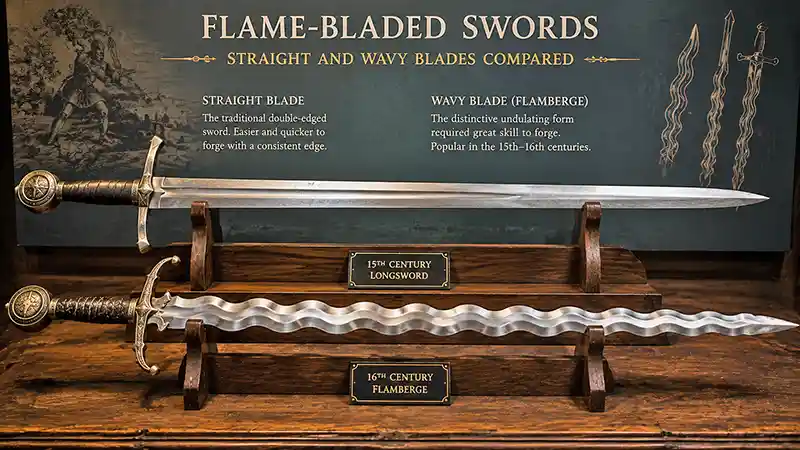
The dramatic shape was not simply the result of a swordsmith getting creative with a hammer. European swords with regularly undulating blades are commonly described today using terms such as flamberge, flambard, or flame-bladed swords, names inspired by the resemblance of the blade to flickering fire. The terminology can be confusing, however, because historical sources were not always consistent, and modern collectors sometimes use "flamberge" broadly for almost any European sword with a wavy blade.
The design appeared most famously during the late medieval and Renaissance periods, particularly on large two-handed swords associated with German and Swiss fighting traditions. Similar waves also appeared on smaller weapons, including rapiers and certain daggers. This is important because it tells us the shape was not tied to one particular type of sword or one specific battlefield role. It was a blade treatment that could be applied to very different weapons.
Creating those waves required considerably more work than producing a conventional straight edge. The smith had to maintain a reasonably consistent pattern while preserving the blade's overall geometry, symmetry, and structural integrity. That extra effort immediately raises the question at the heart of the design: if a straight sword already worked extremely well, what was worth gaining by making a blade wave back and forth?
Modern examples of unusual blade designs can still be found among swords, but the historical flamberge belongs to an era when European swordsmiths were pushing both craftsmanship and visual spectacle to remarkable extremes.
The Waves May Have Changed What Happened When Swords Met
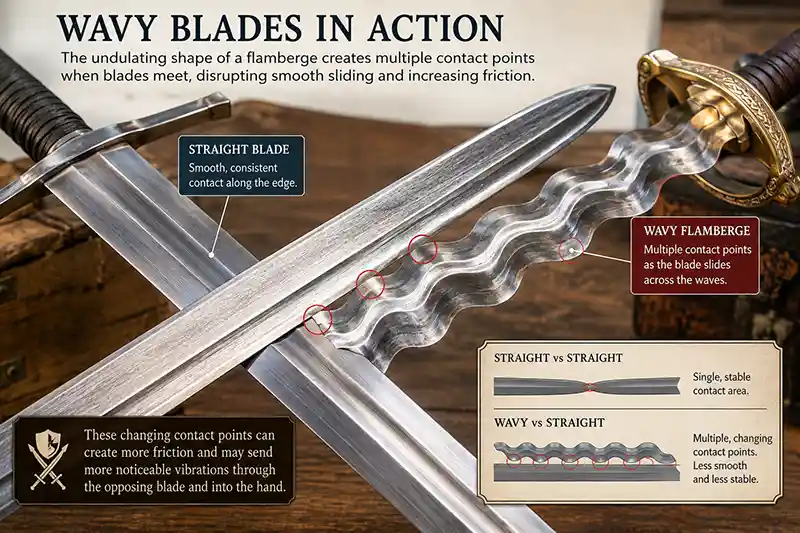
One of the most plausible practical advantages of a wavy blade appeared when it made contact with another weapon. With two conventional straight blades, the edges can slide against one another relatively smoothly. A deeply undulating blade creates a series of changing contact points instead. As an opposing blade travels across those curves, the interaction can feel less smooth and more irregular.
This has led to the frequently repeated claim that a flamberge sent powerful vibrations through an opponent's sword and into the hand holding it. There may be a kernel of truth behind the idea that the unusual geometry changed the sensation of blade-on-blade contact, but the more dramatic versions of the story are difficult to substantiate. There is little reason to imagine that every collision produced a violent shock capable of numbing an opponent's arm or knocking a weapon from the hand.
The waves could also alter the way blades slid and bound against one another during a parry. That does not make the flamberge a magical sword-catching device, but it does provide a more believable mechanical explanation for why the shape might have offered some fighting characteristics beyond appearance alone. Like many unusual historical weapon designs, the interesting part is often found somewhere between genuine function and the legends that accumulated afterward.
Did a Wavy Blade Actually Cut Better?
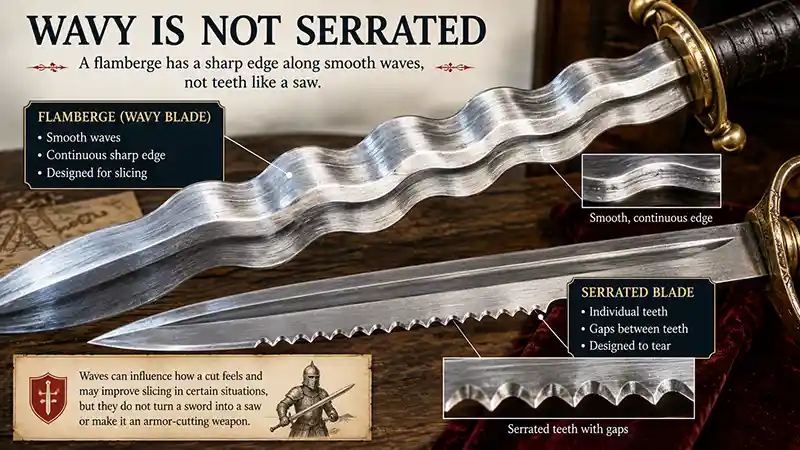
Another popular explanation is that the waves turned the sword into a giant saw. The idea sounds convincing when looking at the blade, but a flamberge was not serrated in the way a saw or modern serrated knife is. Its edge remained sharpened along broad, flowing curves rather than being divided into small teeth designed to tear through material.
The geometry could still influence a cut. As a wavy edge passed through a target, different portions of the blade would meet the material at slightly changing angles. In theory, this could create more of a slicing action at certain points along the edge. Precisely how much practical advantage that produced is much harder to establish, and claims that flame-shaped blades could effortlessly rip through armor or inflict dramatically greater damage should be treated skeptically.
Armor is particularly important here. A wavy edge did not transform a sword into an armor-cutting weapon. Well-made plate armor was extraordinarily difficult to defeat by simply cutting it with any sword, regardless of the shape of its edge. Against an armored opponent, technique, targeting vulnerable openings, and specialized weapons generally mattered far more than adding waves to a blade.
That distinction is worth remembering whenever unusually shaped historical weapons are described as exceptionally lethal. Some genuinely offered clever mechanical advantages, while others gained fearsome reputations that grew far beyond what their design could realistically accomplish. We encountered the same problem with many of the weapons in our look at the most brutal weapons designed for close combat, where appearance and actual battlefield function were not always the same thing.
The Most Famous Wavy Blades Were Enormous
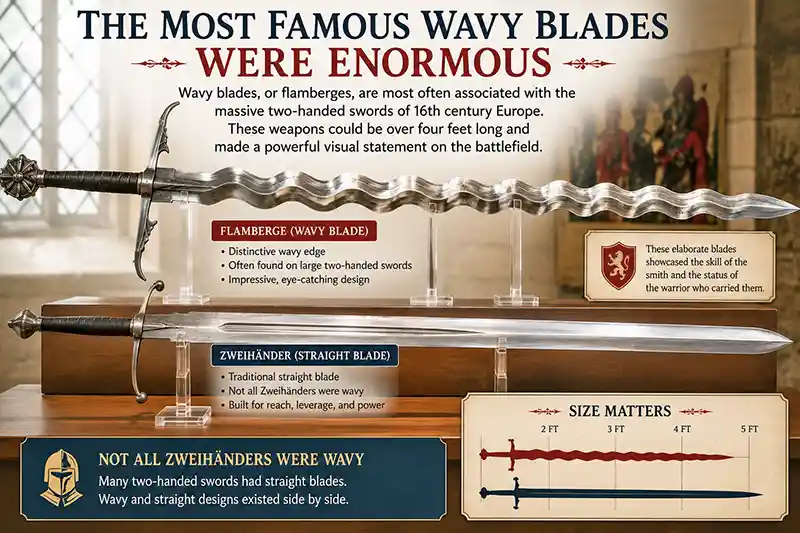
The flamberge is especially associated with the great two-handed swords carried in parts of Europe during the 16th century. Some surviving examples are imposing weapons with long grips, enormous crossguards, and blades that could stretch well over four feet. German examples are often discussed alongside the Zweihander, the huge two-handed sword famously associated with Landsknecht mercenaries.
Not every Zweihander had a wavy blade, and not every flame-bladed sword was a Zweihander. That distinction is easy to lose because modern illustrations frequently combine the two. Many large two-handed swords had perfectly straight blades, while flame-shaped blades could also appear on much smaller weapons.
On the largest swords, however, the waves were impossible to ignore. These weapons already had an extraordinary visual presence, and turning the entire cutting portion into a repeating series of curves made them even more conspicuous. In an age when elite soldiers could display their experience and status through clothing, equipment, and weapons, appearance was not necessarily separate from function. An elaborate blade could demonstrate the skill of its maker, the expense of the weapon, and the standing of the person carrying it.
That may help explain why searching for a single secret mechanical purpose behind the flamberge can be misleading. The design could have influenced blade contact and cutting behavior while simultaneously serving as an impressive display of craftsmanship. Historical weapons did not always have to choose between being functional and being spectacular.
Landsknechts Helped Make the Flamberge Famous
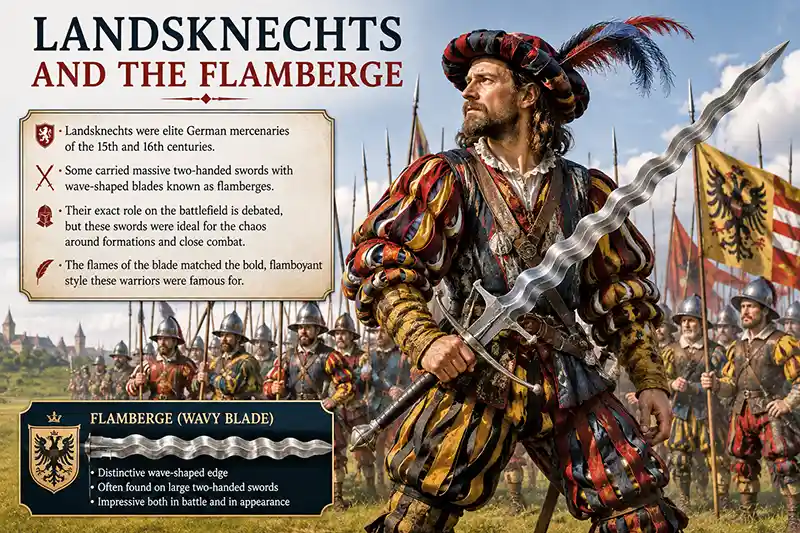
Few soldiers are more closely associated with enormous two-handed swords than the German Landsknechts, the flamboyantly dressed mercenaries who became a major presence on European battlefields during the late 15th and 16th centuries. Contemporary artwork shows Landsknechts carrying an extraordinary variety of weapons, including pikes, halberds, firearms, and large two-handed swords. Some surviving swords from this broader tradition have the unmistakable flame-shaped blades now associated with the flamberge.
The men traditionally linked with the great two-handed sword are often called Doppelsoldner, literally "double-pay men." Modern retellings sometimes portray them charging directly into forests of enemy pikes and casually chopping the shafts apart. That makes for a memorable story, but the precise battlefield role of these swordsmen is more complicated and remains debated. Large swords could be useful in the chaotic fighting surrounding formations, for guarding important personnel and standards, and for controlling space, but reducing their job to "cutting through pikes" oversimplifies how Renaissance infantry actually fought.
The visual connection nevertheless makes sense. Landsknechts were famous for extravagant clothing, slashed fabrics, enormous hats, feathers, and an intentionally imposing appearance. A huge sword with a blade shaped like a line of steel flames fit perfectly into that culture. Whatever practical qualities the waves provided, a flamberge carried by an experienced professional soldier also sent a message before the weapon was ever swung.
That combination of real military use and spectacular appearance is one reason flame-bladed swords remain so recognizable today. They belong to the same fascinating category as many strange weapons that genuinely existed, where historical reality can look more fantastic than something invented for fiction.
Wavy Blades Were Not Limited to Giant Swords
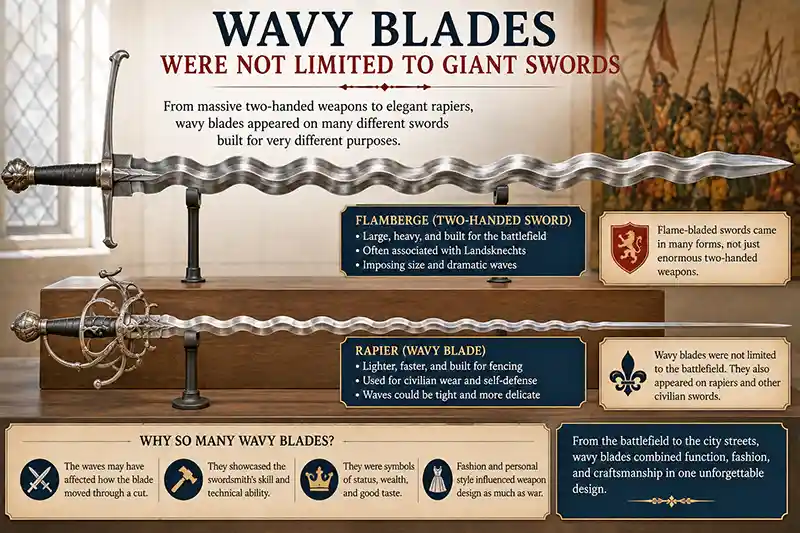
The enormous two-handed flamberge gets most of the attention, but the same basic idea eventually appeared on weapons built for a very different kind of fighting. Surviving European rapiers and other swords can be found with slender, undulating blades, sometimes with waves far tighter and more delicate than those seen on massive two-handed weapons.
On a rapier, the effect is particularly striking. These swords were associated with civilian carrying, fencing, and personal defense rather than the massed infantry formations in which great two-handed swords appeared. A wavy rapier blade therefore cannot be explained simply as a feature developed for fighting pikes or performing some specialized battlefield task. Its presence on such different weapons is one of the strongest reasons to be cautious about assigning the design a single purpose.
By the Renaissance, swords could also be conspicuous objects of fashion and status. Elaborate guards, pierced metalwork, decorated hilts, etched blades, and unusual profiles allowed wealthy owners to carry weapons that demonstrated both taste and expense. Producing a precisely formed wavy blade gave a swordsmith another opportunity to show technical skill while giving the finished weapon an appearance that would have been difficult to mistake for an ordinary sword.
That civilian context also connects the flamberge to the much broader history of bizarre weapons once carried for personal defense. People did not always choose weapons purely because they were the simplest possible tools. Fashion, reputation, craftsmanship, and the desire to own something distinctive could influence weapon design just as surely as combat requirements.
A Wavy Blade Was Harder to Make and Even Harder to Maintain
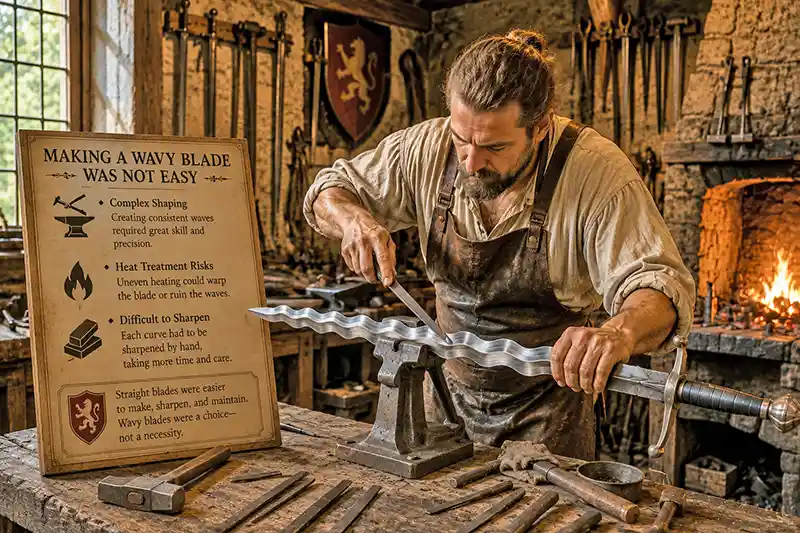
Whatever advantages a flame-shaped blade offered, simplicity was not one of them. A straight sword already demanded careful control of thickness, taper, heat treatment, and edge geometry. Adding a repeating series of waves introduced another layer of precision. If the curves were inconsistent or the blade became distorted during heat treatment, the result could be visually awkward or potentially compromise the weapon.
Sharpening was also less straightforward. A conventional straight edge can be worked along a relatively simple line, while a flamberge requires the sharpener to follow every rise and hollow without gradually destroying the shape that made the blade distinctive. The tighter the waves, the more tedious that process becomes. This was especially significant in an era when maintaining a sword meant working by hand rather than passing it through modern sharpening equipment.
That extra labor helps undermine the idea that wavy blades represented an obvious technological improvement that somehow should have replaced straight swords. If the design had offered an overwhelming combat advantage, flame-shaped blades might have become far more common. Instead, straight blades remained dominant across European swordmaking. The flamberge survived as a specialized and visually extraordinary alternative, impressive precisely because swordsmiths were willing to do something more difficult than necessary.
That distinction between functional construction and decorative complexity remains important when evaluating old swords today. As discussed in our guide to telling a functional sword from a decorative one, an unusual or elaborate appearance alone says very little about whether a blade was actually intended for serious use.
Could a Flamberge Really Break Another Sword?
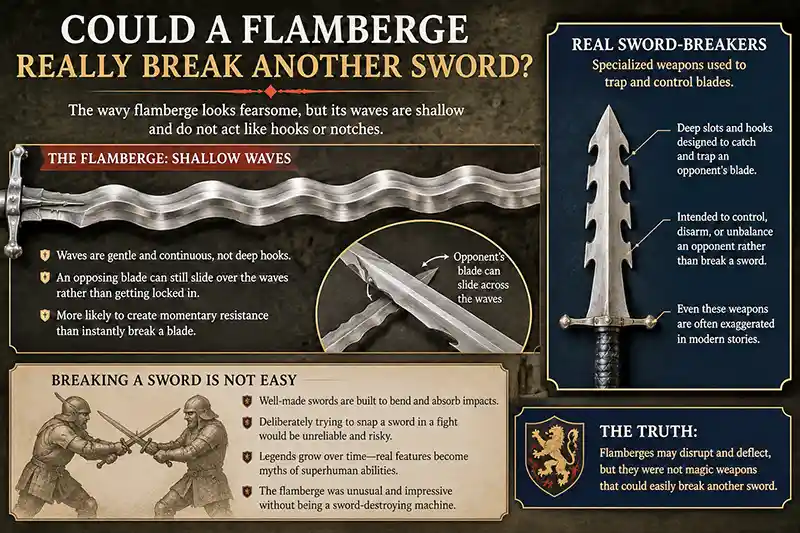
One of the more spectacular claims about wavy blades is that their curves were designed to catch an opponent's sword and snap it. It is an appealing explanation because the flamberge certainly looks as though it should trap anything that touches it. The problem is that the waves themselves do not form deep hooks or notches. An opposing blade can still travel across them rather than becoming securely locked in place.
Actually breaking a well-made sword is also far more difficult than popular depictions suggest. Historical blades were designed to tolerate considerable bending and impact, and deliberately trying to snap one during a fight would be an unreliable strategy. Specialized parrying weapons did exist with teeth, slots, hooks, or other features intended to interfere with an opponent's blade, but even the famous "swordbreaker" dagger is surrounded by modern exaggeration about how literally it was meant to break swords.
A flamberge could certainly make blade contact behave differently. Its waves might interrupt a smooth slide, create momentary resistance, or make a bind feel less predictable. That is a much more defensible possibility than imagining a swordsman simply twisting his wrist and shattering an enemy blade between two curves.
The distinction is a good example of how weapon legends develop. A real physical characteristic becomes associated with a plausible advantage, then generations of retelling transform that advantage into something almost mechanical or superhuman. The flamberge did not need to be a sword-destroying machine to be an unusual and formidable weapon.
Some Wavy Swords May Have Been Made to Impress, Not Fight
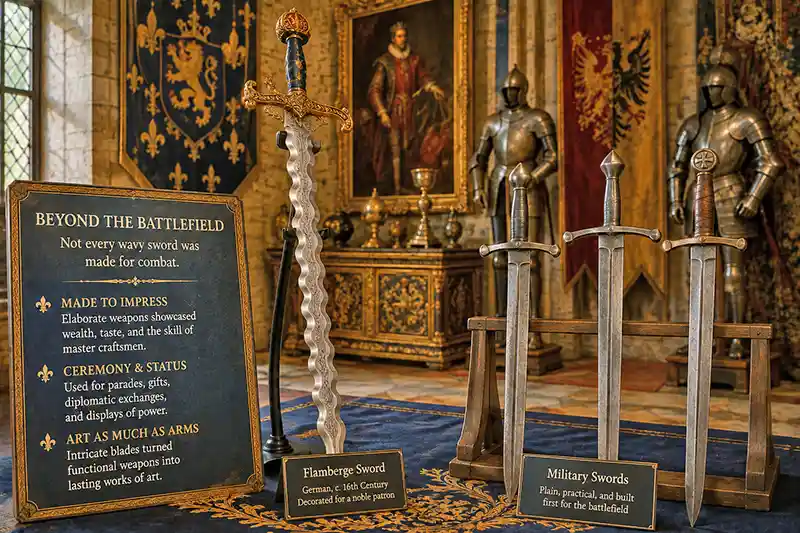
One of the easiest mistakes to make with an elaborate historical weapon is assuming that every surviving example was created for combat. By the Renaissance, European metalworkers were producing spectacular arms for wealthy patrons, ceremonial occasions, guards, processions, diplomatic gifts, and displays of status. A sword could be a weapon and a work of art, but some examples leaned much more heavily toward the second role.
A flame-shaped blade was particularly well suited to this kind of display. Its silhouette could be recognized from across a room, and forging a long sequence of consistent curves advertised the skill and labor invested in the weapon. Combined with etched steel, gilding, elaborate guards, and expensive materials, the result could turn an already prestigious object into something unmistakably exceptional.
This also complicates attempts to explain every surviving flamberge through battlefield mechanics. A wavy blade found on a practical military sword may have been intended to provide some functional characteristics, while a highly decorated example could have emphasized spectacle and craftsmanship. Those motivations were not mutually exclusive, and historians have to consider the entire weapon rather than assuming the unusual blade shape tells the whole story.
That is part of what makes historical weapon design so interesting. Across cultures, weapons evolved under the combined influence of fighting methods, technology, wealth, tradition, and aesthetics. Our look at how different cultures shaped famous knife designs shows the same pattern on a much broader scale: weapons often reveal something about the people who made and carried them as well as the problems they were designed to solve.
The Flamberge Was Not the Only Wavy Blade in the World
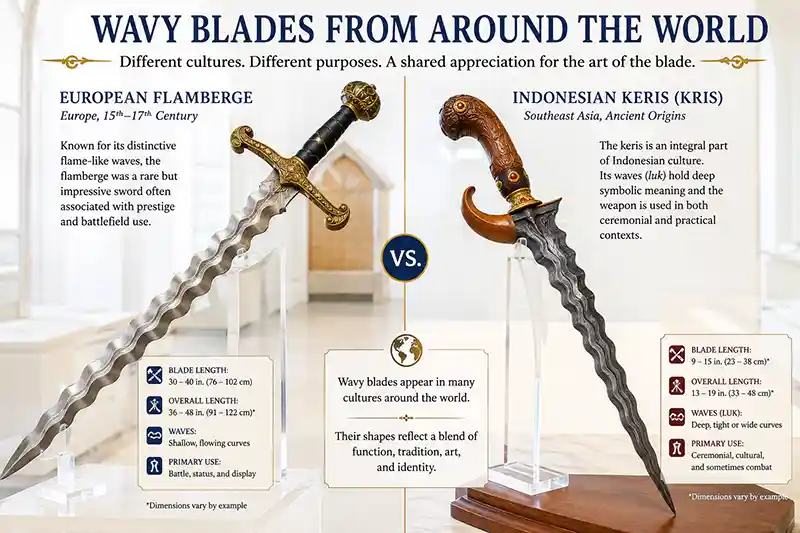
Europe did not have a monopoly on swords with undulating edges. One of the most famous examples comes from Southeast Asia, where the Indonesian keris, also commonly called a kris, was sometimes made with a dramatically wavy blade. At a glance, it is tempting to assume that the keris and European flamberge were variations of the same idea. Historically, however, they developed in very different cultural traditions.
Keris blades can be straight or wavy, and the waves, known as luk, are deeply connected to the weapon's distinctive form and cultural significance. The keris was more than a fighting blade. In Indonesia and surrounding regions it could function as an heirloom, status object, ceremonial weapon, and object associated with spiritual beliefs. Its construction could also involve complex pattern-welded metals that produced striking patterns across the surface of the blade.
There is no need to assume that European swordsmiths copied the keris, or that both designs must have been created for exactly the same mechanical reason. Similar shapes can emerge independently when craftspeople working in different cultures experiment with metal, symbolism, aesthetics, and weapon geometry.
The comparison actually makes the European flamberge more interesting. A wavy edge was not an inevitable improvement to the sword. It was a design choice that different weapon-making traditions could arrive at for very different combinations of practical, artistic, and cultural reasons.
Why Did Wavy Swords Eventually Disappear?
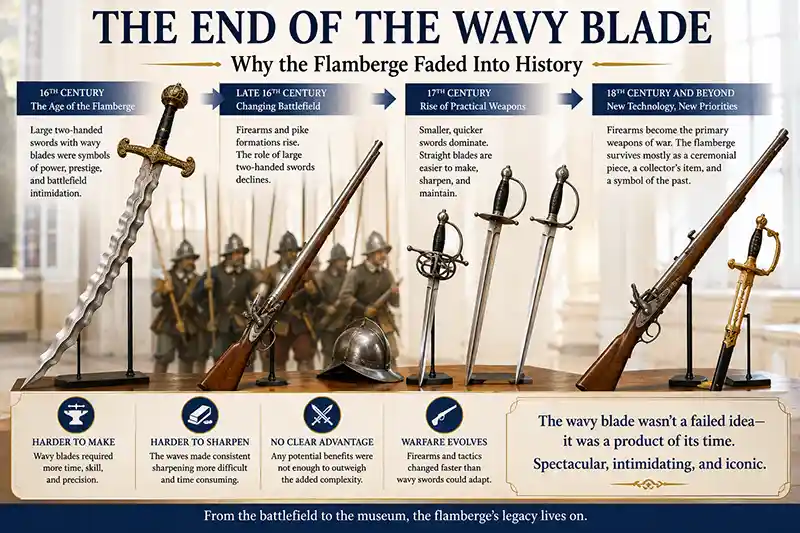
For all their visual drama, wavy blades never displaced the ordinary straight sword. By the 17th century, European warfare was changing rapidly. Firearms became increasingly important, pike-and-shot formations evolved, and the enormous two-handed swords associated with the previous century gradually lost their place as practical military weapons. The specialized environment in which the great flamberge had flourished was disappearing with them.
Smaller flame-bladed swords and rapiers also remained exceptions rather than the rule. Straight blades were easier to manufacture, sharpen, and maintain, and generations of swordsmiths had already developed extremely effective straight-bladed designs. Whatever advantages the waves provided were apparently not compelling enough to justify their additional complexity on most swords.
Eventually, the flamberge became more closely associated with ceremonial weapons, collections, historical displays, and the popular image of the Renaissance warrior than with evolving military technology. Its disappearance may actually tell us something important about its original purpose. The wavy blade was never a revolutionary breakthrough that made conventional swords obsolete. It was an unusual solution that combined possible mechanical benefits with craftsmanship, intimidation, and spectacle.
That is precisely why it remains memorable. Thousands of efficient straight swords survive in museums, yet a flame-shaped blade can still stop someone in their tracks. Centuries after its practical usefulness faded, the feature that made the flamberge complicated and uncommon is also the feature that ensured it would never be forgotten.
So What Were the Waves Actually For?
The most accurate answer is less dramatic than many of the legends: there probably was no single reason. A wavy edge could change the way another blade slid across it and may have altered the behavior of a cut, but the evidence does not support treating the flamberge as a technological breakthrough capable of sawing through armor, effortlessly breaking swords, or sending incapacitating vibrations through an opponent's arm.
At the same time, dismissing the waves as purely decorative goes too far in the opposite direction. Historical swordmakers understood blade geometry extremely well, and some flame-bladed swords were clearly serious weapons rather than ornamental curiosities. The shape could offer distinctive handling characteristics while also making the weapon intimidating, difficult to produce, and instantly recognizable.
Perhaps that combination is the real answer. The flamberge existed in a world where a weapon could solve a practical problem, advertise the skill of its maker, display the wealth or experience of its owner, and frighten an opponent all at once. Modern explanations often try to reduce unusual weapons to a single clever trick. Historical weapons were rarely that simple.
The waves survived in our imagination because they made an already formidable object look almost impossible. The surprising part is not that Renaissance swordsmiths occasionally chose such an extravagant design. It is that underneath all those centuries of mythology was a perfectly real sword.
The Flamberge Was Stranger Than the Legends Needed It to Be
The flamberge is a perfect example of what happens when an unusual historical weapon survives longer in legend than it did on the battlefield. Its waves have been credited with cutting through armor, destroying other swords, producing devastating vibrations, and performing feats that become increasingly difficult to defend once the actual mechanics are examined.
The documented reality is arguably more interesting. Swordsmiths deliberately took one of the most successful weapon forms ever created and made it substantially harder to forge and maintain. They produced enormous flame-bladed swords for professional soldiers, elegant wavy rapiers for a very different world of civilian fencing and status, and elaborate examples in which craftsmanship was clearly part of the appeal. The waves may have influenced cutting and blade contact, but they also transformed the sword into something unmistakable.
That is why the flamberge deserves to be remembered without embellishment. It did not need supernatural abilities to be extraordinary. The fact that skilled craftsmen actually forged long pieces of steel into those flowing curves, and that people genuinely carried some of them as weapons, is strange enough.
What Is a Sword With a Wavy Blade Called?
European swords with pronounced wavy blades are commonly called flamberges today, although historical terminology was not always consistent. The name is associated with the blade's resemblance to flames, which is why terms such as "flame-bladed sword" are also used. Flamberge can describe the wavy blade itself rather than one specific type of sword, since the design appeared on enormous two-handed swords as well as smaller rapiers and other weapons.
Were Flamberge Swords Actually Used in Battle?
Yes. Functional swords with wavy blades survive from the Renaissance, and large flame-bladed two-handed swords are associated with the military traditions of 16th-century Europe. However, not every surviving flamberge should automatically be considered a battlefield weapon. Wavy blades also appeared on highly decorated, ceremonial, and prestige weapons, so the intended purpose has to be judged from the individual sword rather than from its blade shape alone.
Could a Flamberge Cut Through Plate Armor?
No. The waves did not give a flamberge the ability to slice through well-made plate armor. European plate was specifically designed to resist edged weapons, and even powerful straight-bladed swords could not simply cut through it. Against an armored opponent, a swordsman was generally better served by targeting gaps and vulnerable areas or using techniques and weapons designed for defeating armor. Claims that the flamberge's wavy edge functioned like a saw against plate belong more to modern weapon mythology than documented combat reality.
Did Wavy Swords Cause More Severe Wounds?
It is possible that the changing angles of a wavy edge affected the way a blade moved through a target, but claims that flamberges were specifically designed to create dramatically worse wounds are difficult to substantiate. The waves were not saw teeth, and there is little evidence for the gruesome mechanical effects sometimes attributed to them online. A sharpened flamberge was already a dangerous sword without needing a special wound-producing mechanism to explain its design.
Is a Flamberge the Same Thing as a Zweihander?
No. A Zweihander is a large two-handed sword associated particularly with German-speaking regions during the Renaissance, while flamberge generally refers to a flame-like or wavy blade. Some enormous two-handed swords were made with wavy blades, which is why the terms are frequently mixed together today, but many historical Zweihanders had completely straight blades. Wavy blades also appeared on much smaller swords, including rapiers, so the two terms are not interchangeable.
Why Are Wavy Swords Called Flamberges?
The name is connected to the flame-like appearance of the undulating blade, but the terminology has a complicated history. Flamberge ultimately relates to names for famous swords in medieval French literature and was not originally a precise technical term for every sword with a wavy edge. Over time, collectors and modern writers increasingly applied the word to flame-shaped blades, which is how most people encounter the term today.
Are Wavy Swords Stronger Than Straight Swords?
Not inherently. A sword's strength depends far more on its steel, heat treatment, thickness, taper, cross section, and overall construction than on whether its edges are straight or wavy. The flamberge's curves could change how the blade interacted with another weapon, but they did not automatically make the steel stronger or harder to break. In fact, producing a well-made wavy blade required considerable skill because the swordsmith still had to maintain sound geometry throughout the repeating curves.
Did Japanese Swords Ever Have Wavy Blades?
Traditional Japanese swords such as the katana were not normally forged with the physical edge of the blade repeatedly curving back and forth like a European flamberge. What can appear wavy is the hamon, the visible temper line created during differential hardening. Some hamon patterns form dramatic waves, but the actual cutting edge remains smoothly curved rather than flame-shaped. This visual similarity occasionally causes decorative swords and online images to be mistaken for Japanese versions of the flamberge.
Were Wavy Swords More Expensive to Make?
A well-made wavy blade generally required additional labor and skill compared with a simpler straight blade. The swordsmith had to create a consistent series of curves while still controlling the blade's thickness, taper, symmetry, heat treatment, and edge geometry. Elaborate flamberges could also feature expensive guards, engraving, gilding, and other decoration. This does not mean every wavy sword was enormously expensive, but the design gave skilled craftsmen an obvious opportunity to demonstrate work that went beyond basic sword construction.
How Were Flamberge Blades Sharpened?
Sharpening a flamberge required following the contours of the blade rather than working along one relatively straight cutting edge. Each outward curve and inward hollow had to be maintained without gradually flattening or distorting the wave pattern. Period craftsmen had abrasives and specialized tools capable of working complex shapes, but maintaining a flame-shaped edge would have demanded more care than sharpening an equivalent straight blade.
Are Flamberges and Indonesian Keris Swords Related?
There is no good evidence that the European flamberge and Indonesian keris represent the same weapon tradition. Both can have dramatically wavy blades, but they developed in very different regions and cultural contexts. Keris blades could be straight or wavy and carried important ceremonial, social, and spiritual significance in addition to their function as weapons. The similarity is a fascinating example of different weapon-making traditions independently producing blades with undulating forms rather than evidence that one necessarily inspired the other.
You May Also Be Interested In:
Leave a Reply