




Weapons So Dangerous They Were Banned From the Battlefield
August 11th, 2026
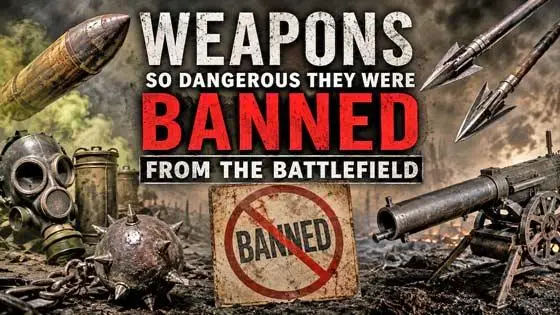
For centuries, armies searched for weapons that could give them even the slightest advantage on the battlefield. But occasionally, a weapon earned a reputation for being so cruel, indiscriminate, or terrifying that governments and military leaders tried to restrict it altogether. Some were targeted by international treaties. Others were condemned by religious authorities or banned by individual nations. And a few supposedly "banned" weapons were never actually prohibited at all, despite legends that persist to this day. From brutal medieval projectiles to weapons that changed the rules of modern warfare, the stories behind these forbidden weapons reveal something fascinating: even in war, humanity has repeatedly tried to decide whether certain ways of killing simply go too far.
The Crossbow: The Weapon the Pope Tried to Ban
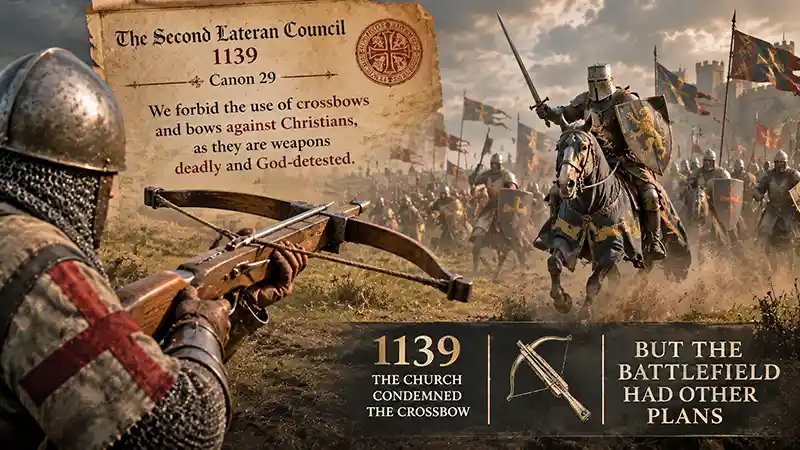
In 1139, the Second Lateran Council issued one of history's most famous restrictions on a battlefield weapon. Canon 29 condemned the use of crossbows and bows against fellow Christians, describing them in terms traditionally translated as "deadly and God-detested." The prohibition did not extend to warfare against non-Christians, an exception that says a great deal about the politics of medieval warfare.
The crossbow had earned a frightening reputation because it changed who could threaten an armored warrior. Becoming an accomplished longbowman required years of practice, while a crossbow was comparatively easier to learn. A soldier of relatively modest training could use one to threaten opponents whose armor, horses, and military education represented enormous investments.
That made the crossbow more than another projectile weapon. It challenged the social structure of medieval warfare. A knight who had trained since childhood could potentially be killed at a distance by someone far below him in the feudal hierarchy. To the warrior elite, there was something deeply unsettling about that equation.
The famous prohibition, however, did not make crossbows disappear from European battlefields. Medieval rulers continued employing crossbowmen, and some cities developed formidable corps of professional crossbow soldiers. Richard the Lionheart famously used crossbowmen in his armies despite the Church's earlier condemnation.
This is an important distinction that will appear repeatedly throughout this article. A weapon being condemned, restricted, or even formally prohibited did not necessarily mean armies stopped using it. Sometimes the battlefield proved much more persuasive than the people trying to regulate it.
Poisoned Weapons: Banned Because the Injury Was Only the Beginning
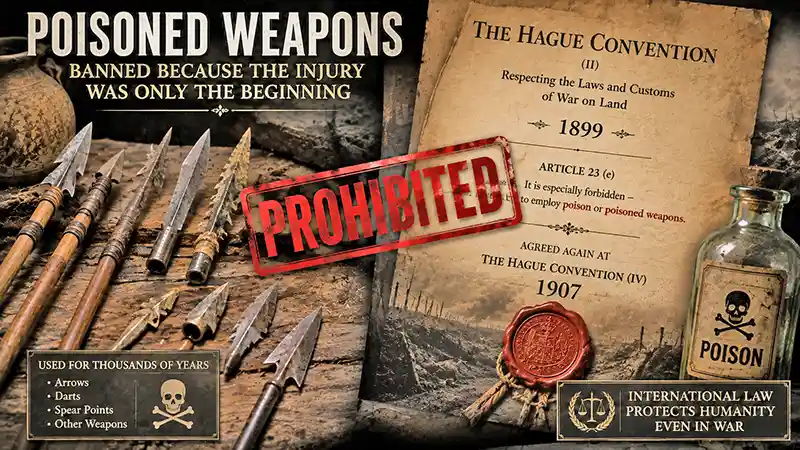
Some weapons were condemned not because of their shape, but because of what was placed on them. Poisoned arrows, darts, spear points, and other weapons have appeared in warfare across different cultures for thousands of years. A wound that might otherwise have been survivable could become deadly after toxins entered the body.
By the modern era, the idea of deliberately poisoning weapons had become one of the clearest examples of a method of warfare considered beyond acceptable limits. The 1899 Hague Convention prohibited the use of "poison or poisoned weapons," and the prohibition was repeated in the 1907 Hague Convention. Unlike the medieval attempt to suppress the crossbow, this restriction became part of the developing international laws governing warfare.
The reasoning was not difficult to understand. A conventional weapon injured through its immediate physical effects. Poison could continue causing suffering long after the initial wound, while the victim might have no way of knowing what substance had entered the body or whether treatment was possible.
Poisoned weapons also created problems that went beyond individual combat. Contaminating weapons, food, or water could threaten people who were never intended targets. As warfare became increasingly industrialized, governments became more concerned that poisons could be deployed on a scale far greater than anything ancient armies had imagined.
That fear would soon lead to something much worse. During World War I, chemical warfare transformed the ancient idea of poisoning an enemy into an industrial battlefield weapon capable of drifting across entire trenches. The international response to that horror would produce some of the strongest weapons prohibitions ever written.
Chemical Weapons: When the Air Itself Became a Weapon
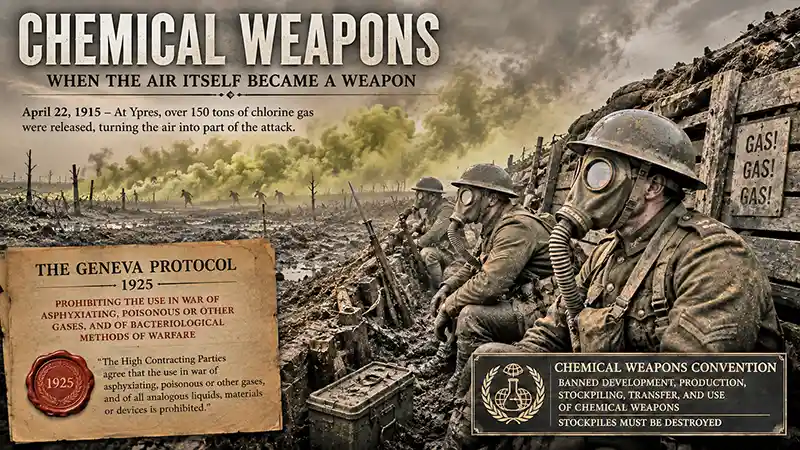
On April 22, 1915, soldiers near Ypres, Belgium watched an eerie greenish-yellow cloud begin drifting across the battlefield. German forces had released more than 150 tons of chlorine gas from thousands of cylinders. The cloud moved toward Allied trenches, turning the air soldiers needed to breathe into part of the attack.
Chemical weapons were not completely new, and international agreements had already attempted to restrict certain forms of poisonous warfare. But World War I transformed poison gas into an industrial weapon. Chlorine was followed by phosgene and mustard agent, while armies developed increasingly sophisticated masks and protective equipment in an attempt to survive the new threat.
Gas became particularly feared because soldiers could not simply hide behind armor or duck beneath a trench wall. Depending on the agent, exposure could injure the lungs, eyes, or skin, and contamination could linger after an attack. The psychological effect was enormous. A strange smell, an approaching cloud, or even a gas alarm could instantly create panic.
After the war, international outrage helped produce the 1925 Geneva Protocol, which prohibited the use in war of chemical and biological weapons. Decades later, the Chemical Weapons Convention went considerably further by prohibiting the development, production, acquisition, stockpiling, retention, transfer, and use of chemical weapons, while requiring the destruction of declared stockpiles.
Few weapons better demonstrate why battlefield prohibitions exist. Poison gas did not become unacceptable because it was ineffective. It became unacceptable precisely because nations had seen what happened when modern industry turned toxic chemicals into weapons of mass warfare.
Expanding Bullets: The Ammunition That Inspired the "Dum-Dum" Ban
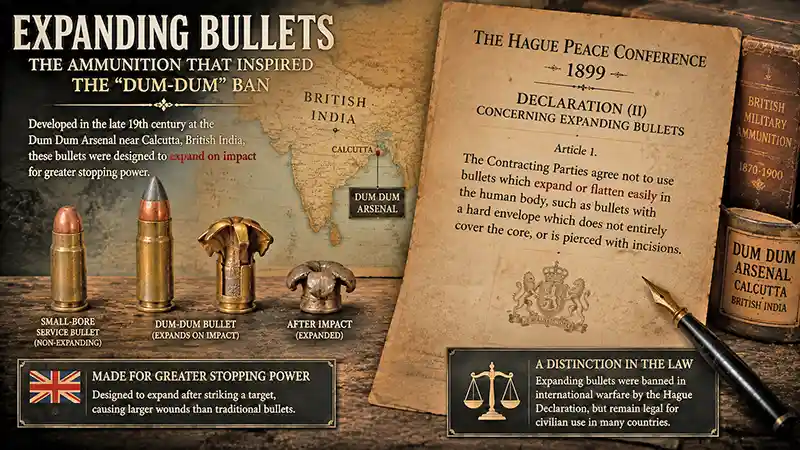
In the late 19th century, British forces experimented with bullets designed to expand after striking a target. Some of the best-known versions were developed at the Dum Dum Arsenal near Calcutta in British India, giving rise to the name "dum-dum bullet." The idea was to create ammunition with greater stopping effect than the small-caliber military bullets then entering service.
The results also produced wounds that many governments considered unnecessarily severe. In 1899, delegates at the Hague Peace Conference adopted a declaration prohibiting bullets that "expand or flatten easily in the human body," including certain projectiles with exposed or altered jackets.
That prohibition created one of the more interesting distinctions in weapons law. Expanding ammunition did not simply disappear. Hollow-point and other expanding bullets would later become widely used in civilian self-defense and law enforcement in many jurisdictions. The Hague restriction specifically concerned their use in international warfare among parties bound by the declaration.
The story also demonstrates why the word "banned" can be misleading. A weapon or type of ammunition can be prohibited in one context while remaining legal or commonly used in another. The rules of warfare, domestic criminal law, and civilian weapons regulations are entirely different legal systems.
That distinction still causes confusion today, much like the complicated history behind why certain weapons are illegal in some places. A weapon's reputation may spread worldwide, while the actual restriction that created that reputation can be surprisingly narrow.
Biological Weapons: When Disease Became a Weapon of War
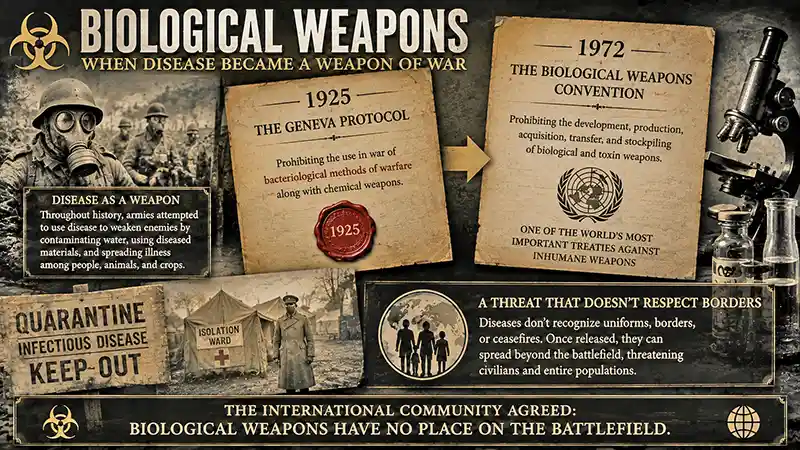
Of all the weapons nations have attempted to prohibit, biological weapons may be among the most frightening because their effects do not necessarily remain confined to a battlefield. Instead of bullets or explosives, biological warfare uses disease-causing organisms or toxins with the potential to spread illness among people, animals, or crops.
Attempts to use disease in warfare long predate modern science. Historical accounts describe armies contaminating water supplies, using diseased material during sieges, and attempting other primitive forms of biological attack. Some famous stories remain disputed, but the underlying idea is unquestionably ancient.
Modern microbiology made the threat considerably more serious. Once scientists understood microorganisms and infectious disease, governments could envision biological weapons developed deliberately rather than relying on crude contamination. Several nations pursued biological warfare programs during the 20th century, demonstrating that the danger was no longer theoretical.
The 1925 Geneva Protocol prohibited the use of bacteriological methods of warfare alongside chemical weapons. Then, in 1972, the Biological Weapons Convention went much further, prohibiting the development, production, acquisition, transfer, and stockpiling of biological and toxin weapons. It became one of the world's most important international agreements restricting an entire category of weapons.
Biological weapons present a problem few conventional battlefield weapons share: disease does not recognize uniforms, borders, or ceasefires. Once released, an infectious agent could potentially threaten civilians and spread far beyond the people originally targeted. That unpredictability helped make biological warfare one of the clearest examples of a weapon the international community decided should have no legitimate place on the battlefield.
Blinding Laser Weapons: Banned Before They Reached the Battlefield
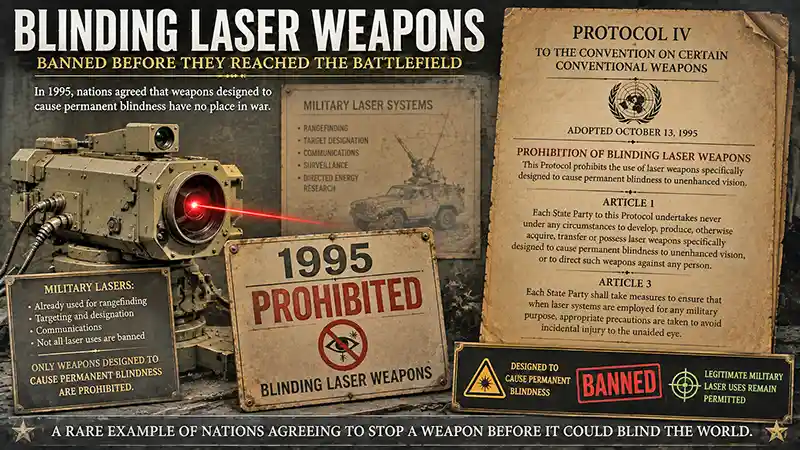
Most weapons are restricted only after armies have witnessed the damage they can cause. Blinding laser weapons are unusual because governments acted before they became a common feature of warfare. In 1995, an international agreement specifically targeted laser weapons designed to cause permanent blindness.
By the late 20th century, military lasers were becoming increasingly sophisticated. Lasers could already be used for rangefinding, targeting, communications, and other battlefield purposes. But the possibility of designing a weapon specifically to permanently blind enemy soldiers raised a disturbing question: should armies be allowed to deliberately destroy someone's eyesight when disabling the person could be the weapon's primary purpose?
The answer came through Protocol IV to the Convention on Certain Conventional Weapons. Adopted in 1995, it prohibited laser weapons specifically designed to cause permanent blindness to unenhanced vision. The agreement also requires precautions when legitimate military laser systems are used to avoid permanent blindness.
Importantly, the prohibition did not ban military lasers altogether. Rangefinders, target designators, and other laser systems remained permissible. The restriction focused specifically on weapons whose combat function was intentionally causing permanent blindness.
That makes blinding laser weapons one of the most remarkable entries on this list. Instead of waiting for a horrifying new weapon to become widespread and then attempting to control it, nations largely agreed that this particular technology should be stopped before it could establish itself on the battlefield.
Anti-Personnel Landmines: Weapons That Keep Killing After the Battle Ends
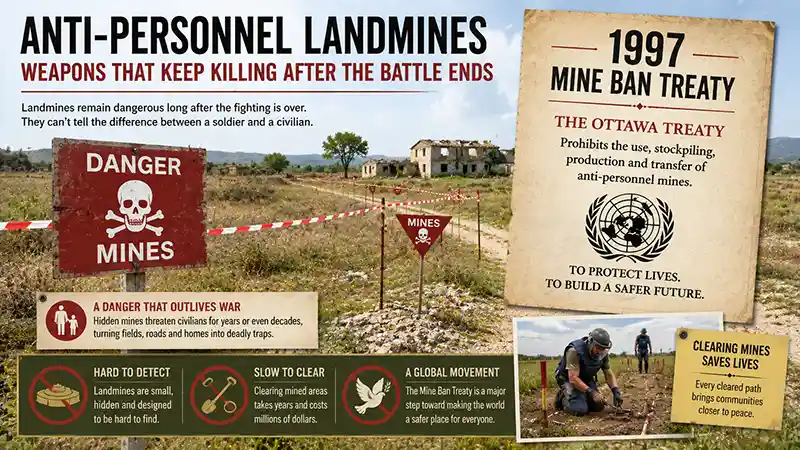
Most battlefield weapons become harmless once the fighting moves somewhere else. Anti-personnel landmines are different. Once buried or concealed, they can remain dangerous long after the soldiers who placed them have disappeared, sometimes threatening civilians years or even decades after a war has ended.
Landmines were used on an enormous scale during 20th-century conflicts because they offered armies a relatively inexpensive way to deny territory, protect defensive positions, and restrict enemy movement. But the same qualities that made them militarily useful created a devastating problem. A mine cannot reliably distinguish between an enemy soldier during a battle and a civilian walking through the same area years later.
By the 1990s, the humanitarian consequences had generated an international movement demanding a prohibition. The result was the 1997 Mine Ban Treaty, commonly called the Ottawa Treaty, which prohibits participating nations from using, stockpiling, producing, or transferring anti-personnel mines and requires the destruction of stockpiles, subject to limited treaty exceptions.
Unlike some entries in this article, however, the prohibition is not universal. A number of countries remain outside the treaty, making anti-personnel mines an important example of why saying a weapon is simply "banned worldwide" can be misleading.
What made these weapons particularly controversial was not just what happened during combat. It was what happened afterward. An abandoned battlefield could eventually become farmland, a road, or a place where children played, while weapons hidden beneath the ground remained ready to function years after the war that put them there had been forgotten.
Weapons That Leave Invisible Fragments: A Ban With a Very Specific Target
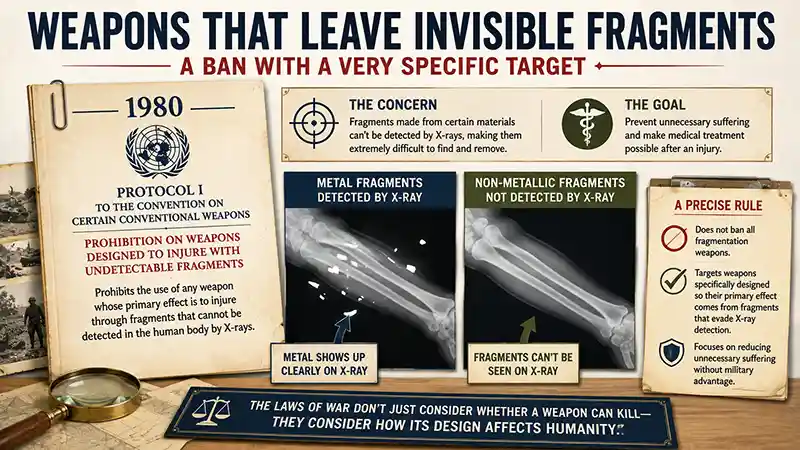
Not every battlefield prohibition covers an entire class of weapons. Some rules are remarkably specific. One of the best examples is Protocol I to the Convention on Certain Conventional Weapons, adopted in 1980, which addresses weapons designed to injure people with fragments that cannot be detected by X-rays.
The concern was what happened after the weapon had already done its damage. Conventional metal fragments can generally be located using medical imaging. But if a weapon were deliberately designed to scatter fragments made from materials that could not be detected by X-rays, surgeons could have far greater difficulty locating and removing them.
The resulting rule is surprisingly straightforward. Protocol I prohibits the use of any weapon whose primary effect is to injure through fragments that cannot be detected in the human body by X-rays.
What makes this prohibition particularly interesting is how narrowly it is written. It does not ban fragmentation weapons in general, nor does it prohibit every object containing plastic, glass, or another nonmetallic material. The restriction concerns weapons specifically designed so their primary injuring effect comes from fragments that evade X-ray detection.
This is a good example of how the laws of war sometimes target not simply whether a weapon can kill, but whether its design causes suffering without providing a meaningful military advantage. A nearly invisible fragment offered little tactical benefit once it entered someone's body. What it could do was make treatment considerably more difficult.
Incendiary Weapons: When Fire Became Too Dangerous for Civilian Areas
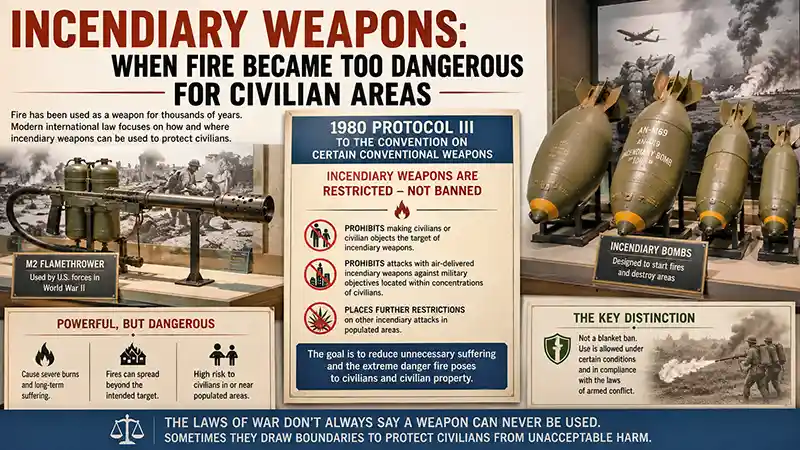
Fire has been used as a weapon for thousands of years, from flaming arrows and burning siege materials to Greek fire and eventually modern flamethrowers and incendiary bombs. Yet despite their terrifying reputation, incendiary weapons were never simply banned from warfare altogether.
Instead, modern international law focused heavily on where and how they could be used. Protocol III to the Convention on Certain Conventional Weapons, adopted in 1980, restricts incendiary weapons because of the severe burns they can cause and the enormous danger fire poses when civilians are nearby.
The protocol prohibits making civilians or civilian objects the target of incendiary weapons. It also prohibits attacks with air-delivered incendiary weapons against military objectives located within concentrations of civilians and places additional restrictions on other incendiary attacks in populated areas.
This is another case where the popular phrase "banned weapon" oversimplifies what actually happened. Flamethrowers, for example, are often described online as weapons that were outlawed by international law. That is not accurate. There is no blanket international prohibition on flamethrowers as a category, although their use is constrained by the broader laws of armed conflict and rules governing incendiary weapons.
That distinction makes incendiary weapons especially useful for understanding this entire subject. The laws of war do not always declare that a weapon can never be used. Sometimes they instead draw boundaries around circumstances where its effects create an unacceptable risk to civilians.
Cluster Munitions: One Weapon That Can Leave Hundreds Behind
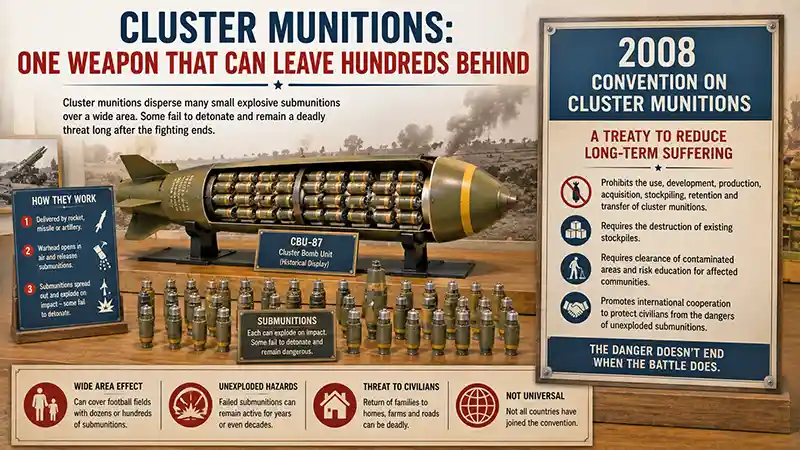
Cluster munitions created a different kind of battlefield problem. Instead of delivering a single explosive charge, these weapons disperse numerous smaller submunitions across a wider area. That can make them effective against dispersed military targets, but it also makes their effects much harder to contain when civilians are nearby.
An even greater concern appears after the attack. Some submunitions can fail to detonate as intended and remain on the ground as unexploded ordnance. Long after soldiers have moved on, these remnants can continue threatening people who return to homes, farms, and roads in former combat zones.
Growing concern over those humanitarian consequences led to the 2008 Convention on Cluster Munitions. For participating nations, the treaty prohibits the use, development, production, acquisition, stockpiling, retention, and transfer of cluster munitions as defined by the convention. It also established requirements for destroying stockpiles and clearing contaminated areas.
Like the Mine Ban Treaty, however, this prohibition is not universal. Several major military powers have not joined the convention. That makes cluster munitions another important reminder that a weapon described as "banned" may actually be prohibited by a treaty that binds some nations but not others.
The controversy surrounding cluster munitions ultimately comes down to two characteristics: they can scatter explosive hazards across a large area, and some of those hazards can remain after the battle has ended. In that sense, their story closely resembles the landmine problem. The danger does not necessarily disappear when the shooting stops.
The Bayonet Myth: Was the Triangular Blade Really Banned?
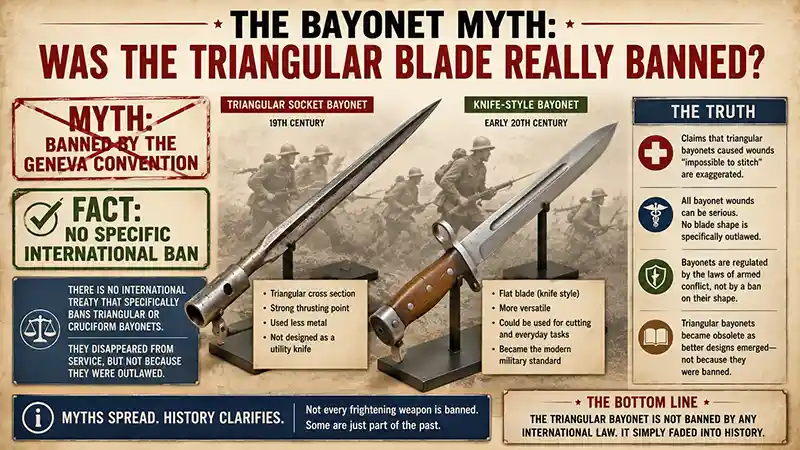
Few battlefield weapons have accumulated as many gruesome legends as the triangular or cruciform bayonet. One of the most persistent claims is that these blades were eventually banned by the Geneva Convention because they produced wounds that were impossible to stitch closed. It is a compelling story, but there is one major problem: there is no international treaty that specifically bans triangular bayonets.
Triangular and cruciform bayonets were very real. Instead of resembling a conventional knife, many early socket bayonets used long, narrow blades with triangular or cross-shaped cross sections. The design produced a rigid point while using relatively little metal, making it well suited for thrusting without requiring the bayonet to function as a utility knife.
As military equipment evolved, armies largely abandoned these designs in favor of knife-style bayonets that were far more versatile. A soldier could use a knife bayonet for cutting and other everyday tasks in addition to mounting it on a rifle. The older spike-like designs gradually became obsolete, helping create the impression that they must have been outlawed.
The claim about wounds being impossible to stitch is also exaggerated. Unusual wounds can certainly complicate medical treatment, but there is no special rule of international law declaring a blade illegal simply because its cross section is triangular.
This is exactly why the word "banned" deserves scrutiny. Some weapons in this article were explicitly prohibited by international agreements. Others were restricted only under certain circumstances. And some, like the supposedly forbidden triangular bayonet, became "banned weapons" largely through stories repeated so often that they eventually sounded like historical fact.
The Trench Knife Myth: Brutal, Feared, but Not Banned From War
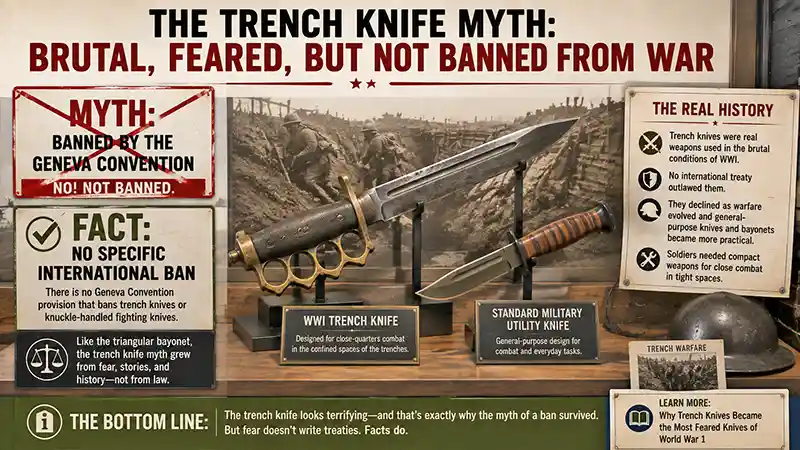
Few weapons look more deserving of the word "banned" than the trench knives developed during World War I. Some combined a heavy blade with a reinforced handguard or knuckle-style grip, creating a compact weapon intended for the brutal close-quarters conditions soldiers encountered inside trenches. Their intimidating appearance has helped produce a persistent claim that trench knives were eventually prohibited by the Geneva Convention.
They weren't. There is no Geneva Convention provision specifically banning trench knives or knuckle-handled fighting knives from warfare. Like the triangular bayonet, the weapon's reputation appears to have become tangled with later restrictions, military changes, and stories repeated without much attention to what international treaties actually say.
Trench knives were very real battlefield weapons. During World War I, soldiers needed compact weapons that could be carried through narrow trenches and used when rifles became awkward at extremely close range. Several nations developed specialized fighting knives, while soldiers also carried privately purchased or improvised weapons.
Their decline had more to do with changing warfare and military equipment than an international prohibition. As armies moved away from the conditions that produced trench raiding weapons in the first place, specialized designs became less important. Knife-style bayonets and general-purpose combat knives could also perform far more everyday tasks.
The mythology surrounding them remains fascinating, which is one reason the trench knife became one of the most feared knives of World War I. Its appearance alone seems to tell us that someone must have outlawed it. In reality, this is another case where a weapon's frightening reputation became more dramatic than its legal history.
Switchblades: Banned at Home, Not on the Battlefield
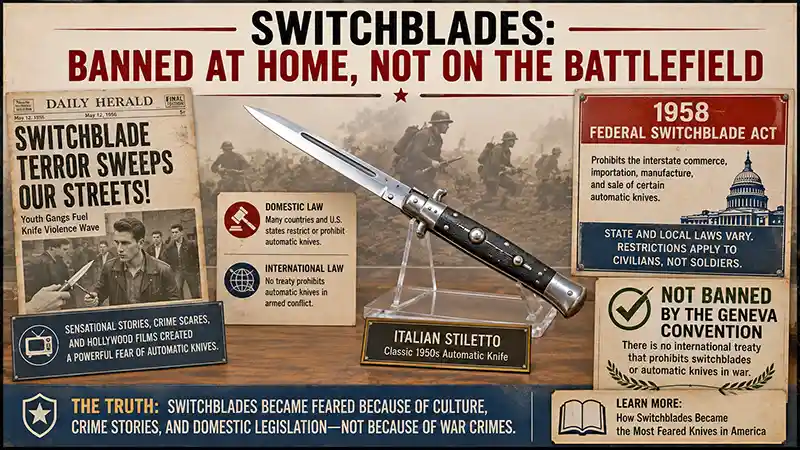
Switchblades are another perfect example of how domestic weapon laws can become confused with the laws of war. Automatic knives developed an almost sinister reputation during the 20th century, particularly in the United States, where newspapers, movies, and politicians increasingly associated them with juvenile gangs and street crime.
That fear eventually produced real legislation. In 1958, the United States passed the Federal Switchblade Act, restricting the interstate commerce and importation of certain automatic knives. Individual states adopted their own laws as well, creating a complicated patchwork of restrictions that has changed considerably over the decades.
But switchblades were not banned from the battlefield by the Geneva Convention. There is no international treaty that specifically prohibits soldiers from carrying or using an automatic knife simply because its blade opens with a spring-loaded mechanism.
The distinction matters because the word "illegal" often gets transformed into "banned weapon" without explaining who imposed the restriction or where it applies. A weapon restricted for civilian possession or commerce in one country is not necessarily prohibited under the international laws governing warfare.
The story of how switchblades became some of the most feared knives in America is largely about culture, crime scares, and domestic legislation rather than battlefield cruelty. Their reputation became so powerful that many people still assume someone must have banned them from war. Nobody did.
Why Are Some Weapons Banned While Others Are Not?
Looking at this list raises an obvious question. If warfare is inherently destructive, how does anyone decide that one weapon crosses the line while another remains acceptable? International humanitarian law does not generally judge weapons simply by how frightening they look or how powerful they are.
Instead, one of the central ideas is whether a weapon causes unnecessary suffering or superfluous injury compared with the military advantage it provides. Another major concern is whether its effects can be directed at military targets without creating an unacceptable danger to civilians.
That helps explain why poisoned weapons and weapons specifically designed to cause permanent blindness have been prohibited, while swords, rifles, artillery, and many other lethal weapons remain lawful under appropriate circumstances. The fact that a weapon can kill does not automatically make it illegal in warfare.
Technology also keeps forcing governments to reconsider where those boundaries should be drawn. Every generation develops new weapons that earlier treaties could never have anticipated, while older weapons sometimes acquire myths about restrictions that never actually existed.
That same confusion appears outside warfare, where completely different laws determine which knives, firearms, and other weapons civilians may own or carry. A weapon can be legal in war but restricted for civilians, prohibited by a treaty but legal in a country that never joined it, or simply rumored to be banned despite no such prohibition existing at all.
The real history is more complicated than a list of "forbidden weapons." And in many cases, that complexity makes the story considerably more interesting.
Are Flamethrowers Really Banned by the Geneva Convention?
No. This is one of the most persistent myths surrounding banned weapons. The Geneva Conventions do not contain a blanket prohibition on flamethrowers, and international law does not automatically make a weapon illegal simply because it uses fire.
The confusion comes partly from the horrific reputation flamethrowers earned during the two World Wars. They were particularly effective against fortified positions, bunkers, and trenches, but the injuries associated with fire made them among the most feared weapons encountered on the battlefield.
Modern restrictions instead fall largely under rules governing incendiary weapons. Protocol III to the Convention on Certain Conventional Weapons places significant limitations on their use, particularly when civilians or concentrations of civilians could be endangered. Other fundamental rules of armed conflict also continue to apply.
So why did flamethrowers largely disappear from modern battlefields? Practicality played a major role. A soldier carrying a flamethrower had limited range, cumbersome equipment, and increasingly faced alternatives capable of attacking fortified positions from much greater distances.
The flamethrower therefore belongs alongside triangular bayonets and trench knives as another weapon whose disappearance helped strengthen the legend that international law must have banned it. In reality, becoming obsolete and becoming illegal are two very different things.
Are Shotguns Banned From Warfare?
No. The idea that shotguns are illegal in war is another remarkably persistent battlefield myth. The story largely traces back to World War I, when American troops used short-barreled pump-action shotguns in trench warfare, most famously the Winchester Model 1897.
Germany strongly objected to their use. In 1918, the German government formally protested, arguing that shotgun ammunition caused excessive injuries and violated the laws of war. Germany even threatened severe punishment for American soldiers captured carrying shotguns or shotgun ammunition.
The United States rejected the protest and continued using them. No international agreement subsequently created a general prohibition against military shotguns, and shotguns have remained in military inventories for roles ranging from close-quarters combat to guard duty and breaching.
The incident nevertheless created the perfect ingredients for a historical myth. There really was an attempt to have the weapon declared unlawful, the controversy happened during one of history's most brutal wars, and the shotgun developed a fearsome reputation in the trenches. Over time, "Germany protested their use" gradually became "shotguns were banned from war."
They weren't. In fact, the trench shotgun may be one of the best examples of a weapon that an enemy desperately wanted treated as illegal but never succeeded in getting internationally banned.
Are Serrated Blades Banned by the Geneva Convention?
No. Serrated knives and bayonets are not specifically prohibited by the Geneva Conventions, despite another widespread claim that their wounds are considered so severe that soldiers are forbidden from carrying them.
Part of the myth may come from World War I sawback bayonets. These intimidating weapons featured large saw teeth along the spine of the blade. The teeth were originally useful for practical tasks such as cutting wood, and specialized sawback bayonets existed before the war for engineers and other troops.
During World War I, however, gruesome stories spread about soldiers deliberately using the saw teeth against enemy troops. German soldiers carrying sawback bayonets reportedly became particularly fearful of being captured because Allied troops sometimes regarded the weapons as evidence of deliberate brutality. Germany eventually reduced their use and modified many existing examples by removing the saw teeth.
That history helped create the modern legend that serrated blades were formally outlawed. But there is no international rule stating that a knife or bayonet becomes illegal merely because its blade has serrations or saw teeth.
Like the trench knife, triangular bayonet, flamethrower, and shotgun, the sawback bayonet demonstrates how easily battlefield rumors can become accepted as legal history. Sometimes the story of a "banned weapon" begins not with a treaty at all, but with soldiers who hated the weapon so much that later generations assumed someone must have outlawed it.
Are .50 Caliber Weapons Illegal to Use Against People?
Another enduring military myth claims that .50 caliber weapons can legally be fired only at equipment, vehicles, or other "materiel" and never directly at enemy soldiers. The claim is often repeated with remarkable confidence, sometimes accompanied by the idea that soldiers must technically aim at an enemy's belt buckle, canteen, or equipment rather than the person wearing it.
There is no general rule in the laws of war that prohibits using .50 caliber ammunition against enemy combatants simply because of the projectile's size. The famous .50 caliber Browning machine gun has served for generations in anti-vehicle, anti-aircraft, and anti-personnel roles.
The myth probably survives because the weapon is extraordinarily powerful compared with an ordinary infantry rifle. Its enormous range and energy make it particularly useful against vehicles and equipment, which may have helped create the impression that those are the only lawful targets.
The same misunderstanding sometimes surrounds .50 caliber sniper rifles. These rifles are frequently described as "anti-materiel rifles" because they can be used against equipment and lightly protected targets, but that designation does not create a legal prohibition against their use on enemy combatants.
This may be the strangest lesson running through the entire history of supposedly banned weapons: battlefield folklore can sometimes be harder to kill than the weapons themselves. A rule gets misunderstood, a rumor spreads among soldiers, and decades later it can be repeated as though someone actually wrote it into the Geneva Conventions.
Are Hollow-Point Bullets Banned in War?
This one is more complicated because, unlike many of the myths we have covered, there really is an international prohibition involving certain expanding bullets. But the common claim that "the Geneva Convention banned hollow points" is still inaccurate.
The relevant agreement came from the 1899 Hague Peace Conference, not the Geneva Conventions. Hague Declaration III prohibited participating nations from using bullets that expand or flatten easily in the human body, including certain jacketed bullets whose construction encouraged expansion.
Modern hollow-point ammunition is designed around that same basic principle of expansion, which is why the Hague restriction is frequently associated with it. But the legal picture depends on the specific ammunition, the countries involved, and which international obligations apply. It is more complicated than a universal rule declaring every hollow-point bullet illegal everywhere.
The distinction becomes even more surprising outside warfare. Expanding ammunition is commonly used by law enforcement agencies and civilians in the United States and elsewhere. One reason is that expansion can reduce the likelihood of a projectile passing completely through its intended target and continuing beyond it.
So this particular battlefield legend contains a large piece of truth wrapped in the wrong explanation. Expanding bullets really were targeted by an international agreement. It just wasn't the Geneva Convention, and the restriction was never a universal ban on possessing or using hollow-point ammunition in every context.
What Does It Actually Mean When a Weapon Is "Banned" in War?
The word "banned" sounds simple, but after looking at these weapons, it should be clear that it can describe several very different situations. Some weapons are explicitly prohibited by international treaties. Others are restricted only in particular circumstances. Some bans apply only to countries that have agreed to specific treaties. And plenty of supposedly forbidden weapons were never banned at all.
Chemical and biological weapons are subject to sweeping international prohibitions. Anti-personnel mines and cluster munitions are prohibited for countries that have joined the treaties covering them, but those agreements are not universal. Incendiary weapons remain lawful under certain circumstances while facing significant restrictions on how they may be used.
Then there are weapons such as trench knives, triangular bayonets, serrated blades, shotguns, and flamethrowers. Their reputations became so fearsome that generations of people came to believe the Geneva Conventions must have outlawed them. In reality, no such blanket prohibitions exist.
Understanding that difference matters because the laws of war are far more nuanced than lists of "legal" and "illegal" weapons circulating online. Treaties specify particular weapons, particular effects, particular circumstances, and sometimes particular countries that have agreed to follow them.
Perhaps that is the most surprising thing about weapons supposedly too dangerous for the battlefield. The truth is rarely that someone simply decided a weapon was "too deadly." The real question has usually been whether its effects cross a line that nations decided even warfare should not cross.
Does the Geneva Convention Actually Ban Specific Weapons?
Not usually in the way people imagine. The phrase "banned by the Geneva Convention" has become a catch-all explanation for almost any weapon considered unusually brutal, but the Geneva Conventions themselves primarily deal with the protection and treatment of wounded soldiers, prisoners of war, civilians, and other people affected by armed conflict.
Many of the specific weapon prohibitions discussed in this article actually come from entirely different agreements. Expanding bullets were addressed by the Hague Declaration of 1899. Chemical and biological warfare was prohibited through agreements including the 1925 Geneva Protocol and later treaties. Blinding laser weapons and certain incendiary weapons are addressed by protocols to the Convention on Certain Conventional Weapons.
Even the name "Geneva Protocol" creates confusion because it sounds like another name for the Geneva Conventions. It isn't. The 1925 Geneva Protocol is a separate international agreement concerning chemical and biological warfare.
That is why claims that shotguns, flamethrowers, serrated knives, trench knives, or triangular bayonets were "banned by Geneva" should immediately raise questions. Sometimes there is a genuine restriction hiding behind the story, but frequently there is no treaty banning the weapon at all.
The Geneva Conventions are enormously important to the laws of war. They just aren't the giant list of forbidden weapons that popular culture has made them out to be.
Who Decides Which Weapons Are Banned in War?
There is no single global authority that simply examines a new weapon and declares it illegal. Most international weapon prohibitions are created through treaties negotiated between nations, sometimes after years of diplomatic debate over whether a particular weapon causes unacceptable humanitarian harm.
Countries then decide whether to sign and ratify those agreements. This explains why some weapons can be prohibited for the militaries of dozens of nations while other countries remain outside the treaty entirely. The Mine Ban Treaty and Convention on Cluster Munitions are prominent examples.
International humanitarian law also contains broader principles that apply even when a particular weapon is not specifically named. Weapons that are inherently indiscriminate or calculated to cause superfluous injury or unnecessary suffering can raise serious legal issues regardless of whether someone has written a treaty devoted exclusively to them.
New technology makes the process even more complicated. Governments must continually consider how existing rules apply to emerging weapons that the people who wrote older treaties could never have imagined.
So when someone says, "That weapon is banned in war," the most useful follow-up question is surprisingly simple: banned by which agreement, and for whom? The answer often reveals a much more interesting story.
Can a Weapon Become Banned After It Has Already Been Used in War?
Yes. In fact, some of the most important weapons restrictions were created only after governments witnessed their consequences on actual battlefields. Chemical warfare is one of the clearest examples. Poison gas was used extensively during World War I before the 1925 Geneva Protocol prohibited its use in warfare.
Other prohibitions followed a similar pattern. Anti-personnel mines had already been deployed across enormous areas before the Mine Ban Treaty was adopted in 1997. Cluster munitions had been used in numerous conflicts before the Convention on Cluster Munitions was adopted in 2008.
But history also contains the opposite approach. Blinding laser weapons were prohibited before they became widely deployed specifically for permanently blinding enemy soldiers. In that case, governments attempted to stop a particularly troubling weapon before battlefield experience demonstrated just how terrible its consequences might be.
That makes weapons law strangely reactive and occasionally preventive. Sometimes humanity establishes a boundary only after seeing what happens when it is crossed. Other times, nations manage to draw the line first.
Can Soldiers Refuse to Use an Illegal Weapon?
Yes. Soldiers are not automatically protected simply because a superior officer ordered them to commit an unlawful act. International law has long recognized that following orders does not necessarily excuse conduct that violates the laws of armed conflict.
Military personnel are generally expected to obey lawful orders, but manifestly unlawful orders present a different situation. If an order clearly requires committing a war crime or using a weapon in a manner prohibited by applicable law, "I was only following orders" is not an automatic defense.
The principle became especially important after World War II, when the Nuremberg trials rejected the idea that superior orders could completely eliminate individual responsibility. Modern military training therefore includes instruction on the laws of armed conflict and the obligation to distinguish lawful orders from clearly unlawful ones.
This adds another layer to the idea of a banned weapon. International law does not apply only to governments negotiating treaties. In certain circumstances, the people actually carrying out military orders can also bear responsibility for what happens on the battlefield.
What Happens If a Country Uses a Banned Weapon?
There is no single punishment automatically triggered whenever a prohibited weapon is used. The consequences depend on the applicable treaty, the circumstances of the attack, the countries involved, and whether the conduct also constitutes a violation of international humanitarian law or a war crime.
Possible consequences can include international investigations, diplomatic pressure, sanctions, criminal prosecutions, and demands for accountability or reparations. Individual commanders or soldiers can potentially face criminal responsibility when their conduct satisfies the requirements for an international crime.
Enforcement is one of the most difficult parts of international law. Treaties can establish clear rules, but enforcing those rules against governments and individuals during or after a conflict can involve complicated questions of jurisdiction, evidence, politics, and international cooperation.
So "banned" does not mean a weapon somehow becomes impossible to use. It means its use may violate legal obligations and potentially carry serious consequences for the people or governments responsible.
Can New Weapons Be Banned Before They Are Ever Used?
Yes, although it is relatively unusual. The clearest example is the international prohibition on laser weapons specifically designed to cause permanent blindness. Governments negotiated Protocol IV to the Convention on Certain Conventional Weapons in the 1990s before such weapons became commonplace on battlefields.
That represented an important change in thinking. Historically, nations often restricted weapons only after witnessing their consequences during wars. With blinding lasers, governments had an opportunity to consider the humanitarian implications of an emerging technology before widespread deployment occurred.
Modern militaries also conduct legal reviews of new weapons to determine whether their intended use complies with international law. Emerging technology can therefore face legal scrutiny long before soldiers encounter it in combat.
The blinding-laser prohibition demonstrates that humanity does not always have to experience the worst consequences of a weapon before deciding that its intended effects cross a line.
Are Nuclear Weapons Banned Under International Law?
The answer is complicated. The Treaty on the Prohibition of Nuclear Weapons, which entered into force in 2021, prohibits participating states from activities including developing, testing, producing, acquiring, possessing, stockpiling, using, or threatening to use nuclear weapons.
However, the nuclear-armed states have not joined that treaty. Other international agreements address nuclear proliferation, testing, deployment, and particular geographic regions without creating a universally accepted prohibition applying identically to every nation.
Nuclear weapons also remain subject to the broader rules of international humanitarian law, including principles concerning distinction, proportionality, and unnecessary suffering. Their enormous destructive effects have generated decades of legal debate over whether and under what conceivable circumstances their use could comply with those rules.
So saying simply that "nuclear weapons are banned" leaves out an enormous amount of context. There is now a treaty explicitly prohibiting them for its parties, but there is not universal participation in that prohibition.
Are There Weapons That Every Country Has Agreed to Ban?
Not necessarily. Even some of the world's strongest weapons prohibitions are based on treaties whose membership is extremely broad without literally including every country. Different nations have joined different agreements, sometimes adding reservations or accepting obligations at different times.
Some prohibitions can also reflect customary international humanitarian law, meaning a rule may have legal significance beyond the membership of a particular treaty. Determining exactly which obligations bind a specific country can therefore require looking at both treaty commitments and customary law.
This is why phrases such as "banned worldwide" should be treated carefully. Anti-personnel mines and cluster munitions, for example, are prohibited under major international treaties, yet some countries remain outside those agreements.
The more accurate question is usually not whether the entire world has banned a weapon. It is which rule prohibits it, which countries are bound by that rule, and under what circumstances the prohibition applies.
You May Also Be Interested In:
- Military Trench Cleaver and Other Dangerous Weapons
- The Real History of Brass Knuckles: From Battlefield to Back Pocket
- The Evolution of Automatic Knives: From Battlefield Tools to Everyday Carry
- The Real History of Escrima Sticks: From Battlefield Weapon to Modern Martial Art
- Unusual Weapons You've Never Seen Before
- Nine Weapons in One with the Army of One
- Crazy Weapons You Need To See!
- Combat War Hammer and Other New Weapons
- New EDC Weapons for Personal Protection
- Combat Arm Blades and Other New Weapons
Leave a Reply