




10 Weapon Myths Hollywood Got Completely Wrong
June 11th, 2026
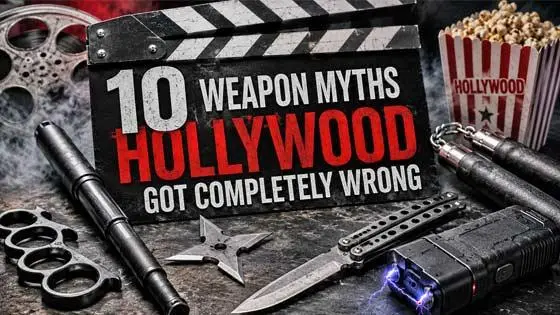
Movies have a funny way of turning ordinary weapons into something almost supernatural. A throwing knife lands perfectly from across the room. A stun gun knocks someone unconscious instantly. Nunchucks turn an average fighter into an unstoppable martial arts master. And somehow, movie silencers make firearms quieter than a whisper.
The problem is, Hollywood rarely prioritizes realism. Directors want drama, cool visuals, and memorable fight scenes, not technical accuracy. Over time, those exaggerated portrayals have shaped the way many people think about weapons, self-defense tools, and even history itself. Some myths are harmless fun. Others are surprisingly persistent.
In reality, many of the weapons movies made famous work very differently than most people expect. Some are harder to use than Hollywood suggests. Some are less effective than their reputation implies. And a few are actually more interesting once you understand how they really work.
In this guide, we are breaking down some of the biggest weapon myths movies still get wrong, from throwing stars and butterfly knives to batons, brass knuckles, stun guns, and more.
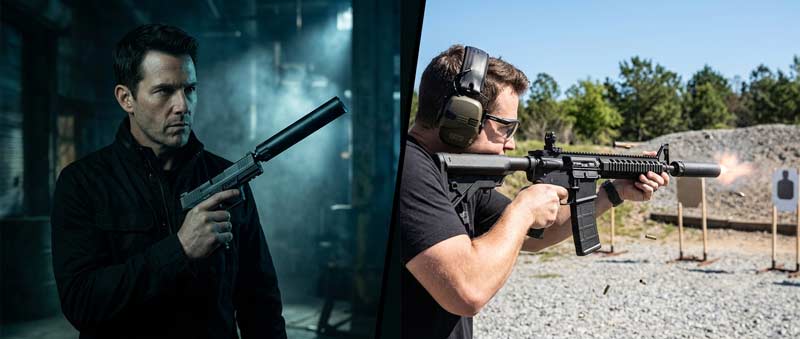
If Hollywood has convinced people of one weapon myth more than almost any other, it is this: attach a suppressor to a firearm and suddenly it sounds like a stapler in a quiet office. A villain fires three shots across a room, nobody notices, and nearby people somehow keep having normal conversations.
Real life works very differently.
Despite the nickname "silencer," firearm suppressors are not actually silent. They reduce noise, but they do not magically erase it. Most suppressed firearms still produce loud gunshots, often comparable to a jackhammer, motorcycle, or thunderclap depending on the caliber and ammunition being used. In many cases, you would absolutely notice one being fired nearby.
Part of the confusion comes from older movies where exaggerated sound effects made suppressors seem nearly invisible to the ear. The tiny "pfft" sound became so common in action films that people started assuming it reflected reality. In truth, suppressors mainly exist to reduce hearing damage, improve control, and slightly lower noise signatures, not to create movie-style stealth weapons.
There are some exceptions. Certain firearm setups using specialized subsonic ammunition can become significantly quieter than standard shots, which is partly where the myth comes from. But even then, "silent" is usually far from accurate.
Hollywood loves this myth because quiet guns make scenes feel dramatic and suspenseful. The reality is much less cinematic. If movies portrayed suppressors accurately, many stealth scenes would sound a lot louder and a lot less cool.
Interestingly, this pattern shows up again and again with weapons in movies. The more visually dramatic something feels on screen, the more reality usually gets bent to make the scene work.
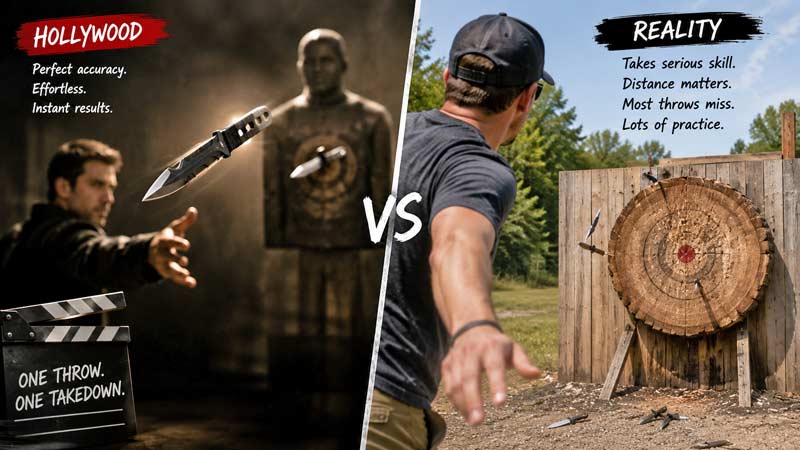
Hollywood makes throwing knives look ridiculously easy. A character casually flicks their wrist from across the room, the knife spins once, lands perfectly tip-first, and instantly stops the bad guy with impossible accuracy.
Real throwing knife use is nowhere near that simple.
The biggest problem is distance. Throwing knives usually require a very specific amount of rotation depending on how far the target is. Move just a few feet closer or farther away and suddenly the knife may rotate too much, not enough, or bounce harmlessly off the target altogether. Skilled throwers spend years practicing consistency, distance control, grip, and timing.
Movies also tend to ignore accuracy under pressure. Hitting a stationary wooden target in practice is one thing. Accurately striking a moving target during a stressful situation is something entirely different. That is one reason throwing knives are more commonly treated as sport, hobby, or entertainment than realistic defensive tools.
That does not mean throwing knives are fake or ineffective. Dedicated throwing designs are carefully balanced for predictable flight, and in skilled hands they can be impressively accurate. But the idea that someone can effortlessly land precision throws in unpredictable real-world situations mostly belongs to Hollywood fantasy.
The same exaggeration shows up with ninja weapons too, especially throwing stars, which movies often portray as impossibly deadly and perfectly accurate. We will get to that myth next.
If you are curious how purpose-built throwing designs actually differ from ordinary knives, you can explore modern throwing knives and see why balance matters so much for repeatable throws.
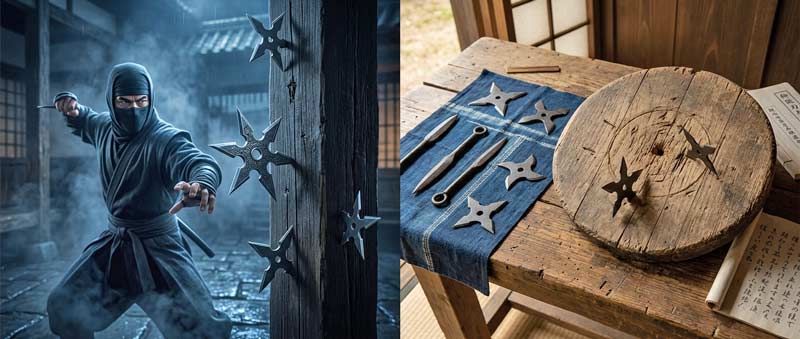
Few weapons have been exaggerated by movies quite like the throwing star. In Hollywood, ninjas casually toss razor-sharp stars across long distances with perfect accuracy, instantly taking down enemies without missing a throw. If action movies were accurate, ninjas apparently never needed backup plans.
The real history of throwing stars, also known as shuriken, is much more interesting and a lot less dramatic.
Historically, shuriken were usually secondary tools rather than primary battlefield weapons. Depending on the time period and region, they could be used for distraction, disruption, slowing pursuit, or creating openings rather than functioning as magical one-hit knockout tools. In many cases, their role was more about strategy than raw stopping power.
Movies also tend to exaggerate their accuracy and range. Throwing any object consistently takes practice, and shuriken are no exception. Distance, spin, angle, and target movement all matter far more than films suggest. The idea that someone could effortlessly land pinpoint throws while running across rooftops belongs firmly in fantasy territory.
That does not make throwing stars fake or useless. Modern enthusiasts still enjoy them for recreational target throwing, martial arts training, and historical interest. Designs vary considerably too, from traditional multi-point stars to straight throwing spikes, each behaving differently in flight. If you want a closer look at the history behind them, we break down what a shuriken actually is and how these tools evolved over time.
Hollywood probably loves the myth because throwing stars look cool on camera. A spinning metal star flying dramatically through the air is simply more cinematic than showing how much skill and practice real throwing requires. Like many weapon myths, entertainment usually wins over realism.
If you are curious about modern designs and how they compare, you can explore different styles of throwing stars here or dive deeper into whether throwing stars are actually effective weapons beyond the movie myths.
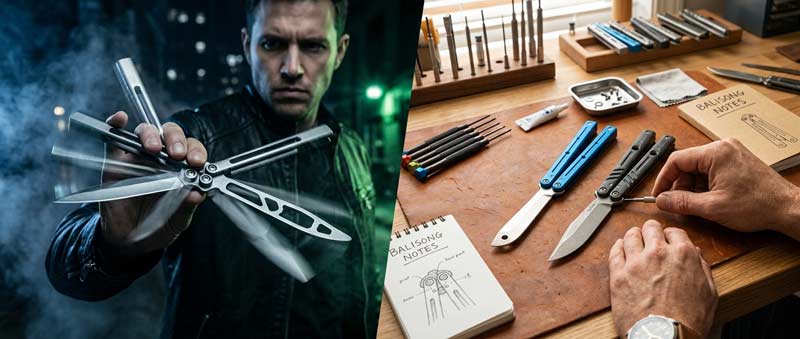
Thanks to movies, martial arts scenes, and internet videos, butterfly knives somehow developed a reputation as superhuman weapons that instantly make someone faster, more dangerous, and nearly impossible to defend against. Hollywood especially loves the dramatic flipping scenes, where a character spins a knife through their fingers for ten seconds before effortlessly winning a fight.
Reality is a lot less cinematic.
The butterfly knife, also called a balisong, was originally valued for portability and compact everyday carry, not flashy tricks. While flipping can absolutely take skill and coordination, most of the dramatic movements people associate with butterfly knives are demonstrations or hobbies rather than practical fighting techniques. In real-world situations, complicated flipping often creates unnecessary risk and wasted movement.
Movies also exaggerate how quickly someone becomes proficient. Skilled manipulation takes time, repetition, and plenty of accidental finger nicks along the way. The smooth, effortless movements seen on screen usually reflect hours or years of practice, not something someone magically masters overnight.
That does not mean butterfly knives are gimmicks. Enthusiasts appreciate them for craftsmanship, mechanics, collecting, and flipping culture, while others simply enjoy the compact design. But the idea that a butterfly knife instantly turns someone into an unstoppable martial arts expert mostly belongs to action movies and video game animations.
Part of what makes the myth so persistent is visual appeal. Few weapons look cooler on camera. A dramatic flip instantly adds tension to a scene, which explains why filmmakers keep using them. In reality, the knife is much more interesting once you separate history and mechanics from Hollywood exaggeration.
If you want to understand how the design actually works, we break down what a balisong really is and how the knife evolved. You can also browse different styles of butterfly knives to see why the design continues to attract collectors and enthusiasts today.
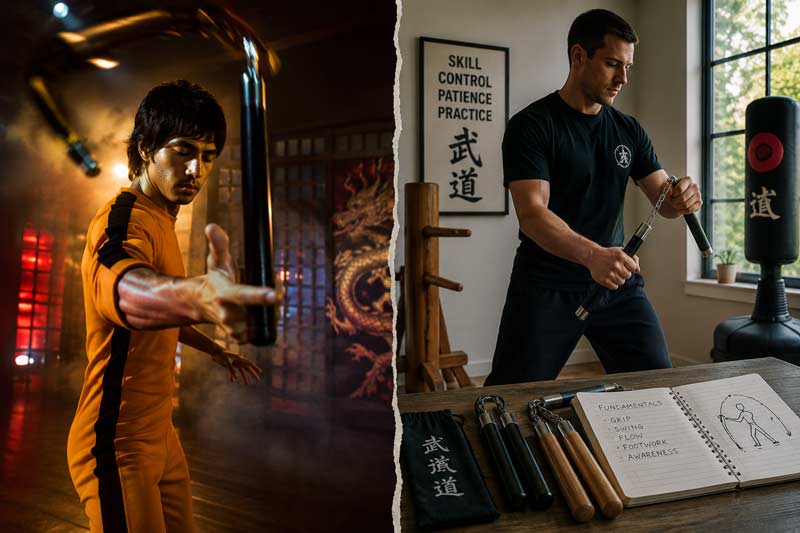
Few weapons owe more of their reputation to movies than nunchucks. For decades, action films have portrayed them as almost unstoppable fighting tools capable of overwhelming opponents through sheer speed and flashy movement. One dramatic spinning sequence later and suddenly the hero looks nearly unbeatable.
The reality is a little more humbling.
Nunchucks require far more control and coordination than movies make them seem. Beginners usually discover this very quickly, often after accidentally hitting themselves in the arm, shoulder, knee, or head during practice. Smooth movement takes repetition, timing, body control, and patience, not just confidence and dramatic music.
Hollywood also tends to exaggerate how practical nunchucks are in every situation. While they can absolutely be effective in trained hands, they are not magical fight-ending tools, nor are they ideal for every environment. Tight spaces, obstacles, and lack of training can make them far harder to use than films suggest.
Interestingly, the history behind nunchucks is much more fascinating than the movie myth. Contrary to popular belief, historians still debate exactly how they evolved, and some of the common stories about them being simple farming tools may be oversimplified. We explore that deeper in our breakdown of why nunchucks were actually invented and the real history behind the weapon.
Part of what keeps the myth alive is visual appeal. Few weapons look more impressive on camera than perfectly controlled spinning movements. Martial arts legends and movie choreography helped cement nunchucks into pop culture, making them feel larger than reality. But behind the dramatic scenes sits something much simpler: a skill-based tool that rewards patience and practice far more than movie magic.
If you want to understand how different styles and materials affect handling, our complete guide to nunchucks breaks down what matters most for beginners and experienced users alike. You can also browse different styles of nunchaku here to see how modern designs vary.
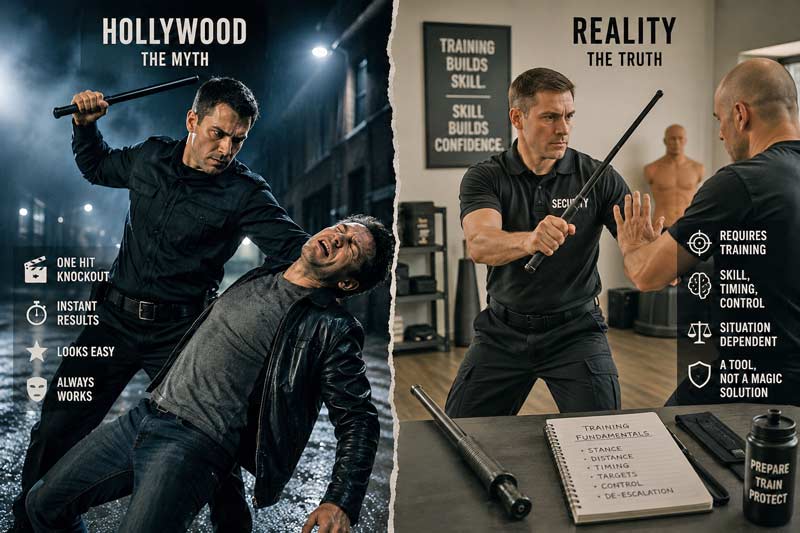
Movies love to portray batons as instant problem-solvers. A security guard lands one dramatic strike, the bad guy collapses immediately, and the scene moves on without much effort. Whether it is police dramas, spy thrillers, or action movies, expandable batons often get treated like guaranteed fight-ending tools.
Reality is far less predictable.
Batons can absolutely be effective tools, but they require training, control, and realistic expectations. In real situations, factors like adrenaline, movement, clothing, pain tolerance, and accuracy all matter. One strike does not automatically stop someone, and real-world encounters rarely unfold with movie-level simplicity.
Hollywood also tends to skip over how difficult baton use can be under pressure. Distance management matters. Timing matters. Targeting matters. Someone standing still for a perfectly choreographed hit is very different from a chaotic real-world encounter. That is one reason security professionals and trained users emphasize technique and preparedness rather than relying on the fantasy of a single dramatic moment.
Interestingly, expandable batons became popular because of practicality, not movie theatrics. Their compact design makes them easier to carry than traditional fixed batons, while still offering reach and control advantages. That practicality is a big reason many professionals still rely on them today. We cover that in more detail in our breakdown of why security professionals still trust expandable batons and how these tools actually get used.
Part of the Hollywood myth comes from pacing. Movies want quick, clean resolutions, not messy unpredictability. But in reality, most self-defense or security tools are exactly that, tools. Their effectiveness depends heavily on training, circumstances, and expectations, not cinematic certainty.
If you want to understand how modern designs work, we also explain how telescoping batons actually work and why expandable designs became so popular. You can also browse different styles of expandable batons here.
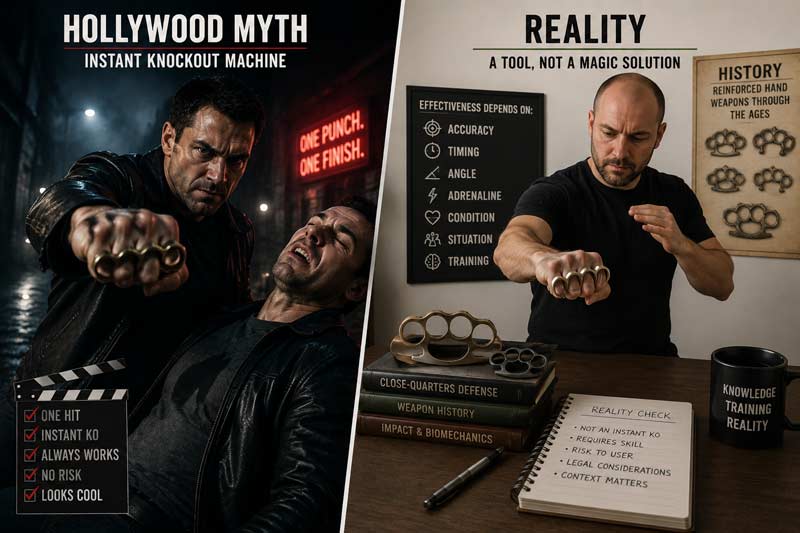
If movies are to be believed, brass knuckles work like an instant off-switch. One punch lands, the other person drops immediately, and the scene ends with almost supernatural efficiency. Action films especially love portraying them as tiny weapons with almost unlimited stopping power.
Reality is much messier.
Brass knuckles, also called knuckle dusters, can absolutely increase impact concentration by reinforcing the hand during strikes, but Hollywood dramatically exaggerates what that actually means. Real-world outcomes depend on countless variables including accuracy, adrenaline, body position, movement, physical condition, and pure unpredictability. There is no guarantee of instant results, no matter what movies suggest.
Another thing films rarely show is risk to the person using them. Poor technique, awkward angles, or unrealistic expectations can create problems of their own. Like many impact tools, effectiveness depends heavily on circumstance, skill, and assumptions about what the tool can realistically do.
Interestingly, the history behind brass knuckles is often more fascinating than their movie reputation. Versions of reinforced hand weapons have appeared in different cultures for centuries, evolving around close-quarters practicality rather than Hollywood drama. We explore that deeper in the real history of brass knuckles and how these compact tools became so recognizable.
Part of the myth survives because movies need fast pacing. A dramatic one-hit scene moves the story forward quickly, while realistic outcomes tend to be unpredictable and complicated. Hollywood prefers certainty. Reality usually does not cooperate.
If you are curious about the mechanics and history behind the design, we also break down what brass knuckles actually are and why their reputation became so exaggerated. You can also browse modern styles of knuckle dusters here.
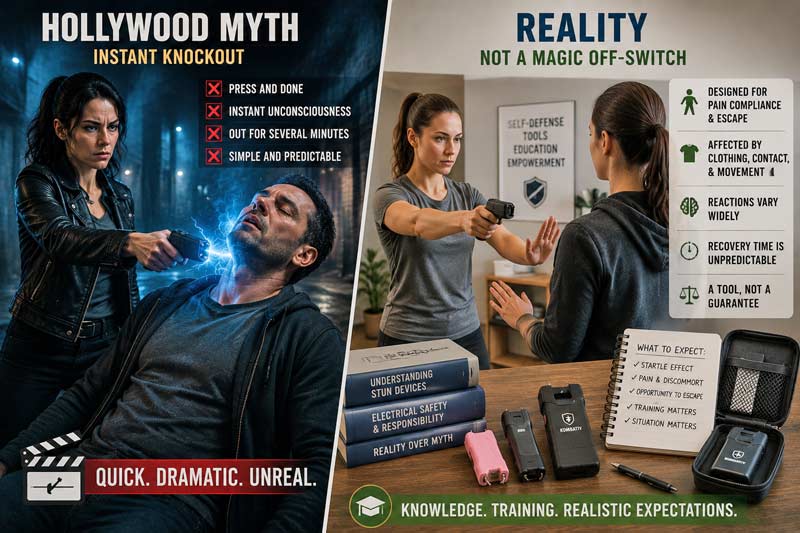
Hollywood absolutely loves this one. A character presses a stun gun against someone for half a second, sparks fly, and the person instantly collapses unconscious for several convenient minutes while the hero casually walks away.
That is not usually how stun devices work in real life.
One of the biggest misconceptions comes from movies blending different devices together. People often confuse conducted electrical weapons used by law enforcement with consumer self-defense stun devices, even though they work very differently. In films, the distinction usually disappears because realism would slow down the plot.
Most civilian stun devices are designed around pain compliance, startle response, and creating an opportunity to escape rather than functioning like an instant off-switch. Reactions can vary dramatically depending on factors like clothing, contact quality, movement, adrenaline, and individual response. There is no guaranteed "movie outcome" button.
Hollywood also exaggerates recovery time. Movies love scenes where someone wakes up several minutes later confused and conveniently harmless. Reality tends to be far less predictable. Responses vary widely, and situations rarely unfold with cinematic certainty.
Interestingly, stun devices became popular because they offered a non-lethal self-defense option that was portable and accessible. Practicality, portability, and deterrence mattered far more than dramatic movie moments. We explain more about that in our guide to how stun guns actually work and what people should realistically expect from them.
Part of what keeps the myth alive is visual drama. Loud electrical sounds, sparks, and instant reactions simply make for good entertainment. But like many Hollywood weapon myths, what looks exciting on screen often leaves out the messy unpredictability of reality.
If you want a deeper breakdown of how modern designs differ, we also cover high-voltage stun devices and how people typically choose one for everyday carry. You can also browse modern stun weapons here.
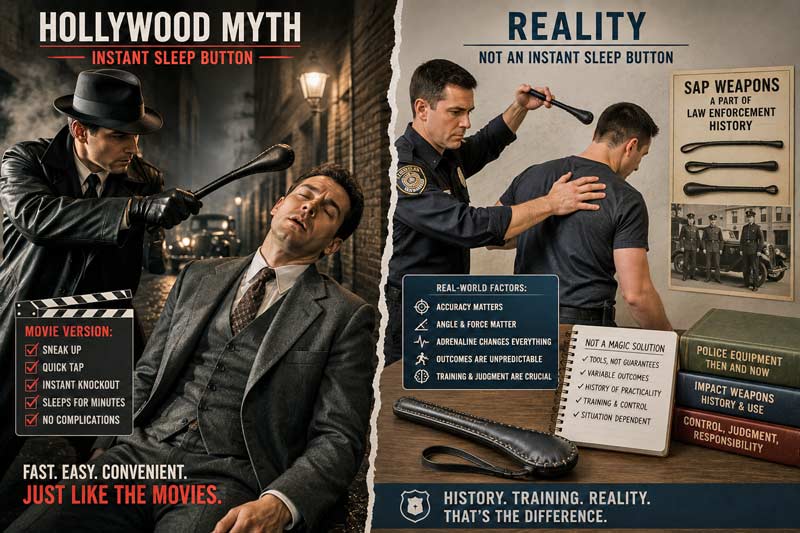
Movies have a strange obsession with blackjacks and slapjacks. A character sneaks up behind someone, gives a quick tap to the head, and the person instantly collapses unconscious for exactly as long as the plot needs. No complications. No unpredictability. Just a perfectly convenient movie nap.
Reality is far less predictable and far less cinematic.
Blackjacks and slapjacks, also called sap weapons, were historically valued because they were compact, portable impact tools, not because they guaranteed instant unconsciousness. Like many close-quarters tools, outcomes depended heavily on countless variables including force, angle, physical condition, movement, adrenaline, and pure circumstance. Hollywood tends to ignore all of that because realism would complicate the story.
Another thing movies rarely show is the unpredictability of real-world outcomes. Human physiology does not follow movie scripts. A dramatic one-hit knockout is not something anyone can reliably expect, which is part of why older law enforcement and security communities focused so heavily on training, control, and situational judgment when these tools were historically carried.
Interestingly, blackjacks became popular because of practicality. Their weighted design made them compact enough to carry while still delivering concentrated force when needed. For a long time, they quietly served as part of law enforcement history before gradually fading from mainstream use. We explore that history further in the police weapon most people forgot ever existed and how sap weapons evolved over time.
Hollywood probably loves this myth because it solves storytelling problems instantly. A quick scene, no mess, no long struggle, and the story keeps moving. But like most weapon myths, reality tends to be more complicated than the movies suggest.
If you are curious about how different designs compare, we also break down what a slapjack actually is and the differences in our guide to slapjack vs blackjack. You can also browse different styles of sap weapons here.
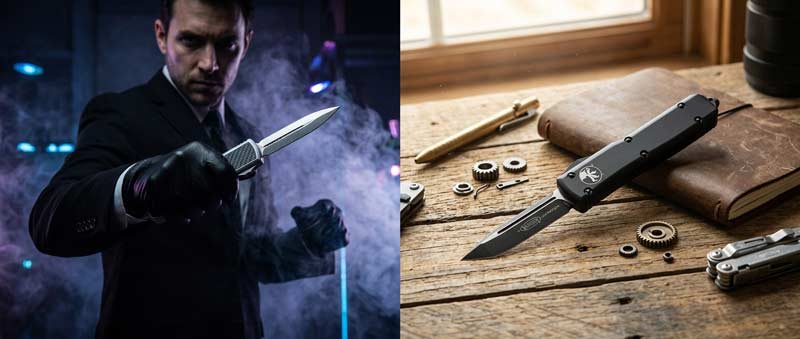
Movies absolutely love OTF knives. A secret agent presses a button, the blade fires out dramatically, and suddenly the character becomes ten times more intimidating. Action films often portray automatic knives as futuristic, ultra-deadly gadgets designed for elite operatives or villains with unlimited resources.
The reality is much less dramatic and a lot more practical.
OTF stands for "out-the-front," meaning the blade deploys straight out of the handle rather than folding open like a traditional pocket knife. While the mechanism looks impressive, most people who carry them appreciate convenience more than movie-style theatrics. Quick one-handed access, compact carry, and mechanical simplicity are usually the bigger selling points.
Hollywood also exaggerates how powerful automatic deployment actually is. Movies often make it seem like the blade launches with incredible force or somehow changes what the knife is capable of. In reality, automatic opening mainly saves time and effort. It does not magically transform a knife into something fundamentally different.
Another myth comes from pop culture reputation. Because switchblades were heavily associated with crime films and rebellious characters during the mid-1900s, many people still assume automatic knives are exotic or unusually dangerous. In practice, they are simply another style of knife mechanism with strengths and tradeoffs like any other design.
Ironically, understanding how OTF knives actually work often makes them more interesting than the movie version. The internal engineering, spring systems, and locking mechanisms are part of why enthusiasts enjoy them. We explain more in our guide to how automatic knives actually work and why the mechanics are more practical than dramatic.
Part of the myth survives because movies love visual flair. A dramatic button press simply looks cooler on camera than slowly opening a normal pocket knife. But like many Hollywood weapon myths, the real story turns out to be more practical than mysterious.
If you want to explore how different styles evolved, you can browse modern automatic knives here and see how designs have changed far beyond the movie stereotypes.
After looking at all these myths, a pattern starts to emerge. Movies are not usually trying to teach realism. They are trying to tell entertaining stories as quickly and dramatically as possible.
A perfectly accurate weapon scene is often slower, messier, and less exciting than audiences expect. Real throwing knives miss. Nunchucks take years of practice. Batons are unpredictable. Stun devices do not work like instant off-switches. And many of the "deadly" movie weapons people fear are often much more complicated in real life than their reputation suggests.
That does not mean Hollywood gets everything wrong. Movies helped introduce millions of people to butterfly knives, nunchucks, throwing stars, OTF knives, and countless other tools they might never have seen otherwise. In many cases, films turned obscure regional weapons into global cultural icons. The problem is that entertainment tends to exaggerate what those tools can realistically do.
Interestingly, reality is often more fascinating than the myth. Once you understand the real history behind a weapon, why it was invented, how people actually used it, and what problems it solved, it becomes much easier to appreciate the design without the movie magic attached.
The next time a movie character silently takes down three people with throwing stars or instantly knocks someone unconscious with a stun gun, you will probably notice the exaggeration. Then again, maybe that is part of the fun.
Hollywood loves spectacle. Reality just happens to be a little more complicated.
If you are curious about the real history and mechanics behind many of these tools, you can explore more guides and modern designs throughout our Kombativ blog and see how these famous weapons actually evolved beyond the myths.
In reality, many of the weapons movies made famous work very differently than most people expect. Some are harder to use than Hollywood suggests. Some are less effective than their reputation implies. And a few are actually more interesting once you understand how they really work.
In this guide, we are breaking down some of the biggest weapon myths movies still get wrong, from throwing stars and butterfly knives to batons, brass knuckles, stun guns, and more.
Myth #1: Silencers Make Guns Whisper Quiet
If Hollywood has convinced people of one weapon myth more than almost any other, it is this: attach a suppressor to a firearm and suddenly it sounds like a stapler in a quiet office. A villain fires three shots across a room, nobody notices, and nearby people somehow keep having normal conversations.
Real life works very differently.
Despite the nickname "silencer," firearm suppressors are not actually silent. They reduce noise, but they do not magically erase it. Most suppressed firearms still produce loud gunshots, often comparable to a jackhammer, motorcycle, or thunderclap depending on the caliber and ammunition being used. In many cases, you would absolutely notice one being fired nearby.
Part of the confusion comes from older movies where exaggerated sound effects made suppressors seem nearly invisible to the ear. The tiny "pfft" sound became so common in action films that people started assuming it reflected reality. In truth, suppressors mainly exist to reduce hearing damage, improve control, and slightly lower noise signatures, not to create movie-style stealth weapons.
There are some exceptions. Certain firearm setups using specialized subsonic ammunition can become significantly quieter than standard shots, which is partly where the myth comes from. But even then, "silent" is usually far from accurate.
Hollywood loves this myth because quiet guns make scenes feel dramatic and suspenseful. The reality is much less cinematic. If movies portrayed suppressors accurately, many stealth scenes would sound a lot louder and a lot less cool.
Interestingly, this pattern shows up again and again with weapons in movies. The more visually dramatic something feels on screen, the more reality usually gets bent to make the scene work.
Myth #2: Throwing Knives Almost Never Work Like Movies
Hollywood makes throwing knives look ridiculously easy. A character casually flicks their wrist from across the room, the knife spins once, lands perfectly tip-first, and instantly stops the bad guy with impossible accuracy.
Real throwing knife use is nowhere near that simple.
The biggest problem is distance. Throwing knives usually require a very specific amount of rotation depending on how far the target is. Move just a few feet closer or farther away and suddenly the knife may rotate too much, not enough, or bounce harmlessly off the target altogether. Skilled throwers spend years practicing consistency, distance control, grip, and timing.
Movies also tend to ignore accuracy under pressure. Hitting a stationary wooden target in practice is one thing. Accurately striking a moving target during a stressful situation is something entirely different. That is one reason throwing knives are more commonly treated as sport, hobby, or entertainment than realistic defensive tools.
That does not mean throwing knives are fake or ineffective. Dedicated throwing designs are carefully balanced for predictable flight, and in skilled hands they can be impressively accurate. But the idea that someone can effortlessly land precision throws in unpredictable real-world situations mostly belongs to Hollywood fantasy.
The same exaggeration shows up with ninja weapons too, especially throwing stars, which movies often portray as impossibly deadly and perfectly accurate. We will get to that myth next.
If you are curious how purpose-built throwing designs actually differ from ordinary knives, you can explore modern throwing knives and see why balance matters so much for repeatable throws.
Myth #3: Throwing Stars Were Never the Deadly Ninja Super Weapons Movies Made Them Seem
Few weapons have been exaggerated by movies quite like the throwing star. In Hollywood, ninjas casually toss razor-sharp stars across long distances with perfect accuracy, instantly taking down enemies without missing a throw. If action movies were accurate, ninjas apparently never needed backup plans.
The real history of throwing stars, also known as shuriken, is much more interesting and a lot less dramatic.
Historically, shuriken were usually secondary tools rather than primary battlefield weapons. Depending on the time period and region, they could be used for distraction, disruption, slowing pursuit, or creating openings rather than functioning as magical one-hit knockout tools. In many cases, their role was more about strategy than raw stopping power.
Movies also tend to exaggerate their accuracy and range. Throwing any object consistently takes practice, and shuriken are no exception. Distance, spin, angle, and target movement all matter far more than films suggest. The idea that someone could effortlessly land pinpoint throws while running across rooftops belongs firmly in fantasy territory.
That does not make throwing stars fake or useless. Modern enthusiasts still enjoy them for recreational target throwing, martial arts training, and historical interest. Designs vary considerably too, from traditional multi-point stars to straight throwing spikes, each behaving differently in flight. If you want a closer look at the history behind them, we break down what a shuriken actually is and how these tools evolved over time.
Hollywood probably loves the myth because throwing stars look cool on camera. A spinning metal star flying dramatically through the air is simply more cinematic than showing how much skill and practice real throwing requires. Like many weapon myths, entertainment usually wins over realism.
If you are curious about modern designs and how they compare, you can explore different styles of throwing stars here or dive deeper into whether throwing stars are actually effective weapons beyond the movie myths.
Myth #4: Butterfly Knives Are Not Magical Fighting Weapons
Thanks to movies, martial arts scenes, and internet videos, butterfly knives somehow developed a reputation as superhuman weapons that instantly make someone faster, more dangerous, and nearly impossible to defend against. Hollywood especially loves the dramatic flipping scenes, where a character spins a knife through their fingers for ten seconds before effortlessly winning a fight.
Reality is a lot less cinematic.
The butterfly knife, also called a balisong, was originally valued for portability and compact everyday carry, not flashy tricks. While flipping can absolutely take skill and coordination, most of the dramatic movements people associate with butterfly knives are demonstrations or hobbies rather than practical fighting techniques. In real-world situations, complicated flipping often creates unnecessary risk and wasted movement.
Movies also exaggerate how quickly someone becomes proficient. Skilled manipulation takes time, repetition, and plenty of accidental finger nicks along the way. The smooth, effortless movements seen on screen usually reflect hours or years of practice, not something someone magically masters overnight.
That does not mean butterfly knives are gimmicks. Enthusiasts appreciate them for craftsmanship, mechanics, collecting, and flipping culture, while others simply enjoy the compact design. But the idea that a butterfly knife instantly turns someone into an unstoppable martial arts expert mostly belongs to action movies and video game animations.
Part of what makes the myth so persistent is visual appeal. Few weapons look cooler on camera. A dramatic flip instantly adds tension to a scene, which explains why filmmakers keep using them. In reality, the knife is much more interesting once you separate history and mechanics from Hollywood exaggeration.
If you want to understand how the design actually works, we break down what a balisong really is and how the knife evolved. You can also browse different styles of butterfly knives to see why the design continues to attract collectors and enthusiasts today.
Myth #5: Nunchucks Do Not Automatically Make You a Martial Arts Master
Few weapons owe more of their reputation to movies than nunchucks. For decades, action films have portrayed them as almost unstoppable fighting tools capable of overwhelming opponents through sheer speed and flashy movement. One dramatic spinning sequence later and suddenly the hero looks nearly unbeatable.
The reality is a little more humbling.
Nunchucks require far more control and coordination than movies make them seem. Beginners usually discover this very quickly, often after accidentally hitting themselves in the arm, shoulder, knee, or head during practice. Smooth movement takes repetition, timing, body control, and patience, not just confidence and dramatic music.
Hollywood also tends to exaggerate how practical nunchucks are in every situation. While they can absolutely be effective in trained hands, they are not magical fight-ending tools, nor are they ideal for every environment. Tight spaces, obstacles, and lack of training can make them far harder to use than films suggest.
Interestingly, the history behind nunchucks is much more fascinating than the movie myth. Contrary to popular belief, historians still debate exactly how they evolved, and some of the common stories about them being simple farming tools may be oversimplified. We explore that deeper in our breakdown of why nunchucks were actually invented and the real history behind the weapon.
Part of what keeps the myth alive is visual appeal. Few weapons look more impressive on camera than perfectly controlled spinning movements. Martial arts legends and movie choreography helped cement nunchucks into pop culture, making them feel larger than reality. But behind the dramatic scenes sits something much simpler: a skill-based tool that rewards patience and practice far more than movie magic.
If you want to understand how different styles and materials affect handling, our complete guide to nunchucks breaks down what matters most for beginners and experienced users alike. You can also browse different styles of nunchaku here to see how modern designs vary.
Myth #6: Batons Do Not End Fights With One Hit
Movies love to portray batons as instant problem-solvers. A security guard lands one dramatic strike, the bad guy collapses immediately, and the scene moves on without much effort. Whether it is police dramas, spy thrillers, or action movies, expandable batons often get treated like guaranteed fight-ending tools.
Reality is far less predictable.
Batons can absolutely be effective tools, but they require training, control, and realistic expectations. In real situations, factors like adrenaline, movement, clothing, pain tolerance, and accuracy all matter. One strike does not automatically stop someone, and real-world encounters rarely unfold with movie-level simplicity.
Hollywood also tends to skip over how difficult baton use can be under pressure. Distance management matters. Timing matters. Targeting matters. Someone standing still for a perfectly choreographed hit is very different from a chaotic real-world encounter. That is one reason security professionals and trained users emphasize technique and preparedness rather than relying on the fantasy of a single dramatic moment.
Interestingly, expandable batons became popular because of practicality, not movie theatrics. Their compact design makes them easier to carry than traditional fixed batons, while still offering reach and control advantages. That practicality is a big reason many professionals still rely on them today. We cover that in more detail in our breakdown of why security professionals still trust expandable batons and how these tools actually get used.
Part of the Hollywood myth comes from pacing. Movies want quick, clean resolutions, not messy unpredictability. But in reality, most self-defense or security tools are exactly that, tools. Their effectiveness depends heavily on training, circumstances, and expectations, not cinematic certainty.
If you want to understand how modern designs work, we also explain how telescoping batons actually work and why expandable designs became so popular. You can also browse different styles of expandable batons here.
Myth #7: Brass Knuckles Are Not Instant Knockout Machines
If movies are to be believed, brass knuckles work like an instant off-switch. One punch lands, the other person drops immediately, and the scene ends with almost supernatural efficiency. Action films especially love portraying them as tiny weapons with almost unlimited stopping power.
Reality is much messier.
Brass knuckles, also called knuckle dusters, can absolutely increase impact concentration by reinforcing the hand during strikes, but Hollywood dramatically exaggerates what that actually means. Real-world outcomes depend on countless variables including accuracy, adrenaline, body position, movement, physical condition, and pure unpredictability. There is no guarantee of instant results, no matter what movies suggest.
Another thing films rarely show is risk to the person using them. Poor technique, awkward angles, or unrealistic expectations can create problems of their own. Like many impact tools, effectiveness depends heavily on circumstance, skill, and assumptions about what the tool can realistically do.
Interestingly, the history behind brass knuckles is often more fascinating than their movie reputation. Versions of reinforced hand weapons have appeared in different cultures for centuries, evolving around close-quarters practicality rather than Hollywood drama. We explore that deeper in the real history of brass knuckles and how these compact tools became so recognizable.
Part of the myth survives because movies need fast pacing. A dramatic one-hit scene moves the story forward quickly, while realistic outcomes tend to be unpredictable and complicated. Hollywood prefers certainty. Reality usually does not cooperate.
If you are curious about the mechanics and history behind the design, we also break down what brass knuckles actually are and why their reputation became so exaggerated. You can also browse modern styles of knuckle dusters here.
Myth #8: Stun Guns Do Not Instantly Knock People Unconscious
Hollywood absolutely loves this one. A character presses a stun gun against someone for half a second, sparks fly, and the person instantly collapses unconscious for several convenient minutes while the hero casually walks away.
That is not usually how stun devices work in real life.
One of the biggest misconceptions comes from movies blending different devices together. People often confuse conducted electrical weapons used by law enforcement with consumer self-defense stun devices, even though they work very differently. In films, the distinction usually disappears because realism would slow down the plot.
Most civilian stun devices are designed around pain compliance, startle response, and creating an opportunity to escape rather than functioning like an instant off-switch. Reactions can vary dramatically depending on factors like clothing, contact quality, movement, adrenaline, and individual response. There is no guaranteed "movie outcome" button.
Hollywood also exaggerates recovery time. Movies love scenes where someone wakes up several minutes later confused and conveniently harmless. Reality tends to be far less predictable. Responses vary widely, and situations rarely unfold with cinematic certainty.
Interestingly, stun devices became popular because they offered a non-lethal self-defense option that was portable and accessible. Practicality, portability, and deterrence mattered far more than dramatic movie moments. We explain more about that in our guide to how stun guns actually work and what people should realistically expect from them.
Part of what keeps the myth alive is visual drama. Loud electrical sounds, sparks, and instant reactions simply make for good entertainment. But like many Hollywood weapon myths, what looks exciting on screen often leaves out the messy unpredictability of reality.
If you want a deeper breakdown of how modern designs differ, we also cover high-voltage stun devices and how people typically choose one for everyday carry. You can also browse modern stun weapons here.
Myth #9: Blackjacks and Slapjacks Were Never "Instant Sleep Buttons"
Movies have a strange obsession with blackjacks and slapjacks. A character sneaks up behind someone, gives a quick tap to the head, and the person instantly collapses unconscious for exactly as long as the plot needs. No complications. No unpredictability. Just a perfectly convenient movie nap.
Reality is far less predictable and far less cinematic.
Blackjacks and slapjacks, also called sap weapons, were historically valued because they were compact, portable impact tools, not because they guaranteed instant unconsciousness. Like many close-quarters tools, outcomes depended heavily on countless variables including force, angle, physical condition, movement, adrenaline, and pure circumstance. Hollywood tends to ignore all of that because realism would complicate the story.
Another thing movies rarely show is the unpredictability of real-world outcomes. Human physiology does not follow movie scripts. A dramatic one-hit knockout is not something anyone can reliably expect, which is part of why older law enforcement and security communities focused so heavily on training, control, and situational judgment when these tools were historically carried.
Interestingly, blackjacks became popular because of practicality. Their weighted design made them compact enough to carry while still delivering concentrated force when needed. For a long time, they quietly served as part of law enforcement history before gradually fading from mainstream use. We explore that history further in the police weapon most people forgot ever existed and how sap weapons evolved over time.
Hollywood probably loves this myth because it solves storytelling problems instantly. A quick scene, no mess, no long struggle, and the story keeps moving. But like most weapon myths, reality tends to be more complicated than the movies suggest.
If you are curious about how different designs compare, we also break down what a slapjack actually is and the differences in our guide to slapjack vs blackjack. You can also browse different styles of sap weapons here.
Myth #10: OTF Knives Are Not Secret Agent Super Weapons
Movies absolutely love OTF knives. A secret agent presses a button, the blade fires out dramatically, and suddenly the character becomes ten times more intimidating. Action films often portray automatic knives as futuristic, ultra-deadly gadgets designed for elite operatives or villains with unlimited resources.
The reality is much less dramatic and a lot more practical.
OTF stands for "out-the-front," meaning the blade deploys straight out of the handle rather than folding open like a traditional pocket knife. While the mechanism looks impressive, most people who carry them appreciate convenience more than movie-style theatrics. Quick one-handed access, compact carry, and mechanical simplicity are usually the bigger selling points.
Hollywood also exaggerates how powerful automatic deployment actually is. Movies often make it seem like the blade launches with incredible force or somehow changes what the knife is capable of. In reality, automatic opening mainly saves time and effort. It does not magically transform a knife into something fundamentally different.
Another myth comes from pop culture reputation. Because switchblades were heavily associated with crime films and rebellious characters during the mid-1900s, many people still assume automatic knives are exotic or unusually dangerous. In practice, they are simply another style of knife mechanism with strengths and tradeoffs like any other design.
Ironically, understanding how OTF knives actually work often makes them more interesting than the movie version. The internal engineering, spring systems, and locking mechanisms are part of why enthusiasts enjoy them. We explain more in our guide to how automatic knives actually work and why the mechanics are more practical than dramatic.
Part of the myth survives because movies love visual flair. A dramatic button press simply looks cooler on camera than slowly opening a normal pocket knife. But like many Hollywood weapon myths, the real story turns out to be more practical than mysterious.
If you want to explore how different styles evolved, you can browse modern automatic knives here and see how designs have changed far beyond the movie stereotypes.
Why Hollywood Keeps Getting Weapons Wrong
After looking at all these myths, a pattern starts to emerge. Movies are not usually trying to teach realism. They are trying to tell entertaining stories as quickly and dramatically as possible.
A perfectly accurate weapon scene is often slower, messier, and less exciting than audiences expect. Real throwing knives miss. Nunchucks take years of practice. Batons are unpredictable. Stun devices do not work like instant off-switches. And many of the "deadly" movie weapons people fear are often much more complicated in real life than their reputation suggests.
That does not mean Hollywood gets everything wrong. Movies helped introduce millions of people to butterfly knives, nunchucks, throwing stars, OTF knives, and countless other tools they might never have seen otherwise. In many cases, films turned obscure regional weapons into global cultural icons. The problem is that entertainment tends to exaggerate what those tools can realistically do.
Interestingly, reality is often more fascinating than the myth. Once you understand the real history behind a weapon, why it was invented, how people actually used it, and what problems it solved, it becomes much easier to appreciate the design without the movie magic attached.
The next time a movie character silently takes down three people with throwing stars or instantly knocks someone unconscious with a stun gun, you will probably notice the exaggeration. Then again, maybe that is part of the fun.
Hollywood loves spectacle. Reality just happens to be a little more complicated.
If you are curious about the real history and mechanics behind many of these tools, you can explore more guides and modern designs throughout our Kombativ blog and see how these famous weapons actually evolved beyond the myths.
You May Also Be Interested In:
- 10 Weapons Hollywood Made Famous That Would Be Terrible in Real Combat
- The Real History of Nunchaku: From Farm Tool to Hollywood Icon
- What Is a Tonfa Weapon and How Was It Originally Used?
- What Is the Most Difficult Weapon to Defend Against?
- Kubaton Weapon: What It Is and How It Works for Self Defense
- What Is the Best Self Defense Weapon for Everyday Carry?
- What Is a Billy Club Weapon and Is It Still Used Today
- What Is the Best Weapon for Fighting in Tight Spaces?
- What Is a Kunai? From Japanese Tool to Ninja Weapon
- The Police Weapon Most People Forgot Ever Existed
Leave a Reply