





Why Did Sword Canes Almost Disappear?
August 27th, 2026
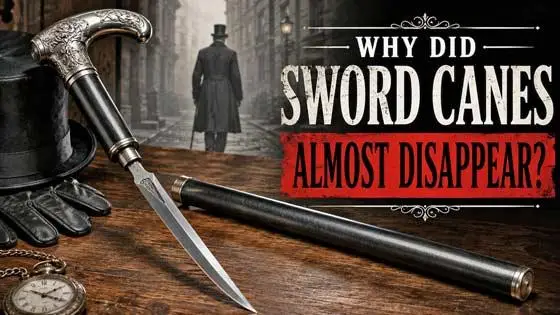
For centuries, a walking cane could be far more than something used for balance. It was a fashion accessory, a symbol of status, and, in some cases, the perfect hiding place for a long steel blade. Sword canes allowed their owners to carry something resembling an ordinary walking stick while concealing a weapon inside, making them particularly intriguing during an era when gentlemen routinely carried canes through crowded city streets. Yet today, sword canes are unusual enough that many people have never encountered one outside a collection or movie. So what happened? Their decline was not caused by one invention or one sudden prohibition. Instead, changing fashion, new attitudes toward concealed weapons, increasingly restrictive laws, and the disappearance of the everyday walking stick gradually stripped away nearly every reason the sword cane had existed in the first place.
Sword Canes Once Hid in Plain Sight
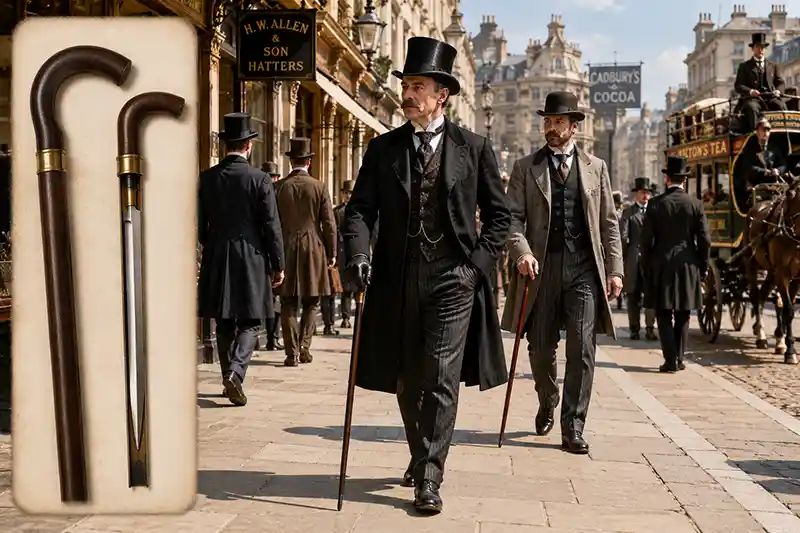
The sword cane only made sense because there was a time when carrying a walking stick attracted almost no attention. During the eighteenth and nineteenth centuries, canes were common accessories among European and American men, particularly in cities. Some were practical walking aids, but many were carried primarily because fashion and social convention said a properly dressed gentleman ought to have one.
That created an almost perfect opportunity for concealment. A narrow blade could be hidden inside the shaft while the handle served as its grip. From the outside, there might be little to distinguish the object from the countless ordinary walking sticks being carried along the same street.
This was the environment in which sword canes flourished. Concealment worked not because the weapon was invisible, but because the object hiding it was completely ordinary. A person could enter a hotel, walk through a railway station, visit a theater, or stroll through a crowded commercial district carrying a cane without necessarily appearing armed.
That placed sword canes among the more ingenious hidden weapons of their era. Unlike a concealed knife or pistol that had to remain underneath clothing, the sword cane could remain openly visible while revealing almost nothing about what was inside.
But this advantage contained the seed of the sword cane's eventual decline. Its disguise depended entirely on a particular fashion remaining commonplace. Once ordinary people stopped carrying walking sticks everywhere they went, the sword cane lost the camouflage that had made the concept so clever in the first place.
The Walking Stick Was Once Part of Being Well Dressed
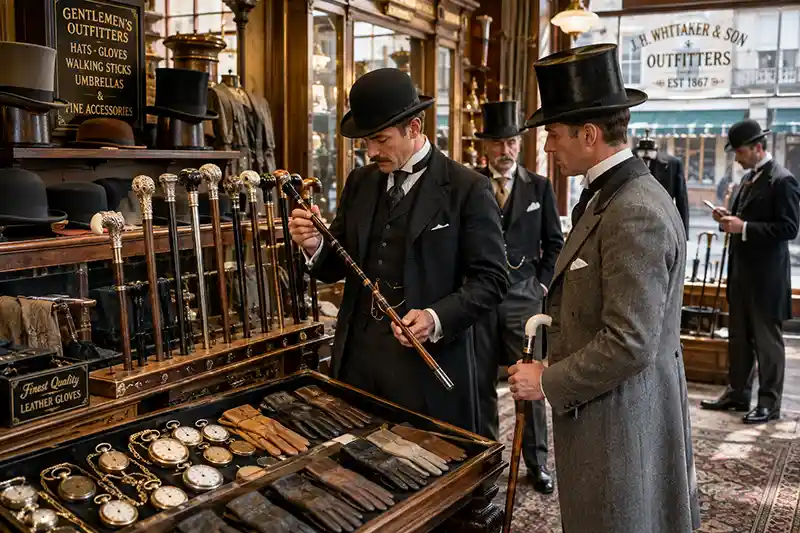
To understand why sword canes eventually faded away, it helps to understand just how ordinary the cane itself once was. During much of the nineteenth century, a walking stick did not automatically suggest age, injury, or difficulty walking. For many men, it belonged in roughly the same category as a hat, gloves, or pocket watch: an accessory that completed the outfit.
That meant cane makers were not limited to producing purely functional walking aids. Handles could be carved from wood, horn, ivory, silver, or other decorative materials, while shafts ranged from restrained everyday designs to elaborate symbols of wealth and personality. Some canes concealed compartments or specialized tools, and a few went considerably further by hiding weapons.
This broader culture of unusual personal accessories helps explain why people once carried such a remarkable assortment of bizarre weapons for self-defense. A sword hidden inside a cane seems eccentric today, but it emerged during a period when everyday objects could serve purposes that modern people would never expect from them.
More importantly, fashion provided the sword cane with social camouflage. A concealed weapon works best when nobody has a reason to inspect the object concealing it. When streets were filled with ordinary walking sticks, there was nothing inherently suspicious about carrying one.
That would eventually become the sword cane's biggest problem. Men's fashion changed dramatically during the twentieth century, and walking sticks gradually stopped being expected accessories. Once the ordinary cane began disappearing from everyday life, anyone carrying one became more noticeable. The sword cane had not changed, but its disguise suddenly worked much less effectively.
Sword Canes Thrived in an Age of Anxiety
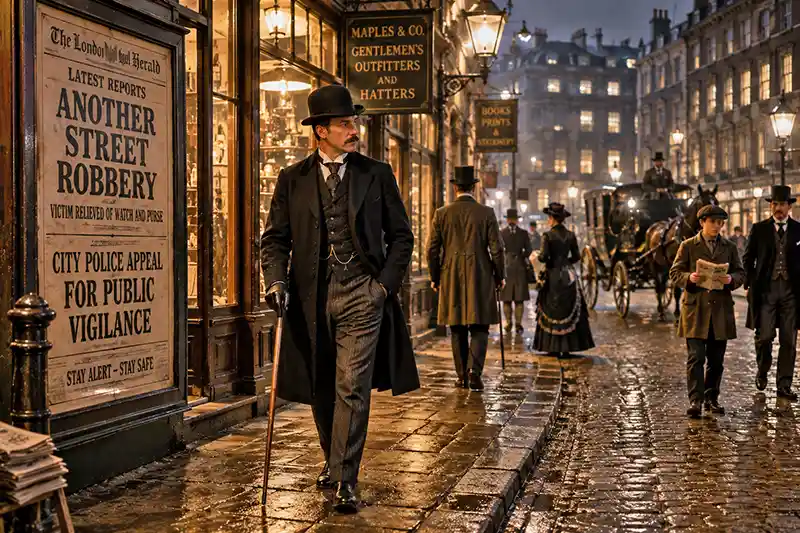
Fashion explains how sword canes could be carried without attracting attention, but it does not completely explain why anyone wanted a blade hidden inside a walking stick. Nineteenth-century cities were growing rapidly, and newspapers regularly filled their pages with robberies, assaults, street gangs, and sensational stories about urban crime. Whether the actual danger matched the public's fears was almost beside the point. Many people believed the streets could be unpredictable.
At the same time, openly carrying a sword was becoming increasingly out of place in civilian life. The age when a gentleman might routinely wear a sword at his side had largely passed, yet the desire for some form of personal protection had not disappeared with it. The sword cane offered an unusual compromise: the reach and appearance of a narrow blade hidden inside an accessory that did not immediately announce itself as a weapon.
It was hardly the only strange solution. The nineteenth and early twentieth centuries produced an astonishing variety of defensive gadgets, disguised weapons, combination devices, and modified everyday objects. Sword canes belonged to a broader period when inventors seemed willing to hide defensive capability inside almost anything a person might reasonably carry.
That cultural environment is important because sword canes were never merely swords with inconvenient scabbards. Their appeal depended on uncertainty. The owner could walk through the city appearing to carry nothing more remarkable than a fashionable cane while knowing there was something very different concealed inside.
Once public attitudes toward carrying concealed weapons began to change, however, that exact feature would become a liability. The disguise that once made the sword cane attractive would eventually become one of the strongest arguments for restricting it.
The Disappearance of the Everyday Cane Changed Everything
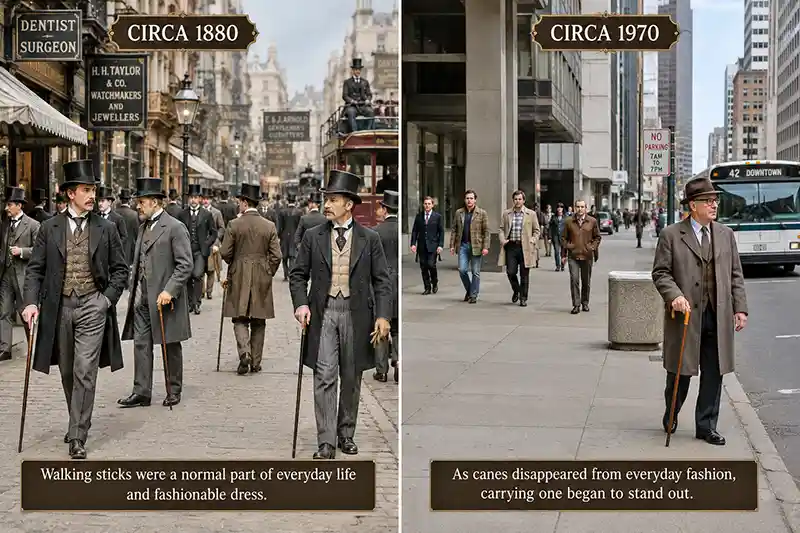
The sword cane did not begin disappearing because its hidden blade suddenly stopped working. One of the biggest reasons was far more mundane: men gradually stopped carrying canes in the first place. As twentieth-century fashion became less formal, many accessories that had once been considered essential simply fell out of everyday use.
Top hats gave way to less formal headwear and eventually to no hat at all. Elaborate waistcoats became less important. Gloves stopped being routine accessories for ordinary outings. The decorative walking stick followed much the same path. A cane increasingly became associated with physical support rather than fashionable dress.
That seemingly minor cultural change was devastating to the sword cane's greatest advantage. In a crowd where dozens of men carried walking sticks, one more cane was virtually invisible. In a crowd where almost nobody carried one, the same object suddenly attracted attention.
The change also altered how people interpreted the object. An able-bodied young man carrying an ornate cane in 1880 might have looked fashionable. The same behavior generations later could seem eccentric, theatrical, or unusual enough to invite questions. Concealment becomes considerably less useful when the object doing the concealing is itself conspicuous.
Modern self-defense canes demonstrate an important difference. A cane can still function as a legitimate walking aid while also being designed with durability and personal protection in mind, without requiring a hidden blade inside the shaft. The sword cane depended much more heavily on an era when the cane itself could disappear into everyday fashion.
In that sense, sword canes were partly defeated by the changing wardrobe. The blade had not become obsolete. Its disguise had.
Concealed Weapon Laws Turned the Sword Canes Best Feature Against It
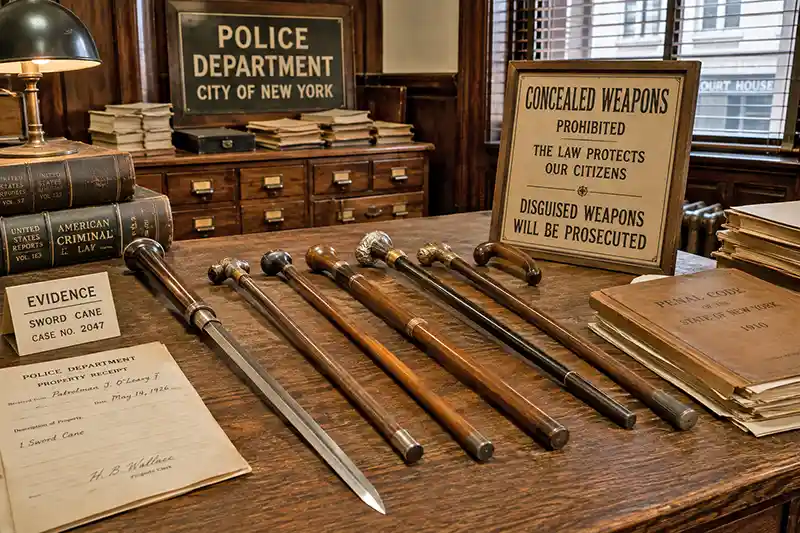
As attitudes toward weapons changed, the very feature that made the sword cane ingenious became increasingly problematic. A conventional sword was obviously a weapon. A sword cane was deliberately designed so that someone looking at it might never realize a blade was present. To lawmakers concerned about concealed weapons, that distinction mattered.
During the nineteenth and twentieth centuries, jurisdictions in the United States and elsewhere increasingly regulated the carrying of concealed weapons. The details varied enormously by place and period, but disguised weapons could present an especially difficult legal problem because their ordinary appearance allowed them to bypass the social warning that normally came with seeing someone armed.
Sword canes were particularly vulnerable to these restrictions. Their entire appeal depended on concealment. Remove the ability to legally carry one in public and much of the practical reason for owning one disappears. Unlike an ordinary cane that could still serve as a walking aid, the hidden blade could transform an otherwise mundane object into something subject to an entirely different set of rules.
This was a profound reversal. A century earlier, looking like an innocent walking stick had been the sword cane's greatest advantage. In the modern regulatory environment, disguising a blade as an innocent walking stick could be precisely what made authorities view it more seriously.
Laws governing sword canes still vary considerably by location, so their legal status should never be assumed simply because ordinary canes or other bladed objects are permitted. But historically, the broader movement toward regulating concealed and disguised weapons removed one of the conditions that had allowed sword canes to thrive in the first place.
The sword cane had been designed to hide what it really was. Eventually, society became far less comfortable with weapons that did exactly that.
Sword Canes Had Another Problem: They Were Compromised Swords
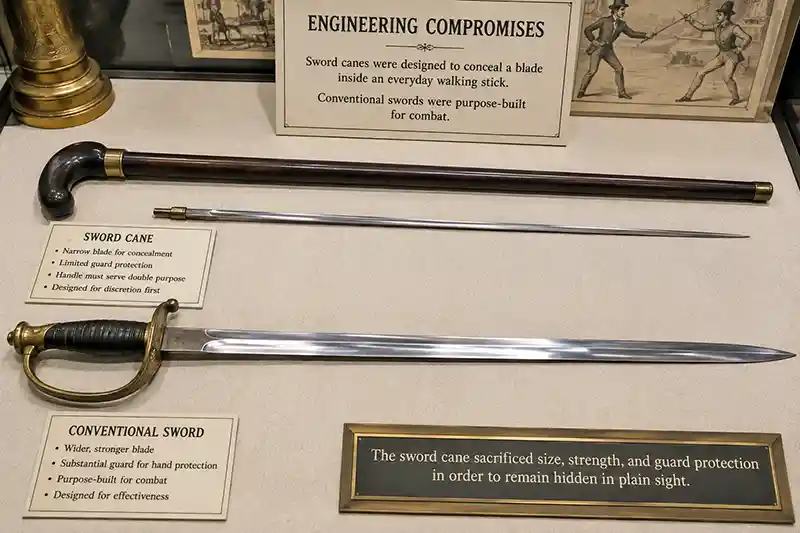
Even during their heyday, sword canes came with an unavoidable engineering problem. The weapon had to remain narrow enough to disappear inside something that still looked and functioned like a walking stick. That placed restrictions on the blade that an ordinary sword did not have to contend with.
Many sword cane blades were relatively slender, and the handle had to perform two completely different jobs. It needed to look convincing as the top of a cane while also serving as the grip once the blade was drawn. There was usually little room for the substantial guard and protective hand structure found on many purpose-built swords.
The cane itself presented compromises as well. A hollow shaft had to contain the blade while remaining strong enough for everyday handling. Makers could produce remarkably elegant solutions, but they were still trying to combine two objects whose ideal designs were fundamentally different.
That did not make sword canes useless. Their appeal was never that they represented the ultimate evolution of the sword. Their advantage was that a blade could be carried in circumstances where wearing an obvious sword would have been socially awkward or unacceptable. The fascinating history of these compromises is part of what makes the history of cane swords so unusual.
But once concealment became less socially useful and more legally troublesome, those compromises became harder to justify. If someone no longer had a compelling reason to hide a sword inside a walking stick, there were few practical reasons to accept the limitations required to make the combination work.
Sword canes therefore faced pressure from both directions. Society was becoming less accommodating toward concealed blades at exactly the same time that the original advantages of disguising one as a cane were disappearing.
The Rise of the Automobile Made Walking Sticks Less Useful
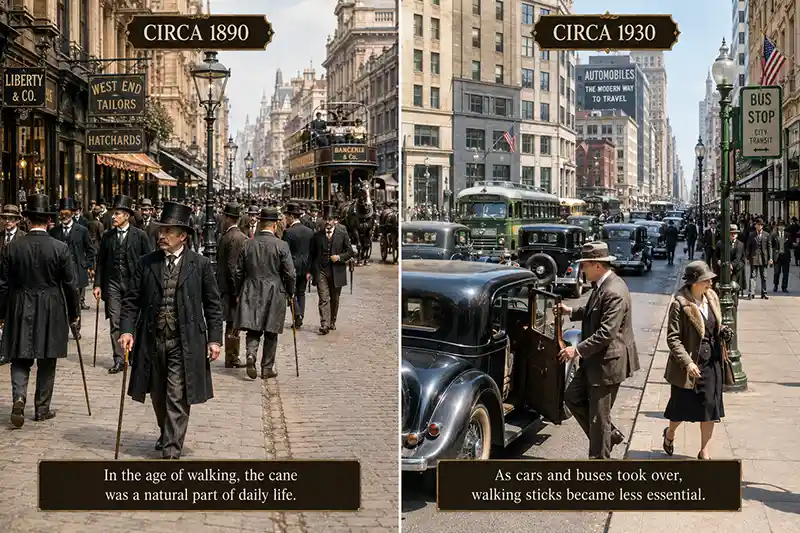
Fashion was not the only thing changing. The way people moved through cities changed too. During the period when sword canes were most at home, daily life involved enormous amounts of walking. Streets, railway stations, promenades, shops, offices, clubs, and theaters were connected by journeys that frequently happened on foot.
The twentieth century gradually rewrote that routine. Automobiles became increasingly accessible, public transportation expanded, and cities evolved around new forms of mobility. A person who once might have walked several miles through town could increasingly travel much of that distance inside a vehicle.
That mattered because the walking stick was an accessory designed for a pedestrian world. Even when carried primarily for fashion, it made sense alongside long coats, formal hats, and hours spent moving through streets on foot. It was considerably less convenient when climbing into an automobile, riding a bus, or moving through increasingly crowded modern interiors.
The automobile also changed what people carried. Everyday accessories tend to survive when they fit naturally into daily routines. Once a cane became something that had to be placed beside a seat, stored somewhere, remembered when leaving the vehicle, and carried around after arriving, its fashionable appeal became easier to abandon.
For the sword cane, this represented another quiet blow. It had depended on millions of ordinary people having perfectly innocent reasons to carry cane-shaped objects. Cars did not make sword canes obsolete overnight, but they helped dismantle the pedestrian culture that had allowed them to blend effortlessly into everyday life.
The sword cane was becoming a relic not because the hidden blade had changed, but because the streets around it had.
Modern Security Made Disguised Weapons Harder to Carry
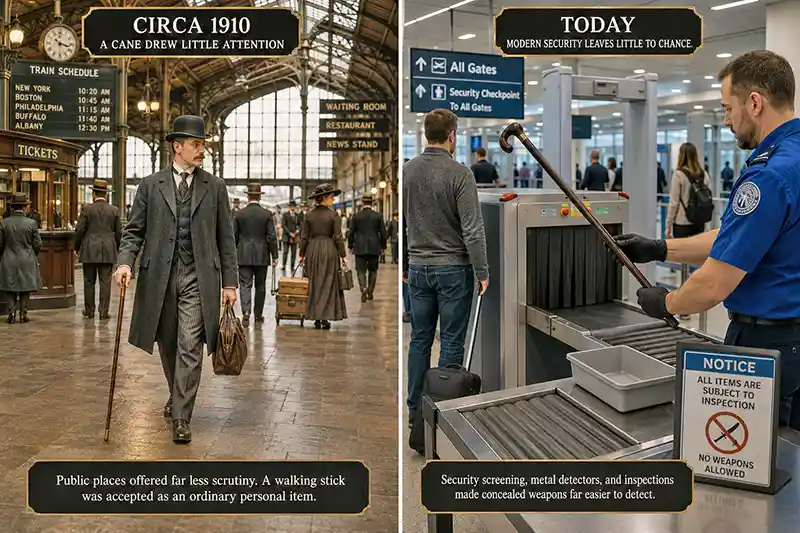
The sword cane also belonged to a world with very different ideas about security. For much of its history, people routinely entered hotels, theaters, railway stations, restaurants, government buildings, and other public spaces without passing through metal detectors, bag inspections, or dedicated security checkpoints. An ordinary-looking cane could move through society with relatively little scrutiny.
That environment changed dramatically during the twentieth century. Airports became one of the clearest examples, but increased security gradually appeared in courthouses, government facilities, schools, entertainment venues, and other controlled spaces. Objects that once would have received little attention could now be inspected, scanned, or prohibited entirely.
This created a unique problem for sword canes. Their concealment was primarily visual. The blade disappeared inside the shaft because someone looking at the outside saw an ordinary walking stick. Modern screening methods did not necessarily depend on outward appearance, making that disguise considerably less useful.
The shift also changed expectations surrounding everyday objects. Security personnel became increasingly accustomed to asking what an unusual object contained rather than simply accepting what it appeared to be. That is particularly significant for disguised weapons, whose entire concept depends on the observer making the wrong assumption.
In earlier centuries, concealment could allow a sword cane to blend into a crowd. In the modern world, concealment could instead create suspicion and serious legal consequences. The development of security screening did not single-handedly destroy the sword cane, but it removed yet another environment in which its disguise had once provided an advantage.
By the late twentieth century, the sword cane was facing a world almost perfectly designed to undermine it: fewer people carried canes, concealed weapons faced greater regulation, and more places had ways of discovering what was hidden inside.
Better Alternatives Took Away Another Reason to Carry One
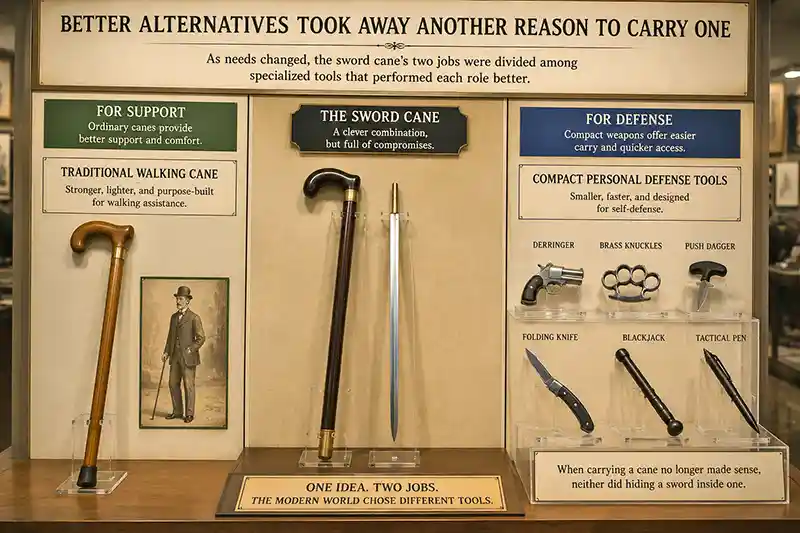
Sword canes also suffered from a problem that affects many ingenious combination weapons: eventually, people had access to alternatives that performed each job better. If someone genuinely needed help walking, an ordinary cane could be lighter, stronger, and designed entirely around support. If someone wanted a compact personal-defense option, there were increasingly other choices that did not require hiding a sword-length blade inside a hollow shaft.
This mattered because the sword cane's appeal had always depended on combining functions. The compromises were worthwhile when carrying an obvious weapon was socially awkward but carrying a walking stick was completely normal. As that social advantage disappeared, the question became harder to answer: why combine a cane and sword at all?
The twentieth century offered an expanding assortment of compact defensive tools, while ordinary walking aids also became increasingly specialized and practical. The sword cane found itself caught between two categories that were evolving independently. It was neither the most practical cane nor the most convenient defensive weapon.
That distinction helps explain why the broader idea of discreet personal protection never vanished along with sword canes. People continued experimenting with concealable defensive tools and unconventional designs. What changed was which forms made sense in the world around them.
Sword canes had once offered an elegant answer to a very specific problem: how could someone carry a substantial blade without looking like they were carrying a substantial blade? By the modern era, fewer people needed that particular solution, and the legal and practical disadvantages of the design increasingly outweighed its cleverness.
The sword cane was not replaced by one superior invention. Instead, its original jobs were gradually divided among objects that could perform them without requiring the strange marriage of walking stick and sword.
World War I Helped Break the Old Culture of Formal Dress
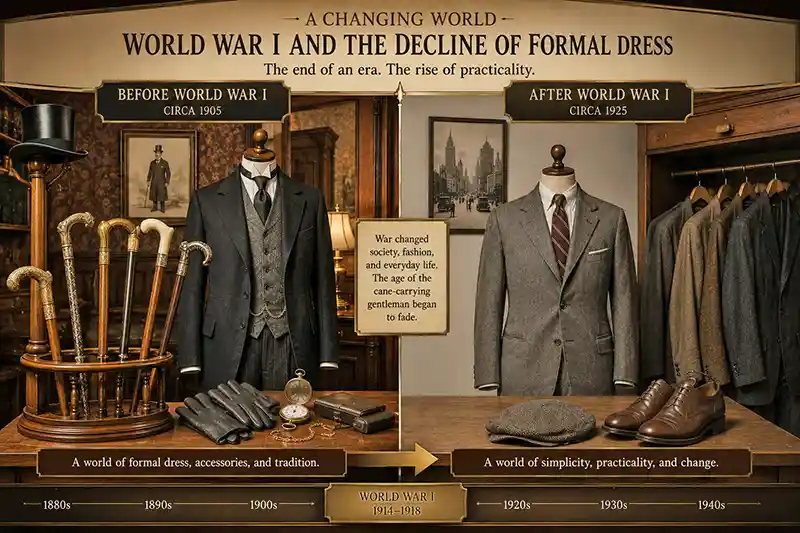
The decline of the sword cane was already underway as transportation, fashion, and attitudes toward weapons changed, but the early twentieth century delivered another major disruption. World War I transformed European society on a scale that reached far beyond the battlefield, and the highly formal world that had made decorative walking sticks commonplace never fully returned in the same form.
Before the war, elaborate standards of dress still shaped public life. Hats, gloves, waistcoats, walking sticks, and other accessories could communicate social position and respectability. After the war, men's clothing gradually moved toward greater practicality and simplicity. The process was not immediate, and canes certainly did not vanish in 1918, but the cultural environment that supported them was weakening.
The war also accelerated a broader transition away from the nineteenth-century relationship between gentlemen and personal weapons. Swords increasingly belonged to military ceremony, collecting, sport, and history rather than ordinary civilian dress. A concealed sword hidden inside a fashionable cane consequently began to feel like an artifact from an earlier social order.
By the 1920s and 1930s, a sword cane could still appear elegant, mysterious, and even sophisticated. But those qualities were becoming nostalgic rather than necessary. The object was slowly changing from something that could plausibly belong to everyday life into something people associated with an earlier generation.
This is an important reason there was no single moment when sword canes "disappeared." Nobody woke up one morning and stopped carrying them. Instead, the cultural ecosystem that had supported them was dismantled piece by piece. Fashion changed. Transportation changed. Laws changed. Security changed. And after the upheavals of the early twentieth century, the old image of the cane-carrying gentleman increasingly belonged to the past.
The Sword Cane Slowly Changed From a Tool Into a Curiosity
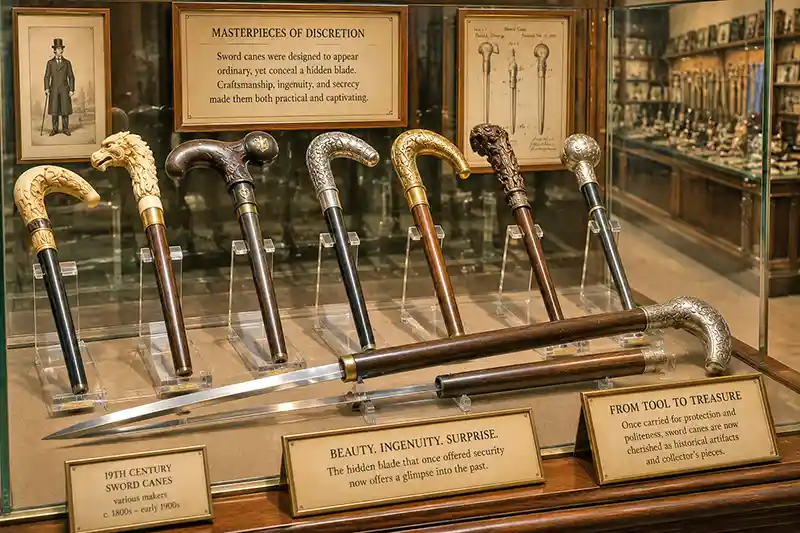
As the practical reasons for carrying sword canes disappeared, the objects themselves did not vanish. Instead, their role began to change. A sword cane that might once have been purchased as a fashionable accessory with a concealed defensive purpose increasingly became something valued for craftsmanship, novelty, history, or sheer mechanical ingenuity.
Antique examples were especially well suited to this transition. Many had elaborate handles, finely finished blades, unusual locking mechanisms, and decorative shafts that reflected the tastes of the period in which they were made. Once removed from their original context, these details made sword canes fascinating collectibles even for someone who would never consider carrying one through a modern city.
Their secrecy became part of the appeal. An ordinary antique walking stick might be beautiful, but discovering that its handle withdraws to reveal a hidden blade immediately transforms it into a conversation piece. The same concealment that had once provided practical discretion now provided surprise.
Museums and private collections also helped preserve sword canes as examples of a much broader historical fascination with disguised objects. They offer a glimpse into a period when manufacturers concealed everything from tools and compartments to weapons inside items designed to look completely ordinary.
This transformation helps explain why sword canes almost disappeared rather than disappearing completely. Their original ecosystem collapsed, but the objects were simply too unusual to be forgotten. Collectors, historical enthusiasts, and modern manufacturers kept the basic concept alive long after everyday society stopped providing much practical reason to carry one.
By surviving as curiosities, sword canes accomplished something strangely appropriate for a disguised weapon. They changed their identity once again.
Pop Culture Kept the Sword Cane More Famous Than Its Real-World Use
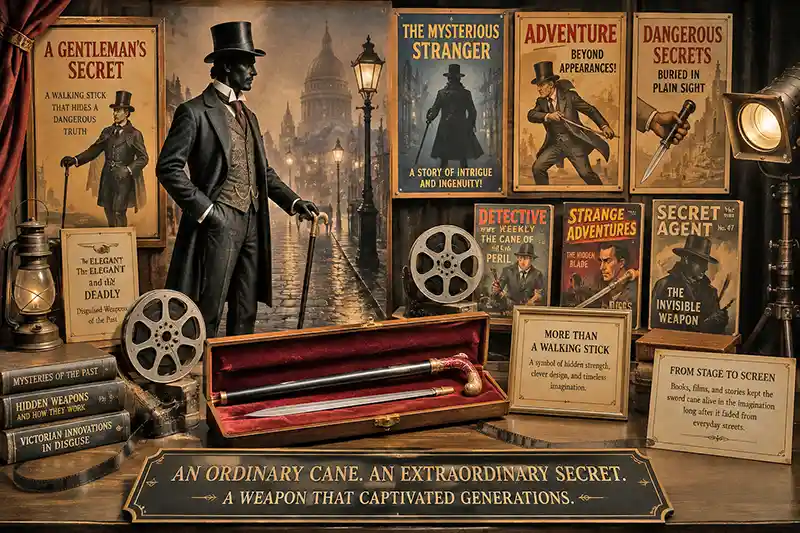
By the time sword canes were becoming increasingly uncommon in everyday life, they had acquired something arguably more durable than practicality: mystique. A perfectly ordinary walking stick that suddenly revealed a hidden blade was almost tailor-made for fiction, where surprise is often more important than whether an object would be convenient to carry every day.
Mystery stories, period adventures, stage productions, films, television, and later video games helped preserve the basic idea. The sword cane fit naturally with aristocratic villains, eccentric gentlemen, secret agents, and characters whose harmless appearance concealed something dangerous. Even audiences who had never encountered a genuine sword cane could immediately understand the reveal.
That fictional image also froze the sword cane in a particular historical atmosphere. Top hats, foggy streets, ornate walking sticks, gas lamps, and concealed blades became part of the same visual language. The weapon remained strongly associated with the nineteenth century even as genuine walking sticks disappeared from ordinary men's fashion.
Ironically, this may be one reason sword canes can seem more historically common than they actually were. They are memorable. Thousands of perfectly ordinary walking sticks attract little attention in retrospect, while the one containing a hidden sword is exactly the sort of object that gets displayed in a museum, photographed in a book, or incorporated into a fictional story.
So while changing fashion and modern restrictions pushed sword canes toward obscurity, popular culture pulled in the opposite direction. The weapon largely disappeared from the sidewalk but survived remarkably well in the imagination.
The Sword Cane Became Too Suspicious to Be Truly Concealed
There is an irony at the heart of the sword cane's decline. The more unusual sword canes became, the worse they became at performing the very trick that originally made them appealing. A disguise only works when the object being imitated looks completely ordinary.
In the nineteenth century, a gentleman carrying a polished wooden cane might disappear among dozens of other men carrying nearly identical accessories. Nobody needed to wonder why he had it. By the late twentieth century, an ornate cane carried by someone who did not appear to need assistance could attract precisely the kind of attention its original designers hoped to avoid.
The sword cane's reputation eventually compounded the problem. Once people became familiar with the idea that walking sticks could conceal blades, an unusually heavy shaft, elaborate handle, visible joint, or other peculiar feature might encourage closer inspection. The weapon's famous disguise was no longer necessarily a secret.
This reveals something important about many concealed weapons: their effectiveness can depend as much on culture as engineering. A brilliantly disguised object in one century can become conspicuous in another simply because the ordinary object it imitates has disappeared from daily life.
Sword canes therefore suffered from a strange feedback loop. Fewer people carried ordinary canes, which made sword canes more noticeable. As sword canes became more noticeable and more closely associated with concealed weapons, their ability to pass unnoticed weakened even further.
Eventually, the sword cane became almost the opposite of what it had once been. Instead of being an unremarkable object capable of hiding something extraordinary, it became an extraordinary object that people might immediately suspect was hiding something.
Modern Sword Canes Survived by Becoming Something Different
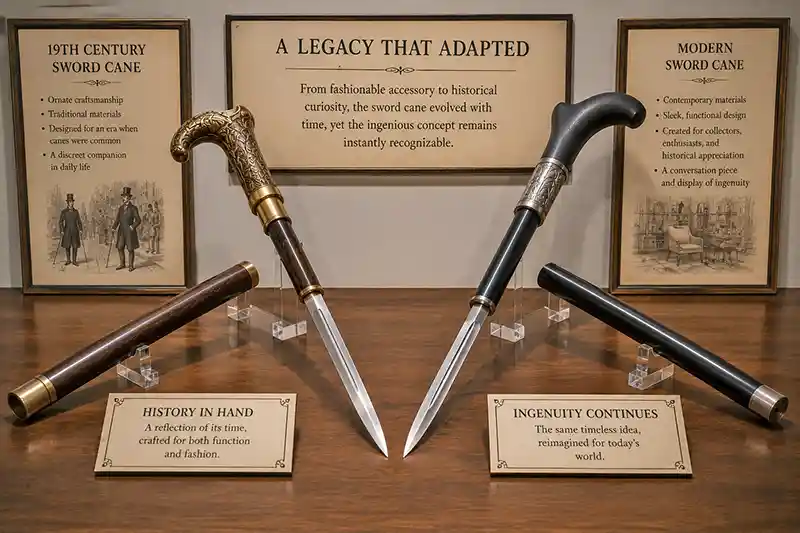
Sword canes never completely disappeared. Modern versions are still manufactured, collected, and admired, but they occupy a very different place in society from their historical predecessors. What was once potentially carried as an inconspicuous everyday accessory is now far more likely to be encountered as a collectible, novelty, historical reproduction, or unusual piece of weapon craftsmanship.
That change is important because the modern sword cane no longer depends on being fashionable in the same way. Someone interested in one today may be fascinated precisely because sword canes are unusual. The characteristic that weakened their usefulness as concealed everyday weapons eventually became part of their appeal as collectibles.
Modern manufacturing has also allowed makers to experiment with materials, blade designs, handles, locking systems, and decorative styles that would have looked very different from many nineteenth-century examples. Yet the central idea remains instantly recognizable: an apparently ordinary cane concealing a long blade within its shaft.
Their survival demonstrates that unusual weapon concepts do not necessarily vanish when their original purpose becomes obsolete. Sometimes they move into entirely different cultural roles. The sword cane migrated from fashionable accessory and potential defensive weapon to historical curiosity and conversation piece.
That is why saying sword canes "disappeared" is not quite accurate. They almost disappeared from the world that originally made them practical. The concept itself survived.
There Was No Single Moment When Sword Canes Disappeared
It would make the story simpler if one law, invention, or cultural event had suddenly ended the age of the sword cane. That does not appear to be what happened. Instead, nearly every condition that had once made the design appealing gradually changed, often at roughly the same time.
Walking sticks fell out of everyday fashion. Automobiles reduced the importance of pedestrian accessories. Men's clothing became less formal. Openly carrying swords had already become socially obsolete, while concealed and disguised weapons attracted increasing legal scrutiny. Later, modern security made hiding a blade inside an innocent-looking object considerably less useful.
None of those changes alone necessarily would have killed the sword cane. Together, however, they removed its reason for existing. The weapon had occupied an unusually narrow niche created by a society in which carrying a sword openly seemed outdated, carrying a walking stick seemed completely ordinary, and concealing one inside the other could still offer a practical advantage.
Once that combination disappeared, the sword cane had nowhere obvious to go. It was too unusual to remain an everyday accessory, too compromised to compete with purpose-built swords, increasingly problematic as a concealed weapon, and unnecessary as a walking aid.
That is what makes its decline more interesting than simple obsolescence. Nobody invented a better sword cane and drove the old ones from the market. The world simply stopped creating the peculiar circumstances that had made sword canes useful.
And perhaps that is the real answer to why sword canes almost disappeared: the weapon did not become obsolete nearly as quickly as the lifestyle that had created it.
Why Did Sword Canes Almost Disappear Instead of Vanishing Completely?
For all the forces working against them, sword canes possessed one quality that helped them survive: they were simply too fascinating to forget. Few historical weapons create the same moment of surprise. What appears to be an elegant walking stick separates to reveal a blade hidden inside, and the basic concept remains intriguing even after its original purpose has largely disappeared.
Collectors preserved antique examples because of their craftsmanship and unusual mechanisms. Museums preserved them because they reveal something about changing fashion, personal protection, and attitudes toward concealed weapons. Modern enthusiasts kept the concept alive because the combination of ordinary object and hidden blade still has an undeniable mechanical appeal.
That survival also separates sword canes from countless forgotten defensive gadgets of the nineteenth century. Many strange inventions disappeared so thoroughly that they now exist mainly in patents, catalogs, or museum collections. The sword cane remained recognizable enough that new generations continued rediscovering it.
But the reason it survived is almost the opposite of the reason it originally succeeded. Historically, the sword cane was valuable because a cane was ordinary. Today, sword canes remain interesting precisely because they are extraordinary.
That reversal tells the entire story. Changing fashion removed their camouflage. Modern transportation weakened the culture of carrying walking sticks. concealed-weapon restrictions complicated their use. Security screening undermined their disguise. Better specialized alternatives reduced their practicality. Yet none of those developments could erase the ingenuity of the original idea.
Sword canes therefore never truly vanished. They simply crossed a boundary that many historical weapons eventually encounter, leaving everyday life behind and entering the worlds of collecting, history, craftsmanship, and curiosity.
Were Sword Canes Actually Common?
Sword canes were real historical objects and were produced in significant variety, but they should not be imagined as something nearly every cane-carrying gentleman secretly owned. Ordinary walking sticks vastly outnumbered examples concealing blades, and sword canes occupied a much more specialized niche.
Part of the confusion comes from how memorable surviving examples are. An ordinary nineteenth-century walking stick may receive little attention today, while an ornate cane that pulls apart to reveal a hidden sword is far more likely to appear in a museum collection, auction catalog, book, or historical weapons exhibit.
Their popularity in fiction has amplified that impression. Sword canes fit the atmosphere of Victorian mysteries and period adventures so perfectly that modern audiences can easily assume they were a standard accessory of the era rather than an unusual variation on an extremely common object.
The distinction is important. Walking sticks really were everywhere in certain social settings, and that widespread use was precisely what made concealing a blade inside one so clever. Sword canes did not need to be common themselves. They benefited from being surrounded by ordinary canes that were.
Were Sword Canes Mainly a Victorian Invention?
Sword canes are strongly associated with the Victorian era, but the basic idea of concealing a blade inside a walking stick is older. Walking sticks, staffs, and similar everyday objects had been adapted to conceal weapons before Queen Victoria came to the throne in 1837.
What the nineteenth century provided was an unusually favorable environment for the concept. Decorative canes became fashionable accessories, especially among well-dressed men in European and American cities. With so many ordinary walking sticks in circulation, a cane containing a hidden blade could blend naturally into its surroundings.
The Victorian association is also strengthened by the sheer variety of unusual canes produced during the broader nineteenth and early twentieth centuries. Makers experimented with canes containing compartments, tools, gadgets, and weapons, turning an otherwise simple accessory into a platform for remarkable mechanical creativity.
So it is more accurate to say that the Victorian period helped make sword canes culturally iconic rather than inventing the concept outright. The idea was older, but the fashions and social conditions of the nineteenth century gave it an exceptionally suitable moment to flourish.
Were Sword Canes Designed for Fighting or Self-Defense?
Sword canes could certainly function as weapons, but it would be misleading to imagine them as purpose-built fighting swords disguised only as an afterthought. Their design had to balance two very different requirements: looking and functioning like a believable walking stick while still containing a usable blade.
That compromise strongly influenced what was hidden inside. Many examples contained narrow thrusting blades rather than the broad cutting blades associated with military sabers or larger swords. Their handles also generally lacked the substantial guards that protected the hand on conventional fighting weapons.
For a civilian concerned about personal protection, however, concealment could have been part of the attraction. A sword cane allowed its owner to possess a blade without openly wearing a sword in a society where doing so had become increasingly unfashionable. The weapon sacrificed some of the advantages of a conventional sword in exchange for discretion.
Individual sword canes varied considerably, so it is difficult to assign one purpose to every surviving example. Some were clearly substantial weapons, while others may have been valued as much for novelty, craftsmanship, status, or mechanical ingenuity as for any expectation that they would actually be used in a confrontation.
That ambiguity is part of what makes sword canes so interesting. They existed somewhere between fashion accessory, concealed weapon, personal-defense object, and conversation piece, and different owners may have valued them for entirely different reasons.
Why Did Sword Canes Usually Have Such Narrow Blades?
The shape of the cane itself placed strict limits on what could be hidden inside it. A sword cane needed enough material around the blade to form a convincing shaft, so there simply was not room for the broad blade found on many conventional swords.
A narrow blade solved that problem elegantly. It could fit inside a relatively slender walking stick without requiring the entire cane to become suspiciously thick or cumbersome. This also helped preserve the illusion that the object was nothing more than an ordinary fashion accessory.
The resulting blades were often better suited to thrusting than heavy cutting. Some resembled narrow swords, while others approached the proportions of long spikes or blades derived from smallsword traditions. There was considerable variation between makers and periods, so not every sword cane followed exactly the same pattern.
Blade width was therefore another example of concealment dictating design. A conventional sword could be built around the requirements of the blade first. With a sword cane, the blade had to accommodate the dimensions and appearance of the object hiding it.
That compromise produced the distinctive proportions we now associate with antique sword canes. Their unusually narrow blades were not simply a stylistic choice. They were one of the consequences of trying to hide a sword inside something that nobody was supposed to recognize as a sword.
How Did a Sword Cane Keep the Blade From Sliding Out?
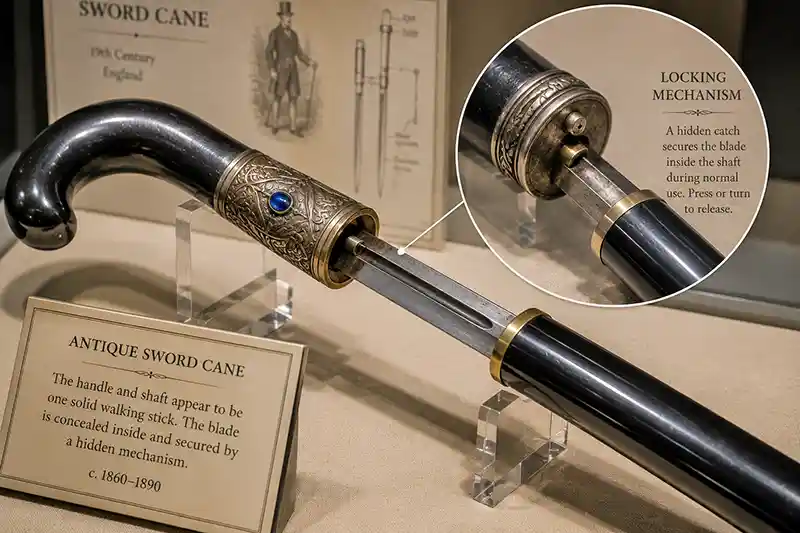
A concealed blade would not have been very practical if it slipped out of the cane every time its owner lifted the handle. Sword cane makers therefore needed some way to keep the two sections securely joined during ordinary use while still allowing the blade to be deliberately withdrawn.
The exact solution varied between makers and designs. Some sword canes relied on tight-fitting friction connections, while others incorporated catches, locking mechanisms, or fittings that helped secure the handle and blade inside the shaft. Better-made examples could disguise these joints surprisingly well so that the cane maintained the appearance of an ordinary walking stick.
This mechanism had to solve another problem as well. A walking cane experiences repeated movement and contact with the ground, so the connection could not be so loose that the sections rattled noticeably or separated accidentally. At the same time, it needed to remain practical enough for the owner to open when intended.
That balance helps explain why antique sword canes can be fascinating pieces of craftsmanship even apart from their concealed blades. Makers were not simply putting a sword inside a hollow stick. They were trying to make two fundamentally different objects behave convincingly as one.
It was another engineering challenge created entirely by concealment. The better the mechanism worked, the less likely anyone looking at the closed cane was to realize there was a mechanism there at all.
Are Sword Canes Legal to Own Today?
There is no single answer that applies everywhere. Sword cane laws can vary significantly between countries, states, and local jurisdictions, and the rules governing ownership may be different from those governing carrying one in public.
One of the complications is that a sword cane can fall into more than one legal category. It contains a blade, but unlike an ordinary sword or knife, that blade is deliberately concealed inside an object that appears to be something else. Some laws specifically address disguised weapons, while others regulate concealed blades more broadly.
This means a sword cane could potentially be legal to possess in a particular location while carrying it concealed in public is restricted or prohibited. Transportation, public buildings, schools, airports, and other controlled locations can introduce additional restrictions as well.
The legal landscape is also one reason modern sword canes occupy such a different role from their historical predecessors. A nineteenth-century owner could benefit from the fact that nobody knew a blade was hidden inside the cane. Today, that exact characteristic may be what places the object into a more heavily regulated category.
Anyone considering owning, transporting, or carrying a sword cane should therefore check the current laws that apply specifically to their jurisdiction rather than assuming that rules for ordinary walking canes, knives, or swords automatically apply.
What Is the Difference Between a Sword Cane and a Sword Stick?
In most contexts, "sword cane" and "sword stick" describe essentially the same concept: a walking stick with a blade concealed inside its shaft. The difference is largely one of terminology rather than an entirely different type of weapon.
"Walking stick" has traditionally been more common in British English, which helps explain the historical use of terms such as "sword stick." In the United States, "cane" became a familiar term for similar objects, making "sword cane" the expression many people recognize today.
Historical examples varied enormously regardless of what they were called. Some looked like elegant gentlemen's walking sticks with decorative handles, while others were considerably more restrained. Blades could also differ in length, cross-section, construction, and intended function.
This variety means the name alone tells you relatively little about a particular example. Two objects described respectively as a sword stick and sword cane might be mechanically almost identical, while two sword canes from different makers could have dramatically different blades and locking systems.
The terminology changed across regions and periods, but the defining idea remained remarkably consistent: the walking stick served as the scabbard, allowing the blade to remain completely hidden until the two sections were separated.
When Were Sword Canes Most Popular?
Sword canes are most strongly associated with the nineteenth century and the early decades of the twentieth century, when walking sticks were still common accessories in Europe and North America. This was the cultural environment that made the concept particularly practical: a concealed blade could hide inside an object that attracted almost no attention.
The Victorian era is especially closely linked with sword canes, although they existed before Queen Victoria's reign and continued afterward. The broader nineteenth century produced an extraordinary variety of walking sticks, including decorative canes, gadget canes, compartment canes, and examples concealing weapons.
Their decline was gradual rather than sudden. As men's fashion became less formal during the early twentieth century, decorative walking sticks became less common. Changes in transportation, concealed-weapon laws, and eventually modern security practices further weakened the advantages sword canes once offered.
So there was no precise year when the sword cane reached its peak and immediately declined. Its golden age belonged broadly to a period when the walking stick was still a normal part of everyday dress and a hidden blade could genuinely hide in plain sight.
Did Women Ever Carry Sword Canes?
Sword canes are overwhelmingly associated in popular culture with male fashions, particularly the image of the nineteenth-century gentleman carrying a walking stick. However, women also carried walking sticks and canes during different periods, and historical weapon canes were not necessarily restricted exclusively to male ownership.
The important distinction is that men's fashion created an especially favorable environment for sword canes because decorative walking sticks became such recognizable accessories of masculine dress. That helps explain why surviving advertisements, illustrations, collections, and modern depictions so often emphasize male owners.
It would therefore be too simplistic to claim that sword canes were exclusively men's objects. At the same time, the historical evidence does not justify replacing the familiar male association with the idea that sword canes were equally commonplace accessories among women.
Like many unusual historical objects, individual ownership could be much more varied than the dominant fashion surrounding it. The cane-carrying gentleman remains the strongest cultural image, but it does not necessarily describe every person who ever possessed one.
Were Sword Canes Ever Used in Real Fights?
Yes. Historical accounts show that sword canes and sword sticks occasionally appeared in genuine violent confrontations rather than existing solely as fashionable curiosities. Given that they contained functional blades, this should not be particularly surprising.
What is much harder to establish is how frequently this happened. Newspaper reports naturally favored unusual and sensational incidents, meaning a confrontation involving a hidden sword was far more likely to attract attention than the thousands of uneventful occasions when someone simply carried a walking stick.
Popular fiction has exaggerated the association even further. The dramatic reveal of a blade from an innocent-looking cane is perfect for mysteries and adventure stories, but that does not mean sword-cane duels were an ordinary feature of Victorian street life.
The safest historical conclusion is that sword canes were real weapons and were sometimes used as such. What we should avoid is allowing their memorable appearance in isolated incidents and fiction to make them seem like a routine weapon of nineteenth-century combat.
How Long Were Sword Cane Blades?
There was no standard sword cane blade length. Historical examples varied according to the overall length of the walking stick, the maker's design, the type of blade being concealed, and how convincingly the finished object needed to function as a cane.
Many contained long, slender blades that occupied much of the available shaft. Others were shorter or constructed more like elongated daggers than conventional swords. Blade profiles could also vary considerably, from narrow thrust-oriented designs to examples with more substantial cutting edges.
The dimensions of the cane created an obvious upper limit. The blade had to disappear completely inside the shaft while leaving enough structure around it for the exterior to remain convincing and usable as a walking stick.
That is why sword cane blades often look unusually thin compared with conventional swords of similar length. Concealment determined the proportions. Makers were not simply designing the ideal sword and adding a cane afterward. They were designing a blade around the limited space available inside the cane.
Why Did Sword Canes Have So Many Different Handle Designs?
The handle was one of the few places where a cane owner could display considerable personality. Historical walking sticks appeared with handles made or decorated using wood, horn, bone, silver, brass, and numerous other materials, with designs ranging from simple curved grips to elaborate sculptural forms.
Sword cane makers could take advantage of the same fashion. An ornate handle helped the object resemble the decorative walking sticks surrounding it while simultaneously serving as the grip for the concealed blade.
That created another interesting engineering challenge. A beautiful cane handle did not automatically make an ideal sword grip. Makers had to balance appearance, comfort, durability, and the mechanism connecting the hidden blade to the shaft.
The enormous variety of handles also reflects why antique sword canes became so collectible after their practical era faded. Two examples can share essentially the same concealed-blade concept while looking completely different when closed.
In a strange way, the handle helped accomplish both sides of the sword cane's identity. It made the object fashionable enough to display openly while helping disguise the fact that the decorative walking stick was anything more than it appeared to be.
You May Also Be Interested In:
- What are the Best Canes for Self-Defense?
- What Is a Fighting Cane? A Beginner's Guide to Martial Arts Canes
- Could Nunchucks Actually Break a Sword?
- Combat Spear Sword and Other New Weapons
- Could an Escrima Stick Actually Stop a Sword?
- How to Tell a Real Katana from a Decorative Sword
- Hidden Sword Battle Stick and Other Combat Weapons
Leave a Reply