




A Complete Guide to Nunchuck Types, Materials, and Styles
November 17th, 2025
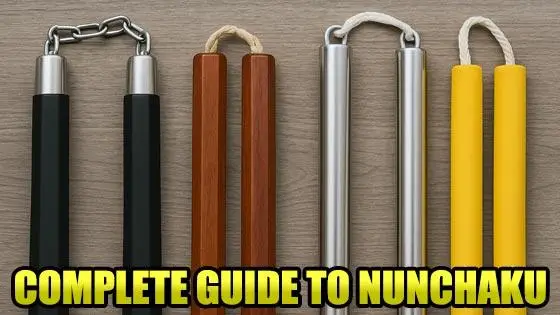
Nunchucks come in a surprising variety of shapes, materials, and designs, and each type feels completely different once you start training with it. Whether you are brand new to martial arts or you have years of practice behind you, understanding these differences makes it much easier to choose a pair that fits your skill level and training goals. Some nunchucks are designed for speed and flow, others are built for precision, and some are simply safer for beginners who are still learning control. This guide walks you through the most common types of nunchaku and explains what makes each option unique so you can pick the right pair with confidence.
Types of Nunchucks by Material
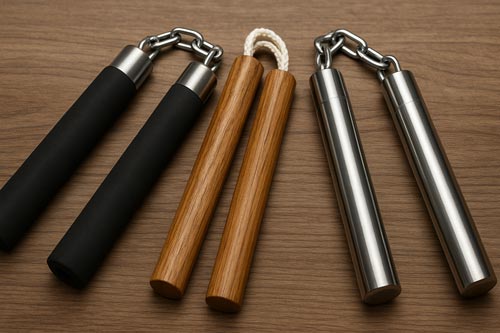
The material you choose has more influence on your training experience than almost anything else. It affects the weight of the nunchucks, the speed they swing at, how they handle impact, and even how confident you feel when trying new moves. Most people start with whatever looks coolest, but that often leads to frustration when the nunchucks feel too light, too heavy, or move faster than expected. Taking a minute to understand the most common materials makes your first or next pair a lot easier to get right.
Foam nunchucks are usually the first step for brand new practitioners. They are lightweight, easy to control, and forgiving when you misjudge distance or timing. The foam padding around the core absorbs most of the sting, which makes it easier to practice drills that involve crossing the body, spinning behind the back, or transitioning between grips. Even people with experience sometimes keep a foam pair around for warmups, flow sessions, or foundational drills where comfort matters more than impact. Because foam is so light, these nunchucks do not build much wrist strength, but they are perfect for learning clean technique without taking unnecessary hits during the early stages.
Wooden nunchucks are what most martial artists think of when they picture a traditional set. They offer a balance of weight, durability, and precision that foam simply cannot match. The handles rotate with a smoother and more grounded feel, which makes techniques easier to control once you understand the motions. Wood also provides enough weight to develop real speed and momentum without feeling overly heavy, so it is a great middle ground for both beginners moving up from foam and experienced users looking for a reliable everyday practice pair. Different hardwoods also have subtle differences in density and finish, which can slightly change the way the nunchucks respond during fast transitions.
Metal nunchucks are typically used by more advanced practitioners who want maximum speed and momentum. Metal handles create a powerful rotational pull during swings, which makes each strike feel sharper and more forceful. They also require more precise hand placement, because mistakes hurt more when the handles have this much weight behind them. These nunchucks are not recommended for complete beginners, but they are rewarding for people who already have control and want to sharpen their flow, strengthen their wrists, or add intensity to their training sessions. Metal designs also tend to be very durable, which makes them a long-lasting choice if you want a pair that can take a beating.
There are also specialty materials like acrylic, rattan, or hybrid designs that mix synthetic cores with rubberized coatings. These options are less common but offer unique benefits. Acrylic nunchucks feel smooth and fast, which makes them popular in demonstration settings where visual flair matters. Rubber-coated handles provide strong grip in sweaty training environments. Rattan is extremely lightweight and flexible, making it useful for speed drills without much impact. These specialty options fill niche training needs and can be great additions once you understand what you want from your main pair.
Choosing the right material comes down to how you train and what feels natural in your hands. Foam is ideal for learning without pain. Wood is the classic all-around choice for balanced training. Metal offers intensity and speed for people who are already comfortable with the basics. Specialty materials fill in the gaps with specific advantages that may not matter to everyone but can make a big difference to the right user. Once you match the material to your experience level and practice goals, the rest of the selection process becomes much easier.
Chain vs Cord Nunchucks
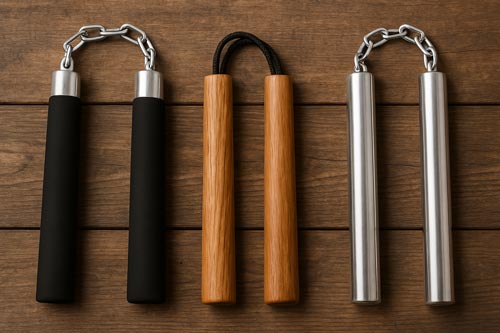
Another major difference between nunchuck designs is whether the handles are connected by a chain or a cord. This choice affects speed, comfort, noise, and how easily you can transition between techniques. Most people develop a preference once they try both styles, but understanding the main differences helps you narrow down the right option before you even pick up a pair.
Chain-linked nunchucks are the most common style in modern martial arts and casual training. The metal chain creates a smooth swinging arc that stays consistent during spins, strikes, and grip changes. Chains also add a bit of weight at the connection point, which increases momentum and helps the handles rotate cleanly through fast transitions. Because the metal can make noise on impact, chain nunchucks tend to feel more dynamic and intense, which some practitioners really enjoy. They also hold up well under long-term use, since the links resist fraying or stretching.
Corded nunchucks have an entirely different feel. The cord connection is quiet, flexible, and slightly more responsive to small wrist movements. This gives you a softer, more controlled rotation that many traditional martial artists prefer. Cord connections also pinch less during certain techniques, which makes them more comfortable during long practice sessions. Since cords do not add extra weight the way chains do, the handles spin with a lighter, more natural rhythm that feels closer to classic Okinawan-style nunchaku. The only downside is that cords eventually wear out, but replacing them is easy and inexpensive.
Choosing between chain and cord often comes down to how you train. If you enjoy fast, powerful movements with a bit of extra swing, the chain is a great fit. If you prefer a quiet, traditional feel with more feedback from your wrist, a corded set might be the better choice. Many people eventually own one of each because the difference in rotation and feedback changes the way techniques feel. Having both options available also makes it easier to switch back and forth as your skill level improves or your training goals shift.
Nunchuck Handle Shapes and Grip Styles
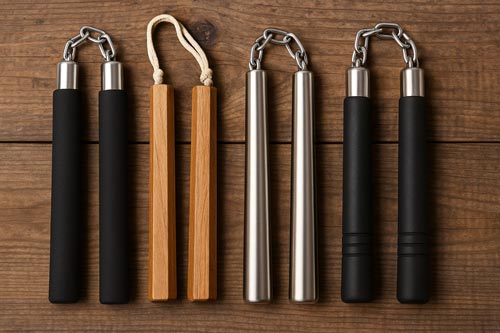
Handle shape plays a bigger role in performance than most people realize. The profile, grip texture, and even the amount of taper can completely change how the nunchucks rotate during fast transitions. Some shapes are better for clean control, others create more speed, and a few are designed specifically for demonstration work. Knowing the differences makes it much easier to choose a pair that fits the type of training you actually want to do.
Round handles are the most common shape because they provide a smooth, predictable rotation. The circular profile allows the handles to spin evenly in the hand, which makes them ideal for classic strikes, wrist rolls, and figure-eight patterns. Many beginners find round handles easier to learn on because they feel natural right away and do not require precise alignment during transitions. These handles work well with both chain and cord connections and are found on everything from foam trainers to hardwood and metal nunchucks.
Octagonal handles offer a completely different feel. The flat edges create a more controlled grip, which reduces slipping and makes orientation easier to feel when the nunchucks are moving quickly. Many traditional Okinawan practitioners prefer octagonal handles because they provide tactile feedback the moment the handle touches the palm. This shape can also help with directional strikes, since the edges make it easier to maintain alignment during impact. While they take a little getting used to, octagonal nunchucks reward you with a noticeably more secure grip once you adjust to the shape.
Tapered handles change the distribution of weight by making the base of the handle thicker than the top. This design shifts more of the mass toward the bottom of the nunchucks, which increases speed during spins and gives the handles a faster, whiplike feel. Tapered profiles are often used in flow demonstrations and freestyle performances where quick rotations and flashy transitions are the main focus. The added rotation speed can make these nunchucks less forgiving for new users, but experienced practitioners enjoy the boost in momentum and the way tapered handles glide through advanced patterns.
Grip texture is another detail worth considering. Smooth wooden or metal handles offer clean, uninterrupted rotation, but they can become slick during long sessions. Rubberized or foam-covered handles improve traction and reduce fatigue, especially during drills that involve a lot of switching between hands. Some wooden nunchucks even include carved grooves that help guide your fingers into a consistent position every time you pick them up. None of these grip styles are universally better, but each one influences how secure and comfortable the nunchucks feel during different types of training.
If you are unsure which shape or grip style to choose, start with a round pair with a neutral finish. Once you get comfortable and figure out the type of techniques you enjoy most, it becomes much easier to fine-tune your preferences. Some practitioners prefer octagonal designs for traditional training, while others gravitate toward tapered handles for speed and performance. The right choice is the one that matches your style and feels natural in your hands when you move.
Lengths and Weight Differences
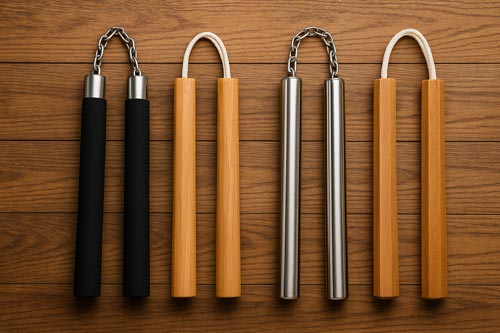
The length and weight of a pair of nunchucks have a huge influence on how they perform. Even small changes in handle length or overall mass can completely transform the speed, control, and impact of each technique. Many beginners assume all nunchucks are roughly the same size, but there are clear differences between lightweight trainers, traditional wooden sets, and heavier metal versions. Understanding how these measurements affect performance makes it much easier to find a pair that feels natural in your hands.
Most standard nunchucks have handles that measure around twelve inches in length. This size offers a good balance between reach and maneuverability, which is why it is widely used in both modern martial arts schools and traditional Okinawan systems. Handles in this range allow smooth wrist rolls, tight figure-eights, and clean transitions without feeling too short or too unwieldy. Shorter handles move quickly but provide less leverage for certain strikes, while longer handles create more reach but can be harder to control during close body movements.
Weight is just as important as length, especially when you move past beginner-level training. Foam and rubberized nunchucks are the lightest options. Their low mass makes them ideal for learning how to control the swinging motion without worrying about taking painful hits. They are perfect for drills, warmups, or practicing new moves at slower speeds. Wooden nunchucks increase the weight significantly, giving the handles more momentum and stability during rotations. The added mass helps develop stronger wrists and cleaner transitions, making wood a reliable everyday training choice for martial artists at almost any skill level.
Metal nunchucks sit at the opposite end of the spectrum. These are the heaviest commonly available designs, and their weight makes every motion feel more forceful. The added momentum creates fast, powerful spins, but it also demands more precision from the user. Even small mistakes become noticeable when the handles have this much rotational pull. Because of this, metal nunchucks are better suited for people who already have solid control and want to push their speed, conditioning, and accuracy to a higher level.
The combination of length and weight also influences how quickly you build muscle memory. Lighter nunchucks allow longer practice sessions without fatigue, while heavier sets accelerate the development of strength and rotation control. Many practitioners eventually keep multiple pairs for different purposes so they can switch between light and heavy training depending on their goals. A foam or rubber pair is great for learning new sequences, a wooden pair becomes the main workhorse for everyday practice, and a metal pair helps build power and conditioning.
If you are unsure where to begin, it is usually best to start with a lightweight or medium-weight pair that sits close to the standard twelve-inch length. Once you understand the basics and get comfortable with your grip, you can move into heavier or slightly longer handles to match your growing skill level. The right length and weight feel natural the moment you start moving, and finding that ideal combination is one of the most satisfying parts of choosing a new set of nunchucks.
Traditional vs Modern Designs
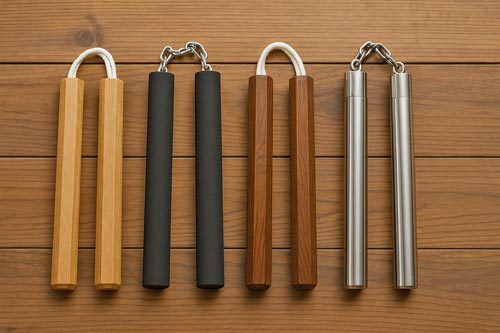
Nunchuck designs have come a long way from their traditional Okinawan roots. While the basic structure has remained the same, the materials, construction methods, and training purposes have evolved significantly. Understanding the difference between traditional and modern designs helps you decide whether you want a pair that stays true to classic martial arts or one that adopts newer features for comfort, durability, or performance. Both styles have their advantages, and many practitioners enjoy owning at least one of each.
Traditional nunchucks usually feature wooden handles connected by a rope or cord. This setup gives them a quiet, controlled rotation that feels smooth and responsive. The simplicity of the design is part of its appeal, and the natural movement of corded nunchucks provides excellent feedback during training. Traditional sets often use hardwoods like oak or hickory because the density of the wood provides a solid, weighted feel without being too heavy. Some classic designs also feature octagonal handles, which give the user a better sense of orientation during fast transitions. These features make traditional nunchucks a favorite for martial artists who value authenticity and precise control over flashy speed.
Modern nunchucks take a very different approach. They often use foam, metal, synthetic rubber, or composite materials that are designed for durability and ease of use. Many modern sets use chain connectors instead of cords because chains require less maintenance and can handle heavier impact without fraying or stretching. This style produces a louder, more aggressive swing that feels powerful and fast. Metal nunchucks, in particular, have become popular among practitioners who want to build strength or practice high-speed rotations. Foam trainers also fall into the modern category because they allow beginners to learn safely without the fear of painful mistakes.
Hybrid nunchucks blend traditional and modern elements. These might feature wooden handles with a chain connector, synthetic grips on classic shapes, or customized weights for specific drills. These designs allow practitioners to enjoy the feel of traditional materials while taking advantage of modern performance improvements. Hybrids are especially popular among people who train regularly and want equipment that holds up to long sessions without sacrificing the feedback they are used to.
Choosing between traditional and modern designs depends on how you plan to use your nunchucks. If you prefer a classic training experience with quiet, controlled rotation, traditional wooden nunchucks with a cord connection will feel natural. If you want something fast, durable, or optimized for strength training, a modern pair with a chain connector might be the better choice. Many practitioners find value in both styles, especially as their skills progress and their training goals become more focused. Having options allows you to switch between the smooth precision of a traditional set and the high-energy rotation of a modern design whenever your practice calls for it.
Choosing the Right Nunchucks for Your Training Goals
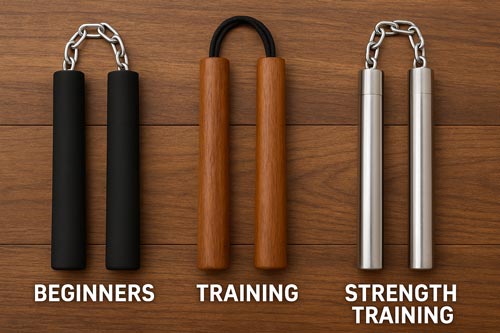
With so many different styles available, choosing the right pair of nunchucks starts with understanding what you want out of your training. Some people want to build speed, others want to focus on traditional techniques, and beginners usually want something safe that helps them learn without getting discouraged. There is no single perfect pair for every person, but there is a perfect pair for every purpose. Once you know your training goals, the decision becomes much easier.
If you are completely new to nunchucks, the safest and most comfortable choice is a lightweight foam pair. Foam helps you develop control without worrying about painful impacts, which makes practicing new movements far less intimidating. You can work on hand switches, basic strikes, wrist rolls, and figure-eight patterns without the fear of catching your elbows or shoulders with a hard wooden handle. Foam also keeps fatigue low, which allows beginners to train longer and build confidence more quickly.
If you already have some experience and want a set that feels solid and balanced, wooden nunchucks are the next logical step. They provide enough weight to create smooth, predictable rotation while still being manageable for most skill levels. Wooden handles also let you feel the momentum more clearly, which helps refine your timing and control. Many martial artists end up using wooden nunchucks as their main training pair because they offer the best blend of tradition, durability, and performance.
For practitioners who want to increase strength, speed, or intensity, metal nunchucks offer a more challenging experience. Their weight creates a powerful swinging motion that demands precise control from the user. Metal is not ideal for beginners, but it is excellent for building endurance and sharpening advanced techniques. Even short training sessions with a heavier pair can significantly improve wrist strength and rotation accuracy, which carries over into faster performance with lighter sets.
Your goals also determine whether you should choose a chain or cord connector. A chain is better if you want fast, aggressive swings with added momentum. It is durable, low maintenance, and ideal for modern training styles. A cord is the better option if you prefer quiet rotation, softer feedback, and a traditional feel. Corded nunchucks tend to be smoother and more responsive, which makes them ideal for kata practice or controlled form work.
Some users eventually mix their training tools by owning multiple pairs. A foam set for practicing new moves, a wooden set for everyday training, and a metal set for conditioning cover almost every training scenario. Switching between materials and styles not only keeps your practice interesting but also helps you understand how different designs affect your technique. This variety leads to better skill development and a deeper familiarity with the weapon overall.
If you are unsure where to begin, think about your experience level and how you want to train. A beginner will always benefit from foam. An intermediate user will almost always enjoy wood. An advanced practitioner often finds metal rewarding. There is no wrong choice as long as the pair you select matches your goals and encourages you to keep practicing. The right nunchucks should feel like a natural extension of your hands, and once you find that connection, your training becomes much more enjoyable.
Safety Considerations When Practicing With Nunchucks
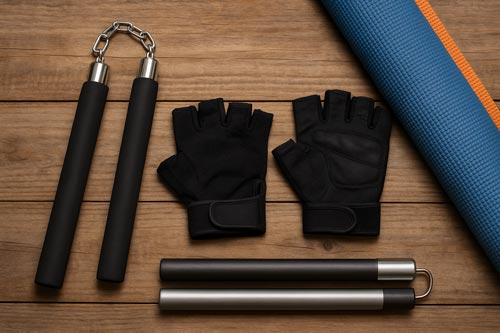
Even though nunchucks are a simple weapon, practicing safely is more important than many people realize. The swinging motion of the handles creates a lot of momentum, and even a soft hit from the wrong angle can lead to bruises or joint strain. Whether you are brand new to the weapon or have been training for years, following a few basic safety guidelines makes your sessions smoother, more comfortable, and a lot more productive.
The first and most obvious step is choosing the right environment. Nunchucks require clear space around your body because the handles travel in wide arcs at high speed. A small room, a low ceiling, or crowded surroundings make accidents far more likely. A training area with plenty of open space lets you move freely without worrying about clipping furniture, lights, or other people. Outdoor practice can also be helpful, especially when you want extra space to work on larger movements or faster rotations.
Warmups also play a big role in preventing injuries. Wrist circles, shoulder rolls, light stretching, and slow figure-eight motions help prepare your joints for the rotational force of the nunchucks. Because the weapon relies so heavily on wrist and shoulder flexibility, jumping into fast spins without warming up often leads to soreness or irritation later. Spending just a couple of minutes getting loose makes a big difference in how smooth your practice feels.
Beginners should always start with foam or padded nunchucks. These reduce the chance of bruising and allow you to practice new movements without fear. Even if you have previous martial arts experience, the unique motion of nunchucks takes time to master, and a padded pair gives you freedom to experiment without hesitation. Once basic control becomes natural, you can transition to wooden or metal handles with much more confidence.
Controlled speed is another important safety factor. It is tempting to jump straight into fast, flashy spins, especially after watching demonstration videos, but speed without technique leads to sloppy form and avoidable mistakes. Practicing slowly helps you build muscle memory and understand how the handles move in relation to your body. Once your technique is solid, increasing speed becomes much safer and far more effective.
Protective gear can also be useful, especially for newer practitioners. Light gloves, wrist supports, or forearm guards help soften accidental impacts during early training sessions. While experienced users often practice without any protection, beginners may find these tools help them train more consistently and with less discomfort. Over time, as your control improves, you will rely on protective gear less frequently.
Finally, keep in mind that fatigue affects control. Nunchucks rely heavily on wrist rotation and shoulder movement, and continued use can cause your form to weaken as your muscles tire. Taking short breaks not only prevents accidental hits but also improves the quality of your overall practice. A few minutes of rest helps you maintain smooth, controlled movements instead of forcing sloppy or rushed techniques.
Where to Find the Right Nunchucks
Once you understand the different materials, shapes, and design styles available, choosing the right pair of nunchucks becomes a much more straightforward process. Your decision really comes down to what you want out of your training. Some people prefer the balanced feel of traditional wooden designs, others enjoy the intensity of metal, and beginners usually appreciate the comfort and safety of foam. When you match the type of nunchucks to your actual goals, your practice becomes smoother, safer, and a lot more enjoyable.
If you are ready to take the next step and pick out a pair that fits your preferences, our store offers options for every experience level. You will find foam trainers for learning new movements, hardwood designs for classic training, metal sets for building power, and both corded and chained variations for different rotation styles. You can explore all of these options in our nunchucks selection, where each product includes the details you need to compare sizes, materials, and styles.
Finding the right pair makes training more rewarding, and having equipment that matches your goals gives you a clear path toward building real control and confidence.
You May Also Be Interested In:
- What Is EDC? A Complete Guide to Everyday Carry Gear
- The Best Self Defense Blades: A Complete Guide to Discreet Protection
- The Complete Guide to Martial Arts Staffs: A Beginner-Friendly Breakdown
- Different Types of Knife Steels Explained
- Different Types of Pocket Knife Locks Explained
- What Is a Shuriken? Types of Ninja Throwing Stars Explained
- A Practical Guide to Modern Self-Defense Weapons
- Best Self Defense Weapons for Everyday Carry (EDC Guide)
- What Is a Bo Staff? Beginner Guide to History, Sizes, and Training
- Power and Protection: A Guide to High Voltage Stun Devices
Leave a Reply