




What Is a Billy Club Weapon and Is It Still Used Today
April 28th, 2026
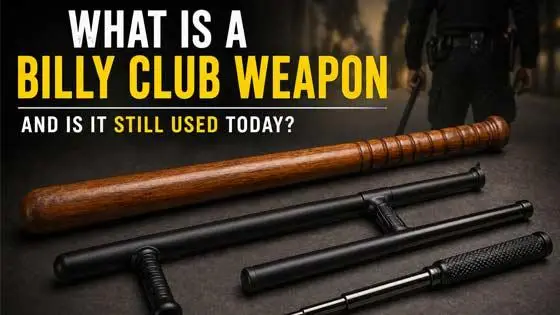
If you have ever heard the term billy club weapon, you probably picture an old-school police officer carrying a short wooden stick. While that image is not far off, there is a lot more to the story. Billy clubs have been used for decades as a simple and effective tool for control and self defense, and they have evolved into several modern variations that are still used today. In this guide, we will break down what a billy club weapon actually is, where it came from, how it was used, and how it compares to the tools people carry now.
What Is a Billy Club Weapon?
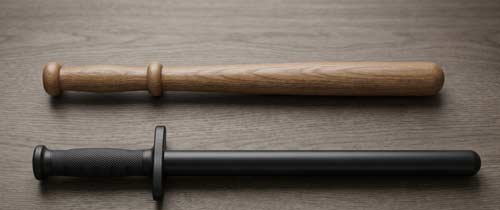
A billy club weapon is a short, solid stick that is designed for striking and control. Traditionally made from hardwood, it is simple in both design and function. Unlike more complex tools, there are no moving parts or mechanisms. It is essentially a compact baton that relies on durability, balance, and ease of handling to be effective.
The classic billy club is usually between 12 and 36 inches long, with a slightly thicker end to add weight and improve impact. This design makes it easy to grip while still delivering enough force to stop or deter someone when used properly. Because of its size and simplicity, it has historically been used in situations where quick access and reliability were important.
You will often hear the term used interchangeably with words like baton, truncheon, or nightstick, although there are small differences between them depending on design and region. In general, they all refer to the same basic concept: a handheld impact tool used for self defense or law enforcement purposes.
What makes the billy club stand out is how straightforward it is. There is nothing complicated about it, which is part of why it has remained relevant for so long. Even as more modern tools have been introduced, the core idea behind the billy club has not changed. It is a simple, durable option that focuses on control and reliability rather than complexity.
Where Did the Billy Club Come From?
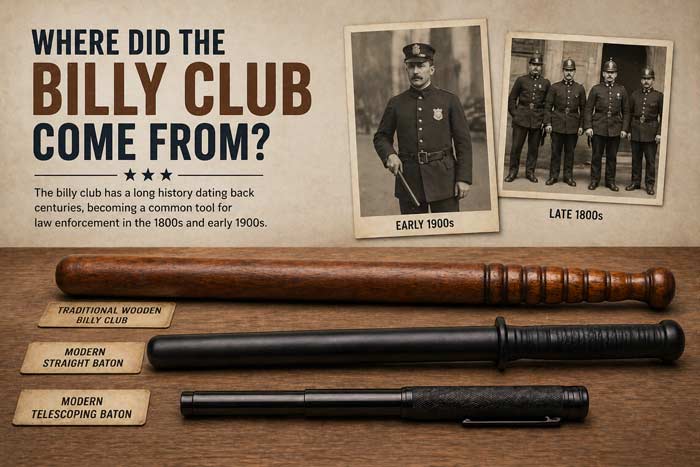
The billy club has a long history that goes back several centuries, but it became especially well known through its use in law enforcement during the 1800s. Early versions were simple wooden sticks carried by watchmen and guards who needed a reliable way to maintain order without relying on more extreme force. Over time, this basic tool evolved into what we now recognize as the classic billy club.
In the United States, billy clubs became closely associated with police officers in the late 19th and early 20th centuries. Officers often carried them as a standard part of their gear, using them for crowd control, self defense, and general enforcement duties. The design was practical for the job. It was durable, easy to carry, and could be used quickly in unpredictable situations.
Different regions developed their own variations. In the United Kingdom, similar tools were commonly referred to as truncheons and were often shorter with a more uniform shape. In other areas, the length, weight, and handle design varied depending on how the tool was intended to be used. Despite these differences, the core concept remained the same across cultures.
As policing methods and equipment advanced, the traditional wooden billy club gradually gave way to more modern options like expandable batons. These newer designs offered better portability and versatility, which made them more practical for everyday use. Even so, the original billy club still holds an important place in the history of law enforcement and remains a recognizable symbol of that era.
How Was the Billy Club Used?
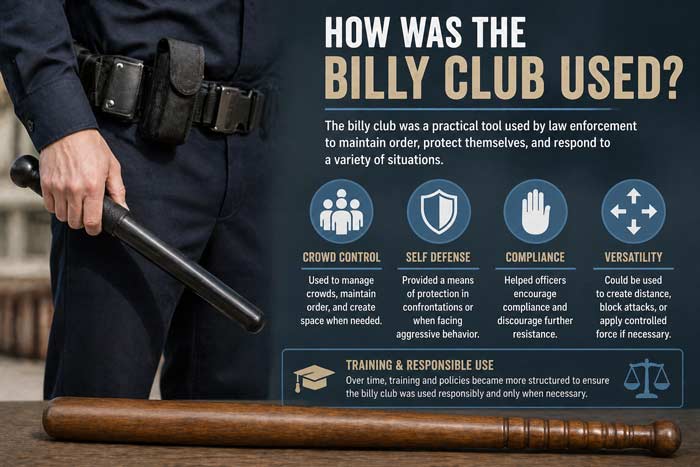
The billy club was designed as a simple tool for control, and its use reflected that purpose. Historically, it was carried by law enforcement officers as a way to manage situations without relying on more extreme measures. Instead of being a tool for prolonged engagement, it was meant to quickly create compliance or give the officer an advantage in a tense moment.
In practice, the billy club was used for a range of situations, including crowd control, self defense, and stopping aggressive behavior. Its solid construction and compact size made it easy to carry on a belt or in hand, allowing for quick access when needed. Because there were no moving parts, it was extremely reliable and could be used immediately without any setup or preparation.
One of the key advantages of the billy club was its versatility. It could be used to create distance, block incoming movement, or apply controlled force when necessary. This made it useful in unpredictable situations where officers needed a tool that could adapt quickly to changing conditions.
Over time, training and policies around its use became more structured. Modern law enforcement agencies emphasize control, restraint, and proper technique to reduce the risk of unnecessary harm. While the traditional billy club is less common today, the principles behind its use still apply to many of the tools that replaced it, including modern baton designs.
Are Billy Clubs Still Used Today?
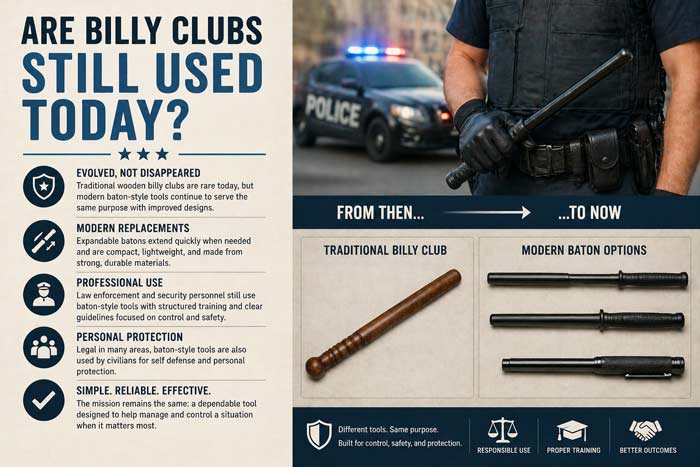
Traditional wooden billy clubs are not as common as they once were, but the concept behind them is still very much in use today. Over time, they have been replaced by more modern tools that offer better portability, durability, and versatility while serving the same general purpose. The role has not disappeared, it has simply evolved.
One of the most common modern replacements is the expandable baton. These are compact when collapsed and extend quickly when needed, making them much easier to carry on a daily basis. They also tend to be made from stronger materials like steel or reinforced alloys, which improves durability while keeping the design relatively lightweight.
Law enforcement and security personnel still use baton-style tools as part of their equipment, but with more structured training and guidelines than in the past. The focus today is on controlled use, minimizing unnecessary harm, and using the tool as a way to manage situations rather than escalate them.
Outside of professional use, baton-style tools are also carried by civilians in some areas for personal protection, depending on local laws. Many people prefer them because they are simple, reliable, and do not rely on electronics or chemicals to function. That said, they are not for everyone, and understanding how and when they can be used is important before choosing to carry one.
So while the classic billy club itself may not be as widely seen, its modern versions are still very relevant. The idea of a simple, durable tool designed to help control a situation has stood the test of time, even as the designs around it have continued to improve.
Billy Club vs Modern Batons: What Is the Difference?
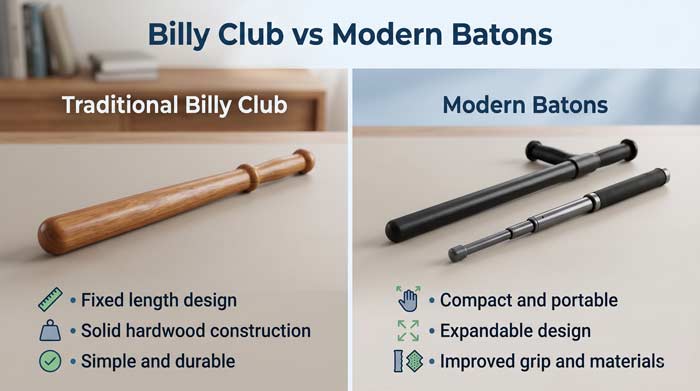
At a glance, a traditional billy club and a modern baton might seem like the same thing, but there are some important differences that affect how they are carried and used. The biggest distinction comes down to design and portability. A billy club is typically a fixed-length wooden stick, while most modern batons are designed to be more compact and easier to carry on a daily basis.
Modern batons, especially expandable models, can collapse down to a much smaller size and extend when needed. This makes them far more convenient for everyday carry compared to a full-length wooden club. They are also usually made from materials like steel or reinforced alloys, which can provide more strength while keeping the overall weight manageable.
Grip and handling are another area where modern designs have improved. Many batons now include textured handles, better balance, and features that make them easier to control in a variety of situations. While the billy club relies on its simplicity, modern versions focus on refining that concept to make the tool more practical and user-friendly.
That said, the core purpose has not changed. Both are designed to be simple, reliable tools that help create distance and control a situation. The difference is that modern batons have been adapted to fit today's needs, with a stronger focus on portability, durability, and ease of carry.
For most people today, the decision comes down to practicality. A traditional billy club has historical value and a straightforward design, but modern batons are generally the more convenient option for everyday use.
Final Thoughts on Billy Club Weapons
The billy club is one of the simplest self defense tools ever created, and that simplicity is exactly why it has lasted so long. Even though the traditional wooden version is not as common today, the core idea behind it is still widely used in modern baton designs. A straightforward, reliable tool that can help create space and control a situation continues to have practical value.
What has changed over time is how these tools are carried and used. Modern versions are more compact, more durable, and better suited for everyday use. They are designed with portability and convenience in mind, which makes them more accessible for people who want something they can carry consistently.
At the same time, it is important to understand that tools like these are only part of the equation. Awareness, good judgment, and understanding your environment will always play a bigger role in personal safety. A tool can help in the right moment, but it should never replace common sense or preparation.
If you are considering a baton-style option, the best approach is to focus on practicality. Look for something that fits your routine, is easy to carry, and feels comfortable to handle. The goal is not to overcomplicate things, but to choose a simple, reliable option that you can depend on if you ever need it.
You May Also Be Interested In:
Leave a Reply