





Different Types of Pocket Knife Locks Explained
May 11th, 2026
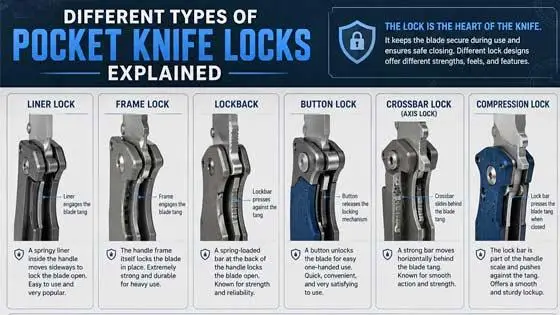
Pocket knives may look simple on the outside, but the locking mechanism inside plays a huge role in how the knife functions, feels, and performs during everyday use. Different lock designs affect everything from opening smoothness and closing style to overall strength, reliability, and long-term durability. That is one reason knife enthusiasts often pay close attention to lock types when comparing different designs.
Over the years, manufacturers have developed a wide variety of locking systems, each with its own advantages, quirks, and fan base. Some locks are known for simplicity and strength, while others are appreciated for smooth operation or one-handed use. Certain lock styles have even become heavily associated with specific types of everyday carry knives and collector-focused designs.
In this guide, we are going to break down some of the most common pocket knife lock types, explain how they work internally, and look at why different knife enthusiasts prefer different systems. Whether you are new to collecting or just curious about the mechanics behind modern everyday folding knives, understanding lock designs makes it much easier to appreciate the engineering that goes into a well-made pocket knife.
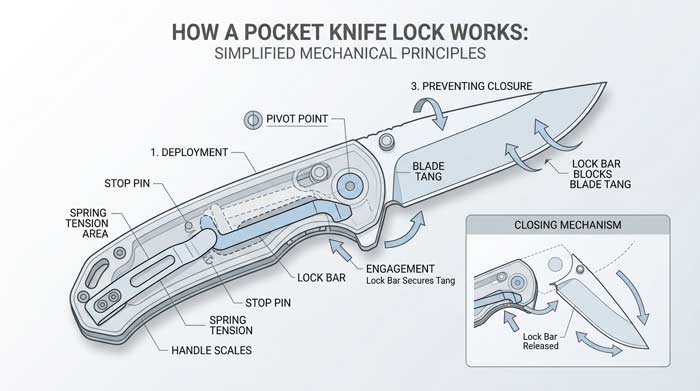
A pocket knife lock is the mechanism inside the handle that keeps the blade securely in place while the knife is open. Without a locking system, the blade could potentially fold closed during use, which is why modern locking mechanisms became such an important part of folding knife design. Different lock types accomplish the same basic goal, but they do it using very different internal designs and moving components.
Most locking systems work by placing some type of pressure or barrier against the blade tang once the knife is fully opened. That pressure prevents the blade from rotating backward until the user intentionally disengages the lock. Some systems rely on spring tension, while others use bars, buttons, or sections of the handle frame itself to keep the blade locked into position.
Over the years, knife manufacturers have developed dozens of different locking styles, each with its own strengths, feel, and fan base. Some lock types are appreciated for simplicity and durability, while others are known for smooth one-handed operation or strong lockup. Knife enthusiasts often have strong personal preferences when it comes to which mechanisms they trust and enjoy carrying most often.
The lock itself also changes how a knife feels during opening and closing. Certain mechanisms create a very smooth and fidget-friendly action, while others feel more mechanical or resistant. That is one reason many enthusiasts become interested in the engineering behind modern EDC knife mechanisms and how different lock designs affect the overall user experience.
Understanding how knife locks function makes it much easier to compare different designs and appreciate the amount of engineering hidden inside a folding knife handle. Even though many locks may look similar from the outside, the internal mechanics can be surprisingly different once you see how each system actually works.
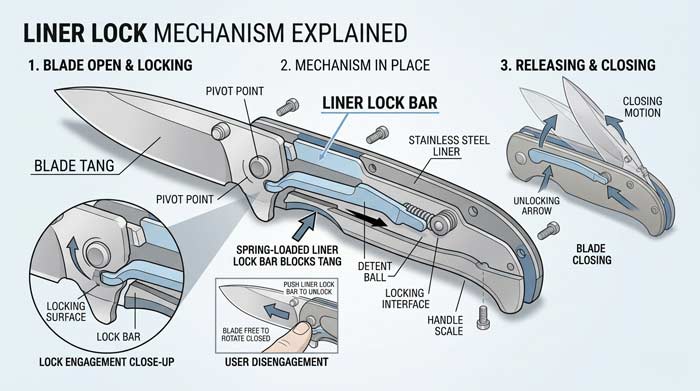
Liner locks are one of the most common locking systems found in modern pocket knives. The design uses a thin metal liner inside the handle that moves sideways behind the blade once the knife is fully opened. That liner acts as a spring-loaded barrier that prevents the blade from rotating closed until the user manually pushes the liner out of the way.
One reason liner locks became so popular is their simplicity. The mechanism is relatively compact, lightweight, and easy to manufacture compared to some more complex lock systems. That helped liner locks become extremely common in both budget-friendly knives and higher-end everyday carry designs over the years.
When opening the knife, the blade rotates around the pivot until the angled section of the blade tang pushes the liner sideways. Once the blade reaches the fully opened position, the liner springs back inward and wedges itself against the tang to hold the blade securely in place. To close the knife, the user simply pushes the liner to the side so the blade can rotate back into the handle.
Many knife enthusiasts appreciate liner locks because they are easy to operate one-handed and often create very smooth opening and closing action. Some people also enjoy how accessible the mechanism feels since the locking bar is exposed and easy to interact with directly. That simplicity helped make liner locks one of the most recognizable systems in the world of modern pocket folders.
Even though newer locking systems have become increasingly popular, liner locks remain extremely common because they balance simplicity, reliability, affordability, and ease of use so well. Many well-known knife designs still rely on liner lock systems today because the mechanism continues to work effectively for everyday carry and general utility use.
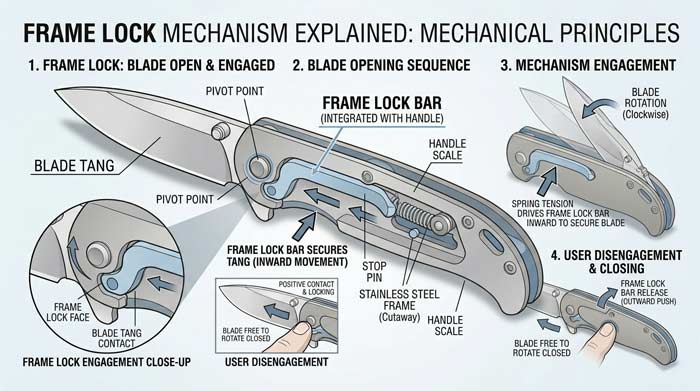
Frame locks operate similarly to liner locks, but instead of using a thin internal liner, the lock mechanism is built directly into the outer frame of the handle itself. When the knife opens, part of the metal handle frame bends inward behind the blade tang and locks the blade into position. This design typically creates a thicker and more solid locking surface compared to traditional liner lock systems.
One reason many enthusiasts like frame locks is because they often feel extremely sturdy during use. Since the locking portion is part of the actual handle frame, the mechanism can provide strong lockup and a very rigid overall feel. Many higher-end everyday carry knives use frame lock systems because of their strength, simplicity, and clean construction.
The opening process works very similarly to a liner lock. As the blade rotates open, the angled blade tang pushes the frame lock outward slightly until the blade reaches full extension. Once fully opened, the frame springs inward and wedges itself against the tang to prevent the blade from closing accidentally. To disengage the lock, the user pushes the frame bar sideways away from the blade.
Frame locks are especially common on knives with metal handles, particularly titanium or stainless steel designs. Some manufacturers also add steel lock inserts to improve long-term wear resistance and maintain consistent lock engagement over time. Small details like lock geometry, tension, and contact surfaces can dramatically affect how smooth and secure the mechanism feels.
Many collectors enjoy frame locks because they combine mechanical simplicity with a very solid, premium feel in the hand. The design also tends to pair well with sleek everyday carry blade designs that focus on strength, durability, and clean minimalist construction.
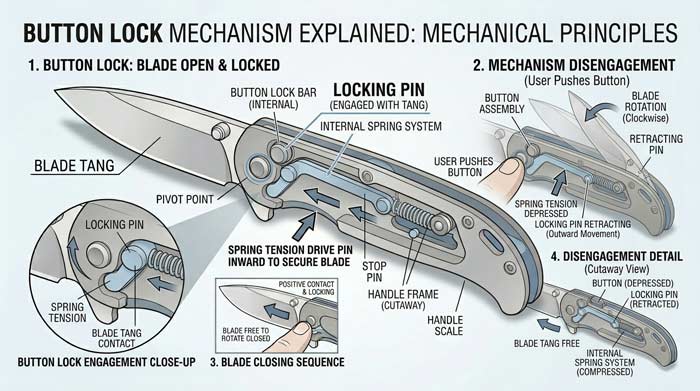
Button locks use a spring-loaded button mechanism to secure the blade in the open position. Unlike liner locks or frame locks that rely on a side bar pressing against the blade tang, button locks typically use a cylindrical locking pin that engages with the blade when the knife is fully opened. Pressing the button retracts that locking pin and allows the blade to move freely again.
One reason button locks have become extremely popular in recent years is how smooth and easy they are to operate. Many people enjoy the simple push-button action because it allows the knife to open and close quickly without needing to place fingers directly in the blade path. That smooth operation also made button locks especially popular among enthusiasts who enjoy fidget-friendly knife designs.
Internally, the mechanism is more complex than it first appears. The button usually connects to a spring-loaded plunger or locking shaft that moves vertically inside the handle. When the blade opens, the locking surface aligns with the button mechanism and the spring forces the lock into position automatically. Pressing the button compresses the spring and pulls the locking surface away from the blade tang so the knife can close.
Another reason button locks became more common is that they pair very well with different opening systems. Some designs use thumb studs, while others combine button locks with flippers or assisted opening mechanisms. The overall action often feels extremely smooth because the blade experiences very little friction from the lock during opening and closing.
Many modern enthusiasts appreciate button locks because they combine mechanical simplicity with a very satisfying user experience. The smooth operation, quick access, and clean handle ergonomics helped make button locks increasingly popular across many styles of one-handed carry knives and modern everyday carry designs.
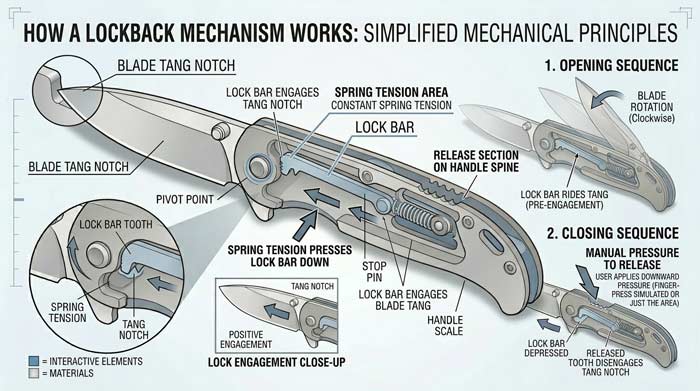
Lockback mechanisms are one of the oldest and most recognizable locking systems used in folding knives. The design uses a rocking lock bar positioned along the spine of the handle that engages with the blade tang when the knife is fully opened. Once the lock engages, the blade stays securely in position until the user presses down on the exposed section of the lock bar near the back of the handle.
One reason lockback designs became so popular is their reputation for strength and reliability. The mechanism creates strong engagement between the lock bar and the blade tang, which gives many lockback knives a very secure feel during use. Because of that dependable design, lockback systems became extremely common in hunting knives, outdoor knives, and traditional folding designs for many years.
Internally, the mechanism relies on spring tension from the lock bar itself. As the blade rotates open, the tang pushes the locking bar upward slightly until the blade reaches full extension. At that point, the lock bar drops into a notch on the tang and prevents the blade from rotating closed. Pressing the exposed rear section of the lock bar lifts the engagement point away from the tang so the blade can fold closed again.
Compared to some modern lock systems, lockbacks are often appreciated for their simplicity and long-term durability rather than fast fidget-style operation. Many people still enjoy the solid click and mechanical feel that lockback knives provide when opening and closing. The mechanism also has a long history in traditional pocket knife manufacturing, which gives it strong appeal among collectors and longtime knife enthusiasts.
Even though newer systems like button locks and crossbar-style locks have become increasingly popular, lockback mechanisms still remain common because they continue to provide dependable lockup and straightforward operation across many styles of traditional folding blade designs and outdoor carry knives.
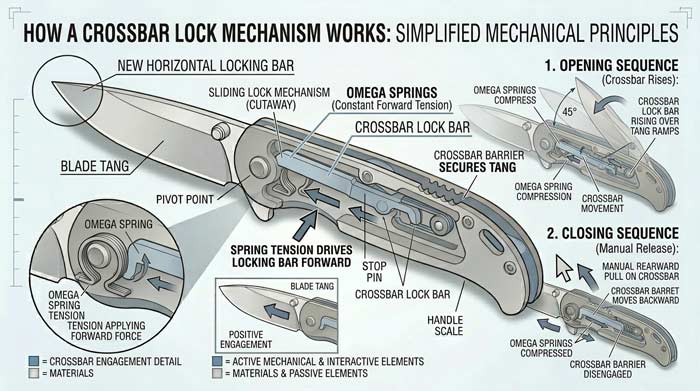
Crossbar locks, sometimes called crossbar-style locks, use a spring-loaded horizontal bar that slides into position behind the blade tang to lock the blade open. Instead of relying on a side liner or frame section pressing against the blade, the locking bar moves forward and backward across the inside of the handle. This creates a very different feel compared to most traditional lock systems.
One reason crossbar locks became so popular is how smooth the mechanism feels during operation. The locking bar usually rides on small springs that automatically pull the bar into position when the blade opens. Pulling the bar backward disengages the lock and allows the blade to swing freely again. Many enthusiasts enjoy how fluid and easy this action feels, especially during one-handed opening and closing.
Another major advantage is that the mechanism is often fully ambidextrous. Since the locking bar extends through both sides of the handle, users can typically operate the lock equally well with either hand. That symmetrical design helped crossbar-style systems become extremely popular among everyday carry enthusiasts looking for smooth operation and easy handling.
Internally, the mechanism uses surprisingly precise geometry. The locking bar must line up properly with the angled surfaces of the blade tang while maintaining consistent spring tension during movement. Small changes in spring strength, bar fitment, or tang shape can dramatically affect how smooth and secure the lock feels during use.
Many collectors appreciate crossbar locks because they combine strong lockup with extremely satisfying mechanical action. The smooth operation and easy one-handed control helped make crossbar-style systems very common on modern EDC folding knife models designed for everyday use and mechanical precision.
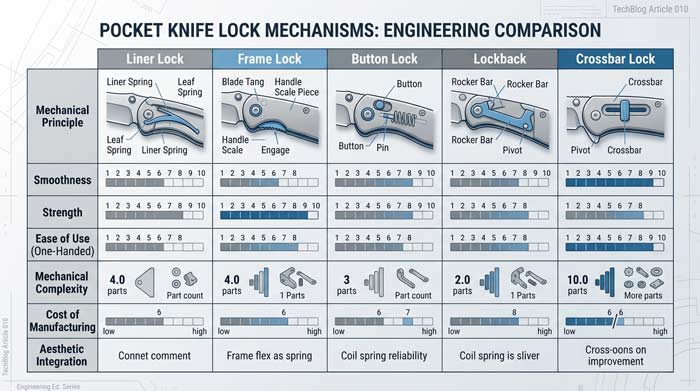
There is no single "best" knife lock because every locking system involves tradeoffs between strength, smoothness, simplicity, weight, ease of use, and personal preference. Some people prioritize maximum lock strength, while others care more about smooth one-handed operation or mechanical simplicity. That is one reason knife enthusiasts often debate lock types so heavily within the everyday carry community.
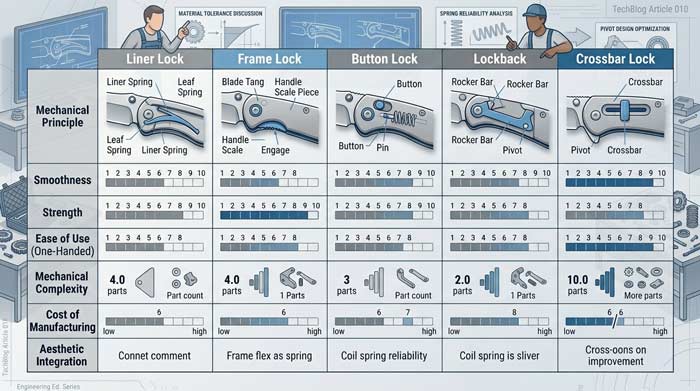
Liner locks and frame locks remain extremely popular because they are simple, reliable, and widely available across many different styles of knives. Button locks and crossbar-style systems are often appreciated for their smooth operation and fidget-friendly feel, while lockback mechanisms continue to attract users who prefer traditional designs and strong mechanical engagement.
The intended use of the knife also matters quite a bit. Some users prefer lightweight and compact knives for simple daily cutting tasks, while others prioritize heavier-duty designs built for outdoor use or demanding work environments. Different lock types can feel very different depending on blade shape, handle materials, spring tension, and overall knife construction.
Another important factor is personal comfort and familiarity. Some people simply enjoy the feel of certain locking systems more than others. A lock that feels smooth, intuitive, and satisfying to one person may not appeal nearly as much to someone else. That is why many collectors eventually experiment with several different mechanisms before deciding which styles they prefer carrying most often.
At the end of the day, modern locking systems have become incredibly refined across the entire world of spring-assisted and mechanical knife designs. Many high-quality knives now offer excellent reliability regardless of lock style, which gives enthusiasts plenty of freedom to focus on the mechanisms and overall experiences they personally enjoy the most.
To someone new to pocket knives, different locking systems may seem like small mechanical details that do not matter very much. But for longtime enthusiasts, the lock mechanism is often one of the most interesting parts of the entire knife. The lock affects how the knife opens, how it closes, how secure it feels during use, and even how satisfying the overall action feels in the hand.
Many collectors enjoy comparing subtle differences between lock systems because each mechanism creates a slightly different user experience. Some locks feel smooth and fluid, while others feel extremely solid and mechanical. Small details like spring tension, lock engagement, button responsiveness, and blade movement can completely change how refined a knife feels during everyday use.
Another reason lock types matter so much is that enthusiasts often associate certain mechanisms with specific styles of knives. Some locking systems are heavily connected to modern minimalist carry designs, while others are more commonly found on traditional outdoor knives or highly mechanical collector-focused pieces. Over time, those associations helped create strong preferences within different areas of the knife community.
Mechanical curiosity also plays a major role. Many enthusiasts simply enjoy understanding how moving parts work together inside a compact folding mechanism. Seeing how springs, lock bars, blade tangs, pivots, and internal geometry interact adds another layer of appreciation beyond just the appearance of the knife itself. That mechanical fascination is one reason engineering-focused discussions remain so common among collectors and everyday carry communities.
As knife technology continues evolving, manufacturers keep experimenting with new lock systems, improved materials, and smoother mechanical designs. That constant innovation helps keep the hobby interesting and gives enthusiasts even more ways to compare different modern pocket carry systems and mechanical designs over time.
Pocket knife locks may seem like small internal details at first, but they play a huge role in how a knife feels, functions, and performs during everyday use. The locking mechanism affects everything from opening smoothness and blade security to long-term durability and overall user experience. That is one reason so many knife enthusiasts become deeply interested in the engineering behind different lock designs over time.
What makes modern knife locks especially interesting is how many different approaches manufacturers have created to solve the same basic problem. Liner locks, frame locks, button locks, lockbacks, and crossbar-style systems all secure the blade in completely different ways while creating their own unique mechanical feel. Even small changes in geometry, spring tension, and internal fitment can dramatically affect how refined a knife feels in the hand.
As everyday carry culture has continued growing, lock systems have also evolved alongside it. Many modern designs focus on smoother action, stronger lockup, easier one-handed operation, and more refined mechanical performance than ever before. That constant innovation keeps enthusiasts interested and helps drive ongoing experimentation throughout the knife industry.
For many collectors, learning how these systems work internally adds another layer of appreciation beyond simply carrying the knife itself. Understanding the moving parts, locking surfaces, and engineering behind the mechanism helps explain why different people develop strong preferences for certain designs and opening styles over time.
Whether someone prefers simple traditional mechanisms or highly refined modern systems, there is no question that lock design remains one of the most important and fascinating parts of modern everyday utility knives and pocket carry tools today.
In this guide, we are going to break down some of the most common pocket knife lock types, explain how they work internally, and look at why different knife enthusiasts prefer different systems. Whether you are new to collecting or just curious about the mechanics behind modern everyday folding knives, understanding lock designs makes it much easier to appreciate the engineering that goes into a well-made pocket knife.
What Is a Pocket Knife Lock?
A pocket knife lock is the mechanism inside the handle that keeps the blade securely in place while the knife is open. Without a locking system, the blade could potentially fold closed during use, which is why modern locking mechanisms became such an important part of folding knife design. Different lock types accomplish the same basic goal, but they do it using very different internal designs and moving components.
Most locking systems work by placing some type of pressure or barrier against the blade tang once the knife is fully opened. That pressure prevents the blade from rotating backward until the user intentionally disengages the lock. Some systems rely on spring tension, while others use bars, buttons, or sections of the handle frame itself to keep the blade locked into position.
Over the years, knife manufacturers have developed dozens of different locking styles, each with its own strengths, feel, and fan base. Some lock types are appreciated for simplicity and durability, while others are known for smooth one-handed operation or strong lockup. Knife enthusiasts often have strong personal preferences when it comes to which mechanisms they trust and enjoy carrying most often.
The lock itself also changes how a knife feels during opening and closing. Certain mechanisms create a very smooth and fidget-friendly action, while others feel more mechanical or resistant. That is one reason many enthusiasts become interested in the engineering behind modern EDC knife mechanisms and how different lock designs affect the overall user experience.
Understanding how knife locks function makes it much easier to compare different designs and appreciate the amount of engineering hidden inside a folding knife handle. Even though many locks may look similar from the outside, the internal mechanics can be surprisingly different once you see how each system actually works.
How Liner Locks Work
Liner locks are one of the most common locking systems found in modern pocket knives. The design uses a thin metal liner inside the handle that moves sideways behind the blade once the knife is fully opened. That liner acts as a spring-loaded barrier that prevents the blade from rotating closed until the user manually pushes the liner out of the way.
One reason liner locks became so popular is their simplicity. The mechanism is relatively compact, lightweight, and easy to manufacture compared to some more complex lock systems. That helped liner locks become extremely common in both budget-friendly knives and higher-end everyday carry designs over the years.
When opening the knife, the blade rotates around the pivot until the angled section of the blade tang pushes the liner sideways. Once the blade reaches the fully opened position, the liner springs back inward and wedges itself against the tang to hold the blade securely in place. To close the knife, the user simply pushes the liner to the side so the blade can rotate back into the handle.
Many knife enthusiasts appreciate liner locks because they are easy to operate one-handed and often create very smooth opening and closing action. Some people also enjoy how accessible the mechanism feels since the locking bar is exposed and easy to interact with directly. That simplicity helped make liner locks one of the most recognizable systems in the world of modern pocket folders.
Even though newer locking systems have become increasingly popular, liner locks remain extremely common because they balance simplicity, reliability, affordability, and ease of use so well. Many well-known knife designs still rely on liner lock systems today because the mechanism continues to work effectively for everyday carry and general utility use.
How Frame Locks Work
Frame locks operate similarly to liner locks, but instead of using a thin internal liner, the lock mechanism is built directly into the outer frame of the handle itself. When the knife opens, part of the metal handle frame bends inward behind the blade tang and locks the blade into position. This design typically creates a thicker and more solid locking surface compared to traditional liner lock systems.
One reason many enthusiasts like frame locks is because they often feel extremely sturdy during use. Since the locking portion is part of the actual handle frame, the mechanism can provide strong lockup and a very rigid overall feel. Many higher-end everyday carry knives use frame lock systems because of their strength, simplicity, and clean construction.
The opening process works very similarly to a liner lock. As the blade rotates open, the angled blade tang pushes the frame lock outward slightly until the blade reaches full extension. Once fully opened, the frame springs inward and wedges itself against the tang to prevent the blade from closing accidentally. To disengage the lock, the user pushes the frame bar sideways away from the blade.
Frame locks are especially common on knives with metal handles, particularly titanium or stainless steel designs. Some manufacturers also add steel lock inserts to improve long-term wear resistance and maintain consistent lock engagement over time. Small details like lock geometry, tension, and contact surfaces can dramatically affect how smooth and secure the mechanism feels.
Many collectors enjoy frame locks because they combine mechanical simplicity with a very solid, premium feel in the hand. The design also tends to pair well with sleek everyday carry blade designs that focus on strength, durability, and clean minimalist construction.
How Button Locks Work
Button locks use a spring-loaded button mechanism to secure the blade in the open position. Unlike liner locks or frame locks that rely on a side bar pressing against the blade tang, button locks typically use a cylindrical locking pin that engages with the blade when the knife is fully opened. Pressing the button retracts that locking pin and allows the blade to move freely again.
One reason button locks have become extremely popular in recent years is how smooth and easy they are to operate. Many people enjoy the simple push-button action because it allows the knife to open and close quickly without needing to place fingers directly in the blade path. That smooth operation also made button locks especially popular among enthusiasts who enjoy fidget-friendly knife designs.
Internally, the mechanism is more complex than it first appears. The button usually connects to a spring-loaded plunger or locking shaft that moves vertically inside the handle. When the blade opens, the locking surface aligns with the button mechanism and the spring forces the lock into position automatically. Pressing the button compresses the spring and pulls the locking surface away from the blade tang so the knife can close.
Another reason button locks became more common is that they pair very well with different opening systems. Some designs use thumb studs, while others combine button locks with flippers or assisted opening mechanisms. The overall action often feels extremely smooth because the blade experiences very little friction from the lock during opening and closing.
Many modern enthusiasts appreciate button locks because they combine mechanical simplicity with a very satisfying user experience. The smooth operation, quick access, and clean handle ergonomics helped make button locks increasingly popular across many styles of one-handed carry knives and modern everyday carry designs.
How Lockback Mechanisms Work
Lockback mechanisms are one of the oldest and most recognizable locking systems used in folding knives. The design uses a rocking lock bar positioned along the spine of the handle that engages with the blade tang when the knife is fully opened. Once the lock engages, the blade stays securely in position until the user presses down on the exposed section of the lock bar near the back of the handle.
One reason lockback designs became so popular is their reputation for strength and reliability. The mechanism creates strong engagement between the lock bar and the blade tang, which gives many lockback knives a very secure feel during use. Because of that dependable design, lockback systems became extremely common in hunting knives, outdoor knives, and traditional folding designs for many years.
Internally, the mechanism relies on spring tension from the lock bar itself. As the blade rotates open, the tang pushes the locking bar upward slightly until the blade reaches full extension. At that point, the lock bar drops into a notch on the tang and prevents the blade from rotating closed. Pressing the exposed rear section of the lock bar lifts the engagement point away from the tang so the blade can fold closed again.
Compared to some modern lock systems, lockbacks are often appreciated for their simplicity and long-term durability rather than fast fidget-style operation. Many people still enjoy the solid click and mechanical feel that lockback knives provide when opening and closing. The mechanism also has a long history in traditional pocket knife manufacturing, which gives it strong appeal among collectors and longtime knife enthusiasts.
Even though newer systems like button locks and crossbar-style locks have become increasingly popular, lockback mechanisms still remain common because they continue to provide dependable lockup and straightforward operation across many styles of traditional folding blade designs and outdoor carry knives.
How Crossbar Locks Work
Crossbar locks, sometimes called crossbar-style locks, use a spring-loaded horizontal bar that slides into position behind the blade tang to lock the blade open. Instead of relying on a side liner or frame section pressing against the blade, the locking bar moves forward and backward across the inside of the handle. This creates a very different feel compared to most traditional lock systems.
One reason crossbar locks became so popular is how smooth the mechanism feels during operation. The locking bar usually rides on small springs that automatically pull the bar into position when the blade opens. Pulling the bar backward disengages the lock and allows the blade to swing freely again. Many enthusiasts enjoy how fluid and easy this action feels, especially during one-handed opening and closing.
Another major advantage is that the mechanism is often fully ambidextrous. Since the locking bar extends through both sides of the handle, users can typically operate the lock equally well with either hand. That symmetrical design helped crossbar-style systems become extremely popular among everyday carry enthusiasts looking for smooth operation and easy handling.
Internally, the mechanism uses surprisingly precise geometry. The locking bar must line up properly with the angled surfaces of the blade tang while maintaining consistent spring tension during movement. Small changes in spring strength, bar fitment, or tang shape can dramatically affect how smooth and secure the lock feels during use.
Many collectors appreciate crossbar locks because they combine strong lockup with extremely satisfying mechanical action. The smooth operation and easy one-handed control helped make crossbar-style systems very common on modern EDC folding knife models designed for everyday use and mechanical precision.
Which Knife Lock Type Is Best?
There is no single "best" knife lock because every locking system involves tradeoffs between strength, smoothness, simplicity, weight, ease of use, and personal preference. Some people prioritize maximum lock strength, while others care more about smooth one-handed operation or mechanical simplicity. That is one reason knife enthusiasts often debate lock types so heavily within the everyday carry community.
Liner locks and frame locks remain extremely popular because they are simple, reliable, and widely available across many different styles of knives. Button locks and crossbar-style systems are often appreciated for their smooth operation and fidget-friendly feel, while lockback mechanisms continue to attract users who prefer traditional designs and strong mechanical engagement.
The intended use of the knife also matters quite a bit. Some users prefer lightweight and compact knives for simple daily cutting tasks, while others prioritize heavier-duty designs built for outdoor use or demanding work environments. Different lock types can feel very different depending on blade shape, handle materials, spring tension, and overall knife construction.
Another important factor is personal comfort and familiarity. Some people simply enjoy the feel of certain locking systems more than others. A lock that feels smooth, intuitive, and satisfying to one person may not appeal nearly as much to someone else. That is why many collectors eventually experiment with several different mechanisms before deciding which styles they prefer carrying most often.
At the end of the day, modern locking systems have become incredibly refined across the entire world of spring-assisted and mechanical knife designs. Many high-quality knives now offer excellent reliability regardless of lock style, which gives enthusiasts plenty of freedom to focus on the mechanisms and overall experiences they personally enjoy the most.
Why Knife Enthusiasts Care So Much About Lock Types
To someone new to pocket knives, different locking systems may seem like small mechanical details that do not matter very much. But for longtime enthusiasts, the lock mechanism is often one of the most interesting parts of the entire knife. The lock affects how the knife opens, how it closes, how secure it feels during use, and even how satisfying the overall action feels in the hand.
Many collectors enjoy comparing subtle differences between lock systems because each mechanism creates a slightly different user experience. Some locks feel smooth and fluid, while others feel extremely solid and mechanical. Small details like spring tension, lock engagement, button responsiveness, and blade movement can completely change how refined a knife feels during everyday use.
Another reason lock types matter so much is that enthusiasts often associate certain mechanisms with specific styles of knives. Some locking systems are heavily connected to modern minimalist carry designs, while others are more commonly found on traditional outdoor knives or highly mechanical collector-focused pieces. Over time, those associations helped create strong preferences within different areas of the knife community.
Mechanical curiosity also plays a major role. Many enthusiasts simply enjoy understanding how moving parts work together inside a compact folding mechanism. Seeing how springs, lock bars, blade tangs, pivots, and internal geometry interact adds another layer of appreciation beyond just the appearance of the knife itself. That mechanical fascination is one reason engineering-focused discussions remain so common among collectors and everyday carry communities.
As knife technology continues evolving, manufacturers keep experimenting with new lock systems, improved materials, and smoother mechanical designs. That constant innovation helps keep the hobby interesting and gives enthusiasts even more ways to compare different modern pocket carry systems and mechanical designs over time.
Final Thoughts on Pocket Knife Lock Mechanisms
Pocket knife locks may seem like small internal details at first, but they play a huge role in how a knife feels, functions, and performs during everyday use. The locking mechanism affects everything from opening smoothness and blade security to long-term durability and overall user experience. That is one reason so many knife enthusiasts become deeply interested in the engineering behind different lock designs over time.
What makes modern knife locks especially interesting is how many different approaches manufacturers have created to solve the same basic problem. Liner locks, frame locks, button locks, lockbacks, and crossbar-style systems all secure the blade in completely different ways while creating their own unique mechanical feel. Even small changes in geometry, spring tension, and internal fitment can dramatically affect how refined a knife feels in the hand.
As everyday carry culture has continued growing, lock systems have also evolved alongside it. Many modern designs focus on smoother action, stronger lockup, easier one-handed operation, and more refined mechanical performance than ever before. That constant innovation keeps enthusiasts interested and helps drive ongoing experimentation throughout the knife industry.
For many collectors, learning how these systems work internally adds another layer of appreciation beyond simply carrying the knife itself. Understanding the moving parts, locking surfaces, and engineering behind the mechanism helps explain why different people develop strong preferences for certain designs and opening styles over time.
Whether someone prefers simple traditional mechanisms or highly refined modern systems, there is no question that lock design remains one of the most important and fascinating parts of modern everyday utility knives and pocket carry tools today.
You May Also Be Interested In:
- The Most Common Pocket Knife Blade Shapes Explained
- Different Types of Knife Steels Explained
- What Is a Shuriken? Types of Ninja Throwing Stars Explained
- The Real History of Brass Knuckles: From Battlefield to Back Pocket
- A Complete Guide to Nunchuck Types, Materials, and Styles
- Why Every Day Should Be an EDC Knife Day: How a Simple Knife Can Make Your Life Easier and Safer
- Best EDC Knife: How to Choose the Right Everyday Carry Knife
- The History and Evolution of the Karambit Knife
- 10 Things You Didn't Know About the Karambit Knife
- Switchblade vs Automatic Knife: What's the Difference?
Leave a Reply