




Karambit vs Push Dagger: Which Blade Would You Bet Your Life On?
December 5th, 2025
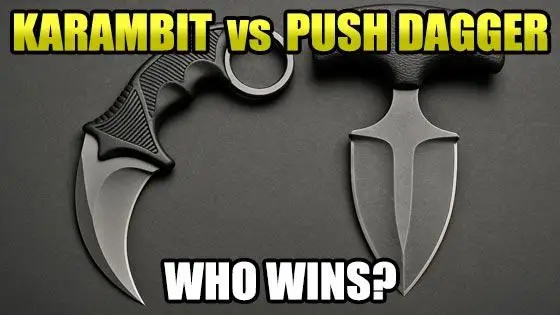
When someone begins looking for a compact defensive knife or a reliable backup tool for tough conditions, two designs immediately stand out. The karambit and the push dagger have both earned serious reputations for being small, strong, and fast in close range situations. They might seem similar at first glance, but each one works very differently and offers its own set of advantages. This comparison cuts straight to practical reality instead of hype, so you can decide with confidence which blade fits your needs and your comfort level.
How Each Blade Design Works
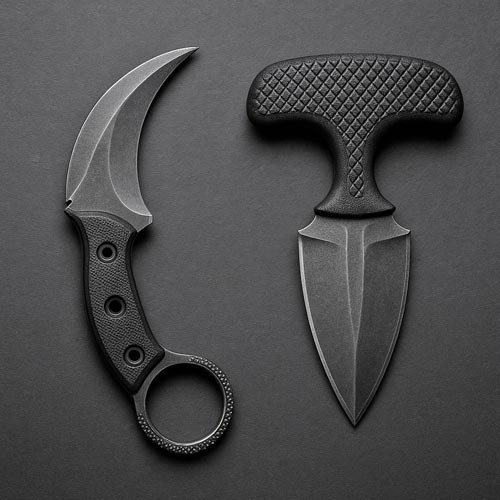
The main difference between a karambit and a push dagger shows up the moment you look at how each one is shaped. A karambit has a curved blade that sweeps inward like a claw, which pulls material toward the cutting edge during a slice. A retention ring sits at the end of the handle to help the user keep control. That design originally came from farming tools in Southeast Asia, but martial artists eventually adapted it for close range defense.
A push dagger flips the traditional knife idea on its side. Instead of a long handle that points in the same direction as the blade, the handle is shaped like a T and sits across the palm. The blade extends out between the fingers. When the user punches forward, the blade follows the exact line of the arm. This creates strong, instinctive power in a very short motion.
Both designs have earned reputations for being extremely effective at close range. They just get there using two completely different philosophies.
Grip and Retention
How well you can hold on to a blade during a high pressure situation matters just as much as how sharp the edge is. If someone grabs your wrist, bumps you off balance, or you are dealing with wet hands, the wrong grip design can cost you control at the worst possible moment.
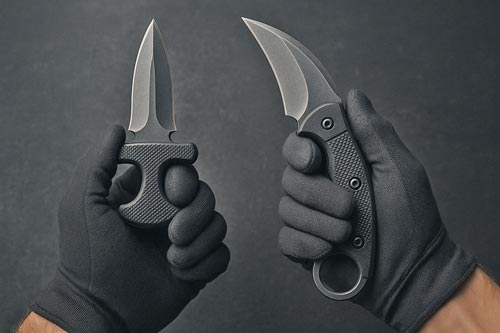
The karambit is built with retention in mind. The ring at the end of the handle anchors the blade to the hand. Even if fingers slip, the ring keeps the grip from breaking completely, which helps prevent accidental drops or disarms. Martial artists use that ring for enhanced leverage, transitions, and weapon retention during grappling. A trained user can move the blade into new striking angles without letting go of it.
Push daggers take a different approach. Instead of a long handle that needs to be maintained with finger grip alone, the T-shaped handle sits across the palm, almost like a set of knuckles. The user only needs to curl their fingers around the sides to keep the blade aligned with a forward driving motion. This makes retention instinctive during a struggle because the natural reaction is to make a fist. Even without formal training, that grip will feel strong under pressure.
Both styles offer dependable control, but the karambit has the more secure mechanical retention system thanks to the ring attachment. The push dagger relies on simple body mechanics, which still performs very well for most people.
Speed and Learning Curve
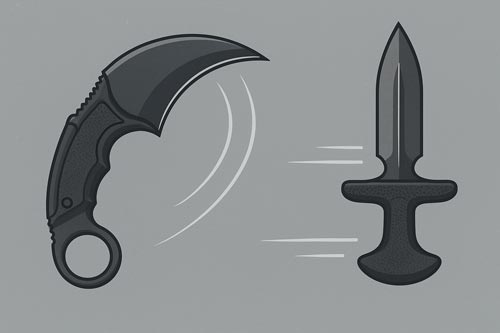
Speed matters in any close range confrontation. When stress kicks in and fine motor skills start to break down, a blade that feels natural and simple is often the one that performs best. Both the karambit and the push dagger are fast in the right hands, but they reach that point in very different ways.
The karambit is a high skill tool. The curved blade is designed for controlled slicing and angled movements that take practice to perform correctly. Many of the most effective karambit techniques come from Filipino martial arts, which teach flipping motions, limb control, and precise targeting. When someone has trained long enough to use a karambit smoothly, the speed and fluidity can be extremely impressive. Without that training, a user may struggle to make the blade work as intended.
The push dagger has almost no learning curve. The T-shaped handle lines the blade up with the direction of a normal punch, so the user does not need any specialized technique to deliver force. Under pressure, people tend to revert to basic instincts, and punching is one of the simplest motor patterns to rely on. That makes the push dagger a reliable option for someone who has not spent time learning advanced knife handling skills.
So while the karambit can reach a much higher performance level in expert hands, the push dagger allows a beginner to reach functional speed almost immediately.
Concealment and Everyday Carry
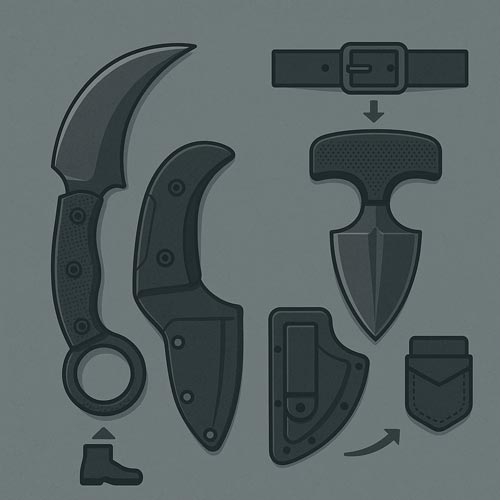
Most people who choose a compact blade are looking for something they can carry easily without drawing attention. Size, shape, and how a knife fits against the body all play a role in how discreet it can be during everyday wear.
Push daggers are strong performers in this category. Their short profile and flat sheath options allow them to disappear under clothing with very little print. A push dagger can ride horizontally along a belt or vertically along the waistband, and many models are sized for boot carry as well. Because the handle sits close to the body, only a small portion of the grip needs to remain accessible for a fast draw.
Karambits are small too, but the curved blade and finger ring create a unique shape that is a little harder to hide. Most people carry a karambit clipped inside a pocket with the ring visible for fast deployment. It is quick to access, but that ring can be a giveaway if concealment is a priority. Certain sheath setups allow for belt or inside-the-waistband carry, but the overall profile still tends to stand out more than a push dagger.
Both knives can work well as everyday backups, but if you want maximum concealment with minimal printing, the push dagger is the easier choice to carry discreetly.
Utility and Survival Tasks
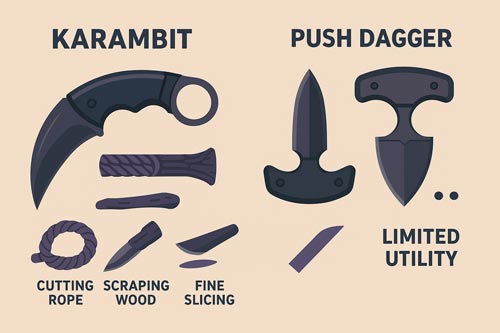
A knife is more than a defensive tool for most people. Even if you carry a blade for personal protection, you still want something that can handle small tasks throughout the day or support basic survival needs if you ever find yourself outdoors. In this area, the karambit and the push dagger could not be more different.
The karambit shines when it comes to controlled cutting. The inward curve of the blade helps guide material toward the sharp edge, which makes slicing rope, opening packages, or shaving tinder feel surprisingly natural. Many users say the karambit feels like an extension of the hand, especially when making small, precision cuts. It is not the same as carrying a full sized utility knife, but it performs well enough that the everyday tasks do not feel like a struggle.
The push dagger is on the opposite side of the spectrum. Its design focuses almost entirely on forward thrust and quick defensive application. Tasks that require dragging the blade through material or carving with the edge can become awkward because the handle shape works against those movement patterns. You can still get the job done in a pinch, but it is not comfortable for long use and not ideal for tasks that require fine blade control.
So while both blades are compact and strong enough to survive harsh environments, the karambit offers more functional value when the knife needs to serve as more than a last resort backup tool.
Defensive Capability at Close Distance
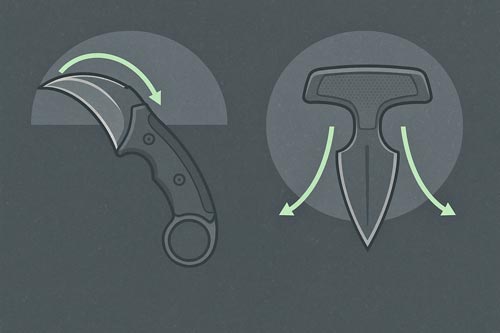
Both of these knives are designed for extremely close range encounters. This is the distance where grappling, holding, and sudden bursts of movement decide what happens next. The difference is how each blade performs when space is limited and reactions must be fast.
The push dagger is built for the clinch. Its T-shaped handle aligns the blade with the natural punching motion, so the user does not need to adjust technique under stress. Even in a tight struggle where someone's weight or grip is creating pressure, the forward drive of a fist can still generate meaningful impact. That simplicity gives the push dagger a strong defensive advantage for anyone without formal training.
The karambit also performs very well at close range, but it requires knowledge and technique to fully unlock its potential. Skilled users can use the curved blade to hook limbs, redirect force, and create space. The retention ring allows rapid changes in grip and striking angles while keeping control of the blade. However, without training, it is harder to apply those advantages when adrenaline is high and movements become chaotic.
So at zero distance, the push dagger provides a reliable response with minimal skill required. In trained hands though, the karambit can offer a wider range of defensive options that go beyond simple strikes.
Which One Is Legal in Your State
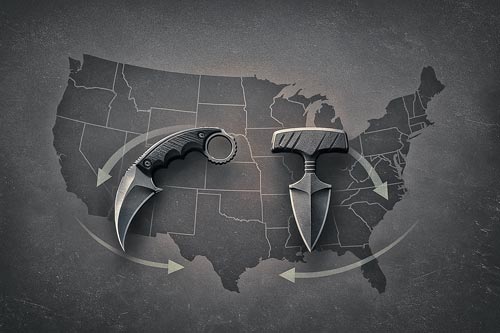
Knife laws are not the same from state to state, and sometimes the difference between a legal carry option and a restricted one comes down to a single design feature. A double edged blade, a concealed carry rule, or a retention ring can all affect whether a specific knife can be carried legally in public. Because both the karambit and the push dagger are capable defensive tools, many states treat them differently from basic folding knives.
Push daggers are often more tightly regulated because of their compact size and the way they are carried. Some states restrict double edged blades entirely, and others limit the concealed carry of defensive knives that can be drawn quickly from a hidden position. If you are considering adding one to your everyday gear, make sure you understand your local restrictions before making a decision. We have a selection of push daggers to explore once you have checked your laws.
Karambits may also face restrictions depending on how they are designed. A larger blade or certain handle features can move them into categories that require specific permits or prohibit carry outside private property. Some regions classify ringed knives as specialty weapons, while others only focus on blade length. If you enjoy the unique control and cutting angles that a curved blade provides, you can browse our selection of karambit knives to compare different shapes and handle designs that may be legal to own in your area.
The safest approach is to check the updated knife laws for your city and state before carrying either style in public. Regulations change and can vary significantly even within the same state, so always confirm the most current legal guidance from official sources.
Which Blade Comes Out on Top
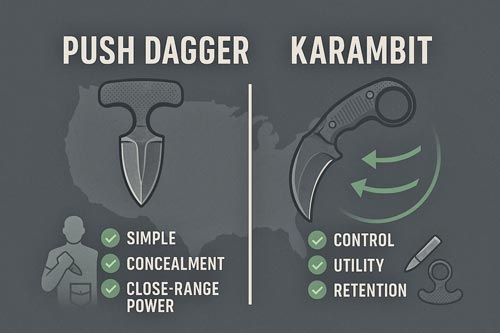
Now that we have looked at how each knife performs in different real world categories, it is clear that both designs succeed by focusing on different strengths. The push dagger delivers fast, instinctive power in close range situations with almost no training required. The karambit offers more control, better utility, and a higher performance ceiling for people willing to learn how to use it properly.
Here is a quick breakdown based on the points covered above:
Push Dagger Benefits
- Compact and easy to conceal
- Natural punching alignment for simple defensive use
- Minimal learning curve to reach functional speed
Karambit Benefits
- Excellent blade retention thanks to the ring
- Precise cutting angles and better general utility
- Advanced techniques allow more options in skilled hands
At the end of the day, the right choice depends entirely on what you want out of a compact blade. If you want a simple and dependable backup that works on instinct, the push dagger is a strong option. If you want something that rewards practice and doubles as a helpful cutting tool, the karambit might make more sense. Some people even choose to own both so they can match the blade to the task.
Final Thoughts
Both the push dagger and the karambit have earned their place as trusted compact blades, and there is no single winner that fits everyone the same way. Each design offers a different kind of advantage, whether that is instinctive strength at close distance or precise control for everyday tasks. The best choice comes down to your comfort level, how much training you are willing to put in, and what situations you expect to face. If you understand the strengths of each blade and choose the one that supports your priorities, you will end up with the right tool at the right time.
You May Also Be Interested In:
- What Is a Push Dagger? History, Design, and Modern Uses
- A Brief History of the Push Dagger: From Trench Warfare to Modern EDC
- 12 Fixed Blade Knives You Should Know About
- Assassin Arm Blade and Other New Weapons
- The Most Common Pocket Knife Blade Shapes Explained
- From Garden Tool to Combat Blade: The Evolution of the Kunai
- Why Karambit Knives Are So Effective
- The History and Evolution of the Karambit Knife
- 10 Things You Didn't Know About the Karambit Knife
- Why Karambit Knives Became So Popular in Video Games
Leave a Reply