





From Garden Tool to Combat Blade: The Evolution of the Kunai
November 10th, 2025
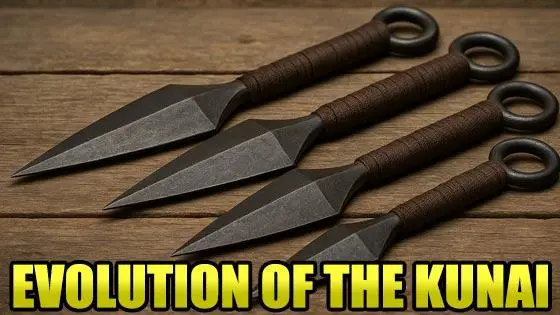
Before it became one of the most recognizable weapons in ninja lore, the kunai was nothing more than a simple hand tool. Farmers, masons, and woodworkers in ancient Japan used it for digging, scraping, and prying long before anyone ever thought to throw one. Over the centuries, this practical tool transformed into a symbol of stealth and precision, appearing in martial arts, anime, and action films around the world. The real story of the kunai, however, is far more fascinating than fiction. It is a tale of adaptation, craftsmanship, and the quiet ingenuity of those who found new purpose in an ordinary object.
Origins: The Tool That Started It All
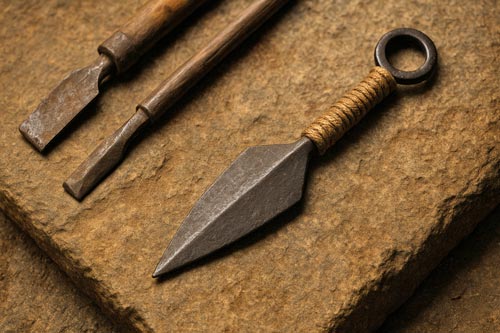
Long before the kunai became a weapon, it was simply a tool found in the hands of farmers, stonemasons, and craftsmen across Japan. The earliest versions appeared during the Muromachi period (1336-1573) when iron was commonly forged into simple instruments for daily work. These early kunai were used for digging, chiseling, prying, and shaping wood or stone, much like a modern garden trowel.
The typical kunai measured between 8 and 12 inches long and had a flat, leaf-shaped blade that was strong but not razor sharp. The metal was left somewhat dull on purpose, allowing workers to use the edge for scraping or levering without worrying about constant chipping or dulling. The handle was often wrapped in cloth or rope to improve grip, and the circular ring at the end had a very practical purpose. It allowed a rope to be tied through it so the tool could be hung from a belt or retrieved easily if dropped.
The simplicity of the kunai made it both affordable and adaptable. It could serve as a makeshift hammer, wedge, or climbing tool depending on what was needed. This versatility is likely what first caught the attention of Japan's covert agents, the ninja. To an ordinary observer, a worker carrying a few iron tools was completely unremarkable. But to a ninja, that same tool could serve as a quiet key to infiltration, survival, and self-defense.
The Ninja Connection
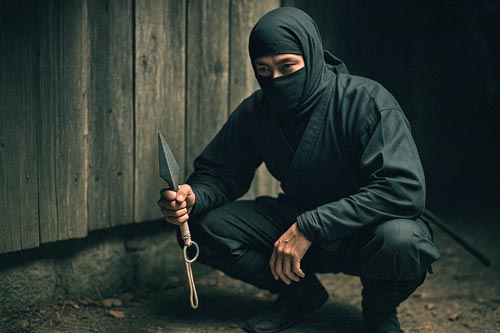
When most people picture a ninja, they think of masked warriors leaping from rooftops or hurling blades through the dark. In reality, ninjas were far more practical and discreet. Known in Japan as shinobi, they were experts in espionage, sabotage, and survival. A true ninja relied on creativity and adaptability more than on weaponry, and that is where the kunai found its place.
Because it started as a tool, the kunai could be carried openly without drawing suspicion. A farmer, laborer, or mason could easily justify having one tied to their belt. For a ninja trying to move unnoticed, this was invaluable. Many historical accounts suggest that ninjas carried two or three kunai at a time, using them in ways that went far beyond simple combat.
Infiltration missions often required climbing over wooden walls or scaling fortress gates. The kunai's strong, flat blade could be used to dig footholds or chip away at stone to create handholds. It could also pry open doors, break locks, or remove hinges quietly. If cornered, a ninja could use the kunai as a last-resort stabbing weapon, but it was primarily valued for its utility. Its weight and durability made it perfect for tasks that other blades would chip or snap under.
Over time, certain ninja schools developed specialized training methods that included the kunai as part of their curriculum. The Togakure-ryu, one of the most well-known ninjutsu traditions, taught ways to use the kunai both as a hand-to-hand weapon and a throwing implement. Unlike finely balanced throwing knives, however, the kunai's wide blade and thick spine made it more of a short-range option, suitable for close defense or surprise attacks.
What made the kunai so powerful in the hands of a ninja wasn't its sharpness or reach; it was its simplicity. It was a tool that could disguise itself as anything, allowing the ninja to blend in completely. Whether it was used to climb walls, dig traps, or defend against an enemy, the kunai became a symbol of how ingenuity could turn ordinary objects into instruments of survival.
From Tool to Weapon
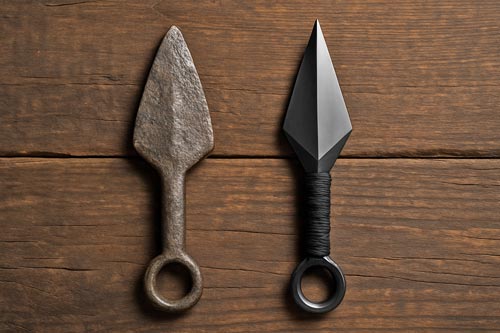
As Japan entered more peaceful eras and the daily work of the shinobi began to evolve, the kunai gradually shifted from being a tool of labor to a weapon of training and combat. Once people realized how effective its sturdy shape could be in self-defense, craftsmen started creating versions meant specifically for martial use. These adaptations marked the beginning of the kunai's transformation from utility to weaponry.
The earliest weaponized kunai were still quite simple, but the metal was forged with greater precision and sometimes sharpened along the edges or tip. Unlike the farming versions, which were used for scraping or digging, these newer models were balanced more carefully and refined for better handling. They were still thicker and heavier than most knives, which gave them an advantage when striking hard surfaces or blocking other weapons.
Some martial arts schools began experimenting with throwing techniques, discovering that the kunai's shape gave it a natural balance that could be controlled with practice. Although it was not originally designed for throwing, the flat, weight-forward blade made it suitable for short-distance throws. The user could grip the handle or the ring, depending on their preferred technique, and achieve decent accuracy within a few meters. In this way, the kunai became an early form of a throwing knife, simple, rugged, and effective in skilled hands.
As blacksmiths continued to refine their craft, certain versions were made with slimmer, sharper blades that were easier to conceal and more aerodynamic. Others were produced with larger handles or weighted rings to give the thrower more control. These customized forms helped the kunai become a legitimate part of martial weaponry, no longer just a disguise or a backup tool.
By the Edo period, the kunai had earned its place among other Japanese blades such as shuriken and tanto knives. It became known not only as a multipurpose instrument but also as a symbol of adaptability. A tool born in the dirt and stone of Japan's countryside had transformed into a reliable weapon for both defense and offense, a reminder that the most unassuming objects can evolve into something extraordinary when guided by skill and purpose.
Symbolism and Design
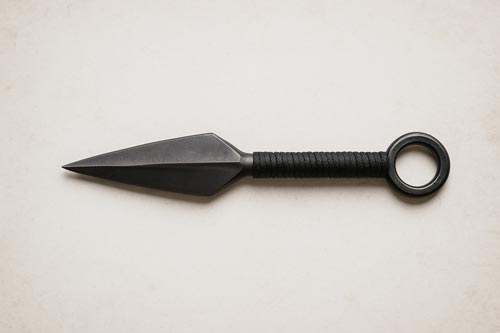
The kunai's design is a perfect example of Japanese efficiency. Every curve, edge, and ring served a purpose, and nothing was added for decoration alone. While the modern perception of the kunai often focuses on its sharp point or throwing ability, the original design was built around function and practicality rather than beauty or intimidation.
A traditional kunai consisted of three main parts: the blade, the handle, and the ring pommel. The blade was short and wide, usually leaf-shaped, and forged from a single piece of iron. Unlike fine swords or daggers, the kunai was never polished or ornamented. Its strength came from its thickness and its ability to endure rough work without breaking. The edges were sometimes sharpened slightly, but the primary goal was durability, not cutting power.
The handle was typically wrapped in cloth or rope to improve grip and to make it easier to use in wet or muddy environments. This wrapping could also provide an improvised storage place for small items such as bits of flint or wire, adding to the kunai's practicality in the field. The handle's proportions balanced the weight of the blade, giving the user more control when using the tool as a lever or when throwing it at close range.
The most recognizable part of the kunai is the circular ring at the end of the handle. Although it has become a signature feature of the weapon, its original purpose was purely functional. The ring allowed users to tie a cord through it for carrying or hanging, and ninjas later discovered that the same cord could serve as a retrieval line when throwing the kunai or as a climbing aid. The ring could also add balance and serve as a striking surface if the handle was used in reverse grip.
This combination of simplicity and versatility made the kunai a symbol of the ninja's mindset. Rather than carrying an arsenal of weapons, a skilled shinobi could turn one simple object into a dozen different tools. In this way, the kunai came to represent resourcefulness, adaptability, and quiet precision, traits that defined the ninja way of life.
Kunai in Popular Culture
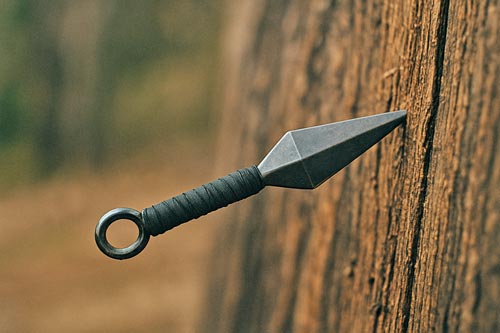
The kunai might have remained a historical footnote if not for its dramatic revival in modern entertainment. Over the past century, it has evolved from a simple farming tool into one of the most recognizable weapons in pop culture. Movies, television shows, and especially anime have transformed the kunai into a sleek and deadly symbol of the ninja's skill and mystery.
One of the most influential portrayals came from Japanese cinema during the mid-20th century, when samurai and ninja films first gained international attention. Directors and fight choreographers often included kunai in their action scenes because of its distinctive shape and compact size. The small dagger-like blade photographed beautifully on screen and helped create the modern visual language of the ninja: fast, silent, and precise.
In more recent years, anime and video games have cemented the kunai's legendary status. Series like Naruto, Mortal Kombat, and countless others have introduced it to a global audience. In these stories, the kunai is often shown as a fast, aerodynamic throwing knife that can slice through enemies or even carry explosive tags. While these depictions exaggerate its abilities, they have also made the kunai a household term among martial arts and gaming fans.
Outside of fiction, the kunai has also become a popular item for collectors, martial artists, and cosplayers. Modern manufacturers produce versions made from stainless steel, aluminum, and even polymer for safe training. Some are designed for accurate throwing practice, while others are replicas modeled after the weapons seen in popular media. The result is a modern fusion of history and art, where a once humble tool now represents both discipline and creativity.
Despite the myths and embellishments that surround it, the kunai's popularity in media reflects something deeper about human fascination with transformation. It shows how an ordinary object, when combined with imagination and purpose, can capture the spirit of an entire culture. Whether used in combat, training, or performance, the kunai continues to remind us that simplicity can be powerful when guided by mastery.
Modern Kunai: From Training to Tactical
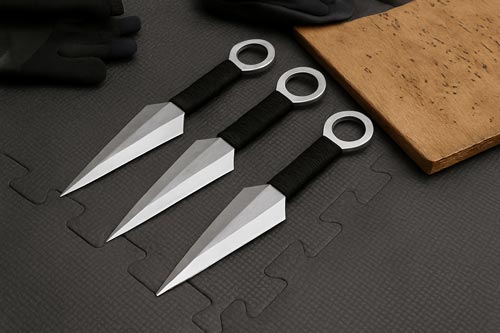
In the modern world, the kunai has taken on a new identity that bridges history, martial arts, and modern craftsmanship. While the ancient versions were made of rough iron and used primarily for labor, today's kunai are designed for performance, balance, and visual appeal. They are crafted not for farmers or masons but for martial artists, collectors, and enthusiasts who appreciate both the history and the art of blade design.
Modern kunai are typically made from stainless steel or other durable alloys that resist rust and wear. Unlike their historical counterparts, they often have symmetrical blades, fine points, and smooth surfaces designed for clean throws. The result is a weapon that performs more like a throwing knife, allowing for accuracy and consistency in training sessions. Some versions even feature cord-wrapped handles for improved grip, replicating the traditional style while adapting to modern materials.
In martial arts schools and dojos, the kunai has become a training tool for learning precision and control. Practitioners use it to develop proper throwing mechanics, distance judgment, and discipline. Many students start with dull or rubber practice kunai before moving on to weighted metal versions. This allows them to experience the traditional techniques safely while building confidence and skill.
Beyond martial arts, the kunai has found a place in tactical culture. Some knife makers produce reinforced models designed for field use, including self-defense or outdoor applications. These versions may feature black oxide coatings, ergonomic grips, and balanced designs suitable for both throwing and close-quarters use. Though inspired by history, they reflect modern engineering and a focus on practical performance.
Collectors and fans of Japanese culture also value the kunai for its symbolic meaning. It represents more than just a weapon or tool; it stands as a link between ancient tradition and modern craftsmanship. Whether displayed on a shelf, carried for training, or used in competition, the kunai continues to evolve while staying true to its roots as a symbol of resourcefulness and discipline.
Technique and Training
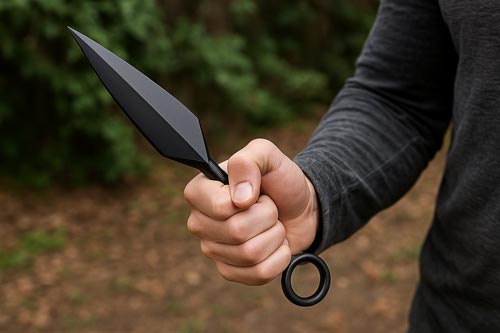
Throwing a kunai looks effortless when performed by experts, but learning to do it correctly takes patience and precision. The key to mastering the technique lies not in strength, but in rhythm, timing, and control. Whether used for sport, martial arts training, or historical demonstration, the kunai teaches balance and focus in a way that few other weapons can.
Beginners often start at a distance of around ten feet, working to develop consistency before moving farther away. The most important element is the grip. Some practitioners hold the kunai by the handle, while others prefer to grip the ring at the end, depending on the desired throwing style. A smooth release is essential, as any twist of the wrist or uneven pressure can send the blade off course. The goal is not to throw with force but to allow the kunai's weight and shape to carry it toward the target naturally.
As skill improves, practitioners experiment with different throwing techniques. The most common is the rotational throw, where the kunai spins through the air and strikes the target point-first. More advanced throwers may practice no-spin throwing, a method that keeps the blade steady and flies straight. This style requires delicate control over wrist movement and release speed but creates a satisfying sense of precision when mastered.
Training with a kunai also involves practicing defensive applications. In close-range drills, martial artists may use the kunai for parrying, trapping, or redirecting attacks. While not as sharp as other blades, the shape of the kunai allows for effective control and leverage. The ring at the base can be used to hook an opponent's wrist or clothing, adding a layer of versatility to the weapon's design.
Like all martial training, learning to throw or handle a kunai safely requires discipline and respect. Practitioners often begin with dull training versions and gradually move to sharper or heavier models under supervision. The emphasis is always on technique rather than power. Over time, this careful approach develops both accuracy and awareness, making the kunai an excellent teacher of patience and precision.
Legacy of the Kunai
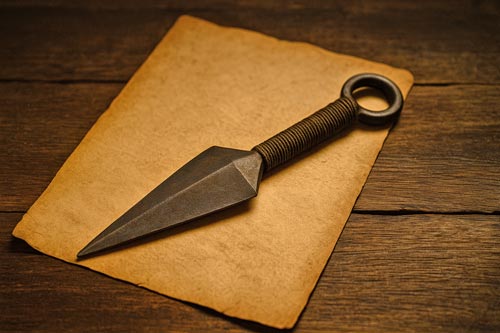
The kunai's legacy stretches far beyond its origins as a simple hand tool. What began as a practical instrument for farmers and craftsmen evolved into a symbol of discipline, adaptability, and ingenuity. Few weapons in history have undergone such a transformation while still maintaining their original simplicity of form and function. The kunai embodies the Japanese philosophy that even the most ordinary object can become extraordinary when used with skill and intention.
Throughout the centuries, the kunai has represented more than just a blade. For the shinobi, it was a tool of survival and resourcefulness. For martial artists, it became a symbol of focus and precision. And for modern enthusiasts, it stands as a bridge between history and art. Every throw, every grip, and every forged blade carries a story that connects the modern practitioner to those who came centuries before.
The enduring appeal of the kunai lies in its balance of practicality and symbolism. It reminds us that mastery often comes not from the complexity of the tool, but from the skill of the person using it. Whether used to till soil, scale walls, or strike a target, the kunai has always rewarded patience, practice, and creativity. Its design has changed little over time because it was never about looking dangerous; it was about being useful in the hands of someone who understood its purpose.
Today, the kunai's influence can be seen across cultures and generations. It appears in martial arts dojos, competitive throwing ranges, video games, and film. Each adaptation tells part of the same story, a story of transformation and timeless utility. From the fields of feudal Japan to the hands of modern martial artists, the kunai continues to inspire respect for craftsmanship, simplicity, and skill.
Final Thoughts
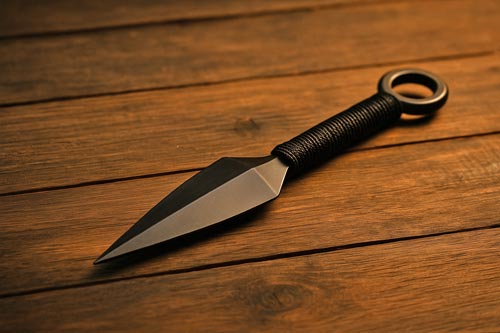
The kunai's journey from everyday tool to legendary weapon is a story of creativity and adaptation. It began as a simple implement for digging and shaping, yet it evolved into one of the most enduring symbols of the ninja's art. What makes the kunai remarkable is not just its design, but its versatility. It could serve as a weapon, a climbing tool, a lock breaker, or even a survival aid, depending on the skill of the person holding it.
In many ways, the kunai reflects the heart of Japanese craftsmanship: functional, balanced, and efficient. Its design has stood the test of time because it never needed embellishment. Whether used for work or combat, the kunai has always represented the same values of simplicity and purpose. Even as modern versions continue to evolve, the spirit of the original remains unchanged.
For collectors and martial artists today, owning a kunai is about more than just having a piece of steel. It is a way to connect with a centuries-old tradition of ingenuity and self-reliance. The kunai teaches patience, respect, and discipline, qualities that apply far beyond the dojo or the throwing range. It reminds us that mastery is often found not in the tool itself, but in how we choose to use it.
If you want to explore authentic and modern versions of this iconic weapon, visit our kunai knives for a selection designed for both training and performance. Whether you are a martial artist, a collector, or simply someone who appreciates the history behind the blade, the kunai remains a timeless example of how something simple can leave a lasting impact on the world.
You May Also Be Interested In:
- What Is a Kunai? From Japanese Tool to Ninja Weapon
- The Real History of Nunchaku: From Farm Tool to Hollywood Icon
- Assassin Arm Blade and Other New Weapons
- 12 Fixed Blade Knives You Should Know About
- The History and Evolution of the Karambit Knife
- History and Evolution of Self-Defense Keychains
- Karambit vs Push Dagger: Which Blade Would You Bet Your Life On?
- The Evolution of the Shuriken: From Samurai to Modern Martial Arts
- The Most Common Pocket Knife Blade Shapes Explained
- The Evolution of Automatic Knives: From Battlefield Tools to Everyday Carry
Leave a Reply